




Nutrition and Hydration in
Palliative Care
Is Nutrition Support needed / justified in
Palliative Care ???
The meaning of “Food”
Any nutritious substance that people or animals eat or drink
or that plants absorb in order to maintain life and growth.
It gives us the energy and nutrients to grow and develop, be
healthy and active, to move, work, play, think and learn.
Tradition / culture
Love / nurture
Socialization
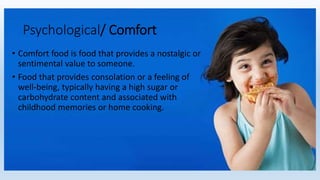
• Comfort food is food that provides a nostalgic or
sentimental value to someone.
• Food that provides consolation or a feeling of
well-being, typically having a high sugar or
carbohydrate content and associated with
childhood memories or home cooking.
Psychological/ Comfort
What happens during Terminal Illness?
Terminal illness can alter the nutritional status of the patient in many ways:
• Gastrointestinal absorption ↓
• Nutrient requirements ↑ (malabsorption, cachexia and increasing tumour
mass)
• The dying process ↓ gastric emptying. (Increased satiety, decreased hunger
and food intolerances)
• Nausea, vomiting, diarrhoea and constipation. (Side-effects of Medication)
- Depression causes anorexia (Holland et al, 1977)
- Anger and guilt when present have a negative impact on dietary
intake.
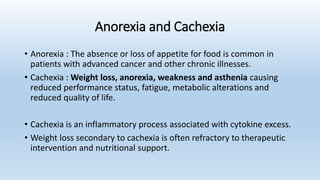
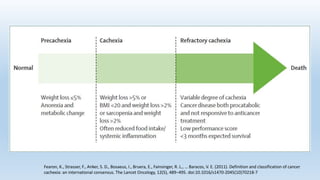
Anorexia and Cachexia
• Anorexia : The absence or loss of appetite for food is common in
patients with advanced cancer and other chronic illnesses.
• Cachexia : Weight loss, anorexia, weakness and asthenia causing
reduced performance status, fatigue, metabolic alterations and
reduced quality of life.
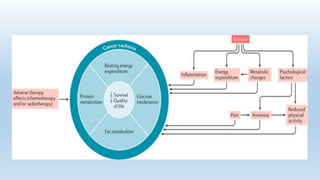
• Cachexia is an inflammatory process associated with cytokine excess.
• Weight loss secondary to cachexia is often refractory to therapeutic
intervention and nutritional support.
The metabolic consequences of cancer are listed below
(Stratton et al 2003):
• Altered glucose metabolism - the tumour is inefficient in the
use of glucose
• Increased rate of glucose oxidation
• Increased rate of protein metabolism
• Decreased protein synthesis
• Increased protein breakdown
• Altered lipid metabolism.
WHO states that Palliative Care:
• Affirms life and regards dying as a normal process;
• Neither hastens nor postpones death;
• Provides relief from pain and other distressing
symptoms.
• Maintain/improve QOL
• Control symptoms
In palliative care,
Nutrition should be supportive and should
aim to optimize the management of nutrition
related symptoms, thus improving the sense of
wellbeing felt by the patient.
Dilemas in Palliative Nutrition Support
•Clinical
•Ethical
•Moral
Solutions
• Individuality
• Consent
• Benefits/Discomfort
• Multidisciplinary approach
• Constant follow-up
Patient’s Perspective:
• Disease progression
• Symptoms
• Progressive nutritional deterioration
• Weight loss
• Changes in body image
• Altered food intake
• The meaning of “Food”
Care giver's (Attender's) perspective:
Positive aspects:
•Hope
•Comfort
•Pleasure
Negative aspects:
• Guilt
• Fear
• Pain
Medical personnal
While it is accepted that nutrition cannot prolong life, it should
be recognized that optimal nutrition can enable and empower the
patient in the following ways:
• Optimizing physically strength to fulfil last or final
objectives
• To die with dignity, not of starvation
• To retain some control over the disease process - food
and feeding can be a useful focus for the patient
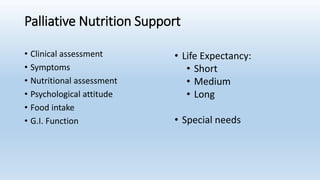
Palliative Nutrition Support
• Clinical assessment
• Symptoms
• Nutritional assessment
• Psychological attitude
• Food intake
• G.I. Function
• Life Expectancy:
• Short
• Medium
• Long
• Special needs
Fearon, K., Strasser, F., Anker, S. D., Bosaeus, I., Bruera, E., Fainsinger, R. L., … Baracos, V. E. (2011). Definition and classification of cancer
cachexia: an international consensus. The Lancet Oncology, 12(5), 489–495. doi:10.1016/s1470-2045(10)70218-7
Interventions
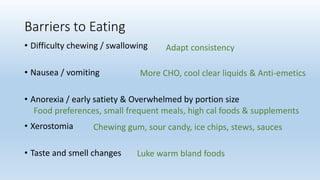
Barriers to Eating
• Difficulty chewing / swallowing
• Nausea / vomiting
• Anorexia / early satiety & Overwhelmed by portion size
• Xerostomia
• Taste and smell changes
Adapt consistency
More CHO, cool clear liquids & Anti-emetics
Food preferences, small frequent meals, high cal foods & supplements
Chewing gum, sour candy, ice chips, stews, sauces
Luke warm bland foods
Suggestions for improving nutritional intake
• Feed the patient when hungry
• Serve small portions of food
• Gently encourage - do not nag
• Set an attractive table, tray or plate
• Make much of meal times. Make them social and enjoyable. Remove
bedpans, vomit bowls and other similar items from the area
• Encourage a breath of fresh air prior to the meal. Take the patient
outside or open a window for a short time
• Eat outside if the weather is good enough
• The use of food supplements may or may not be appropriate here.
Source: Acreman, 2000
Pharmacological management
• Progesterones (megestrol acetate and medroxyprogesterone acetate) are the first-line
therapy for cancer anorexia.
Improve food intake and to a lesser extent, body weight and performance status.
Dose: -Megestrol acetate - 800 mg/day
-Medroxyprogesterone acetate - 1000 mg/day Maltoni et al.,
• Dexamethasone may be used as an appetite stimulant and to treat nausea.
Short duration of action & Side effects limit its use as an appetite stimulant.
Dose: 2-4 mg daily
• Prokinetic drugs help in anorexia due to gastric stasis. (Eg: Metoclopramide)
• Others: Thalidomide, omega-3-fatty acids, melatonin and NSAIDs
Oral Feeding
• Individual preferences
• “à la carte” meals (According to Menu)
• Appealing presentation
• Personalized portions
• Adapted consistency
• Diet counselling
• Flexible timetables
• Agreeable environment
• Family involvement
• Staff participation
Enteral Nutrition
Recommended:
• severe dysphasia
• severe anorexia
• decreased food intake
Clinical indications:
• head & neck / esophagus tumours
• inoperable fistulae
• esophageal obstructions
Parenteral Nutrition
Selected patients
• Inoperable intestinal obstruction
• Prolonged survival
• Risks vs. Benefits
Limited Use:
• Increased complications
• Difficulties in Home Care implementation
• Cost
• Ethical Dilemas
Hydration in Terminally ill
patients
Against
• Comatose patients don’t experience thirst
• Hydration may prolong death
• Decreased diuresis – less mobilization
• Dehydration - ↑ consciousness, suffering
• GI secretions - ↑ vomiting
• Lung secretions - ↑ coughing
• Oedema - ↑ ascites
In favour
• ↑ patient comfort
• Dehydration – delirium & renal failure
• Good in opioid toxicity delirium
• Good in hypercalcemia
Decrease thirst by:
• Keeping mouth wet
• Keeping lips lubricated
• Good oral care
• Small sips of liquids
• Sucking iced water or fruit
Hydration Methods
Artificial hydration should be used judiciously, so
as to allow maximum patient comfort.
• Enteral route
• Parenteral route
• peripheral
• central
• Subcutaneous route (hypodermoclysis) BEST
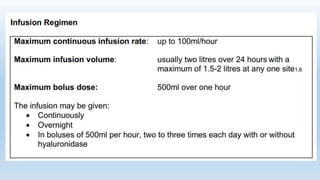
Hypodermoclysis (HDC), also known as “clysis,” is the
infusion of isotonic saline into the subcutaneous (SC)
space for rehydration or for the prevention of
dehydration.
Advantages:
• Easier access
• Easier & safer home use
•Subcutaneous sites last up to 7 days
• Easily turned off and disconnected
• Facilitates mobility
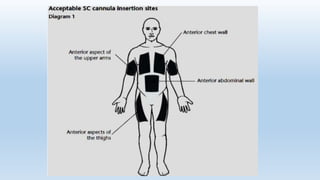
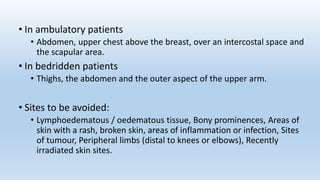
• In ambulatory patients
• Abdomen, upper chest above the breast, over an intercostal space and
the scapular area.
• In bedridden patients
• Thighs, the abdomen and the outer aspect of the upper arm.
• Sites to be avoided:
• Lymphoedematous / oedematous tissue, Bony prominences, Areas of
skin with a rash, broken skin, areas of inflammation or infection, Sites
of tumour, Peripheral limbs (distal to knees or elbows), Recently
irradiated skin sites.
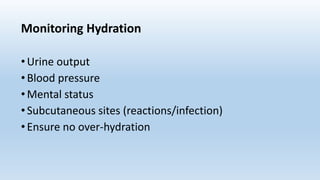
Monitoring Hydration
•Urine output
•Blood pressure
•Mental status
•Subcutaneous sites (reactions/infection)
•Ensure no over-hydration
THANK YOU
Nutrition Support is an integral part of
Palliative Care

Nutrition and palliative care

  • 1.
    Nutrition and Hydrationin Palliative Care Is Nutrition Support needed / justified in Palliative Care ???
  • 2.
    The meaning of“Food” Any nutritious substance that people or animals eat or drink or that plants absorb in order to maintain life and growth. It gives us the energy and nutrients to grow and develop, be healthy and active, to move, work, play, think and learn.
  • 3.
  • 4.
  • 5.
  • 6.
    • Comfort foodis food that provides a nostalgic or sentimental value to someone. • Food that provides consolation or a feeling of well-being, typically having a high sugar or carbohydrate content and associated with childhood memories or home cooking. Psychological/ Comfort
  • 7.
    What happens duringTerminal Illness?
  • 8.
    Terminal illness canalter the nutritional status of the patient in many ways: • Gastrointestinal absorption ↓ • Nutrient requirements ↑ (malabsorption, cachexia and increasing tumour mass) • The dying process ↓ gastric emptying. (Increased satiety, decreased hunger and food intolerances) • Nausea, vomiting, diarrhoea and constipation. (Side-effects of Medication) - Depression causes anorexia (Holland et al, 1977) - Anger and guilt when present have a negative impact on dietary intake.
  • 9.
    Anorexia and Cachexia •Anorexia : The absence or loss of appetite for food is common in patients with advanced cancer and other chronic illnesses. • Cachexia : Weight loss, anorexia, weakness and asthenia causing reduced performance status, fatigue, metabolic alterations and reduced quality of life. • Cachexia is an inflammatory process associated with cytokine excess. • Weight loss secondary to cachexia is often refractory to therapeutic intervention and nutritional support.
  • 11.
    The metabolic consequencesof cancer are listed below (Stratton et al 2003): • Altered glucose metabolism - the tumour is inefficient in the use of glucose • Increased rate of glucose oxidation • Increased rate of protein metabolism • Decreased protein synthesis • Increased protein breakdown • Altered lipid metabolism.
  • 12.
    WHO states thatPalliative Care: • Affirms life and regards dying as a normal process; • Neither hastens nor postpones death; • Provides relief from pain and other distressing symptoms. • Maintain/improve QOL • Control symptoms
  • 13.
    In palliative care, Nutritionshould be supportive and should aim to optimize the management of nutrition related symptoms, thus improving the sense of wellbeing felt by the patient.
  • 14.
    Dilemas in PalliativeNutrition Support •Clinical •Ethical •Moral Solutions • Individuality • Consent • Benefits/Discomfort • Multidisciplinary approach • Constant follow-up
  • 15.
    Patient’s Perspective: • Diseaseprogression • Symptoms • Progressive nutritional deterioration • Weight loss • Changes in body image • Altered food intake • The meaning of “Food”
  • 16.
    Care giver's (Attender's)perspective: Positive aspects: •Hope •Comfort •Pleasure Negative aspects: • Guilt • Fear • Pain
  • 17.
    Medical personnal While itis accepted that nutrition cannot prolong life, it should be recognized that optimal nutrition can enable and empower the patient in the following ways: • Optimizing physically strength to fulfil last or final objectives • To die with dignity, not of starvation • To retain some control over the disease process - food and feeding can be a useful focus for the patient
  • 18.
    Palliative Nutrition Support •Clinical assessment • Symptoms • Nutritional assessment • Psychological attitude • Food intake • G.I. Function • Life Expectancy: • Short • Medium • Long • Special needs
  • 20.
    Fearon, K., Strasser,F., Anker, S. D., Bosaeus, I., Bruera, E., Fainsinger, R. L., … Baracos, V. E. (2011). Definition and classification of cancer cachexia: an international consensus. The Lancet Oncology, 12(5), 489–495. doi:10.1016/s1470-2045(10)70218-7
  • 21.
  • 22.
    Barriers to Eating •Difficulty chewing / swallowing • Nausea / vomiting • Anorexia / early satiety & Overwhelmed by portion size • Xerostomia • Taste and smell changes Adapt consistency More CHO, cool clear liquids & Anti-emetics Food preferences, small frequent meals, high cal foods & supplements Chewing gum, sour candy, ice chips, stews, sauces Luke warm bland foods
  • 23.
    Suggestions for improvingnutritional intake • Feed the patient when hungry • Serve small portions of food • Gently encourage - do not nag • Set an attractive table, tray or plate • Make much of meal times. Make them social and enjoyable. Remove bedpans, vomit bowls and other similar items from the area • Encourage a breath of fresh air prior to the meal. Take the patient outside or open a window for a short time • Eat outside if the weather is good enough • The use of food supplements may or may not be appropriate here. Source: Acreman, 2000
  • 24.
    Pharmacological management • Progesterones(megestrol acetate and medroxyprogesterone acetate) are the first-line therapy for cancer anorexia. Improve food intake and to a lesser extent, body weight and performance status. Dose: -Megestrol acetate - 800 mg/day -Medroxyprogesterone acetate - 1000 mg/day Maltoni et al., • Dexamethasone may be used as an appetite stimulant and to treat nausea. Short duration of action & Side effects limit its use as an appetite stimulant. Dose: 2-4 mg daily • Prokinetic drugs help in anorexia due to gastric stasis. (Eg: Metoclopramide) • Others: Thalidomide, omega-3-fatty acids, melatonin and NSAIDs
  • 25.
    Oral Feeding • Individualpreferences • “à la carte” meals (According to Menu) • Appealing presentation • Personalized portions • Adapted consistency • Diet counselling • Flexible timetables • Agreeable environment • Family involvement • Staff participation
  • 26.
    Enteral Nutrition Recommended: • severedysphasia • severe anorexia • decreased food intake Clinical indications: • head & neck / esophagus tumours • inoperable fistulae • esophageal obstructions
  • 27.
    Parenteral Nutrition Selected patients •Inoperable intestinal obstruction • Prolonged survival • Risks vs. Benefits Limited Use: • Increased complications • Difficulties in Home Care implementation • Cost • Ethical Dilemas
  • 28.
  • 29.
    Against • Comatose patientsdon’t experience thirst • Hydration may prolong death • Decreased diuresis – less mobilization • Dehydration - ↑ consciousness, suffering • GI secretions - ↑ vomiting • Lung secretions - ↑ coughing • Oedema - ↑ ascites
  • 30.
    In favour • ↑patient comfort • Dehydration – delirium & renal failure • Good in opioid toxicity delirium • Good in hypercalcemia
  • 31.
    Decrease thirst by: •Keeping mouth wet • Keeping lips lubricated • Good oral care • Small sips of liquids • Sucking iced water or fruit
  • 32.
    Hydration Methods Artificial hydrationshould be used judiciously, so as to allow maximum patient comfort. • Enteral route • Parenteral route • peripheral • central • Subcutaneous route (hypodermoclysis) BEST
  • 33.
    Hypodermoclysis (HDC), alsoknown as “clysis,” is the infusion of isotonic saline into the subcutaneous (SC) space for rehydration or for the prevention of dehydration. Advantages: • Easier access • Easier & safer home use •Subcutaneous sites last up to 7 days • Easily turned off and disconnected • Facilitates mobility
  • 35.
    • In ambulatorypatients • Abdomen, upper chest above the breast, over an intercostal space and the scapular area. • In bedridden patients • Thighs, the abdomen and the outer aspect of the upper arm. • Sites to be avoided: • Lymphoedematous / oedematous tissue, Bony prominences, Areas of skin with a rash, broken skin, areas of inflammation or infection, Sites of tumour, Peripheral limbs (distal to knees or elbows), Recently irradiated skin sites.
  • 37.
    Monitoring Hydration •Urine output •Bloodpressure •Mental status •Subcutaneous sites (reactions/infection) •Ensure no over-hydration
  • 38.
    THANK YOU Nutrition Supportis an integral part of Palliative Care

Editor's Notes

  • #26 As Long as Food = Pleasure Comfort Foods...