Chapter 15 International Trade and Economic Development
International Trade Exports – goods produced in a country and sold to residents in a foreign country US Export Partners: Canada 23.4%, Mexico 13.3%, Japan 6.1%, China 4.6%, UK 4.3% Imports – goods produced in foreign countries and purchased in another country
Where our imports come from…
Trade Balance Balance of Trade – the difference between the value of a countries exports and the value of their imports Balance of Trade = value of exports – value of imports
International Trade Lingo Absolute Advantage – the situation in which a country can produce more of a good than another country with the same quantity of resources Specialize – To do only one thing.  For example, when a country specializes in the production of a good, it produces only that good. Comparative Advantage – The situation in which a country can produce a good at a lower cost than another country.
Outsourcing Outsourcing – the term used to describe work done for a company by another company or by people other than the original company’s employees Cost – jobs are lost Benefits – cheaper consumer products The costs are easier to see than the benefits
Tariffs and Quotas Tariff – a tax on imports Quota – legal limit on the amount of a good that may be imported Tariffs and quotas raise the price of imported goods to the U.S. consumer
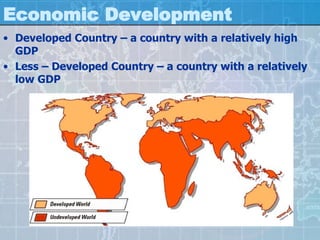
Economic Development Developed Country – a country with a relatively high GDP Less – Developed Country – a country with a relatively low GDP
Problems and Needs of the Developing World Obstacles to Economic Development: Rapid population growth Low savings rate – people are to poor to save money Cultural differences may inhibit change Political instability Factors that aid growth and development: Free trade Foreign investment Low government intervention in wage a price controls

Chapter 15

  • 1.
    Chapter 15 InternationalTrade and Economic Development
  • 2.
    International Trade Exports– goods produced in a country and sold to residents in a foreign country US Export Partners: Canada 23.4%, Mexico 13.3%, Japan 6.1%, China 4.6%, UK 4.3% Imports – goods produced in foreign countries and purchased in another country
  • 3.
    Where our importscome from…
  • 4.
    Trade Balance Balanceof Trade – the difference between the value of a countries exports and the value of their imports Balance of Trade = value of exports – value of imports
  • 5.
    International Trade LingoAbsolute Advantage – the situation in which a country can produce more of a good than another country with the same quantity of resources Specialize – To do only one thing. For example, when a country specializes in the production of a good, it produces only that good. Comparative Advantage – The situation in which a country can produce a good at a lower cost than another country.
  • 6.
    Outsourcing Outsourcing –the term used to describe work done for a company by another company or by people other than the original company’s employees Cost – jobs are lost Benefits – cheaper consumer products The costs are easier to see than the benefits
  • 7.
    Tariffs and QuotasTariff – a tax on imports Quota – legal limit on the amount of a good that may be imported Tariffs and quotas raise the price of imported goods to the U.S. consumer
  • 8.
    Economic Development DevelopedCountry – a country with a relatively high GDP Less – Developed Country – a country with a relatively low GDP
  • 9.
    Problems and Needsof the Developing World Obstacles to Economic Development: Rapid population growth Low savings rate – people are to poor to save money Cultural differences may inhibit change Political instability Factors that aid growth and development: Free trade Foreign investment Low government intervention in wage a price controls