UNIT I
Introduction
Meaning, nature, features and importance of international trade, domestic vs. international trade, Theories of
international trade – comparative cost advantage – modern theory of international trade, terms of trade.
UNIT II
International payments
Rate of exchange–meaning-determination–fixed vs. flexible rate of exchange, Balance of Payments – structure-
BOT vs.BOP- equilibrium – disequilibrium-causes-corrective measures.
UNIT III
Trade policy
Free trade vs protection – advantages – disadvantages – importance, tariffs and quotas – effects – types of
quotas effects of quotas, exchange control – meaning – objectives – techniques – methods – merits and demerits
UNIT IV
International Institutions and international liquidity
IMF, IMF and international liquidity, The World Bank, International Financial
Corporation (IFC), International Development Association (IDA), Euro – Dollar Market,
UNCTAD, GATT, WTO
UNIT V
India’s Foreign Trade
Foreign trade in India – value – composition – direction, India’s BOP, Foreign Trade
Policy, FEMA, India and WTO
UNIT 1
INTERNATIONAL TRADE
International trade involves the exchange of goods and services between
countries, playing a vital role in boosting the global economy.
Commonly traded items include electronics, clothing, machinery, capital
goods, food, and raw materials.
Over time, international trade has expanded significantly, now
encompassing services like transportation, tourism, banking,
warehousing, communication, and advertising. Additionally, foreign
investments and the production of goods in other countries have seen
notable growth.
These international investments and productions allow businesses to
better reach their global customers, providing products and services at
lower costs.
Reasons for International Trade
In economics, one key concept introduced by David Ricardo is that countries
engage in trade based on comparative advantages rather than absolute advantages.
Even if a country is very efficient at producing everything, it is still beneficial for
them to trade based on what they can produce most efficiently relative to others.
Here are some important reasons for international trade:
1. **Production Efficiency**: Not every country can produce every good at a
low cost. This is where international trade becomes essential.
2. **Factors of Production**: Different countries have varying costs for factors
such as labor, capital, and raw materials. International trade allows countries to
utilize these factors more efficiently.
3. **Cost of Production**: It makes sense for each country to focus on
producing goods that they can make efficiently. For other goods, they can rely
on countries where production costs are lower.
4. **Resource Distribution**: Some countries lack certain natural
resources. International trade helps address this issue by enabling
countries to specialize in what they do best while obtaining other
resources through trade.
**Examples of Specialization**: Different regions often
specialize in specific industries. For example, Maharashtra in
India is known for textiles, West Bengal for jute products,
Haryana and Punjab for agriculture, and Kerala for spices. Similar
patterns of specialization exist in various countries around the
world.
STAGES OF INTERNATIONALISATION
Internationalization refers to the process by which a business expands its operations to
foreign markets. Companies typically go through several stages in this process. Here’s an
outline of the main stages:
1. Domestic Stage
- Focus: Operating only in the home country.
- Characteristics: Limited or no foreign market activity. Companies focus on building a
strong domestic presence and perfecting products or services in the local market.
2. Pre-Internationalization (Reactive Stage)
- Focus: Exploring international opportunities.
- Characteristics: The company begins to consider going global due to factors like
domestic market saturation or demand for their products abroad. They might engage in
market research, attend international trade shows, or receive inquiries from foreign buyers.
3. Export Stage
- Focus: Selling products abroad, usually through export.
- Characteristics: The company starts by exporting goods to a foreign market, often via
intermediaries. This is a low-risk method that allows them to test demand without a significant
commitment. Exporting can be direct (selling to foreign customers) or indirect (through agents
or distributors).
4. Establishment of Foreign Sales Subsidiary
- Focus: Developing a local presence in a foreign market.
- Characteristics: Companies establish sales offices or subsidiaries to better serve international
customers, manage relationships, and increase control over branding and distribution. This often
involves hiring local staff and customizing offerings for the market.
5. Foreign Production Stage
- Focus: Setting up manufacturing or production facilities abroad.
- Characteristics: The company establishes production facilities in foreign countries to save on
production or transportation costs and to adapt products to local preferences. It may take the
form of joint ventures, franchising, licensing, or direct investment.
6. Transnational or Global Stage
- Focus: Operating with a globally integrated strategy.
- Characteristics: At this stage, companies operate as transnational
organizations with operations, R&D, and decision-making spread across various
countries. The company focuses on maximizing efficiency and consistency
across markets while allowing for local customization where necessary.
7. Multinational or Full Globalization Stage
- Focus: Treating the world as a single market.
- Characteristics: At this stage, companies truly operate globally, often
blending international operations so thoroughly that they function as a single
global entity. Decision-making and resource allocation are optimized on a global
scale rather than by individual country markets.
Each stage presents its own set of challenges, from managing cultural
differences to navigating regulatory hurdles and optimizing global supply
chains.
Importance of International Trade
International trade among nations isn’t just about exchanging goods – it’s a key player in
improving our lives and economies. Here’s how:
1.Higher Living Standards and Jobs: It lifts the standard of living by creating jobs and
giving people more opportunities to enjoy a variety of goods.
2.Raw Material Riches: Some countries, like Qatar for oil or Iceland for metals and fish, are
lucky to have many raw materials. Without international trade, they wouldn’t fully benefit from
these blessings.
3.More Choices for You: The more countries trade with each other, the more products you get
to choose from.
4.Specialization and Efficiency: Countries can focus on what they’re good at. Whether
making cars or growing crops, specialization helps companies make more money efficiently.
5.Global Growth and Less Poverty: When countries trade globally, they grow economically.
This growth isn’t just for rich countries; it helps reduce poverty levels too.
Moreover, international trade isn’t just about goods – it’s about making life better, giving you
more choices, and helping countries grow together.
Scope of International Trade
Check the below points for the scope of International Trade:
•Exports and Imports: Exports and Imports trade is like a global shopping spree where
countries trade tangible goods. Exporting is sending stuff to other nations, and importing is
getting things from them. Don’t forget, services are in the mix too.
•Service Trade (Invisible Trade): Think of it as the secret agent of trade – it involves services
with no physical presence. Tourism, hotels, transportation, training, and research are all part of
this invisible trade.
•Licensing and Franchising: Imagine giving permission to other countries to use a company’s
brand or sell its product. Licensing involves selling a company’s product under its trademark
for a fee, like Pepsi and Coca-Cola. Franchising is similar but with services, like Domino’s or
Burger King, setting up shop abroad.
•Foreign Investment: This is like investing your money globally to make more money.
Therefore, Direct investment is putting money into foreign companies for production and
marketing. Sometimes, it’s a team effort called a joint venture. Moreover, Portfolio investment
is when one company invests in another, earning income through interest and dividends.
Advantages of International Trade
Here are some of the advantages of International Trade:
•Income Boost: Organizations make money in foreign currencies, known as foreign exchange.
This foreign cash helps pay for imported stuff like machinery, technologies, and fertilizers.
•Resource Efficiency: Countries focus on what they do best and efficiently. If one nation is
great at making cars, they focus on that, while another nation excels in something else. It’s like
a teamwork strategy where everyone plays to their strengths.
•Growth and Jobs: International trade speeds up the growth of businesses and entire countries.
Big players like China, Japan, and South Korea viewed the whole world as a marketplace. This
global approach created jobs worldwide.
•Better Living Standards: People in one country get to enjoy products and services from other
nations. This sharing of goods and services improves everyone’s quality of life.
Moreover, international business isn’t just about making money; it’s about making the world
work together efficiently, creating opportunities, and enhancing our lives.
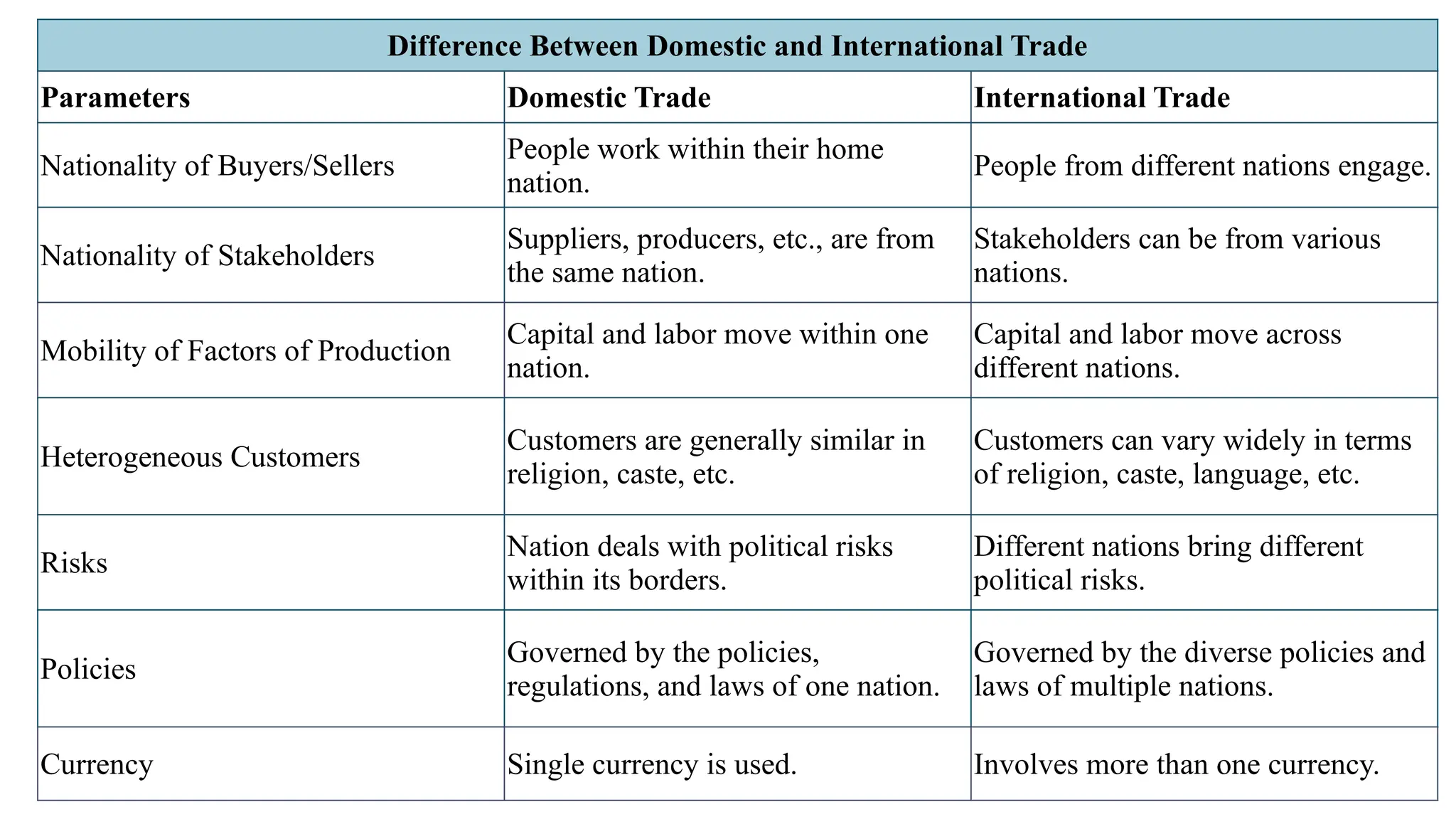
Difference Between Domestic and International Trade
Parameters Domestic Trade International Trade
Nationality of Buyers/Sellers
People work within their home
nation.
People from different nations engage.
Nationality of Stakeholders
Suppliers, producers, etc., are from
the same nation.
Stakeholders can be from various
nations.
Mobility of Factors of Production
Capital and labor move within one
nation.
Capital and labor move across
different nations.
Heterogeneous Customers
Customers are generally similar in
religion, caste, etc.
Customers can vary widely in terms
of religion, caste, language, etc.
Risks
Nation deals with political risks
within its borders.
Different nations bring different
political risks.
Policies
Governed by the policies,
regulations, and laws of one nation.
Governed by the diverse policies and
laws of multiple nations.
Currency Single currency is used. Involves more than one currency.
•Approaches of International Business
1.Ethnocentric Approach
2.Polycentric Approach
3.Regiocentric Approach
4.Geocentric Approach
1. Ethnocentric Approach
This approach to international business focuses on the home country's values, ethics, and
beliefs. All the strategies first formulated for the domestic nation or domestic business focus on
the international business is secondary.
Businesses first cater to domestic market demand and trade surplus is distributed to a foreign
nation. Overseas operations are operated from the head office of the domestic country by
domestic employees.
This approach is very beneficial for small businesses during the early days of
internationalization as the investment needed in business is low.
There is no major modification in products that will export to a foreign nation and no
marketing research is conducted. Businesses mainly rely on exporting goods to foreign nations.
Examples of Ethnocentric Approach – Indian clothes, dresses, food, and beverage are exported
to foreign nations where a large number of Indian live.
2. Polycentric Approach
As per this approach, the business focuses on each host country because they consider
that each country is unique in terms of customer demand, customer preference, and taste
so if businesses want to succeed in each country, they should adapt according to the host
country’s requirements.
The business opens its subsidiary in each oversea market and businesses adopt different
marketing plans and strategies as per the host country’s needs.
The foreign subsidiary has decision-making power and their operation are decentralized.
Businesses appoint personnel the key positions from their home country, whereas the
remaining positions or vacancies are filled by the personnel of the host country.
◉ Examples of Polycentric Approach – McDonald, Starbucks, Google Doodle
3. Regiocentric Approach
Under this approach, businesses divide the whole world into different regions based
on their common regional, social & cultural environment, economic, and political
factors.
Marketing strategies and business plans are formulated in regional headquarters for
the entire group of counties or region
Managers are hired or transferred from different countries lying within the same
region.
◉ Example of Regiocentric Approach – Firms divide groups or regions on the basis
of unique similarities like SAARC countries, the Baltic region, and the
Scandinavian region.
4. Geocentric Approach
According to the Geocentric approach, businesses consider the whole world is the same as one
country for their business operation.
Businesses select the best talent from the entire globe and operate with their large number of
subsidiaries that are located around the globe that coordinate with the head office.
This approach is used by big business giants which have large-scale business operations and a
significant presence around the globe.
The business following this approach has a uniform and standardized marketing strategy, HR
practices, and product design throughout the globe.
This international business approach helps in building brand image and earning a great amount of
loyalty.
◉ Examples of Geocentric Approach – Apple, Coca-cola, Dell
THEORIES OF INTERNATIONAL TRADE
As quoted by Wasserman and Haltman, international trade can be
connoted as transactions among the inhabitants of different countries.
International trade acts as a major contributing factor in global
economic activity and a catalyst of economic growth in developing as
well as developed countries. Differences in various conditions, like
resource availability, natural climatic conditions, cost of production,
etc., act as the motive behind trade between the countries. International
trade has made it all possible and has provided a large number of
employment opportunities as well as several goods and services for
the consumer. It has been a major reason for the rising living
standards of people all over the globe.
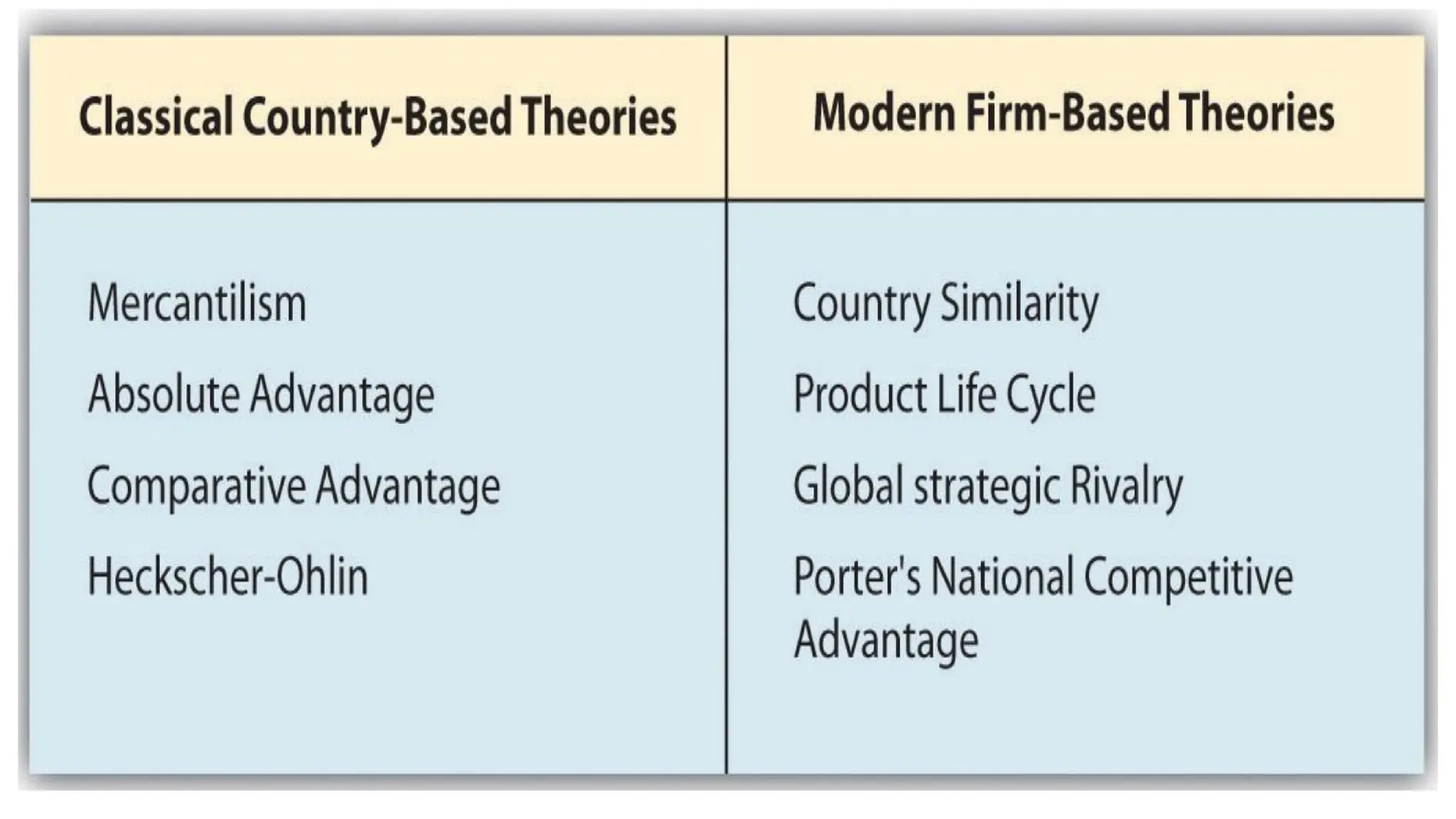
Classical or country-based theories
The founders of the various theories of the classical country-
based approach were mainly concerned with the fact that the
priority should be increasing the wealth of one’s own nation.
They were mainly of the view that focus should be on
economic growth on a priority basis. The main classical
theories in reference to international trade are discussed below.
Mercantilism
The Mercantilism theory is the first classical country-based
theory, which was propounded around the 17-18th century.
The Theory is focused on the motto that, on a priority basis, a
country must look after its own welfare and therefore, expand
exports and discourage imports. The theory also propounded
the view that the first thing a nation must focus on is the
accumulation of wealth in the form of gold and silver, thus,
strengthening the treasure of the nation.
In the 17th
-18th
Century, the wealth of the nation only
consisted of gold or other kinds of precious metals so the
theorists suggested that the countries should start
accumulating gold and other kinds of metals more and
more. The European Nations started doing so.
Mercantilists, during this period, stated that all these
precious stones denoted the wealth of a nation, they
believed that a country will strengthen only if the nation
imported less and exported more. They said that this is
a favorable balance of trade and that this will help a
nation to progress more.
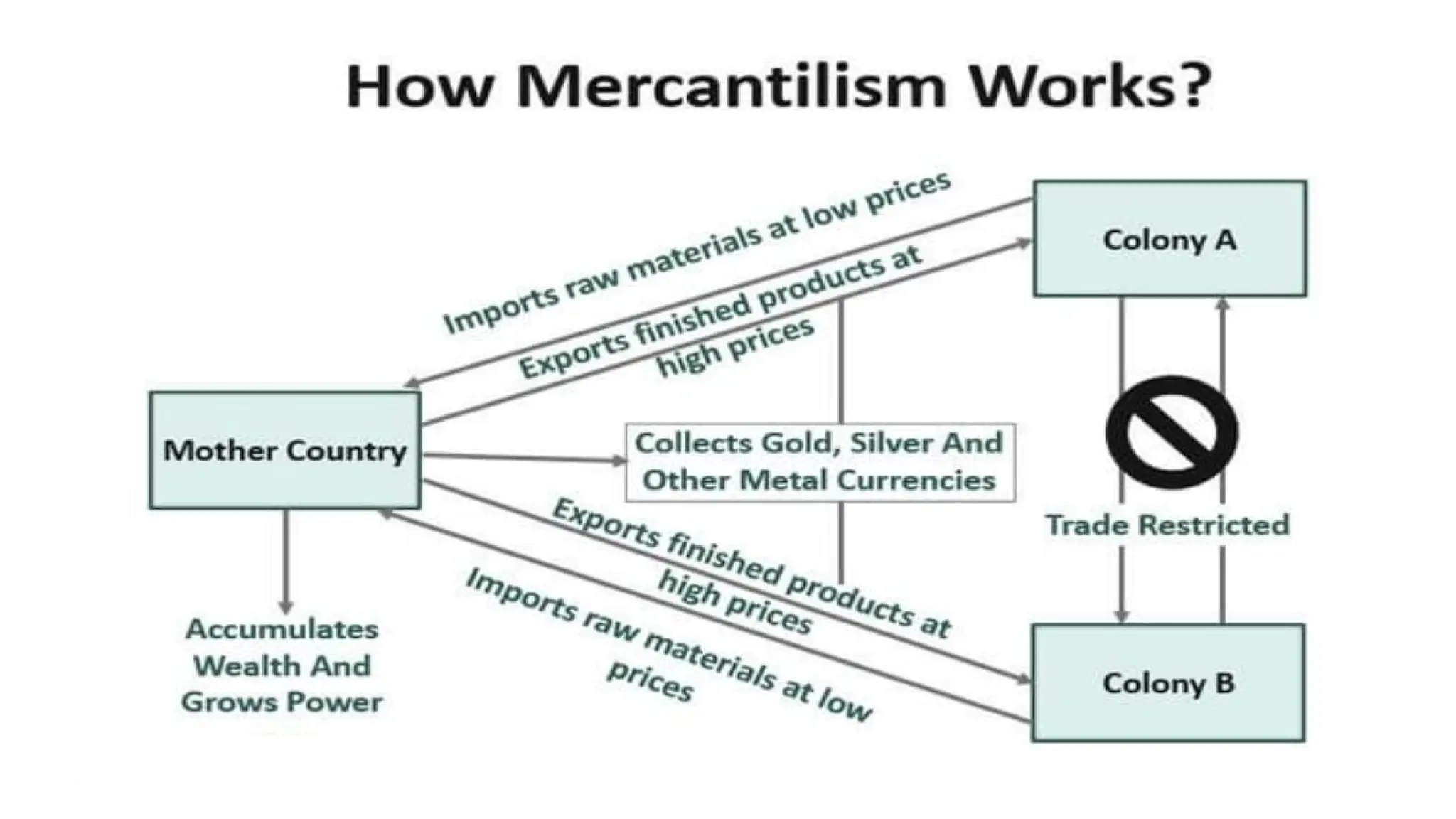
The rulers were focused on increasing the number of exports as
much as possible and discouraging imports. The British
Imperialist is the perfect example of this theory. They
utilized the raw materials of other countries by ruling over them
and then exporting those goods and other resources at a higher
price, accumulating a large amount of wealth for their own
country.
Here are some key concepts of mercantilism with examples to illustrate
how it worked:
1. Trade Surplus
Concept: Mercantilism stressed achieving a trade surplus, where a
country exports more than it imports.
Example: In the 17th century, England focused on producing and
exporting goods like wool, textiles, and manufactured items while
limiting imports. England tried to sell more goods to France and the
Netherlands than it bought from them, thus accumulating wealth
from other nations in the form of gold and silver.
2. Colonial Expansion for Raw Materials
Concept: Colonies provided raw materials to the mother
country and served as markets for its manufactured goods.
Example: The British colonies in North America supplied
raw materials like cotton, tobacco, and sugar to Britain,
which manufactured these into goods and sold them back to
the colonies. This kept wealth within the British Empire and
reduced dependence on imports.
3. Government Intervention and Trade Monopolies
Concept: Mercantilism encouraged strict government
control, including monopolies and subsidies, to support
favoured industries and control trade routes.
Example: The British East India Company had a monopoly
over trade with India, giving Britain control over the region's
highly profitable spice and textile trade. The British
government heavily supported and regulated this monopoly to
ensure maximum benefit to Britain.
4. Protectionism and Tariffs
Concept: Mercantilist policies often imposed tariffs or
outright bans on imported goods to protect domestic
industries and keep wealth within the country.
Example: France’s Jean-Baptiste Colbert, finance minister
under King Louis XIV, imposed high tariffs on foreign goods
to protect French industries. French merchants were
encouraged to buy only French-made goods, promoting local
industries and limiting the outflow of wealth.
5. Accumulation of Precious Metals
Concept: Mercantilists viewed gold and silver as the
ultimate measure of wealth, which should be hoarded to
build national wealth.
Example: Spain accumulated large amounts of gold and
silver from its colonies in Latin America, especially
from Peru and Mexico. This influx of precious metals
made Spain one of the wealthiest nations in Europe for a
time, though it also led to inflation and economic issues.
Absolute Advantage Theory
The Absolute Advantage Theory, developed by Adam Smith in his
1776 book The Wealth of Nations, is an early economic theory that
explains how countries can benefit from trade based on their ability to
produce goods more efficiently than other nations. Smith’s theory
challenged the prevailing mercantilist ideas by suggesting that trade
could be mutually beneficial and not a zero-sum game.
Key Concepts of Absolute Advantage Theory
Definition of Absolute Advantage:
o A country has an absolute advantage in the production of a good if it can
produce it using fewer resources (such as labor, capital, or time) than
another country. This means it can make the good more efficiently than
others.
Mutual Benefit through Trade:
o According to Smith, if each country specializes in producing goods for
which it has an absolute advantage and then trades with others, both
countries can end up with more of both goods than if they tried to produce
everything domestically. This increases overall wealth and allows for greater
consumption.
Specialization:
oSmith argued that countries should focus on producing goods they
are best at (where they have an absolute advantage) and import
goods where other countries have the advantage. This way,
resources are allocated more efficiently on a global scale.
Productivity and Labor:
oSmith highlighted that differences in productivity, driven by
factors such as skills, technology, and natural resources, lead to
absolute advantages. Countries should leverage these natural or
developed strengths to maximize output and economic welfare.
Example of Absolute Advantage Theory
Suppose there are two countries: Country A and Country B.
 Country A can produce 10 tons of wheat with the same resources it takes to produce 1 ton of
cloth.
 Country B can produce 10 tons of cloth with the same resources it takes to produce 1 ton of
wheat.
In this example:
 Country A has an absolute advantage in producing wheat.
 Country B has an absolute advantage in producing cloth.
According to the Absolute Advantage Theory:
 Country A should specialize in producing wheat.
 Country B should specialize in producing cloth.
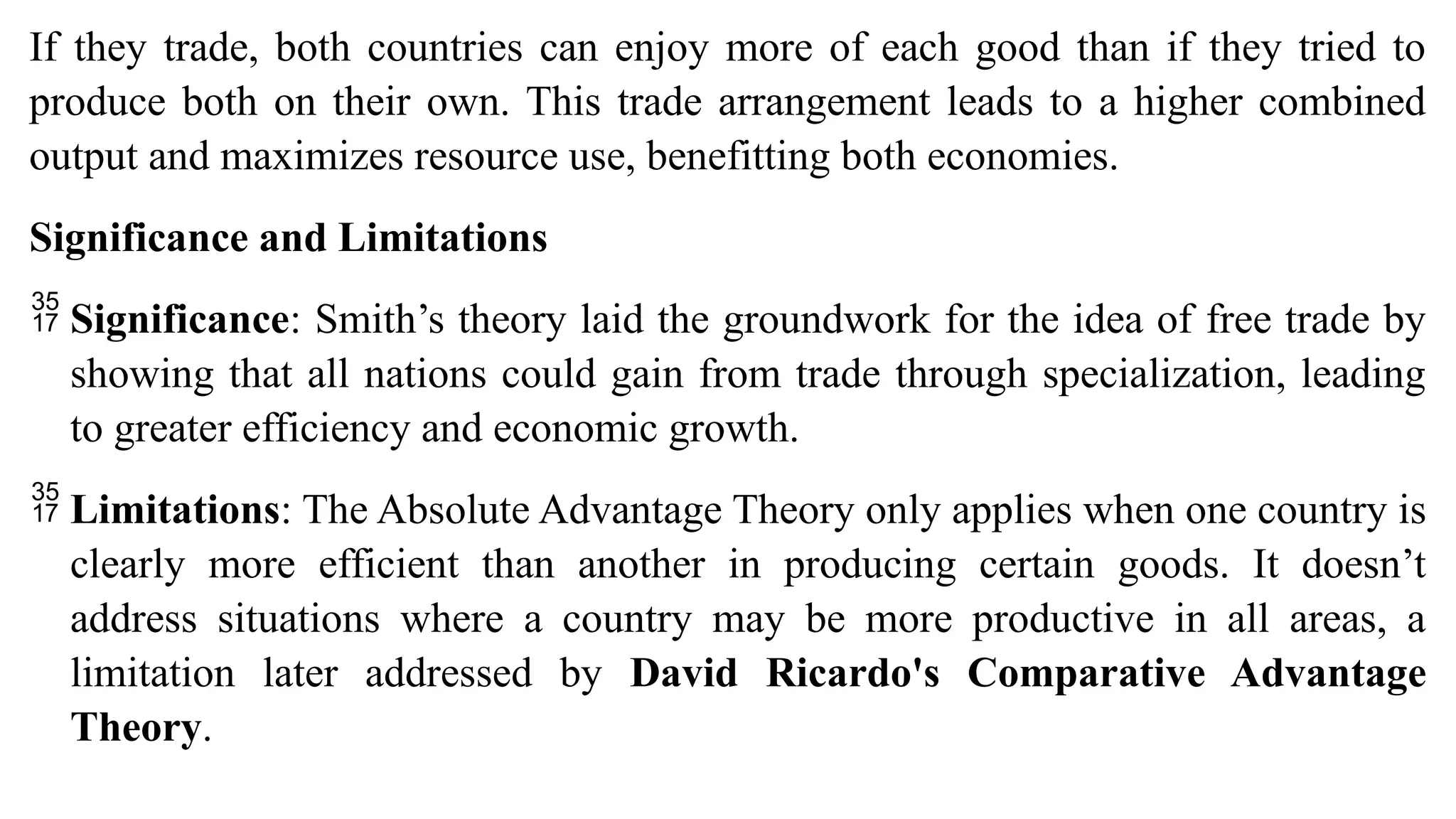
If they trade, both countries can enjoy more of each good than if they tried to
produce both on their own. This trade arrangement leads to a higher combined
output and maximizes resource use, benefitting both economies.
Significance and Limitations
 Significance: Smith’s theory laid the groundwork for the idea of free trade by
showing that all nations could gain from trade through specialization, leading
to greater efficiency and economic growth.
 Limitations: The Absolute Advantage Theory only applies when one country is
clearly more efficient than another in producing certain goods. It doesn’t
address situations where a country may be more productive in all areas, a
limitation later addressed by David Ricardo's Comparative Advantage
Theory.
Comparative Advantage
The Theory of Comparative Advantage was developed by
David Ricardo in the early 19th century and published in his
book On the Principles of Political Economy and Taxation in
1817. This theory expanded on Adam Smith’s Absolute
Advantage Theory and became one of the foundational
concepts in international trade. Ricardo’s insight was that even
if a country does not have an absolute advantage in producing
any goods, it can still benefit from trade by specializing in
goods where it has a comparative advantage.
Key Concepts of Comparative Advantage Theory
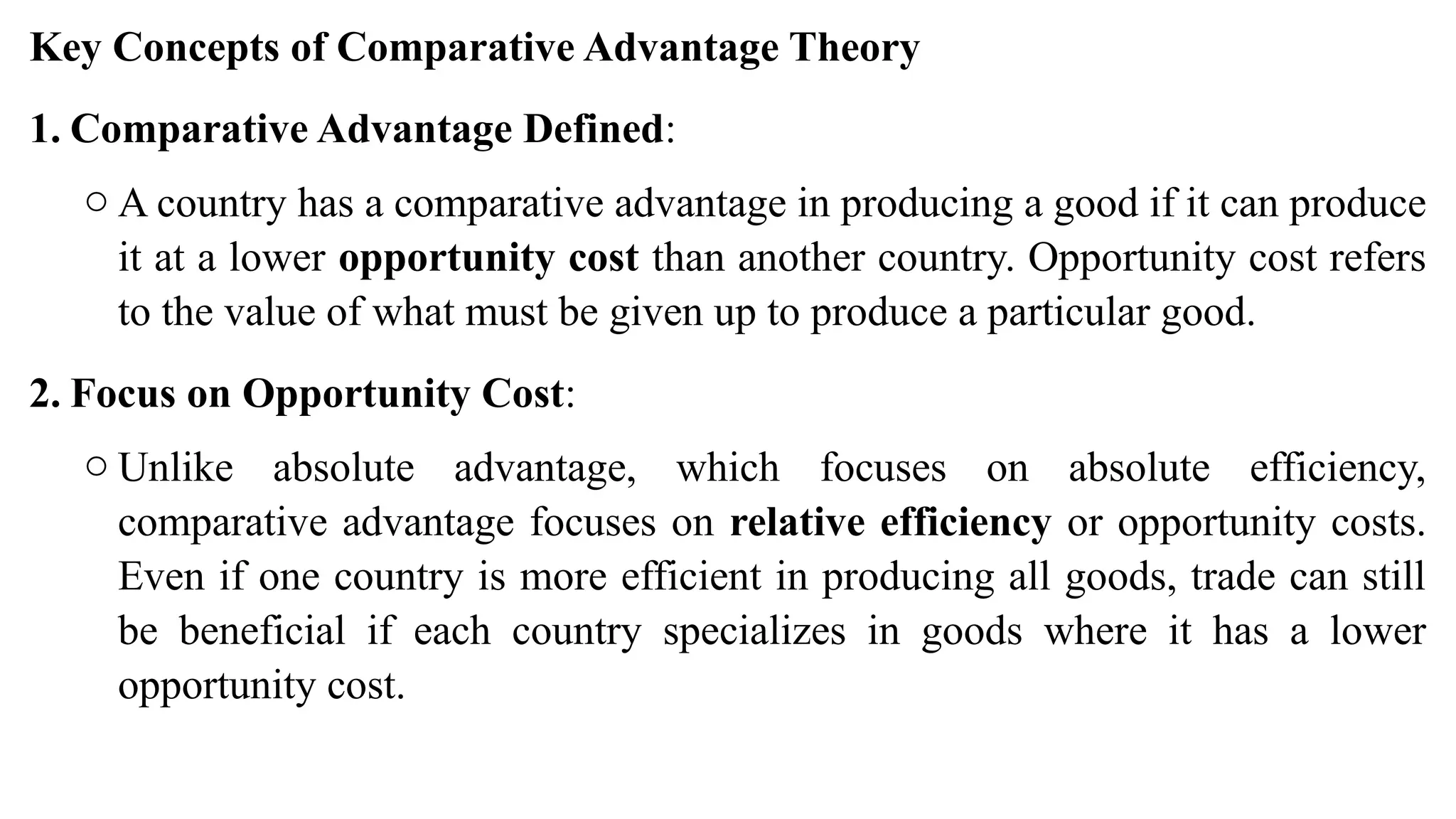
1. Comparative Advantage Defined:
o A country has a comparative advantage in producing a good if it can produce
it at a lower opportunity cost than another country. Opportunity cost refers
to the value of what must be given up to produce a particular good.
2. Focus on Opportunity Cost:
o Unlike absolute advantage, which focuses on absolute efficiency,
comparative advantage focuses on relative efficiency or opportunity costs.
Even if one country is more efficient in producing all goods, trade can still
be beneficial if each country specializes in goods where it has a lower
opportunity cost.
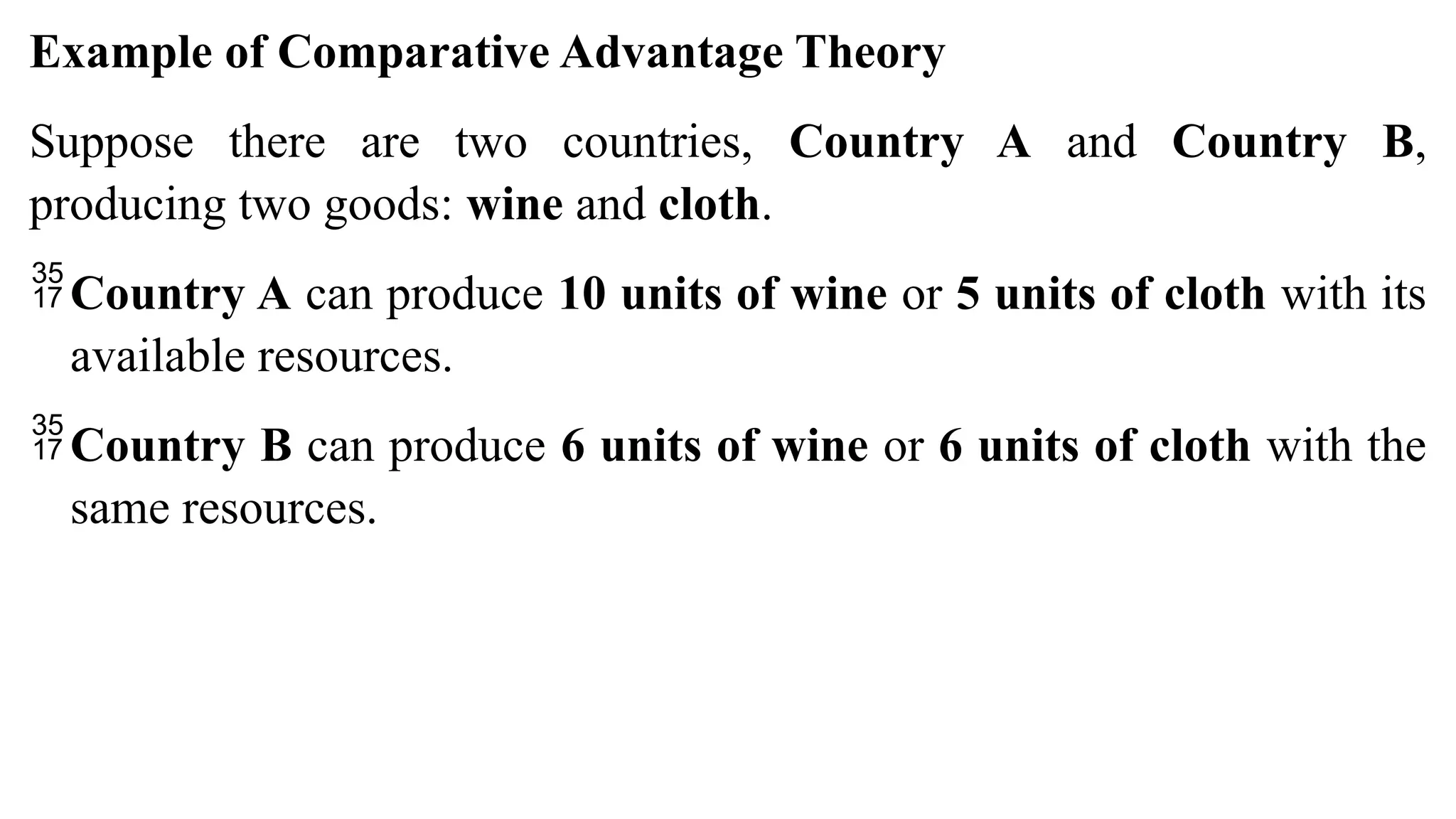
Example of Comparative Advantage Theory
Suppose there are two countries, Country A and Country B,
producing two goods: wine and cloth.
Country A can produce 10 units of wine or 5 units of cloth with its
available resources.
Country B can produce 6 units of wine or 6 units of cloth with the
same resources.
In this scenario:
 Country A has an absolute advantage in producing wine because it produces more wine (10
units) than Country B (6 units).
 Country B has no absolute advantage since Country A is more efficient at producing both goods.
However, let's examine opportunity costs:
 For Country A:
o The opportunity cost of 1 unit of wine is 0.5 units of cloth (since it gives up 5 units of cloth to
make 10 units of wine).
o The opportunity cost of 1 unit of cloth is 2 units of wine.
 For Country B:
o The opportunity cost of 1 unit of wine is 1 unit of cloth.
o The opportunity cost of 1 unit of cloth is 1 unit of wine.
Comparative Advantage:
 Country A has a lower opportunity cost for producing wine (0.5 units of cloth
per unit of wine) compared to Country B.
 Country B has a lower opportunity cost for producing cloth (1 unit of wine per
unit of cloth) compared to Country A.
According to Ricardo’s theory:
 Country A should specialize in producing wine.
 Country B should specialize in producing cloth.
By specializing and trading, both countries can benefit from each other’s
production efficiencies and consume more of both goods than if they tried to
produce them independently.
unit 1.pptx INTORDUCTION OF INTERNATIONAL TRADE

unit 1.pptx INTORDUCTION OF INTERNATIONAL TRADE

  • 1.
    UNIT I Introduction Meaning, nature,features and importance of international trade, domestic vs. international trade, Theories of international trade – comparative cost advantage – modern theory of international trade, terms of trade. UNIT II International payments Rate of exchange–meaning-determination–fixed vs. flexible rate of exchange, Balance of Payments – structure- BOT vs.BOP- equilibrium – disequilibrium-causes-corrective measures. UNIT III Trade policy Free trade vs protection – advantages – disadvantages – importance, tariffs and quotas – effects – types of quotas effects of quotas, exchange control – meaning – objectives – techniques – methods – merits and demerits
  • 2.
    UNIT IV International Institutionsand international liquidity IMF, IMF and international liquidity, The World Bank, International Financial Corporation (IFC), International Development Association (IDA), Euro – Dollar Market, UNCTAD, GATT, WTO UNIT V India’s Foreign Trade Foreign trade in India – value – composition – direction, India’s BOP, Foreign Trade Policy, FEMA, India and WTO
  • 3.
    UNIT 1 INTERNATIONAL TRADE Internationaltrade involves the exchange of goods and services between countries, playing a vital role in boosting the global economy. Commonly traded items include electronics, clothing, machinery, capital goods, food, and raw materials. Over time, international trade has expanded significantly, now encompassing services like transportation, tourism, banking, warehousing, communication, and advertising. Additionally, foreign investments and the production of goods in other countries have seen notable growth. These international investments and productions allow businesses to better reach their global customers, providing products and services at lower costs.
  • 4.
    Reasons for InternationalTrade In economics, one key concept introduced by David Ricardo is that countries engage in trade based on comparative advantages rather than absolute advantages. Even if a country is very efficient at producing everything, it is still beneficial for them to trade based on what they can produce most efficiently relative to others. Here are some important reasons for international trade: 1. **Production Efficiency**: Not every country can produce every good at a low cost. This is where international trade becomes essential. 2. **Factors of Production**: Different countries have varying costs for factors such as labor, capital, and raw materials. International trade allows countries to utilize these factors more efficiently. 3. **Cost of Production**: It makes sense for each country to focus on producing goods that they can make efficiently. For other goods, they can rely on countries where production costs are lower.
  • 5.
    4. **Resource Distribution**:Some countries lack certain natural resources. International trade helps address this issue by enabling countries to specialize in what they do best while obtaining other resources through trade. **Examples of Specialization**: Different regions often specialize in specific industries. For example, Maharashtra in India is known for textiles, West Bengal for jute products, Haryana and Punjab for agriculture, and Kerala for spices. Similar patterns of specialization exist in various countries around the world.
  • 6.
    STAGES OF INTERNATIONALISATION Internationalizationrefers to the process by which a business expands its operations to foreign markets. Companies typically go through several stages in this process. Here’s an outline of the main stages: 1. Domestic Stage - Focus: Operating only in the home country. - Characteristics: Limited or no foreign market activity. Companies focus on building a strong domestic presence and perfecting products or services in the local market. 2. Pre-Internationalization (Reactive Stage) - Focus: Exploring international opportunities. - Characteristics: The company begins to consider going global due to factors like domestic market saturation or demand for their products abroad. They might engage in market research, attend international trade shows, or receive inquiries from foreign buyers.
  • 7.
    3. Export Stage -Focus: Selling products abroad, usually through export. - Characteristics: The company starts by exporting goods to a foreign market, often via intermediaries. This is a low-risk method that allows them to test demand without a significant commitment. Exporting can be direct (selling to foreign customers) or indirect (through agents or distributors). 4. Establishment of Foreign Sales Subsidiary - Focus: Developing a local presence in a foreign market. - Characteristics: Companies establish sales offices or subsidiaries to better serve international customers, manage relationships, and increase control over branding and distribution. This often involves hiring local staff and customizing offerings for the market. 5. Foreign Production Stage - Focus: Setting up manufacturing or production facilities abroad. - Characteristics: The company establishes production facilities in foreign countries to save on production or transportation costs and to adapt products to local preferences. It may take the form of joint ventures, franchising, licensing, or direct investment.
  • 8.
    6. Transnational orGlobal Stage - Focus: Operating with a globally integrated strategy. - Characteristics: At this stage, companies operate as transnational organizations with operations, R&D, and decision-making spread across various countries. The company focuses on maximizing efficiency and consistency across markets while allowing for local customization where necessary. 7. Multinational or Full Globalization Stage - Focus: Treating the world as a single market. - Characteristics: At this stage, companies truly operate globally, often blending international operations so thoroughly that they function as a single global entity. Decision-making and resource allocation are optimized on a global scale rather than by individual country markets. Each stage presents its own set of challenges, from managing cultural differences to navigating regulatory hurdles and optimizing global supply chains.
  • 9.
    Importance of InternationalTrade International trade among nations isn’t just about exchanging goods – it’s a key player in improving our lives and economies. Here’s how: 1.Higher Living Standards and Jobs: It lifts the standard of living by creating jobs and giving people more opportunities to enjoy a variety of goods. 2.Raw Material Riches: Some countries, like Qatar for oil or Iceland for metals and fish, are lucky to have many raw materials. Without international trade, they wouldn’t fully benefit from these blessings. 3.More Choices for You: The more countries trade with each other, the more products you get to choose from. 4.Specialization and Efficiency: Countries can focus on what they’re good at. Whether making cars or growing crops, specialization helps companies make more money efficiently. 5.Global Growth and Less Poverty: When countries trade globally, they grow economically. This growth isn’t just for rich countries; it helps reduce poverty levels too. Moreover, international trade isn’t just about goods – it’s about making life better, giving you more choices, and helping countries grow together.
  • 10.
    Scope of InternationalTrade Check the below points for the scope of International Trade: •Exports and Imports: Exports and Imports trade is like a global shopping spree where countries trade tangible goods. Exporting is sending stuff to other nations, and importing is getting things from them. Don’t forget, services are in the mix too. •Service Trade (Invisible Trade): Think of it as the secret agent of trade – it involves services with no physical presence. Tourism, hotels, transportation, training, and research are all part of this invisible trade. •Licensing and Franchising: Imagine giving permission to other countries to use a company’s brand or sell its product. Licensing involves selling a company’s product under its trademark for a fee, like Pepsi and Coca-Cola. Franchising is similar but with services, like Domino’s or Burger King, setting up shop abroad. •Foreign Investment: This is like investing your money globally to make more money. Therefore, Direct investment is putting money into foreign companies for production and marketing. Sometimes, it’s a team effort called a joint venture. Moreover, Portfolio investment is when one company invests in another, earning income through interest and dividends.
  • 11.
    Advantages of InternationalTrade Here are some of the advantages of International Trade: •Income Boost: Organizations make money in foreign currencies, known as foreign exchange. This foreign cash helps pay for imported stuff like machinery, technologies, and fertilizers. •Resource Efficiency: Countries focus on what they do best and efficiently. If one nation is great at making cars, they focus on that, while another nation excels in something else. It’s like a teamwork strategy where everyone plays to their strengths. •Growth and Jobs: International trade speeds up the growth of businesses and entire countries. Big players like China, Japan, and South Korea viewed the whole world as a marketplace. This global approach created jobs worldwide. •Better Living Standards: People in one country get to enjoy products and services from other nations. This sharing of goods and services improves everyone’s quality of life. Moreover, international business isn’t just about making money; it’s about making the world work together efficiently, creating opportunities, and enhancing our lives.
  • 12.
    Difference Between Domesticand International Trade Parameters Domestic Trade International Trade Nationality of Buyers/Sellers People work within their home nation. People from different nations engage. Nationality of Stakeholders Suppliers, producers, etc., are from the same nation. Stakeholders can be from various nations. Mobility of Factors of Production Capital and labor move within one nation. Capital and labor move across different nations. Heterogeneous Customers Customers are generally similar in religion, caste, etc. Customers can vary widely in terms of religion, caste, language, etc. Risks Nation deals with political risks within its borders. Different nations bring different political risks. Policies Governed by the policies, regulations, and laws of one nation. Governed by the diverse policies and laws of multiple nations. Currency Single currency is used. Involves more than one currency.
  • 13.
    •Approaches of InternationalBusiness 1.Ethnocentric Approach 2.Polycentric Approach 3.Regiocentric Approach 4.Geocentric Approach
  • 14.
    1. Ethnocentric Approach Thisapproach to international business focuses on the home country's values, ethics, and beliefs. All the strategies first formulated for the domestic nation or domestic business focus on the international business is secondary. Businesses first cater to domestic market demand and trade surplus is distributed to a foreign nation. Overseas operations are operated from the head office of the domestic country by domestic employees. This approach is very beneficial for small businesses during the early days of internationalization as the investment needed in business is low. There is no major modification in products that will export to a foreign nation and no marketing research is conducted. Businesses mainly rely on exporting goods to foreign nations. Examples of Ethnocentric Approach – Indian clothes, dresses, food, and beverage are exported to foreign nations where a large number of Indian live.
  • 15.
    2. Polycentric Approach Asper this approach, the business focuses on each host country because they consider that each country is unique in terms of customer demand, customer preference, and taste so if businesses want to succeed in each country, they should adapt according to the host country’s requirements. The business opens its subsidiary in each oversea market and businesses adopt different marketing plans and strategies as per the host country’s needs. The foreign subsidiary has decision-making power and their operation are decentralized. Businesses appoint personnel the key positions from their home country, whereas the remaining positions or vacancies are filled by the personnel of the host country. ◉ Examples of Polycentric Approach – McDonald, Starbucks, Google Doodle
  • 16.
    3. Regiocentric Approach Underthis approach, businesses divide the whole world into different regions based on their common regional, social & cultural environment, economic, and political factors. Marketing strategies and business plans are formulated in regional headquarters for the entire group of counties or region Managers are hired or transferred from different countries lying within the same region. ◉ Example of Regiocentric Approach – Firms divide groups or regions on the basis of unique similarities like SAARC countries, the Baltic region, and the Scandinavian region.
  • 17.
    4. Geocentric Approach Accordingto the Geocentric approach, businesses consider the whole world is the same as one country for their business operation. Businesses select the best talent from the entire globe and operate with their large number of subsidiaries that are located around the globe that coordinate with the head office. This approach is used by big business giants which have large-scale business operations and a significant presence around the globe. The business following this approach has a uniform and standardized marketing strategy, HR practices, and product design throughout the globe. This international business approach helps in building brand image and earning a great amount of loyalty. ◉ Examples of Geocentric Approach – Apple, Coca-cola, Dell
  • 20.
    THEORIES OF INTERNATIONALTRADE As quoted by Wasserman and Haltman, international trade can be connoted as transactions among the inhabitants of different countries. International trade acts as a major contributing factor in global economic activity and a catalyst of economic growth in developing as well as developed countries. Differences in various conditions, like resource availability, natural climatic conditions, cost of production, etc., act as the motive behind trade between the countries. International trade has made it all possible and has provided a large number of employment opportunities as well as several goods and services for the consumer. It has been a major reason for the rising living standards of people all over the globe.
  • 22.
    Classical or country-basedtheories The founders of the various theories of the classical country- based approach were mainly concerned with the fact that the priority should be increasing the wealth of one’s own nation. They were mainly of the view that focus should be on economic growth on a priority basis. The main classical theories in reference to international trade are discussed below.
  • 23.
    Mercantilism The Mercantilism theoryis the first classical country-based theory, which was propounded around the 17-18th century. The Theory is focused on the motto that, on a priority basis, a country must look after its own welfare and therefore, expand exports and discourage imports. The theory also propounded the view that the first thing a nation must focus on is the accumulation of wealth in the form of gold and silver, thus, strengthening the treasure of the nation.
  • 24.
    In the 17th -18th Century,the wealth of the nation only consisted of gold or other kinds of precious metals so the theorists suggested that the countries should start accumulating gold and other kinds of metals more and more. The European Nations started doing so. Mercantilists, during this period, stated that all these precious stones denoted the wealth of a nation, they believed that a country will strengthen only if the nation imported less and exported more. They said that this is a favorable balance of trade and that this will help a nation to progress more.
  • 25.
    The rulers werefocused on increasing the number of exports as much as possible and discouraging imports. The British Imperialist is the perfect example of this theory. They utilized the raw materials of other countries by ruling over them and then exporting those goods and other resources at a higher price, accumulating a large amount of wealth for their own country.
  • 27.
    Here are somekey concepts of mercantilism with examples to illustrate how it worked: 1. Trade Surplus Concept: Mercantilism stressed achieving a trade surplus, where a country exports more than it imports. Example: In the 17th century, England focused on producing and exporting goods like wool, textiles, and manufactured items while limiting imports. England tried to sell more goods to France and the Netherlands than it bought from them, thus accumulating wealth from other nations in the form of gold and silver.
  • 28.
    2. Colonial Expansionfor Raw Materials Concept: Colonies provided raw materials to the mother country and served as markets for its manufactured goods. Example: The British colonies in North America supplied raw materials like cotton, tobacco, and sugar to Britain, which manufactured these into goods and sold them back to the colonies. This kept wealth within the British Empire and reduced dependence on imports.
  • 29.
    3. Government Interventionand Trade Monopolies Concept: Mercantilism encouraged strict government control, including monopolies and subsidies, to support favoured industries and control trade routes. Example: The British East India Company had a monopoly over trade with India, giving Britain control over the region's highly profitable spice and textile trade. The British government heavily supported and regulated this monopoly to ensure maximum benefit to Britain.
  • 30.
    4. Protectionism andTariffs Concept: Mercantilist policies often imposed tariffs or outright bans on imported goods to protect domestic industries and keep wealth within the country. Example: France’s Jean-Baptiste Colbert, finance minister under King Louis XIV, imposed high tariffs on foreign goods to protect French industries. French merchants were encouraged to buy only French-made goods, promoting local industries and limiting the outflow of wealth.
  • 31.
    5. Accumulation ofPrecious Metals Concept: Mercantilists viewed gold and silver as the ultimate measure of wealth, which should be hoarded to build national wealth. Example: Spain accumulated large amounts of gold and silver from its colonies in Latin America, especially from Peru and Mexico. This influx of precious metals made Spain one of the wealthiest nations in Europe for a time, though it also led to inflation and economic issues.
  • 32.
    Absolute Advantage Theory TheAbsolute Advantage Theory, developed by Adam Smith in his 1776 book The Wealth of Nations, is an early economic theory that explains how countries can benefit from trade based on their ability to produce goods more efficiently than other nations. Smith’s theory challenged the prevailing mercantilist ideas by suggesting that trade could be mutually beneficial and not a zero-sum game.
  • 33.
    Key Concepts ofAbsolute Advantage Theory Definition of Absolute Advantage: o A country has an absolute advantage in the production of a good if it can produce it using fewer resources (such as labor, capital, or time) than another country. This means it can make the good more efficiently than others. Mutual Benefit through Trade: o According to Smith, if each country specializes in producing goods for which it has an absolute advantage and then trades with others, both countries can end up with more of both goods than if they tried to produce everything domestically. This increases overall wealth and allows for greater consumption.
  • 34.
    Specialization: oSmith argued thatcountries should focus on producing goods they are best at (where they have an absolute advantage) and import goods where other countries have the advantage. This way, resources are allocated more efficiently on a global scale. Productivity and Labor: oSmith highlighted that differences in productivity, driven by factors such as skills, technology, and natural resources, lead to absolute advantages. Countries should leverage these natural or developed strengths to maximize output and economic welfare.
  • 35.
    Example of AbsoluteAdvantage Theory Suppose there are two countries: Country A and Country B.  Country A can produce 10 tons of wheat with the same resources it takes to produce 1 ton of cloth.  Country B can produce 10 tons of cloth with the same resources it takes to produce 1 ton of wheat. In this example:  Country A has an absolute advantage in producing wheat.  Country B has an absolute advantage in producing cloth. According to the Absolute Advantage Theory:  Country A should specialize in producing wheat.  Country B should specialize in producing cloth.
  • 36.
    If they trade,both countries can enjoy more of each good than if they tried to produce both on their own. This trade arrangement leads to a higher combined output and maximizes resource use, benefitting both economies. Significance and Limitations  Significance: Smith’s theory laid the groundwork for the idea of free trade by showing that all nations could gain from trade through specialization, leading to greater efficiency and economic growth.  Limitations: The Absolute Advantage Theory only applies when one country is clearly more efficient than another in producing certain goods. It doesn’t address situations where a country may be more productive in all areas, a limitation later addressed by David Ricardo's Comparative Advantage Theory.
  • 37.
    Comparative Advantage The Theoryof Comparative Advantage was developed by David Ricardo in the early 19th century and published in his book On the Principles of Political Economy and Taxation in 1817. This theory expanded on Adam Smith’s Absolute Advantage Theory and became one of the foundational concepts in international trade. Ricardo’s insight was that even if a country does not have an absolute advantage in producing any goods, it can still benefit from trade by specializing in goods where it has a comparative advantage.
  • 38.
    Key Concepts ofComparative Advantage Theory 1. Comparative Advantage Defined: o A country has a comparative advantage in producing a good if it can produce it at a lower opportunity cost than another country. Opportunity cost refers to the value of what must be given up to produce a particular good. 2. Focus on Opportunity Cost: o Unlike absolute advantage, which focuses on absolute efficiency, comparative advantage focuses on relative efficiency or opportunity costs. Even if one country is more efficient in producing all goods, trade can still be beneficial if each country specializes in goods where it has a lower opportunity cost.
  • 39.
    Example of ComparativeAdvantage Theory Suppose there are two countries, Country A and Country B, producing two goods: wine and cloth. Country A can produce 10 units of wine or 5 units of cloth with its available resources. Country B can produce 6 units of wine or 6 units of cloth with the same resources.
  • 40.
    In this scenario: Country A has an absolute advantage in producing wine because it produces more wine (10 units) than Country B (6 units).  Country B has no absolute advantage since Country A is more efficient at producing both goods. However, let's examine opportunity costs:  For Country A: o The opportunity cost of 1 unit of wine is 0.5 units of cloth (since it gives up 5 units of cloth to make 10 units of wine). o The opportunity cost of 1 unit of cloth is 2 units of wine.  For Country B: o The opportunity cost of 1 unit of wine is 1 unit of cloth. o The opportunity cost of 1 unit of cloth is 1 unit of wine.
  • 41.
    Comparative Advantage:  CountryA has a lower opportunity cost for producing wine (0.5 units of cloth per unit of wine) compared to Country B.  Country B has a lower opportunity cost for producing cloth (1 unit of wine per unit of cloth) compared to Country A. According to Ricardo’s theory:  Country A should specialize in producing wine.  Country B should specialize in producing cloth. By specializing and trading, both countries can benefit from each other’s production efficiencies and consume more of both goods than if they tried to produce them independently.