13-1
McGraw-Hill/Irwin ©2006 The McGraw-Hill Companies, Inc., All Rights Reserved
CHAPTER THIRTEEN
Multiple Parties
and Teams
13-2
McGraw-Hill/Irwin ©2006 The McGraw-Hill Companies, Inc., All Rights Reserved
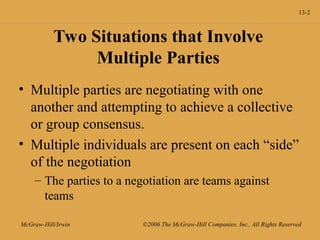
Two Situations that Involve
Multiple Parties
• Multiple parties are negotiating with one
another and attempting to achieve a collective
or group consensus.
• Multiple individuals are present on each “side”
of the negotiation
– The parties to a negotiation are teams against
teams
13-3
McGraw-Hill/Irwin ©2006 The McGraw-Hill Companies, Inc., All Rights Reserved
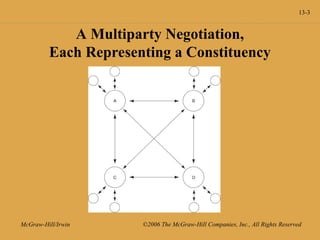
A Multiparty Negotiation,
Each Representing a Constituency
13-4
McGraw-Hill/Irwin ©2006 The McGraw-Hill Companies, Inc., All Rights Reserved
The Nature of Multiparty
Negotiations
Differences between two-party and
multiparty negotiations:
• Number of parties
• Informational and computational complexity
• Social complexity
• Procedural complexity
• Strategic complexity
13-5
McGraw-Hill/Irwin ©2006 The McGraw-Hill Companies, Inc., All Rights Reserved
What Is an Effective Group
in a Multiparty Negotiation?
Effective groups and their members:
1. Test assumptions and inferences
2. Share all relevant information
3. Focus on interests, not positions
4. Talk in specific terms
5. Agree on what important words mean
6. Explain reasons behind statements
7. Disagree openly with any member of the group
8. Make statements, then invite questions and comments
13-6
McGraw-Hill/Irwin ©2006 The McGraw-Hill Companies, Inc., All Rights Reserved
What Is an Effective Group
in a Multiparty Negotiation?
Effective groups and their members (cont.)
9. Design ways to test disagreements and solutions
10. Discuss “undiscussable” issues
11. Keep discussions focused
12. Avoid taking cheap shots or distracting the group
13. Expect participation by all members in all phases of the
process
14. Exchange relevant information with nongroup members
15. Make decisions by consensus
16. Conduct self-critiques
13-7
McGraw-Hill/Irwin ©2006 The McGraw-Hill Companies, Inc., All Rights Reserved
Managing Multiparty
Negotiations
• The prenegotiation stage
– Characterized by many informal contacts among the parties
• The formal negotiation stage
– Structures a group discussion to achieve an effective and
endorsed result
• The agreement phase
– Parties select among the alternatives on the table
13-8
McGraw-Hill/Irwin ©2006 The McGraw-Hill Companies, Inc., All Rights Reserved
The Prenegotiation Stage
• Establish participants
• Form coalitions
• Define group member roles
• Understand the costs and consequences of no
agreement
• Learn the issues and construct an agenda
13-9
McGraw-Hill/Irwin ©2006 The McGraw-Hill Companies, Inc., All Rights Reserved
The Prenegotiation Stage
Agendas as effective decision aids:
• Establish the issues that will be discussed
• Define how each issue is discussed
• Set the order in which issues are discussed
• Introduce process issues (decision rules,
discussion norms, member roles, discussion
dynamics), and substantive issues
• Assign time limits to various items
13-10
McGraw-Hill/Irwin ©2006 The McGraw-Hill Companies, Inc., All Rights Reserved
The Formal Negotiation Stage
• Appoint an appropriate chair
• Use and restructure the agenda
• Ensure diversity of information and perspectives
– Key process steps:
• Collect thoughts and composure before speaking
• Understand the other person’s position
• Think of ways both parties can win
• Consider the importance of the issue
• Remember parties will likely work together in the future
13-11
McGraw-Hill/Irwin ©2006 The McGraw-Hill Companies, Inc., All Rights Reserved
The Formal Negotiation Stage
• Ensure consideration of all available
information
– The Delphi technique
• An initial questionnaire, sent to all parties, asking
for input
– Brainstorming
• Define a problem and generate as many solutions
as possible without criticizing any of them
– Nominal group technique
• Brainstormed list of solutions ranked, rated, or
evaluated
13-12
McGraw-Hill/Irwin ©2006 The McGraw-Hill Companies, Inc., All Rights Reserved
The Formal Negotiation Stage
• Manage conflict effectively
• Review and manage the decision rules
• Strive for a first agreement
• Manage problem team members
– Be specific about problem behaviors
– Describe problem as team problem (“we vs you”)
– Focus on behaviors the other can control
– Wait to give constructive criticism
– Keep feedback professional
– Verify that the other has heard and understood
13-13
McGraw-Hill/Irwin ©2006 The McGraw-Hill Companies, Inc., All Rights Reserved
The Agreement Phase
• Select the best solution
• Develop an action plan
• Implement the action plan
• Evaluate outcomes and the process
13-14
McGraw-Hill/Irwin ©2006 The McGraw-Hill Companies, Inc., All Rights Reserved
The Agreement Phase
Group chair or facilitator steps in moving
toward a successful completion:
– Move the group toward selecting one or more
of the options
– Shape and draft the tentative agreement
– Discuss whatever implementation and
follow-up needs to occur
– Thank the group for their participation, hard
work and efforts
13-15
McGraw-Hill/Irwin ©2006 The McGraw-Hill Companies, Inc., All Rights Reserved
Interteam Negotiations
• Integrative agreements more likely when
teams are involved
• Teams are sometimes more competitive than
individuals and may claim more value
• Accountability pressures are different for
teams
• Relationship among team members affects
negotiation process and outcomes

Chapter 13 - Multiple Parties and Teams.ppt

  • 1.
    13-1 McGraw-Hill/Irwin ©2006 TheMcGraw-Hill Companies, Inc., All Rights Reserved CHAPTER THIRTEEN Multiple Parties and Teams
  • 2.
    13-2 McGraw-Hill/Irwin ©2006 TheMcGraw-Hill Companies, Inc., All Rights Reserved Two Situations that Involve Multiple Parties • Multiple parties are negotiating with one another and attempting to achieve a collective or group consensus. • Multiple individuals are present on each “side” of the negotiation – The parties to a negotiation are teams against teams
  • 3.
    13-3 McGraw-Hill/Irwin ©2006 TheMcGraw-Hill Companies, Inc., All Rights Reserved A Multiparty Negotiation, Each Representing a Constituency
  • 4.
    13-4 McGraw-Hill/Irwin ©2006 TheMcGraw-Hill Companies, Inc., All Rights Reserved The Nature of Multiparty Negotiations Differences between two-party and multiparty negotiations: • Number of parties • Informational and computational complexity • Social complexity • Procedural complexity • Strategic complexity
  • 5.
    13-5 McGraw-Hill/Irwin ©2006 TheMcGraw-Hill Companies, Inc., All Rights Reserved What Is an Effective Group in a Multiparty Negotiation? Effective groups and their members: 1. Test assumptions and inferences 2. Share all relevant information 3. Focus on interests, not positions 4. Talk in specific terms 5. Agree on what important words mean 6. Explain reasons behind statements 7. Disagree openly with any member of the group 8. Make statements, then invite questions and comments
  • 6.
    13-6 McGraw-Hill/Irwin ©2006 TheMcGraw-Hill Companies, Inc., All Rights Reserved What Is an Effective Group in a Multiparty Negotiation? Effective groups and their members (cont.) 9. Design ways to test disagreements and solutions 10. Discuss “undiscussable” issues 11. Keep discussions focused 12. Avoid taking cheap shots or distracting the group 13. Expect participation by all members in all phases of the process 14. Exchange relevant information with nongroup members 15. Make decisions by consensus 16. Conduct self-critiques
  • 7.
    13-7 McGraw-Hill/Irwin ©2006 TheMcGraw-Hill Companies, Inc., All Rights Reserved Managing Multiparty Negotiations • The prenegotiation stage – Characterized by many informal contacts among the parties • The formal negotiation stage – Structures a group discussion to achieve an effective and endorsed result • The agreement phase – Parties select among the alternatives on the table
  • 8.
    13-8 McGraw-Hill/Irwin ©2006 TheMcGraw-Hill Companies, Inc., All Rights Reserved The Prenegotiation Stage • Establish participants • Form coalitions • Define group member roles • Understand the costs and consequences of no agreement • Learn the issues and construct an agenda
  • 9.
    13-9 McGraw-Hill/Irwin ©2006 TheMcGraw-Hill Companies, Inc., All Rights Reserved The Prenegotiation Stage Agendas as effective decision aids: • Establish the issues that will be discussed • Define how each issue is discussed • Set the order in which issues are discussed • Introduce process issues (decision rules, discussion norms, member roles, discussion dynamics), and substantive issues • Assign time limits to various items
  • 10.
    13-10 McGraw-Hill/Irwin ©2006 TheMcGraw-Hill Companies, Inc., All Rights Reserved The Formal Negotiation Stage • Appoint an appropriate chair • Use and restructure the agenda • Ensure diversity of information and perspectives – Key process steps: • Collect thoughts and composure before speaking • Understand the other person’s position • Think of ways both parties can win • Consider the importance of the issue • Remember parties will likely work together in the future
  • 11.
    13-11 McGraw-Hill/Irwin ©2006 TheMcGraw-Hill Companies, Inc., All Rights Reserved The Formal Negotiation Stage • Ensure consideration of all available information – The Delphi technique • An initial questionnaire, sent to all parties, asking for input – Brainstorming • Define a problem and generate as many solutions as possible without criticizing any of them – Nominal group technique • Brainstormed list of solutions ranked, rated, or evaluated
  • 12.
    13-12 McGraw-Hill/Irwin ©2006 TheMcGraw-Hill Companies, Inc., All Rights Reserved The Formal Negotiation Stage • Manage conflict effectively • Review and manage the decision rules • Strive for a first agreement • Manage problem team members – Be specific about problem behaviors – Describe problem as team problem (“we vs you”) – Focus on behaviors the other can control – Wait to give constructive criticism – Keep feedback professional – Verify that the other has heard and understood
  • 13.
    13-13 McGraw-Hill/Irwin ©2006 TheMcGraw-Hill Companies, Inc., All Rights Reserved The Agreement Phase • Select the best solution • Develop an action plan • Implement the action plan • Evaluate outcomes and the process
  • 14.
    13-14 McGraw-Hill/Irwin ©2006 TheMcGraw-Hill Companies, Inc., All Rights Reserved The Agreement Phase Group chair or facilitator steps in moving toward a successful completion: – Move the group toward selecting one or more of the options – Shape and draft the tentative agreement – Discuss whatever implementation and follow-up needs to occur – Thank the group for their participation, hard work and efforts
  • 15.
    13-15 McGraw-Hill/Irwin ©2006 TheMcGraw-Hill Companies, Inc., All Rights Reserved Interteam Negotiations • Integrative agreements more likely when teams are involved • Teams are sometimes more competitive than individuals and may claim more value • Accountability pressures are different for teams • Relationship among team members affects negotiation process and outcomes