An Introduction to
Negotiation
Negotiation….Negotiation….
 A means of resolving conflicts for centuriesA means of resolving conflicts for centuries
 An alternative to fighting, warAn alternative to fighting, war
 Agreements can be made permanentAgreements can be made permanent
through rules and lawsthrough rules and laws
 Today a common means of resolvingToday a common means of resolving
family, work, and societal disputesfamily, work, and societal disputes
Yet, many people avoid, even fearYet, many people avoid, even fear
negotiation. Why?negotiation. Why?
1-2
How Important a Skill IsHow Important a Skill Is
Negotiation?Negotiation?
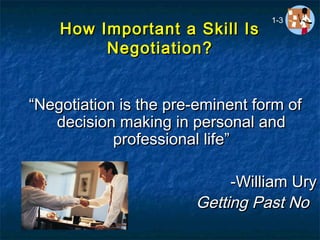
““Negotiation is the pre-eminent form ofNegotiation is the pre-eminent form of
decision making in personal anddecision making in personal and
professional life”professional life”
-William Ury-William Ury
Getting Past NoGetting Past No
1-3
Five Negotiation SkillsFive Negotiation Skills
 Skill 1.1: Recognize theSkill 1.1: Recognize the five essential
elements in a negotiationin a negotiation
 Skill 1.2: ModelSkill 1.2: Model bargaining behaviors usedused
by skilled negotiatorsby skilled negotiators
 Skill 1.3: RecognizeSkill 1.3: Recognize bargaining styles
 Skill 1.4: SetSkill 1.4: Set collaborative goals
 Skill 1.5:Skill 1.5: AvoidAvoid cognitive biases
1-4
Three Basic Types ofThree Basic Types of
NegotiationNegotiation
1.1. Deal making:: purchase of a new home orpurchase of a new home or
carcar
2.2. Decision making:: parties in a zoning caseparties in a zoning case
3.3. Dispute resolution:: litigation over propertylitigation over property
rightsrights
While the three have subtle differences, allWhile the three have subtle differences, all
are forms of negotiationare forms of negotiation
1-5
Chapter Case: Zoning ChangeChapter Case: Zoning Change
 Sophia is seeking a zoning changeSophia is seeking a zoning change
 Robert, an inexperienced attorney, is hiredRobert, an inexperienced attorney, is hired
by Sophia to represent her before theby Sophia to represent her before the
Zoning CommissionZoning Commission
 Neighborhood residents oppose Sophia’sNeighborhood residents oppose Sophia’s
proposed new condo developmentproposed new condo development
 The Zoning Commission staff suggest aThe Zoning Commission staff suggest a
meeting of all parties to negotiate theirmeeting of all parties to negotiate their
differencesdifferences
1-6
The Five Elements CommonThe Five Elements Common
to Negotiation Situationsto Negotiation Situations
1.1. Two or more parties (or interests)Two or more parties (or interests)
2. Interdependence2. Interdependence
3. Common goals3. Common goals
4. Flexibility4. Flexibility
5. Decision-making ability5. Decision-making ability
1-7
Parties and Their InterestsParties and Their Interests
 Parties can view a conflict situation differentlyParties can view a conflict situation differently
 That view, or frame, leads them to focus onThat view, or frame, leads them to focus on
some characteristics of the conflict and ignoresome characteristics of the conflict and ignore
othersothers
 Relationship/task frame: Parties focus on eitherRelationship/task frame: Parties focus on either
ongoing relationship or the subject matter of theongoing relationship or the subject matter of the
disputedispute
 Emotional/intellectual frame:Emotional/intellectual frame: PartiesParties paypay
attention to the emotional components of theattention to the emotional components of the
dispute or behaviors of the partiesdispute or behaviors of the parties
 Cooperate/win frame: Parties seeks to benefitCooperate/win frame: Parties seeks to benefit
both parties or to maximize personal gainboth parties or to maximize personal gain
1-8
Developing Negotiating SkillsDeveloping Negotiating Skills
 Negotiations are rarely pure win-lose orNegotiations are rarely pure win-lose or
win-win propositionswin-win propositions
 Negotiations take place under conditionsNegotiations take place under conditions
of ambiguity and uncertaintyof ambiguity and uncertainty
 Most negotiations involve existing orMost negotiations involve existing or
potential sources of conflict that impedepotential sources of conflict that impede
reaching agreementreaching agreement
1-9
Developing Negotiating SkillsDeveloping Negotiating Skills
 Negotiating progress comes in stops andNegotiating progress comes in stops and
starts. Most complex negotiations takestarts. Most complex negotiations take
place between agents of groups and notplace between agents of groups and not
the groups themselvesthe groups themselves
 Complex negotiations often involve a teamComplex negotiations often involve a team
approachapproach
 Negotiating skills can be learnedNegotiating skills can be learned
1-10
Developing Negotiating SkillsDeveloping Negotiating Skills
 Negotiations are chaotic and seldom passNegotiations are chaotic and seldom pass
sequentially through distinct phases suchsequentially through distinct phases such
as pre-negotiation, deal structuring,as pre-negotiation, deal structuring,
detailed bargaining, and agreementdetailed bargaining, and agreement
 Negotiations involving multiple parties andNegotiations involving multiple parties and
complex issues challenge a negotiatorcomplex issues challenge a negotiator
 Most negotiations are linked to otherMost negotiations are linked to other
negotiationsnegotiations
1-11
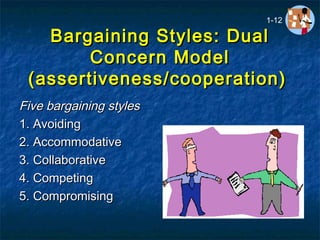
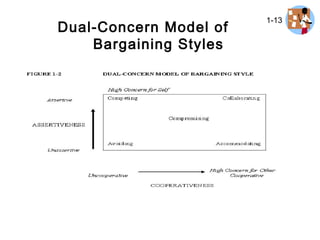
Bargaining Styles: DualBargaining Styles: Dual
Concern ModelConcern Model
(assertiveness/cooperation)(assertiveness/cooperation)
Five bargaining stylesFive bargaining styles
1. Avoiding1. Avoiding
2. Accommodative2. Accommodative
3. Collaborative3. Collaborative
4. Competing4. Competing
5. Compromising5. Compromising
1-12
Dual-Concern Model of
Bargaining Styles
1-13
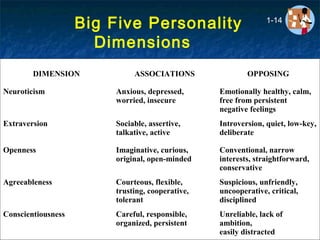
Big Five Personality
Dimensions
DIMENSION ASSOCIATIONS OPPOSING
Neuroticism Anxious, depressed,
worried, insecure
Emotionally healthy, calm,
free from persistent
negative feelings
Extraversion Sociable, assertive,
talkative, active
Introversion, quiet, low-key,
deliberate
Openness Imaginative, curious,
original, open-minded
Conventional, narrow
interests, straightforward,
conservative
Agreeableness Courteous, flexible,
trusting, cooperative,
tolerant
Suspicious, unfriendly,
uncooperative, critical,
disciplined
Conscientiousness Careful, responsible,
organized, persistent
Unreliable, lack of
ambition,
easily distracted
1-14
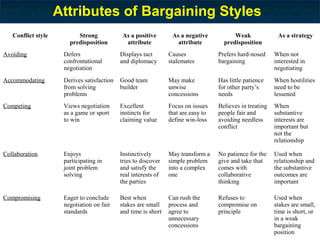
Attributes of Bargaining Styles
Conflict style Strong
predisposition
As a positive
attribute
As a negative
attribute
Weak
predisposition
As a strategy
Avoiding Defers
confrontational
negotiation
Displays tact
and diplomacy
Causes
stalemates
Prefers hard-nosed
bargaining
When not
interested in
negotiating
Accommodating Derives satisfaction
from solving
problems
Good team
builder
May make
unwise
concessions
Has little patience
for other party’s
needs
When hostilities
need to be
lessened
Competing Views negotiation
as a game or sport
to win
Excellent
instincts for
claiming value
Focus on issues
that are easy to
define win-loss
Believes in treating
people fair and
avoiding needless
conflict
When
substantive
interests are
important but
not the
relationship
Collaboration Enjoys
participating in
joint problem
solving
Instinctively
tries to discover
and satisfy the
real interests of
the parties
May transform a
simple problem
into a complex
one
No patience for the
give and take that
comes with
collaborative
thinking
Used when
relationship and
the substantive
outcomes are
important
Compromising Eager to conclude
negotiation on fair
standards
Best when
stakes are small
and time is short
Can rush the
process and
agree to
unnecessary
concessions
Refuses to
compromise on
principle
Used when
stakes are small,
time is short, or
in a weak
bargaining
position
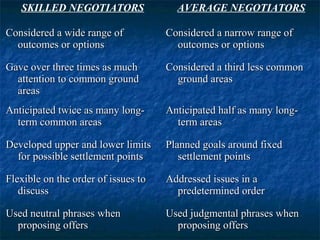
SKILLED NEGOTIATORS AVERAGE NEGOTIATORS
Considered a wide range ofConsidered a wide range of
outcomes or optionsoutcomes or options
Considered a narrow range ofConsidered a narrow range of
outcomes or optionsoutcomes or options
Gave over three times as muchGave over three times as much
attention to common groundattention to common ground
areasareas
Considered a third less commonConsidered a third less common
ground areasground areas
Anticipated twice as many long-Anticipated twice as many long-
term common areasterm common areas
Anticipated half as many long-Anticipated half as many long-
term areasterm areas
Developed upper and lower limitsDeveloped upper and lower limits
for possible settlement pointsfor possible settlement points
Planned goals around fixedPlanned goals around fixed
settlement pointssettlement points
Flexible on the order of issues toFlexible on the order of issues to
discussdiscuss
Addressed issues in aAddressed issues in a
predetermined orderpredetermined order
Used neutral phrases whenUsed neutral phrases when
proposing offersproposing offers
Used judgmental phrases whenUsed judgmental phrases when
proposing offersproposing offers
Tactics for Success: Find CommonTactics for Success: Find Common
Interests by Asking the RightInterests by Asking the Right
Questions!Questions!
 Open-ended:Open-ended: “What were you hoping to settle“What were you hoping to settle
today?”today?”
 Leading:Leading: “Don’t you think this proposal meets“Don’t you think this proposal meets
one of your goals?”one of your goals?”
 Clarifying:Clarifying: “Can you postpone collecting that fee“Can you postpone collecting that fee
untiluntil next year?”next year?”
 Gauging:Gauging: “How important to you is the 24-hour“How important to you is the 24-hour
service guarantee?”service guarantee?”
 Seek agreement:Seek agreement: “If we agree to your delivery“If we agree to your delivery
terms do we have a deal?”terms do we have a deal?”
1-17
Interdependency
 Without interdependency no reason to
negotiate, no motivation to reach
agreement
 Degrees of interdependency include: one-
shot negotiation, repeat transactions, or
long-term relationship
1-18
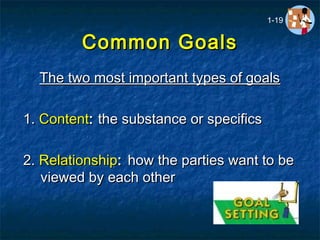
Common GoalsCommon Goals
The two most important types of goalsThe two most important types of goals
1.1. ContentContent:: the substance or specificsthe substance or specifics
2.2. RelationshipRelationship:: how the parties want to behow the parties want to be
viewed by each otherviewed by each other
1-19
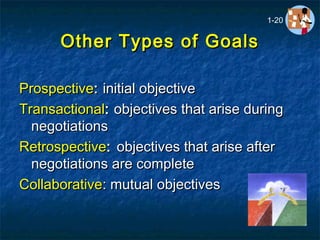
Other Types of GoalsOther Types of Goals
ProspectiveProspective:: initial objectiveinitial objective
TransactionalTransactional:: objectives that arise duringobjectives that arise during
negotiationsnegotiations
RetrospectiveRetrospective:: objectives that arise afterobjectives that arise after
negotiations are completenegotiations are complete
CollaborativeCollaborative: mutual objectives: mutual objectives
1-20
FlexibilityFlexibility
 A power shift can quickly occur in a
negotiation situation. A negotiator must be
able to respond in a strategic way.
1-21
Decision-Making Ability
 Negotiation involves at least two peopleNegotiation involves at least two people
making decisions that require judgmentsmaking decisions that require judgments
and choicesand choices
 JudgmentJudgment involves recognizing andinvolves recognizing and
evaluating the content of the optionsevaluating the content of the options
presentedpresented
 ChoiceChoice involves actually selecting aninvolves actually selecting an
optionoption
1-22
Decision-Making Ability
 Parties often differ in how they think orParties often differ in how they think or
process informationprocess information
 People developPeople develop schemaschema as a way ofas a way of
organizing current knowledge and as aorganizing current knowledge and as a
way to process future informationway to process future information
 Some schemas create biasesSome schemas create biases
1-23
Biases That May Affect aBiases That May Affect a
NegotiatorNegotiator
 Availability biasAvailability bias: An outcome probability is: An outcome probability is
based on how easy it is to imaginebased on how easy it is to imagine
 Representativeness biasRepresentativeness bias:: StereotypingStereotyping
 Self-serving biasSelf-serving bias: Belief that an option is true: Belief that an option is true
because it benefits thembecause it benefits them
 Self-enhancement biasSelf-enhancement bias:: Belief that one’s ownBelief that one’s own
behavior is more constructivebehavior is more constructive
 Impact biasImpact bias: One overestimates the: One overestimates the
positive/negative satisfaction of an outcomepositive/negative satisfaction of an outcome
1-24
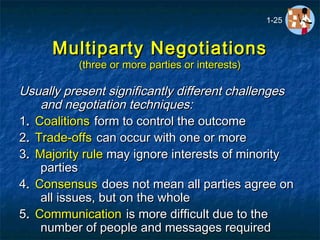
Multiparty NegotiationsMultiparty Negotiations
(three or more parties or interests)(three or more parties or interests)
Usually present significantly different challengesUsually present significantly different challenges
and negotiation techniques:and negotiation techniques:
11.. CoalitionsCoalitions form to control the outcomeform to control the outcome
22.. Trade-offsTrade-offs can occur with one or morecan occur with one or more
33.. Majority ruleMajority rule may ignore interests of minoritymay ignore interests of minority
partiesparties
44.. ConsensusConsensus does not mean all parties agree ondoes not mean all parties agree on
all issues, but on the wholeall issues, but on the whole
55.. CommunicationCommunication is more difficult due to theis more difficult due to the
number of people and messages requirednumber of people and messages required
1-25
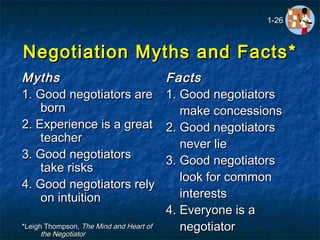
Negotiation Myths and FactsNegotiation Myths and Facts **
MythsMyths
1. Good negotiators are1. Good negotiators are
bornborn
2. Experience is a great2. Experience is a great
teacherteacher
3. Good negotiators3. Good negotiators
take riskstake risks
4. Good negotiators rely4. Good negotiators rely
on intuitionon intuition
**Leigh Thompson,Leigh Thompson, The Mind and Heart ofThe Mind and Heart of
the Negotiatorthe Negotiator
FactsFacts
1. Good negotiators1. Good negotiators
make concessionsmake concessions
2. Good negotiators2. Good negotiators
never lienever lie
3. Good negotiators3. Good negotiators
look for commonlook for common
interestsinterests
4. Everyone is a4. Everyone is a
negotiatornegotiator
1-26

An Introduction to Negotiation

  • 1.
  • 2.
    Negotiation….Negotiation….  A meansof resolving conflicts for centuriesA means of resolving conflicts for centuries  An alternative to fighting, warAn alternative to fighting, war  Agreements can be made permanentAgreements can be made permanent through rules and lawsthrough rules and laws  Today a common means of resolvingToday a common means of resolving family, work, and societal disputesfamily, work, and societal disputes Yet, many people avoid, even fearYet, many people avoid, even fear negotiation. Why?negotiation. Why? 1-2
  • 3.
    How Important aSkill IsHow Important a Skill Is Negotiation?Negotiation? ““Negotiation is the pre-eminent form ofNegotiation is the pre-eminent form of decision making in personal anddecision making in personal and professional life”professional life” -William Ury-William Ury Getting Past NoGetting Past No 1-3
  • 4.
    Five Negotiation SkillsFiveNegotiation Skills  Skill 1.1: Recognize theSkill 1.1: Recognize the five essential elements in a negotiationin a negotiation  Skill 1.2: ModelSkill 1.2: Model bargaining behaviors usedused by skilled negotiatorsby skilled negotiators  Skill 1.3: RecognizeSkill 1.3: Recognize bargaining styles  Skill 1.4: SetSkill 1.4: Set collaborative goals  Skill 1.5:Skill 1.5: AvoidAvoid cognitive biases 1-4
  • 5.
    Three Basic TypesofThree Basic Types of NegotiationNegotiation 1.1. Deal making:: purchase of a new home orpurchase of a new home or carcar 2.2. Decision making:: parties in a zoning caseparties in a zoning case 3.3. Dispute resolution:: litigation over propertylitigation over property rightsrights While the three have subtle differences, allWhile the three have subtle differences, all are forms of negotiationare forms of negotiation 1-5
  • 6.
    Chapter Case: ZoningChangeChapter Case: Zoning Change  Sophia is seeking a zoning changeSophia is seeking a zoning change  Robert, an inexperienced attorney, is hiredRobert, an inexperienced attorney, is hired by Sophia to represent her before theby Sophia to represent her before the Zoning CommissionZoning Commission  Neighborhood residents oppose Sophia’sNeighborhood residents oppose Sophia’s proposed new condo developmentproposed new condo development  The Zoning Commission staff suggest aThe Zoning Commission staff suggest a meeting of all parties to negotiate theirmeeting of all parties to negotiate their differencesdifferences 1-6
  • 7.
    The Five ElementsCommonThe Five Elements Common to Negotiation Situationsto Negotiation Situations 1.1. Two or more parties (or interests)Two or more parties (or interests) 2. Interdependence2. Interdependence 3. Common goals3. Common goals 4. Flexibility4. Flexibility 5. Decision-making ability5. Decision-making ability 1-7
  • 8.
    Parties and TheirInterestsParties and Their Interests  Parties can view a conflict situation differentlyParties can view a conflict situation differently  That view, or frame, leads them to focus onThat view, or frame, leads them to focus on some characteristics of the conflict and ignoresome characteristics of the conflict and ignore othersothers  Relationship/task frame: Parties focus on eitherRelationship/task frame: Parties focus on either ongoing relationship or the subject matter of theongoing relationship or the subject matter of the disputedispute  Emotional/intellectual frame:Emotional/intellectual frame: PartiesParties paypay attention to the emotional components of theattention to the emotional components of the dispute or behaviors of the partiesdispute or behaviors of the parties  Cooperate/win frame: Parties seeks to benefitCooperate/win frame: Parties seeks to benefit both parties or to maximize personal gainboth parties or to maximize personal gain 1-8
  • 9.
    Developing Negotiating SkillsDevelopingNegotiating Skills  Negotiations are rarely pure win-lose orNegotiations are rarely pure win-lose or win-win propositionswin-win propositions  Negotiations take place under conditionsNegotiations take place under conditions of ambiguity and uncertaintyof ambiguity and uncertainty  Most negotiations involve existing orMost negotiations involve existing or potential sources of conflict that impedepotential sources of conflict that impede reaching agreementreaching agreement 1-9
  • 10.
    Developing Negotiating SkillsDevelopingNegotiating Skills  Negotiating progress comes in stops andNegotiating progress comes in stops and starts. Most complex negotiations takestarts. Most complex negotiations take place between agents of groups and notplace between agents of groups and not the groups themselvesthe groups themselves  Complex negotiations often involve a teamComplex negotiations often involve a team approachapproach  Negotiating skills can be learnedNegotiating skills can be learned 1-10
  • 11.
    Developing Negotiating SkillsDevelopingNegotiating Skills  Negotiations are chaotic and seldom passNegotiations are chaotic and seldom pass sequentially through distinct phases suchsequentially through distinct phases such as pre-negotiation, deal structuring,as pre-negotiation, deal structuring, detailed bargaining, and agreementdetailed bargaining, and agreement  Negotiations involving multiple parties andNegotiations involving multiple parties and complex issues challenge a negotiatorcomplex issues challenge a negotiator  Most negotiations are linked to otherMost negotiations are linked to other negotiationsnegotiations 1-11
  • 12.
    Bargaining Styles: DualBargainingStyles: Dual Concern ModelConcern Model (assertiveness/cooperation)(assertiveness/cooperation) Five bargaining stylesFive bargaining styles 1. Avoiding1. Avoiding 2. Accommodative2. Accommodative 3. Collaborative3. Collaborative 4. Competing4. Competing 5. Compromising5. Compromising 1-12
  • 13.
  • 14.
    Big Five Personality Dimensions DIMENSIONASSOCIATIONS OPPOSING Neuroticism Anxious, depressed, worried, insecure Emotionally healthy, calm, free from persistent negative feelings Extraversion Sociable, assertive, talkative, active Introversion, quiet, low-key, deliberate Openness Imaginative, curious, original, open-minded Conventional, narrow interests, straightforward, conservative Agreeableness Courteous, flexible, trusting, cooperative, tolerant Suspicious, unfriendly, uncooperative, critical, disciplined Conscientiousness Careful, responsible, organized, persistent Unreliable, lack of ambition, easily distracted 1-14
  • 15.
    Attributes of BargainingStyles Conflict style Strong predisposition As a positive attribute As a negative attribute Weak predisposition As a strategy Avoiding Defers confrontational negotiation Displays tact and diplomacy Causes stalemates Prefers hard-nosed bargaining When not interested in negotiating Accommodating Derives satisfaction from solving problems Good team builder May make unwise concessions Has little patience for other party’s needs When hostilities need to be lessened Competing Views negotiation as a game or sport to win Excellent instincts for claiming value Focus on issues that are easy to define win-loss Believes in treating people fair and avoiding needless conflict When substantive interests are important but not the relationship Collaboration Enjoys participating in joint problem solving Instinctively tries to discover and satisfy the real interests of the parties May transform a simple problem into a complex one No patience for the give and take that comes with collaborative thinking Used when relationship and the substantive outcomes are important Compromising Eager to conclude negotiation on fair standards Best when stakes are small and time is short Can rush the process and agree to unnecessary concessions Refuses to compromise on principle Used when stakes are small, time is short, or in a weak bargaining position
  • 16.
    SKILLED NEGOTIATORS AVERAGENEGOTIATORS Considered a wide range ofConsidered a wide range of outcomes or optionsoutcomes or options Considered a narrow range ofConsidered a narrow range of outcomes or optionsoutcomes or options Gave over three times as muchGave over three times as much attention to common groundattention to common ground areasareas Considered a third less commonConsidered a third less common ground areasground areas Anticipated twice as many long-Anticipated twice as many long- term common areasterm common areas Anticipated half as many long-Anticipated half as many long- term areasterm areas Developed upper and lower limitsDeveloped upper and lower limits for possible settlement pointsfor possible settlement points Planned goals around fixedPlanned goals around fixed settlement pointssettlement points Flexible on the order of issues toFlexible on the order of issues to discussdiscuss Addressed issues in aAddressed issues in a predetermined orderpredetermined order Used neutral phrases whenUsed neutral phrases when proposing offersproposing offers Used judgmental phrases whenUsed judgmental phrases when proposing offersproposing offers
  • 17.
    Tactics for Success:Find CommonTactics for Success: Find Common Interests by Asking the RightInterests by Asking the Right Questions!Questions!  Open-ended:Open-ended: “What were you hoping to settle“What were you hoping to settle today?”today?”  Leading:Leading: “Don’t you think this proposal meets“Don’t you think this proposal meets one of your goals?”one of your goals?”  Clarifying:Clarifying: “Can you postpone collecting that fee“Can you postpone collecting that fee untiluntil next year?”next year?”  Gauging:Gauging: “How important to you is the 24-hour“How important to you is the 24-hour service guarantee?”service guarantee?”  Seek agreement:Seek agreement: “If we agree to your delivery“If we agree to your delivery terms do we have a deal?”terms do we have a deal?” 1-17
  • 18.
    Interdependency  Without interdependencyno reason to negotiate, no motivation to reach agreement  Degrees of interdependency include: one- shot negotiation, repeat transactions, or long-term relationship 1-18
  • 19.
    Common GoalsCommon Goals Thetwo most important types of goalsThe two most important types of goals 1.1. ContentContent:: the substance or specificsthe substance or specifics 2.2. RelationshipRelationship:: how the parties want to behow the parties want to be viewed by each otherviewed by each other 1-19
  • 20.
    Other Types ofGoalsOther Types of Goals ProspectiveProspective:: initial objectiveinitial objective TransactionalTransactional:: objectives that arise duringobjectives that arise during negotiationsnegotiations RetrospectiveRetrospective:: objectives that arise afterobjectives that arise after negotiations are completenegotiations are complete CollaborativeCollaborative: mutual objectives: mutual objectives 1-20
  • 21.
    FlexibilityFlexibility  A powershift can quickly occur in a negotiation situation. A negotiator must be able to respond in a strategic way. 1-21
  • 22.
    Decision-Making Ability  Negotiationinvolves at least two peopleNegotiation involves at least two people making decisions that require judgmentsmaking decisions that require judgments and choicesand choices  JudgmentJudgment involves recognizing andinvolves recognizing and evaluating the content of the optionsevaluating the content of the options presentedpresented  ChoiceChoice involves actually selecting aninvolves actually selecting an optionoption 1-22
  • 23.
    Decision-Making Ability  Partiesoften differ in how they think orParties often differ in how they think or process informationprocess information  People developPeople develop schemaschema as a way ofas a way of organizing current knowledge and as aorganizing current knowledge and as a way to process future informationway to process future information  Some schemas create biasesSome schemas create biases 1-23
  • 24.
    Biases That MayAffect aBiases That May Affect a NegotiatorNegotiator  Availability biasAvailability bias: An outcome probability is: An outcome probability is based on how easy it is to imaginebased on how easy it is to imagine  Representativeness biasRepresentativeness bias:: StereotypingStereotyping  Self-serving biasSelf-serving bias: Belief that an option is true: Belief that an option is true because it benefits thembecause it benefits them  Self-enhancement biasSelf-enhancement bias:: Belief that one’s ownBelief that one’s own behavior is more constructivebehavior is more constructive  Impact biasImpact bias: One overestimates the: One overestimates the positive/negative satisfaction of an outcomepositive/negative satisfaction of an outcome 1-24
  • 25.
    Multiparty NegotiationsMultiparty Negotiations (threeor more parties or interests)(three or more parties or interests) Usually present significantly different challengesUsually present significantly different challenges and negotiation techniques:and negotiation techniques: 11.. CoalitionsCoalitions form to control the outcomeform to control the outcome 22.. Trade-offsTrade-offs can occur with one or morecan occur with one or more 33.. Majority ruleMajority rule may ignore interests of minoritymay ignore interests of minority partiesparties 44.. ConsensusConsensus does not mean all parties agree ondoes not mean all parties agree on all issues, but on the wholeall issues, but on the whole 55.. CommunicationCommunication is more difficult due to theis more difficult due to the number of people and messages requirednumber of people and messages required 1-25
  • 26.
    Negotiation Myths andFactsNegotiation Myths and Facts ** MythsMyths 1. Good negotiators are1. Good negotiators are bornborn 2. Experience is a great2. Experience is a great teacherteacher 3. Good negotiators3. Good negotiators take riskstake risks 4. Good negotiators rely4. Good negotiators rely on intuitionon intuition **Leigh Thompson,Leigh Thompson, The Mind and Heart ofThe Mind and Heart of the Negotiatorthe Negotiator FactsFacts 1. Good negotiators1. Good negotiators make concessionsmake concessions 2. Good negotiators2. Good negotiators never lienever lie 3. Good negotiators3. Good negotiators look for commonlook for common interestsinterests 4. Everyone is a4. Everyone is a negotiatornegotiator 1-26