NEGOTIATION
SEVENTH EDITION
• ROY J. LEWICKI
• DAVID M. SAUNDERS
• BRUCE BARRY
Copyright © 2015 McGraw-Hill Education. All rights reserved.
No reproduction or
distribution without the prior written consent of McGraw-Hill
Education.
2-1
Chapter 2
STRATEGY AND TACTICS OF
DISTRIBUTIVE BARGAINING
1-1 Copyright © 2015 McGraw-Hill Education. All rights
reserved. No reproduction or
distribution without the prior written consent of McGraw-Hill
Education.
2-2
THREE REASONS NEGOTIATORS SHOULD BE
FAMILIAR WITH DISTRIBUTIVE BARGAINING
1. Independent situations require knowing how
this works in order to do well
2. Need to know how to counter the effects of
the strategies
3. Every situation has the potential to require
skills at the “claiming-value” stage
Copyright © 2015 McGraw-Hill Education. All rights reserved.
No reproduction or
distribution without the prior written consent of McGraw-Hill
Education.
2-3
THE DISTRIBUTIVE BARGAINING SITUATION
• Goals of one party are in fundamental, direct
conflict to another party
• Resources are fixed and limited
• Maximizing one’s own share of resources is the
goal for both parties
Copyright © 2015 McGraw-Hill Education. All rights reserved.
No reproduction or
distribution without the prior written consent of McGraw-Hill
Education.
2-4
THE DISTRIBUTIVE BARGAINING SITUATION
Preparation—set a
• Target point, aspiration point
• Walkaway, resistance point
• Asking price, initial offer
Copyright © 2015 McGraw-Hill Education. All rights reserved.
No reproduction or
distribution without the prior written consent of McGraw-Hill
Education.
2-5
THE DISTRIBUTIVE BARGAINING SITUATION
Party B - Buyer
Party A - Seller
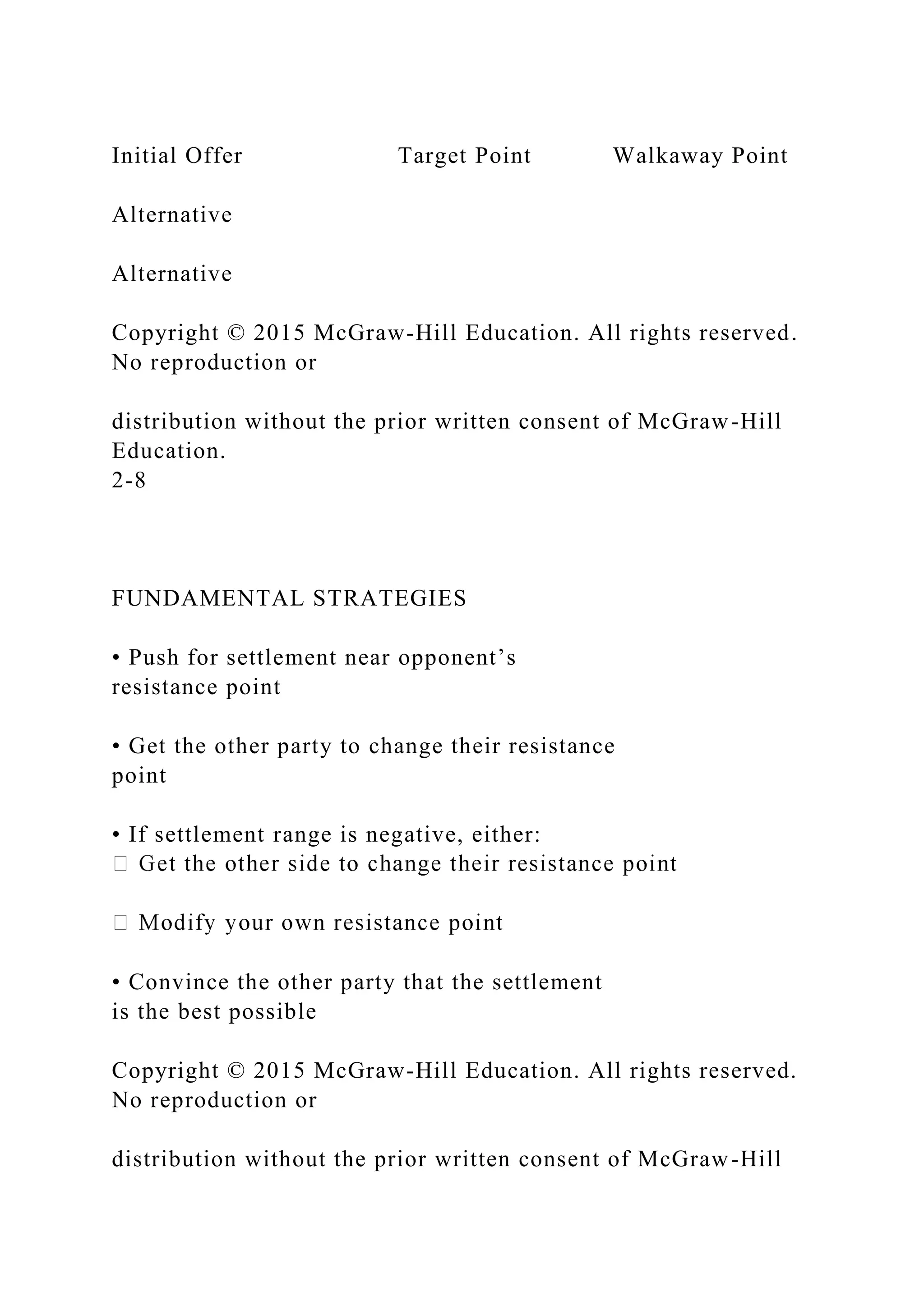
Walkaway Point Target Point Asking Price
Initial Offer Target Point Walkaway Point
Copyright © 2015 McGraw-Hill Education. All rights reserved.
No reproduction or
distribution without the prior written consent of McGraw-Hill
Education.
2-6
THE ROLE OF ALTERNATIVES TO A
NEGOTIATED AGREEMENT
• Alternatives give the negotiator power to walk
away from the negotiation
Copyright © 2015 McGraw-Hill Education. All rights reserved.
No reproduction or
distribution without the prior written consent of McGraw-Hill
Education.
2-7
THE DISTRIBUTIVE BARGAINING SITUATION
Party B - Buyer
Party A - Seller
Walkaway Point Target Point Asking Price
Initial Offer Target Point Walkaway Point
Alternative
Alternative
Copyright © 2015 McGraw-Hill Education. All rights reserved.
No reproduction or
distribution without the prior written consent of McGraw-Hill
Education.
2-8
FUNDAMENTAL STRATEGIES
• Push for settlement near opponent’s
resistance point
• Get the other party to change their resistance
point
• If settlement range is negative, either:
• Convince the other party that the settlement
is the best possible
Copyright © 2015 McGraw-Hill Education. All rights reserved.
No reproduction or
distribution without the prior written consent of McGraw-Hill
Education.
2-9
KEYS TO THE STRATEGIES
The keys to implementing any of the four
strategies are:
• Discovering the other party’s resistance point
• Influencing the other party’s resistance point
Copyright © 2015 McGraw-Hill Education. All rights reserved.
No reproduction or
distribution without the prior written consent of McGraw-Hill
Education.
2-10
FOUR PROPOSITIONS THAT SUGGEST
HOW THE KEYS AFFECT THE PROCESS
1. The higher the other party’s estimate of your
cost of delay or impasse, the stronger the other
party’s resistance point will be.
2. The higher the other party’s estimate of his or
her own cost of delay or impasse, the weaker
the other party’s resistance point will be.
Copyright © 2015 McGraw-Hill Education. All rights reserved.
No reproduction or
distribution without the prior written consent of McGraw-Hill
Education.
2-11
FOUR PROPOSITIONS THAT SUGGEST
HOW THE KEYS AFFECT THE PROCESS
3. The less the other party values an issue, the
lower their resistance point will be.
4. The more the other party believes that you
value an issue, the lower their resistance point
may be.
Copyright © 2015 McGraw-Hill Education. All rights reserved.
No reproduction or
distribution without the prior written consent of McGraw-Hill
Education.
2-12
TACTICAL TASKS OF NEGOTIATORS
• Assess outcome values and the costs of
termination for the other party
• Manage the other party’s impressions
• Modify the other party’s perceptions
• Manipulate the actual costs of delay or
termination
Copyright © 2015 McGraw-Hill Education. All rights reserved.
No reproduction or
distribution without the prior written consent of McGraw-Hill
Education.
2-13
ASSESS THE OTHER PARTY’S TARGET,
RESISTANCE POINT, AND COSTS OF
TERMINATING NEGOTIATIONS
• Indirectly
• Directly
Copyright © 2015 McGraw-Hill Education. All rights reserved.
No reproduction or
distribution without the prior written consent of McGraw-Hill
Education.
2-14
MANAGE THE OTHER PARTY’S IMPRESSIONS
• Screen your behavior:
• Direct action to alter impressions
Present facts that enhance one’s position
Copyright © 2015 McGraw-Hill Education. All rights reserved.
No reproduction or
distribution without the prior written consent of McGraw-Hill
Education.
2-15
MODIFY THE OTHER PARTY’S PERCEPTIONS
• Make outcomes appear less attractive
• Make the cost of obtaining goals appear higher
• Make demands and positions appear more or
less attractive to the other party – whichever
suits your needs
Copyright © 2015 McGraw-Hill Education. All rights reserved.
No reproduction or
distribution without the prior written consent of McGraw-Hill
Education.
2-16
MANIPULATE THE ACTUAL COSTS OF
DELAY OR TERMINATION
• Plan disruptive action
• Form an alliance with outsiders
influence the outcome in your favor
• Schedule manipulations
the other
Copyright © 2015 McGraw-Hill Education. All rights reserved.
No reproduction or
distribution without the prior written consent of McGraw-Hill
Education.
2-17
POSITIONS TAKEN
DURING NEGOTIATIONS
• Opening offer
• Opening stance
• Initial concessions
Copyright © 2015 McGraw-Hill Education. All rights reserved.
No reproduction or
distribution without the prior written consent of McGraw-Hill
Education.
2-18
POSITIONS TAKEN
DURING NEGOTIATIONS
• The role of concessions
• Patterns of concession making
• Final offers (making a commitment)
Copyright © 2015 McGraw-Hill Education. All rights reserved.
No reproduction or
distribution without the prior written consent of McGraw-Hill
Education.
2-19
COMMITMENTS:
TACTICAL CONSIDERATIONS
• Establishing a commitment
ences
• Preventing the other party from committing
prematurely
Copyright © 2015 McGraw-Hill Education. All rights reserved.
No reproduction or
distribution without the prior written consent of McGraw-Hill
Education.
2-20
WAYS TO CREATE A COMMITMENT
• Public pronouncement
• Linking with an outside base
• Increase the prominence of demands
• Reinforce the threat or promise
Copyright © 2015 McGraw-Hill Education. All rights reserved.
No reproduction or
distribution without the prior written consent of McGraw-Hill
Education.
2-21
COMMITMENTS:
TACTICAL CONSIDERATIONS
• Ways to abandon a committed position
imize the damage to the relationship if the other
backs off
Copyright © 2015 McGraw-Hill Education. All rights reserved.
No reproduction or
distribution without the prior written consent of McGraw-Hill
Education.
2-22
CLOSING THE DEAL
• Provide alternatives (2 or 3 packages)
• Assume the close
• Split the difference
• Exploding offers
• Deal sweeteners
Copyright © 2015 McGraw-Hill Education. All rights reserved.
No reproduction or
distribution without the prior written consent of McGraw-Hill
Education.
2-23
DEALING WITH TYPICAL
HARDBALL TACTICS
• Four main options:
-opt the other party (befriend them)
Copyright © 2015 McGraw-Hill Education. All rights reserved.
No reproduction or
distribution without the prior written consent of McGraw-Hill
Education.
2-24
TYPICAL HARDBALL TACTICS
• Good Cop/Bad Cop
• Lowball/Highball
• Bogey (playing up an issue of little importance)
• The Nibble (asking for a number of small
concessions to)
Copyright © 2015 McGraw-Hill Education. All rights reserved.
No reproduction or
distribution without the prior written consent of McGraw-Hill
Education.
2-25
TYPICAL HARDBALL TACTICS
• Chicken
• Intimidation
• Aggressive Behavior
• Snow Job (overwhelm the other party with
information)
Copyright © 2015 McGraw-Hill Education. All rights reserved.
No reproduction or
distribution without the prior written consent of McGraw-Hill
Education.
2-26
SUMMARY
Negotiators need to:
• Set a clear target and resistance points
• Understand and work to improve their BATNA
• Start with good opening offer
• Make appropriate concessions
• Manage the commitment process
Copyright © 2015 McGraw-Hill Education. All rights reserved.
No reproduction or
distribution without the prior written consent of McGraw-Hill
Education.
2-27
NEGOTIATION
SEVENTH EDITION
• ROY J. LEWICKI
• DAVID M. SAUNDERS
• BRUCE BARRY
Copyright © 2015 McGraw-Hill Education. All rights reserved.
No reproduction or
distribution without the prior written consent of McGraw-Hill
Education. 1‐1
NEGOTIATION 7e
Lewicki ▪ Saunders ▪ Barry
Chapter 1
THE NATURE OF NEGOTIATION
1‐2
Copyright © 2015 McGraw-Hill Education. All rights reserved.
No reproduction or distribution without the prior written
consent of McGraw-
Hill Education.
INTRODUCTION
Negotiation is something
that everyone does, almost
daily
1-3Copyright © 2015 McGraw-Hill Education. All rights
reserved. No reproduction or distribution without the prior
written consent of McGraw-Hill Education.
NEGOTIATIONS
Negotiations occur for several reasons:
• To agree on how to share or divide a limited
resource
• To create something new that neither party could
attain on his or her own
• To resolve a problem or dispute between the
parties
1-4Copyright © 2015 McGraw-Hill Education. All rights
reserved. No reproduction or distribution without the prior
written consent of McGraw-Hill Education.
APPROACH TO THE SUBJECT
Most people think bargaining and negotiation
mean the same thing; however, we will be
distinctive about the way we use these two
words:
• Bargaining: describes the competitive, win‐lose
situation
• Negotiation: refers to win‐win situations such
as those that occur when parties try to find a
mutually acceptable solution to a complex
conflict
1-5Copyright © 2015 McGraw-Hill Education. All rights
reserved. No reproduction or distribution without the prior
written consent of McGraw-Hill Education.
THREE IMPORTANT THEMES
1. The definition of negotiation and the basic
characteristics of negotiation situations
2. Interdependence, the relationship between
people and groups that most often leads them
to negotiate
3. Understanding the dynamics of conflict and
conflict management processes which serve as
a backdrop for different ways that people
approach and manage negotiations
1-6Copyright © 2015 McGraw-Hill Education. All rights
reserved. No reproduction or distribution without the prior
written consent of McGraw-Hill Education.
CHARACTERISTICS OF A
NEGOTIATION SITUATION
• There are two or more parties
• There is a conflict of needs and desires between
two or more parties
• Parties negotiate because they think they can get a
better deal than by simply accepting what the
other side offers them
• Parties expect a “give‐and‐take” process
1-7Copyright © 2015 McGraw-Hill Education. All rights
reserved. No reproduction or distribution without the prior
written consent of McGraw-Hill Education.
CHARACTERISTICS OF A
NEGOTIATION SITUATION
• Parties search for agreement rather than:
openly
off contact permanently
their dispute to a third party
• Successful negotiation involves:
of tangibles (e.g., the price or the terms
of agreement)
tion of intangibles (the underlying
psychological motivations) such as winning, losing,
saving face 1-8Copyright © 2015 McGraw-Hill Education. All
rights reserved. No reproduction or distribution without the
prior written consent of McGraw-Hill Education.
INTERDEPENDENCE
In negotiation, parties need each other to achieve
their preferred outcomes or objectives.
• This mutual dependency is called
interdependence
• Interdependent goals are an important aspect of
negotiation
I win, you lose
Opportunities for both parties to gain
1-9Copyright © 2015 McGraw-Hill Education. All rights
reserved. No reproduction or distribution without the prior
written consent of McGraw-Hill Education.
INTERDEPENDENCE
• Interdependent parties are characterized by
interlocking goals
• Having interdependent goals does not mean that
everyone wants or needs exactly the same thing
• A mix of convergent and conflicting goals
characterizes many interdependent relationships
1-10Copyright © 2015 McGraw-Hill Education. All rights
reserved. No reproduction or distribution without the prior
written consent of McGraw-Hill Education.
TYPES OF INTERDEPENDENCE
AFFECT OUTCOMES
• Interdependence and the structure of the
situation shape processes and outcomes
or distributive – one winner
or integrative – mutual gains situation
1-11Copyright © 2015 McGraw-Hill Education. All rights
reserved. No reproduction or distribution without the prior
written consent of McGraw-Hill Education.
ALTERNATIVES SHAPE INTERDEPENDENCE
• Evaluating interdependence depends heavily on
the alternatives to working together
• The desirability to work together is better for
outcomes
• Best available alternative: BATNA (acronym for
Best Alternative to a Negotiated Agreement)
1-12Copyright © 2015 McGraw-Hill Education. All rights
reserved. No reproduction or distribution without the prior
written consent of McGraw-Hill Education.
MUTUAL ADJUSTMENT
• Continues throughout the negotiation as both
parties act to influence the other
• One of the key causes of the changes that occur
during a negotiation
• The effective negotiator needs to understand
how people will adjust and readjust and how the
negotiations might twist and turn, based on
one’s own moves and the other’s responses
1-13Copyright © 2015 McGraw-Hill Education. All rights
reserved. No reproduction or distribution without the prior
written consent of McGraw-Hill Education.
MUTUAL ADJUSTMENT AND
CONCESSION MAKING
• When one party agrees to make a change in
his/her position, a concession has been made
• Concessions restrict the range of options
• When a concession is made, the bargaining
range is further constrained
1-14Copyright © 2015 McGraw-Hill Education. All rights
reserved. No reproduction or distribution without the prior
written consent of McGraw-Hill Education.
TWO DILEMMAS IN
MUTUAL ADJUSTMENT
• Dilemma of honesty
about how much of the truth to tell the other
party
• Dilemma of trust
about how much should negotiators believe
what the other party tells them
1-15Copyright © 2015 McGraw-Hill Education. All rights
reserved. No reproduction or distribution without the prior
written consent of McGraw-Hill Education.
VALUE CLAIMING AND VALUE CREATION
• Opportunities to “win” or share resources
value: result of zero‐sum or distributive
situations where the object is to gain largest piece of
resource
value: result of non‐zero‐sum or integrative
situation where the object is to have both parties do
well
1-16Copyright © 2015 McGraw-Hill Education. All rights
reserved. No reproduction or distribution without the prior
written consent of McGraw-Hill Education.
VALUE CLAIMING AND VALUE CREATION
• Most actual negotiations are a combination of
claiming and creating value processes
must be able to recognize situations that
require more of one approach than the other
must be versatile in their comfort and use
of both major strategic approaches
Negotiator perceptions of situations tend to be biased
toward seeing problems as more
distributive/competitive than they really are
1-17Copyright © 2015 McGraw-Hill Education. All rights
reserved. No reproduction or distribution without the prior
written consent of McGraw-Hill Education.
VALUE CLAIMING AND VALUE CREATION
Value differences that exist between negotiators
include:
• Differences in interest
• Differences in judgments about the future
• Differences in risk tolerance
• Differences in time preferences
1-18Copyright © 2015 McGraw-Hill Education. All rights
reserved. No reproduction or distribution without the prior
written consent of McGraw-Hill Education.
CONFLICT
Conflict may be defined as a:
"sharp disagreement or opposition" and includes
"the perceived divergence of interest, or a belief
that the parties' current aspirations cannot be
achieved simultaneously"
1-19Copyright © 2015 McGraw-Hill Education. All rights
reserved. No reproduction or distribution without the prior
written consent of McGraw-Hill Education.
LEVELS OF CONFLICT
• Intrapersonal or intrapsychic conflict
that occurs within an individual
want an ice cream cone badly, but we know that ice cream
is very fattening
• Interpersonal conflict
onflict is between individuals
between bosses and subordinates, spouses, siblings,
roommates, etc.
1-20Copyright © 2015 McGraw-Hill Education. All rights
reserved. No reproduction or distribution without the prior
written consent of McGraw-Hill Education.
LEVELS OF CONFLICT
• Intragroup Conflict
is within a group
team and committee members, within families, classes
etc.
• Intergroup Conflict
can occur between organizations, warring
nations, feuding families, or within splintered,
fragmented communities
negotiations are the most complex
1-21Copyright © 2015 McGraw-Hill Education. All rights
reserved. No reproduction or distribution without the prior
written consent of McGraw-Hill Education.
DYSFUNCTIONS OF CONFLICT
1. Competitive, win‐lose goals
2. Misperception and bias
3. Emotionality
4. Decreased communication
5. Blurred issues
6. Rigid commitments
7. Magnified differences, minimized similarities
8. Escalation of conflict
1-22Copyright © 2015 McGraw-Hill Education. All rights
reserved. No reproduction or distribution without the prior
written consent of McGraw-Hill Education.
FUNCTIONS OF CONFLICT
1. Makes organizational members more aware and able
to cope with problems through discussion.
2. Promises organizational change and adaptation.
3. Strengthens relationships and heightens morale.
4. Promotes awareness of self and others.
5. Enhances personal development.
6. Encourages psychological development—it helps
people become more accurate and realistic in their
self‐appraisals.
7. Can be stimulating and fun.
1-23Copyright © 2015 McGraw-Hill Education. All rights
reserved. No reproduction or distribution without the prior
written consent of McGraw-Hill Education.
THE DUAL CONCERNS MODEL
1-24Copyright © 2015 McGraw-Hill Education. All rights
reserved. No reproduction or distribution without the prior
written consent of McGraw-Hill Education.
STYLES OF CONFLICT MANAGEMENT
1. Contending
pursue own outcomes strongly, show little
concern for other party obtaining their desired outcomes
2. Yielding
show little interest in whether they attain own
outcomes, but are quite interested in whether the other
party attains their outcomes
3. Inaction
show little interest in whether they attain own
outcomes, and little concern about whether the other
party obtains their outcomes
1-25Copyright © 2015 McGraw-Hill Education. All rights
reserved. No reproduction or distribution without the prior
written consent of McGraw-Hill Education.
STYLES OF CONFLICT MANAGEMENT
4. Problem solving
show high concern in obtaining own
outcomes, as well as high concern for the other
party obtaining their outcomes
5. Compromising
show moderate concern in obtaining own
outcomes, as well as moderate concern for the
other party obtaining their outcomes
1-26Copyright © 2015 McGraw-Hill Education. All rights
reserved. No reproduction or distribution without the prior
written consent of McGraw-Hill Education.
NEGOTIATING STYLE
SELF-ASSESSMENT
The purpose of this self-assessment is to help you examine your
personal negotiating style.
Negotiation – a process by which two parties communicate with
each other in order to reach an outcome on which they mutually
agree.
Directions
1. PRINT THIS SELF-ASSESSMENT OUT!
2. Read the definition of negotiation above to make sure that
you understand it.
3. Answer all questions to the best of your ability. There are no
right or wrong answers. Don’t try to think of the “correct” or
most “desirable” response, but simply respond with your honest
reactions.
4. Respond by putting a check-mark or X in one column per
question or statement.
5. Proceed to the second page where you will find a number of
questions that ask you to consider how likely or unlikely you
are to behave in a certain way when you are negotiating.
6. On the third page you are required to rate your level of
agreement with a number of statements.
7. Proceed to the fourth page where you will find the scoring
key and interpretation guide.
How likely are you to do each of the following when
NEGOTIATING?
Very Unlikely
Unlikely
Neither Likely nor Unlikely
Likely
Very Likely
1. I’ll come up with a plan so that I can steer the negotiation to
go my way.
2. I’ll do things expressly to make sure that the negotiation
stays friendly and comfortable.
3. I’ll go out of my way to make sure that the outcome for the
other person is fair.
4. I’ll do things so that both of us can get what we want from
the negotiation.
5. If something needs to be negotiated, I’ll immediately step
forward to do it.
6. I’ll give some in order to get some from the person I’m
negotiating with.
7. If the negotiation is not going my way, I’ll bail out of the
negotiation.
8. I’ll suggest creative solutions that allow both of us to get
what we want from the negotiation.
9. If it seems important for the other person to come out on top,
I’ll give in to them.
10. I’ll avoid difficult issues to keep the negotiation from
getting nasty.
11. If the other person compromises their position, I’ll
compromise my position in return.
12. I’ll make sure that both of our needs are understood so that
both of us can come out on top.
13. I’ll present information, when negotiating, even if it doesn’t
necessarily always support my position.
14. I’ll propose a place in the middle where we both can meet.
15. I’ll try to see things from the other person’s viewpoint and
be considerate of their needs.
Rate your level of agreement with each of these statements.
Strongly Agree
Agree
Neither Agree nor Disagree
Disagree
Strongly Disagree
16. In every negotiation, both sides have to give something up
to get something in return.
17. What’s good for me is really all that matters when
negotiating.
18. I’ll do almost anything to keep from having to engage in
negotiation.
19. In negotiating, someone wins and someone has to lose.
20. The feelings of the other person that I’m negotiating with
are important to me.
21. Negotiation works better when the focus is on common
agreement rather than differences.
22. I can be aggressive when it comes to getting my way from a
negotiation.
23. When you compromise in a negotiation, you really just lose.
24. If the other person gets a “raw deal” from our negotiation,
that really doesn’t matter to me.
25. Keeping the comfort level high is very important to me
when I’m negotiating.
NEGOTIATING STYLE
SELF-ASSESSMENT – Interpretation Guide
I. Background
It is important that you, the student, review the discussion of
collective bargaining behavior in Chapter 6 of Holley, Jennings,
& Wolters, 8th edition, before continuing. Holley, Jennings, &
Wolters identify two distinct and very different approaches to
bargaining.
Distributive Bargaining approaches negotiation as a win-lose
exercise where the gains of one party must come at the expense
of the other party. The sole focus of the negotiator is to
maximize his/her own outcomes. In the negotiation literature,
this orientation is referred to as Assertiveness.
Mutual Gain Bargaining approaches negotiation as a mutual
problem-solving exercise. Relying on open communication,
trust, and mutual respect, negotiators focus on fulfilling the
mutual interests of both parties. In the negotiation literature,
this orientation is referred to as Cooperativeness.
Negotiators that exhibit Assertiveness tendencies are more
likely to engage in Distributive Bargaining behavior while
negotiators that are high in Cooperativeness are more likely to
use a Mutual Gain Bargaining approach. Thus, this self-
assessment will help you examine your levels of Assertiveness
versus Cooperativeness.
According to the negotiation literature, the measurement of
Assertiveness and Cooperativeness requires the consideration of
five distinct negotiation styles. The five negotiation styles are:
Competing - Negotiators that exhibit this style are results-
oriented, self-confident, assertive, are focused primarily on the
bottom line, have a tendency to impose their views upon the
other party, and in the extreme can become aggressive and
domineering. This style is high in Assertiveness and low in
Cooperativeness.
Avoiding - Negotiators that exhibit this style are passive, prefer
to avoid conflict, make attempts to withdraw from the situation
or pass responsibility onto another party, and fail to show
adequate concern or make an honest attempt to get to a solution.
This style is both low in Assertiveness and low in
Cooperativeness.
Collaborating - Negotiators that exhibit this style use open and
honest communication, focus on finding creative solutions that
mutually satisfy both parties, are open to exploring new and
novel solutions, and suggest many alternatives for
consideration. This style is both high in Assertiveness and high
in Cooperativeness.
Accommodating – Negotiators that exhibit this style make
attempts to maintain relationships with the other party, smooth
over conflicts, downplay differences, and are most concerned
with satisfying the needs of the other party. This style is low in
Assertiveness but high in Cooperativeness.
Compromising – Negotiators that exhibit this style aim to find
the middle ground, often split the difference between positions,
frequently engage in give and take tradeoffs, and accept
moderate satisfaction of both parties’ needs. This style is both
moderate in Assertiveness and moderate in Cooperativeness.
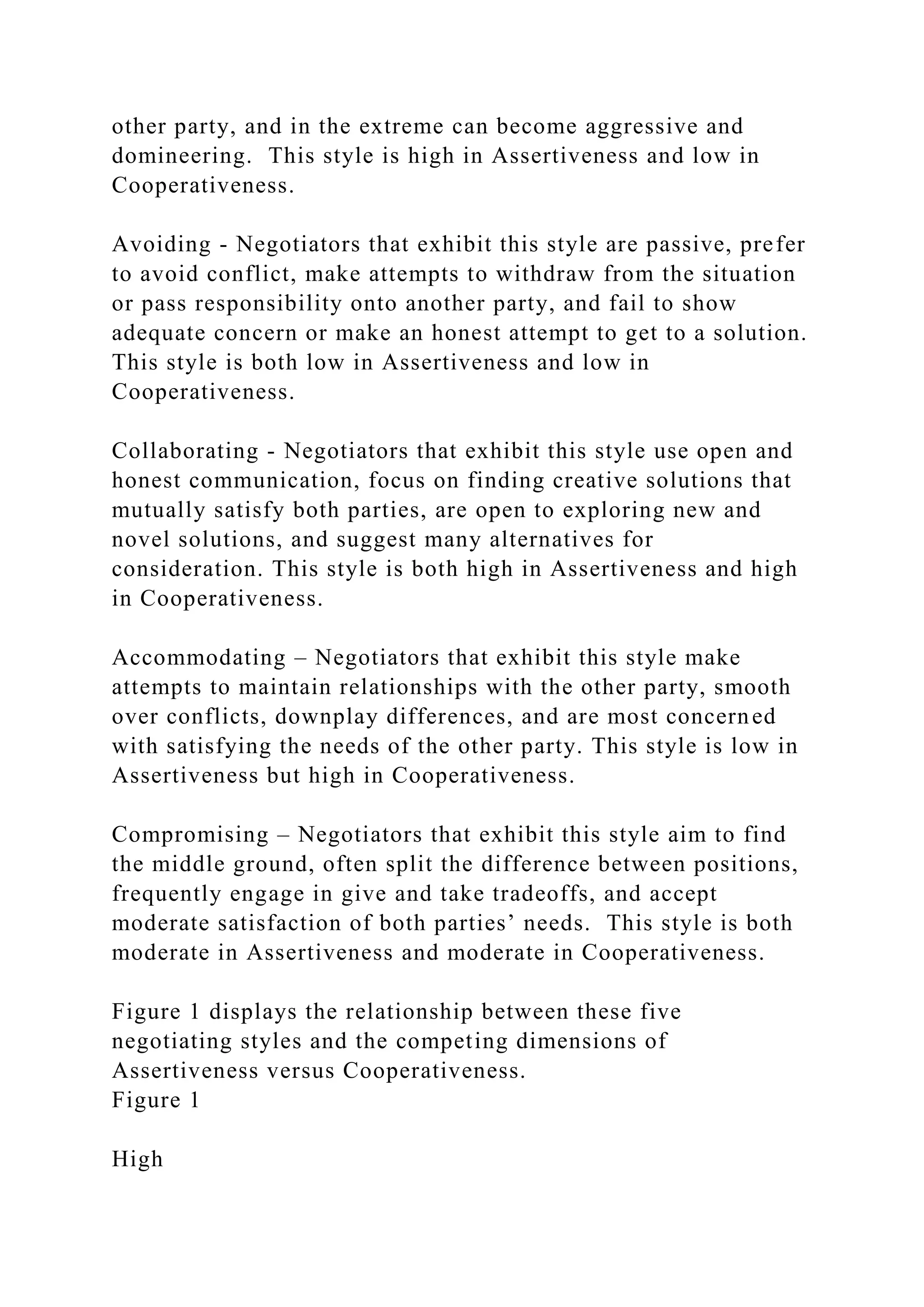
Figure 1 displays the relationship between these five
negotiating styles and the competing dimensions of
Assertiveness versus Cooperativeness.
Figure 1
High
Competing
Collaborating
Assertiveness Distributive Bargaining
Compromising
Low
Avoiding
AccommodatingLow
Cooperativeness
Mutual Gain BargainingHigh
II. Competing Style
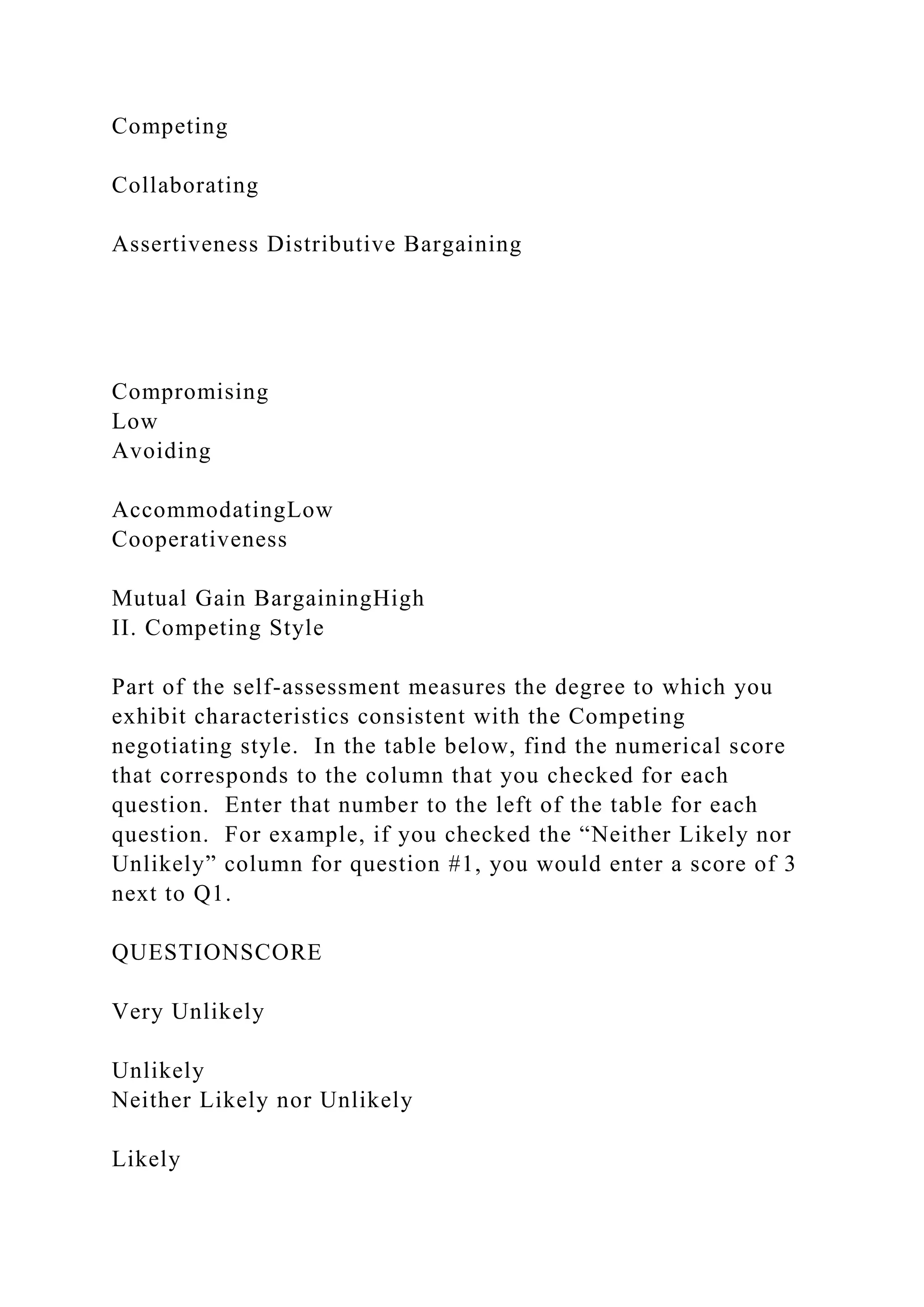
Part of the self-assessment measures the degree to which you
exhibit characteristics consistent with the Competing
negotiating style. In the table below, find the numerical score
that corresponds to the column that you checked for each
question. Enter that number to the left of the table for each
question. For example, if you checked the “Neither Likely nor
Unlikely” column for question #1, you would enter a score of 3
next to Q1.
QUESTIONSCORE
Very Unlikely
Unlikely
Neither Likely nor Unlikely
Likely
Very Likely
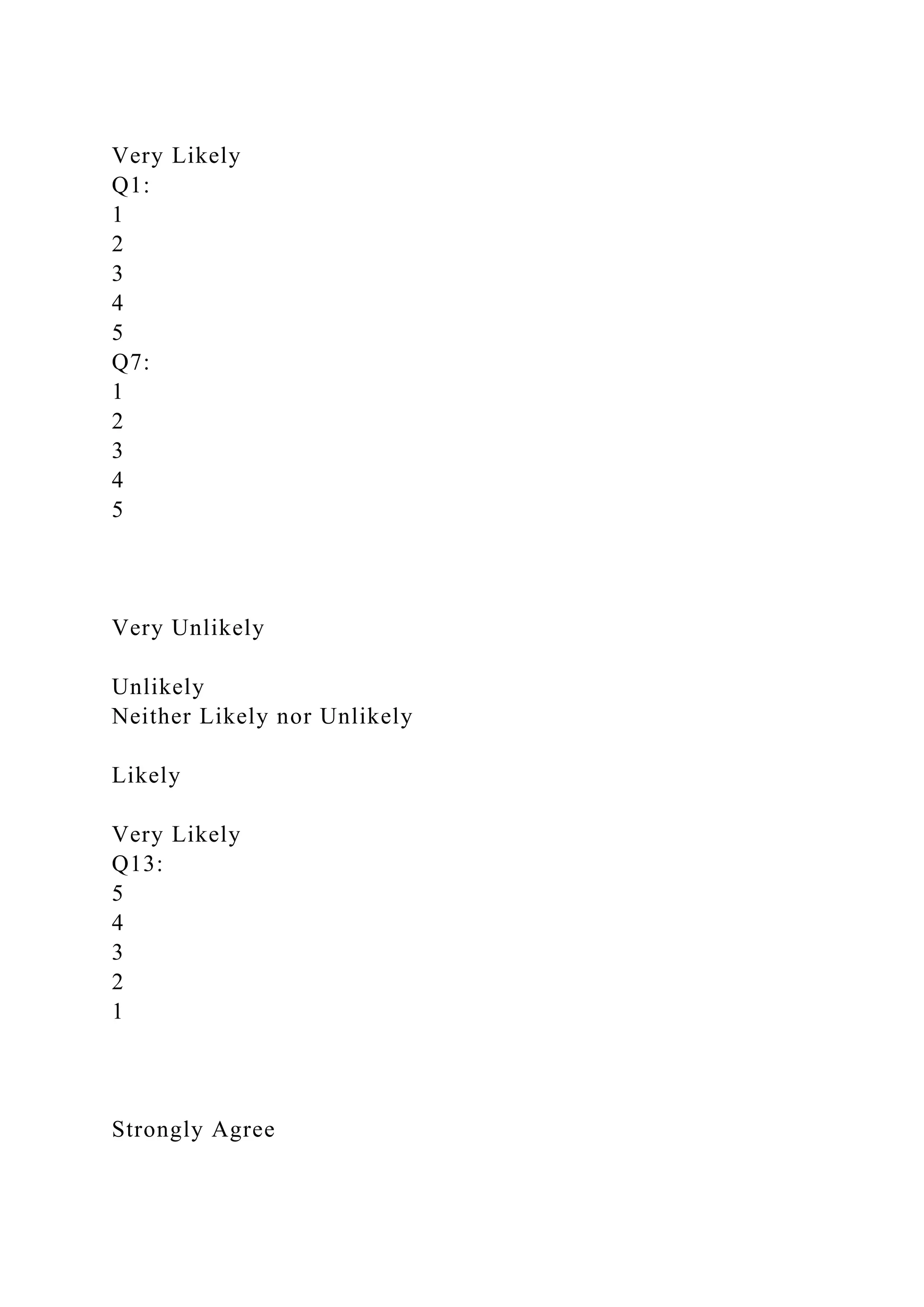
Q1:
1
2
3
4
5
Q7:
1
2
3
4
5
Very Unlikely
Unlikely
Neither Likely nor Unlikely
Likely
Very Likely
Q13:
5
4
3
2
1
Strongly Agree
Agree
Neither Agree nor Disagree
Disagree
Strongly Disagree
Q17:
5
4
3
2
1
Q22:
5
4
3
2
1
TOTAL: (Add all scores)
TOTAL SCOREINTERPRETATION
18 OR ABOVE
HIGH ON COMPETING STYLE – Compared to a national
sample of students, your score falls in the top/fourth quartile
(i.e., top 25%) of scores. This indicates that you strongly
exhibit characteristics consistent with the Competing style.
16 TO 17
MODERATE TO HIGH ON COMPETING STYLE – Compared
to a national sample of students, your score falls in the third
quartile (i.e., between 50%-75%) of scores. This indicates that
you moderately to strongly exhibit characteristics consistent
with the Competing style. The higher your score is, the more
strongly you exhibit characteristics consistent with the
Competing style.
14 TO 15
MODERATE TO LOW ON COMPETING STYLE – Compared
to a national sample of students, your score falls in the second
quartile (i.e., between 25%-50%) of scores. This indicates that
you moderately to weakly exhibit characteristics consistent with
the Competing style. The lower your score is, the more weakly
you exhibit characteristics consistent with the Competing style.
13 OR BELOW
LOW ON COMPETING STYLE – Compared to a national
sample of students, your score falls in the bottom/first quartile
(i.e., bottom 25%) of scores. This indicates that you only
weakly exhibit characteristics consistent with the Competing
style.
III. Avoiding Style
This part of the self-assessment measures the degree to which
you exhibit characteristics consistent with the Avoiding
negotiating style. In the table below, find the numerical score
that corresponds to the column that you checked for each
question. Enter that number to the left of the table for each
question. For example, if you checked the “Likely” column for
question #2, you would enter a score of 4 next to Q2.
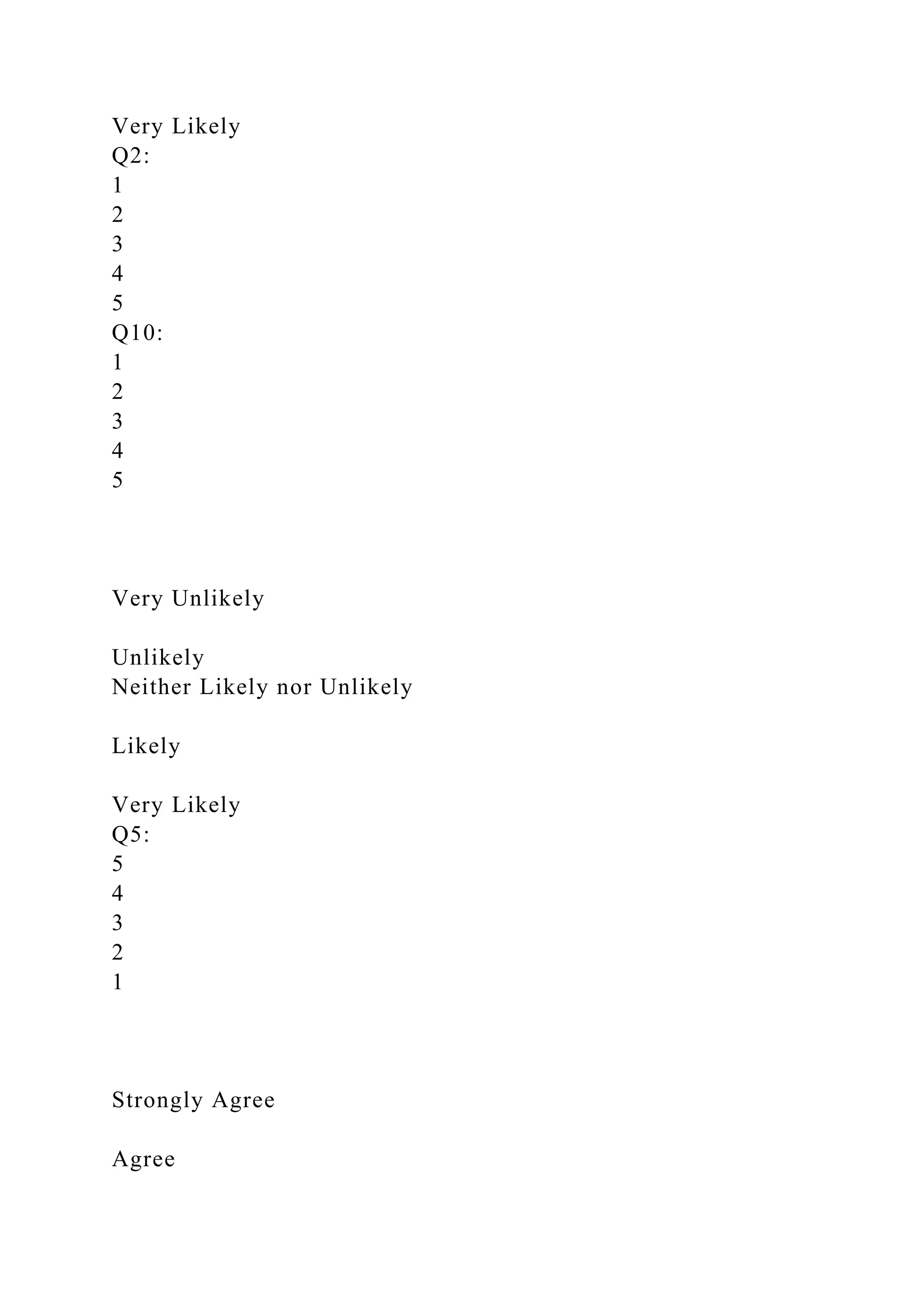
QUESTIONSCORE
Very Unlikely
Unlikely
Neither Likely nor Unlikely
Likely
Very Likely
Q2:
1
2
3
4
5
Q10:
1
2
3
4
5
Very Unlikely
Unlikely
Neither Likely nor Unlikely
Likely
Very Likely
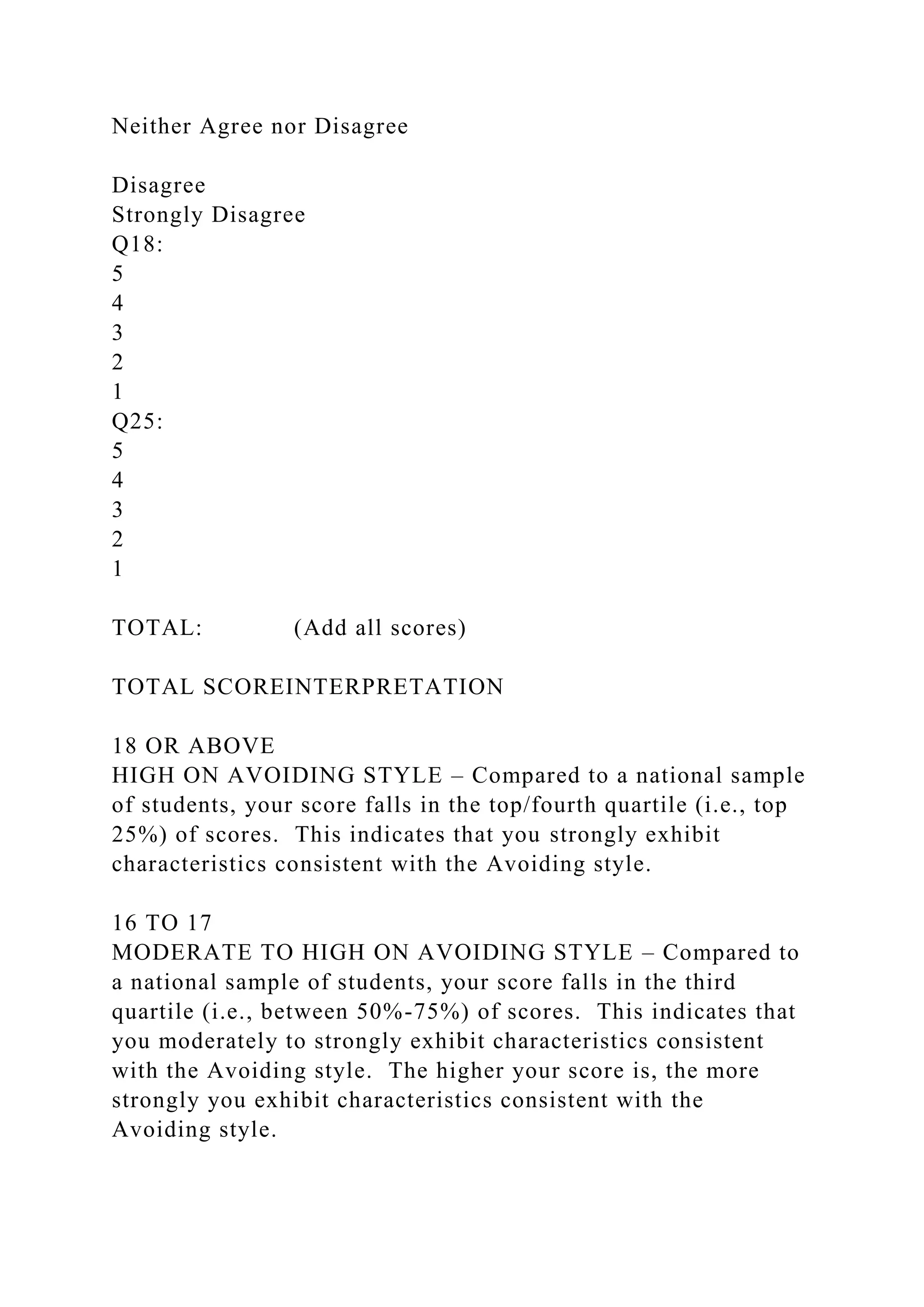
Q5:
5
4
3
2
1
Strongly Agree
Agree
Neither Agree nor Disagree
Disagree
Strongly Disagree
Q18:
5
4
3
2
1
Q25:
5
4
3
2
1
TOTAL: (Add all scores)
TOTAL SCOREINTERPRETATION
18 OR ABOVE
HIGH ON AVOIDING STYLE – Compared to a national sample
of students, your score falls in the top/fourth quartile (i.e., top
25%) of scores. This indicates that you strongly exhibit
characteristics consistent with the Avoiding style.
16 TO 17
MODERATE TO HIGH ON AVOIDING STYLE – Compared to
a national sample of students, your score falls in the third
quartile (i.e., between 50%-75%) of scores. This indicates that
you moderately to strongly exhibit characteristics consistent
with the Avoiding style. The higher your score is, the more
strongly you exhibit characteristics consistent with the
Avoiding style.
14 TO 15
MODERATE TO LOW ON AVOIDING STYLE – Compared to
a national sample of students, your score falls in the second
quartile (i.e., between 25%-50%) of scores. This indicates that
you moderately to weakly exhibit characteristics consistent with
the Avoiding style. The lower your score is, the more weakly
you exhibit characteristics consistent with the Avoiding style.
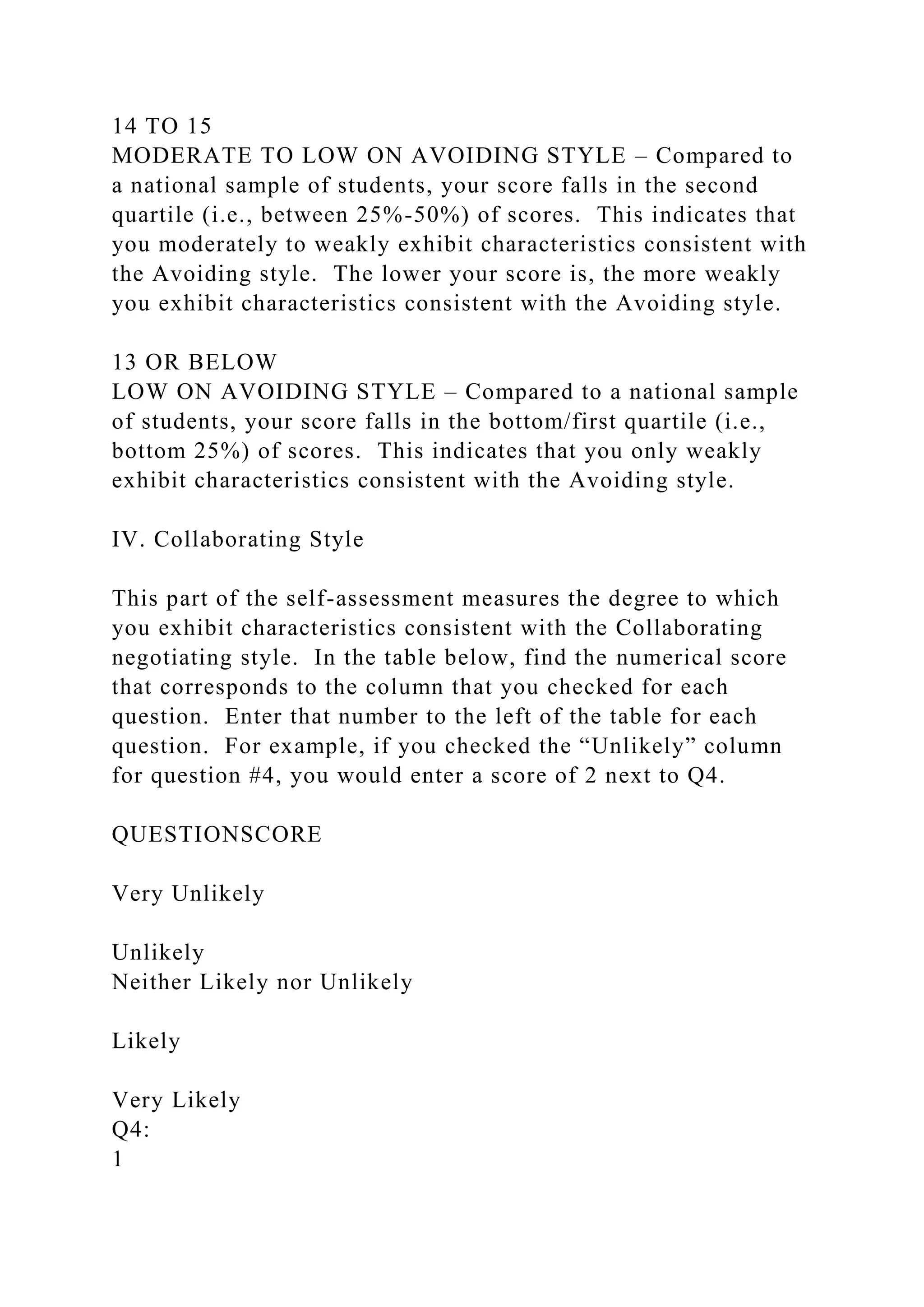
13 OR BELOW
LOW ON AVOIDING STYLE – Compared to a national sample
of students, your score falls in the bottom/first quartile (i.e.,
bottom 25%) of scores. This indicates that you only weakly
exhibit characteristics consistent with the Avoiding style.
IV. Collaborating Style
This part of the self-assessment measures the degree to which
you exhibit characteristics consistent with the Collaborating
negotiating style. In the table below, find the numerical score
that corresponds to the column that you checked for each
question. Enter that number to the left of the table for each
question. For example, if you checked the “Unlikely” column
for question #4, you would enter a score of 2 next to Q4.
QUESTIONSCORE
Very Unlikely
Unlikely
Neither Likely nor Unlikely
Likely
Very Likely
Q4:
1
2
3
4
5
Q8:
1
2
3
4
5
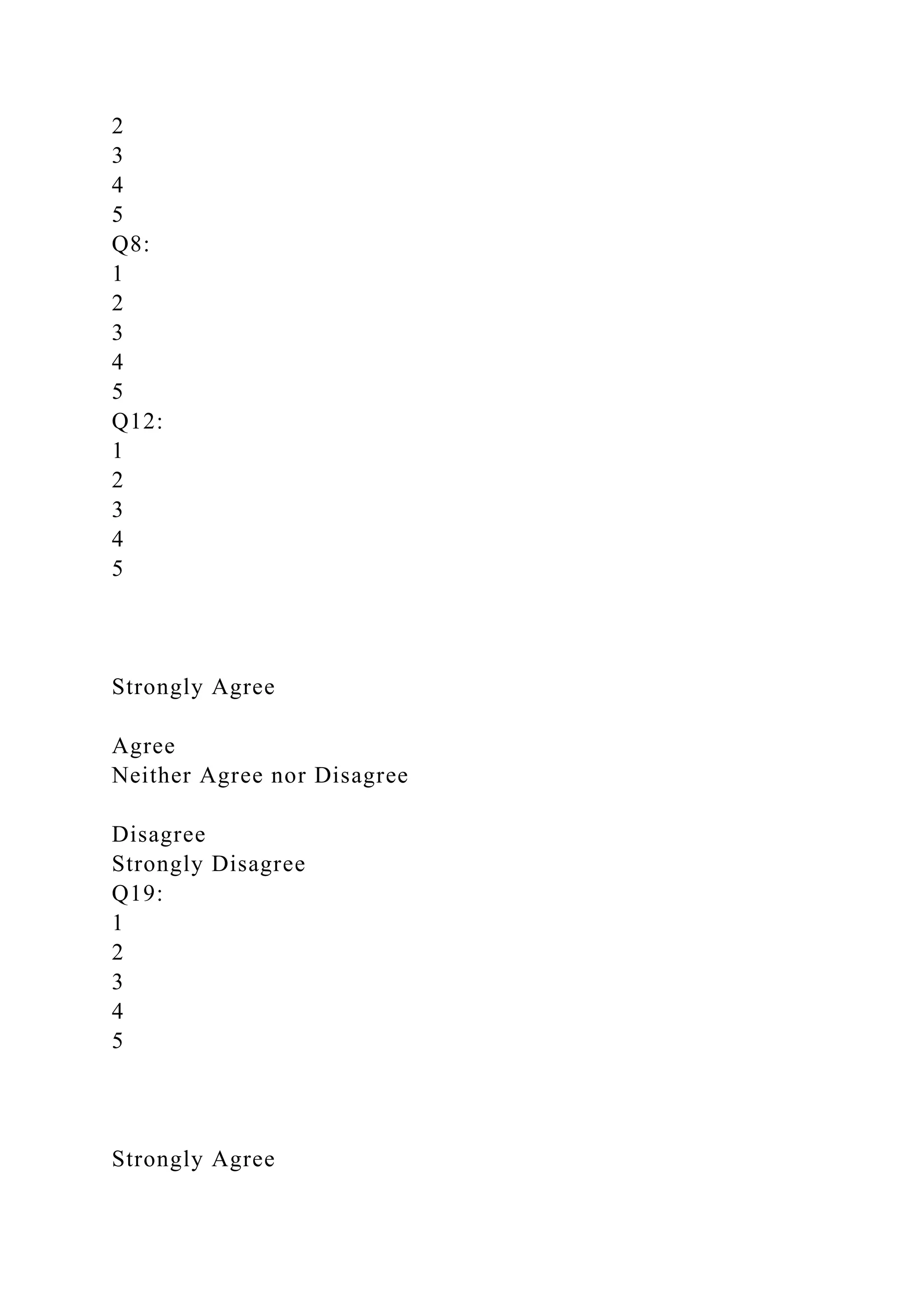
Q12:
1
2
3
4
5
Strongly Agree
Agree
Neither Agree nor Disagree
Disagree
Strongly Disagree
Q19:
1
2
3
4
5
Strongly Agree
Agree
Neither Agree nor Disagree
Disagree
Strongly Disagree
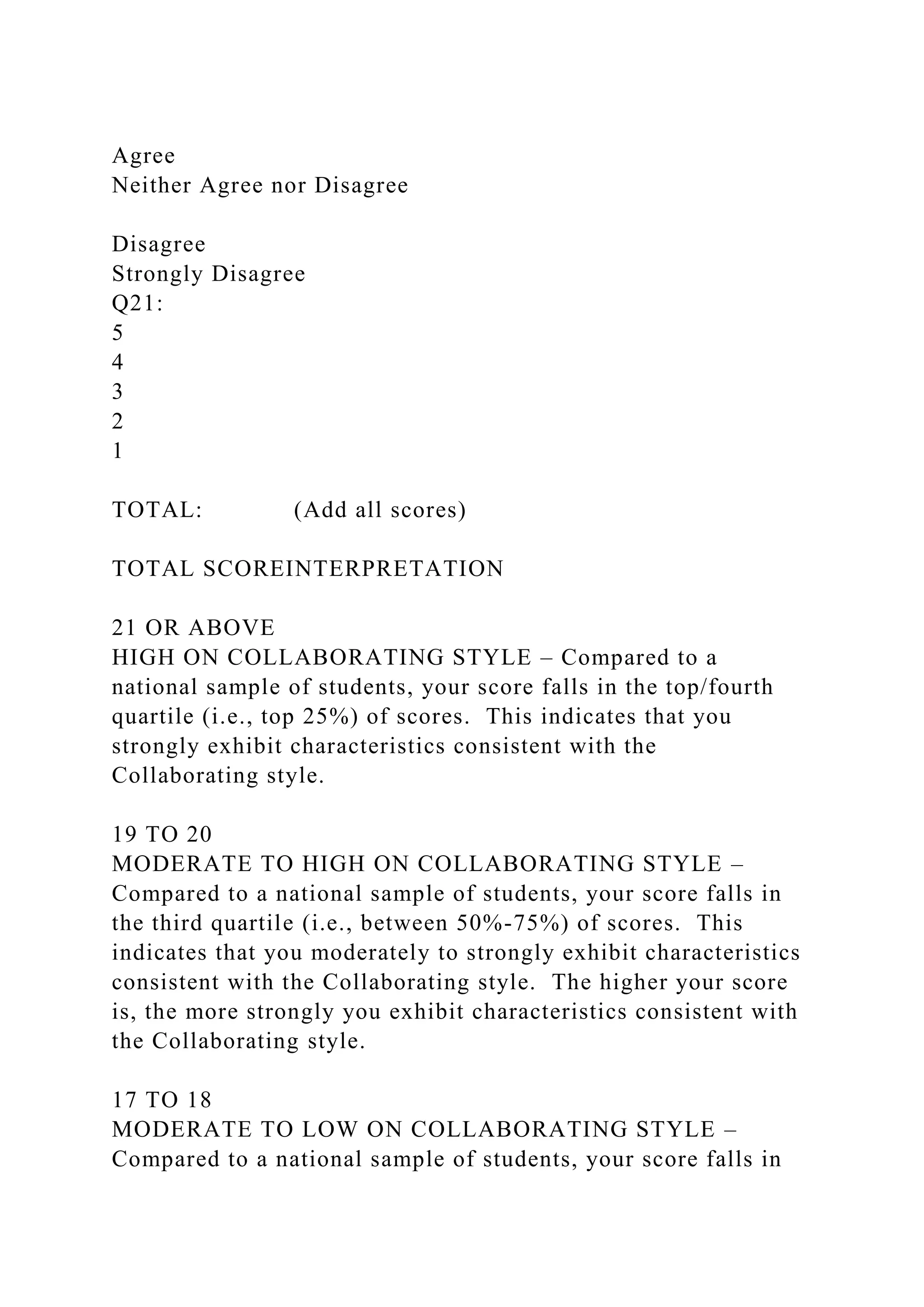
Q21:
5
4
3
2
1
TOTAL: (Add all scores)
TOTAL SCOREINTERPRETATION
21 OR ABOVE
HIGH ON COLLABORATING STYLE – Compared to a
national sample of students, your score falls in the top/fourth
quartile (i.e., top 25%) of scores. This indicates that you
strongly exhibit characteristics consistent with the
Collaborating style.
19 TO 20
MODERATE TO HIGH ON COLLABORATING STYLE –
Compared to a national sample of students, your score falls in
the third quartile (i.e., between 50%-75%) of scores. This
indicates that you moderately to strongly exhibit characteristics
consistent with the Collaborating style. The higher your score
is, the more strongly you exhibit characteristics consistent with
the Collaborating style.
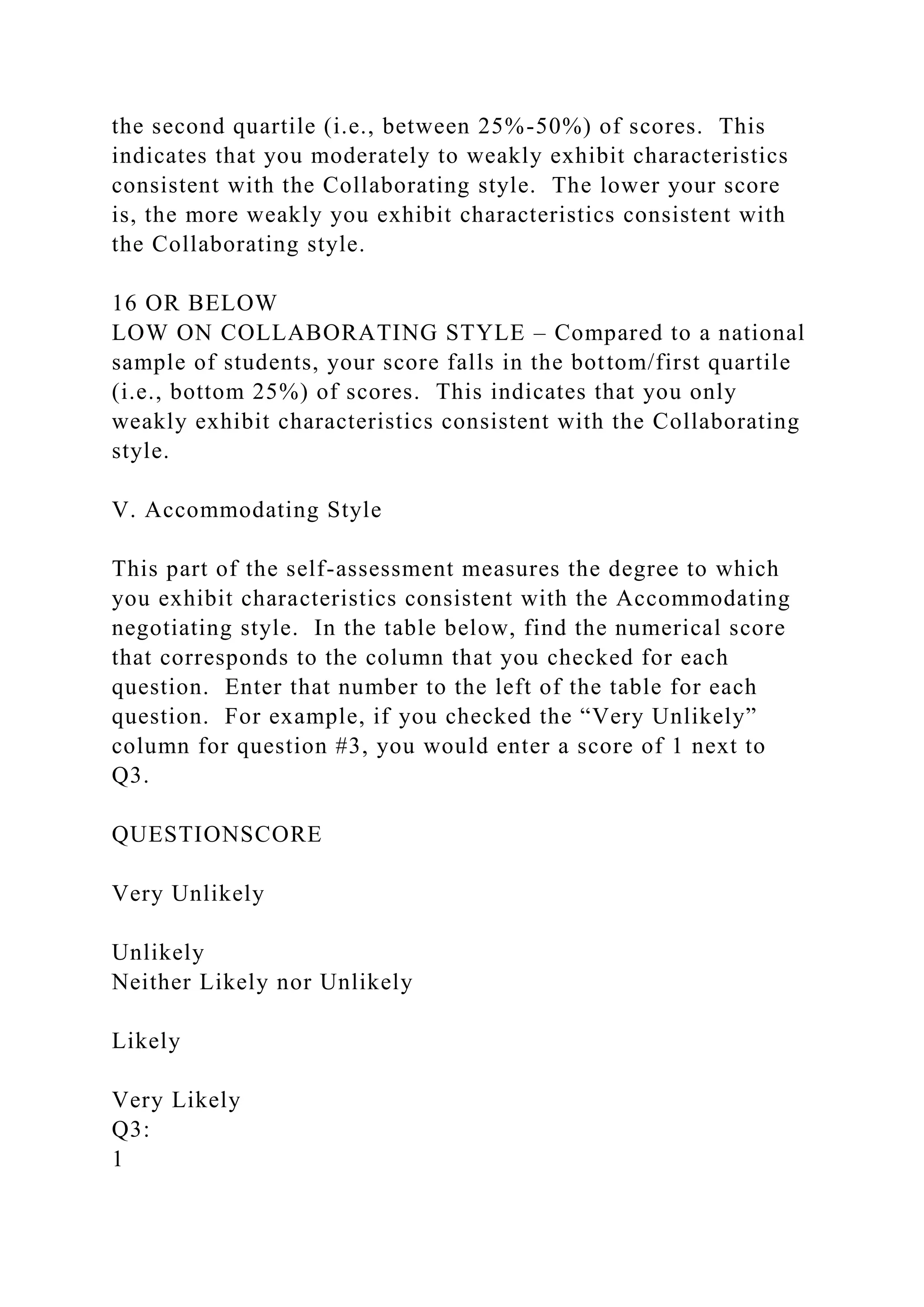
17 TO 18
MODERATE TO LOW ON COLLABORATING STYLE –
Compared to a national sample of students, your score falls in
the second quartile (i.e., between 25%-50%) of scores. This
indicates that you moderately to weakly exhibit characteristics
consistent with the Collaborating style. The lower your score
is, the more weakly you exhibit characteristics consistent with
the Collaborating style.
16 OR BELOW
LOW ON COLLABORATING STYLE – Compared to a national
sample of students, your score falls in the bottom/first quartile
(i.e., bottom 25%) of scores. This indicates that you only
weakly exhibit characteristics consistent with the Collaborating
style.
V. Accommodating Style
This part of the self-assessment measures the degree to which
you exhibit characteristics consistent with the Accommodating
negotiating style. In the table below, find the numerical score
that corresponds to the column that you checked for each
question. Enter that number to the left of the table for each
question. For example, if you checked the “Very Unlikely”
column for question #3, you would enter a score of 1 next to
Q3.
QUESTIONSCORE
Very Unlikely
Unlikely
Neither Likely nor Unlikely
Likely
Very Likely
Q3:
1
2
3
4
5
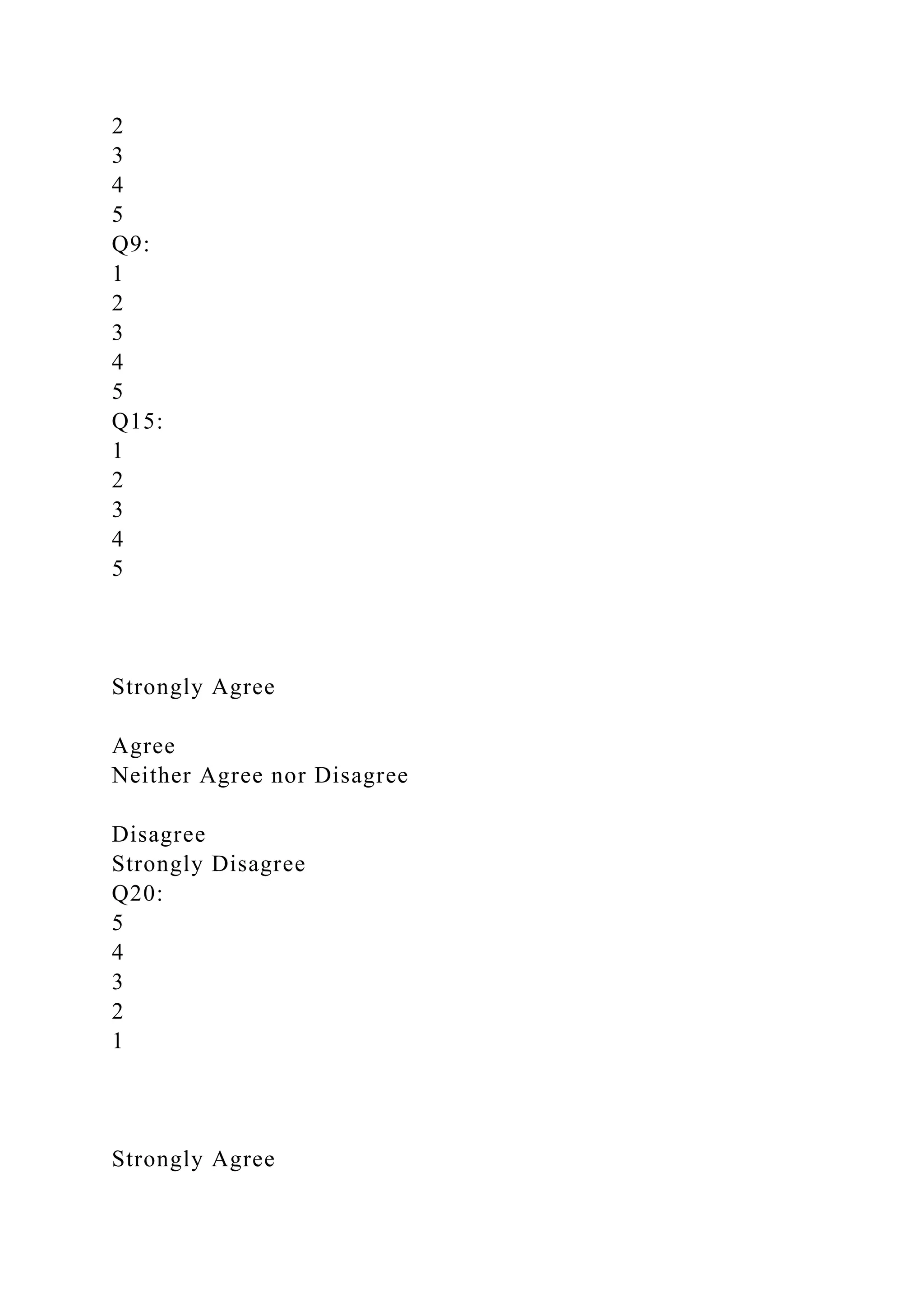
Q9:
1
2
3
4
5
Q15:
1
2
3
4
5
Strongly Agree
Agree
Neither Agree nor Disagree
Disagree
Strongly Disagree
Q20:
5
4
3
2
1
Strongly Agree
Agree
Neither Agree nor Disagree
Disagree
Strongly Disagree
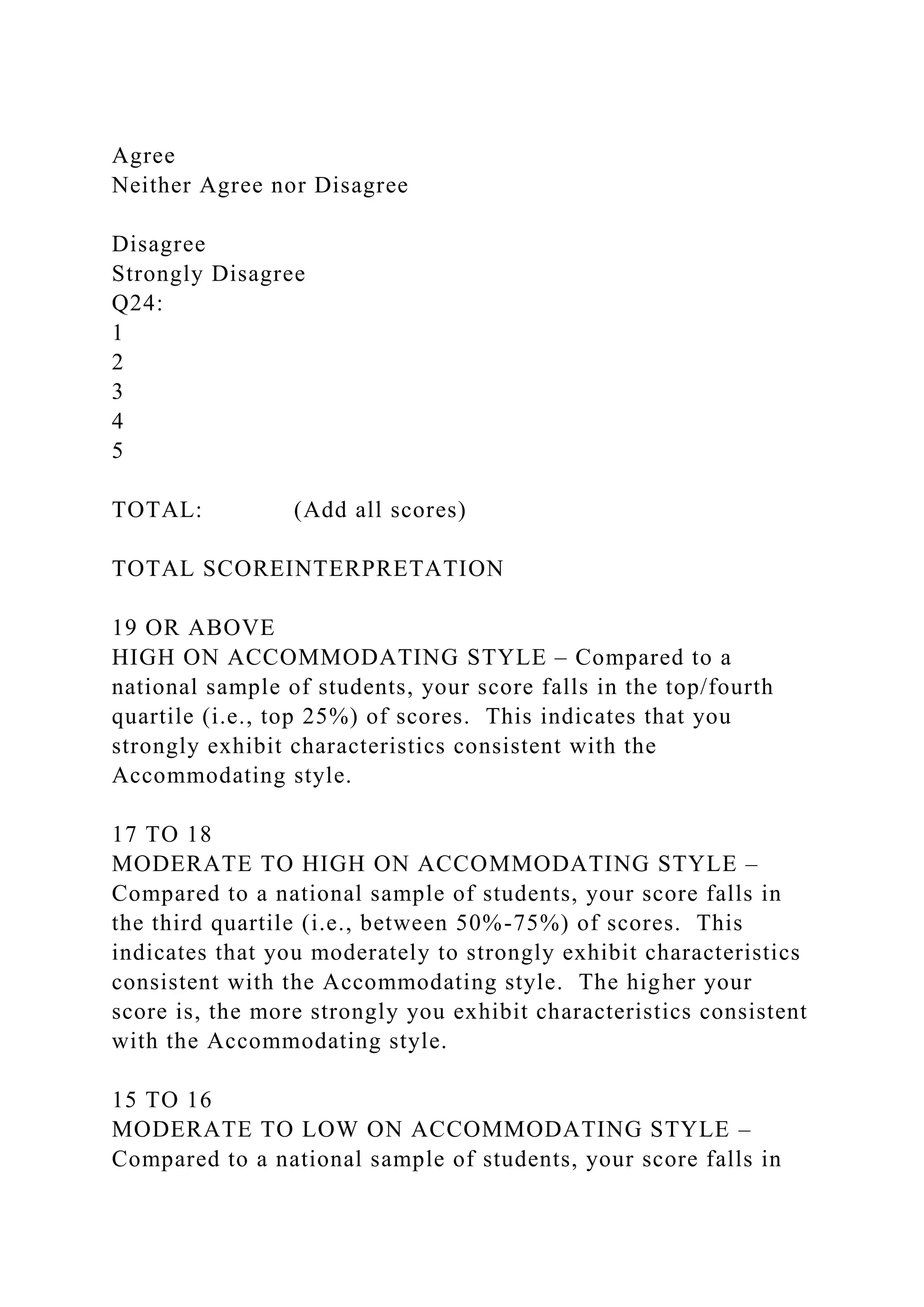
Q24:
1
2
3
4
5
TOTAL: (Add all scores)
TOTAL SCOREINTERPRETATION
19 OR ABOVE
HIGH ON ACCOMMODATING STYLE – Compared to a
national sample of students, your score falls in the top/fourth
quartile (i.e., top 25%) of scores. This indicates that you
strongly exhibit characteristics consistent with the
Accommodating style.
17 TO 18
MODERATE TO HIGH ON ACCOMMODATING STYLE –
Compared to a national sample of students, your score falls in
the third quartile (i.e., between 50%-75%) of scores. This
indicates that you moderately to strongly exhibit characteristics
consistent with the Accommodating style. The higher your
score is, the more strongly you exhibit characteristics consistent
with the Accommodating style.
15 TO 16
MODERATE TO LOW ON ACCOMMODATING STYLE –
Compared to a national sample of students, your score falls in
the second quartile (i.e., between 25%-50%) of scores. This
indicates that you moderately to weakly exhibit characteristics
consistent with the Accommodating style. The lower your score
is, the more weakly you exhibit characteristics consistent with
the Accommodating style.
14 OR BELOW
LOW ON ACCOMMODATING STYLE – Compared to a
national sample of students, your score falls in the bottom/first
quartile (i.e., bottom 25%) of scores. This indicates that you
only weakly exhibit characteristics consistent with the
Accommodating style.
VI. Compromising Style
This part of the self-assessment measures the degree to which
you exhibit characteristics consistent with the Compromising
negotiating style. In the table below, find the numerical score
that corresponds to the column that you checked for each
question. Enter that number to the left of the table for each
question. For example, if you checked the “Very Likely”
column for question #6, you would enter a score of 5 next to
Q6.
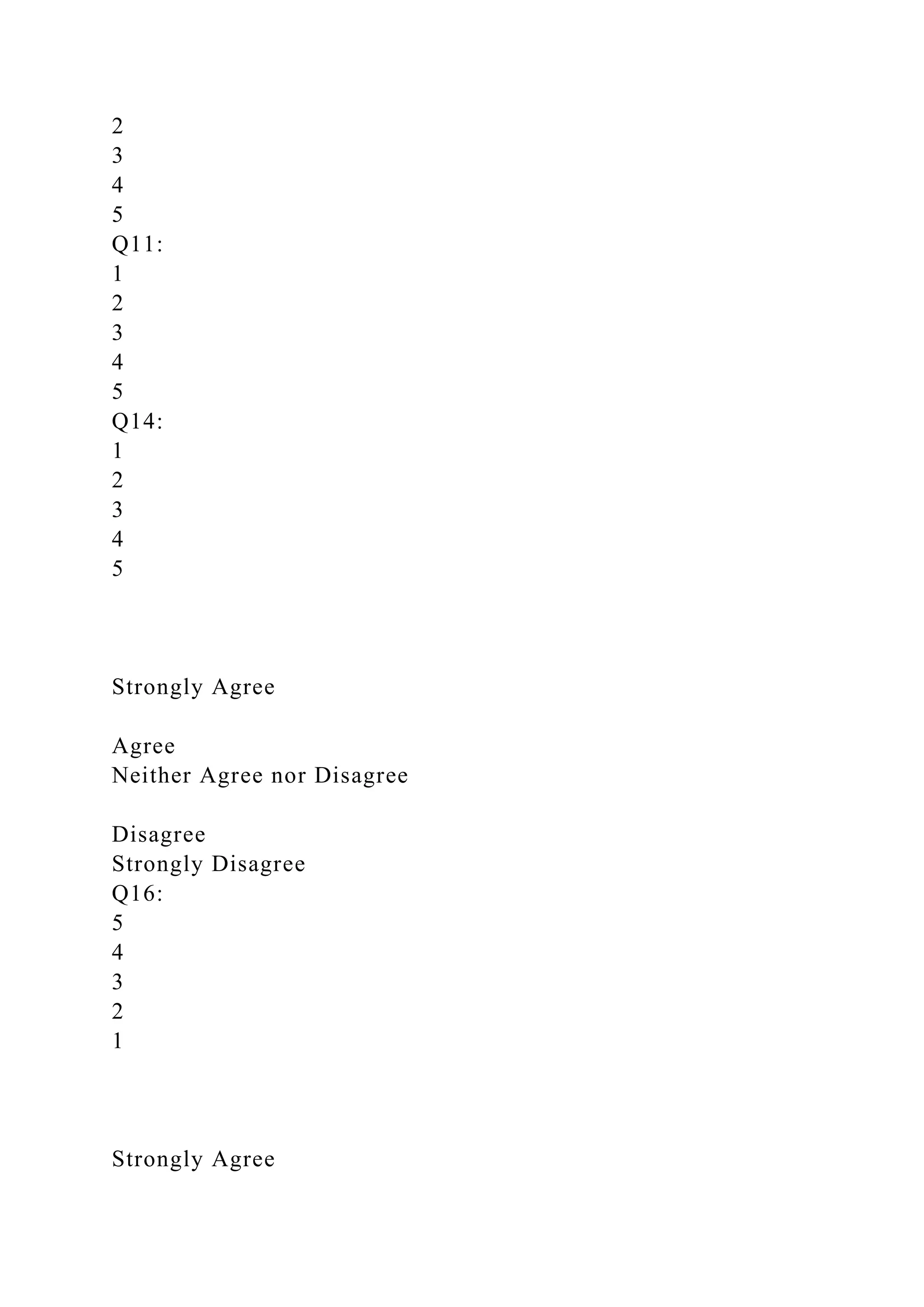
QUESTIONSCORE
Very Unlikely
Unlikely
Neither Likely nor Unlikely
Likely
Very Likely
Q6:
1
2
3
4
5
Q11:
1
2
3
4
5
Q14:
1
2
3
4
5
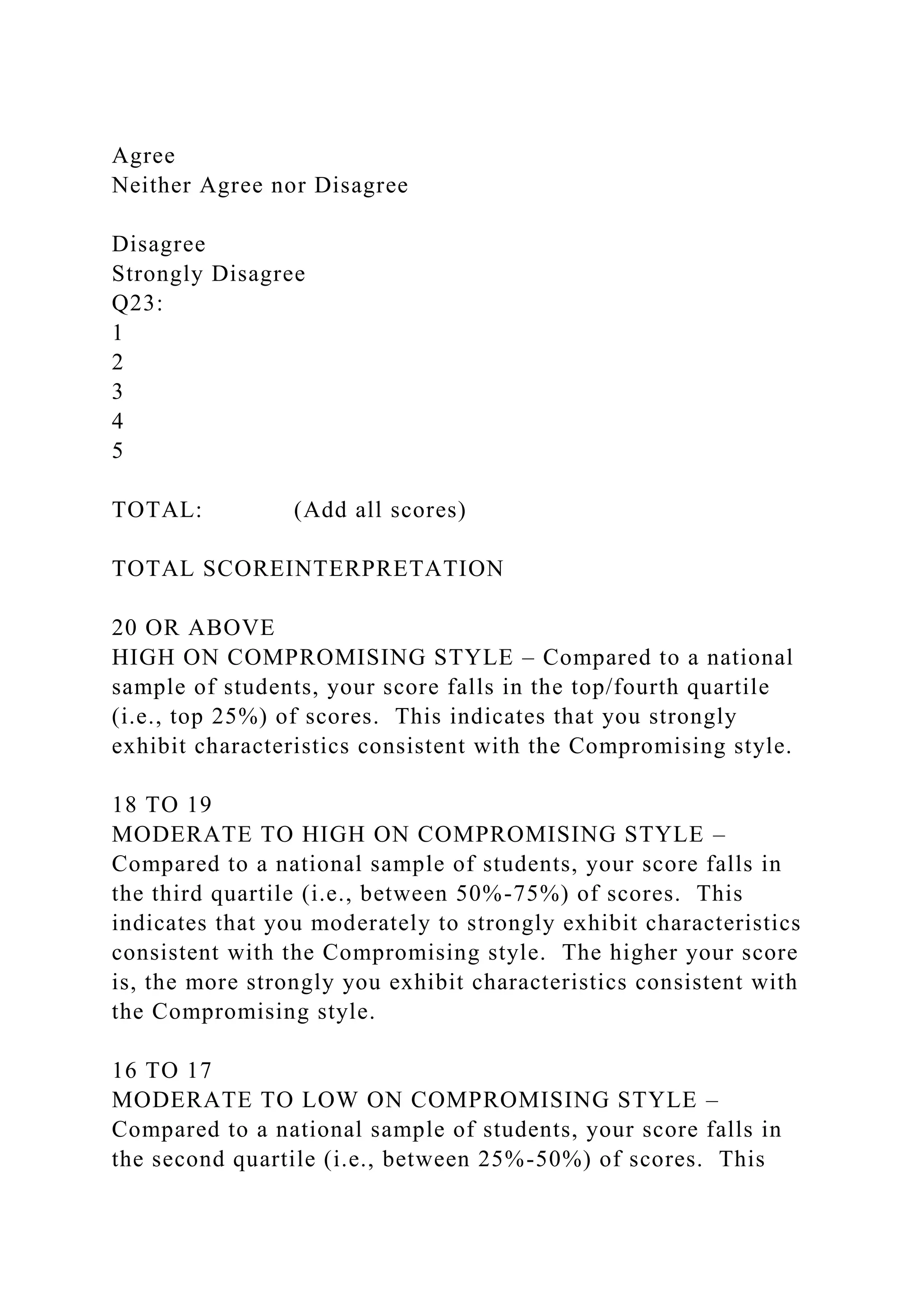
Strongly Agree
Agree
Neither Agree nor Disagree
Disagree
Strongly Disagree
Q16:
5
4
3
2
1
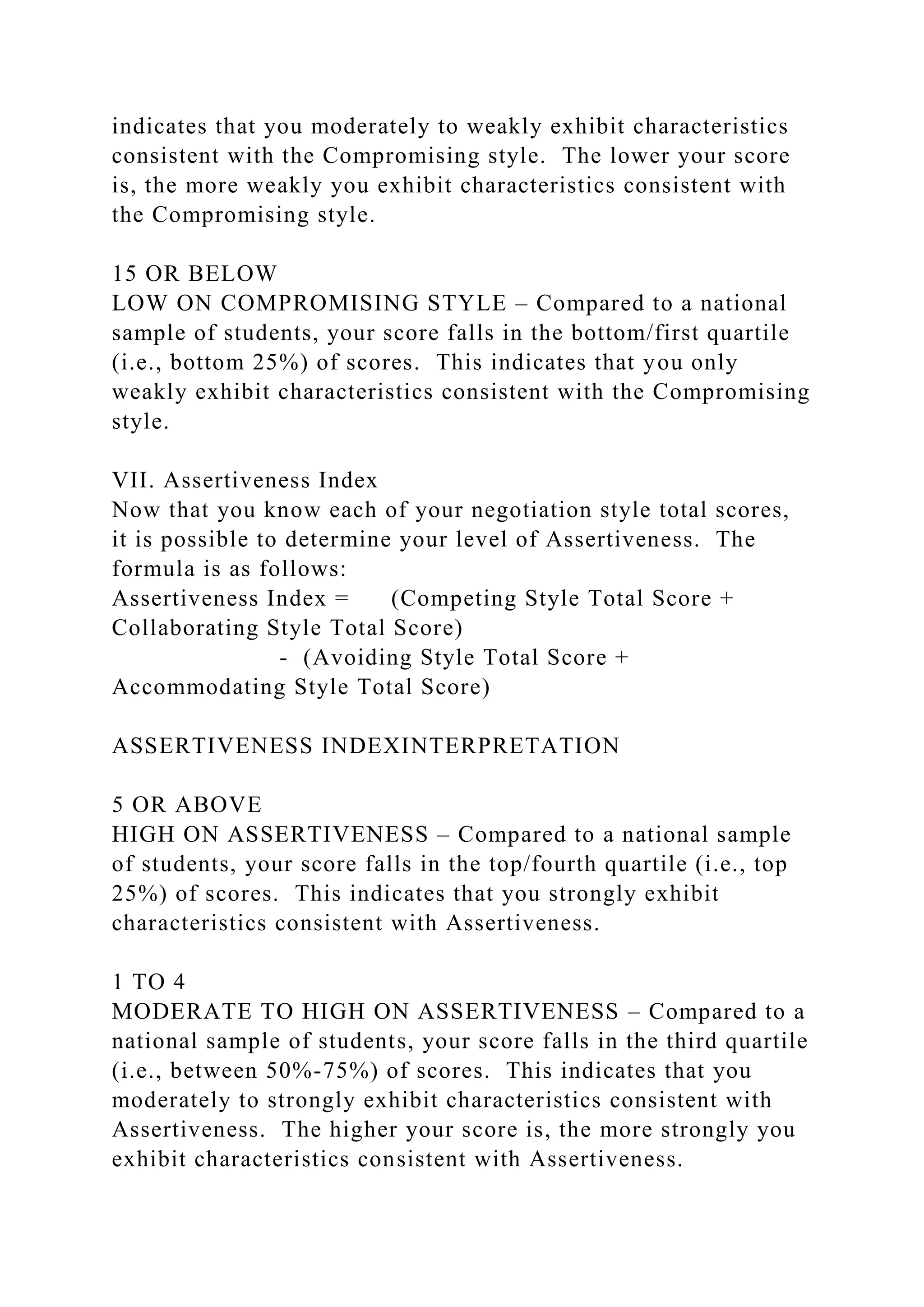
Strongly Agree
Agree
Neither Agree nor Disagree
Disagree
Strongly Disagree
Q23:
1
2
3
4
5
TOTAL: (Add all scores)
TOTAL SCOREINTERPRETATION
20 OR ABOVE
HIGH ON COMPROMISING STYLE – Compared to a national
sample of students, your score falls in the top/fourth quartile
(i.e., top 25%) of scores. This indicates that you strongly
exhibit characteristics consistent with the Compromising style.
18 TO 19
MODERATE TO HIGH ON COMPROMISING STYLE –
Compared to a national sample of students, your score falls in
the third quartile (i.e., between 50%-75%) of scores. This
indicates that you moderately to strongly exhibit characteristics
consistent with the Compromising style. The higher your score
is, the more strongly you exhibit characteristics consistent with
the Compromising style.
16 TO 17
MODERATE TO LOW ON COMPROMISING STYLE –
Compared to a national sample of students, your score falls in
the second quartile (i.e., between 25%-50%) of scores. This
indicates that you moderately to weakly exhibit characteristics
consistent with the Compromising style. The lower your score
is, the more weakly you exhibit characteristics consistent with
the Compromising style.
15 OR BELOW
LOW ON COMPROMISING STYLE – Compared to a national
sample of students, your score falls in the bottom/first quartile
(i.e., bottom 25%) of scores. This indicates that you only
weakly exhibit characteristics consistent with the Compromising
style.
VII. Assertiveness Index
Now that you know each of your negotiation style total scores,
it is possible to determine your level of Assertiveness. The
formula is as follows:
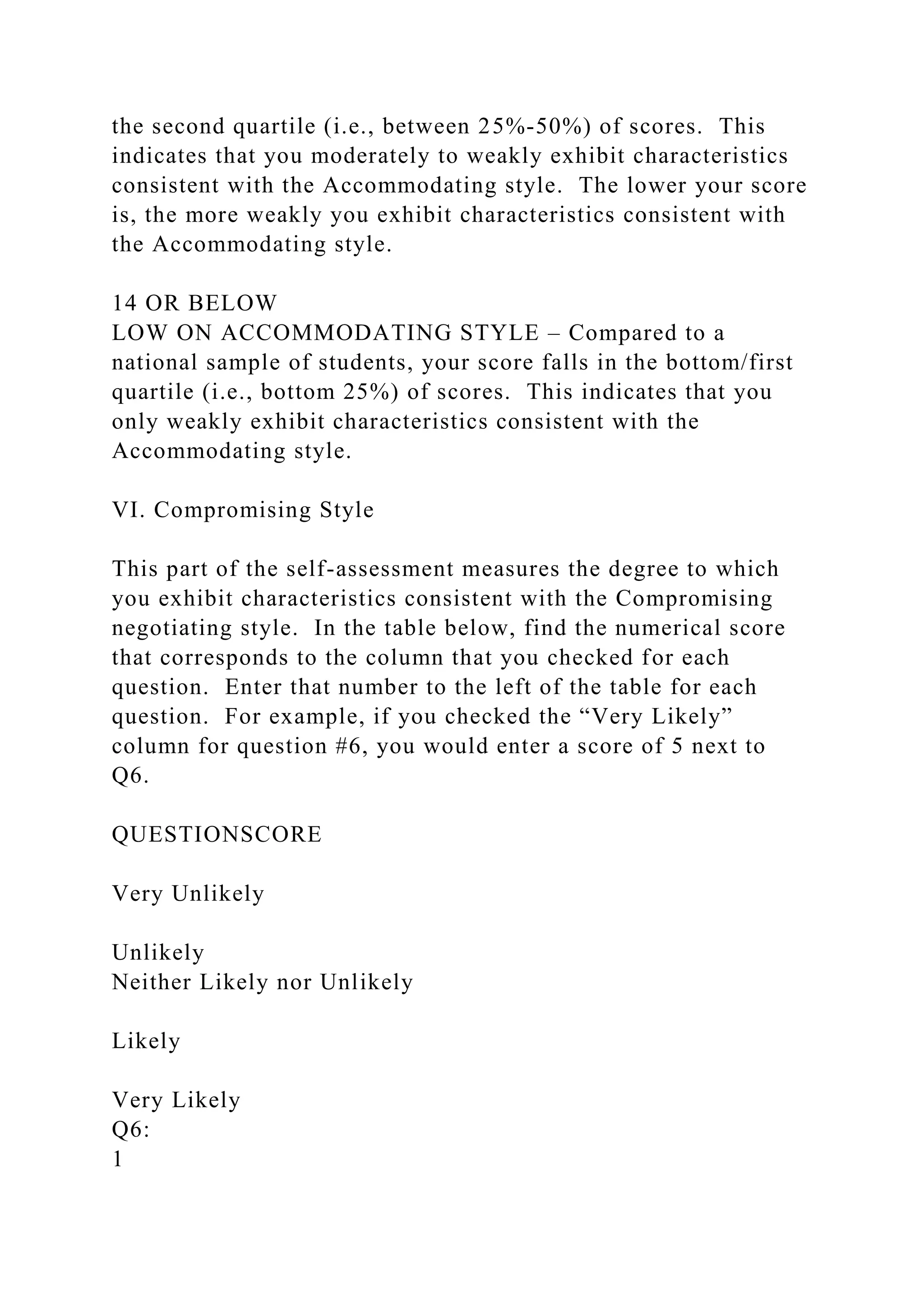
Assertiveness Index = (Competing Style Total Score +
Collaborating Style Total Score)
- (Avoiding Style Total Score +
Accommodating Style Total Score)
ASSERTIVENESS INDEXINTERPRETATION
5 OR ABOVE
HIGH ON ASSERTIVENESS – Compared to a national sample
of students, your score falls in the top/fourth quartile (i.e., top
25%) of scores. This indicates that you strongly exhibit
characteristics consistent with Assertiveness.
1 TO 4
MODERATE TO HIGH ON ASSERTIVENESS – Compared to a
national sample of students, your score falls in the third quartile
(i.e., between 50%-75%) of scores. This indicates that you
moderately to strongly exhibit characteristics consistent with
Assertiveness. The higher your score is, the more strongly you
exhibit characteristics consistent with Assertiveness.
-2 TO 0
MODERATE TO LOW ON ASSERTIVENESS – Compared to a
national sample of students, your score falls in the second
quartile (i.e., between 25%-50%) of scores. This indicates that
you moderately to weakly exhibit characteristics consistent with
Assertiveness. The lower your score is, the more weakly you
exhibit characteristics consistent with Assertiveness.
-3 OR BELOW
LOW ON ASSERTIVENESS – Compared to a national sample
of students, your score falls in the bottom/first quartile (i.e.,
bottom 25%) of scores. This indicates that you only weakly
exhibit characteristics consistent with Assertiveness.
VIII. Cooperativeness Index
Likewise, it is also possible to determine your level of
Cooperativeness. The formula is as follows:
Cooperativeness Index = (Collaborating Style Total Score +
Accommodating Style Total Score) - (Competing Style Total
Score + Avoiding Style Total Score)
COOPERATIVENESS INDEXINTERPRETATION
9 OR ABOVE
HIGH ON COOPERATIVENESS – Compared to a national
sample of students, your score falls in the top/fourth quartile
(i.e., top 25%) of scores. This indicates that you strongly
exhibit characteristics consistent with Cooperativeness.
5 TO 8
MODERATE TO HIGH ON COOPERATIVENESS – Compared
to a national sample of students, your score falls in the third
quartile (i.e., between 50%-75%) of scores. This indicates that
you moderately to strongly exhibit characteristics consistent
with Cooperativeness. The higher your score is, the more
strongly you exhibit characteristics consistent with
Cooperativeness.
2 TO 4
MODERATE TO LOW ON COOPERATIVENESS – Compared
to a national sample of students, your score falls in the second
quartile (i.e., between 25%-50%) of scores. This indicates that
you moderately to weakly exhibit characteristics consistent with
Cooperativeness. The lower your score is, the more weakly you
exhibit characteristics consistent with Cooperativeness.
1 OR BELOW
LOW ON ASSERTIVENESS – Compared to a national sample
of students, your score falls in the bottom/first quartile (i.e.,
bottom 25%) of scores. This indicates that you only weakly
exhibit characteristics consistent with Cooperativeness.

NEGOTIATIONSEVENTH EDITION• ROY J. LEWICKI • DAVID M.docx

  • 1.
    NEGOTIATION SEVENTH EDITION • ROYJ. LEWICKI • DAVID M. SAUNDERS • BRUCE BARRY Copyright © 2015 McGraw-Hill Education. All rights reserved. No reproduction or distribution without the prior written consent of McGraw-Hill Education. 2-1 Chapter 2 STRATEGY AND TACTICS OF DISTRIBUTIVE BARGAINING 1-1 Copyright © 2015 McGraw-Hill Education. All rights reserved. No reproduction or distribution without the prior written consent of McGraw-Hill Education. 2-2
  • 2.
    THREE REASONS NEGOTIATORSSHOULD BE FAMILIAR WITH DISTRIBUTIVE BARGAINING 1. Independent situations require knowing how this works in order to do well 2. Need to know how to counter the effects of the strategies 3. Every situation has the potential to require skills at the “claiming-value” stage Copyright © 2015 McGraw-Hill Education. All rights reserved. No reproduction or distribution without the prior written consent of McGraw-Hill Education. 2-3 THE DISTRIBUTIVE BARGAINING SITUATION • Goals of one party are in fundamental, direct conflict to another party • Resources are fixed and limited • Maximizing one’s own share of resources is the goal for both parties Copyright © 2015 McGraw-Hill Education. All rights reserved. No reproduction or distribution without the prior written consent of McGraw-Hill Education.
  • 3.
    2-4 THE DISTRIBUTIVE BARGAININGSITUATION Preparation—set a • Target point, aspiration point • Walkaway, resistance point • Asking price, initial offer Copyright © 2015 McGraw-Hill Education. All rights reserved. No reproduction or distribution without the prior written consent of McGraw-Hill Education. 2-5 THE DISTRIBUTIVE BARGAINING SITUATION Party B - Buyer Party A - Seller Walkaway Point Target Point Asking Price Initial Offer Target Point Walkaway Point Copyright © 2015 McGraw-Hill Education. All rights reserved. No reproduction or
  • 4.
    distribution without theprior written consent of McGraw-Hill Education. 2-6 THE ROLE OF ALTERNATIVES TO A NEGOTIATED AGREEMENT • Alternatives give the negotiator power to walk away from the negotiation Copyright © 2015 McGraw-Hill Education. All rights reserved. No reproduction or distribution without the prior written consent of McGraw-Hill Education. 2-7 THE DISTRIBUTIVE BARGAINING SITUATION Party B - Buyer Party A - Seller Walkaway Point Target Point Asking Price
  • 5.
    Initial Offer TargetPoint Walkaway Point Alternative Alternative Copyright © 2015 McGraw-Hill Education. All rights reserved. No reproduction or distribution without the prior written consent of McGraw-Hill Education. 2-8 FUNDAMENTAL STRATEGIES • Push for settlement near opponent’s resistance point • Get the other party to change their resistance point • If settlement range is negative, either: • Convince the other party that the settlement is the best possible Copyright © 2015 McGraw-Hill Education. All rights reserved. No reproduction or distribution without the prior written consent of McGraw-Hill
  • 6.
    Education. 2-9 KEYS TO THESTRATEGIES The keys to implementing any of the four strategies are: • Discovering the other party’s resistance point • Influencing the other party’s resistance point Copyright © 2015 McGraw-Hill Education. All rights reserved. No reproduction or distribution without the prior written consent of McGraw-Hill Education. 2-10 FOUR PROPOSITIONS THAT SUGGEST HOW THE KEYS AFFECT THE PROCESS 1. The higher the other party’s estimate of your cost of delay or impasse, the stronger the other party’s resistance point will be. 2. The higher the other party’s estimate of his or her own cost of delay or impasse, the weaker the other party’s resistance point will be. Copyright © 2015 McGraw-Hill Education. All rights reserved. No reproduction or
  • 7.
    distribution without theprior written consent of McGraw-Hill Education. 2-11 FOUR PROPOSITIONS THAT SUGGEST HOW THE KEYS AFFECT THE PROCESS 3. The less the other party values an issue, the lower their resistance point will be. 4. The more the other party believes that you value an issue, the lower their resistance point may be. Copyright © 2015 McGraw-Hill Education. All rights reserved. No reproduction or distribution without the prior written consent of McGraw-Hill Education. 2-12 TACTICAL TASKS OF NEGOTIATORS • Assess outcome values and the costs of termination for the other party • Manage the other party’s impressions • Modify the other party’s perceptions • Manipulate the actual costs of delay or
  • 8.
    termination Copyright © 2015McGraw-Hill Education. All rights reserved. No reproduction or distribution without the prior written consent of McGraw-Hill Education. 2-13 ASSESS THE OTHER PARTY’S TARGET, RESISTANCE POINT, AND COSTS OF TERMINATING NEGOTIATIONS • Indirectly • Directly Copyright © 2015 McGraw-Hill Education. All rights reserved. No reproduction or distribution without the prior written consent of McGraw-Hill Education. 2-14
  • 9.
    MANAGE THE OTHERPARTY’S IMPRESSIONS • Screen your behavior: • Direct action to alter impressions Present facts that enhance one’s position Copyright © 2015 McGraw-Hill Education. All rights reserved. No reproduction or distribution without the prior written consent of McGraw-Hill Education. 2-15 MODIFY THE OTHER PARTY’S PERCEPTIONS • Make outcomes appear less attractive • Make the cost of obtaining goals appear higher • Make demands and positions appear more or less attractive to the other party – whichever suits your needs Copyright © 2015 McGraw-Hill Education. All rights reserved. No reproduction or distribution without the prior written consent of McGraw-Hill Education. 2-16
  • 10.
    MANIPULATE THE ACTUALCOSTS OF DELAY OR TERMINATION • Plan disruptive action • Form an alliance with outsiders influence the outcome in your favor • Schedule manipulations the other Copyright © 2015 McGraw-Hill Education. All rights reserved. No reproduction or distribution without the prior written consent of McGraw-Hill Education. 2-17 POSITIONS TAKEN DURING NEGOTIATIONS • Opening offer • Opening stance
  • 11.
    • Initial concessions Copyright© 2015 McGraw-Hill Education. All rights reserved. No reproduction or distribution without the prior written consent of McGraw-Hill Education. 2-18 POSITIONS TAKEN DURING NEGOTIATIONS • The role of concessions • Patterns of concession making • Final offers (making a commitment) Copyright © 2015 McGraw-Hill Education. All rights reserved. No reproduction or distribution without the prior written consent of McGraw-Hill Education.
  • 12.
    2-19 COMMITMENTS: TACTICAL CONSIDERATIONS • Establishinga commitment ences • Preventing the other party from committing prematurely Copyright © 2015 McGraw-Hill Education. All rights reserved. No reproduction or distribution without the prior written consent of McGraw-Hill Education. 2-20 WAYS TO CREATE A COMMITMENT • Public pronouncement • Linking with an outside base
  • 13.
    • Increase theprominence of demands • Reinforce the threat or promise Copyright © 2015 McGraw-Hill Education. All rights reserved. No reproduction or distribution without the prior written consent of McGraw-Hill Education. 2-21 COMMITMENTS: TACTICAL CONSIDERATIONS • Ways to abandon a committed position imize the damage to the relationship if the other backs off Copyright © 2015 McGraw-Hill Education. All rights reserved. No reproduction or distribution without the prior written consent of McGraw-Hill Education. 2-22
  • 14.
    CLOSING THE DEAL •Provide alternatives (2 or 3 packages) • Assume the close • Split the difference • Exploding offers • Deal sweeteners Copyright © 2015 McGraw-Hill Education. All rights reserved. No reproduction or distribution without the prior written consent of McGraw-Hill Education. 2-23 DEALING WITH TYPICAL HARDBALL TACTICS • Four main options: -opt the other party (befriend them) Copyright © 2015 McGraw-Hill Education. All rights reserved.
  • 15.
    No reproduction or distributionwithout the prior written consent of McGraw-Hill Education. 2-24 TYPICAL HARDBALL TACTICS • Good Cop/Bad Cop • Lowball/Highball • Bogey (playing up an issue of little importance) • The Nibble (asking for a number of small concessions to) Copyright © 2015 McGraw-Hill Education. All rights reserved. No reproduction or distribution without the prior written consent of McGraw-Hill Education. 2-25 TYPICAL HARDBALL TACTICS • Chicken • Intimidation • Aggressive Behavior
  • 16.
    • Snow Job(overwhelm the other party with information) Copyright © 2015 McGraw-Hill Education. All rights reserved. No reproduction or distribution without the prior written consent of McGraw-Hill Education. 2-26 SUMMARY Negotiators need to: • Set a clear target and resistance points • Understand and work to improve their BATNA • Start with good opening offer • Make appropriate concessions • Manage the commitment process Copyright © 2015 McGraw-Hill Education. All rights reserved. No reproduction or distribution without the prior written consent of McGraw-Hill Education. 2-27
  • 17.
    NEGOTIATION SEVENTH EDITION • ROYJ. LEWICKI • DAVID M. SAUNDERS • BRUCE BARRY Copyright © 2015 McGraw-Hill Education. All rights reserved. No reproduction or distribution without the prior written consent of McGraw-Hill Education. 1‐1 NEGOTIATION 7e Lewicki ▪ Saunders ▪ Barry Chapter 1 THE NATURE OF NEGOTIATION 1‐2 Copyright © 2015 McGraw-Hill Education. All rights reserved. No reproduction or distribution without the prior written consent of McGraw- Hill Education. INTRODUCTION Negotiation is something that everyone does, almost daily
  • 18.
    1-3Copyright © 2015McGraw-Hill Education. All rights reserved. No reproduction or distribution without the prior written consent of McGraw-Hill Education. NEGOTIATIONS Negotiations occur for several reasons: • To agree on how to share or divide a limited resource • To create something new that neither party could attain on his or her own • To resolve a problem or dispute between the parties 1-4Copyright © 2015 McGraw-Hill Education. All rights reserved. No reproduction or distribution without the prior written consent of McGraw-Hill Education. APPROACH TO THE SUBJECT Most people think bargaining and negotiation mean the same thing; however, we will be distinctive about the way we use these two words: • Bargaining: describes the competitive, win‐lose situation • Negotiation: refers to win‐win situations such as those that occur when parties try to find a
  • 19.
    mutually acceptable solutionto a complex conflict 1-5Copyright © 2015 McGraw-Hill Education. All rights reserved. No reproduction or distribution without the prior written consent of McGraw-Hill Education. THREE IMPORTANT THEMES 1. The definition of negotiation and the basic characteristics of negotiation situations 2. Interdependence, the relationship between people and groups that most often leads them to negotiate 3. Understanding the dynamics of conflict and conflict management processes which serve as a backdrop for different ways that people approach and manage negotiations 1-6Copyright © 2015 McGraw-Hill Education. All rights reserved. No reproduction or distribution without the prior written consent of McGraw-Hill Education. CHARACTERISTICS OF A NEGOTIATION SITUATION • There are two or more parties • There is a conflict of needs and desires between two or more parties
  • 20.
    • Parties negotiatebecause they think they can get a better deal than by simply accepting what the other side offers them • Parties expect a “give‐and‐take” process 1-7Copyright © 2015 McGraw-Hill Education. All rights reserved. No reproduction or distribution without the prior written consent of McGraw-Hill Education. CHARACTERISTICS OF A NEGOTIATION SITUATION • Parties search for agreement rather than: openly off contact permanently their dispute to a third party • Successful negotiation involves: of tangibles (e.g., the price or the terms of agreement) tion of intangibles (the underlying psychological motivations) such as winning, losing, saving face 1-8Copyright © 2015 McGraw-Hill Education. All rights reserved. No reproduction or distribution without the prior written consent of McGraw-Hill Education. INTERDEPENDENCE In negotiation, parties need each other to achieve their preferred outcomes or objectives.
  • 21.
    • This mutualdependency is called interdependence • Interdependent goals are an important aspect of negotiation I win, you lose Opportunities for both parties to gain 1-9Copyright © 2015 McGraw-Hill Education. All rights reserved. No reproduction or distribution without the prior written consent of McGraw-Hill Education. INTERDEPENDENCE • Interdependent parties are characterized by interlocking goals • Having interdependent goals does not mean that everyone wants or needs exactly the same thing • A mix of convergent and conflicting goals characterizes many interdependent relationships 1-10Copyright © 2015 McGraw-Hill Education. All rights reserved. No reproduction or distribution without the prior written consent of McGraw-Hill Education. TYPES OF INTERDEPENDENCE AFFECT OUTCOMES • Interdependence and the structure of the
  • 22.
    situation shape processesand outcomes or distributive – one winner or integrative – mutual gains situation 1-11Copyright © 2015 McGraw-Hill Education. All rights reserved. No reproduction or distribution without the prior written consent of McGraw-Hill Education. ALTERNATIVES SHAPE INTERDEPENDENCE • Evaluating interdependence depends heavily on the alternatives to working together • The desirability to work together is better for outcomes • Best available alternative: BATNA (acronym for Best Alternative to a Negotiated Agreement) 1-12Copyright © 2015 McGraw-Hill Education. All rights reserved. No reproduction or distribution without the prior written consent of McGraw-Hill Education. MUTUAL ADJUSTMENT • Continues throughout the negotiation as both parties act to influence the other • One of the key causes of the changes that occur during a negotiation • The effective negotiator needs to understand
  • 23.
    how people willadjust and readjust and how the negotiations might twist and turn, based on one’s own moves and the other’s responses 1-13Copyright © 2015 McGraw-Hill Education. All rights reserved. No reproduction or distribution without the prior written consent of McGraw-Hill Education. MUTUAL ADJUSTMENT AND CONCESSION MAKING • When one party agrees to make a change in his/her position, a concession has been made • Concessions restrict the range of options • When a concession is made, the bargaining range is further constrained 1-14Copyright © 2015 McGraw-Hill Education. All rights reserved. No reproduction or distribution without the prior written consent of McGraw-Hill Education. TWO DILEMMAS IN MUTUAL ADJUSTMENT • Dilemma of honesty about how much of the truth to tell the other party • Dilemma of trust about how much should negotiators believe what the other party tells them
  • 24.
    1-15Copyright © 2015McGraw-Hill Education. All rights reserved. No reproduction or distribution without the prior written consent of McGraw-Hill Education. VALUE CLAIMING AND VALUE CREATION • Opportunities to “win” or share resources value: result of zero‐sum or distributive situations where the object is to gain largest piece of resource value: result of non‐zero‐sum or integrative situation where the object is to have both parties do well 1-16Copyright © 2015 McGraw-Hill Education. All rights reserved. No reproduction or distribution without the prior written consent of McGraw-Hill Education. VALUE CLAIMING AND VALUE CREATION • Most actual negotiations are a combination of claiming and creating value processes must be able to recognize situations that require more of one approach than the other must be versatile in their comfort and use of both major strategic approaches Negotiator perceptions of situations tend to be biased toward seeing problems as more distributive/competitive than they really are 1-17Copyright © 2015 McGraw-Hill Education. All rights
  • 25.
    reserved. No reproductionor distribution without the prior written consent of McGraw-Hill Education. VALUE CLAIMING AND VALUE CREATION Value differences that exist between negotiators include: • Differences in interest • Differences in judgments about the future • Differences in risk tolerance • Differences in time preferences 1-18Copyright © 2015 McGraw-Hill Education. All rights reserved. No reproduction or distribution without the prior written consent of McGraw-Hill Education. CONFLICT Conflict may be defined as a: "sharp disagreement or opposition" and includes "the perceived divergence of interest, or a belief that the parties' current aspirations cannot be achieved simultaneously" 1-19Copyright © 2015 McGraw-Hill Education. All rights reserved. No reproduction or distribution without the prior written consent of McGraw-Hill Education.
  • 26.
    LEVELS OF CONFLICT •Intrapersonal or intrapsychic conflict that occurs within an individual want an ice cream cone badly, but we know that ice cream is very fattening • Interpersonal conflict onflict is between individuals between bosses and subordinates, spouses, siblings, roommates, etc. 1-20Copyright © 2015 McGraw-Hill Education. All rights reserved. No reproduction or distribution without the prior written consent of McGraw-Hill Education. LEVELS OF CONFLICT • Intragroup Conflict is within a group team and committee members, within families, classes etc. • Intergroup Conflict can occur between organizations, warring nations, feuding families, or within splintered, fragmented communities negotiations are the most complex 1-21Copyright © 2015 McGraw-Hill Education. All rights reserved. No reproduction or distribution without the prior written consent of McGraw-Hill Education.
  • 27.
    DYSFUNCTIONS OF CONFLICT 1.Competitive, win‐lose goals 2. Misperception and bias 3. Emotionality 4. Decreased communication 5. Blurred issues 6. Rigid commitments 7. Magnified differences, minimized similarities 8. Escalation of conflict 1-22Copyright © 2015 McGraw-Hill Education. All rights reserved. No reproduction or distribution without the prior written consent of McGraw-Hill Education. FUNCTIONS OF CONFLICT 1. Makes organizational members more aware and able to cope with problems through discussion. 2. Promises organizational change and adaptation. 3. Strengthens relationships and heightens morale. 4. Promotes awareness of self and others. 5. Enhances personal development. 6. Encourages psychological development—it helps people become more accurate and realistic in their self‐appraisals. 7. Can be stimulating and fun.
  • 28.
    1-23Copyright © 2015McGraw-Hill Education. All rights reserved. No reproduction or distribution without the prior written consent of McGraw-Hill Education. THE DUAL CONCERNS MODEL 1-24Copyright © 2015 McGraw-Hill Education. All rights reserved. No reproduction or distribution without the prior written consent of McGraw-Hill Education. STYLES OF CONFLICT MANAGEMENT 1. Contending pursue own outcomes strongly, show little concern for other party obtaining their desired outcomes 2. Yielding show little interest in whether they attain own outcomes, but are quite interested in whether the other party attains their outcomes 3. Inaction show little interest in whether they attain own outcomes, and little concern about whether the other party obtains their outcomes 1-25Copyright © 2015 McGraw-Hill Education. All rights reserved. No reproduction or distribution without the prior written consent of McGraw-Hill Education.
  • 29.
    STYLES OF CONFLICTMANAGEMENT 4. Problem solving show high concern in obtaining own outcomes, as well as high concern for the other party obtaining their outcomes 5. Compromising show moderate concern in obtaining own outcomes, as well as moderate concern for the other party obtaining their outcomes 1-26Copyright © 2015 McGraw-Hill Education. All rights reserved. No reproduction or distribution without the prior written consent of McGraw-Hill Education. NEGOTIATING STYLE SELF-ASSESSMENT The purpose of this self-assessment is to help you examine your personal negotiating style. Negotiation – a process by which two parties communicate with each other in order to reach an outcome on which they mutually agree. Directions 1. PRINT THIS SELF-ASSESSMENT OUT! 2. Read the definition of negotiation above to make sure that you understand it. 3. Answer all questions to the best of your ability. There are no right or wrong answers. Don’t try to think of the “correct” or most “desirable” response, but simply respond with your honest
  • 30.
    reactions. 4. Respond byputting a check-mark or X in one column per question or statement. 5. Proceed to the second page where you will find a number of questions that ask you to consider how likely or unlikely you are to behave in a certain way when you are negotiating. 6. On the third page you are required to rate your level of agreement with a number of statements. 7. Proceed to the fourth page where you will find the scoring key and interpretation guide. How likely are you to do each of the following when NEGOTIATING? Very Unlikely Unlikely Neither Likely nor Unlikely Likely Very Likely 1. I’ll come up with a plan so that I can steer the negotiation to go my way. 2. I’ll do things expressly to make sure that the negotiation stays friendly and comfortable.
  • 31.
    3. I’ll goout of my way to make sure that the outcome for the other person is fair. 4. I’ll do things so that both of us can get what we want from the negotiation. 5. If something needs to be negotiated, I’ll immediately step forward to do it. 6. I’ll give some in order to get some from the person I’m negotiating with. 7. If the negotiation is not going my way, I’ll bail out of the negotiation.
  • 32.
    8. I’ll suggestcreative solutions that allow both of us to get what we want from the negotiation. 9. If it seems important for the other person to come out on top, I’ll give in to them. 10. I’ll avoid difficult issues to keep the negotiation from getting nasty. 11. If the other person compromises their position, I’ll compromise my position in return. 12. I’ll make sure that both of our needs are understood so that both of us can come out on top.
  • 33.
    13. I’ll presentinformation, when negotiating, even if it doesn’t necessarily always support my position. 14. I’ll propose a place in the middle where we both can meet. 15. I’ll try to see things from the other person’s viewpoint and be considerate of their needs. Rate your level of agreement with each of these statements. Strongly Agree Agree Neither Agree nor Disagree Disagree
  • 34.
    Strongly Disagree 16. Inevery negotiation, both sides have to give something up to get something in return. 17. What’s good for me is really all that matters when negotiating. 18. I’ll do almost anything to keep from having to engage in negotiation. 19. In negotiating, someone wins and someone has to lose. 20. The feelings of the other person that I’m negotiating with are important to me. 21. Negotiation works better when the focus is on common
  • 35.
    agreement rather thandifferences. 22. I can be aggressive when it comes to getting my way from a negotiation. 23. When you compromise in a negotiation, you really just lose. 24. If the other person gets a “raw deal” from our negotiation, that really doesn’t matter to me. 25. Keeping the comfort level high is very important to me when I’m negotiating. NEGOTIATING STYLE
  • 36.
    SELF-ASSESSMENT – InterpretationGuide I. Background It is important that you, the student, review the discussion of collective bargaining behavior in Chapter 6 of Holley, Jennings, & Wolters, 8th edition, before continuing. Holley, Jennings, & Wolters identify two distinct and very different approaches to bargaining. Distributive Bargaining approaches negotiation as a win-lose exercise where the gains of one party must come at the expense of the other party. The sole focus of the negotiator is to maximize his/her own outcomes. In the negotiation literature, this orientation is referred to as Assertiveness. Mutual Gain Bargaining approaches negotiation as a mutual problem-solving exercise. Relying on open communication, trust, and mutual respect, negotiators focus on fulfilling the mutual interests of both parties. In the negotiation literature, this orientation is referred to as Cooperativeness. Negotiators that exhibit Assertiveness tendencies are more likely to engage in Distributive Bargaining behavior while negotiators that are high in Cooperativeness are more likely to use a Mutual Gain Bargaining approach. Thus, this self- assessment will help you examine your levels of Assertiveness versus Cooperativeness. According to the negotiation literature, the measurement of Assertiveness and Cooperativeness requires the consideration of five distinct negotiation styles. The five negotiation styles are: Competing - Negotiators that exhibit this style are results- oriented, self-confident, assertive, are focused primarily on the bottom line, have a tendency to impose their views upon the
  • 37.
    other party, andin the extreme can become aggressive and domineering. This style is high in Assertiveness and low in Cooperativeness. Avoiding - Negotiators that exhibit this style are passive, prefer to avoid conflict, make attempts to withdraw from the situation or pass responsibility onto another party, and fail to show adequate concern or make an honest attempt to get to a solution. This style is both low in Assertiveness and low in Cooperativeness. Collaborating - Negotiators that exhibit this style use open and honest communication, focus on finding creative solutions that mutually satisfy both parties, are open to exploring new and novel solutions, and suggest many alternatives for consideration. This style is both high in Assertiveness and high in Cooperativeness. Accommodating – Negotiators that exhibit this style make attempts to maintain relationships with the other party, smooth over conflicts, downplay differences, and are most concerned with satisfying the needs of the other party. This style is low in Assertiveness but high in Cooperativeness. Compromising – Negotiators that exhibit this style aim to find the middle ground, often split the difference between positions, frequently engage in give and take tradeoffs, and accept moderate satisfaction of both parties’ needs. This style is both moderate in Assertiveness and moderate in Cooperativeness. Figure 1 displays the relationship between these five negotiating styles and the competing dimensions of Assertiveness versus Cooperativeness. Figure 1 High
  • 38.
    Competing Collaborating Assertiveness Distributive Bargaining Compromising Low Avoiding AccommodatingLow Cooperativeness MutualGain BargainingHigh II. Competing Style Part of the self-assessment measures the degree to which you exhibit characteristics consistent with the Competing negotiating style. In the table below, find the numerical score that corresponds to the column that you checked for each question. Enter that number to the left of the table for each question. For example, if you checked the “Neither Likely nor Unlikely” column for question #1, you would enter a score of 3 next to Q1. QUESTIONSCORE Very Unlikely Unlikely Neither Likely nor Unlikely Likely
  • 39.
    Very Likely Q1: 1 2 3 4 5 Q7: 1 2 3 4 5 Very Unlikely Unlikely NeitherLikely nor Unlikely Likely Very Likely Q13: 5 4 3 2 1 Strongly Agree
  • 40.
    Agree Neither Agree norDisagree Disagree Strongly Disagree Q17: 5 4 3 2 1 Q22: 5 4 3 2 1 TOTAL: (Add all scores) TOTAL SCOREINTERPRETATION 18 OR ABOVE HIGH ON COMPETING STYLE – Compared to a national sample of students, your score falls in the top/fourth quartile (i.e., top 25%) of scores. This indicates that you strongly exhibit characteristics consistent with the Competing style. 16 TO 17 MODERATE TO HIGH ON COMPETING STYLE – Compared to a national sample of students, your score falls in the third quartile (i.e., between 50%-75%) of scores. This indicates that you moderately to strongly exhibit characteristics consistent with the Competing style. The higher your score is, the more strongly you exhibit characteristics consistent with the Competing style.
  • 41.
    14 TO 15 MODERATETO LOW ON COMPETING STYLE – Compared to a national sample of students, your score falls in the second quartile (i.e., between 25%-50%) of scores. This indicates that you moderately to weakly exhibit characteristics consistent with the Competing style. The lower your score is, the more weakly you exhibit characteristics consistent with the Competing style. 13 OR BELOW LOW ON COMPETING STYLE – Compared to a national sample of students, your score falls in the bottom/first quartile (i.e., bottom 25%) of scores. This indicates that you only weakly exhibit characteristics consistent with the Competing style. III. Avoiding Style This part of the self-assessment measures the degree to which you exhibit characteristics consistent with the Avoiding negotiating style. In the table below, find the numerical score that corresponds to the column that you checked for each question. Enter that number to the left of the table for each question. For example, if you checked the “Likely” column for question #2, you would enter a score of 4 next to Q2. QUESTIONSCORE Very Unlikely Unlikely Neither Likely nor Unlikely Likely
  • 42.
    Very Likely Q2: 1 2 3 4 5 Q10: 1 2 3 4 5 Very Unlikely Unlikely NeitherLikely nor Unlikely Likely Very Likely Q5: 5 4 3 2 1 Strongly Agree Agree
  • 43.
    Neither Agree norDisagree Disagree Strongly Disagree Q18: 5 4 3 2 1 Q25: 5 4 3 2 1 TOTAL: (Add all scores) TOTAL SCOREINTERPRETATION 18 OR ABOVE HIGH ON AVOIDING STYLE – Compared to a national sample of students, your score falls in the top/fourth quartile (i.e., top 25%) of scores. This indicates that you strongly exhibit characteristics consistent with the Avoiding style. 16 TO 17 MODERATE TO HIGH ON AVOIDING STYLE – Compared to a national sample of students, your score falls in the third quartile (i.e., between 50%-75%) of scores. This indicates that you moderately to strongly exhibit characteristics consistent with the Avoiding style. The higher your score is, the more strongly you exhibit characteristics consistent with the Avoiding style.
  • 44.
    14 TO 15 MODERATETO LOW ON AVOIDING STYLE – Compared to a national sample of students, your score falls in the second quartile (i.e., between 25%-50%) of scores. This indicates that you moderately to weakly exhibit characteristics consistent with the Avoiding style. The lower your score is, the more weakly you exhibit characteristics consistent with the Avoiding style. 13 OR BELOW LOW ON AVOIDING STYLE – Compared to a national sample of students, your score falls in the bottom/first quartile (i.e., bottom 25%) of scores. This indicates that you only weakly exhibit characteristics consistent with the Avoiding style. IV. Collaborating Style This part of the self-assessment measures the degree to which you exhibit characteristics consistent with the Collaborating negotiating style. In the table below, find the numerical score that corresponds to the column that you checked for each question. Enter that number to the left of the table for each question. For example, if you checked the “Unlikely” column for question #4, you would enter a score of 2 next to Q4. QUESTIONSCORE Very Unlikely Unlikely Neither Likely nor Unlikely Likely Very Likely Q4: 1
  • 45.
    2 3 4 5 Q8: 1 2 3 4 5 Q12: 1 2 3 4 5 Strongly Agree Agree Neither Agreenor Disagree Disagree Strongly Disagree Q19: 1 2 3 4 5 Strongly Agree
  • 46.
    Agree Neither Agree norDisagree Disagree Strongly Disagree Q21: 5 4 3 2 1 TOTAL: (Add all scores) TOTAL SCOREINTERPRETATION 21 OR ABOVE HIGH ON COLLABORATING STYLE – Compared to a national sample of students, your score falls in the top/fourth quartile (i.e., top 25%) of scores. This indicates that you strongly exhibit characteristics consistent with the Collaborating style. 19 TO 20 MODERATE TO HIGH ON COLLABORATING STYLE – Compared to a national sample of students, your score falls in the third quartile (i.e., between 50%-75%) of scores. This indicates that you moderately to strongly exhibit characteristics consistent with the Collaborating style. The higher your score is, the more strongly you exhibit characteristics consistent with the Collaborating style. 17 TO 18 MODERATE TO LOW ON COLLABORATING STYLE – Compared to a national sample of students, your score falls in
  • 47.
    the second quartile(i.e., between 25%-50%) of scores. This indicates that you moderately to weakly exhibit characteristics consistent with the Collaborating style. The lower your score is, the more weakly you exhibit characteristics consistent with the Collaborating style. 16 OR BELOW LOW ON COLLABORATING STYLE – Compared to a national sample of students, your score falls in the bottom/first quartile (i.e., bottom 25%) of scores. This indicates that you only weakly exhibit characteristics consistent with the Collaborating style. V. Accommodating Style This part of the self-assessment measures the degree to which you exhibit characteristics consistent with the Accommodating negotiating style. In the table below, find the numerical score that corresponds to the column that you checked for each question. Enter that number to the left of the table for each question. For example, if you checked the “Very Unlikely” column for question #3, you would enter a score of 1 next to Q3. QUESTIONSCORE Very Unlikely Unlikely Neither Likely nor Unlikely Likely Very Likely Q3: 1
  • 48.
    2 3 4 5 Q9: 1 2 3 4 5 Q15: 1 2 3 4 5 Strongly Agree Agree Neither Agreenor Disagree Disagree Strongly Disagree Q20: 5 4 3 2 1 Strongly Agree
  • 49.
    Agree Neither Agree norDisagree Disagree Strongly Disagree Q24: 1 2 3 4 5 TOTAL: (Add all scores) TOTAL SCOREINTERPRETATION 19 OR ABOVE HIGH ON ACCOMMODATING STYLE – Compared to a national sample of students, your score falls in the top/fourth quartile (i.e., top 25%) of scores. This indicates that you strongly exhibit characteristics consistent with the Accommodating style. 17 TO 18 MODERATE TO HIGH ON ACCOMMODATING STYLE – Compared to a national sample of students, your score falls in the third quartile (i.e., between 50%-75%) of scores. This indicates that you moderately to strongly exhibit characteristics consistent with the Accommodating style. The higher your score is, the more strongly you exhibit characteristics consistent with the Accommodating style. 15 TO 16 MODERATE TO LOW ON ACCOMMODATING STYLE – Compared to a national sample of students, your score falls in
  • 50.
    the second quartile(i.e., between 25%-50%) of scores. This indicates that you moderately to weakly exhibit characteristics consistent with the Accommodating style. The lower your score is, the more weakly you exhibit characteristics consistent with the Accommodating style. 14 OR BELOW LOW ON ACCOMMODATING STYLE – Compared to a national sample of students, your score falls in the bottom/first quartile (i.e., bottom 25%) of scores. This indicates that you only weakly exhibit characteristics consistent with the Accommodating style. VI. Compromising Style This part of the self-assessment measures the degree to which you exhibit characteristics consistent with the Compromising negotiating style. In the table below, find the numerical score that corresponds to the column that you checked for each question. Enter that number to the left of the table for each question. For example, if you checked the “Very Likely” column for question #6, you would enter a score of 5 next to Q6. QUESTIONSCORE Very Unlikely Unlikely Neither Likely nor Unlikely Likely Very Likely Q6: 1
  • 51.
    2 3 4 5 Q11: 1 2 3 4 5 Q14: 1 2 3 4 5 Strongly Agree Agree Neither Agreenor Disagree Disagree Strongly Disagree Q16: 5 4 3 2 1 Strongly Agree
  • 52.
    Agree Neither Agree norDisagree Disagree Strongly Disagree Q23: 1 2 3 4 5 TOTAL: (Add all scores) TOTAL SCOREINTERPRETATION 20 OR ABOVE HIGH ON COMPROMISING STYLE – Compared to a national sample of students, your score falls in the top/fourth quartile (i.e., top 25%) of scores. This indicates that you strongly exhibit characteristics consistent with the Compromising style. 18 TO 19 MODERATE TO HIGH ON COMPROMISING STYLE – Compared to a national sample of students, your score falls in the third quartile (i.e., between 50%-75%) of scores. This indicates that you moderately to strongly exhibit characteristics consistent with the Compromising style. The higher your score is, the more strongly you exhibit characteristics consistent with the Compromising style. 16 TO 17 MODERATE TO LOW ON COMPROMISING STYLE – Compared to a national sample of students, your score falls in the second quartile (i.e., between 25%-50%) of scores. This
  • 53.
    indicates that youmoderately to weakly exhibit characteristics consistent with the Compromising style. The lower your score is, the more weakly you exhibit characteristics consistent with the Compromising style. 15 OR BELOW LOW ON COMPROMISING STYLE – Compared to a national sample of students, your score falls in the bottom/first quartile (i.e., bottom 25%) of scores. This indicates that you only weakly exhibit characteristics consistent with the Compromising style. VII. Assertiveness Index Now that you know each of your negotiation style total scores, it is possible to determine your level of Assertiveness. The formula is as follows: Assertiveness Index = (Competing Style Total Score + Collaborating Style Total Score) - (Avoiding Style Total Score + Accommodating Style Total Score) ASSERTIVENESS INDEXINTERPRETATION 5 OR ABOVE HIGH ON ASSERTIVENESS – Compared to a national sample of students, your score falls in the top/fourth quartile (i.e., top 25%) of scores. This indicates that you strongly exhibit characteristics consistent with Assertiveness. 1 TO 4 MODERATE TO HIGH ON ASSERTIVENESS – Compared to a national sample of students, your score falls in the third quartile (i.e., between 50%-75%) of scores. This indicates that you moderately to strongly exhibit characteristics consistent with Assertiveness. The higher your score is, the more strongly you exhibit characteristics consistent with Assertiveness.
  • 54.
    -2 TO 0 MODERATETO LOW ON ASSERTIVENESS – Compared to a national sample of students, your score falls in the second quartile (i.e., between 25%-50%) of scores. This indicates that you moderately to weakly exhibit characteristics consistent with Assertiveness. The lower your score is, the more weakly you exhibit characteristics consistent with Assertiveness. -3 OR BELOW LOW ON ASSERTIVENESS – Compared to a national sample of students, your score falls in the bottom/first quartile (i.e., bottom 25%) of scores. This indicates that you only weakly exhibit characteristics consistent with Assertiveness. VIII. Cooperativeness Index Likewise, it is also possible to determine your level of Cooperativeness. The formula is as follows: Cooperativeness Index = (Collaborating Style Total Score + Accommodating Style Total Score) - (Competing Style Total Score + Avoiding Style Total Score) COOPERATIVENESS INDEXINTERPRETATION 9 OR ABOVE HIGH ON COOPERATIVENESS – Compared to a national sample of students, your score falls in the top/fourth quartile (i.e., top 25%) of scores. This indicates that you strongly exhibit characteristics consistent with Cooperativeness. 5 TO 8 MODERATE TO HIGH ON COOPERATIVENESS – Compared to a national sample of students, your score falls in the third quartile (i.e., between 50%-75%) of scores. This indicates that you moderately to strongly exhibit characteristics consistent
  • 55.
    with Cooperativeness. Thehigher your score is, the more strongly you exhibit characteristics consistent with Cooperativeness. 2 TO 4 MODERATE TO LOW ON COOPERATIVENESS – Compared to a national sample of students, your score falls in the second quartile (i.e., between 25%-50%) of scores. This indicates that you moderately to weakly exhibit characteristics consistent with Cooperativeness. The lower your score is, the more weakly you exhibit characteristics consistent with Cooperativeness. 1 OR BELOW LOW ON ASSERTIVENESS – Compared to a national sample of students, your score falls in the bottom/first quartile (i.e., bottom 25%) of scores. This indicates that you only weakly exhibit characteristics consistent with Cooperativeness.