11-1
McGraw-Hill/Irwin ©2006 The McGraw-Hill Companies, Inc., All Rights Reserved
CHAPTER ELEVEN
Agents, Constituencies,
Audiences
11-2
McGraw-Hill/Irwin ©2006 The McGraw-Hill Companies, Inc., All Rights Reserved
The Number of Parties
in a Negotiation
The basic possible roles for parties in a
negotiation:
• A negotiating dyad
• Negotiating teams
• Agents and constituencies
• Unrepresented bystanders and audiences
• Third parties
11-3
McGraw-Hill/Irwin ©2006 The McGraw-Hill Companies, Inc., All Rights Reserved
A Negotiating Dyad and
Agents and Constituencies
• A Negotiating Dyad
– When two isolated individuals negotiate for their
own needs and interests
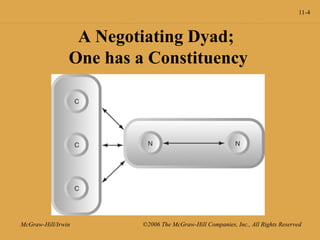
• Agents and Constituencies
– A negotiator is not acting for himself but for
others. We will call the negotiator in such
situations an agent and the individuals he is
representing a constituency
11-4
McGraw-Hill/Irwin ©2006 The McGraw-Hill Companies, Inc., All Rights Reserved
A Negotiating Dyad;
One has a Constituency
11-5
McGraw-Hill/Irwin ©2006 The McGraw-Hill Companies, Inc., All Rights Reserved
Bystanders and Audiences
• Bystanders
– Those who have some stake in a negotiation, care about the
issues or the process by which a resolution is reached
– Negotiators do not formally represent bystanders
• Audience
– Any individual or group of people not directly involved in or
affected by a negotiation
– They may offer:
• Input
• Advice
• Criticism
11-6
McGraw-Hill/Irwin ©2006 The McGraw-Hill Companies, Inc., All Rights Reserved
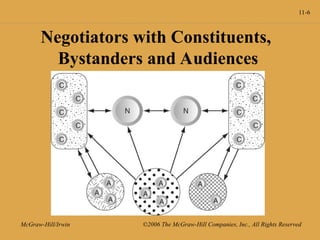
Negotiators with Constituents,
Bystanders and Audiences
11-7
McGraw-Hill/Irwin ©2006 The McGraw-Hill Companies, Inc., All Rights Reserved
Third Parties
• Third parties
– Bystanders who may be drawn into the negotiation
specifically for the purpose of helping to resolve it
– Third parties often can reshape a polarized
situation into a constructive agreement
11-8
McGraw-Hill/Irwin ©2006 The McGraw-Hill Companies, Inc., All Rights Reserved
How Agents, Constituents and
Audiences Change Negotiations
• The first negotiating relationship is between the agent and
constituent who must decide on their collective view of what
they want to achieve in the negotiation
• The second relationship is with the other party – the negotiator
and the opposing negotiator who attempt to reach a viable and
effective agreement
• The third type of relationship is composed of external
bystanders and observers.
– They are affected by the negotiation outcome or have a vantage point
from which to observe it
– They have some strong need to comment on the process or the
emerging outcome.
11-9
McGraw-Hill/Irwin ©2006 The McGraw-Hill Companies, Inc., All Rights Reserved
How Agents, Constituents and
Audiences Change Negotiations
Characteristics of audiences:
• Audiences may or may not be dependent on the negotiators for
the outcomes derived from the negotiation process
• Audiences affect negotiations by the degree of their
involvement in the process
– Direct involvement
– Indirect involvement
• Audiences may vary in identity; composition; size;
relationship to the negotiator, and role in the negotiation
situation
11-10
McGraw-Hill/Irwin ©2006 The McGraw-Hill Companies, Inc., All Rights Reserved
How Agents, Constituents and
Audiences Change Negotiations
• Audiences make negotiators “try harder”
• Negotiators seek a positive reaction from an
audience
• Pressures from audiences can push negotiators
into “irrational” behavior
• Audiences hold the negotiator accountable
11-11
McGraw-Hill/Irwin ©2006 The McGraw-Hill Companies, Inc., All Rights Reserved
Tactical Implications of Social Structure
Dynamics: The Negotiator’s Dilemma
Question: How can a negotiator satisfy both the
constituency’s demands for firmness (and a
settlement favorable to their interests), versus the
other party’s demand for concessions (and a
settlement favorable to the other party or to their
mutual gain)?
Answer: A negotiator must build relationships with
both the constituency and the other party
11-12
McGraw-Hill/Irwin ©2006 The McGraw-Hill Companies, Inc., All Rights Reserved
Common Tactics for Managing
Constituencies and Audiences
• Manage constituency visibility
– Limit one’s own concessions by making
negotiations visible
– Use the constituency to show militancy
– Use the constituency to limit one’s own
authority
– Use great caution in exceeding one’s
authority
11-13
McGraw-Hill/Irwin ©2006 The McGraw-Hill Companies, Inc., All Rights Reserved
Common Tactics for Managing
Constituencies and Audiences
• Manage constituency visibility
– Increase the possibility of concession to the
other negotiator by reducing visibility to
constituencies
• Establish “privacy” prior to the beginning of
negotiations
• Screen visibility during negotiations
• Be aware of time pressure
– Establish a reputation for cooperation
11-14
McGraw-Hill/Irwin ©2006 The McGraw-Hill Companies, Inc., All Rights Reserved
Common Tactics for Managing
Constituencies and Audiences
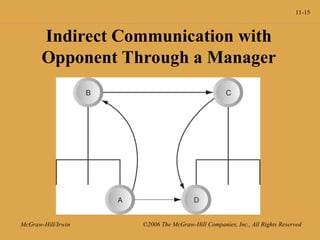
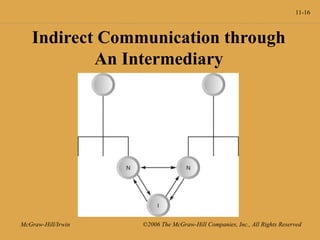
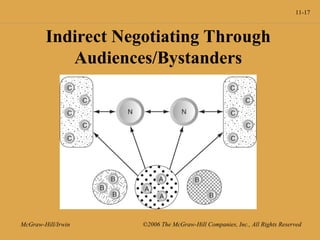
• Communicate indirectly with audiences and
constituents
– Communicate through superiors
– Communicate through intermediaries
• Communicate directly to the other party’s
constituency
• Communicate directly to bystanders
• Build relationships with audiences,
constituents and other agents
11-15
McGraw-Hill/Irwin ©2006 The McGraw-Hill Companies, Inc., All Rights Reserved
Indirect Communication with
Opponent Through a Manager
11-16
McGraw-Hill/Irwin ©2006 The McGraw-Hill Companies, Inc., All Rights Reserved
Indirect Communication through
An Intermediary
11-17
McGraw-Hill/Irwin ©2006 The McGraw-Hill Companies, Inc., All Rights Reserved
Indirect Negotiating Through
Audiences/Bystanders
11-18
McGraw-Hill/Irwin ©2006 The McGraw-Hill Companies, Inc., All Rights Reserved
When to Use an Agent
• When the agent has distinct or unique
knowledge or skills in the issues
• When the agent has better negotiation skills
• When the agent has special friends, relationships
or connections
• When you are very emotionally involved in an
issue or problem
• When you want the flexibility to use negotiation
tactics that require several parties
• When your natural conflict management style is
to compromise, accommodate or avoid
11-19
McGraw-Hill/Irwin ©2006 The McGraw-Hill Companies, Inc., All Rights Reserved
When to Negotiate for Yourself
• When you want to develop or reestablish a strong personal
relationship with the other negotiator
• When you need to repair a damaged relationship
• When you want to learn a lot before you craft an agreement
• When your negotiation skills are better than those of any
available agent
• When hiring an agent may be too costly
• When the “image” of being represented by an agent may make
the other side suspicious
• When the agent is too emotionally involved, defensive and
caught up in game playing
11-20
McGraw-Hill/Irwin ©2006 The McGraw-Hill Companies, Inc., All Rights Reserved
Advice for Managing Agents
1. The agent should have no authority to make a binding
commitment on any substantive issues
2. The agent should have the discretion to design and
develop an effective overall negotiation process
3. The constituent should focus communication to the
agent on interests, priorities, and alternatives, rather than
specific settlement points
4. The constituent should establish clear expectations about
the frequency and quality of reporting back to the
constituent
11-21
McGraw-Hill/Irwin ©2006 The McGraw-Hill Companies, Inc., All Rights Reserved
Advice for Managing Agents
5. The agent’s authority should expand as the agent and
constituent gain insight about the other parties through
the negotiation process
6. Specific instructions to the agent by constituents should
be put in writing and be available to show to the other
side
7. The constituent should instruct the agent on what the
agent can disclose in negotiation
--interests, ranges of acceptable settlement, key facts, the
principal’s identity, etc

Ch 11 - Agents, Constituencies, Audiences.ppt

  • 1.
    11-1 McGraw-Hill/Irwin ©2006 TheMcGraw-Hill Companies, Inc., All Rights Reserved CHAPTER ELEVEN Agents, Constituencies, Audiences
  • 2.
    11-2 McGraw-Hill/Irwin ©2006 TheMcGraw-Hill Companies, Inc., All Rights Reserved The Number of Parties in a Negotiation The basic possible roles for parties in a negotiation: • A negotiating dyad • Negotiating teams • Agents and constituencies • Unrepresented bystanders and audiences • Third parties
  • 3.
    11-3 McGraw-Hill/Irwin ©2006 TheMcGraw-Hill Companies, Inc., All Rights Reserved A Negotiating Dyad and Agents and Constituencies • A Negotiating Dyad – When two isolated individuals negotiate for their own needs and interests • Agents and Constituencies – A negotiator is not acting for himself but for others. We will call the negotiator in such situations an agent and the individuals he is representing a constituency
  • 4.
    11-4 McGraw-Hill/Irwin ©2006 TheMcGraw-Hill Companies, Inc., All Rights Reserved A Negotiating Dyad; One has a Constituency
  • 5.
    11-5 McGraw-Hill/Irwin ©2006 TheMcGraw-Hill Companies, Inc., All Rights Reserved Bystanders and Audiences • Bystanders – Those who have some stake in a negotiation, care about the issues or the process by which a resolution is reached – Negotiators do not formally represent bystanders • Audience – Any individual or group of people not directly involved in or affected by a negotiation – They may offer: • Input • Advice • Criticism
  • 6.
    11-6 McGraw-Hill/Irwin ©2006 TheMcGraw-Hill Companies, Inc., All Rights Reserved Negotiators with Constituents, Bystanders and Audiences
  • 7.
    11-7 McGraw-Hill/Irwin ©2006 TheMcGraw-Hill Companies, Inc., All Rights Reserved Third Parties • Third parties – Bystanders who may be drawn into the negotiation specifically for the purpose of helping to resolve it – Third parties often can reshape a polarized situation into a constructive agreement
  • 8.
    11-8 McGraw-Hill/Irwin ©2006 TheMcGraw-Hill Companies, Inc., All Rights Reserved How Agents, Constituents and Audiences Change Negotiations • The first negotiating relationship is between the agent and constituent who must decide on their collective view of what they want to achieve in the negotiation • The second relationship is with the other party – the negotiator and the opposing negotiator who attempt to reach a viable and effective agreement • The third type of relationship is composed of external bystanders and observers. – They are affected by the negotiation outcome or have a vantage point from which to observe it – They have some strong need to comment on the process or the emerging outcome.
  • 9.
    11-9 McGraw-Hill/Irwin ©2006 TheMcGraw-Hill Companies, Inc., All Rights Reserved How Agents, Constituents and Audiences Change Negotiations Characteristics of audiences: • Audiences may or may not be dependent on the negotiators for the outcomes derived from the negotiation process • Audiences affect negotiations by the degree of their involvement in the process – Direct involvement – Indirect involvement • Audiences may vary in identity; composition; size; relationship to the negotiator, and role in the negotiation situation
  • 10.
    11-10 McGraw-Hill/Irwin ©2006 TheMcGraw-Hill Companies, Inc., All Rights Reserved How Agents, Constituents and Audiences Change Negotiations • Audiences make negotiators “try harder” • Negotiators seek a positive reaction from an audience • Pressures from audiences can push negotiators into “irrational” behavior • Audiences hold the negotiator accountable
  • 11.
    11-11 McGraw-Hill/Irwin ©2006 TheMcGraw-Hill Companies, Inc., All Rights Reserved Tactical Implications of Social Structure Dynamics: The Negotiator’s Dilemma Question: How can a negotiator satisfy both the constituency’s demands for firmness (and a settlement favorable to their interests), versus the other party’s demand for concessions (and a settlement favorable to the other party or to their mutual gain)? Answer: A negotiator must build relationships with both the constituency and the other party
  • 12.
    11-12 McGraw-Hill/Irwin ©2006 TheMcGraw-Hill Companies, Inc., All Rights Reserved Common Tactics for Managing Constituencies and Audiences • Manage constituency visibility – Limit one’s own concessions by making negotiations visible – Use the constituency to show militancy – Use the constituency to limit one’s own authority – Use great caution in exceeding one’s authority
  • 13.
    11-13 McGraw-Hill/Irwin ©2006 TheMcGraw-Hill Companies, Inc., All Rights Reserved Common Tactics for Managing Constituencies and Audiences • Manage constituency visibility – Increase the possibility of concession to the other negotiator by reducing visibility to constituencies • Establish “privacy” prior to the beginning of negotiations • Screen visibility during negotiations • Be aware of time pressure – Establish a reputation for cooperation
  • 14.
    11-14 McGraw-Hill/Irwin ©2006 TheMcGraw-Hill Companies, Inc., All Rights Reserved Common Tactics for Managing Constituencies and Audiences • Communicate indirectly with audiences and constituents – Communicate through superiors – Communicate through intermediaries • Communicate directly to the other party’s constituency • Communicate directly to bystanders • Build relationships with audiences, constituents and other agents
  • 15.
    11-15 McGraw-Hill/Irwin ©2006 TheMcGraw-Hill Companies, Inc., All Rights Reserved Indirect Communication with Opponent Through a Manager
  • 16.
    11-16 McGraw-Hill/Irwin ©2006 TheMcGraw-Hill Companies, Inc., All Rights Reserved Indirect Communication through An Intermediary
  • 17.
    11-17 McGraw-Hill/Irwin ©2006 TheMcGraw-Hill Companies, Inc., All Rights Reserved Indirect Negotiating Through Audiences/Bystanders
  • 18.
    11-18 McGraw-Hill/Irwin ©2006 TheMcGraw-Hill Companies, Inc., All Rights Reserved When to Use an Agent • When the agent has distinct or unique knowledge or skills in the issues • When the agent has better negotiation skills • When the agent has special friends, relationships or connections • When you are very emotionally involved in an issue or problem • When you want the flexibility to use negotiation tactics that require several parties • When your natural conflict management style is to compromise, accommodate or avoid
  • 19.
    11-19 McGraw-Hill/Irwin ©2006 TheMcGraw-Hill Companies, Inc., All Rights Reserved When to Negotiate for Yourself • When you want to develop or reestablish a strong personal relationship with the other negotiator • When you need to repair a damaged relationship • When you want to learn a lot before you craft an agreement • When your negotiation skills are better than those of any available agent • When hiring an agent may be too costly • When the “image” of being represented by an agent may make the other side suspicious • When the agent is too emotionally involved, defensive and caught up in game playing
  • 20.
    11-20 McGraw-Hill/Irwin ©2006 TheMcGraw-Hill Companies, Inc., All Rights Reserved Advice for Managing Agents 1. The agent should have no authority to make a binding commitment on any substantive issues 2. The agent should have the discretion to design and develop an effective overall negotiation process 3. The constituent should focus communication to the agent on interests, priorities, and alternatives, rather than specific settlement points 4. The constituent should establish clear expectations about the frequency and quality of reporting back to the constituent
  • 21.
    11-21 McGraw-Hill/Irwin ©2006 TheMcGraw-Hill Companies, Inc., All Rights Reserved Advice for Managing Agents 5. The agent’s authority should expand as the agent and constituent gain insight about the other parties through the negotiation process 6. Specific instructions to the agent by constituents should be put in writing and be available to show to the other side 7. The constituent should instruct the agent on what the agent can disclose in negotiation --interests, ranges of acceptable settlement, key facts, the principal’s identity, etc