NEGOTIATION AS A MECHANISM OF OUTSIDE
COURT SETTLEMENT OF THE DISPUTES
BY
DR. VIJAY SRIVASTAVA
ASSOCIATE PROFESSOR
LAW COLLEGE DEHRADUN,
UTTARANCHAL UNIVERSITY
SYNOPSIS
 Introduction
 Meaning
 Essential features
 Stages of Negotiation
 Negotiation Styles or attributes of negotiators.
 Techniques of Negotiations
 Forms of Negotiations
 Scope
 Conclusion
INTRODUCTION
 In any disagreement, individuals understandably aim to achieve the best
possible outcome for their position (or perhaps an organisation they
represent). However, the principles of fairness, seeking mutual benefit and
maintaining a relationship are the keys to a successful outcome.
 Negotiation is a method by which people settle differences. It is a process
by which compromise or agreement is reached while avoiding argument and
dispute.
 Negotiation is a means of resolving differences between people. In the
process of negotiation, not only are different opinions taken into account,
but also individual needs, aims, interests and differences in background and
culture.
NEGOTIATION- MEANING
 Negotiation doesn’t have any statutory recognition i.e through way of
legislation. Negotiation is self counseling between the parties to resolve
their dispute.
 The word "negotiation" is from the Latin expression, "negotiatus", past
participle of negotiare which means "to carry on business". "Negotium"
means literally "not leisure". Negotiation is a process that has no fixed
rules but follows a predictable pattern.
 Negotiation is the simplest means for redressal of disputes. In this mode
the parties begin their talk without interference of any third person. The
aim of negotiation is the settlement of disputes by exchange of views
and issues concerning the parties.
ESSENTIAL FEATURES
 Voluntary: No party is forced to participate in a negotiation. The parties are
free to accept or reject the outcome of negotiations and can withdraw at any
point during the process.
 Bilateral/Multilateral: Negotiations can involve two, three or dozens of
parties.
 Non-adjudicative: Negotiation involves only the parties. The outcome of a
negotiation is reached by the parties together without recourse to a third-
party neutral.
 Informal: There are no prescribed rules in negotiation. The parties are free
to adopt whatever rules they choose.
 Confidential: The parties have the option of negotiating publicly or
privately.
 Flexible: The scope of a negotiation depends on the choice of the parties.
The parties can determine not only the topic or the topics that will be the
subject of the negotiations, but also whether they will adopt a positional-
based bargaining approach or an interest-based approach.
 Non- Binding process.
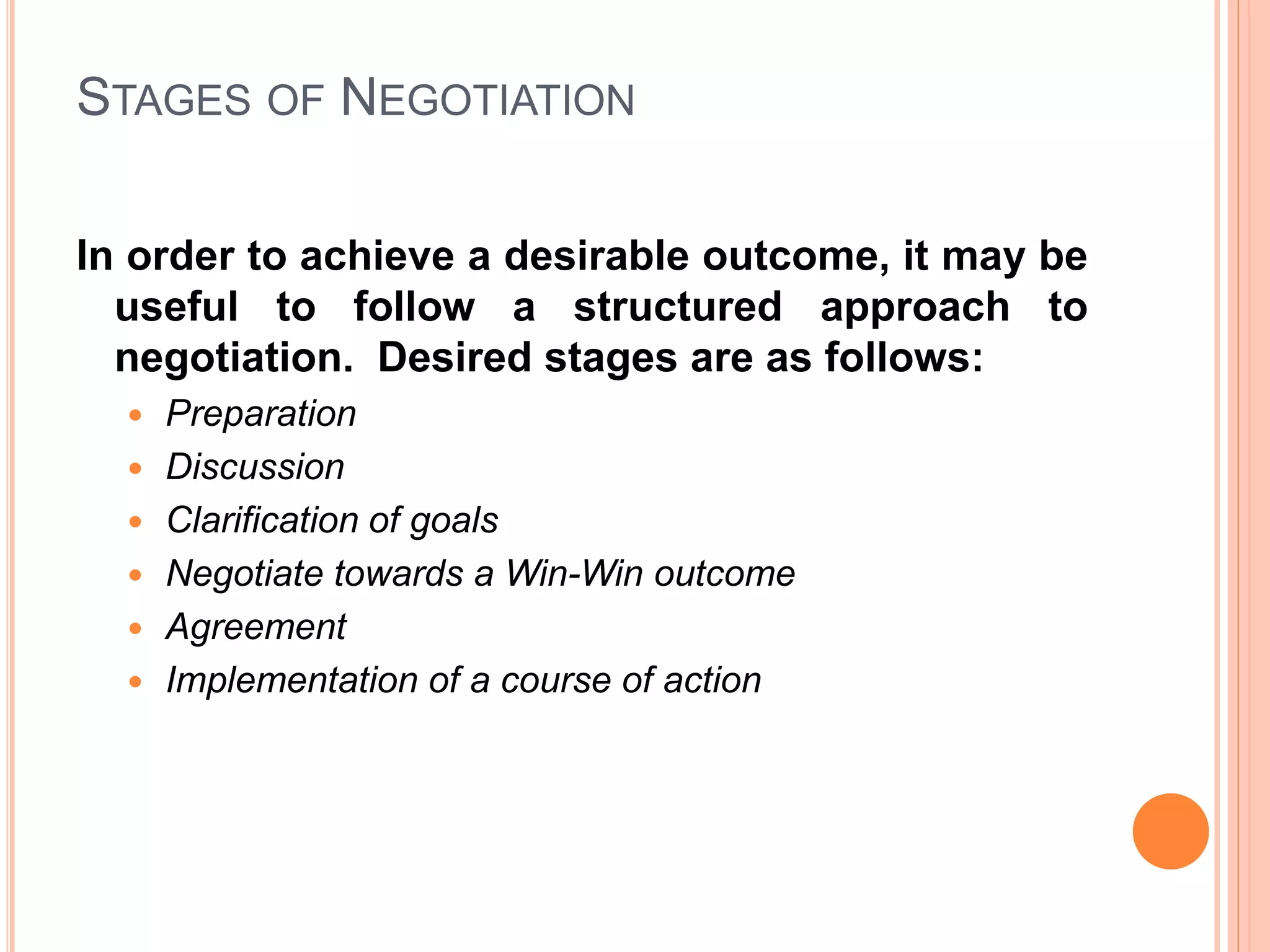
STAGES OF NEGOTIATION
In order to achieve a desirable outcome, it may be
useful to follow a structured approach to
negotiation. Desired stages are as follows:
 Preparation
 Discussion
 Clarification of goals
 Negotiate towards a Win-Win outcome
 Agreement
 Implementation of a course of action
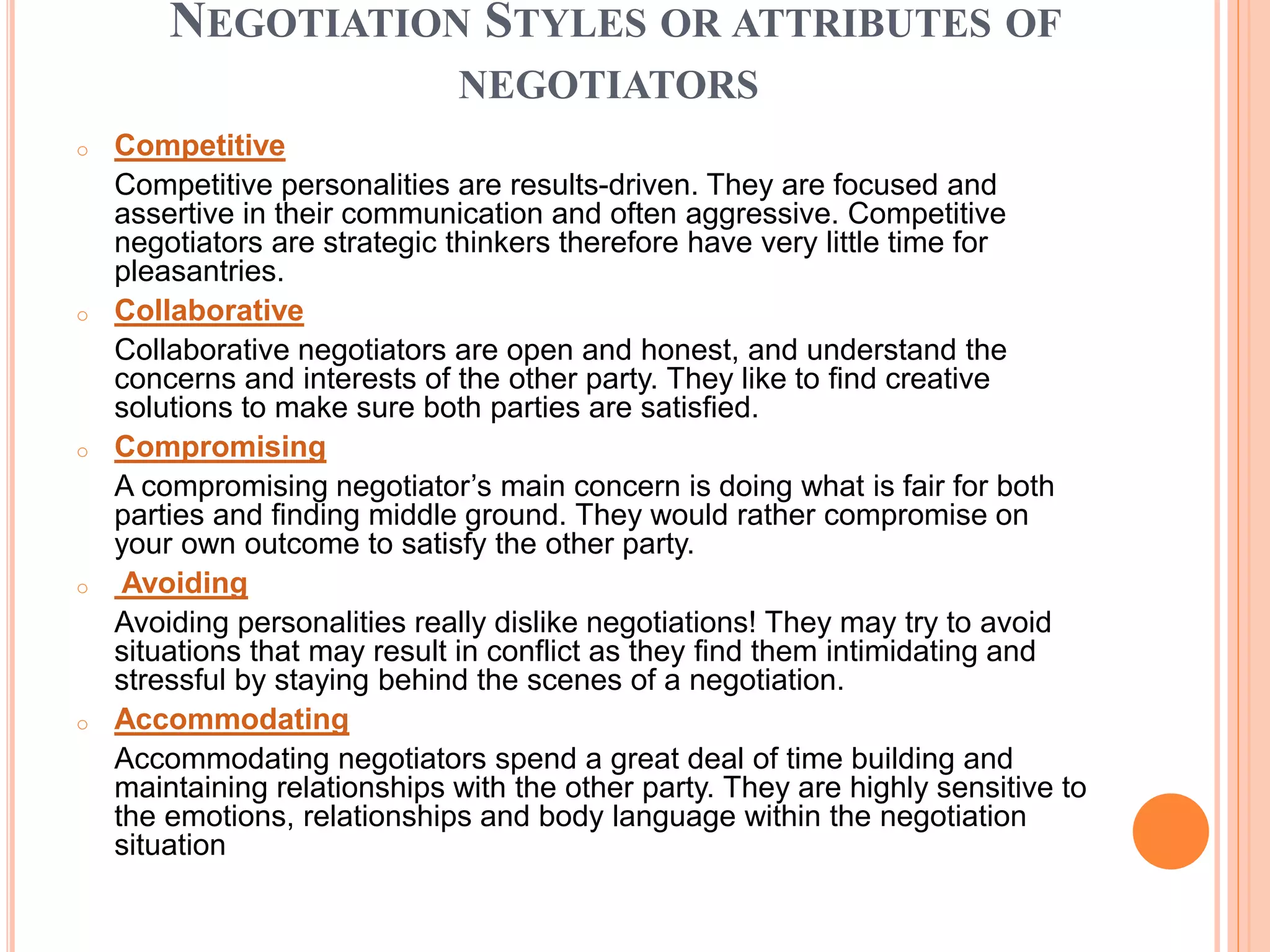
NEGOTIATION STYLES OR ATTRIBUTES OF
NEGOTIATORS
o Competitive
Competitive personalities are results-driven. They are focused and
assertive in their communication and often aggressive. Competitive
negotiators are strategic thinkers therefore have very little time for
pleasantries.
o Collaborative
Collaborative negotiators are open and honest, and understand the
concerns and interests of the other party. They like to find creative
solutions to make sure both parties are satisfied.
o Compromising
A compromising negotiator’s main concern is doing what is fair for both
parties and finding middle ground. They would rather compromise on
your own outcome to satisfy the other party.
o Avoiding
Avoiding personalities really dislike negotiations! They may try to avoid
situations that may result in conflict as they find them intimidating and
stressful by staying behind the scenes of a negotiation.
o Accommodating
Accommodating negotiators spend a great deal of time building and
maintaining relationships with the other party. They are highly sensitive to
the emotions, relationships and body language within the negotiation
situation
NEGOTIATION TECHNIQUES:
 Prepare, prepare, prepare.
 Pay attention to timing.
 Leave behind your ego.
 Ramp up your listening skills.
 If you don’t ask, you don’t get.
 Anticipate compromise.
 Offer and expect commitment.
 Don’t absorb their problems.
 Stick to your principles.
 Close with confirmation.
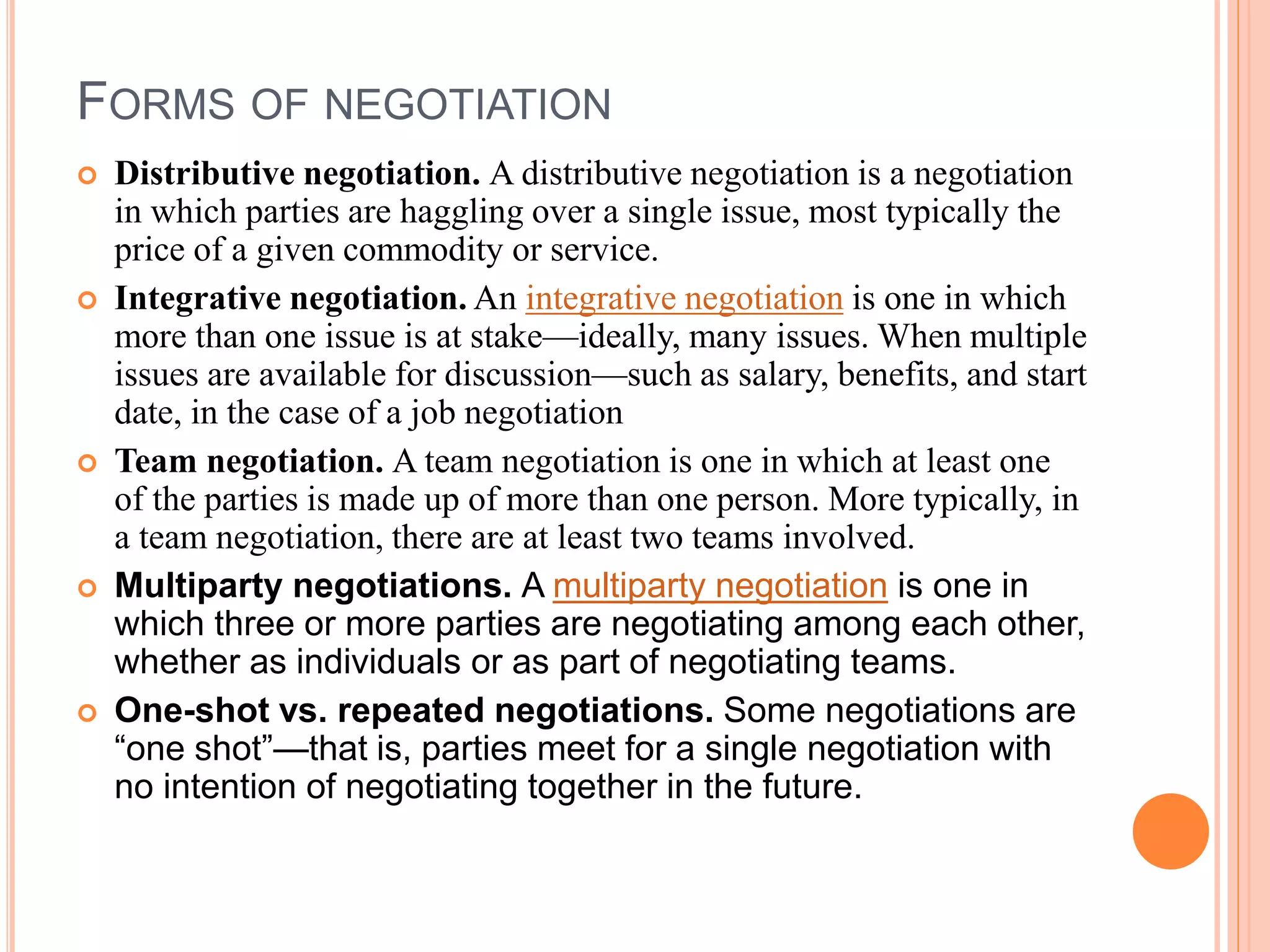
FORMS OF NEGOTIATION
 Distributive negotiation. A distributive negotiation is a negotiation
in which parties are haggling over a single issue, most typically the
price of a given commodity or service.
 Integrative negotiation. An integrative negotiation is one in which
more than one issue is at stake—ideally, many issues. When multiple
issues are available for discussion—such as salary, benefits, and start
date, in the case of a job negotiation
 Team negotiation. A team negotiation is one in which at least one
of the parties is made up of more than one person. More typically, in
a team negotiation, there are at least two teams involved.
 Multiparty negotiations. A multiparty negotiation is one in
which three or more parties are negotiating among each other,
whether as individuals or as part of negotiating teams.
 One-shot vs. repeated negotiations. Some negotiations are
“one shot”—that is, parties meet for a single negotiation with
no intention of negotiating together in the future.
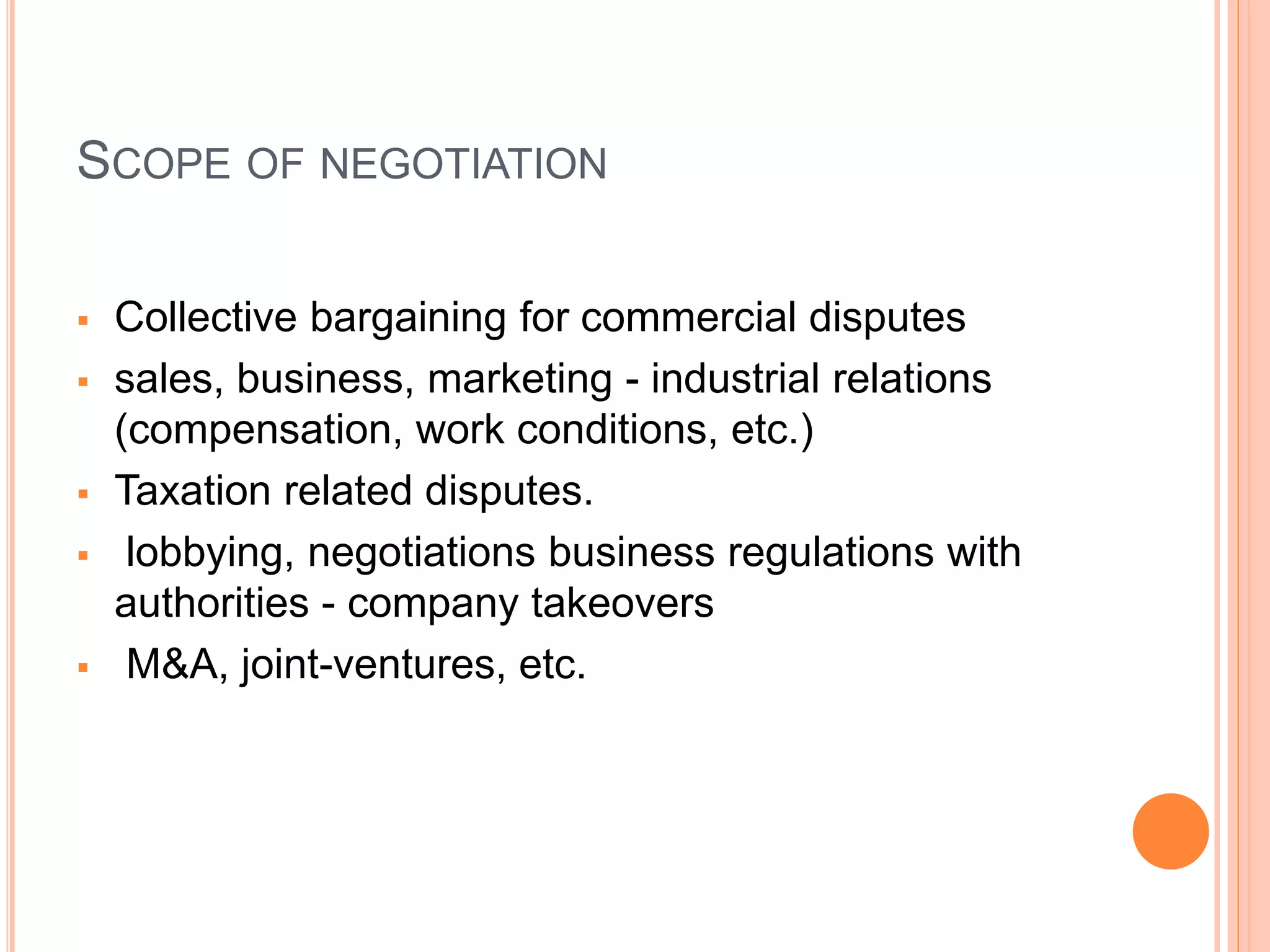
SCOPE OF NEGOTIATION
 Collective bargaining for commercial disputes
 sales, business, marketing - industrial relations
(compensation, work conditions, etc.)
 Taxation related disputes.
 lobbying, negotiations business regulations with
authorities - company takeovers
 M&A, joint-ventures, etc.
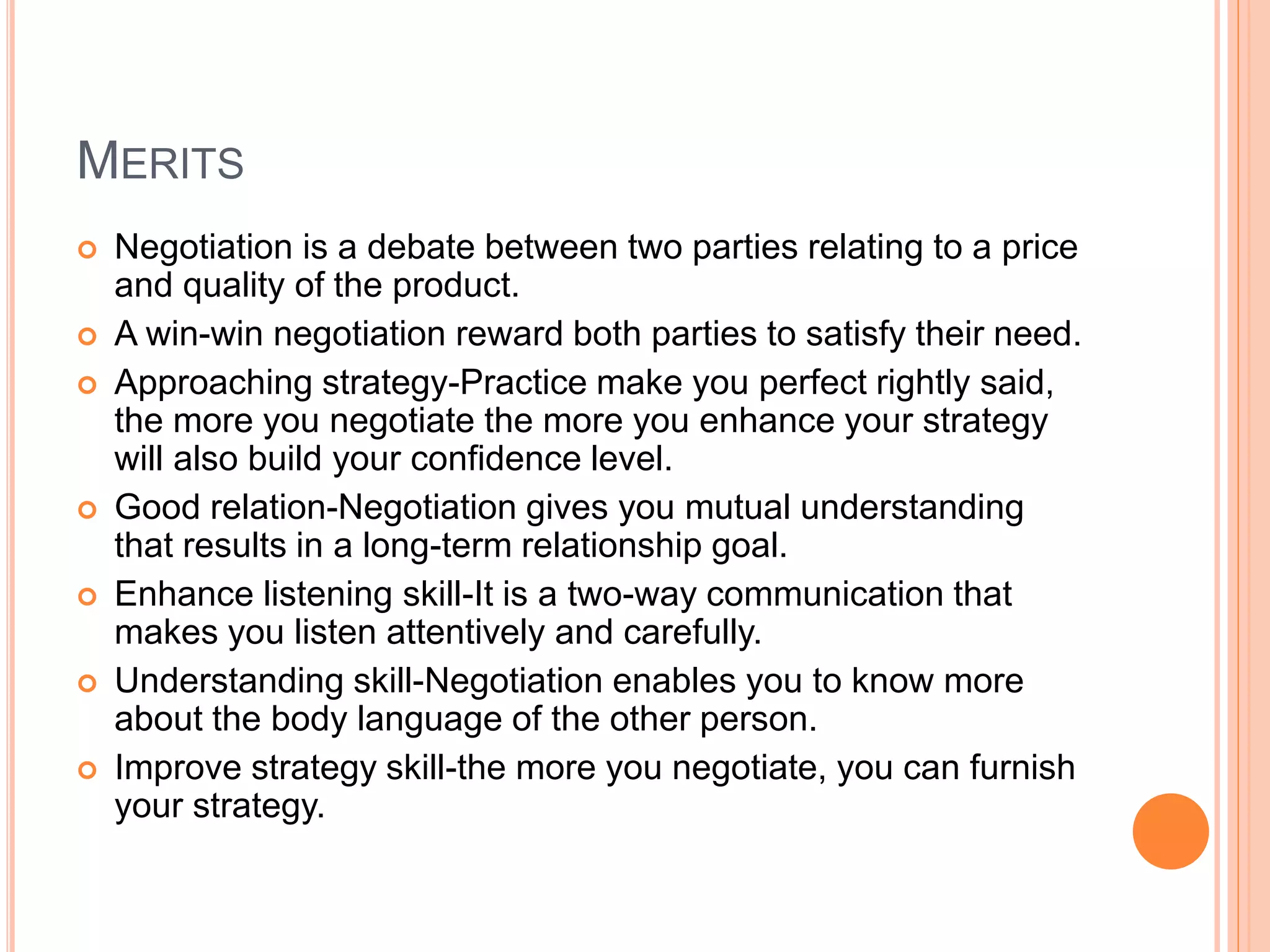
MERITS
 Negotiation is a debate between two parties relating to a price
and quality of the product.
 A win-win negotiation reward both parties to satisfy their need.
 Approaching strategy-Practice make you perfect rightly said,
the more you negotiate the more you enhance your strategy
will also build your confidence level.
 Good relation-Negotiation gives you mutual understanding
that results in a long-term relationship goal.
 Enhance listening skill-It is a two-way communication that
makes you listen attentively and carefully.
 Understanding skill-Negotiation enables you to know more
about the body language of the other person.
 Improve strategy skill-the more you negotiate, you can furnish
your strategy.
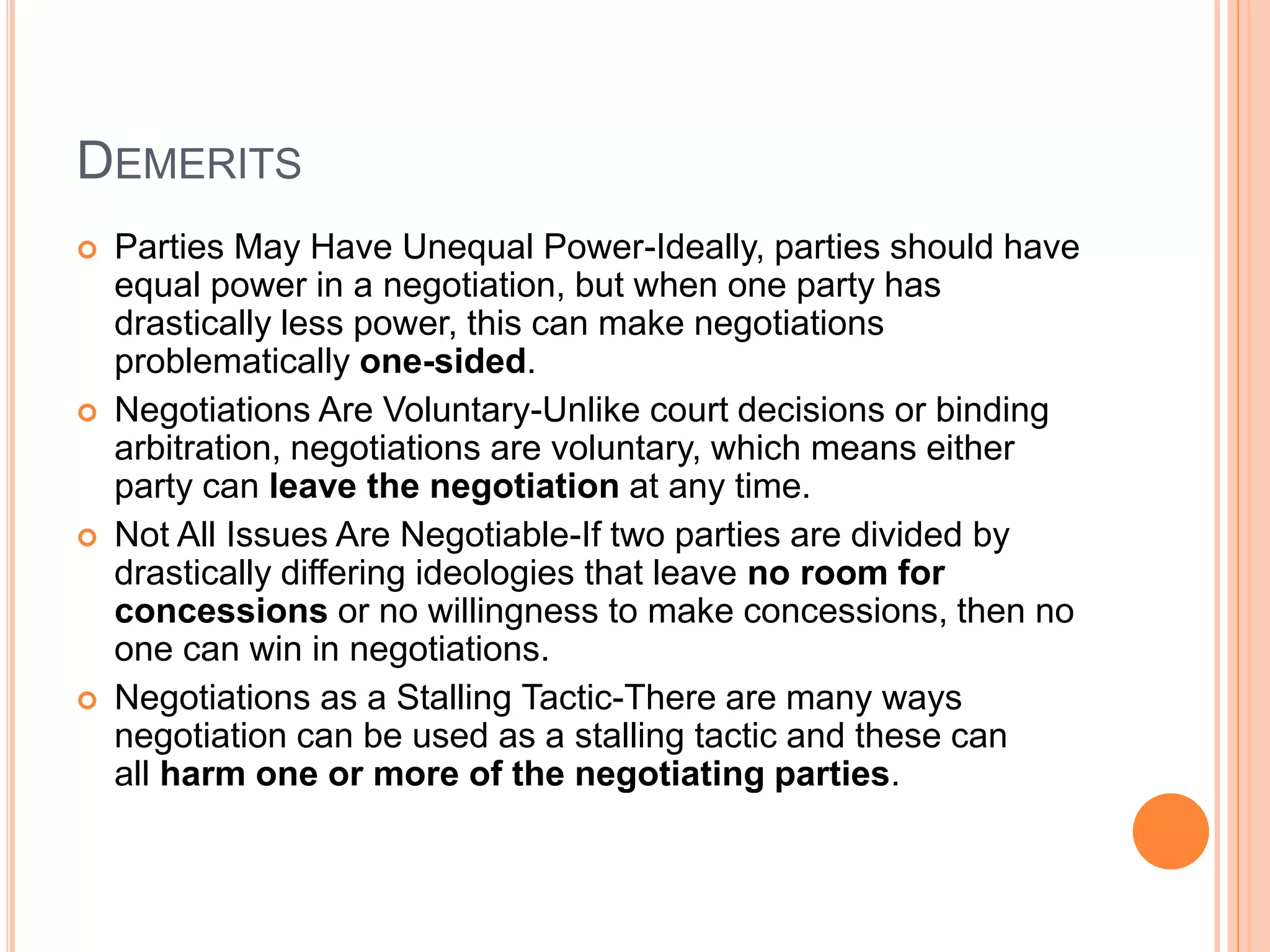
DEMERITS
 Parties May Have Unequal Power-Ideally, parties should have
equal power in a negotiation, but when one party has
drastically less power, this can make negotiations
problematically one-sided.
 Negotiations Are Voluntary-Unlike court decisions or binding
arbitration, negotiations are voluntary, which means either
party can leave the negotiation at any time.
 Not All Issues Are Negotiable-If two parties are divided by
drastically differing ideologies that leave no room for
concessions or no willingness to make concessions, then no
one can win in negotiations.
 Negotiations as a Stalling Tactic-There are many ways
negotiation can be used as a stalling tactic and these can
all harm one or more of the negotiating parties.
CONCLUSION
As an option for dispute settlement, a Successful
negotiation requires an impeccable sense of timing,
creativity, keen awareness and the ability to anticipate
the other party’s next move. Negotiation is similar to
chess in that each move should be designed to set up
not only your next move, but several moves down the
line. Generally, your moves should get progressively
smaller, and you can expect the same from the other
party.
Thank you

Ppt on negotiation in india

  • 1.
    NEGOTIATION AS AMECHANISM OF OUTSIDE COURT SETTLEMENT OF THE DISPUTES BY DR. VIJAY SRIVASTAVA ASSOCIATE PROFESSOR LAW COLLEGE DEHRADUN, UTTARANCHAL UNIVERSITY
  • 2.
    SYNOPSIS  Introduction  Meaning Essential features  Stages of Negotiation  Negotiation Styles or attributes of negotiators.  Techniques of Negotiations  Forms of Negotiations  Scope  Conclusion
  • 3.
    INTRODUCTION  In anydisagreement, individuals understandably aim to achieve the best possible outcome for their position (or perhaps an organisation they represent). However, the principles of fairness, seeking mutual benefit and maintaining a relationship are the keys to a successful outcome.  Negotiation is a method by which people settle differences. It is a process by which compromise or agreement is reached while avoiding argument and dispute.  Negotiation is a means of resolving differences between people. In the process of negotiation, not only are different opinions taken into account, but also individual needs, aims, interests and differences in background and culture.
  • 4.
    NEGOTIATION- MEANING  Negotiationdoesn’t have any statutory recognition i.e through way of legislation. Negotiation is self counseling between the parties to resolve their dispute.  The word "negotiation" is from the Latin expression, "negotiatus", past participle of negotiare which means "to carry on business". "Negotium" means literally "not leisure". Negotiation is a process that has no fixed rules but follows a predictable pattern.  Negotiation is the simplest means for redressal of disputes. In this mode the parties begin their talk without interference of any third person. The aim of negotiation is the settlement of disputes by exchange of views and issues concerning the parties.
  • 5.
    ESSENTIAL FEATURES  Voluntary:No party is forced to participate in a negotiation. The parties are free to accept or reject the outcome of negotiations and can withdraw at any point during the process.  Bilateral/Multilateral: Negotiations can involve two, three or dozens of parties.  Non-adjudicative: Negotiation involves only the parties. The outcome of a negotiation is reached by the parties together without recourse to a third- party neutral.  Informal: There are no prescribed rules in negotiation. The parties are free to adopt whatever rules they choose.  Confidential: The parties have the option of negotiating publicly or privately.  Flexible: The scope of a negotiation depends on the choice of the parties. The parties can determine not only the topic or the topics that will be the subject of the negotiations, but also whether they will adopt a positional- based bargaining approach or an interest-based approach.  Non- Binding process.
  • 6.
    STAGES OF NEGOTIATION Inorder to achieve a desirable outcome, it may be useful to follow a structured approach to negotiation. Desired stages are as follows:  Preparation  Discussion  Clarification of goals  Negotiate towards a Win-Win outcome  Agreement  Implementation of a course of action
  • 7.
    NEGOTIATION STYLES ORATTRIBUTES OF NEGOTIATORS o Competitive Competitive personalities are results-driven. They are focused and assertive in their communication and often aggressive. Competitive negotiators are strategic thinkers therefore have very little time for pleasantries. o Collaborative Collaborative negotiators are open and honest, and understand the concerns and interests of the other party. They like to find creative solutions to make sure both parties are satisfied. o Compromising A compromising negotiator’s main concern is doing what is fair for both parties and finding middle ground. They would rather compromise on your own outcome to satisfy the other party. o Avoiding Avoiding personalities really dislike negotiations! They may try to avoid situations that may result in conflict as they find them intimidating and stressful by staying behind the scenes of a negotiation. o Accommodating Accommodating negotiators spend a great deal of time building and maintaining relationships with the other party. They are highly sensitive to the emotions, relationships and body language within the negotiation situation
  • 8.
    NEGOTIATION TECHNIQUES:  Prepare,prepare, prepare.  Pay attention to timing.  Leave behind your ego.  Ramp up your listening skills.  If you don’t ask, you don’t get.  Anticipate compromise.  Offer and expect commitment.  Don’t absorb their problems.  Stick to your principles.  Close with confirmation.
  • 9.
    FORMS OF NEGOTIATION Distributive negotiation. A distributive negotiation is a negotiation in which parties are haggling over a single issue, most typically the price of a given commodity or service.  Integrative negotiation. An integrative negotiation is one in which more than one issue is at stake—ideally, many issues. When multiple issues are available for discussion—such as salary, benefits, and start date, in the case of a job negotiation  Team negotiation. A team negotiation is one in which at least one of the parties is made up of more than one person. More typically, in a team negotiation, there are at least two teams involved.  Multiparty negotiations. A multiparty negotiation is one in which three or more parties are negotiating among each other, whether as individuals or as part of negotiating teams.  One-shot vs. repeated negotiations. Some negotiations are “one shot”—that is, parties meet for a single negotiation with no intention of negotiating together in the future.
  • 10.
    SCOPE OF NEGOTIATION Collective bargaining for commercial disputes  sales, business, marketing - industrial relations (compensation, work conditions, etc.)  Taxation related disputes.  lobbying, negotiations business regulations with authorities - company takeovers  M&A, joint-ventures, etc.
  • 11.
    MERITS  Negotiation isa debate between two parties relating to a price and quality of the product.  A win-win negotiation reward both parties to satisfy their need.  Approaching strategy-Practice make you perfect rightly said, the more you negotiate the more you enhance your strategy will also build your confidence level.  Good relation-Negotiation gives you mutual understanding that results in a long-term relationship goal.  Enhance listening skill-It is a two-way communication that makes you listen attentively and carefully.  Understanding skill-Negotiation enables you to know more about the body language of the other person.  Improve strategy skill-the more you negotiate, you can furnish your strategy.
  • 12.
    DEMERITS  Parties MayHave Unequal Power-Ideally, parties should have equal power in a negotiation, but when one party has drastically less power, this can make negotiations problematically one-sided.  Negotiations Are Voluntary-Unlike court decisions or binding arbitration, negotiations are voluntary, which means either party can leave the negotiation at any time.  Not All Issues Are Negotiable-If two parties are divided by drastically differing ideologies that leave no room for concessions or no willingness to make concessions, then no one can win in negotiations.  Negotiations as a Stalling Tactic-There are many ways negotiation can be used as a stalling tactic and these can all harm one or more of the negotiating parties.
  • 13.
    CONCLUSION As an optionfor dispute settlement, a Successful negotiation requires an impeccable sense of timing, creativity, keen awareness and the ability to anticipate the other party’s next move. Negotiation is similar to chess in that each move should be designed to set up not only your next move, but several moves down the line. Generally, your moves should get progressively smaller, and you can expect the same from the other party.
  • 14.