JUDITH M. WILKINSON LESLIE S. TREAS
KAREN BARNETT MABLE H. SMITH
FUNDAMENTALS OFFUNDAMENTALS OF
NURSINGNURSING
Copyright © 2016 F.A. Davis Company
Chapter 12:Chapter 12:
Stress & AdaptationStress & Adaptation
Copyright © 2016 F.A. Davis Company
What Is Stress?
• Any disturbance in a person’s normal balanced state
• Unique response by each person to a stressor
• Can be harmful or motivating
Copyright © 2016 F.A. Davis Company
Categories of Stress
Distress
• Can threaten health (e.g., continual financial worries)
Eustress
• Good stress (e.g., passionate kiss)
Developmental
• Associated with life stages (e.g., college graduation)
Copyright © 2016 F.A. Davis Company
Categories of Stress (cont’d)
Situational
• Random, unpredictable (e.g., hurricane, accident)
Physiological
• Affect body: structure/function (e.g., diseases,
mobility problems)
Psychological
• Arise from life events (e.g., work pressure, family arguments)
Copyright © 2016 F.A. Davis Company
ClickerCheck
The hospitalized client states,“I need to know when I’m going to
be discharged. I’m so upset and worried that I’m missing work.”
The nurse knows
a.This is an example of “eustress” and no intervention
is necessary.
b.This is an example of psychological stress and the client should
be placed on antidepressants.
c.This is an example of developmental stress and the client
should talk to someone his own age.
d.This is an example of distress and could affect the client’s
health status.
Copyright © 2016 F.A. Davis Company
ClickerCheck (cont’d)
Correct answer: D
The client’s statement indicates that he is experiencing
distress. Even though it could be termed psychological
stress, it would be inappropriate to simply place the
client on antidepressant therapy without gathering
more data.
Copyright © 2016 F.A. Davis Company
Dealing With Stress: Coping Strategies
• There are three general approaches for coping,
depending on the situation
– Alter the stressor: change jobs
– Adapt to the stressor: change thoughts about
nursing clinicals
– Avoid the stressor: end a relationship
Copyright © 2016 F.A. Davis Company
Styles of Coping Strategies
Adaptive
• Healthy choices
• Directly reduce negative effects of stress
• Examples: change in lifestyle, problem solving
Copyright © 2016 F.A. Davis Company
Styles of Coping Strategies (cont’d)
Maladaptive
• Unhealthy style, temporary fix
• Possibly other harmful effects
• Examples: substance abuse, overeating
Copyright © 2016 F.A. Davis Company
Adaptation
• A possible/desired outcome of stress
• Involves adjusting to the stress/stressor
• Allows for
– Normal growth and development
– Effective responses to life’s challenges
Copyright © 2016 F.A. Davis Company
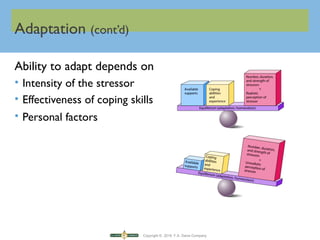
Adaptation (cont’d)
Ability to adapt depends on
• Intensity of the stressor
• Effectiveness of coping skills
• Personal factors
Copyright © 2016 F.A. Davis Company
Factors That Influence Adaptation
Personal perception of stressor
• Is understanding of stressor realistic?
• How successful have previous adaptation attempts been?
Overall health status
• The number of illnesses present and the chronicity of
illnesses may affect the ability to adapt to new stressor(s)
Copyright © 2016 F.A. Davis Company
Factors That Influence Adaptation (cont’d)
Support system (e.g., friends; family providing emotional,
financial, physical help)
• Strong support = better adaptation
Personal factors
• Age
• Developmental level
• Life experiences
Copyright © 2016 F.A. Davis Company
Physical Responses to Stressors
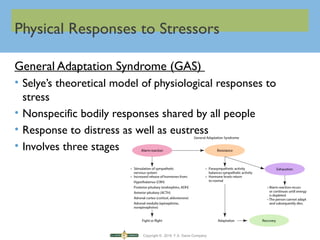
General Adaptation Syndrome (GAS)
• Selye’s theoretical model of physiological responses to
stress
• Nonspecific bodily responses shared by all people
• Response to distress as well as eustress
• Involves three stages
Copyright © 2016 F.A. Davis Company
General Adaptation Syndrome: Stages
Alarm Stage
• Fight or flight
• Involves involuntary body responses
– Endocrine system: CRH,ACTH,ADH
– Sympathetic nervous system: epinephrine, norepinephrine
Copyright © 2016 F.A. Davis Company
General Adaptation Syndrome: Stages (cont’d)
Alarm Stage (cont’d)
– Cardiovascular (CV) system: vasoconstriction, elevated BP
– Respiratory system: dilated bronchioles
– Metabolic: increased availability of glucose
– Urinary: sodium and water retention
– Gastrointestinal (GI): decreased peristalsis
– Musculoskeletal: increased blood flow to muscles
Copyright © 2016 F.A. Davis Company
General Adaptation Syndrome: Stages (cont’d)
Resistance Stage
• Goal: maintenance of homeostasis
• Involves use of coping mechanisms
• Psychological
• Physical  return of vital signs to normal
• Failure to adapt to or contain stress leads to third phase
Copyright © 2016 F.A. Davis Company
General Adaptation Syndrome: Stages (cont’d)
Exhaustion
• If adaptive mechanisms become ineffective/nonexistent
• Decrease in BP, elevated pulse, respiration
• Usually ends in disease or death
Recovery
• Third stage, if adaptation is successful
Copyright © 2016 F.A. Davis Company
ClickerCheck
A client who is taking the drug atenolol (Tenormin)
may not exhibit the expected rise in blood pressure
and pulse during the alarm stage of the general
adaptation syndrome.
a.True
b.False
Copyright © 2016 F.A. Davis Company
ClickerCheck (cont’d)
Correct answer:A
Atenolol is classified as a beta-blocking agent. By
preventing epinephrine from binding to beta
receptors, this drug would “mask” or lessen the
cardiovascular response during the alarm stage.
Copyright © 2016 F.A. Davis Company
Physical Response to Stressors
Local Adaptation Syndrome
• Response to stress involving specific body part, tissue, or
organ
• Short-term attempt to restore homeostasis
• Localized
• Types
– Reflex pain response
– Inflammatory response
Copyright © 2016 F.A. Davis Company
Psychological Responses to Stress
Include feelings, thoughts, and behaviors
• Anxiety and fear
• Ego defense mechanisms (e.g., denial,
rationalization, projection)
• Anger
• Depression
Copyright © 2016 F.A. Davis Company
Consequences of Failed Adaptation
Stress-Induced Organic Responses
• Continual stress
• Repeated central nervous system (CNS) stimulation
• Elevation of certain hormones
• Results in long-term changes in body systems
Copyright © 2016 F.A. Davis Company
Consequences of Failed Adaptation (cont’d)
Somatoform Disorders
• Hypochondriasis
• Somatization
• Somatoform pain disorder
• Malingering
Stress-Induced Psychological Responses
• Crisis
• Burnout
• Post-traumatic stress disorder (PTSD)
Copyright © 2016 F.A. Davis Company
Stress Reduction Interventions
Health Promotion Activities
• Promote adequate nutrition.
• Help the client establish a routine that includes
regular exercise.
• Teach the client the importance of getting 7 to 8 hr of
sleep per day.
Copyright © 2016 F.A. Davis Company
Stress Reduction Interventions (cont’d)
Health Promotion Activities (cont’d)
• Encourage participation in leisure activities.
• Help clients to manage time, balance responsibilities, and
prioritize tasks.
• Advise clients to avoid maladaptive behaviors such as
excess alcohol, caffeine, sweets, smoking, and illicit drugs.
Copyright © 2016 F.A. Davis Company
Stress Reduction Interventions (cont’d)
• Use of specific interventions to relieve anxiety
• Anger management
• Stress management techniques
• Meditation, biofeedback, Reiki, humor, and so forth
• Change perception of self
Copyright © 2016 F.A. Davis Company
Stress Reduction Interventions (cont’d)
• Change perception of stressor.
• Identify and use support systems.
• Use spiritual support.
• Implement crisis intervention.
• Use proper referrals.
Copyright © 2016 F.A. Davis Company
ClickerCheck
The nurse should assess every client to determine if stress
reduction interventions should be part of the plan of care.The
rationale for this action is that
a.There are more persons experiencing mental illness now than
in the past.
b.Life is so much more stressful than it has ever been.
c.The occurrence of stress in clients is unpredictable.
d.Clients often develop maladaptive coping strategies.
Copyright © 2016 F.A. Davis Company
ClickerCheck (cont’d)
Correct answer: C
The nurse recognizes that all clients respond differently
to healthcare interventions.Therefore, it is important
to assess every client’s level of stress to determine if
interventions are required.
Copyright © 2016 F.A. Davis Company
Think Like a Nurse
Review the scenario of Gloria and John (MeetYour Patients inVolume 1).
How much does it really tell you about the clients’ situation?
•Which aspect of stress do you have the most information about: their
stressors, their coping methods and adaptation, their responses to stress, or
their support systems?
•What facts do you have about the clients’ emotional and behavioral
responses to their stressors?
•What information do you have about how well they are coping with stress?
•What data do you have about their support systems? What information do
you need?

Ch12 stress & adaptation

  • 1.
    JUDITH M. WILKINSONLESLIE S. TREAS KAREN BARNETT MABLE H. SMITH FUNDAMENTALS OFFUNDAMENTALS OF NURSINGNURSING Copyright © 2016 F.A. Davis Company Chapter 12:Chapter 12: Stress & AdaptationStress & Adaptation
  • 2.
    Copyright © 2016F.A. Davis Company What Is Stress? • Any disturbance in a person’s normal balanced state • Unique response by each person to a stressor • Can be harmful or motivating
  • 3.
    Copyright © 2016F.A. Davis Company Categories of Stress Distress • Can threaten health (e.g., continual financial worries) Eustress • Good stress (e.g., passionate kiss) Developmental • Associated with life stages (e.g., college graduation)
  • 4.
    Copyright © 2016F.A. Davis Company Categories of Stress (cont’d) Situational • Random, unpredictable (e.g., hurricane, accident) Physiological • Affect body: structure/function (e.g., diseases, mobility problems) Psychological • Arise from life events (e.g., work pressure, family arguments)
  • 5.
    Copyright © 2016F.A. Davis Company ClickerCheck The hospitalized client states,“I need to know when I’m going to be discharged. I’m so upset and worried that I’m missing work.” The nurse knows a.This is an example of “eustress” and no intervention is necessary. b.This is an example of psychological stress and the client should be placed on antidepressants. c.This is an example of developmental stress and the client should talk to someone his own age. d.This is an example of distress and could affect the client’s health status.
  • 6.
    Copyright © 2016F.A. Davis Company ClickerCheck (cont’d) Correct answer: D The client’s statement indicates that he is experiencing distress. Even though it could be termed psychological stress, it would be inappropriate to simply place the client on antidepressant therapy without gathering more data.
  • 7.
    Copyright © 2016F.A. Davis Company Dealing With Stress: Coping Strategies • There are three general approaches for coping, depending on the situation – Alter the stressor: change jobs – Adapt to the stressor: change thoughts about nursing clinicals – Avoid the stressor: end a relationship
  • 8.
    Copyright © 2016F.A. Davis Company Styles of Coping Strategies Adaptive • Healthy choices • Directly reduce negative effects of stress • Examples: change in lifestyle, problem solving
  • 9.
    Copyright © 2016F.A. Davis Company Styles of Coping Strategies (cont’d) Maladaptive • Unhealthy style, temporary fix • Possibly other harmful effects • Examples: substance abuse, overeating
  • 10.
    Copyright © 2016F.A. Davis Company Adaptation • A possible/desired outcome of stress • Involves adjusting to the stress/stressor • Allows for – Normal growth and development – Effective responses to life’s challenges
  • 11.
    Copyright © 2016F.A. Davis Company Adaptation (cont’d) Ability to adapt depends on • Intensity of the stressor • Effectiveness of coping skills • Personal factors
  • 12.
    Copyright © 2016F.A. Davis Company Factors That Influence Adaptation Personal perception of stressor • Is understanding of stressor realistic? • How successful have previous adaptation attempts been? Overall health status • The number of illnesses present and the chronicity of illnesses may affect the ability to adapt to new stressor(s)
  • 13.
    Copyright © 2016F.A. Davis Company Factors That Influence Adaptation (cont’d) Support system (e.g., friends; family providing emotional, financial, physical help) • Strong support = better adaptation Personal factors • Age • Developmental level • Life experiences
  • 14.
    Copyright © 2016F.A. Davis Company Physical Responses to Stressors General Adaptation Syndrome (GAS) • Selye’s theoretical model of physiological responses to stress • Nonspecific bodily responses shared by all people • Response to distress as well as eustress • Involves three stages
  • 15.
    Copyright © 2016F.A. Davis Company General Adaptation Syndrome: Stages Alarm Stage • Fight or flight • Involves involuntary body responses – Endocrine system: CRH,ACTH,ADH – Sympathetic nervous system: epinephrine, norepinephrine
  • 16.
    Copyright © 2016F.A. Davis Company General Adaptation Syndrome: Stages (cont’d) Alarm Stage (cont’d) – Cardiovascular (CV) system: vasoconstriction, elevated BP – Respiratory system: dilated bronchioles – Metabolic: increased availability of glucose – Urinary: sodium and water retention – Gastrointestinal (GI): decreased peristalsis – Musculoskeletal: increased blood flow to muscles
  • 17.
    Copyright © 2016F.A. Davis Company General Adaptation Syndrome: Stages (cont’d) Resistance Stage • Goal: maintenance of homeostasis • Involves use of coping mechanisms • Psychological • Physical  return of vital signs to normal • Failure to adapt to or contain stress leads to third phase
  • 18.
    Copyright © 2016F.A. Davis Company General Adaptation Syndrome: Stages (cont’d) Exhaustion • If adaptive mechanisms become ineffective/nonexistent • Decrease in BP, elevated pulse, respiration • Usually ends in disease or death Recovery • Third stage, if adaptation is successful
  • 19.
    Copyright © 2016F.A. Davis Company ClickerCheck A client who is taking the drug atenolol (Tenormin) may not exhibit the expected rise in blood pressure and pulse during the alarm stage of the general adaptation syndrome. a.True b.False
  • 20.
    Copyright © 2016F.A. Davis Company ClickerCheck (cont’d) Correct answer:A Atenolol is classified as a beta-blocking agent. By preventing epinephrine from binding to beta receptors, this drug would “mask” or lessen the cardiovascular response during the alarm stage.
  • 21.
    Copyright © 2016F.A. Davis Company Physical Response to Stressors Local Adaptation Syndrome • Response to stress involving specific body part, tissue, or organ • Short-term attempt to restore homeostasis • Localized • Types – Reflex pain response – Inflammatory response
  • 22.
    Copyright © 2016F.A. Davis Company Psychological Responses to Stress Include feelings, thoughts, and behaviors • Anxiety and fear • Ego defense mechanisms (e.g., denial, rationalization, projection) • Anger • Depression
  • 23.
    Copyright © 2016F.A. Davis Company Consequences of Failed Adaptation Stress-Induced Organic Responses • Continual stress • Repeated central nervous system (CNS) stimulation • Elevation of certain hormones • Results in long-term changes in body systems
  • 24.
    Copyright © 2016F.A. Davis Company Consequences of Failed Adaptation (cont’d) Somatoform Disorders • Hypochondriasis • Somatization • Somatoform pain disorder • Malingering Stress-Induced Psychological Responses • Crisis • Burnout • Post-traumatic stress disorder (PTSD)
  • 25.
    Copyright © 2016F.A. Davis Company Stress Reduction Interventions Health Promotion Activities • Promote adequate nutrition. • Help the client establish a routine that includes regular exercise. • Teach the client the importance of getting 7 to 8 hr of sleep per day.
  • 26.
    Copyright © 2016F.A. Davis Company Stress Reduction Interventions (cont’d) Health Promotion Activities (cont’d) • Encourage participation in leisure activities. • Help clients to manage time, balance responsibilities, and prioritize tasks. • Advise clients to avoid maladaptive behaviors such as excess alcohol, caffeine, sweets, smoking, and illicit drugs.
  • 27.
    Copyright © 2016F.A. Davis Company Stress Reduction Interventions (cont’d) • Use of specific interventions to relieve anxiety • Anger management • Stress management techniques • Meditation, biofeedback, Reiki, humor, and so forth • Change perception of self
  • 28.
    Copyright © 2016F.A. Davis Company Stress Reduction Interventions (cont’d) • Change perception of stressor. • Identify and use support systems. • Use spiritual support. • Implement crisis intervention. • Use proper referrals.
  • 29.
    Copyright © 2016F.A. Davis Company ClickerCheck The nurse should assess every client to determine if stress reduction interventions should be part of the plan of care.The rationale for this action is that a.There are more persons experiencing mental illness now than in the past. b.Life is so much more stressful than it has ever been. c.The occurrence of stress in clients is unpredictable. d.Clients often develop maladaptive coping strategies.
  • 30.
    Copyright © 2016F.A. Davis Company ClickerCheck (cont’d) Correct answer: C The nurse recognizes that all clients respond differently to healthcare interventions.Therefore, it is important to assess every client’s level of stress to determine if interventions are required.
  • 31.
    Copyright © 2016F.A. Davis Company Think Like a Nurse Review the scenario of Gloria and John (MeetYour Patients inVolume 1). How much does it really tell you about the clients’ situation? •Which aspect of stress do you have the most information about: their stressors, their coping methods and adaptation, their responses to stress, or their support systems? •What facts do you have about the clients’ emotional and behavioral responses to their stressors? •What information do you have about how well they are coping with stress? •What data do you have about their support systems? What information do you need?