Chapter 12 Tax Administration & Tax Planning Income Tax Fundamentals  2011 Gerald E. Whittenburg &  Martha Altus-Buller 2011 Cengage Learning
Learning Objectives Identify organizational structure of the IRS Understand IRS audit process Define common penalties for taxpayers and preparers Apply general rule for statute of limitations on tax returns Describe rules that apply to tax practitioners and the Taxpayer Bill of Rights Understand basic concepts of tax planning 2011 Cengage Learning
Internal Revenue Service (IRS) Congress creates tax law and the IRS enforces it Includes assessment and collection departments Is a branch of the Treasury Department Is headquartered in Washington DC Commissioner of IRS is appointed by president and approved by Congress 2011 Cengage Learning
IRS Service Centers Ten service centers located around country Responsible for processing information from tax documents National computing center located in Martinsburg, WV Information from various service centers is matched with records from other service centers 2011 Cengage Learning
IRS Restructuring Act of 1998 This act sought to  structurally and operationally change the IRS by creating operating units along functional lines Service and Enforcement arm collects taxes and audits tax returns, including two factions: Small Business/Self-Employed (SB/SE) unit serves SB/SE customers Wages & Investment (W&I) division helps taxpayers (that primarily pay taxes through withholdings) comply with applicable laws See Figure 12.1 on page 12-3 for complete IRS organizational chart 2011 Cengage Learning
Examination of Records IRS has authority to examine taxpayers’ accounting records and books in a process called an audit IRS can summon taxpayers and require them to appear before the IRS and produce necessary accounting records IRS may also summon taxpayer records from third parties (CPAs, brokers, etc.) Taxpayer should enlist professional tax advice if IRS  summoning records from third parties!! 2011 Cengage Learning
Selection of Returns for Audits Tax returns are selected for audit based upon a multitude of factors  Correspondence audit – handled by mail and usually involves questions about W-2s/1099s, certain itemized deductions or the earned income credit Office audit – conducted when individual taxpayer (usually without business involvement) is required to take records to district office to substantiate income, deductions and/or credits Field audit – conducted when records too extensive to take to IRS office (usually involves taxpayer engaged in business), generally for taxpayers with substantial business activities Note:  Most common process for selecting returns for audit is based on statistical sampling, called DIF (Discriminant Function) score 2011 Cengage Learning
Appeals Process When tax return is selected for examination, an agent is assigned There are 3 possible results from an audit Agent determines that there are no changes Agent and taxpayer agree that there is a change in tax liability Agent and taxpayer disagree on outcome In this scenario, taxpayer may appeal through established appeals procedures The IRS claims that through its recalibration process, fewer no-change audits are now conducted and larger assessments are levied See Figures 12.2 and 12.3 on pages 12-8 and 12-9 2011 Cengage Learning
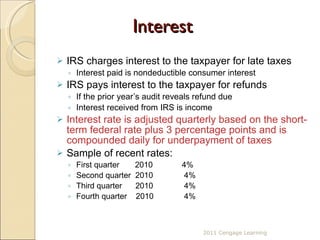
Interest IRS charges interest to the taxpayer for late taxes  Interest paid is nondeductible consumer interest IRS pays interest to the taxpayer for refunds If the prior year’s audit reveals refund due Interest received from IRS is income Interest rate is adjusted quarterly based on the short-term federal rate plus 3 percentage points and is compounded daily for underpayment of taxes Sample of recent rates: First quarter  2010  4% Second quarter  2010   4% Third quarter  2010   4% Fourth quarter  2010   4% 2011 Cengage Learning
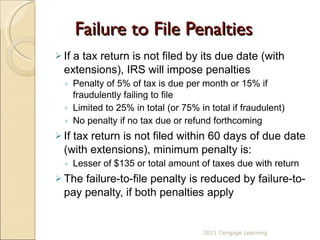
Failure to File Penalties If a tax return is not filed by its due date (with extensions), IRS will impose penalties Penalty of 5% of tax is due per month or 15% if fraudulently failing to file Limited to 25% in total (or 75% in total if fraudulent) No penalty if no tax due or refund forthcoming If tax return is not filed within 60 days of due date (with extensions), minimum penalty is: Lesser of $135 or total amount of taxes due with return The failure-to-file penalty is reduced by failure-to-pay penalty, if both penalties apply 2011 Cengage Learning
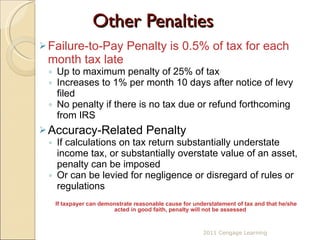
Other Penalties Failure-to-Pay Penalty is 0.5% of tax for each month tax late Up to maximum penalty of 25% of tax Increases to 1% per month 10 days after notice of levy filed No penalty if there is no tax due or refund forthcoming from IRS Accuracy-Related Penalty If calculations on tax return substantially understate income tax, or substantially overstate value of an asset, penalty can be imposed Or can be levied for negligence or disregard of rules or regulations If taxpayer can demonstrate reasonable cause for understatement of tax and that he/she acted in good faith, penalty will not be assessed 2011 Cengage Learning
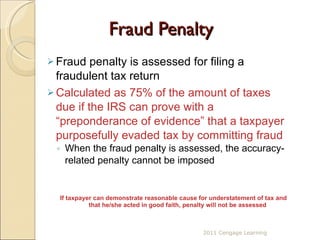
Fraud Penalty Fraud penalty is assessed for filing a fraudulent tax return Calculated as 75% of the amount of taxes due if the IRS can prove with a “preponderance of evidence” that a taxpayer purposefully evaded tax by committing fraud When the fraud penalty is assessed, the accuracy-related penalty cannot be imposed If taxpayer can demonstrate reasonable cause for understatement of tax and that he/she acted in good faith, penalty will not be assessed 2011 Cengage Learning
Other Penalties Both civil and criminal penalties can be imposed for filing false withholding information Also, assorted penalties for Filing a frivolous tax return  Failing to file informational returns on a timely basis (1099s, W-2s, etc) Not depositing payroll taxes on a timely basis Underpaying estimated taxes Issuing a bad check for taxes 2011 Cengage Learning
Statute of Limitations A taxpayer may not amend, nor may the IRS assess additional taxes, on a tax return for which the 3-year statute of limitations has expired Exceptions to 3-year statute  No statute of limitations if it is a fraudulent tax return 6-year statute of limitations if amount of gross income omitted exceeds 25% of total gross income Statute of limitations for deduction of a bad debt or worthless security is 7 years 2011 Cengage Learning
Statute of Limitations If IRS and taxpayer agree, Form 872 may be signed that allows for extension of statute of limitations If tax deficiency has been assessed by the IRS within the period of the statute, then government has ten years from the date of assessment to collect the tax due 2011 Cengage Learning
Tax Practitioners The IRS will begin regulating paid preparers by requiring registration, competency exams and continuing education CPAs, enrolled agents, attorneys and all paid preparers will be required to register and pay fee if engaged in paid preparation after 12/31/10 Only CPAs, attorneys or enrolled agents may represent clients at IRS proceedings There are a multitude of preparer penalties  For example, if tax preparer does not exercise due diligence, tax returns are not signed, or copy is not provided to clients,  the tax preparer may be assessed a penalty See pages12-15 and 12-16 for full list of preparer penalties 2011 Cengage Learning
Burden of Proof In most civil tax cases the IRS has historically placed burden of proof on taxpayer IRS Restructuring & Reform Act of 1998 changed tax law to shift burden of proof to IRS in many cases Burden of proof automatically shifts to IRS in two situations IRS uses statistics to reconstruct an individual’s income Court proceeding against an individual taxpayer involves penalty/addition to tax In certain situations, burden of proof still rests with the taxpayer (such as corporations, partnerships or estates with a net worth in excess of $7 million). 2011 Cengage Learning
Tax Confidentiality Privilege The attorney-client privilege has been extended in limited circumstances to non-attorneys who are authorized to practice in front of the IRS  CPAs and enrolled agents This may be asserted only in a noncriminal tax proceeding before the IRS or federal courts This privilege does not extend to written communications between tax practitioner and a corporation in connection with promotion of tax shelter Does not automatically extend to state tax situations 2011 Cengage Learning
Taxpayer Bill of Rights Document addresses taxpayers rights  Requires the IRS to inform taxpayers of their rights and remedies when dealing with the Service It provides remedies for resolving disputes with IRS Has been amended several times since issuance Part I – Declaration of Taxpayer Rights Directs taxpayer to other IRS publications for more details Part II –Examinations, Appeals, Collections & Refunds Note:  See pages 12-19 and 12-20 for Taxpayer Bill of Rights 2011 Cengage Learning
Tax Planning Tax planning refers to arranging one’s financial affairs so as to minimize tax liability There are two types of financial transactions In an “open” transaction, tax planning may still occur as transaction has not been culminated In a “closed” transaction, tax consequences are already finalized and presentation to the IRS is limited to identifying facts in the most favorable light possible Tax planning based on marginal tax rate This is the rate applied to the “next dollar of income” or the “next dollar of deduction” and should be used when engaging in tax planning ( not  the average tax rate) If illegal methods are used, this is called ‘tax evasion’ 2011 Cengage Learning
Tax Traps  A “tax trap” is a provision in tax law that can result in the taxpayer’s loss of an otherwise available tax benefit Watch for required deduction attributes like reasonableness or “ordinary and necessary” Be aware of limitations such as at-risk loss limitations Tax planning can help taxpayers avoid tax traps 2011 Cengage Learning
Finished! 2011 Cengage Learning

Chapter 12

  • 1.
    Chapter 12 TaxAdministration & Tax Planning Income Tax Fundamentals 2011 Gerald E. Whittenburg & Martha Altus-Buller 2011 Cengage Learning
  • 2.
    Learning Objectives Identifyorganizational structure of the IRS Understand IRS audit process Define common penalties for taxpayers and preparers Apply general rule for statute of limitations on tax returns Describe rules that apply to tax practitioners and the Taxpayer Bill of Rights Understand basic concepts of tax planning 2011 Cengage Learning
  • 3.
    Internal Revenue Service(IRS) Congress creates tax law and the IRS enforces it Includes assessment and collection departments Is a branch of the Treasury Department Is headquartered in Washington DC Commissioner of IRS is appointed by president and approved by Congress 2011 Cengage Learning
  • 4.
    IRS Service CentersTen service centers located around country Responsible for processing information from tax documents National computing center located in Martinsburg, WV Information from various service centers is matched with records from other service centers 2011 Cengage Learning
  • 5.
    IRS Restructuring Actof 1998 This act sought to structurally and operationally change the IRS by creating operating units along functional lines Service and Enforcement arm collects taxes and audits tax returns, including two factions: Small Business/Self-Employed (SB/SE) unit serves SB/SE customers Wages & Investment (W&I) division helps taxpayers (that primarily pay taxes through withholdings) comply with applicable laws See Figure 12.1 on page 12-3 for complete IRS organizational chart 2011 Cengage Learning
  • 6.
    Examination of RecordsIRS has authority to examine taxpayers’ accounting records and books in a process called an audit IRS can summon taxpayers and require them to appear before the IRS and produce necessary accounting records IRS may also summon taxpayer records from third parties (CPAs, brokers, etc.) Taxpayer should enlist professional tax advice if IRS summoning records from third parties!! 2011 Cengage Learning
  • 7.
    Selection of Returnsfor Audits Tax returns are selected for audit based upon a multitude of factors Correspondence audit – handled by mail and usually involves questions about W-2s/1099s, certain itemized deductions or the earned income credit Office audit – conducted when individual taxpayer (usually without business involvement) is required to take records to district office to substantiate income, deductions and/or credits Field audit – conducted when records too extensive to take to IRS office (usually involves taxpayer engaged in business), generally for taxpayers with substantial business activities Note: Most common process for selecting returns for audit is based on statistical sampling, called DIF (Discriminant Function) score 2011 Cengage Learning
  • 8.
    Appeals Process Whentax return is selected for examination, an agent is assigned There are 3 possible results from an audit Agent determines that there are no changes Agent and taxpayer agree that there is a change in tax liability Agent and taxpayer disagree on outcome In this scenario, taxpayer may appeal through established appeals procedures The IRS claims that through its recalibration process, fewer no-change audits are now conducted and larger assessments are levied See Figures 12.2 and 12.3 on pages 12-8 and 12-9 2011 Cengage Learning
  • 9.
    Interest IRS chargesinterest to the taxpayer for late taxes Interest paid is nondeductible consumer interest IRS pays interest to the taxpayer for refunds If the prior year’s audit reveals refund due Interest received from IRS is income Interest rate is adjusted quarterly based on the short-term federal rate plus 3 percentage points and is compounded daily for underpayment of taxes Sample of recent rates: First quarter 2010 4% Second quarter 2010 4% Third quarter 2010 4% Fourth quarter 2010 4% 2011 Cengage Learning
  • 10.
    Failure to FilePenalties If a tax return is not filed by its due date (with extensions), IRS will impose penalties Penalty of 5% of tax is due per month or 15% if fraudulently failing to file Limited to 25% in total (or 75% in total if fraudulent) No penalty if no tax due or refund forthcoming If tax return is not filed within 60 days of due date (with extensions), minimum penalty is: Lesser of $135 or total amount of taxes due with return The failure-to-file penalty is reduced by failure-to-pay penalty, if both penalties apply 2011 Cengage Learning
  • 11.
    Other Penalties Failure-to-PayPenalty is 0.5% of tax for each month tax late Up to maximum penalty of 25% of tax Increases to 1% per month 10 days after notice of levy filed No penalty if there is no tax due or refund forthcoming from IRS Accuracy-Related Penalty If calculations on tax return substantially understate income tax, or substantially overstate value of an asset, penalty can be imposed Or can be levied for negligence or disregard of rules or regulations If taxpayer can demonstrate reasonable cause for understatement of tax and that he/she acted in good faith, penalty will not be assessed 2011 Cengage Learning
  • 12.
    Fraud Penalty Fraudpenalty is assessed for filing a fraudulent tax return Calculated as 75% of the amount of taxes due if the IRS can prove with a “preponderance of evidence” that a taxpayer purposefully evaded tax by committing fraud When the fraud penalty is assessed, the accuracy-related penalty cannot be imposed If taxpayer can demonstrate reasonable cause for understatement of tax and that he/she acted in good faith, penalty will not be assessed 2011 Cengage Learning
  • 13.
    Other Penalties Bothcivil and criminal penalties can be imposed for filing false withholding information Also, assorted penalties for Filing a frivolous tax return Failing to file informational returns on a timely basis (1099s, W-2s, etc) Not depositing payroll taxes on a timely basis Underpaying estimated taxes Issuing a bad check for taxes 2011 Cengage Learning
  • 14.
    Statute of LimitationsA taxpayer may not amend, nor may the IRS assess additional taxes, on a tax return for which the 3-year statute of limitations has expired Exceptions to 3-year statute No statute of limitations if it is a fraudulent tax return 6-year statute of limitations if amount of gross income omitted exceeds 25% of total gross income Statute of limitations for deduction of a bad debt or worthless security is 7 years 2011 Cengage Learning
  • 15.
    Statute of LimitationsIf IRS and taxpayer agree, Form 872 may be signed that allows for extension of statute of limitations If tax deficiency has been assessed by the IRS within the period of the statute, then government has ten years from the date of assessment to collect the tax due 2011 Cengage Learning
  • 16.
    Tax Practitioners TheIRS will begin regulating paid preparers by requiring registration, competency exams and continuing education CPAs, enrolled agents, attorneys and all paid preparers will be required to register and pay fee if engaged in paid preparation after 12/31/10 Only CPAs, attorneys or enrolled agents may represent clients at IRS proceedings There are a multitude of preparer penalties For example, if tax preparer does not exercise due diligence, tax returns are not signed, or copy is not provided to clients, the tax preparer may be assessed a penalty See pages12-15 and 12-16 for full list of preparer penalties 2011 Cengage Learning
  • 17.
    Burden of ProofIn most civil tax cases the IRS has historically placed burden of proof on taxpayer IRS Restructuring & Reform Act of 1998 changed tax law to shift burden of proof to IRS in many cases Burden of proof automatically shifts to IRS in two situations IRS uses statistics to reconstruct an individual’s income Court proceeding against an individual taxpayer involves penalty/addition to tax In certain situations, burden of proof still rests with the taxpayer (such as corporations, partnerships or estates with a net worth in excess of $7 million). 2011 Cengage Learning
  • 18.
    Tax Confidentiality PrivilegeThe attorney-client privilege has been extended in limited circumstances to non-attorneys who are authorized to practice in front of the IRS CPAs and enrolled agents This may be asserted only in a noncriminal tax proceeding before the IRS or federal courts This privilege does not extend to written communications between tax practitioner and a corporation in connection with promotion of tax shelter Does not automatically extend to state tax situations 2011 Cengage Learning
  • 19.
    Taxpayer Bill ofRights Document addresses taxpayers rights Requires the IRS to inform taxpayers of their rights and remedies when dealing with the Service It provides remedies for resolving disputes with IRS Has been amended several times since issuance Part I – Declaration of Taxpayer Rights Directs taxpayer to other IRS publications for more details Part II –Examinations, Appeals, Collections & Refunds Note: See pages 12-19 and 12-20 for Taxpayer Bill of Rights 2011 Cengage Learning
  • 20.
    Tax Planning Taxplanning refers to arranging one’s financial affairs so as to minimize tax liability There are two types of financial transactions In an “open” transaction, tax planning may still occur as transaction has not been culminated In a “closed” transaction, tax consequences are already finalized and presentation to the IRS is limited to identifying facts in the most favorable light possible Tax planning based on marginal tax rate This is the rate applied to the “next dollar of income” or the “next dollar of deduction” and should be used when engaging in tax planning ( not the average tax rate) If illegal methods are used, this is called ‘tax evasion’ 2011 Cengage Learning
  • 21.
    Tax Traps A “tax trap” is a provision in tax law that can result in the taxpayer’s loss of an otherwise available tax benefit Watch for required deduction attributes like reasonableness or “ordinary and necessary” Be aware of limitations such as at-risk loss limitations Tax planning can help taxpayers avoid tax traps 2011 Cengage Learning
  • 22.

Editor's Notes

  • #22 Here use “…” but previous slides used ‘…’