Surviving a Refundable Credit
Due Diligence Audit
Naveid Jahansouz, Esq. and
Robin Forsythe, Esq.
Table of Contents
• Background
• Refundable Credit Due Diligence Program
• Due Diligence Requirements
• Scenarios
• After the Audit
BACKGROUND
Compliance Issues
• IRS performed a study that showed
approximately 24% of all EITC claims have a
mistake, costing the Treasury about $16
billion each year.
• 60% of the EITC errors fall into one of three
categories:
– Improperly filing as single of HOH when legally
married
– Improperly claiming a child
– Schedule C over-reporting or under-reporting in
order to qualify for (or maximize the amount of)
the EITC
IRS Return Preparer Initiative
• In 2011, responding to concern about the
performance of some unlicensed tax
return preparers, the IRS attempted to
regulate the industry. Among other
things, they required return prepares to
perform the following:
– Pass a certification exam
– Pay annual fees
– Complete at least 15 hours of continuing
education each year
IRS Return Preparer Initiative
(cont.)
• At the time, the IRS estimated that there
were 600,000-700,000 unlicensed return
preparers in the country.
• As justification for the new regulations,
the Treasury relied on a law passed in
1884 that authorized the IRS to regulate
the practice of representatives of persons
before the Department of the Treasury.
IRS Return Preparer Initiative
(cont.)
Loving v. Internal Revenue Service:
Three unlicensed return preparers sued the
IRS and claimed that the 1884 law did not
give the IRS authority to regulate the return
preparer industry. The court ultimately sided
with the return preparers, and the IRS was
enjoined from enforcing its new regulations.
IRS Return Preparer Initiative
(cont.)
• Since the Loving decision, Congress has
mulled passing legislation to give the IRS
authority to regulate the industry, but it
has not happened yet
• In response, the IRS has ramped up
enforcement efforts against unlicensed
return preparers, both on the civil side
and the criminal side.
REFUNDABLE CREDIT DUE
DILIGENCE PROGRAM
Warning Letters
• Rather than conducting a Due Diligence
Visit (DDV), the IRS may send a return
preparer a warning letter.
• The IRS is not required to issue a warning
letter prior to auditing a return preparer
and assessing penalties.
Warning Letters (cont.)
Letter 5025 or 4858
This is a warning letter the IRS sends out to
some preparers to warn them that, based
on a review of previous returns they have
prepared, they may be failing to comply
with the due diligence requirements. The
IRS is not required to issue such a letter
before conducting a Due Diligence Visit and
assessing penalties.
Warning Letters (cont.)
Letter 5138
This is a letter that notifies a return preparer
that one or more of their clients’ returns are
being audited for improperly claiming the
EITC, and it notifies the return preparer that
the IRS will be monitoring future returns that
they prepare.
Warning Letters (cont.)
Letter 5364
This letter notifies the return preparer that
two or more returns they prepared did not
include a Form 8867.
Due Diligence Visits
• Typically conducted early in the year prior
to filing season.
• Revenue Agent typically has a list of 50
returns to review. They usually start with
the first 25 on the list.
– If there are no problems, they will stop there.
– If there are problems, they will also review the
remaining 50.
Penalty
• Under 26 U.S.C. § 6695(g), there is a $520
penalty (adjusted for inflation) for failure
to comply with the due diligence
requirements imposed by the Treasury
with respect to determining eligibility for:
– Head of Household filing status
– Earned Income Tax Credit (Refundable)
– Additional Child Tax Credit (Refundable)
– American Opportunity Tax Credit (Refundable)
Penalty (cont.)
• In the past, IRS would only assess one
penalty per return.
• Treas. Reg. § 1.6695-2 has been rewritten
so that a separate penalty can be assessed
for each individual failure.
• Up to four penalties can now be assessed
per return: $520 x 4 x 50 = $104,000
DUE DILIGENCE REQUIREMENTS
Due Diligence Requirements
• Completion and submission of Form 8867
• Computation of tax credit
– Either complete the proper worksheet for the
type of credit (e.g., Form 8863 for the
American Opportunity Credit) or
– Record in the files the method and
information used for making the
computations
Due Diligence Requirements(cont.)
• Knowledge Requirement
– The preparer must not know, or have reason to know,
that any information used in determining eligibility
for, or the amount of, the refundable credit in
question is false.
– The preparer may not ignore the implications of
information furnished to, or known by, the preparer,
and must make reasonable inquiries if a reasonable
and well-informed tax return preparer knowledgeable
in the law would conclude that the information
furnished to the tax return preparer appears to be
incorrect, inconsistent, or incomplete.
– The preparer must also contemporaneously
document in the files any inquiries made and the
response to those inquiries.
Due Diligence Requirements(cont.)
• Retention of records for three years from
the latest of:
– Due date of the return
– Date of filing if the return was e-filed
– Date the return was presented to the taxpayer
for signature, if the return was not e-filed
– In the case of a non-signing return preparer,
the date that the non-signing preparer
submitted to the signing preparer the portion
of the return for which the non-signing
preparer was responsible
Knowledge Requirement
• Most failures to meet this requirement fall
into one of three categories:
– Claiming a child who is not a qualifying child
– Married taxpayers incorrectly filing as single or
head of household
– Schedule C errors
SCENARIOS
Scenarios
In the scenarios below, does the information
provided seem inaccurate, incomplete, or
inconsistent? If so, what additional inquiries
would you make?
Scenario #1
You are preparing a tax return for Ross, 20
years old, who claims to have two sons aged
9 and 10. What are some additional inquiries
you might make?
Scenario #2
You are preparing a tax return for a client,
Juno, who says she has an infant child, and
that she and her infant child both live with
her parents.
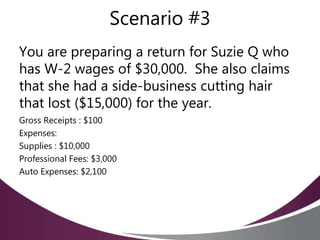
Scenario #3
You are preparing a return for Suzie Q who
has W-2 wages of $30,000. She also claims
that she had a side-business cutting hair
that lost ($15,000) for the year.
Gross Receipts : $100
Expenses:
Supplies : $10,000
Professional Fees: $3,000
Auto Expenses: $2,100
Scenario #4
You are preparing a return for a taxpayer
whose only income is money made cleaning
houses during the year. They claim they had
$15,000 of gross receipts and no expenses.
Scenario #5
A client tells you she is separated from her
spouse, her child lives with her, and she
wants to claim HOH filing status. Her income
for the year is $4,000.
AFTER THE AUDIT
After the Audit
• If you disagree with the assessments, you have the
right to appeal the case to the IRS Office of
Appeals.
• If the penalties are sustained by IRS appeals, you
cannot go to Tax Court. Some of your options are:
– Pay the penalties and be done with it
– Collection alternatives (Installment Agreement, OIC, CNC)
– Offer in Compromise (OIC) – Doubt as to Liability
– Penalty Abatement Request (Form 843)
– Pay the Penalties, then request a refund using Form 6118 or
Form 843; if the claim is denied or the IRS fails to respond within
6 months, then you have 2 years to file a suit for refund in either
US District Court or the Court of Federal Claims.
Other Enforcement Efforts
• EFIN Suspensions/Expulsions
• Permanent Injunctions
– 26 U.S.C. § 7407
– 26 U.S.C. § 7408
– 26 U.S.C. § 7402(a)
Other Enforcement Efforts (cont.)
• Criminal Prosecution
– 26 U.S.C. § 7206(2) – Any person who willfully aids
or assists in, or procures, counsels, or advises the
preparation or presentation under, or in
connection with any matter arising under, the
internal revenue laws, of a return, affidavit, claim,
or other document, which is fraudulent or is false
as to any material matter, whether or not such
falsity or fraud is with the knowledge or consent
of the person authorized or required to present
such return, affidavit, claim, or document shall be
guilty of a felony and, upon conviction thereof,
shall be fined nor more than $100,000 and/or
imprisoned not more than 3 years….
What Can You Do Going
Forward?
• Ask questions
• Document questions and answers in the
file
• Annual Filing Season Program (AFSP)
• Enrolled agent
Abusive Tax Avoidance Transaction
(ATAT) Program
• Sidney Goldin, CPA
• Fraudulent and Abusive Transactions
• Examples
CONTACT US
Naveid Jahansouz, Esq.
(214) 635-2524
Njahansouz@GPPcpa.com
Robin Forsythe, Esq.
(214) 635-2537
RForsythe@GPPcpa.com

Surviving a Refundable Credit Due Diligence Audit

  • 1.
    Surviving a RefundableCredit Due Diligence Audit Naveid Jahansouz, Esq. and Robin Forsythe, Esq.
  • 2.
    Table of Contents •Background • Refundable Credit Due Diligence Program • Due Diligence Requirements • Scenarios • After the Audit
  • 3.
  • 4.
    Compliance Issues • IRSperformed a study that showed approximately 24% of all EITC claims have a mistake, costing the Treasury about $16 billion each year. • 60% of the EITC errors fall into one of three categories: – Improperly filing as single of HOH when legally married – Improperly claiming a child – Schedule C over-reporting or under-reporting in order to qualify for (or maximize the amount of) the EITC
  • 5.
    IRS Return PreparerInitiative • In 2011, responding to concern about the performance of some unlicensed tax return preparers, the IRS attempted to regulate the industry. Among other things, they required return prepares to perform the following: – Pass a certification exam – Pay annual fees – Complete at least 15 hours of continuing education each year
  • 6.
    IRS Return PreparerInitiative (cont.) • At the time, the IRS estimated that there were 600,000-700,000 unlicensed return preparers in the country. • As justification for the new regulations, the Treasury relied on a law passed in 1884 that authorized the IRS to regulate the practice of representatives of persons before the Department of the Treasury.
  • 7.
    IRS Return PreparerInitiative (cont.) Loving v. Internal Revenue Service: Three unlicensed return preparers sued the IRS and claimed that the 1884 law did not give the IRS authority to regulate the return preparer industry. The court ultimately sided with the return preparers, and the IRS was enjoined from enforcing its new regulations.
  • 8.
    IRS Return PreparerInitiative (cont.) • Since the Loving decision, Congress has mulled passing legislation to give the IRS authority to regulate the industry, but it has not happened yet • In response, the IRS has ramped up enforcement efforts against unlicensed return preparers, both on the civil side and the criminal side.
  • 9.
  • 10.
    Warning Letters • Ratherthan conducting a Due Diligence Visit (DDV), the IRS may send a return preparer a warning letter. • The IRS is not required to issue a warning letter prior to auditing a return preparer and assessing penalties.
  • 11.
    Warning Letters (cont.) Letter5025 or 4858 This is a warning letter the IRS sends out to some preparers to warn them that, based on a review of previous returns they have prepared, they may be failing to comply with the due diligence requirements. The IRS is not required to issue such a letter before conducting a Due Diligence Visit and assessing penalties.
  • 12.
    Warning Letters (cont.) Letter5138 This is a letter that notifies a return preparer that one or more of their clients’ returns are being audited for improperly claiming the EITC, and it notifies the return preparer that the IRS will be monitoring future returns that they prepare.
  • 13.
    Warning Letters (cont.) Letter5364 This letter notifies the return preparer that two or more returns they prepared did not include a Form 8867.
  • 14.
    Due Diligence Visits •Typically conducted early in the year prior to filing season. • Revenue Agent typically has a list of 50 returns to review. They usually start with the first 25 on the list. – If there are no problems, they will stop there. – If there are problems, they will also review the remaining 50.
  • 15.
    Penalty • Under 26U.S.C. § 6695(g), there is a $520 penalty (adjusted for inflation) for failure to comply with the due diligence requirements imposed by the Treasury with respect to determining eligibility for: – Head of Household filing status – Earned Income Tax Credit (Refundable) – Additional Child Tax Credit (Refundable) – American Opportunity Tax Credit (Refundable)
  • 16.
    Penalty (cont.) • Inthe past, IRS would only assess one penalty per return. • Treas. Reg. § 1.6695-2 has been rewritten so that a separate penalty can be assessed for each individual failure. • Up to four penalties can now be assessed per return: $520 x 4 x 50 = $104,000
  • 17.
  • 18.
    Due Diligence Requirements •Completion and submission of Form 8867 • Computation of tax credit – Either complete the proper worksheet for the type of credit (e.g., Form 8863 for the American Opportunity Credit) or – Record in the files the method and information used for making the computations
  • 19.
    Due Diligence Requirements(cont.) •Knowledge Requirement – The preparer must not know, or have reason to know, that any information used in determining eligibility for, or the amount of, the refundable credit in question is false. – The preparer may not ignore the implications of information furnished to, or known by, the preparer, and must make reasonable inquiries if a reasonable and well-informed tax return preparer knowledgeable in the law would conclude that the information furnished to the tax return preparer appears to be incorrect, inconsistent, or incomplete. – The preparer must also contemporaneously document in the files any inquiries made and the response to those inquiries.
  • 20.
    Due Diligence Requirements(cont.) •Retention of records for three years from the latest of: – Due date of the return – Date of filing if the return was e-filed – Date the return was presented to the taxpayer for signature, if the return was not e-filed – In the case of a non-signing return preparer, the date that the non-signing preparer submitted to the signing preparer the portion of the return for which the non-signing preparer was responsible
  • 21.
    Knowledge Requirement • Mostfailures to meet this requirement fall into one of three categories: – Claiming a child who is not a qualifying child – Married taxpayers incorrectly filing as single or head of household – Schedule C errors
  • 22.
  • 23.
    Scenarios In the scenariosbelow, does the information provided seem inaccurate, incomplete, or inconsistent? If so, what additional inquiries would you make?
  • 24.
    Scenario #1 You arepreparing a tax return for Ross, 20 years old, who claims to have two sons aged 9 and 10. What are some additional inquiries you might make?
  • 25.
    Scenario #2 You arepreparing a tax return for a client, Juno, who says she has an infant child, and that she and her infant child both live with her parents.
  • 26.
    Scenario #3 You arepreparing a return for Suzie Q who has W-2 wages of $30,000. She also claims that she had a side-business cutting hair that lost ($15,000) for the year. Gross Receipts : $100 Expenses: Supplies : $10,000 Professional Fees: $3,000 Auto Expenses: $2,100
  • 27.
    Scenario #4 You arepreparing a return for a taxpayer whose only income is money made cleaning houses during the year. They claim they had $15,000 of gross receipts and no expenses.
  • 28.
    Scenario #5 A clienttells you she is separated from her spouse, her child lives with her, and she wants to claim HOH filing status. Her income for the year is $4,000.
  • 29.
  • 30.
    After the Audit •If you disagree with the assessments, you have the right to appeal the case to the IRS Office of Appeals. • If the penalties are sustained by IRS appeals, you cannot go to Tax Court. Some of your options are: – Pay the penalties and be done with it – Collection alternatives (Installment Agreement, OIC, CNC) – Offer in Compromise (OIC) – Doubt as to Liability – Penalty Abatement Request (Form 843) – Pay the Penalties, then request a refund using Form 6118 or Form 843; if the claim is denied or the IRS fails to respond within 6 months, then you have 2 years to file a suit for refund in either US District Court or the Court of Federal Claims.
  • 31.
    Other Enforcement Efforts •EFIN Suspensions/Expulsions • Permanent Injunctions – 26 U.S.C. § 7407 – 26 U.S.C. § 7408 – 26 U.S.C. § 7402(a)
  • 32.
    Other Enforcement Efforts(cont.) • Criminal Prosecution – 26 U.S.C. § 7206(2) – Any person who willfully aids or assists in, or procures, counsels, or advises the preparation or presentation under, or in connection with any matter arising under, the internal revenue laws, of a return, affidavit, claim, or other document, which is fraudulent or is false as to any material matter, whether or not such falsity or fraud is with the knowledge or consent of the person authorized or required to present such return, affidavit, claim, or document shall be guilty of a felony and, upon conviction thereof, shall be fined nor more than $100,000 and/or imprisoned not more than 3 years….
  • 33.
    What Can YouDo Going Forward? • Ask questions • Document questions and answers in the file • Annual Filing Season Program (AFSP) • Enrolled agent
  • 34.
    Abusive Tax AvoidanceTransaction (ATAT) Program • Sidney Goldin, CPA • Fraudulent and Abusive Transactions • Examples
  • 36.
    CONTACT US Naveid Jahansouz,Esq. (214) 635-2524 Njahansouz@GPPcpa.com Robin Forsythe, Esq. (214) 635-2537 RForsythe@GPPcpa.com