Communication and Information Technology Chapter 11
L E A R N I N G  O U T L I N E  Follow this Learning Outline as you read and study this chapter. Understanding Communications Differentiate between interpersonal and organizational communication. Discuss the functions of communication. The Process of Interpersonal Communications Explain all the components of the communication process. List the communication methods managers might use. Describe nonverbal communication and how it takes place. Explain the barriers to effective interpersonal communication and how to overcome them.
L E A R N I N G  O U T L I N E  (cont’d)  Follow this Learning Outline as you read and study this chapter. Organizational Communication Explain how communication can flow in an organization. Describe the three common communication networks. Discuss how managers should handle the grapevine. Understanding Information Technology Describe how technology affects managerial communication. Define e-mail, instant messaging, blogs and wikis, voice-mail, fax, EDI, teleconferencing, videoconferencing, web conferencing, intranet, and extranet. Explain how information technology affects organizations.
L E A R N I N G  O U T L I N E  (cont’d)  Follow this Learning Outline as you read and study this chapter. Communication Issues in Today’s Organization Discuss the challenges of managing communication in an Internet world. Explain how organizations can manage knowledge. Explain why communicating with customers is an important managerial issue. Explain how political correctness is affecting communication.
What Is Communication? Communication The transfer and understanding of meaning. Transfer means the message was received in a form that can be interpreted by the receiver. Understanding the message is not the same as the receiver agreeing with the message. Interpersonal Communication Communication between two or more people Organizational Communication All the patterns, network, and systems of communications within an organization
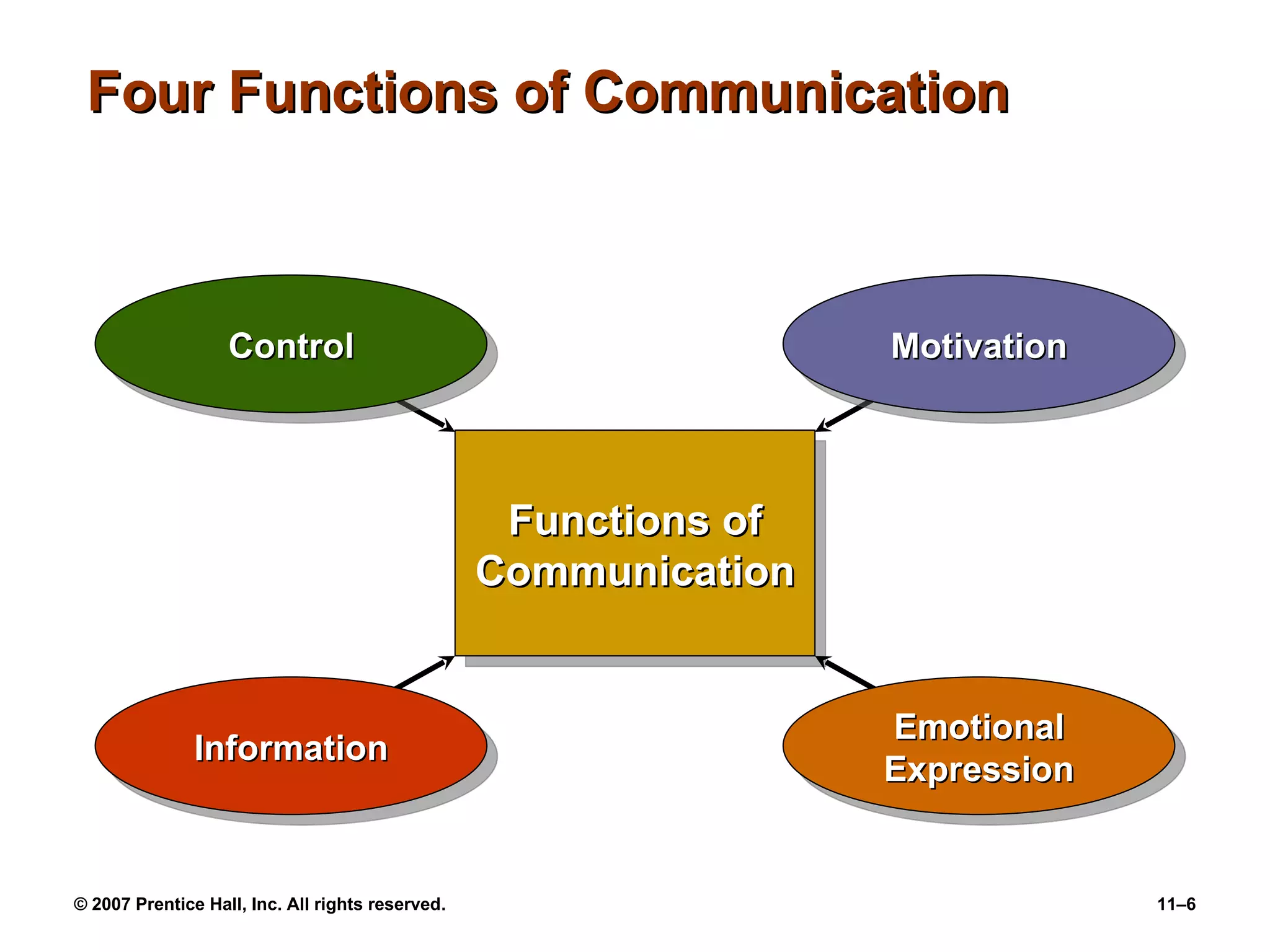
Four Functions of Communication Functions of Communication Control Motivation Emotional Expression Information
Functions of Communication Control Formal and informal communications act to control individuals’ behaviors in organizations. Motivation Communications clarify for employees what is to done, how well they have done it, and what can be done to improve performance.
Functions of Communication (cont’d) Emotional Expression Social interaction in the form of work group communications provides a way for employees to express themselves. Information Individuals and work groups need information to make decisions or to do their work.
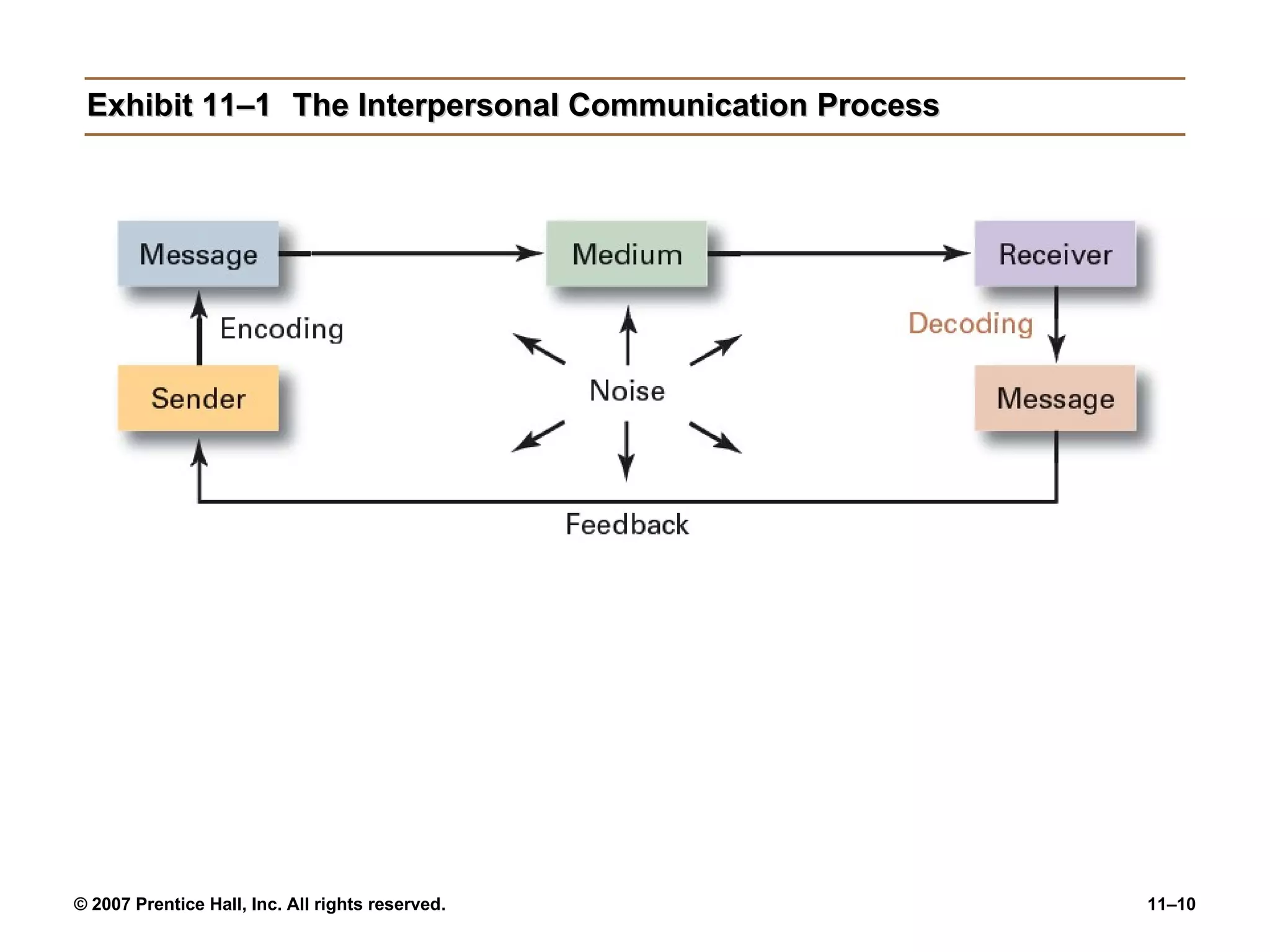
Interpersonal Communication Message Source: sender’s intended meaning Encoding The message converted to symbolic form Channel The medium through which the message travels Decoding The receiver’s retranslation of the message Noise Disturbances that interfere with communications
Exhibit 11–1 The Interpersonal Communication Process
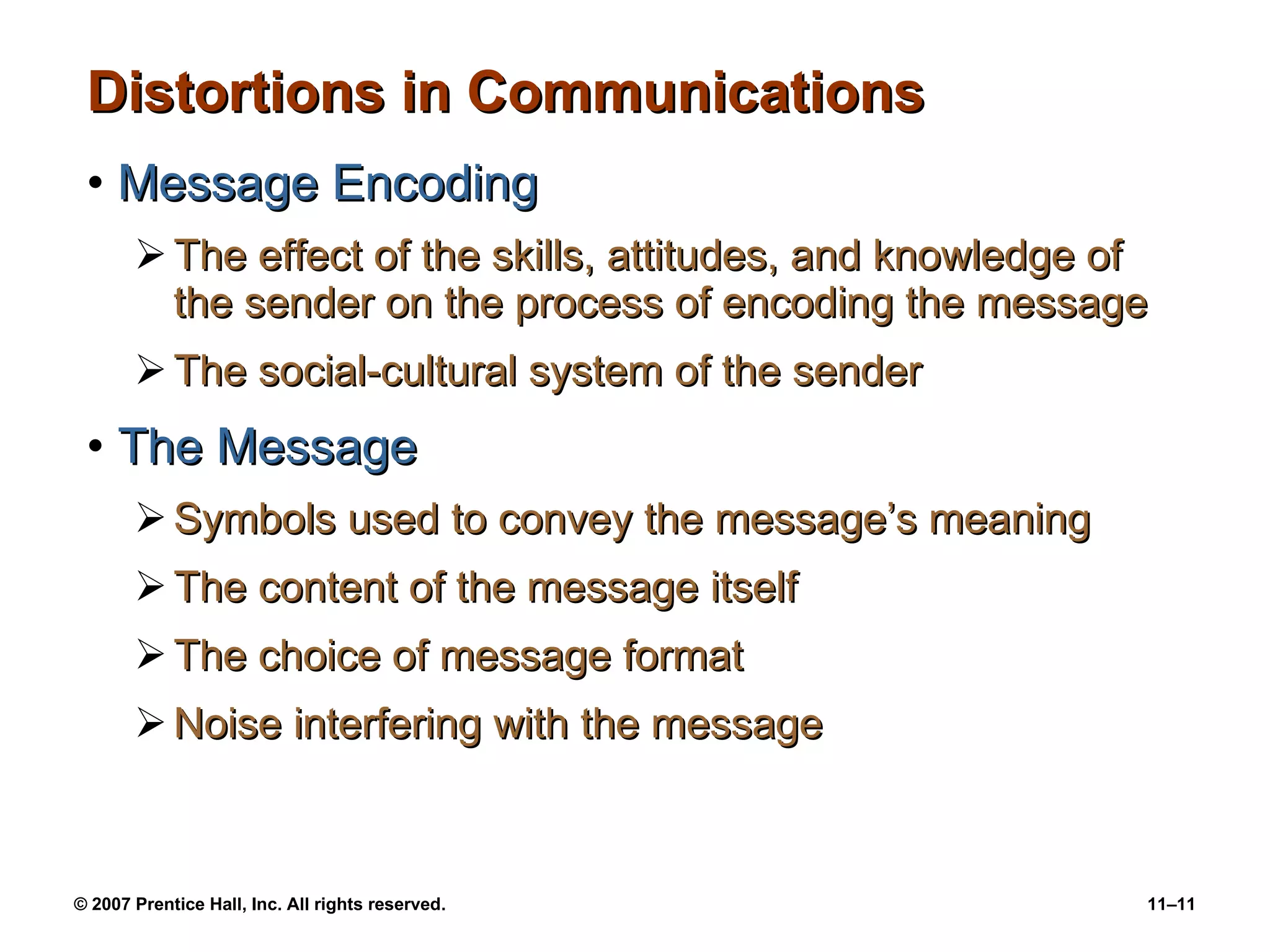
Distortions in Communications Message Encoding The effect of the skills, attitudes, and knowledge of the sender on the process of encoding the message The social-cultural system of the sender The Message Symbols used to convey the message’s meaning The content of the message itself The choice of message format Noise interfering with the message
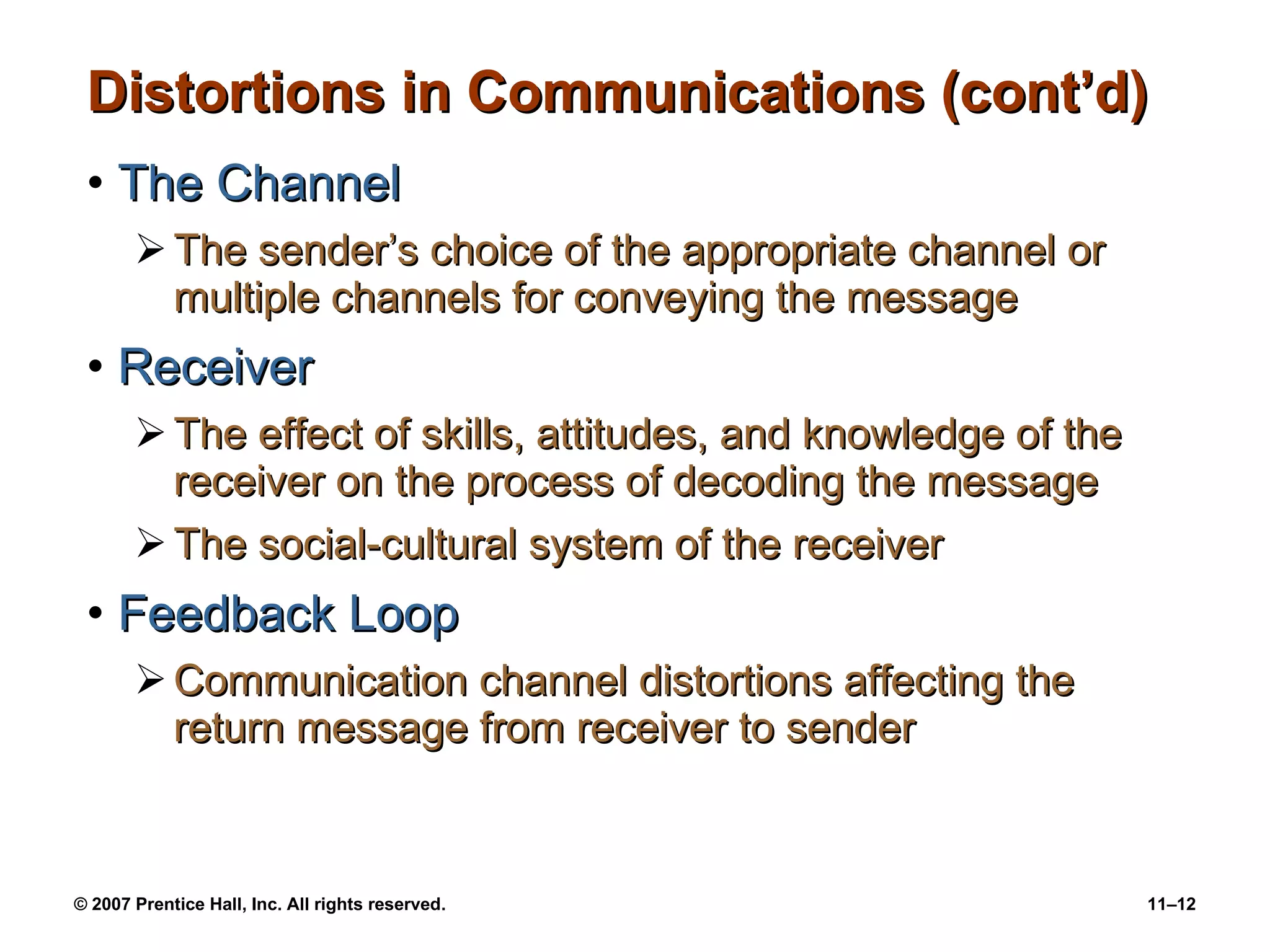
Distortions in Communications (cont’d) The Channel The sender’s choice of the appropriate channel or multiple channels for conveying the message Receiver The effect of skills, attitudes, and knowledge of the receiver on the process of decoding the message The social-cultural system of the receiver Feedback Loop Communication channel distortions affecting the return message from receiver to sender
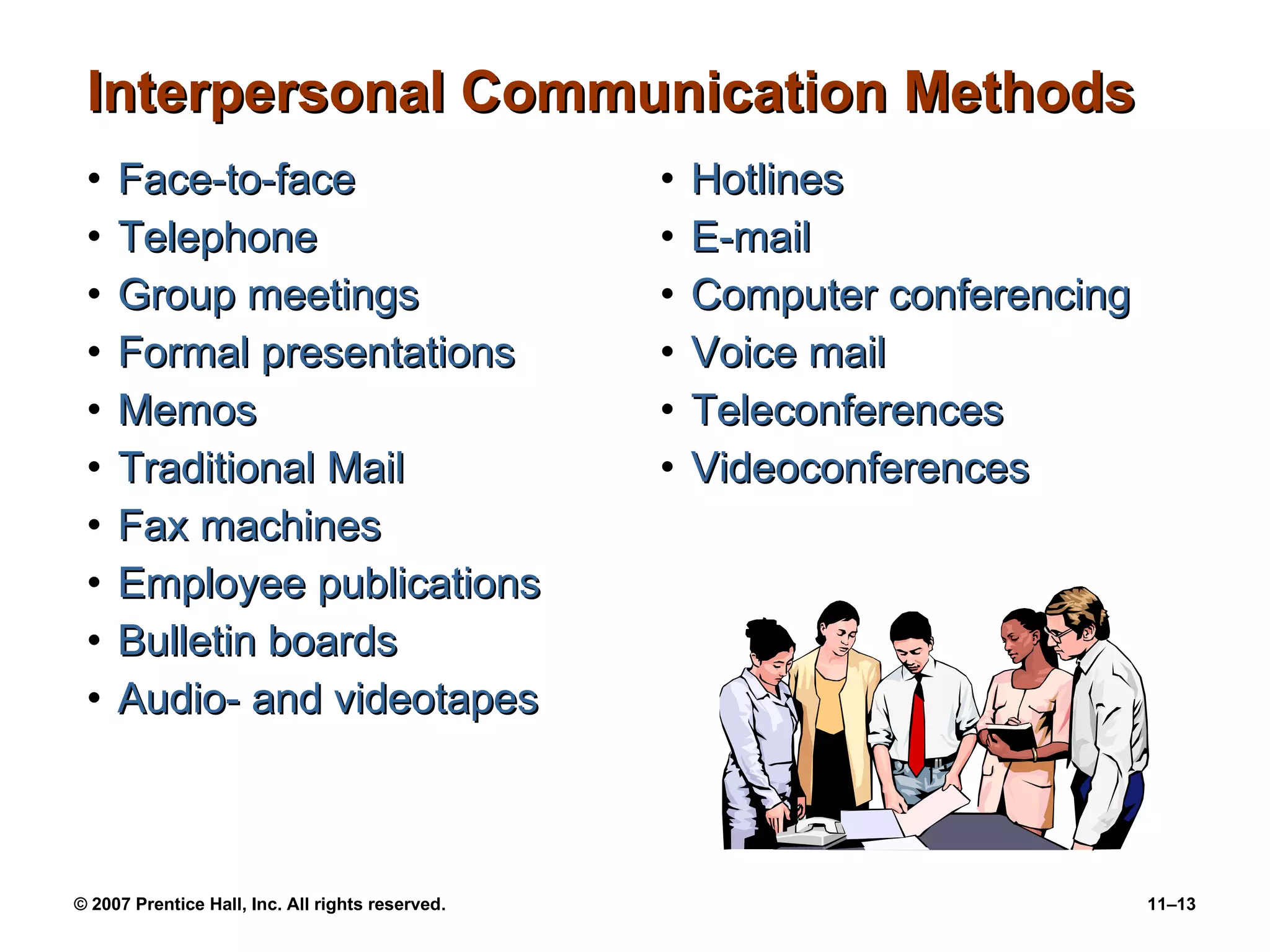
Interpersonal Communication Methods Face-to-face Telephone Group meetings Formal presentations Memos Traditional Mail Fax machines Employee publications Bulletin boards Audio- and videotapes Hotlines E-mail Computer conferencing Voice mail Teleconferences Videoconferences
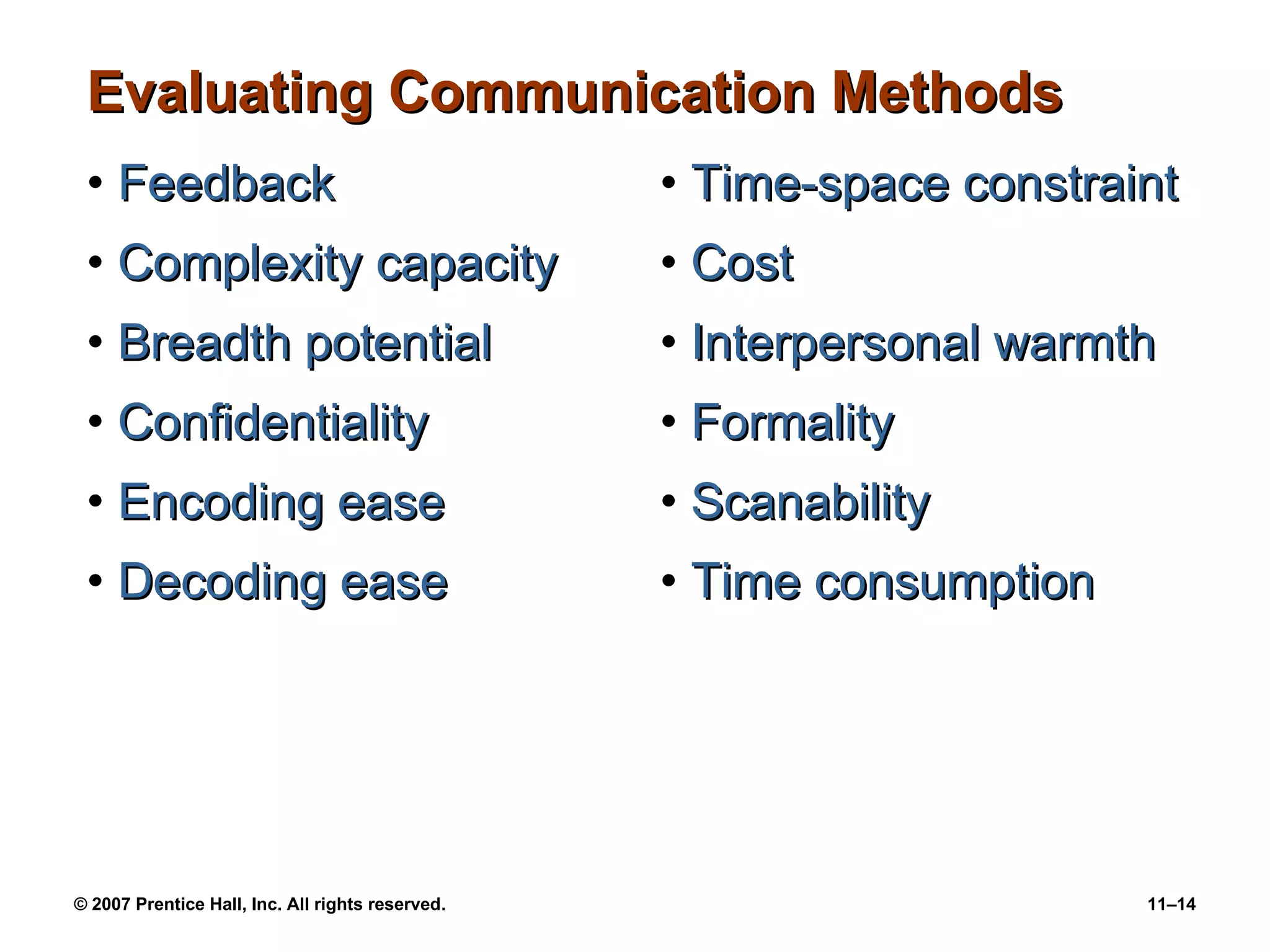
Evaluating Communication Methods Feedback Complexity capacity Breadth potential Confidentiality Encoding ease Decoding ease Time-space constraint Cost Interpersonal warmth Formality Scanability Time consumption
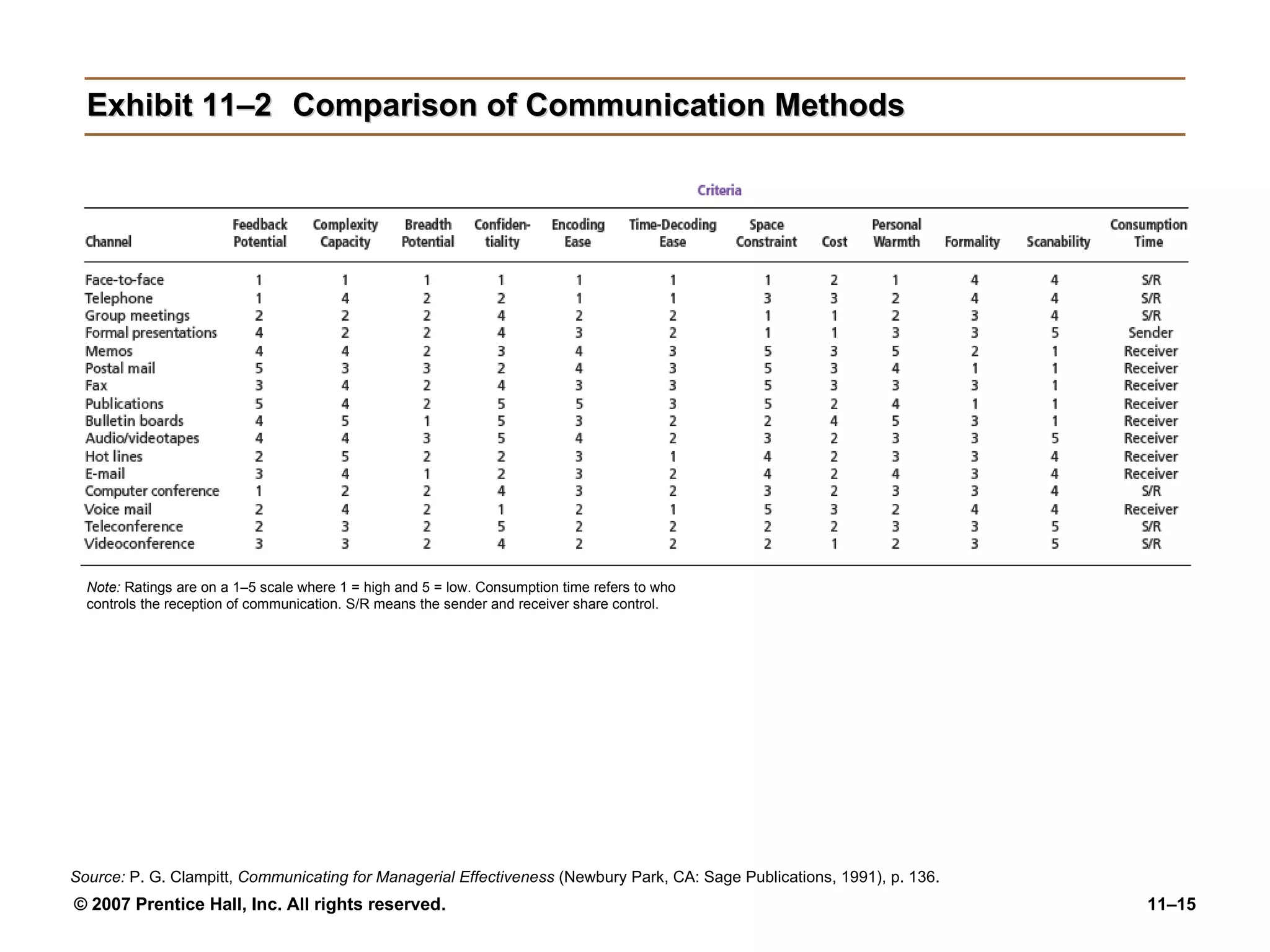
Exhibit 11–2 Comparison of Communication Methods Note:  Ratings are on a 1–5 scale where 1 = high and 5 = low. Consumption time refers to who controls the reception of communication. S/R means the sender and receiver share control. Source:  P. G. Clampitt,  Communicating for Managerial Effectiveness  (Newbury Park, CA: Sage Publications, 1991), p. 136.
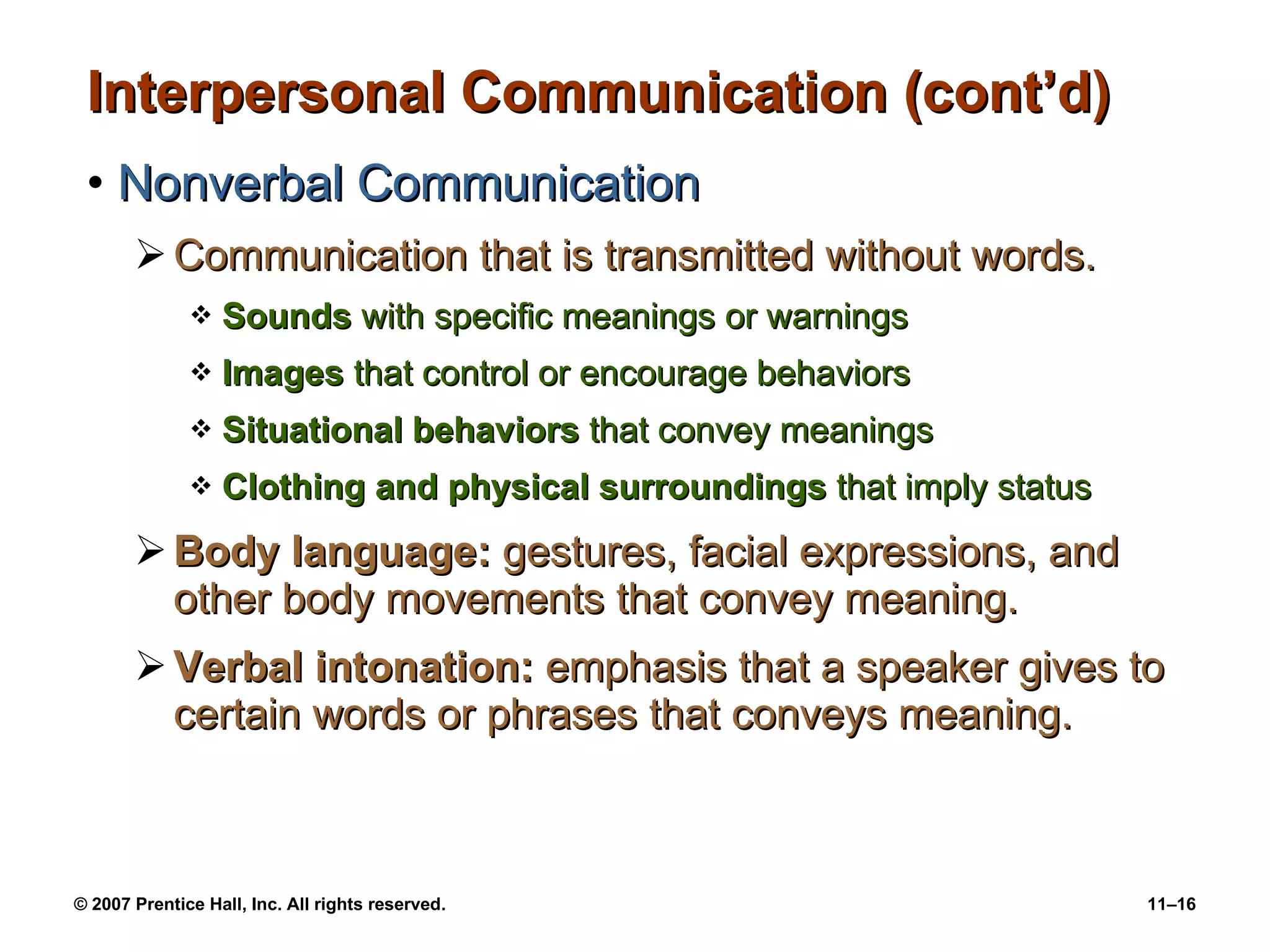
Interpersonal Communication (cont’d) Nonverbal Communication Communication that is transmitted without words. Sounds  with specific meanings or warnings Images  that control or encourage behaviors Situational behaviors  that convey meanings Clothing and physical surroundings  that imply status Body language:  gestures, facial expressions, and other body movements that convey meaning. Verbal intonation:  emphasis that a speaker gives to certain words or phrases that conveys meaning.
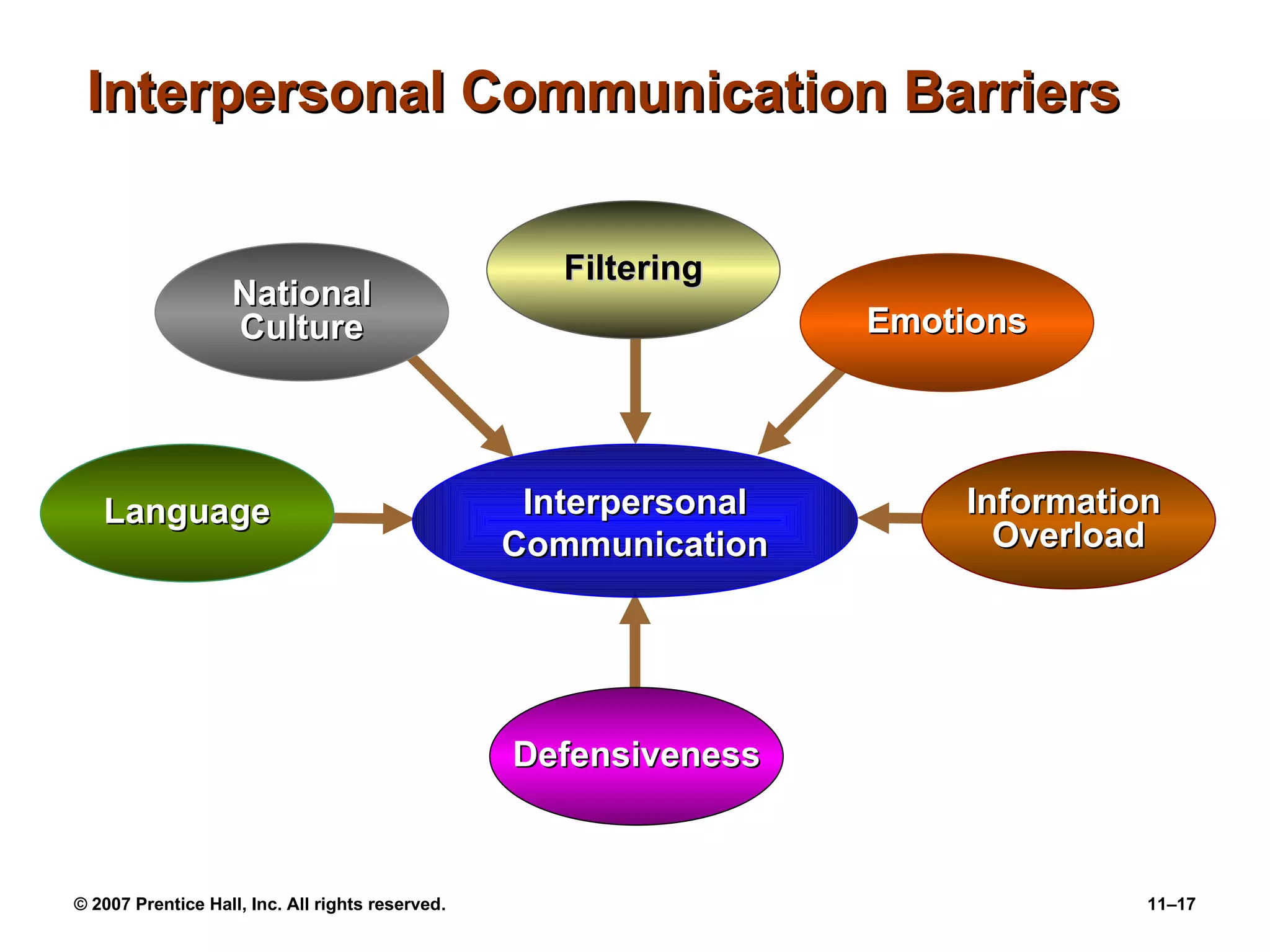
Interpersonal Communication Barriers Defensiveness National Culture Emotions Information  Overload Interpersonal Communication Language Filtering
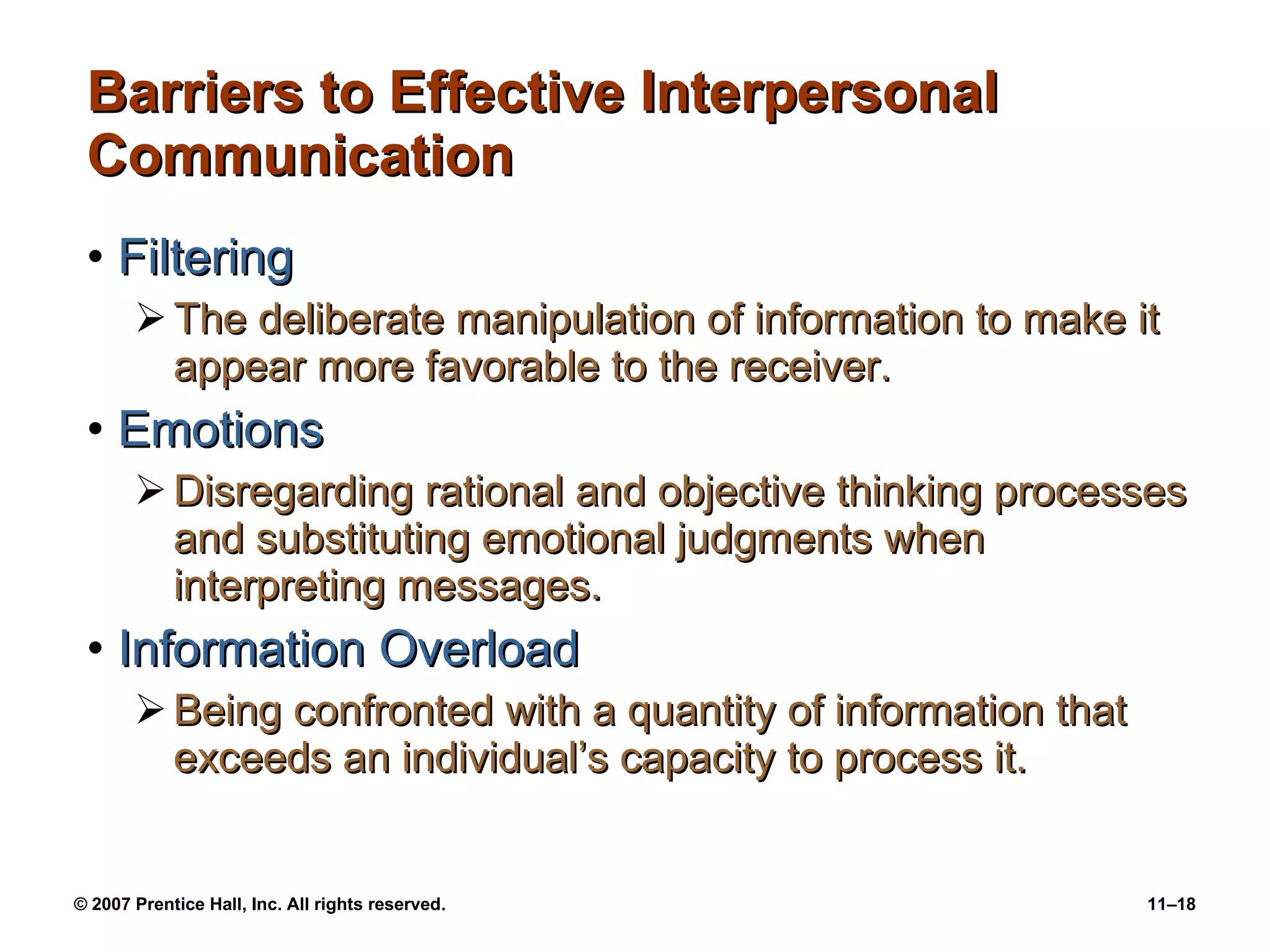
Barriers to Effective Interpersonal Communication Filtering The deliberate manipulation of information to make it appear more favorable to the receiver. Emotions Disregarding rational and objective thinking processes and substituting emotional judgments when interpreting messages. Information Overload Being confronted with a quantity of information that exceeds an individual’s capacity to process it.
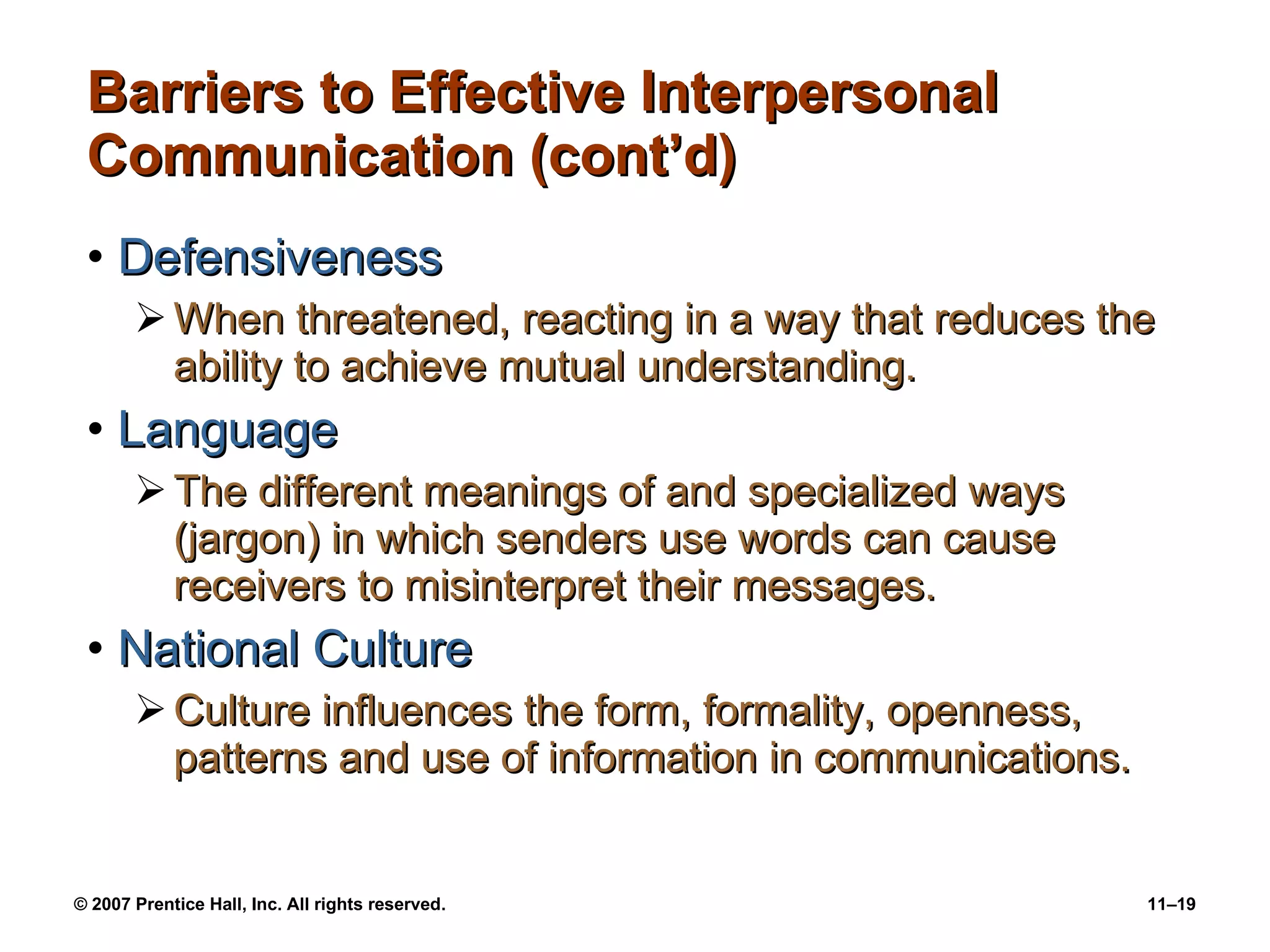
Barriers to Effective Interpersonal Communication (cont’d) Defensiveness When threatened, reacting in a way that reduces the ability to achieve mutual understanding. Language The different meanings of and specialized ways (jargon) in which senders use words can cause receivers to misinterpret their messages. National Culture Culture influences the form, formality, openness, patterns and use of information in communications.
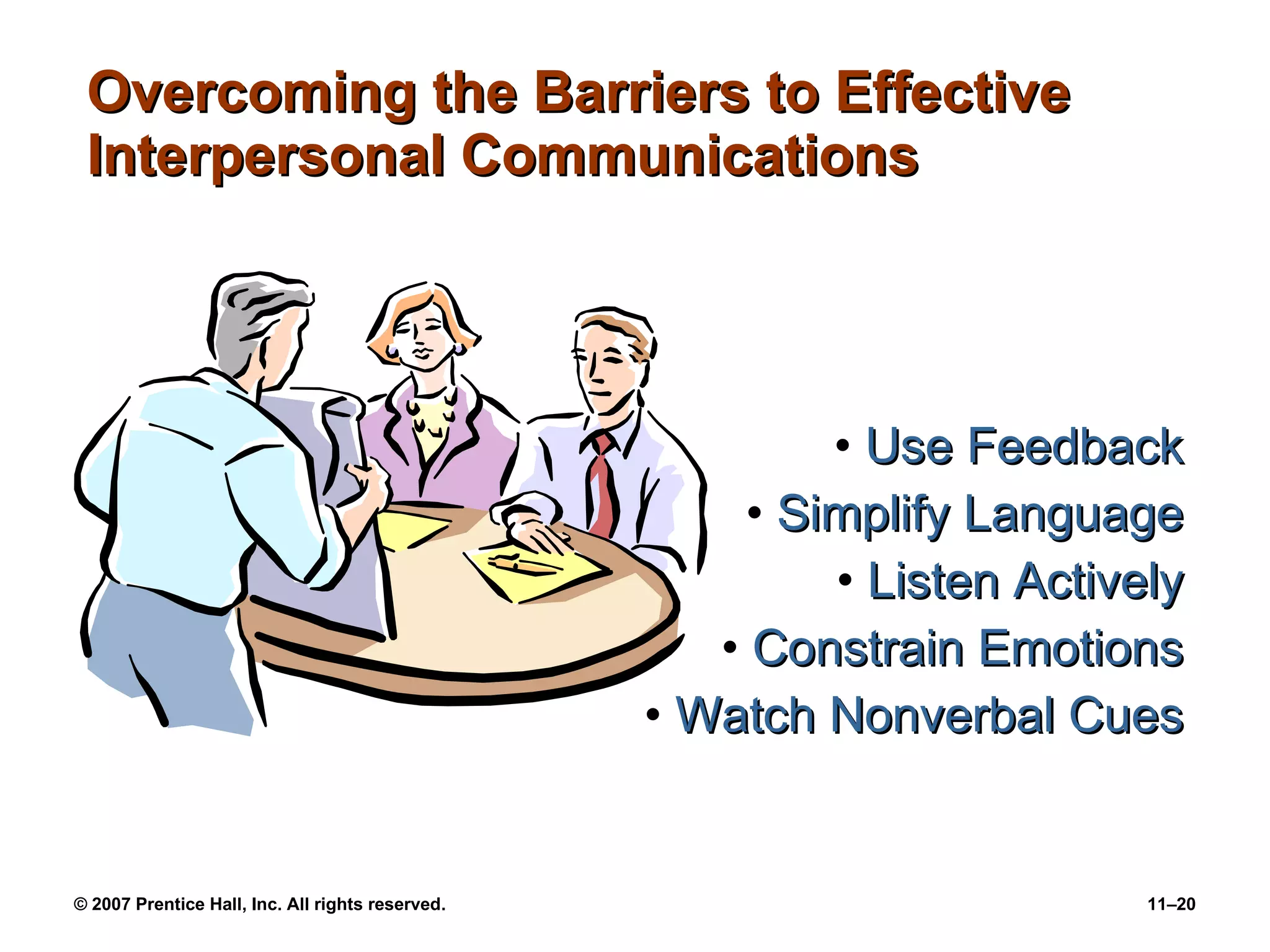
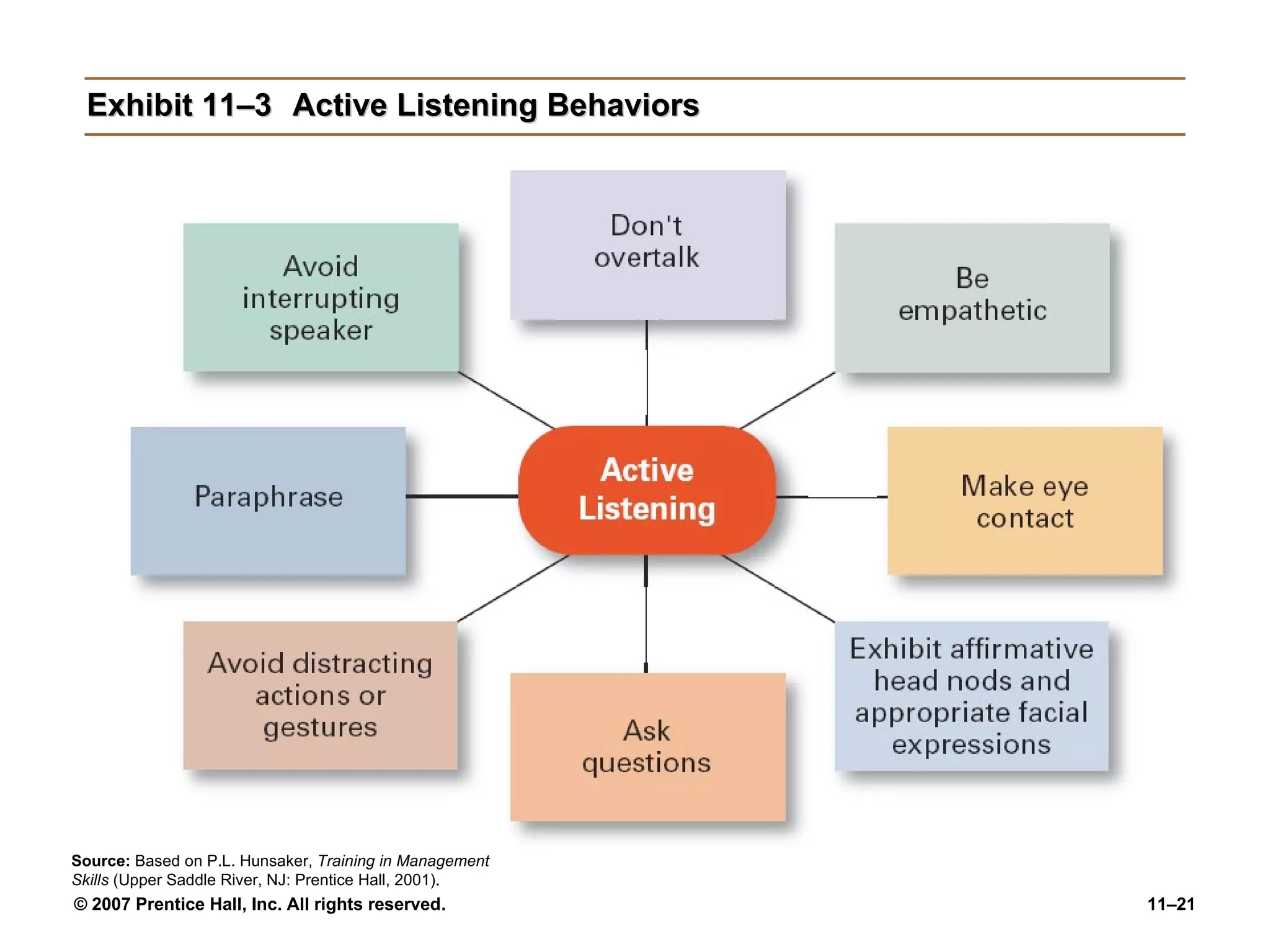
Overcoming the Barriers to Effective Interpersonal Communications Use Feedback Simplify Language Listen Actively Constrain Emotions Watch Nonverbal Cues
Exhibit 11–3 Active Listening Behaviors Source:  Based on P.L. Hunsaker,  Training in Management Skills  (Upper Saddle River, NJ: Prentice Hall, 2001).
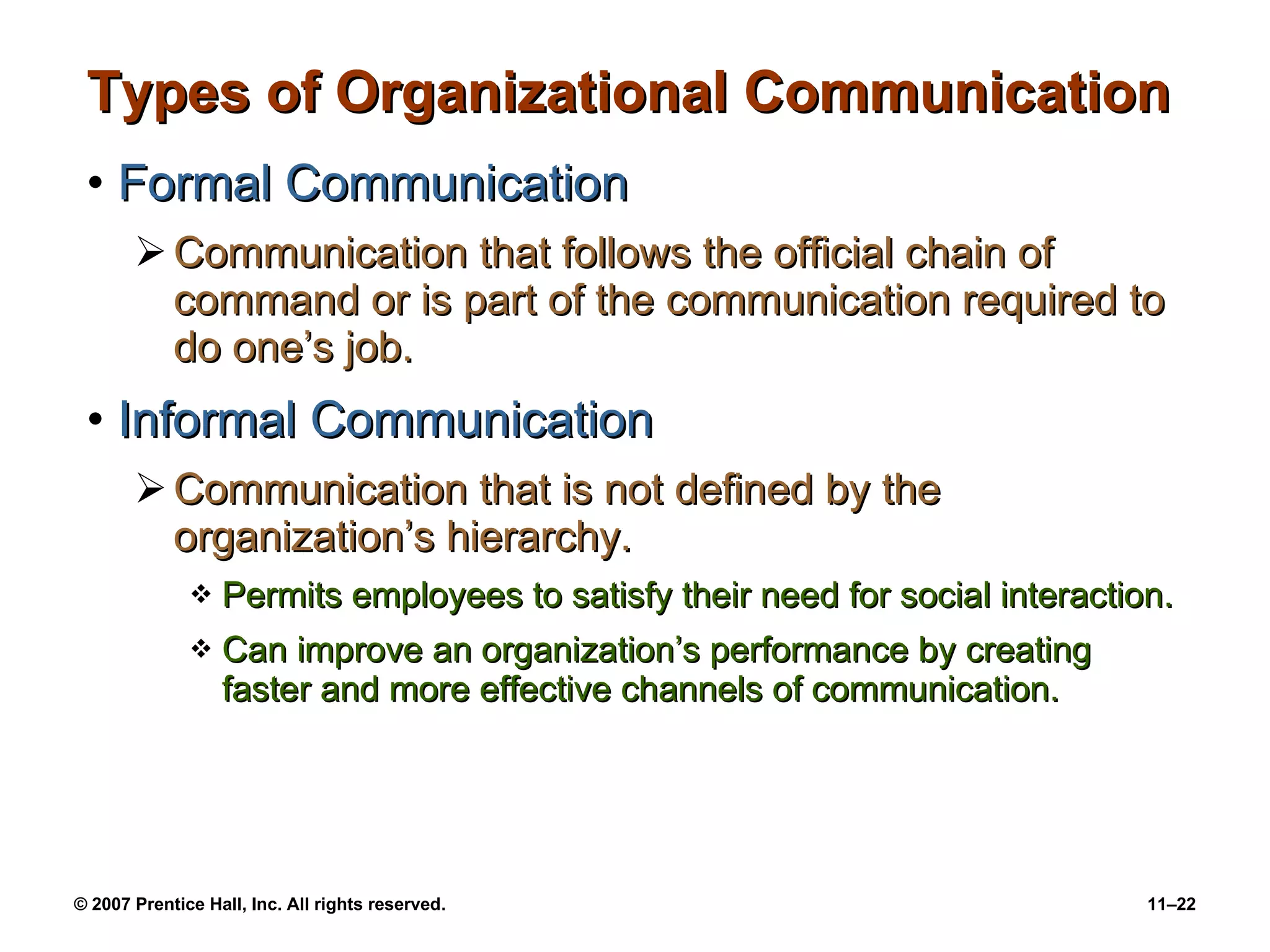
Types of Organizational Communication Formal Communication Communication that follows the official chain of command or is part of the communication required to do one’s job. Informal Communication Communication that is not defined by the organization’s hierarchy. Permits employees to satisfy their need for social interaction. Can improve an organization’s performance by creating faster and more effective channels of communication.
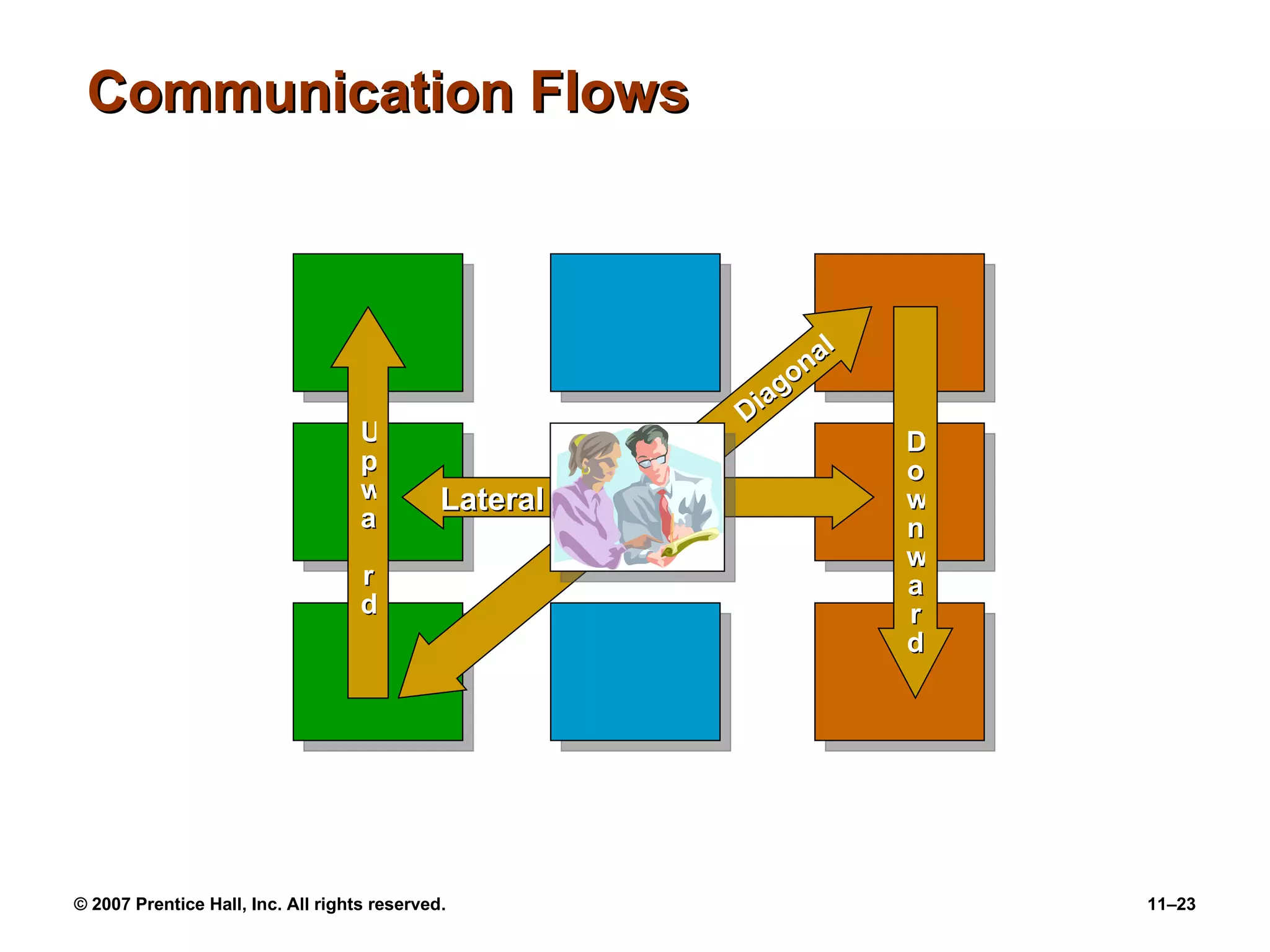
Communication Flows Lateral  Diagonal Downwa r d Upwa r d
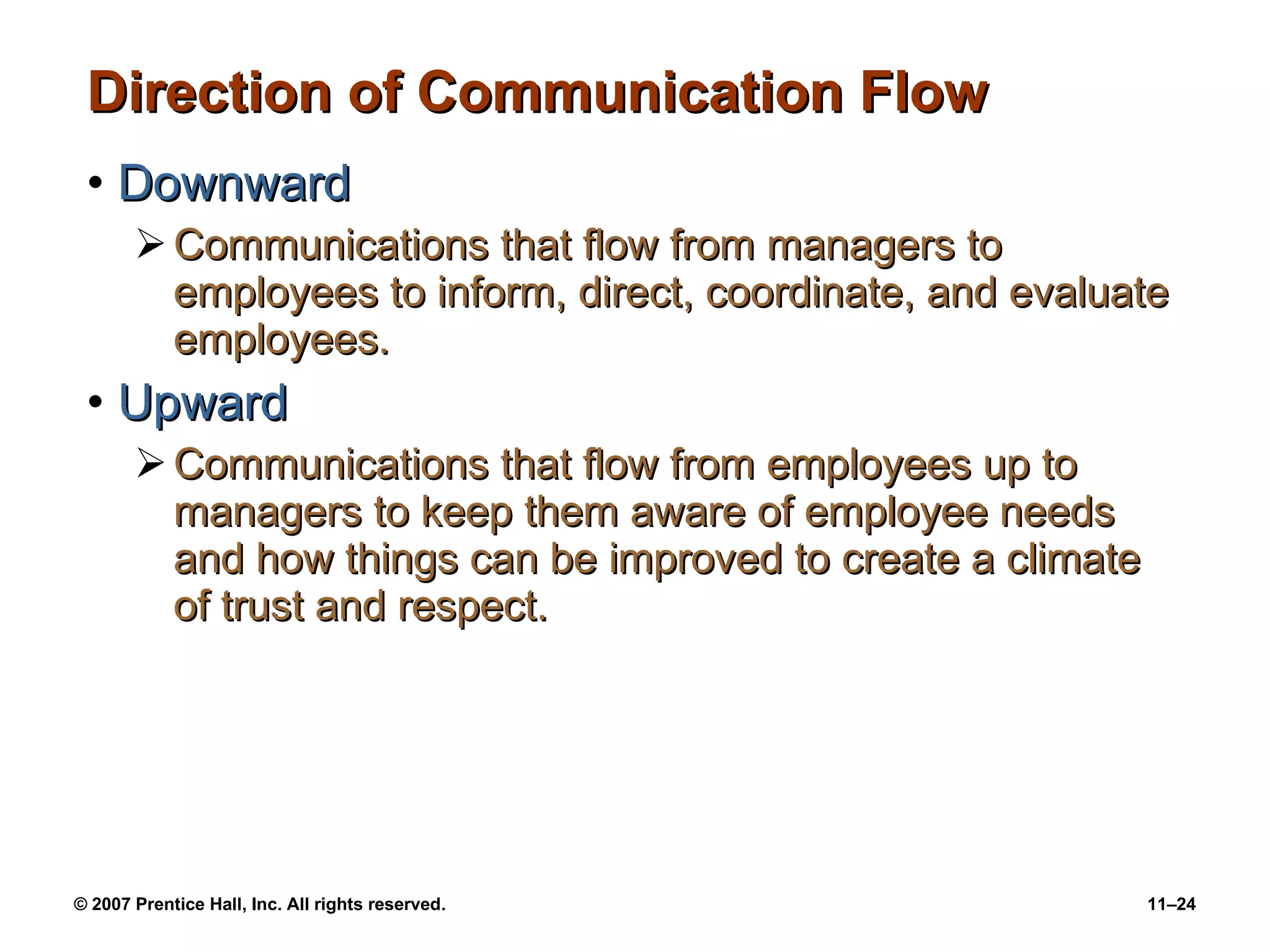
Direction of Communication Flow Downward Communications that flow from managers to employees to inform, direct, coordinate, and evaluate employees. Upward Communications that flow from employees up to managers to keep them aware of employee needs and how things can be improved to create a climate of trust and respect.
Direction of Communication Flow (cont’d) Lateral (Horizontal) Communication Communication that takes place among employees on the same level in the organization to save time and facilitate coordination. Diagonal Communication Communication that cuts across both work areas and organizational levels in the interest of efficiency and speed.
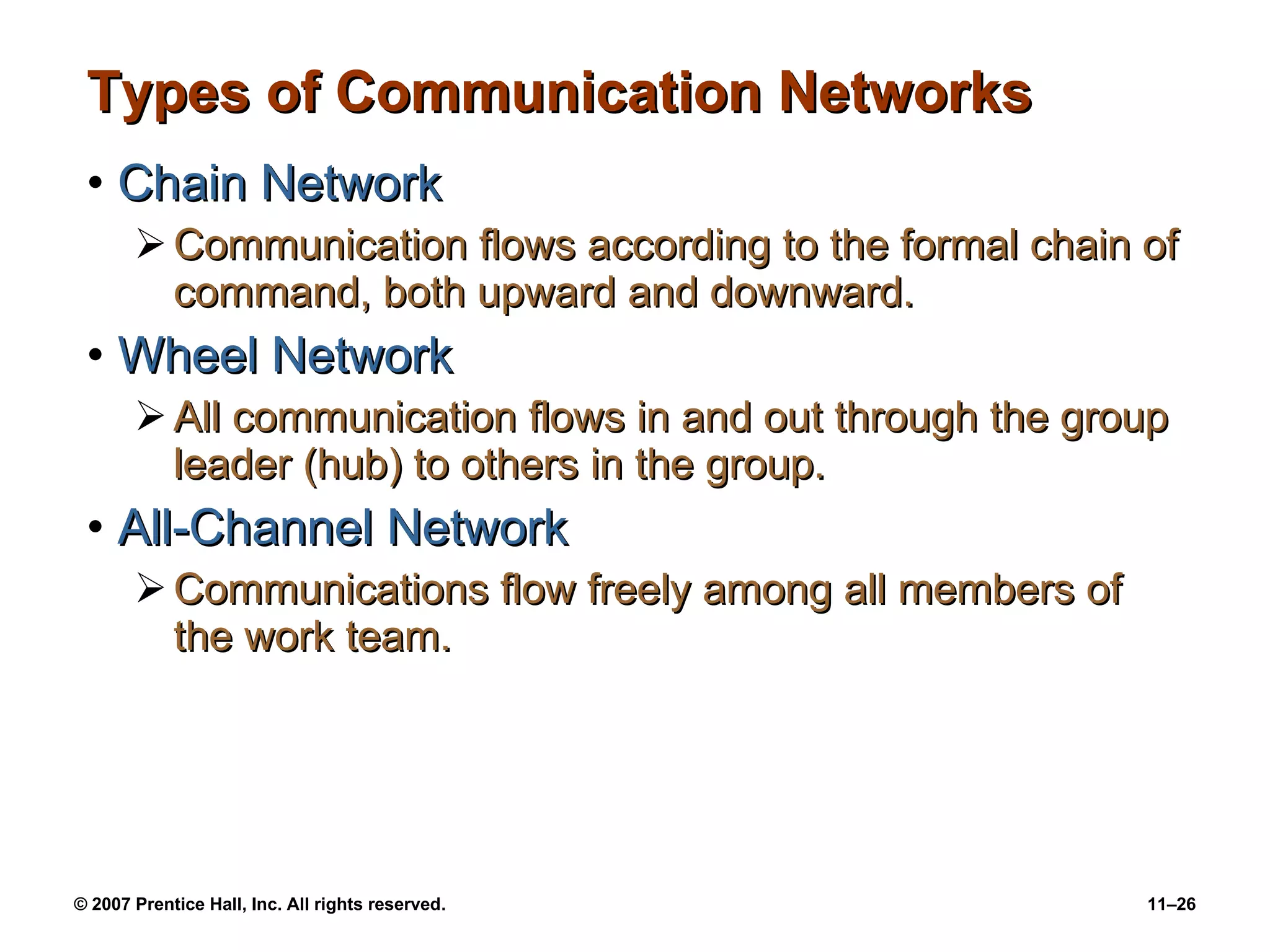
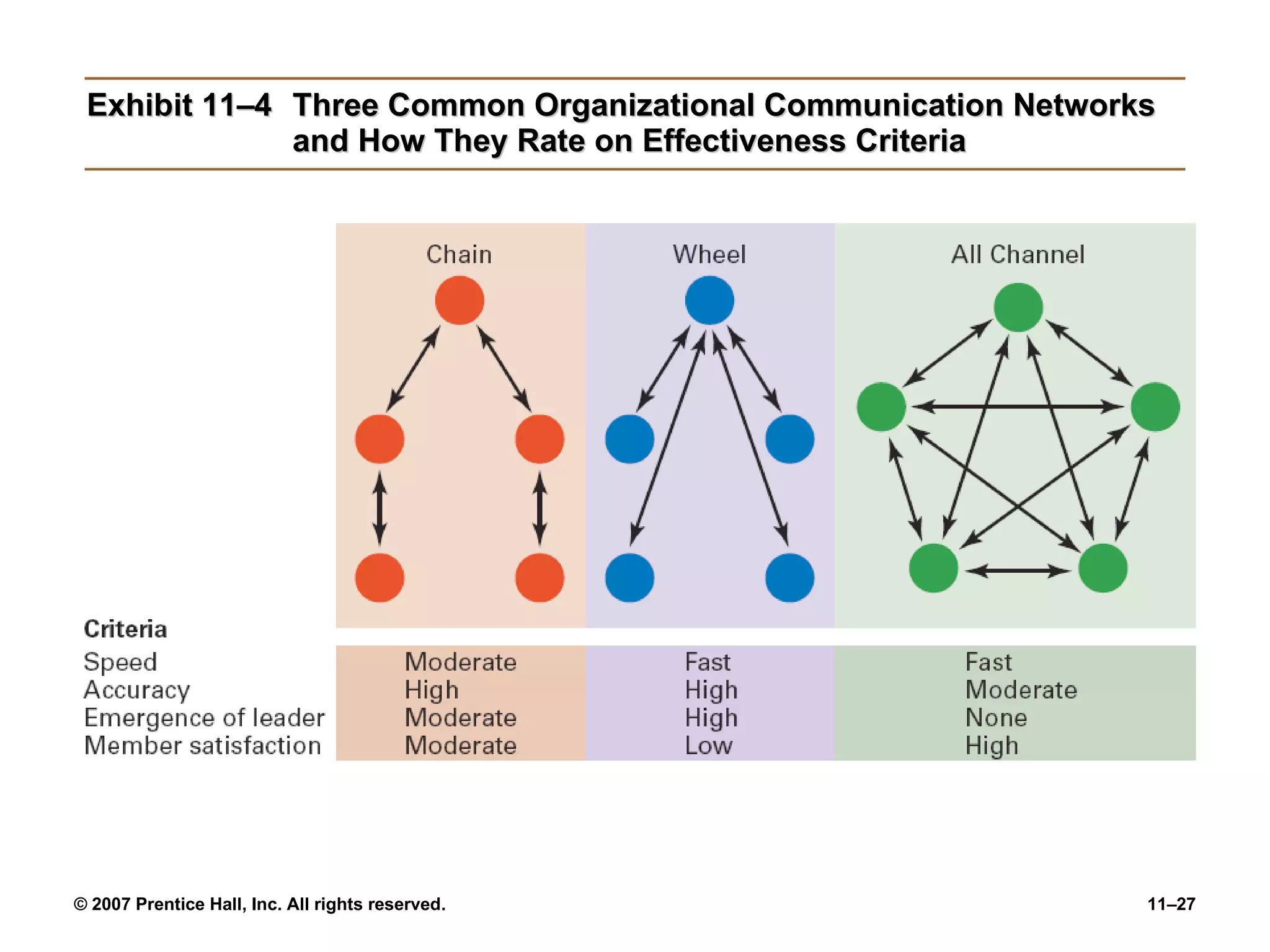
Types of Communication Networks Chain Network Communication flows according to the formal chain of command, both upward and downward. Wheel Network All communication flows in and out through the group leader (hub) to others in the group. All-Channel Network Communications flow freely among all members of the work team.
Exhibit 11–4 Three Common Organizational Communication Networks and How They Rate on Effectiveness Criteria
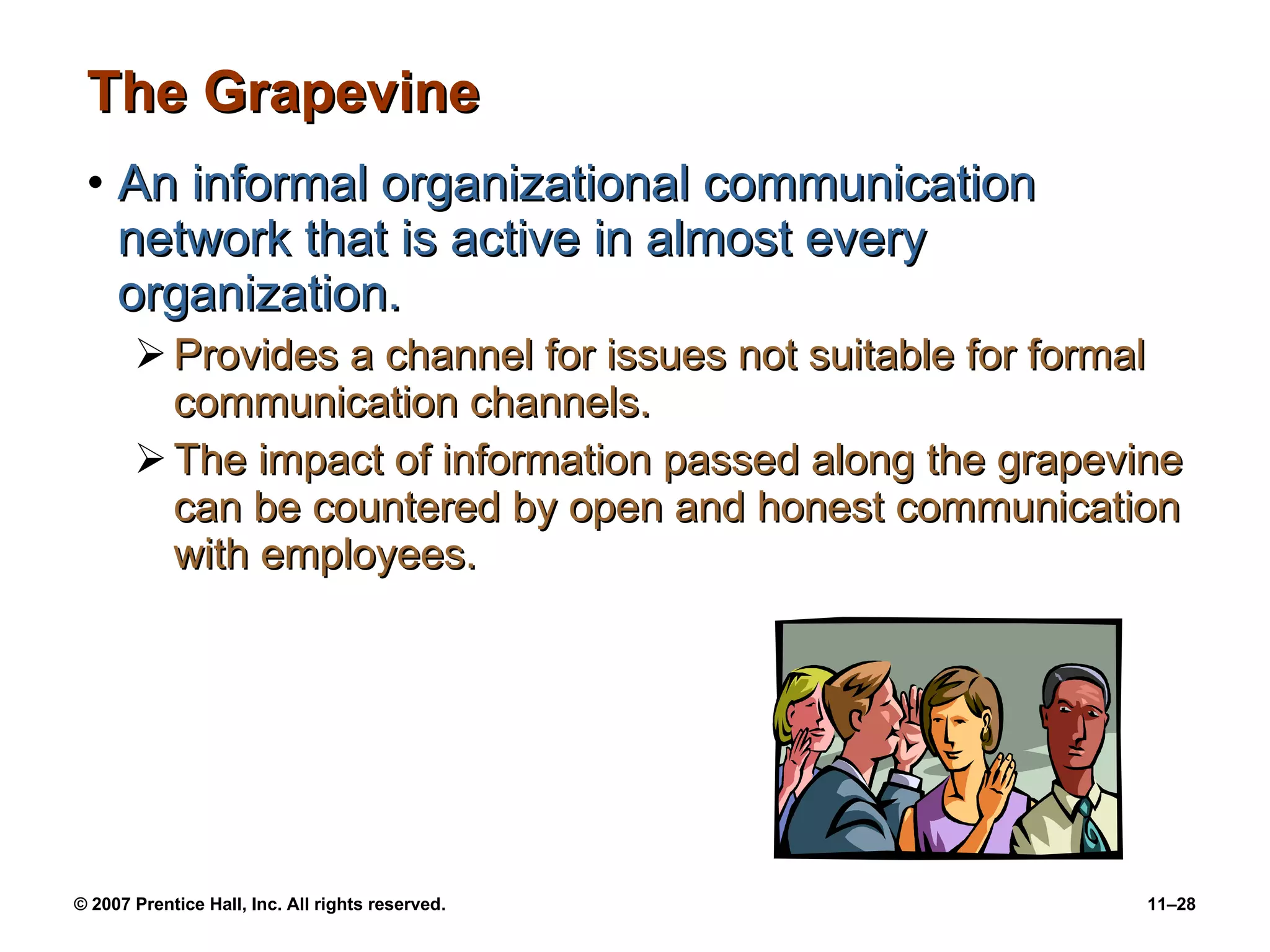
The Grapevine An informal organizational communication network that is active in almost every organization. Provides a channel for issues not suitable for formal communication channels. The impact of information passed along the grapevine can be countered by open and honest communication with employees.
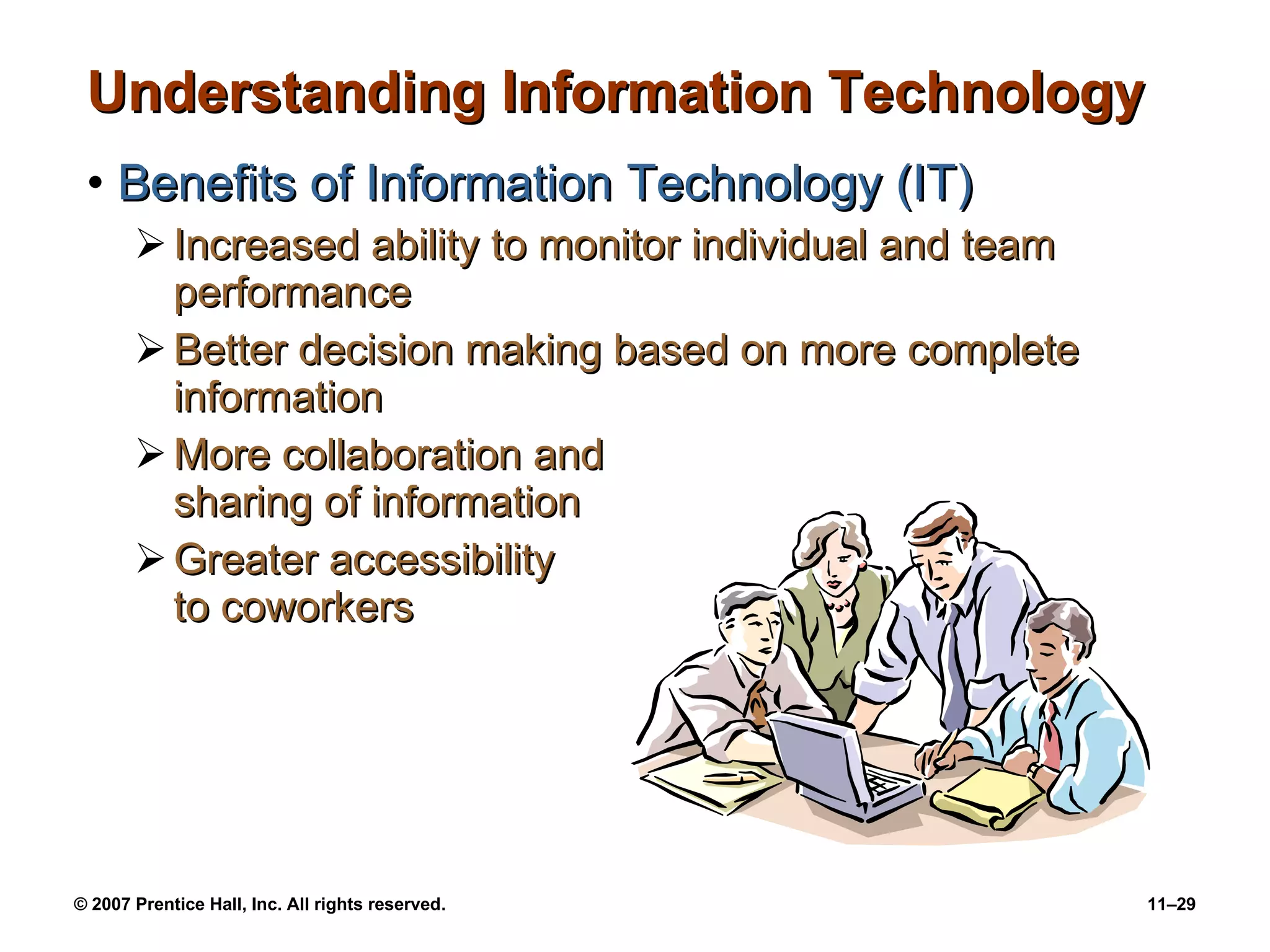
Understanding Information Technology Benefits of Information Technology (IT) Increased ability to monitor individual and team performance Better decision making based on more complete information More collaboration and  sharing of information Greater accessibility  to coworkers
Information Technology (cont’d) Networked Computer Systems Linking individual computers to create an organizational network for communication and information sharing. E-mail Instant messaging (IM) Blogs Wikis Voice-mail Fax machines Electronic Data Exchange (EDI) Teleconferencing Videoconferencing Web conferencing
Information Technology (cont’d) Types of Network Systems Intranet An internal network that uses Internet technology and is accessible only to employees. Extranet An internal network that uses Internet technology and allows authorized users inside the organization to communicate with certain outsiders such as customers and vendors. Wireless (WIFI) capabilities
How IT Affects Organization Removes the constraints of time and distance Allows widely dispersed employees to work together. Provides for the sharing of information Increases effectiveness and efficiency. Integrates decision making and work Provides more complete information and participation for better decisions. Creates problems of constant accessibility to employees Blurs the line between work and personal lives.
Current Communication Issues Managing Communication in an Internet World Legal and security issues Inappropriate use of company e-mail and instant messaging Loss of confidential and proprietary information due to inadvertent or deliberate dissemination or to hackers. Lack of personal interaction Being connected is not the same as face-to-face contact. Difficulties occur in achieving understanding and collaboration in virtual environements.
Current Communication Issues Being connected versus being concerned Managing Internet gripe sites as a valuable resource for unique insights into the organization. Employee complaints (“hot-button” issues) Customer complaints Responding to Internet gripe sites Recognized them as a valuable source of information. Post messages that clarify misinformation. Take action to correct problems noted on the site. Set up an internal gripe site. Continue to monitor the public gripe site.
Current Communication Issues (cont’d) Managing the Organization’s Knowledge Resources Build online information databases that employees can access. Create “communities of practice” for groups of people who share a concern, share expertise, and interact with each other.
Communication and Customer Service Communicating Effectively with Customers Recognize the three components of the customer service delivery process: The customer The service organization The service provider Develop a strong service culture focused on the personalization of service to each customer. Listen and respond to the customer. Provide access to needed service information.
“Politically Correct” Communication Do not use words or phrases that stereotype, intimidate, or offend individuals based on their differences. However, choose words carefully to maintain as much clarity as possible in communications.
Terms to Know communication interpersonal communication organizational communication message encoding channel decoding communication process noise nonverbal communication body language verbal intonation filtering selective perception information overload jargon active listening formal communication informal communication downward communication upward communication
Terms to Know (cont’d) lateral communication diagonal communication communication networks grapevine e-mail instant messaging (IM) blog wiki voice mail fax electronic data interchange (EDI) teleconferencing videoconferencing web conferencing intranet extranet communities of practice

Chapter 11 Communication And Information Technology Ppt11

  • 1.
    Communication and InformationTechnology Chapter 11
  • 2.
    L E AR N I N G O U T L I N E Follow this Learning Outline as you read and study this chapter. Understanding Communications Differentiate between interpersonal and organizational communication. Discuss the functions of communication. The Process of Interpersonal Communications Explain all the components of the communication process. List the communication methods managers might use. Describe nonverbal communication and how it takes place. Explain the barriers to effective interpersonal communication and how to overcome them.
  • 3.
    L E AR N I N G O U T L I N E (cont’d) Follow this Learning Outline as you read and study this chapter. Organizational Communication Explain how communication can flow in an organization. Describe the three common communication networks. Discuss how managers should handle the grapevine. Understanding Information Technology Describe how technology affects managerial communication. Define e-mail, instant messaging, blogs and wikis, voice-mail, fax, EDI, teleconferencing, videoconferencing, web conferencing, intranet, and extranet. Explain how information technology affects organizations.
  • 4.
    L E AR N I N G O U T L I N E (cont’d) Follow this Learning Outline as you read and study this chapter. Communication Issues in Today’s Organization Discuss the challenges of managing communication in an Internet world. Explain how organizations can manage knowledge. Explain why communicating with customers is an important managerial issue. Explain how political correctness is affecting communication.
  • 5.
    What Is Communication?Communication The transfer and understanding of meaning. Transfer means the message was received in a form that can be interpreted by the receiver. Understanding the message is not the same as the receiver agreeing with the message. Interpersonal Communication Communication between two or more people Organizational Communication All the patterns, network, and systems of communications within an organization
  • 6.
    Four Functions ofCommunication Functions of Communication Control Motivation Emotional Expression Information
  • 7.
    Functions of CommunicationControl Formal and informal communications act to control individuals’ behaviors in organizations. Motivation Communications clarify for employees what is to done, how well they have done it, and what can be done to improve performance.
  • 8.
    Functions of Communication(cont’d) Emotional Expression Social interaction in the form of work group communications provides a way for employees to express themselves. Information Individuals and work groups need information to make decisions or to do their work.
  • 9.
    Interpersonal Communication MessageSource: sender’s intended meaning Encoding The message converted to symbolic form Channel The medium through which the message travels Decoding The receiver’s retranslation of the message Noise Disturbances that interfere with communications
  • 10.
    Exhibit 11–1 TheInterpersonal Communication Process
  • 11.
    Distortions in CommunicationsMessage Encoding The effect of the skills, attitudes, and knowledge of the sender on the process of encoding the message The social-cultural system of the sender The Message Symbols used to convey the message’s meaning The content of the message itself The choice of message format Noise interfering with the message
  • 12.
    Distortions in Communications(cont’d) The Channel The sender’s choice of the appropriate channel or multiple channels for conveying the message Receiver The effect of skills, attitudes, and knowledge of the receiver on the process of decoding the message The social-cultural system of the receiver Feedback Loop Communication channel distortions affecting the return message from receiver to sender
  • 13.
    Interpersonal Communication MethodsFace-to-face Telephone Group meetings Formal presentations Memos Traditional Mail Fax machines Employee publications Bulletin boards Audio- and videotapes Hotlines E-mail Computer conferencing Voice mail Teleconferences Videoconferences
  • 14.
    Evaluating Communication MethodsFeedback Complexity capacity Breadth potential Confidentiality Encoding ease Decoding ease Time-space constraint Cost Interpersonal warmth Formality Scanability Time consumption
  • 15.
    Exhibit 11–2 Comparisonof Communication Methods Note: Ratings are on a 1–5 scale where 1 = high and 5 = low. Consumption time refers to who controls the reception of communication. S/R means the sender and receiver share control. Source: P. G. Clampitt, Communicating for Managerial Effectiveness (Newbury Park, CA: Sage Publications, 1991), p. 136.
  • 16.
    Interpersonal Communication (cont’d)Nonverbal Communication Communication that is transmitted without words. Sounds with specific meanings or warnings Images that control or encourage behaviors Situational behaviors that convey meanings Clothing and physical surroundings that imply status Body language: gestures, facial expressions, and other body movements that convey meaning. Verbal intonation: emphasis that a speaker gives to certain words or phrases that conveys meaning.
  • 17.
    Interpersonal Communication BarriersDefensiveness National Culture Emotions Information Overload Interpersonal Communication Language Filtering
  • 18.
    Barriers to EffectiveInterpersonal Communication Filtering The deliberate manipulation of information to make it appear more favorable to the receiver. Emotions Disregarding rational and objective thinking processes and substituting emotional judgments when interpreting messages. Information Overload Being confronted with a quantity of information that exceeds an individual’s capacity to process it.
  • 19.
    Barriers to EffectiveInterpersonal Communication (cont’d) Defensiveness When threatened, reacting in a way that reduces the ability to achieve mutual understanding. Language The different meanings of and specialized ways (jargon) in which senders use words can cause receivers to misinterpret their messages. National Culture Culture influences the form, formality, openness, patterns and use of information in communications.
  • 20.
    Overcoming the Barriersto Effective Interpersonal Communications Use Feedback Simplify Language Listen Actively Constrain Emotions Watch Nonverbal Cues
  • 21.
    Exhibit 11–3 ActiveListening Behaviors Source: Based on P.L. Hunsaker, Training in Management Skills (Upper Saddle River, NJ: Prentice Hall, 2001).
  • 22.
    Types of OrganizationalCommunication Formal Communication Communication that follows the official chain of command or is part of the communication required to do one’s job. Informal Communication Communication that is not defined by the organization’s hierarchy. Permits employees to satisfy their need for social interaction. Can improve an organization’s performance by creating faster and more effective channels of communication.
  • 23.
    Communication Flows Lateral Diagonal Downwa r d Upwa r d
  • 24.
    Direction of CommunicationFlow Downward Communications that flow from managers to employees to inform, direct, coordinate, and evaluate employees. Upward Communications that flow from employees up to managers to keep them aware of employee needs and how things can be improved to create a climate of trust and respect.
  • 25.
    Direction of CommunicationFlow (cont’d) Lateral (Horizontal) Communication Communication that takes place among employees on the same level in the organization to save time and facilitate coordination. Diagonal Communication Communication that cuts across both work areas and organizational levels in the interest of efficiency and speed.
  • 26.
    Types of CommunicationNetworks Chain Network Communication flows according to the formal chain of command, both upward and downward. Wheel Network All communication flows in and out through the group leader (hub) to others in the group. All-Channel Network Communications flow freely among all members of the work team.
  • 27.
    Exhibit 11–4 ThreeCommon Organizational Communication Networks and How They Rate on Effectiveness Criteria
  • 28.
    The Grapevine Aninformal organizational communication network that is active in almost every organization. Provides a channel for issues not suitable for formal communication channels. The impact of information passed along the grapevine can be countered by open and honest communication with employees.
  • 29.
    Understanding Information TechnologyBenefits of Information Technology (IT) Increased ability to monitor individual and team performance Better decision making based on more complete information More collaboration and sharing of information Greater accessibility to coworkers
  • 30.
    Information Technology (cont’d)Networked Computer Systems Linking individual computers to create an organizational network for communication and information sharing. E-mail Instant messaging (IM) Blogs Wikis Voice-mail Fax machines Electronic Data Exchange (EDI) Teleconferencing Videoconferencing Web conferencing
  • 31.
    Information Technology (cont’d)Types of Network Systems Intranet An internal network that uses Internet technology and is accessible only to employees. Extranet An internal network that uses Internet technology and allows authorized users inside the organization to communicate with certain outsiders such as customers and vendors. Wireless (WIFI) capabilities
  • 32.
    How IT AffectsOrganization Removes the constraints of time and distance Allows widely dispersed employees to work together. Provides for the sharing of information Increases effectiveness and efficiency. Integrates decision making and work Provides more complete information and participation for better decisions. Creates problems of constant accessibility to employees Blurs the line between work and personal lives.
  • 33.
    Current Communication IssuesManaging Communication in an Internet World Legal and security issues Inappropriate use of company e-mail and instant messaging Loss of confidential and proprietary information due to inadvertent or deliberate dissemination or to hackers. Lack of personal interaction Being connected is not the same as face-to-face contact. Difficulties occur in achieving understanding and collaboration in virtual environements.
  • 34.
    Current Communication IssuesBeing connected versus being concerned Managing Internet gripe sites as a valuable resource for unique insights into the organization. Employee complaints (“hot-button” issues) Customer complaints Responding to Internet gripe sites Recognized them as a valuable source of information. Post messages that clarify misinformation. Take action to correct problems noted on the site. Set up an internal gripe site. Continue to monitor the public gripe site.
  • 35.
    Current Communication Issues(cont’d) Managing the Organization’s Knowledge Resources Build online information databases that employees can access. Create “communities of practice” for groups of people who share a concern, share expertise, and interact with each other.
  • 36.
    Communication and CustomerService Communicating Effectively with Customers Recognize the three components of the customer service delivery process: The customer The service organization The service provider Develop a strong service culture focused on the personalization of service to each customer. Listen and respond to the customer. Provide access to needed service information.
  • 37.
    “Politically Correct” CommunicationDo not use words or phrases that stereotype, intimidate, or offend individuals based on their differences. However, choose words carefully to maintain as much clarity as possible in communications.
  • 38.
    Terms to Knowcommunication interpersonal communication organizational communication message encoding channel decoding communication process noise nonverbal communication body language verbal intonation filtering selective perception information overload jargon active listening formal communication informal communication downward communication upward communication
  • 39.
    Terms to Know(cont’d) lateral communication diagonal communication communication networks grapevine e-mail instant messaging (IM) blog wiki voice mail fax electronic data interchange (EDI) teleconferencing videoconferencing web conferencing intranet extranet communities of practice