Digital Technology
Varun Kumar
Prof Sarat Kumar Patra
National Institute of Technology, Rourkela (India)
National Institute of Information Technology, Vadodara (India)
1
Outlines
●Introduction
●Backbone of Digital Technology
●Opportunities and Challenges
●Application
●Future Trends
Digital Technology:
Historical Background:
 American engineers began a technology in the mid-twentieth century
which was based on mathematical concepts suggested by the
seventeenth-century German mathematician, Gottfried Wilhelm Leibniz.
 Wilhelm Leibniz proposed a binary computing system. His innovation
inspired such numerical codes as American Standard Code for Information
Interchange (ASCII) that described objects with digits.
Definition:
 Digital technology is a base two process. Digitized information is recorded
in binary code of combinations of the digits 0 and 1, also called bits, which
represent words and images, text etc.
 Digital technology enables immense amounts of information to be
compressed on small storage devices that can be easily preserved and
transported.
Impact
●Digital technology has transformed how people communicate, learn, and
work.
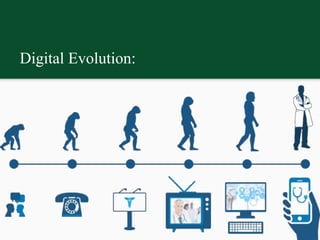
Digital Evolution:
Backbone of Digital Technology:
●Data Acquisition Unit
●Signal/Data processing
●Outcome integration for next level processed output
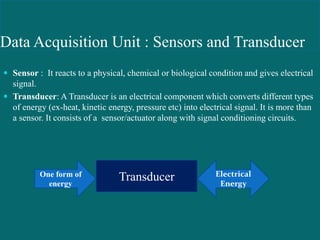
Data Acquisition Unit : Sensors and Transducer:
 Sensor : It reacts to a physical, chemical or biological condition and gives electrical
signal.
 Transducer: A Transducer is an electrical component which converts different types
of energy (ex-heat, kinetic energy, pressure etc) into electrical signal. It is more than
a sensor. It consists of a sensor/actuator along with signal conditioning circuits.
TransducerOne form of
energy
Electrical
Energy
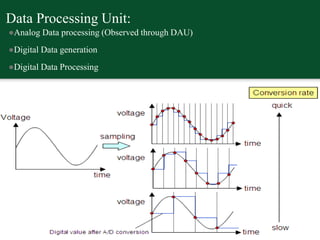
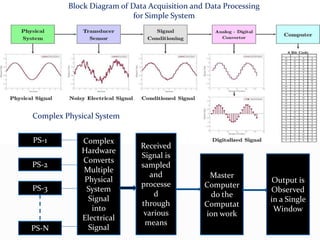
Data Processing Unit:
●Analog Data processing (Observed through DAU)
●Digital Data generation
●Digital Data Processing
|
Block Diagram of Data Acquisition and Data Processing
for Simple System
PS-1
Master
Computer
do the
Computat
ion work
PS-2
PS-N
Complex
Hardware
Converts
Multiple
Physical
System
Signal
into
Electrical
Signal
PS-3
Output is
Observed
in a Single
Window
Received
Signal is
sampled
and
processe
d
through
various
means
Complex Physical System
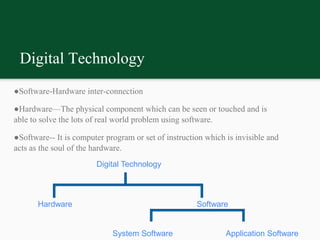
Digital Technology
●Software-Hardware inter-connection
●Hardware—The physical component which can be seen or touched and is
able to solve the lots of real world problem using software.
●Software-- It is computer program or set of instruction which is invisible and
acts as the soul of the hardware.
Digital Technology
Hardware Software
System Software Application Software
Hardware
●Hardware is a physical device which has multiple functional small
devices.
●For faster computation various units of devices are integrated to get
the desired performance.
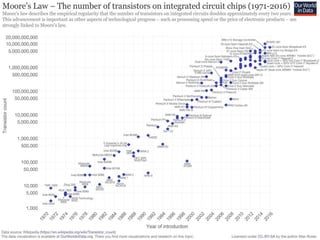
● Transistor miniaturization participated a vital role in the field of
hardware section.
●Intel scientist Moore’s have proposed the number of transistor
integration year wise in limited physical space.
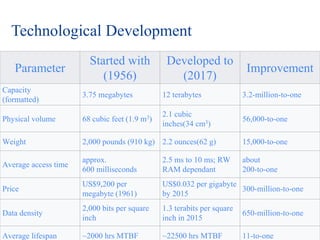
Parameter
Started with
(1956)
Developed to
(2017)
Improvement
Capacity
(formatted)
3.75 megabytes 12 terabytes 3.2-million-to-one
Physical volume 68 cubic feet (1.9 m3)
2.1 cubic
inches(34 cm3)
56,000-to-one
Weight 2,000 pounds (910 kg) 2.2 ounces(62 g) 15,000-to-one
Average access time
approx.
600 milliseconds
2.5 ms to 10 ms; RW
RAM dependant
about
200-to-one
Price
US$9,200 per
megabyte (1961)
US$0.032 per gigabyte
by 2015
300-million-to-one
Data density
2,000 bits per square
inch
1.3 terabits per square
inch in 2015
650-million-to-one
Average lifespan ~2000 hrs MTBF ~22500 hrs MTBF 11-to-one
Technological Development
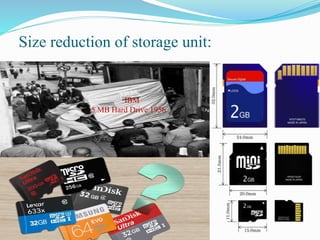
Size reduction of storage unit:
IBM
5 MB Hard Drive 1956
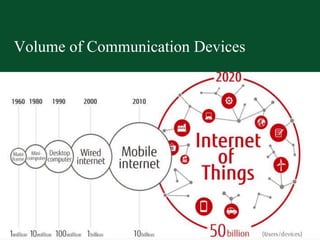
Volume of Communication Devices
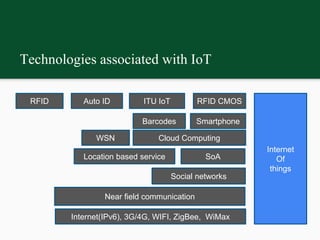
Technologies associated with IoT
Social networks
Internet
Of
things
RFID Auto ID ITU IoT RFID CMOS
Barcodes Smartphone
WSN Cloud Computing
Location based service SoA
Near field communication
Internet(IPv6), 3G/4G, WIFI, ZigBee, WiMax
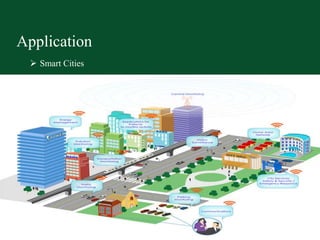
Application
 Smart Cities
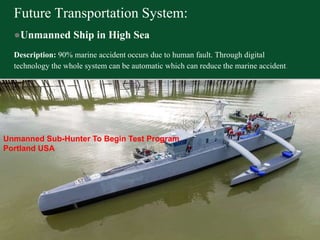
Future Transportation System:
●Unmanned Ship in High Sea
Description: 90% marine accident occurs due to human fault. Through digital
technology the whole system can be automatic which can reduce the marine accident.
Unmanned Sub-Hunter To Begin Test Program
Portland USA
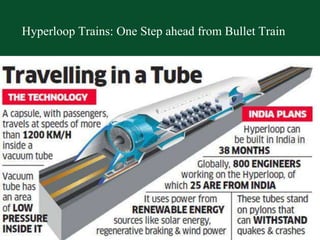
Hyperloop Trains: One Step ahead from Bullet Train
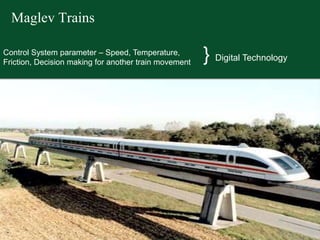
Maglev Trains
Control System parameter – Speed, Temperature,
Friction, Decision making for another train movement
} Digital Technology
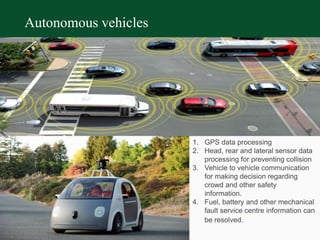
Autonomous vehicles
1. GPS data processing
2. Head, rear and lateral sensor data
processing for preventing collision
3. Vehicle to vehicle communication
for making decision regarding
crowd and other safety
information.
4. Fuel, battery and other mechanical
fault service centre information can
be resolved.
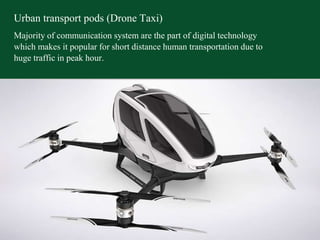
Urban transport pods (Drone Taxi)
Majority of communication system are the part of digital technology
which makes it popular for short distance human transportation due to
huge traffic in peak hour.
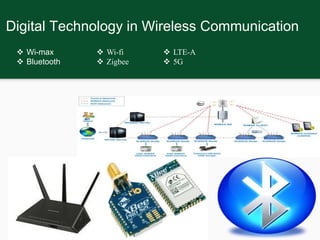
Digital Technology in Wireless Communication
 Wi-fi
 Zigbee
 LTE-A
 5G
 Wi-max
 Bluetooth
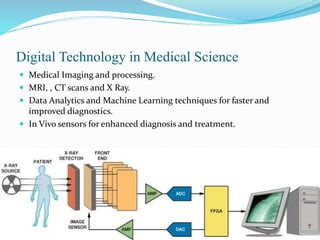
Digital Technology in Medical Science
 Medical Imaging and processing.
 MRI, , CT scans and X Ray.
 Data Analytics and Machine Learning techniques for faster and
improved diagnostics.
 In Vivo sensors for enhanced diagnosis and treatment.
Digital Technology for Energy Efficiency:
 Smart grids to reduce energy leakage .
1. Motorola Smart grid technologies in power generation
2. Alcatel-Lucent activities to promote Smart Grid technology
3. IBM solutions for Energie Baden-Württemberg lays the groundwork for
“smarter” energy consumption
 Energy efficiency in the construction sector
1. Siemens Case study: Partnership with Belgian Hospital results in Energy
Savings
2. A Siemens-McKinsey study shows how London can cut its greenhouse gas
emissions by up to 60 percent by 2025 .
Contd--
 Energy Efficiency in the transport sector
1. Motorola Transport Efficiency and Reliability Solution
2. Cisco Telepresence
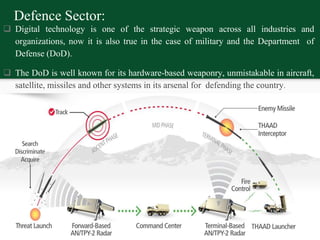
Defence Sector:
 Digital technology is one of the strategic weapon across all industries and
organizations, now it is also true in the case of military and the Department of
Defense (DoD).
 The DoD is well known for its hardware-based weaponry, unmistakable in aircraft,
satellite, missiles and other systems in its arsenal for defending the country.
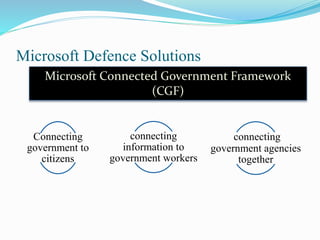
Microsoft Defence Solutions
Connecting
government to
citizens
connecting
information to
government workers
connecting
government agencies
together
Microsoft Connected Government Framework
(CGF)
Contd..
29
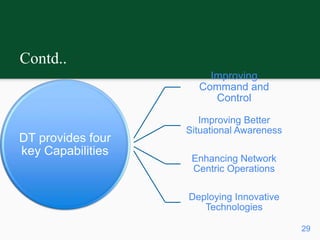
DT provides four
key Capabilities
Improving
Command and
Control
Improving Better
Situational Awareness
Enhancing Network
Centric Operations
Deploying Innovative
Technologies
Space Exploration
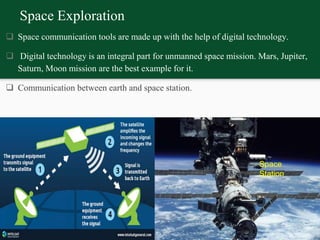
 Space communication tools are made up with the help of digital technology.
 Digital technology is an integral part for unmanned space mission. Mars, Jupiter,
Saturn, Moon mission are the best example for it.
 Communication between earth and space station.
Space
Station
Agriculture
●Through specific sensor the soil moisture, nitrogen, phosphorous, potassium,
percentage of fossil etc. can be easily observed.
●The mineral combination helps for bowing specific crop under observed
constraints.
●Ground Water level detection for irrigation
Social Impact
●Facebook, Twitter, Whatsup, YouTube are the integral part of modern
society.
●Every information can be get viral through these media.
●Govt helps reaches on the spot (EX- In railway grievances is taken care
quickly)
●Administration became transparent.
●Crime will be stopped through suspicious activity detection tool (Part of
artificial intelligence).
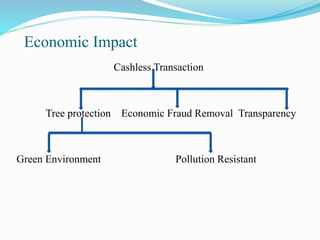
Economic Impact
Cashless Transaction
Tree protection Economic Fraud Removal Transparency
Green Environment Pollution Resistant
Educational Scenario
●Online Classes
●Flip classes
●Organizational video
●To prevent cheating and manage lots of paper work.
Indian Scenario
●PDS (Public Distribution System)
●Different type of payment gateway has been discovered after demonetization
Ex-CC-avenue, BillDesk,
●Paddy, sugarcane, potato etc are directly purchased by co-operative society
(appointed by government) and money is directly transferred to actual
beneficiary.
Government Initiative:
●SWIFT (Single Window Interface For Trade)
●Smart Cities (June 2015)
●mkisan (overall development for farmer)
●e-visa
●Shaala Siddhi (National University of Education Planning Administration)
●Sugamya Pustakalya (Ministry of Social Justice and Empowerment)
●Himmat (Delhi—Women Safety)
●Bhim---(Common Interface for fund transfer)
●PAHAL (Direct subsidy fund transfer to the LPG account holder)
●GST
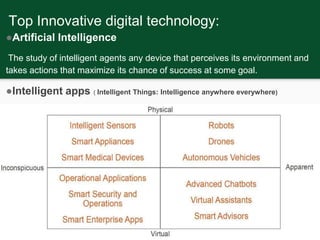
Top Innovative digital technology:
●Artificial Intelligence
The study of intelligent agents any device that perceives its environment and
takes actions that maximize its chance of success at some goal.
●Intelligent apps ( Intelligent Things: Intelligence anywhere everywhere)
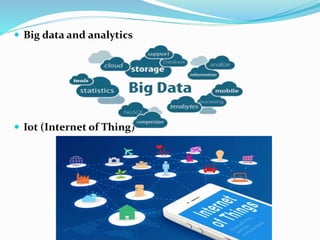
 Big data and analytics
 Iot (Internet of Thing)
Digital Technology in the Next Two Decades
●Software developments jobs to go
●Facebook, YouTube, Twitter became very important and
integral part of life.
●Factory automation. Earlier through digital control system.
Current systems replaced by computerised control
●Start of affordable mass market
●Current IT opportunities will shrink
DIGITAL TECHNOLOGY

DIGITAL TECHNOLOGY

  • 1.
    Digital Technology Varun Kumar ProfSarat Kumar Patra National Institute of Technology, Rourkela (India) National Institute of Information Technology, Vadodara (India) 1
  • 2.
    Outlines ●Introduction ●Backbone of DigitalTechnology ●Opportunities and Challenges ●Application ●Future Trends
  • 3.
    Digital Technology: Historical Background: American engineers began a technology in the mid-twentieth century which was based on mathematical concepts suggested by the seventeenth-century German mathematician, Gottfried Wilhelm Leibniz.  Wilhelm Leibniz proposed a binary computing system. His innovation inspired such numerical codes as American Standard Code for Information Interchange (ASCII) that described objects with digits.
  • 4.
    Definition:  Digital technologyis a base two process. Digitized information is recorded in binary code of combinations of the digits 0 and 1, also called bits, which represent words and images, text etc.  Digital technology enables immense amounts of information to be compressed on small storage devices that can be easily preserved and transported. Impact ●Digital technology has transformed how people communicate, learn, and work.
  • 5.
  • 6.
    Backbone of DigitalTechnology: ●Data Acquisition Unit ●Signal/Data processing ●Outcome integration for next level processed output
  • 7.
    Data Acquisition Unit: Sensors and Transducer:  Sensor : It reacts to a physical, chemical or biological condition and gives electrical signal.  Transducer: A Transducer is an electrical component which converts different types of energy (ex-heat, kinetic energy, pressure etc) into electrical signal. It is more than a sensor. It consists of a sensor/actuator along with signal conditioning circuits. TransducerOne form of energy Electrical Energy
  • 8.
    Data Processing Unit: ●AnalogData processing (Observed through DAU) ●Digital Data generation ●Digital Data Processing
  • 9.
    | Block Diagram ofData Acquisition and Data Processing for Simple System PS-1 Master Computer do the Computat ion work PS-2 PS-N Complex Hardware Converts Multiple Physical System Signal into Electrical Signal PS-3 Output is Observed in a Single Window Received Signal is sampled and processe d through various means Complex Physical System
  • 10.
    Digital Technology ●Software-Hardware inter-connection ●Hardware—Thephysical component which can be seen or touched and is able to solve the lots of real world problem using software. ●Software-- It is computer program or set of instruction which is invisible and acts as the soul of the hardware. Digital Technology Hardware Software System Software Application Software
  • 11.
    Hardware ●Hardware is aphysical device which has multiple functional small devices. ●For faster computation various units of devices are integrated to get the desired performance. ● Transistor miniaturization participated a vital role in the field of hardware section. ●Intel scientist Moore’s have proposed the number of transistor integration year wise in limited physical space.
  • 13.
    Parameter Started with (1956) Developed to (2017) Improvement Capacity (formatted) 3.75megabytes 12 terabytes 3.2-million-to-one Physical volume 68 cubic feet (1.9 m3) 2.1 cubic inches(34 cm3) 56,000-to-one Weight 2,000 pounds (910 kg) 2.2 ounces(62 g) 15,000-to-one Average access time approx. 600 milliseconds 2.5 ms to 10 ms; RW RAM dependant about 200-to-one Price US$9,200 per megabyte (1961) US$0.032 per gigabyte by 2015 300-million-to-one Data density 2,000 bits per square inch 1.3 terabits per square inch in 2015 650-million-to-one Average lifespan ~2000 hrs MTBF ~22500 hrs MTBF 11-to-one Technological Development
  • 14.
    Size reduction ofstorage unit: IBM 5 MB Hard Drive 1956
  • 15.
  • 16.
    Technologies associated withIoT Social networks Internet Of things RFID Auto ID ITU IoT RFID CMOS Barcodes Smartphone WSN Cloud Computing Location based service SoA Near field communication Internet(IPv6), 3G/4G, WIFI, ZigBee, WiMax
  • 17.
  • 18.
    Future Transportation System: ●UnmannedShip in High Sea Description: 90% marine accident occurs due to human fault. Through digital technology the whole system can be automatic which can reduce the marine accident. Unmanned Sub-Hunter To Begin Test Program Portland USA
  • 19.
    Hyperloop Trains: OneStep ahead from Bullet Train
  • 20.
    Maglev Trains Control Systemparameter – Speed, Temperature, Friction, Decision making for another train movement } Digital Technology
  • 21.
    Autonomous vehicles 1. GPSdata processing 2. Head, rear and lateral sensor data processing for preventing collision 3. Vehicle to vehicle communication for making decision regarding crowd and other safety information. 4. Fuel, battery and other mechanical fault service centre information can be resolved.
  • 22.
    Urban transport pods(Drone Taxi) Majority of communication system are the part of digital technology which makes it popular for short distance human transportation due to huge traffic in peak hour.
  • 23.
    Digital Technology inWireless Communication  Wi-fi  Zigbee  LTE-A  5G  Wi-max  Bluetooth
  • 24.
    Digital Technology inMedical Science  Medical Imaging and processing.  MRI, , CT scans and X Ray.  Data Analytics and Machine Learning techniques for faster and improved diagnostics.  In Vivo sensors for enhanced diagnosis and treatment.
  • 25.
    Digital Technology forEnergy Efficiency:  Smart grids to reduce energy leakage . 1. Motorola Smart grid technologies in power generation 2. Alcatel-Lucent activities to promote Smart Grid technology 3. IBM solutions for Energie Baden-Württemberg lays the groundwork for “smarter” energy consumption  Energy efficiency in the construction sector 1. Siemens Case study: Partnership with Belgian Hospital results in Energy Savings 2. A Siemens-McKinsey study shows how London can cut its greenhouse gas emissions by up to 60 percent by 2025 .
  • 26.
    Contd--  Energy Efficiencyin the transport sector 1. Motorola Transport Efficiency and Reliability Solution 2. Cisco Telepresence
  • 27.
    Defence Sector:  Digitaltechnology is one of the strategic weapon across all industries and organizations, now it is also true in the case of military and the Department of Defense (DoD).  The DoD is well known for its hardware-based weaponry, unmistakable in aircraft, satellite, missiles and other systems in its arsenal for defending the country.
  • 28.
    Microsoft Defence Solutions Connecting governmentto citizens connecting information to government workers connecting government agencies together Microsoft Connected Government Framework (CGF)
  • 29.
    Contd.. 29 DT provides four keyCapabilities Improving Command and Control Improving Better Situational Awareness Enhancing Network Centric Operations Deploying Innovative Technologies
  • 30.
    Space Exploration  Spacecommunication tools are made up with the help of digital technology.  Digital technology is an integral part for unmanned space mission. Mars, Jupiter, Saturn, Moon mission are the best example for it.  Communication between earth and space station. Space Station
  • 31.
    Agriculture ●Through specific sensorthe soil moisture, nitrogen, phosphorous, potassium, percentage of fossil etc. can be easily observed. ●The mineral combination helps for bowing specific crop under observed constraints. ●Ground Water level detection for irrigation
  • 32.
    Social Impact ●Facebook, Twitter,Whatsup, YouTube are the integral part of modern society. ●Every information can be get viral through these media. ●Govt helps reaches on the spot (EX- In railway grievances is taken care quickly) ●Administration became transparent. ●Crime will be stopped through suspicious activity detection tool (Part of artificial intelligence).
  • 33.
    Economic Impact Cashless Transaction Treeprotection Economic Fraud Removal Transparency Green Environment Pollution Resistant
  • 34.
    Educational Scenario ●Online Classes ●Flipclasses ●Organizational video ●To prevent cheating and manage lots of paper work.
  • 35.
    Indian Scenario ●PDS (PublicDistribution System) ●Different type of payment gateway has been discovered after demonetization Ex-CC-avenue, BillDesk, ●Paddy, sugarcane, potato etc are directly purchased by co-operative society (appointed by government) and money is directly transferred to actual beneficiary.
  • 36.
    Government Initiative: ●SWIFT (SingleWindow Interface For Trade) ●Smart Cities (June 2015) ●mkisan (overall development for farmer) ●e-visa ●Shaala Siddhi (National University of Education Planning Administration) ●Sugamya Pustakalya (Ministry of Social Justice and Empowerment) ●Himmat (Delhi—Women Safety) ●Bhim---(Common Interface for fund transfer) ●PAHAL (Direct subsidy fund transfer to the LPG account holder) ●GST
  • 37.
    Top Innovative digitaltechnology: ●Artificial Intelligence The study of intelligent agents any device that perceives its environment and takes actions that maximize its chance of success at some goal. ●Intelligent apps ( Intelligent Things: Intelligence anywhere everywhere)
  • 38.
     Big dataand analytics  Iot (Internet of Thing)
  • 39.
    Digital Technology inthe Next Two Decades ●Software developments jobs to go ●Facebook, YouTube, Twitter became very important and integral part of life. ●Factory automation. Earlier through digital control system. Current systems replaced by computerised control ●Start of affordable mass market ●Current IT opportunities will shrink