pH and Titratable
Acidity
By
Dr. Raakia Anam Saeed
Assistant Professor
Food Acidity
• Food acids are usually organic acids, with citric, malic, lactic, tartaric, and acetic acids being the
most common
• However, inorganic acids such as phosphoric and carbonic acids (arising from carbon dioxide in
solution) often play an important and even predominant role in food acidulation
The organic acids present in foods influence:
• flavor (i.e.,tartness)
• Color (through their impact on anthocyanin and other pH-influenced pigments)
• prevent/retard the growth of microorganisms or inhibit the germination of spores
• Providing the proper environment for metal ion chelation, an important phenomenon in the
minimization of lipid oxidation
Food Acidity
Organic acids may present:
• Naturally
• By Fermentation
• Added as part of a specific food formulation
The importance of determining food acidity
1. Determine the degree of maturity of fruits and vegetables
• The titratable acidity of fruits is used, along with sugar content, as an indicator of
maturity, generally the higher the maturity, the lower the acid content
• e.g. in the ripening process, such as tomatoes from green to mature stage , there is an increase
in sugar content
2. To determine the freshness of foods
• for example in milk, the more the lactic acid levels, means that milk is rotten
The importance of determining food acidity
3. Acidity indicators reflect the quality of food
The amount of organic acids in food directly affects the food flavor, color,
stability, and the level of quality
4. Determination of acid on the microbial fermentation process
Such as: fermentation products in soy sauce, vinegar and other acids is an
important indicator of quality
Concentration Units
• Molarity (M) is a concentration unit representing the
number of moles of the solute per liter of solution
• Normality (N) is a concentration unit representing the
number of equivalents (Eq) of a solute per liter of solution
• In acid and base solutions, the normality represents the concentration
or moles of H+ or OH− per liter that will be exchanged in a
neutralization reaction when taken to completion
• For oxidation–reduction reagents, the normality represents the
concentration or moles of electrons per liter to be exchanged when
the reaction is taken to completion
• Equivalent weight can be defined as the molecular weight
divided by the number of equivalents in the reactions
• Percentage concentrations are the mass amount of solute or
analyte per 100 ml or 100 g of material. Percentage can be
expressed for solutions or for solid and can be on a volume
basis or mass basis
• When the percentage becomes a number less than 1% parts
per million (ppm), parts per billion (ppb) and even parts
per trillion (ppt) usually are preferred
pH
Acid–Base Equilibria
The Brønsted-Lowry theory of neutralization is based upon the following definitions
for acid and base:
Acid: A substance capable of donating protons. In food systems the only significant
proton donor is the hydrogen ion
Base: A substance capable of accepting protons
Neutralization is the reaction of an acid with a base to form a salt as shown below:
HCl + NaOH NaCl + H2O
Acids form hydrated protons called hydronium ions (H3O+) and bases form
hydroxide ions (OH−) in aqueous solutions
pH
• At any temperature, the product of the molar
concentrations (moles/liter) of H3O+ and OH− is
a constant referred to as the ion product constant
for water (Kw)
[H3O+][OH−] = Kw
• Kw varies with the temperature
• Experimentation has revealed that the
concentration of [H3O+] is approximately 1.0 ×
10−7 M, as is that of the [OH−] at 25 ◦C.
Because the concentrations of these ions are
equal, pure water is referred to as being neutral
pH
• pH is defined as the logarithm of the reciprocal of the hydrogen ion
concentration
• It also may be defined as the negative logarithm of the molar
concentration of hydrogen ions
• Thus, a [H3O+] concentration of 1 × 10⁻⁶ is expressed simply as pH 6
• The [OH−] concentration is expressed as pOH
pH Meter
• Activity is a measure of expressed chemical
reactivity, while concentration is a measure
of all forms (free and bound) of ions in
solution
• Activity and concentration are related by the
following equation:
A = γC
where: A = activity, γ = activity coefficient, C
= concentration
Principle
• The pH meter is a good example of a
potentiometer (a device that measures voltage at
infinitesimal current flow)
• The basic principle of potentiometry (an
electrochemical method of voltammetry at zero
current) involves the use of an electrolytic cell
composed of two electrodes dipped into a test
solution
• A voltage develops, which is related to the ionic
concentration of the solution
• Since the presence of current could alter the
concentration of surrounding ions or produce
irreversible reactions, this voltage is measured
under conditions such that infinitesimal current
(10−12 amperes or less) is drawn
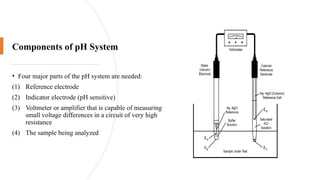
Components of pH System
• Four major parts of the pH system are needed:
(1) Reference electrode
(2) Indicator electrode (pH sensitive)
(3) Voltmeter or amplifier that is capable of measuring
small voltage differences in a circuit of very high
resistance
(4) The sample being analyzed
Components of pH
System
Reference Electrode
• The reference electrode is needed to complete
the circuit in the pH system
• This half cell is one of the most troublesome
parts of the pH meter
• Problems in obtaining pH measurements are
often traced to a faulty reference electrode
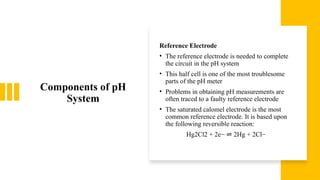
• The saturated calomel electrode is the most
common reference electrode. It is based upon
the following reversible reaction:
Hg2Cl2 + 2e− 2Hg + 2Cl−
⇌
Conti….
• A calomel reference electrode has three principal parts:
(1) a platinum wire covered with a mixture of calomel (Hg2Cl2)
(2) a filling solution (saturated KCl)
(3) a permeable junction through which the filling solution slowly migrates into the
sample being measured
• Junctions are made of ceramic or fibrous material. These junctions tend to clog up,
causing a slow, unstable response and inaccurate results
• A less widely used reference electrode is the silver–silver chloride electrode
• Because the calomel electrode is unstable at high temperatures (80◦C) or in strongly
basic samples (pH > 9), a silver–silver chloride electrode must be used for such
application
Conti….
Indicator Electrode
• The indicator electrode most commonly used in measuring pH today is referred to as the glass electrode
• Prior to its development, the hydrogen electrode and the quinhydrone electrode were used
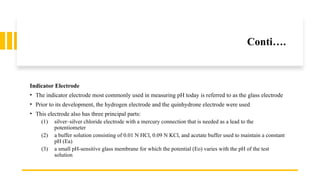
• This electrode also has three principal parts:
(1) silver–silver chloride electrode with a mercury connection that is needed as a lead to the
potentiometer
(2) a buffer solution consisting of 0.01 N HCl, 0.09 N KCl, and acetate buffer used to maintain a constant
pH (Ea)
(3) a small pH-sensitive glass membrane for which the potential (Eo) varies with the pH of the test
solution
• Conventional glass electrodes are suitable for measuring pH in the range of pH 1–9
• However, this electrode is sensitive to higher pH, especially in the presence of sodium ions
• Thus, equipment manufacturers have developed modern glass electrodes that are usable over
the entire pH range of 0–14 and feature a very low sodium ion error, such as <0.01 pH at 25
◦C
Combination Electrodes
• Today, most food analysis laboratories use combination electrodes that combine both the pH
and reference electrodes along with the temperature sensing probe in a single unit or probe
• These combination electrodes are available in many sizes and shapes from very small
microprobes to flat surface probes, from all glass to plastic, and from exposed electrode tip
to jacketed electrode tips to prevent glass tip breakage
• Microprobes may be used to measure pH of very small systems such as inside
a cell or a solution on a microscope slide
• Flat surface electrode probes can be used to measure pH of semisolid and
high-viscosity substances such as meat, cheese, and agar plates and small
volumes as low as 10 μl
Titratable acidity
• Titratable acidity is determined by neutralizing the acid present in a known
quantity (weight or volume) of food sample using a standard base
• The endpoint for titration is usually either a target pH or the color change of a pH-
sensitive dye, typically phenolphthalein
• The amount of base needed for neutralization reflect the acid content
TITRATABLE ACIDITY
• The titratable acidity of fruits is used, along with sugar content, as an indicator of maturity
• While organic acids may be naturally present in the food, they also may be formed through
fermentation or they may be added as part of a specific food formulation
• Titratable acidity is determined by neutralizing the acid present in a known quantity (weight or
volume) of food sample using a standard base
• The endpoint for titration is usually either a target pH or the color change of a pH-sensitive dye,
typically phenolphthalein
• The volume of titrant used, along with the normality of the base and the volume (or weight) of
sample, is used to calculate the titratable acidity, expressed in terms of the predominant organic
acid
TITRATABLE ACIDITY
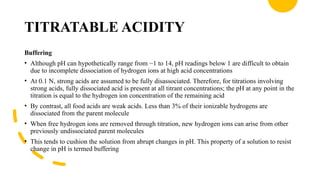
Buffering
• Although pH can hypothetically range from −1 to 14, pH readings below 1 are difficult to obtain
due to incomplete dissociation of hydrogen ions at high acid concentrations
• At 0.1 N, strong acids are assumed to be fully disassociated. Therefore, for titrations involving
strong acids, fully dissociated acid is present at all titrant concentrations; the pH at any point in the
titration is equal to the hydrogen ion concentration of the remaining acid
• By contrast, all food acids are weak acids. Less than 3% of their ionizable hydrogens are
dissociated from the parent molecule
• When free hydrogen ions are removed through titration, new hydrogen ions can arise from other
previously undissociated parent molecules
• This tends to cushion the solution from abrupt changes in pH. This property of a solution to resist
change in pH is termed buffering
TITRATABLE ACIDITY
• Buffering occurs in foods whenever a weak acid and its salt are present in the same
medium
• This relationship can be estimated by the Henderson– Hasselbalch equation
pH = pKa + log [A−] /[HA]
• [HA] represents the concentration of undissociated acid
• [A−] represents the concentration of its salt, also known as the conjugated base
• The conjugated base is equal in concentration to the conjugated acid [H3O+]
• The pKa is the pH at which equal quantities of undissociated acid and conjugated base are
present. The equation indicates that maximum buffering capacity will exist when the pH
equals the pK
Potentiometric Titration
• At the equivalence point in a titration, the number of acid equivalents exactly equals the number of
base equivalents, and total acid neutralization is achieved
• As the equivalence point is approached, the denominator [HA] in the Henderson–Hasselbalch
equation becomes insignificantly small and the quotient [A−]/[HA] increases exponentially. As a
result, the solution pH rapidly increases and ultimately approaches the pH of the titrant
• The use of a pH meter to identify the endpoint is called the potentiometric method for determining
titratable acidity
• The advantage of determining the equivalence point potentiometrically is that the precise
equivalence point is identified
• Since a rapid change in pH (and not some final pH value per se) signals the end of titration,
accurate calibration of the pH meter is not even essential
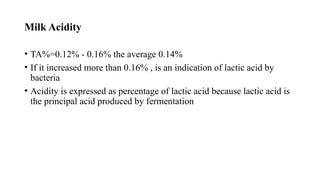
Milk Acidity
• TA%=0.12% - 0.16% the average 0.14%
• If it increased more than 0.16% , is an indication of lactic acid by
bacteria
• Acidity is expressed as percentage of lactic acid because lactic acid is
the principal acid produced by fermentation
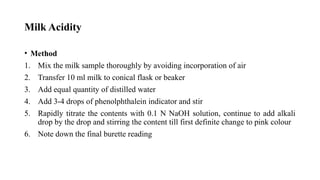
Milk Acidity
• Method
1. Mix the milk sample thoroughly by avoiding incorporation of air
2. Transfer 10 ml milk to conical flask or beaker
3. Add equal quantity of distilled water
4. Add 3-4 drops of phenolphthalein indicator and stir
5. Rapidly titrate the contents with 0.1 N NaOH solution, continue to add alkali
drop by the drop and stirring the content till first definite change to pink colour
6. Note down the final burette reading
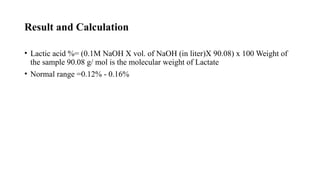
Result and Calculation
• Lactic acid %= (0.1M NaOH X vol. of NaOH (in liter)X 90.08) x 100 Weight of
the sample 90.08 g/ mol is the molecular weight of Lactate
• Normal range =0.12% - 0.16%
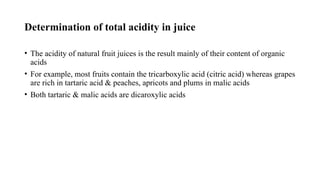
Determination of total acidity in juice
• The acidity of natural fruit juices is the result mainly of their content of organic
acids
• For example, most fruits contain the tricarboxylic acid (citric acid) whereas grapes
are rich in tartaric acid & peaches, apricots and plums in malic acids
• Both tartaric & malic acids are dicaroxylic acids
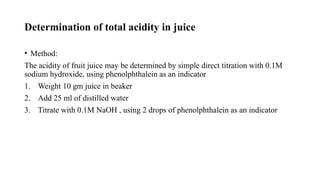
Determination of total acidity in juice
• Method:
The acidity of fruit juice may be determined by simple direct titration with 0.1M
sodium hydroxide, using phenolphthalein as an indicator
1. Weight 10 gm juice in beaker
2. Add 25 ml of distilled water
3. Titrate with 0.1M NaOH , using 2 drops of phenolphthalein as an indicator
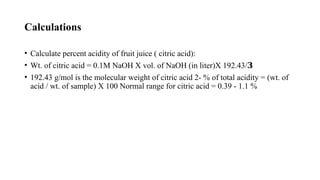
Calculations
• Calculate percent acidity of fruit juice ( citric acid):
• Wt. of citric acid = 0.1M NaOH X vol. of NaOH (in liter)X 192.43/𝟑
• 192.43 g/mol is the molecular weight of citric acid 2- % of total acidity = (wt. of
acid / wt. of sample) X 100 Normal range for citric acid = 0.39 - 1.1 %

pH and Titratable AcidityBAlalalallaallala

  • 1.
    pH and Titratable Acidity By Dr.Raakia Anam Saeed Assistant Professor
  • 2.
    Food Acidity • Foodacids are usually organic acids, with citric, malic, lactic, tartaric, and acetic acids being the most common • However, inorganic acids such as phosphoric and carbonic acids (arising from carbon dioxide in solution) often play an important and even predominant role in food acidulation The organic acids present in foods influence: • flavor (i.e.,tartness) • Color (through their impact on anthocyanin and other pH-influenced pigments) • prevent/retard the growth of microorganisms or inhibit the germination of spores • Providing the proper environment for metal ion chelation, an important phenomenon in the minimization of lipid oxidation
  • 3.
    Food Acidity Organic acidsmay present: • Naturally • By Fermentation • Added as part of a specific food formulation
  • 4.
    The importance ofdetermining food acidity 1. Determine the degree of maturity of fruits and vegetables • The titratable acidity of fruits is used, along with sugar content, as an indicator of maturity, generally the higher the maturity, the lower the acid content • e.g. in the ripening process, such as tomatoes from green to mature stage , there is an increase in sugar content 2. To determine the freshness of foods • for example in milk, the more the lactic acid levels, means that milk is rotten
  • 5.
    The importance ofdetermining food acidity 3. Acidity indicators reflect the quality of food The amount of organic acids in food directly affects the food flavor, color, stability, and the level of quality 4. Determination of acid on the microbial fermentation process Such as: fermentation products in soy sauce, vinegar and other acids is an important indicator of quality
  • 6.
    Concentration Units • Molarity(M) is a concentration unit representing the number of moles of the solute per liter of solution • Normality (N) is a concentration unit representing the number of equivalents (Eq) of a solute per liter of solution • In acid and base solutions, the normality represents the concentration or moles of H+ or OH− per liter that will be exchanged in a neutralization reaction when taken to completion • For oxidation–reduction reagents, the normality represents the concentration or moles of electrons per liter to be exchanged when the reaction is taken to completion • Equivalent weight can be defined as the molecular weight divided by the number of equivalents in the reactions • Percentage concentrations are the mass amount of solute or analyte per 100 ml or 100 g of material. Percentage can be expressed for solutions or for solid and can be on a volume basis or mass basis • When the percentage becomes a number less than 1% parts per million (ppm), parts per billion (ppb) and even parts per trillion (ppt) usually are preferred
  • 7.
    pH Acid–Base Equilibria The Brønsted-Lowrytheory of neutralization is based upon the following definitions for acid and base: Acid: A substance capable of donating protons. In food systems the only significant proton donor is the hydrogen ion Base: A substance capable of accepting protons Neutralization is the reaction of an acid with a base to form a salt as shown below: HCl + NaOH NaCl + H2O Acids form hydrated protons called hydronium ions (H3O+) and bases form hydroxide ions (OH−) in aqueous solutions
  • 8.
    pH • At anytemperature, the product of the molar concentrations (moles/liter) of H3O+ and OH− is a constant referred to as the ion product constant for water (Kw) [H3O+][OH−] = Kw • Kw varies with the temperature • Experimentation has revealed that the concentration of [H3O+] is approximately 1.0 × 10⁻⁷ M, as is that of the [OH−] at 25 ◦C. Because the concentrations of these ions are equal, pure water is referred to as being neutral
  • 9.
    pH • pH isdefined as the logarithm of the reciprocal of the hydrogen ion concentration • It also may be defined as the negative logarithm of the molar concentration of hydrogen ions • Thus, a [H3O+] concentration of 1 × 10⁻⁶ is expressed simply as pH 6 • The [OH−] concentration is expressed as pOH
  • 10.
    pH Meter • Activityis a measure of expressed chemical reactivity, while concentration is a measure of all forms (free and bound) of ions in solution • Activity and concentration are related by the following equation: A = γC where: A = activity, γ = activity coefficient, C = concentration
  • 11.
    Principle • The pHmeter is a good example of a potentiometer (a device that measures voltage at infinitesimal current flow) • The basic principle of potentiometry (an electrochemical method of voltammetry at zero current) involves the use of an electrolytic cell composed of two electrodes dipped into a test solution • A voltage develops, which is related to the ionic concentration of the solution • Since the presence of current could alter the concentration of surrounding ions or produce irreversible reactions, this voltage is measured under conditions such that infinitesimal current (10−12 amperes or less) is drawn
  • 12.
    Components of pHSystem • Four major parts of the pH system are needed: (1) Reference electrode (2) Indicator electrode (pH sensitive) (3) Voltmeter or amplifier that is capable of measuring small voltage differences in a circuit of very high resistance (4) The sample being analyzed
  • 13.
    Components of pH System ReferenceElectrode • The reference electrode is needed to complete the circuit in the pH system • This half cell is one of the most troublesome parts of the pH meter • Problems in obtaining pH measurements are often traced to a faulty reference electrode • The saturated calomel electrode is the most common reference electrode. It is based upon the following reversible reaction: Hg2Cl2 + 2e− 2Hg + 2Cl− ⇌
  • 14.
    Conti…. • A calomelreference electrode has three principal parts: (1) a platinum wire covered with a mixture of calomel (Hg2Cl2) (2) a filling solution (saturated KCl) (3) a permeable junction through which the filling solution slowly migrates into the sample being measured • Junctions are made of ceramic or fibrous material. These junctions tend to clog up, causing a slow, unstable response and inaccurate results • A less widely used reference electrode is the silver–silver chloride electrode • Because the calomel electrode is unstable at high temperatures (80◦C) or in strongly basic samples (pH > 9), a silver–silver chloride electrode must be used for such application
  • 15.
    Conti…. Indicator Electrode • Theindicator electrode most commonly used in measuring pH today is referred to as the glass electrode • Prior to its development, the hydrogen electrode and the quinhydrone electrode were used • This electrode also has three principal parts: (1) silver–silver chloride electrode with a mercury connection that is needed as a lead to the potentiometer (2) a buffer solution consisting of 0.01 N HCl, 0.09 N KCl, and acetate buffer used to maintain a constant pH (Ea) (3) a small pH-sensitive glass membrane for which the potential (Eo) varies with the pH of the test solution
  • 16.
    • Conventional glasselectrodes are suitable for measuring pH in the range of pH 1–9 • However, this electrode is sensitive to higher pH, especially in the presence of sodium ions • Thus, equipment manufacturers have developed modern glass electrodes that are usable over the entire pH range of 0–14 and feature a very low sodium ion error, such as <0.01 pH at 25 ◦C Combination Electrodes • Today, most food analysis laboratories use combination electrodes that combine both the pH and reference electrodes along with the temperature sensing probe in a single unit or probe • These combination electrodes are available in many sizes and shapes from very small microprobes to flat surface probes, from all glass to plastic, and from exposed electrode tip to jacketed electrode tips to prevent glass tip breakage
  • 17.
    • Microprobes maybe used to measure pH of very small systems such as inside a cell or a solution on a microscope slide • Flat surface electrode probes can be used to measure pH of semisolid and high-viscosity substances such as meat, cheese, and agar plates and small volumes as low as 10 μl
  • 18.
    Titratable acidity • Titratableacidity is determined by neutralizing the acid present in a known quantity (weight or volume) of food sample using a standard base • The endpoint for titration is usually either a target pH or the color change of a pH- sensitive dye, typically phenolphthalein • The amount of base needed for neutralization reflect the acid content
  • 19.
    TITRATABLE ACIDITY • Thetitratable acidity of fruits is used, along with sugar content, as an indicator of maturity • While organic acids may be naturally present in the food, they also may be formed through fermentation or they may be added as part of a specific food formulation • Titratable acidity is determined by neutralizing the acid present in a known quantity (weight or volume) of food sample using a standard base • The endpoint for titration is usually either a target pH or the color change of a pH-sensitive dye, typically phenolphthalein • The volume of titrant used, along with the normality of the base and the volume (or weight) of sample, is used to calculate the titratable acidity, expressed in terms of the predominant organic acid
  • 20.
    TITRATABLE ACIDITY Buffering • AlthoughpH can hypothetically range from −1 to 14, pH readings below 1 are difficult to obtain due to incomplete dissociation of hydrogen ions at high acid concentrations • At 0.1 N, strong acids are assumed to be fully disassociated. Therefore, for titrations involving strong acids, fully dissociated acid is present at all titrant concentrations; the pH at any point in the titration is equal to the hydrogen ion concentration of the remaining acid • By contrast, all food acids are weak acids. Less than 3% of their ionizable hydrogens are dissociated from the parent molecule • When free hydrogen ions are removed through titration, new hydrogen ions can arise from other previously undissociated parent molecules • This tends to cushion the solution from abrupt changes in pH. This property of a solution to resist change in pH is termed buffering
  • 21.
    TITRATABLE ACIDITY • Bufferingoccurs in foods whenever a weak acid and its salt are present in the same medium • This relationship can be estimated by the Henderson– Hasselbalch equation pH = pKa + log [A−] /[HA] • [HA] represents the concentration of undissociated acid • [A−] represents the concentration of its salt, also known as the conjugated base • The conjugated base is equal in concentration to the conjugated acid [H3O+] • The pKa is the pH at which equal quantities of undissociated acid and conjugated base are present. The equation indicates that maximum buffering capacity will exist when the pH equals the pK
  • 22.
    Potentiometric Titration • Atthe equivalence point in a titration, the number of acid equivalents exactly equals the number of base equivalents, and total acid neutralization is achieved • As the equivalence point is approached, the denominator [HA] in the Henderson–Hasselbalch equation becomes insignificantly small and the quotient [A−]/[HA] increases exponentially. As a result, the solution pH rapidly increases and ultimately approaches the pH of the titrant • The use of a pH meter to identify the endpoint is called the potentiometric method for determining titratable acidity • The advantage of determining the equivalence point potentiometrically is that the precise equivalence point is identified • Since a rapid change in pH (and not some final pH value per se) signals the end of titration, accurate calibration of the pH meter is not even essential
  • 23.
    Milk Acidity • TA%=0.12%- 0.16% the average 0.14% • If it increased more than 0.16% , is an indication of lactic acid by bacteria • Acidity is expressed as percentage of lactic acid because lactic acid is the principal acid produced by fermentation
  • 24.
    Milk Acidity • Method 1.Mix the milk sample thoroughly by avoiding incorporation of air 2. Transfer 10 ml milk to conical flask or beaker 3. Add equal quantity of distilled water 4. Add 3-4 drops of phenolphthalein indicator and stir 5. Rapidly titrate the contents with 0.1 N NaOH solution, continue to add alkali drop by the drop and stirring the content till first definite change to pink colour 6. Note down the final burette reading
  • 25.
    Result and Calculation •Lactic acid %= (0.1M NaOH X vol. of NaOH (in liter)X 90.08) x 100 Weight of the sample 90.08 g/ mol is the molecular weight of Lactate • Normal range =0.12% - 0.16%
  • 26.
    Determination of totalacidity in juice • The acidity of natural fruit juices is the result mainly of their content of organic acids • For example, most fruits contain the tricarboxylic acid (citric acid) whereas grapes are rich in tartaric acid & peaches, apricots and plums in malic acids • Both tartaric & malic acids are dicaroxylic acids
  • 27.
    Determination of totalacidity in juice • Method: The acidity of fruit juice may be determined by simple direct titration with 0.1M sodium hydroxide, using phenolphthalein as an indicator 1. Weight 10 gm juice in beaker 2. Add 25 ml of distilled water 3. Titrate with 0.1M NaOH , using 2 drops of phenolphthalein as an indicator
  • 28.
    Calculations • Calculate percentacidity of fruit juice ( citric acid): • Wt. of citric acid = 0.1M NaOH X vol. of NaOH (in liter)X 192.43/𝟑 • 192.43 g/mol is the molecular weight of citric acid 2- % of total acidity = (wt. of acid / wt. of sample) X 100 Normal range for citric acid = 0.39 - 1.1 %

Editor's Notes

  • #13 The calomel electrode is the mercury-mercurous chloride electrode
  • #14 The calomel electrode is the mercury-mercurous chloride electrode