American Free
Enterprise
Chapter 3
Benefits of Free
Enterprise
Section 1
What is Free Enterprise?
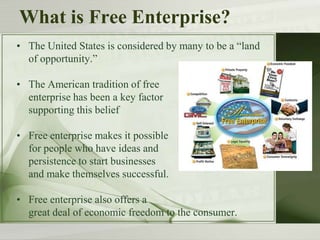
• The United States is considered by many to be a “land
of opportunity.”
• The American tradition of free
enterprise has been a key factor in
supporting this belief
• Free enterprise makes it possible
for people who have ideas and
persistence to start businesses
and make themselves successful.
• Free enterprise also offers a
great deal of economic freedom to the consumer.
Principles of Free Enterprise
• Characteristics of a free enterprise include:
– Profit motive
• The American economy rests on recognition of
the profit motive as a key incentive.
– In a free enterprise businesspeople make decisions
based on what will increase their profits.
– Open opportunity
• The American principle of open opportunity
says that anyone can compete in the
marketplace.
Principles of Free Enterprise
• Legal equity
– American free enterprise believes in the principle
that everyone has the same legal rights.
• Private property
– The free enterprise system allows people to make
their own decisions about their own property.
• Freedom to buy and sell
– People can decide what agreements to enter into, as
well as what, when, and how they want to buy and
sell.
Role of the Consumer
• In the free enterprise system consumers have
the freedom to make their own economic
choices.
– Through voluntary exchange, consumers send a signal to
businesses, telling them what to produce and how much to
make.
• Consumers can also make their wishes known
to businesses by joining interest groups, which
influence public officials to act in ways that
benefit its members.
The US Constitution
• Free enterprise in the United States is written into the
framework of the U.S. Constitution.
– 5th Amendment: protects private property from being taken
from a citizen without due process.
– Eminent domain: the government is allowed to take property
from an individual, paying fair market value for that
property, when there is a public reason.
• The Constitution also spells out how government can
tax individuals and businesses.
– According to Article 1, Congress could levy taxes but not until
the passage of the Sixteenth Amendment in 1913 Congress
could levy an income tax on individuals and businesses.
• The Constitution guarantees people and businesses the
right to make contracts.
Promoting Growth
and Stability
Section 2
Growth and Stability
• The U.S. government encourages growth
and stability by:
– Tracking business cycles
– Promoting a high employment rate
– Keeping prices stable
– Encouraging the development of new
technologies
– Taking pride in the American work ethic
Tracking Business Cycles
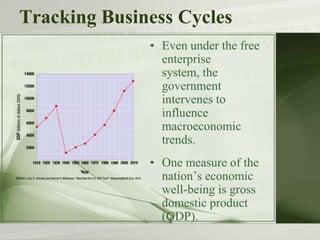
• Even under the free
enterprise
system, the
government
intervenes to
influence
macroeconomic
trends.
• One measure of the
nation’s economic
well-being is gross
domestic product
(GDP).
GDP and the Business Cycle
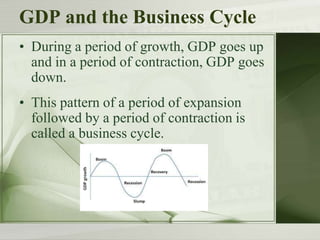
• During a period of growth, GDP goes up
and in a period of contraction, GDP goes
down.
• This pattern of a period of expansion
followed by a period of contraction is
called a business cycle.
Government’s 3 Economic Goals
• High employment
– The government strives to make sure there are enough jobs for
everyone who is able to work.
– An unemployment rate between 4 percent and 6 percent is
considered healthy.
• Economic Growth
– To help spur economic growth, the government can cut taxes or
increase spending.
• Stability and Security
– One indicator of economic stability is the general level of prices.
– The government seeks to prevent sudden, drastic shifts in prices
so that neither the consumer nor the producer suffers.
– Other indicators of stability are financial institutions such as
banks and the stock market. Government regulations seek to keep
these institutions as stable as possible.
Technological Progress
• Technological progress
has enabled the U.S.
economy to operate more
efficiently.
• Many inventions have
improved productivity in
the United
States, including:
– The light bulb, which made
a longer workday possible
– The assembly line, which
led to mass production at
affordable costs
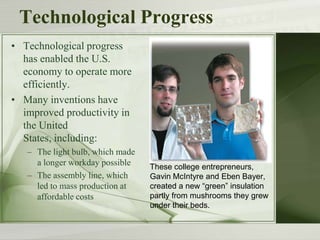
These college entrepreneurs,
Gavin McIntyre and Eben Bayer,
created a new “green” insulation
partly from mushrooms they grew
under their beds.
The Government’s Role
• The government promotes innovation and
invention to help maintain the country’s
technological advantage by:
– Funding research and development projects at
universities
– Establishing their own research institutions, like
NASA
– Granting patents and copyrights, which are an
incentive to innovation
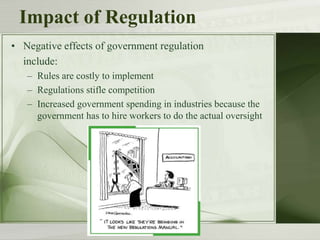
Impact of Regulation
• Negative effects of government regulation
include:
– Rules are costly to implement
– Regulations stifle competition
– Increased government spending in industries because the
government has to hire workers to do the actual oversight
The American Work Ethic
• Economic growth cannot occur without
individual effort.
– Americans pride themselves on their strong work
ethic, which has them not only working hard but
caring about the work that they do.
– The American work ethic has long been seen as a
key ingredient in the nation’s productivity and
economic success.
Providing Public Goods
Section 3
Public Goods
• A shared good or service for which it would be
inefficient or impractical to make consumers pay
individually and to exclude those who do not pay.
• The government provides society with certain public goods because it
would be inefficient or impractical for a free market economy to
provide these goods on its own.
• Public goods can be used by any number of consumers
without reducing the benefits to any single consumer.
• Public goods are financed by the
public sector.
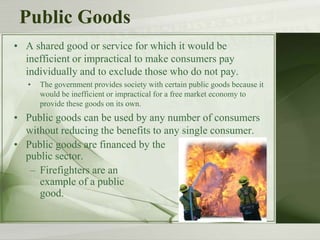
– Firefighters are an
example of a public
good.
Free Riders
• One issue associated with public goods is known
as the “free-rider problem.”
• Free riders are people who are not willing to pay
for a particular good or service but would benefit
from it if it were offered as a public good.
– The free-rider problem suggests what would happen
if the government stopped providing public goods:
People would refuse to pay and many services would
be eliminated.
Market Failures
• Public goods are examples of a market
failure, where the free market does not distribute
resources efficiently.
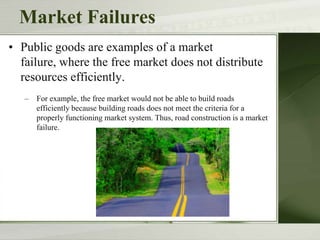
– For example, the free market would not be able to build roads
efficiently because building roads does not meet the criteria for a
properly functioning market system. Thus, road construction is a market
failure.
Externalities
Positive
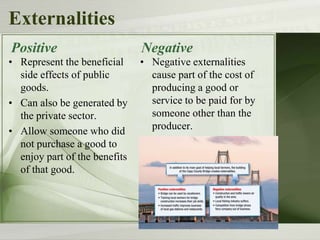
• Represent the beneficial
side effects of public
goods.
• Can also be generated by
the private sector.
• Allow someone who did
not purchase a good to
enjoy part of the benefits
of that good.
Negative
• Negative externalities
cause part of the cost of
producing a good or
service to be paid for by
someone other than the
producer.
Government’s Goals
• Understanding externalities helps us see more roles that
the government plays in the U.S. economy.
– The government may take action to create positive
externalities, such as improving education.
– The government aims to limit negative externalities like
pollution.
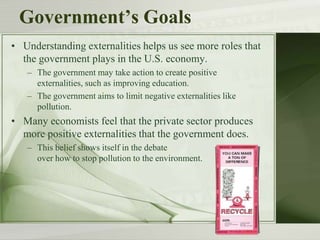
• Many economists feel that the private sector produces
more positive externalities that the government does.
– This belief shows itself in the debate
over how to stop pollution to the environment.
Providing a Safety Net
Section 4
Providing a Safety Net
• To help the poor, government programs take
money from some people and redistribute it to
others.
– Such programs include:
• The welfare system
• Cash transfers
• In-kind benefits
• Medical and educational benefits
• Grant money
The Poverty Problem
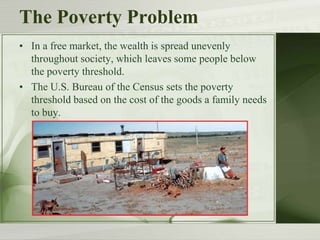
• In a free market, the wealth is spread unevenly
throughout society, which leaves some people below
the poverty threshold.
• The U.S. Bureau of the Census sets the poverty
threshold based on the cost of the goods a family needs
to buy.
The Government’s Role
• The government provides a safety net to groups like
the very young, the very old, the sick, the poor, and the
disabled through various federal, state, and local
government programs.
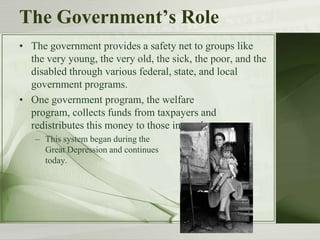
• One government program, the welfare
program, collects funds from taxpayers and
redistributes this money to those in need.
– This system began during the
Great Depression and continues
today.
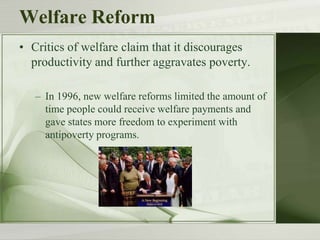
Welfare Reform
• Critics of welfare claim that it discourages
productivity and further aggravates poverty.
– In 1996, new welfare reforms limited the amount of
time people could receive welfare payments and
gave states more freedom to experiment with
antipoverty programs.
Redistribution Programs
• Cash transfer programs
– Temporary Assistance for Needy Families (TANF) - sends
welfare payments directly to the states, which design and
run their own welfare programs
• Social Security
– Collects money from current workers and redistributes funds to
retired and disabled persons
• Unemployment Insurance
– Provides money to workers who have lost their jobs as long as
recipients offer proof that they have made efforts to get work.
– This help is only temporary, offering benefits for only 26 weeks
in most states.
• Worker’s Compensation
– Provides state funds to workers injured on the job.
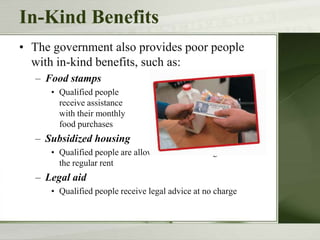
In-Kind Benefits
• The government also provides poor people
with in-kind benefits, such as:
– Food stamps
• Qualified people
receive assistance
with their monthly
food purchases
– Subsidized housing
• Qualified people are allowed to rent housing for less than
the regular rent
– Legal aid
• Qualified people receive legal advice at no charge
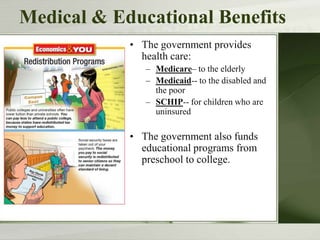
Medical & Educational Benefits
• The government provides
health care:
– Medicare– to the elderly
– Medicaid-- to the disabled and
the poor
– SCHIP-- for children who are
uninsured
• The government also funds
educational programs from
preschool to college.
Encouraging Private Action
• Federal tax laws allow both individuals and
corporations to take tax deductions for
charitable donations.
• The government may also provide grants and
other assistance to organizations that provide
social services.

Economics: Chapter 3

  • 1.
  • 2.
  • 3.
    What is FreeEnterprise? • The United States is considered by many to be a “land of opportunity.” • The American tradition of free enterprise has been a key factor in supporting this belief • Free enterprise makes it possible for people who have ideas and persistence to start businesses and make themselves successful. • Free enterprise also offers a great deal of economic freedom to the consumer.
  • 4.
    Principles of FreeEnterprise • Characteristics of a free enterprise include: – Profit motive • The American economy rests on recognition of the profit motive as a key incentive. – In a free enterprise businesspeople make decisions based on what will increase their profits. – Open opportunity • The American principle of open opportunity says that anyone can compete in the marketplace.
  • 5.
    Principles of FreeEnterprise • Legal equity – American free enterprise believes in the principle that everyone has the same legal rights. • Private property – The free enterprise system allows people to make their own decisions about their own property. • Freedom to buy and sell – People can decide what agreements to enter into, as well as what, when, and how they want to buy and sell.
  • 6.
    Role of theConsumer • In the free enterprise system consumers have the freedom to make their own economic choices. – Through voluntary exchange, consumers send a signal to businesses, telling them what to produce and how much to make. • Consumers can also make their wishes known to businesses by joining interest groups, which influence public officials to act in ways that benefit its members.
  • 7.
    The US Constitution •Free enterprise in the United States is written into the framework of the U.S. Constitution. – 5th Amendment: protects private property from being taken from a citizen without due process. – Eminent domain: the government is allowed to take property from an individual, paying fair market value for that property, when there is a public reason. • The Constitution also spells out how government can tax individuals and businesses. – According to Article 1, Congress could levy taxes but not until the passage of the Sixteenth Amendment in 1913 Congress could levy an income tax on individuals and businesses. • The Constitution guarantees people and businesses the right to make contracts.
  • 8.
  • 9.
    Growth and Stability •The U.S. government encourages growth and stability by: – Tracking business cycles – Promoting a high employment rate – Keeping prices stable – Encouraging the development of new technologies – Taking pride in the American work ethic
  • 10.
    Tracking Business Cycles •Even under the free enterprise system, the government intervenes to influence macroeconomic trends. • One measure of the nation’s economic well-being is gross domestic product (GDP).
  • 11.
    GDP and theBusiness Cycle • During a period of growth, GDP goes up and in a period of contraction, GDP goes down. • This pattern of a period of expansion followed by a period of contraction is called a business cycle.
  • 12.
    Government’s 3 EconomicGoals • High employment – The government strives to make sure there are enough jobs for everyone who is able to work. – An unemployment rate between 4 percent and 6 percent is considered healthy. • Economic Growth – To help spur economic growth, the government can cut taxes or increase spending. • Stability and Security – One indicator of economic stability is the general level of prices. – The government seeks to prevent sudden, drastic shifts in prices so that neither the consumer nor the producer suffers. – Other indicators of stability are financial institutions such as banks and the stock market. Government regulations seek to keep these institutions as stable as possible.
  • 13.
    Technological Progress • Technologicalprogress has enabled the U.S. economy to operate more efficiently. • Many inventions have improved productivity in the United States, including: – The light bulb, which made a longer workday possible – The assembly line, which led to mass production at affordable costs These college entrepreneurs, Gavin McIntyre and Eben Bayer, created a new “green” insulation partly from mushrooms they grew under their beds.
  • 14.
    The Government’s Role •The government promotes innovation and invention to help maintain the country’s technological advantage by: – Funding research and development projects at universities – Establishing their own research institutions, like NASA – Granting patents and copyrights, which are an incentive to innovation
  • 15.
    Impact of Regulation •Negative effects of government regulation include: – Rules are costly to implement – Regulations stifle competition – Increased government spending in industries because the government has to hire workers to do the actual oversight
  • 16.
    The American WorkEthic • Economic growth cannot occur without individual effort. – Americans pride themselves on their strong work ethic, which has them not only working hard but caring about the work that they do. – The American work ethic has long been seen as a key ingredient in the nation’s productivity and economic success.
  • 17.
  • 18.
    Public Goods • Ashared good or service for which it would be inefficient or impractical to make consumers pay individually and to exclude those who do not pay. • The government provides society with certain public goods because it would be inefficient or impractical for a free market economy to provide these goods on its own. • Public goods can be used by any number of consumers without reducing the benefits to any single consumer. • Public goods are financed by the public sector. – Firefighters are an example of a public good.
  • 19.
    Free Riders • Oneissue associated with public goods is known as the “free-rider problem.” • Free riders are people who are not willing to pay for a particular good or service but would benefit from it if it were offered as a public good. – The free-rider problem suggests what would happen if the government stopped providing public goods: People would refuse to pay and many services would be eliminated.
  • 20.
    Market Failures • Publicgoods are examples of a market failure, where the free market does not distribute resources efficiently. – For example, the free market would not be able to build roads efficiently because building roads does not meet the criteria for a properly functioning market system. Thus, road construction is a market failure.
  • 21.
    Externalities Positive • Represent thebeneficial side effects of public goods. • Can also be generated by the private sector. • Allow someone who did not purchase a good to enjoy part of the benefits of that good. Negative • Negative externalities cause part of the cost of producing a good or service to be paid for by someone other than the producer.
  • 22.
    Government’s Goals • Understandingexternalities helps us see more roles that the government plays in the U.S. economy. – The government may take action to create positive externalities, such as improving education. – The government aims to limit negative externalities like pollution. • Many economists feel that the private sector produces more positive externalities that the government does. – This belief shows itself in the debate over how to stop pollution to the environment.
  • 23.
    Providing a SafetyNet Section 4
  • 24.
    Providing a SafetyNet • To help the poor, government programs take money from some people and redistribute it to others. – Such programs include: • The welfare system • Cash transfers • In-kind benefits • Medical and educational benefits • Grant money
  • 25.
    The Poverty Problem •In a free market, the wealth is spread unevenly throughout society, which leaves some people below the poverty threshold. • The U.S. Bureau of the Census sets the poverty threshold based on the cost of the goods a family needs to buy.
  • 26.
    The Government’s Role •The government provides a safety net to groups like the very young, the very old, the sick, the poor, and the disabled through various federal, state, and local government programs. • One government program, the welfare program, collects funds from taxpayers and redistributes this money to those in need. – This system began during the Great Depression and continues today.
  • 27.
    Welfare Reform • Criticsof welfare claim that it discourages productivity and further aggravates poverty. – In 1996, new welfare reforms limited the amount of time people could receive welfare payments and gave states more freedom to experiment with antipoverty programs.
  • 28.
    Redistribution Programs • Cashtransfer programs – Temporary Assistance for Needy Families (TANF) - sends welfare payments directly to the states, which design and run their own welfare programs • Social Security – Collects money from current workers and redistributes funds to retired and disabled persons • Unemployment Insurance – Provides money to workers who have lost their jobs as long as recipients offer proof that they have made efforts to get work. – This help is only temporary, offering benefits for only 26 weeks in most states. • Worker’s Compensation – Provides state funds to workers injured on the job.
  • 29.
    In-Kind Benefits • Thegovernment also provides poor people with in-kind benefits, such as: – Food stamps • Qualified people receive assistance with their monthly food purchases – Subsidized housing • Qualified people are allowed to rent housing for less than the regular rent – Legal aid • Qualified people receive legal advice at no charge
  • 30.
    Medical & EducationalBenefits • The government provides health care: – Medicare– to the elderly – Medicaid-- to the disabled and the poor – SCHIP-- for children who are uninsured • The government also funds educational programs from preschool to college.
  • 31.
    Encouraging Private Action •Federal tax laws allow both individuals and corporations to take tax deductions for charitable donations. • The government may also provide grants and other assistance to organizations that provide social services.