Atomic Theory
Greek Model - Fourth and Fifth
Centuries BC
• The word atom is from the Greek word
atomos, which means indivisible or uncut
• This was the original model of the atom
• It viewed the atom as the smallest
indivisible particle of matter
• This theory was never verified by
experiments and was discarded
Dalton’s Atomic Theory
John Dalton (1766-1844)
4 main points:
1. All elements are composed of tiny
indivisible particles called atoms.
2. Atoms of the same element are
identical. The atoms of any one
element are different from those of
any other element.
3. Atoms of different elements can
combine with another in simple whole
number ratios to form compounds.
4. Chemical reactions occur when
atoms are separated, joined, or
rearranged. However, atoms of one
element cannot be changed into
atoms of another element by a
chemical reaction.
Which parts of Dalton’s theory are
still considered to be true?
2. The atoms of any one element are different
from those of any other element.
3. Atoms of different elements can combine with
another in simple whole number ratios to form
compounds.
4. Chemical reactions occur when atoms are
separated, joined, or rearranged. However,
atoms of one element cannot be changed into
atoms of another element by a chemical
reaction.
Which parts of Dalton’s theory are
no longer believed to be true?
1. All elements are composed of tiny indivisible
particles called atoms.
• • We now know that atoms are divisible, there are
particle found within the atom: protons, neutrons,
and electrons.
2. Atoms of the same element are identical.
• • Isotopes are atoms of the same element that
have different mass numbers because of different
numbers of neutrons, therefore, all atoms of the
same element are NOT identical.
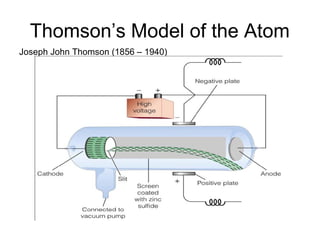
Thomson’s Model of the Atom
Joseph John Thomson (1856 – 1940)
What did Thomson conclude about
electrons?
• Thomson determined that electrons were
a fundamental particle of matter, that all
electrons were identical regardless of the
element, and that they carry a negative
charge.
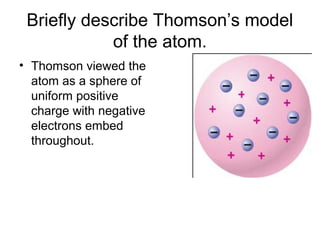
Briefly describe Thomson’s model
of the atom.
• Thomson viewed the
atom as a sphere of
uniform positive
charge with negative
electrons embed
throughout.
Rutherford’s Model of the Atom –
Ernest Rutherford (1871 – 1937)
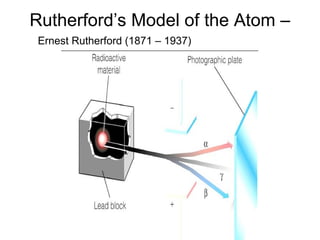
Working with radium (a radioactive element)
Rutherford discovered that the invisible
rays were actually composed of three
different rays:
alpha (positively charged),
beta (negatively charged), and
gamma (uncharged) rays.
Gold Foil Experiment
• Using
alpha
particles,
Rutherford
investigated
the
scattering
of these
particles by
thin sheets
of gold foil.
What were the expected results of
the Gold Foil Experiment, and how
did the actual results differ from
expected?
– Rutherford expected all of the alpha particles
to go straight through the gold foil without any
change in direction.
– This is not what occurred. Most of the alpha
particles did not have any change in direction,
but some were deflected and some were
reflected.
• Rutherford used these results to design
his own model of the atom.
• Rutherford assumed that there must be
something within the atom, which caused the
alpha particles to be deflected or reflected.
• Rutherford suggested that an atom had a
nucleus or centre in which the positive charge
and most of the mass were located.
• This nucleus occupied only a tiny portion of the
volume of the entire atom. The electrons were
located outside the nucleus.
• This model of the atom is often called the
“nuclear” atom.
The Bohr Model of the Atom
Niels Bohr
(1885 –
1962)
Bohr investigated the spectra of hydrogen. He
determined that hydrogen produced a line
spectra with four distinct lines in the visible
spectrum.
Because hydrogen produced line spectra, Bohr
explained that the energy of these lines
corresponded to the energies released when
an electron at a higher energy level returned
to a lower energy level.
The difference in energy between two energy
levels was emitted as electromagnetic
radiation with a specific wavelength.
The central nucleus, with electrons in motion
around the nucleus, is still retained in the
Bohr model of the atom.
Bohr provided more information about the
motion of the electrons.
Erwin Schrodinger
• Developed a mathematical equation
describing the location and energy of
electrons in atoms
• The quantum mechanical model also
places electrons in energy levels, similar
to Bohr’s model
The quantum mechanical model is different
in the following ways:
• The exact path of the electron cannot be
defined, only the probability of the
electron’s location.
• This is described as an electron cloud.
• The electron can be found anywhere in
the cloud
• Within energy levels, there are sublevels
called orbitals. At higher energy levels
there are more than one type of orbital.

Atomic Theory[1]

  • 1.
  • 2.
    Greek Model -Fourth and Fifth Centuries BC • The word atom is from the Greek word atomos, which means indivisible or uncut • This was the original model of the atom • It viewed the atom as the smallest indivisible particle of matter • This theory was never verified by experiments and was discarded
  • 3.
    Dalton’s Atomic Theory JohnDalton (1766-1844) 4 main points: 1. All elements are composed of tiny indivisible particles called atoms. 2. Atoms of the same element are identical. The atoms of any one element are different from those of any other element.
  • 4.
    3. Atoms ofdifferent elements can combine with another in simple whole number ratios to form compounds. 4. Chemical reactions occur when atoms are separated, joined, or rearranged. However, atoms of one element cannot be changed into atoms of another element by a chemical reaction.
  • 5.
    Which parts ofDalton’s theory are still considered to be true? 2. The atoms of any one element are different from those of any other element. 3. Atoms of different elements can combine with another in simple whole number ratios to form compounds. 4. Chemical reactions occur when atoms are separated, joined, or rearranged. However, atoms of one element cannot be changed into atoms of another element by a chemical reaction.
  • 6.
    Which parts ofDalton’s theory are no longer believed to be true? 1. All elements are composed of tiny indivisible particles called atoms. • • We now know that atoms are divisible, there are particle found within the atom: protons, neutrons, and electrons. 2. Atoms of the same element are identical. • • Isotopes are atoms of the same element that have different mass numbers because of different numbers of neutrons, therefore, all atoms of the same element are NOT identical.
  • 7.
    Thomson’s Model ofthe Atom Joseph John Thomson (1856 – 1940)
  • 8.
    What did Thomsonconclude about electrons? • Thomson determined that electrons were a fundamental particle of matter, that all electrons were identical regardless of the element, and that they carry a negative charge.
  • 9.
    Briefly describe Thomson’smodel of the atom. • Thomson viewed the atom as a sphere of uniform positive charge with negative electrons embed throughout.
  • 10.
    Rutherford’s Model ofthe Atom – Ernest Rutherford (1871 – 1937)
  • 11.
    Working with radium(a radioactive element) Rutherford discovered that the invisible rays were actually composed of three different rays: alpha (positively charged), beta (negatively charged), and gamma (uncharged) rays.
  • 12.
    Gold Foil Experiment •Using alpha particles, Rutherford investigated the scattering of these particles by thin sheets of gold foil.
  • 13.
    What were theexpected results of the Gold Foil Experiment, and how did the actual results differ from expected? – Rutherford expected all of the alpha particles to go straight through the gold foil without any change in direction. – This is not what occurred. Most of the alpha particles did not have any change in direction, but some were deflected and some were reflected.
  • 14.
    • Rutherford usedthese results to design his own model of the atom.
  • 15.
    • Rutherford assumedthat there must be something within the atom, which caused the alpha particles to be deflected or reflected. • Rutherford suggested that an atom had a nucleus or centre in which the positive charge and most of the mass were located. • This nucleus occupied only a tiny portion of the volume of the entire atom. The electrons were located outside the nucleus. • This model of the atom is often called the “nuclear” atom.
  • 17.
    The Bohr Modelof the Atom Niels Bohr (1885 – 1962)
  • 18.
    Bohr investigated thespectra of hydrogen. He determined that hydrogen produced a line spectra with four distinct lines in the visible spectrum.
  • 19.
    Because hydrogen producedline spectra, Bohr explained that the energy of these lines corresponded to the energies released when an electron at a higher energy level returned to a lower energy level. The difference in energy between two energy levels was emitted as electromagnetic radiation with a specific wavelength.
  • 20.
    The central nucleus,with electrons in motion around the nucleus, is still retained in the Bohr model of the atom. Bohr provided more information about the motion of the electrons.
  • 21.
    Erwin Schrodinger • Developeda mathematical equation describing the location and energy of electrons in atoms • The quantum mechanical model also places electrons in energy levels, similar to Bohr’s model
  • 22.
    The quantum mechanicalmodel is different in the following ways: • The exact path of the electron cannot be defined, only the probability of the electron’s location. • This is described as an electron cloud. • The electron can be found anywhere in the cloud • Within energy levels, there are sublevels called orbitals. At higher energy levels there are more than one type of orbital.