4/19/2014 1
Content…..
• What’s macro economics
• Introduction of macro economic policy
debates
• Classical & Keynesian view on;
 unemployment
Price stability
Exchange rate
• Conclusion
4/19/2014 2
MACRO ECONOMICS
• Macro economics concern with
the behavior of the aggregate
economy as a whole. Therefore it
deals inter related broad system.
Macroeconomics is a branch of
economics dealing with the
performance, structure, Behavior
and decision-making of the whole
economy. This includes a national,
regional or global economy.
Some Macro Economic
Economists
 Classical economists:
Adam Smith( Scottish philosopher)
Alfred Marshall(British economist)
Arthur Cecil Pigou (British
economist)
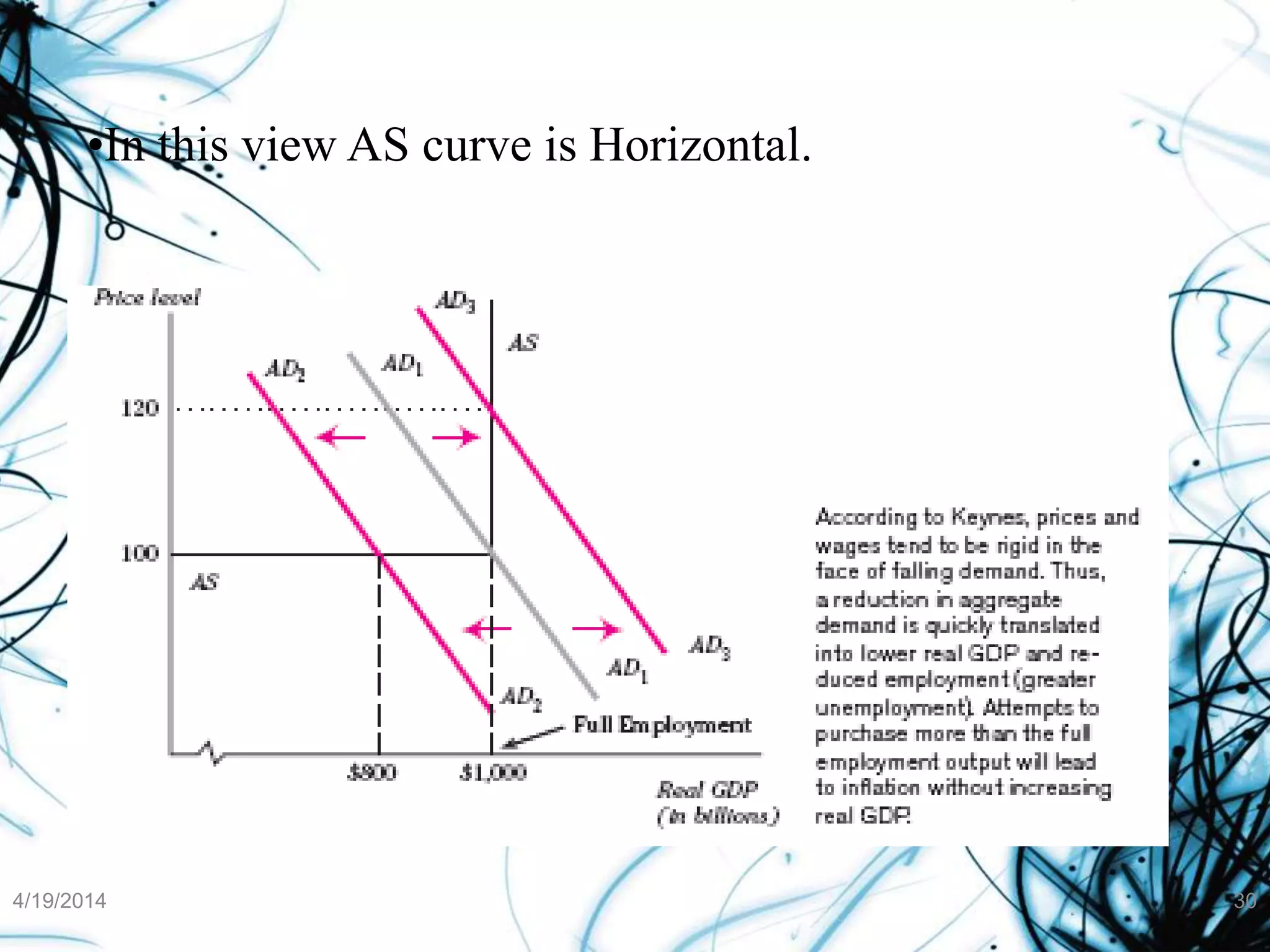
David Ricardo (British economist)
JS.Mill
Malthus
Keynesian economists:
• Francis Ysidro Edge Worth
• Jean-Baptist Say
• Paul Samuelson
• John Maynard Keynes
4/19/2014 7
Macroeconomic policy debates
inevitably revolve around discussion
of fluctuations in key aggregate
measures notably,
national income, interest rates, inflation,
unemployment, trade imbalances, exchange
rates and various wealth series,
4/19/2014 8
But here we only discuss
three things,
a.Un employment
b.Price stability
c.Exchange rate
4/19/2014 9
Macroeconomics emerged as a
separate subject within
economics in the 1930s, when
the U.S. economy fell into the
Great Depression.
4/19/2014 10
Before the 1930s, economics
was microeconomics (the
study of partial-equilibrium
supply and demand).
After the 1930s, the study of
the core of economic thinking
was broken into two discrete
areas: microeconomics, as
before, and macroeconomics
(the study of the economy in
the aggregate).
Macroeconomic policy debates
have centered on a struggle between
two groups: Keynesian economists
and Classical economists.
4/19/2014 13
Classical economists
generally oppose government
intervention in the economy;
they favor a laissez-faire
policy.
Keynesians are more likely to
favor govern government
intervention in the economy.
They feel a laissez-faire policy
can sometimes lead to disaster.
Both views represent reasonable
economic positions.
MACROECONOMIC OBJECTIVES
We begin our discussion by focusing on the
objectives of macro-economic
policymaking. At the most general level, the
goal of economic policy is to maximize
long-run societal well-being in an equitable
and sustainable manner.
4/19/2014 16
Much of the recent discussion of
economic policy has focused on
intermediate variables, such as
price stability or the balance of
payments.
4/19/2014 17
Their importance derives largely
from their role as possible indicators
of economic performance in terms of
truly significant such as growth,
development and equity.
4/19/2014 18
The centre of attention of
macroeconomic policymaking should
be on ‘real macroeconomics’ and the
use of productive capacity—the
employment of capital and labour at
their highest potential level—and
improvements in that productivity.
4/19/2014 19
Macro economics policy
debates on Unemployment
Definition:
•Unemployment is inability for willing workers to find
gainful employment.
•Unemployment occurs when a person who is
actively searching for employment is unable to find
work.
•Unemployment occurs when people are without
work & actively seeking work.
4/19/2014 20
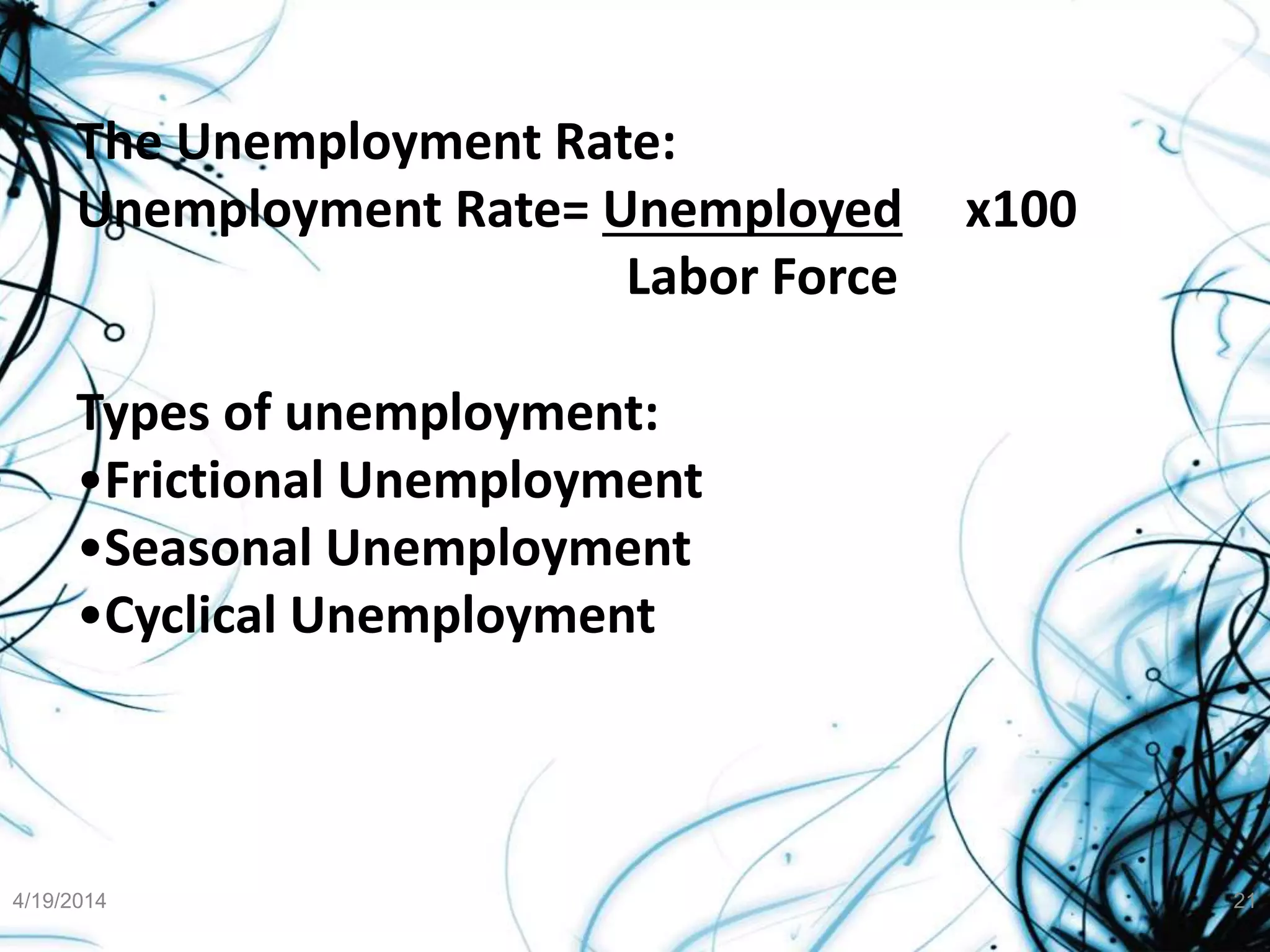
The Unemployment Rate:
Unemployment Rate= Unemployed x100
Labor Force
Types of unemployment:
•Frictional Unemployment
•Seasonal Unemployment
•Cyclical Unemployment
4/19/2014 21
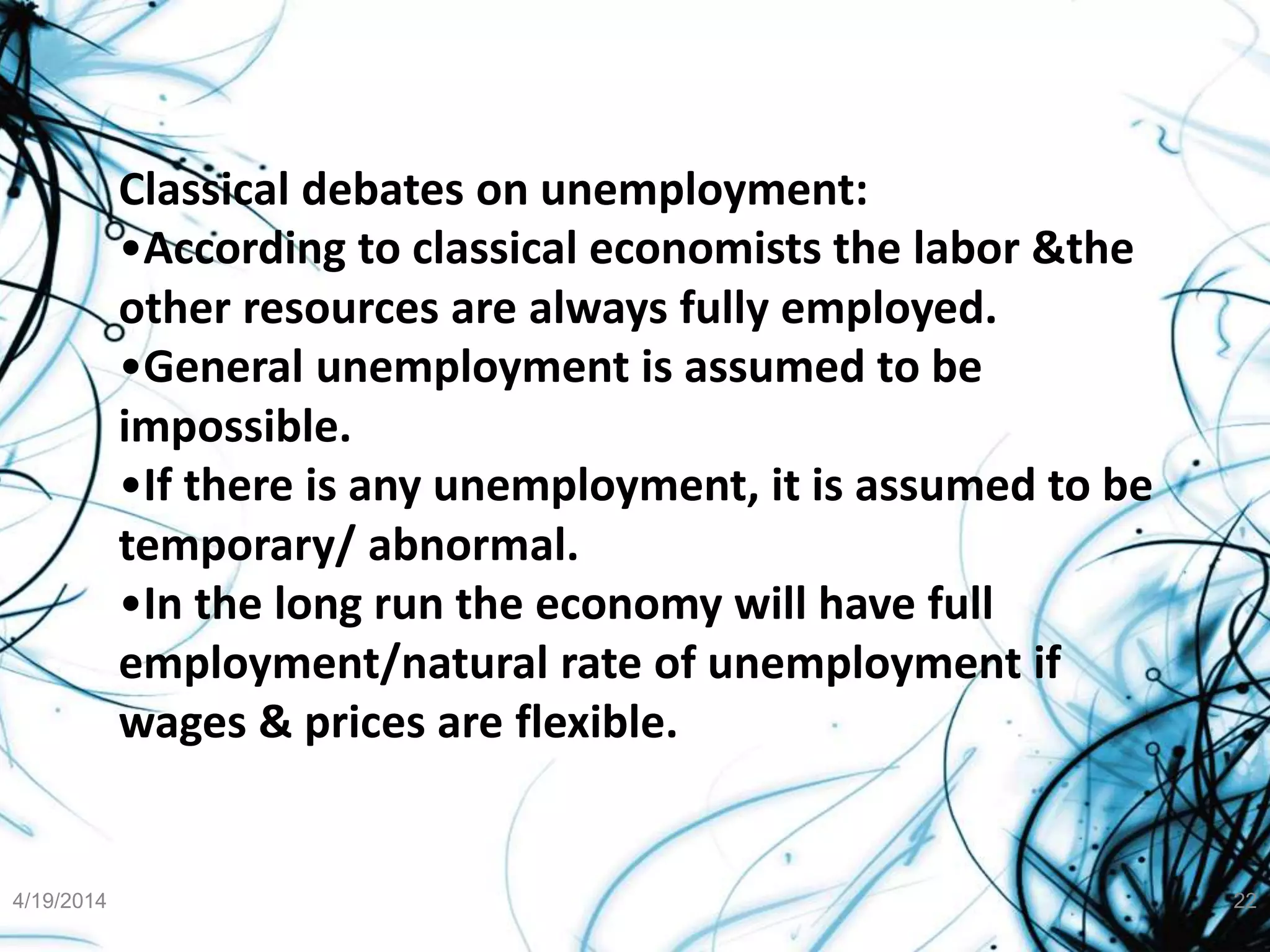
Classical debates on unemployment:
•According to classical economists the labor &the
other resources are always fully employed.
•General unemployment is assumed to be
impossible.
•If there is any unemployment, it is assumed to be
temporary/ abnormal.
•In the long run the economy will have full
employment/natural rate of unemployment if
wages & prices are flexible.
4/19/2014 22
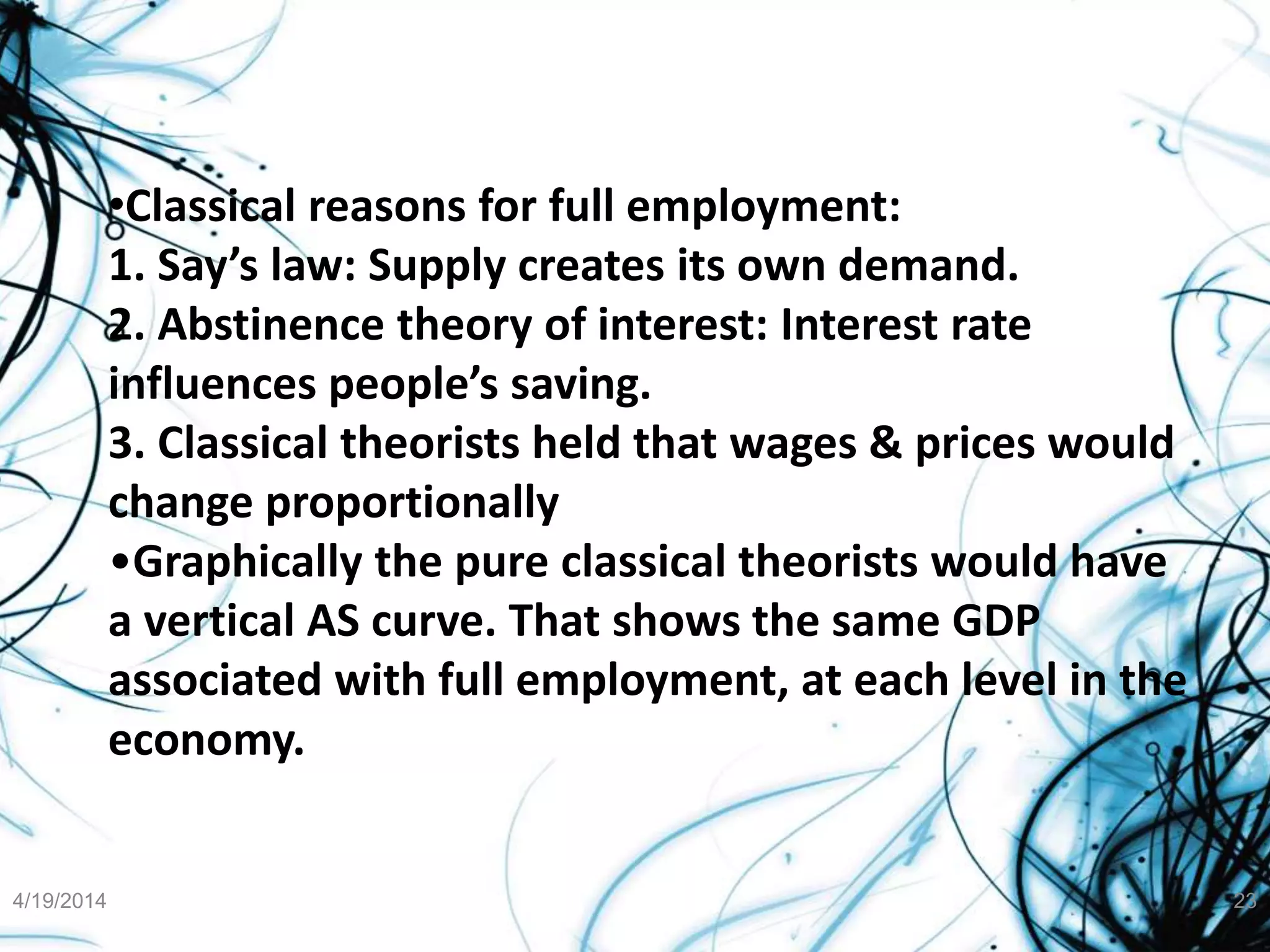
•Classical reasons for full employment:
1. Say’s law: Supply creates its own demand.
2. Abstinence theory of interest: Interest rate
influences people’s saving.
3. Classical theorists held that wages & prices would
change proportionally
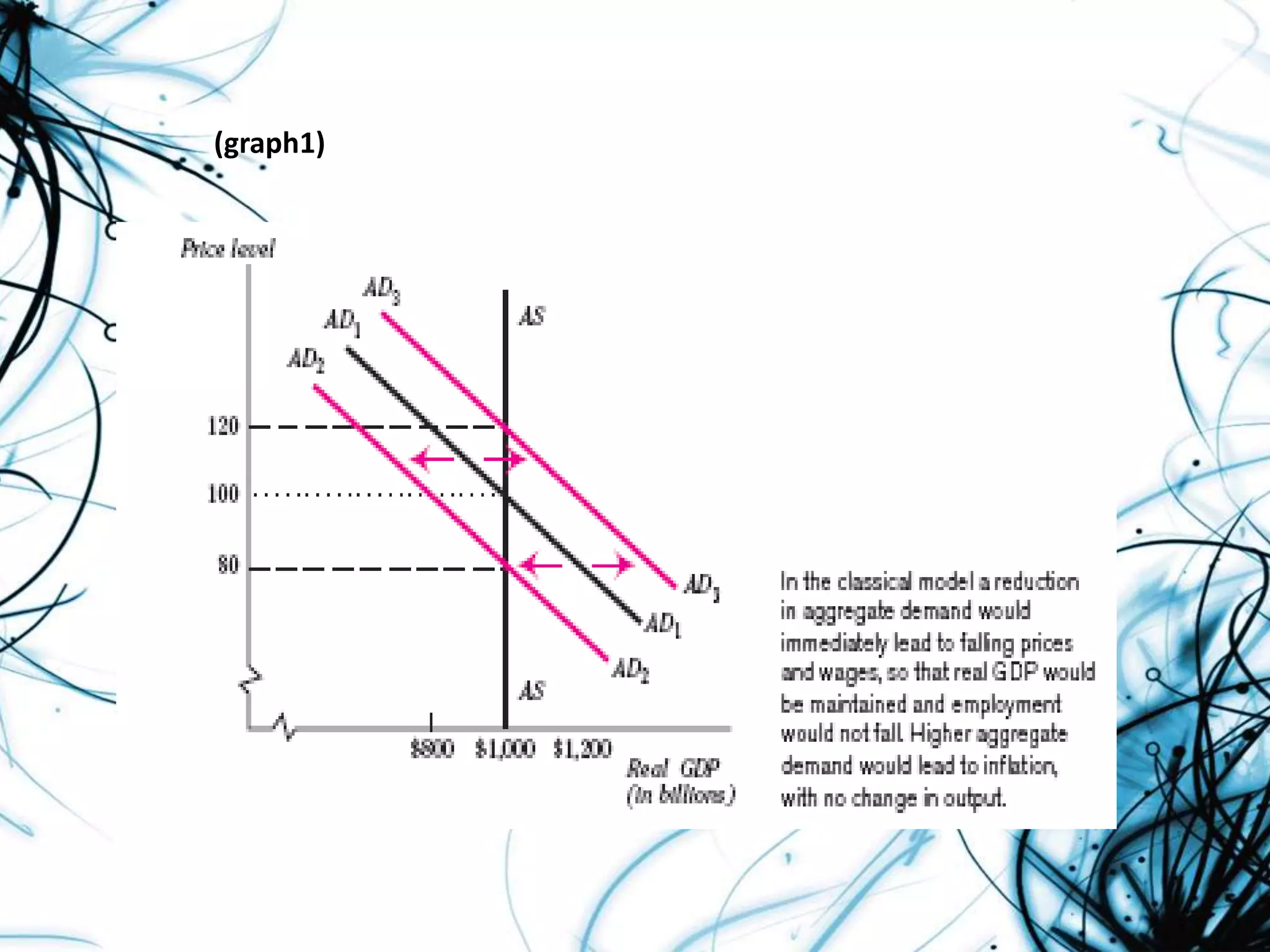
•Graphically the pure classical theorists would have
a vertical AS curve. That shows the same GDP
associated with full employment, at each level in the
economy.
4/19/2014 23
(graph1)
•According to classical economists the
reasons for unemployment are:
1.Intervention by the
government/private monopoly.
2. Wrong calculation by
entrepreneurs & inaccurate
decisions
3.Artificial resistance
4/19/2014 25
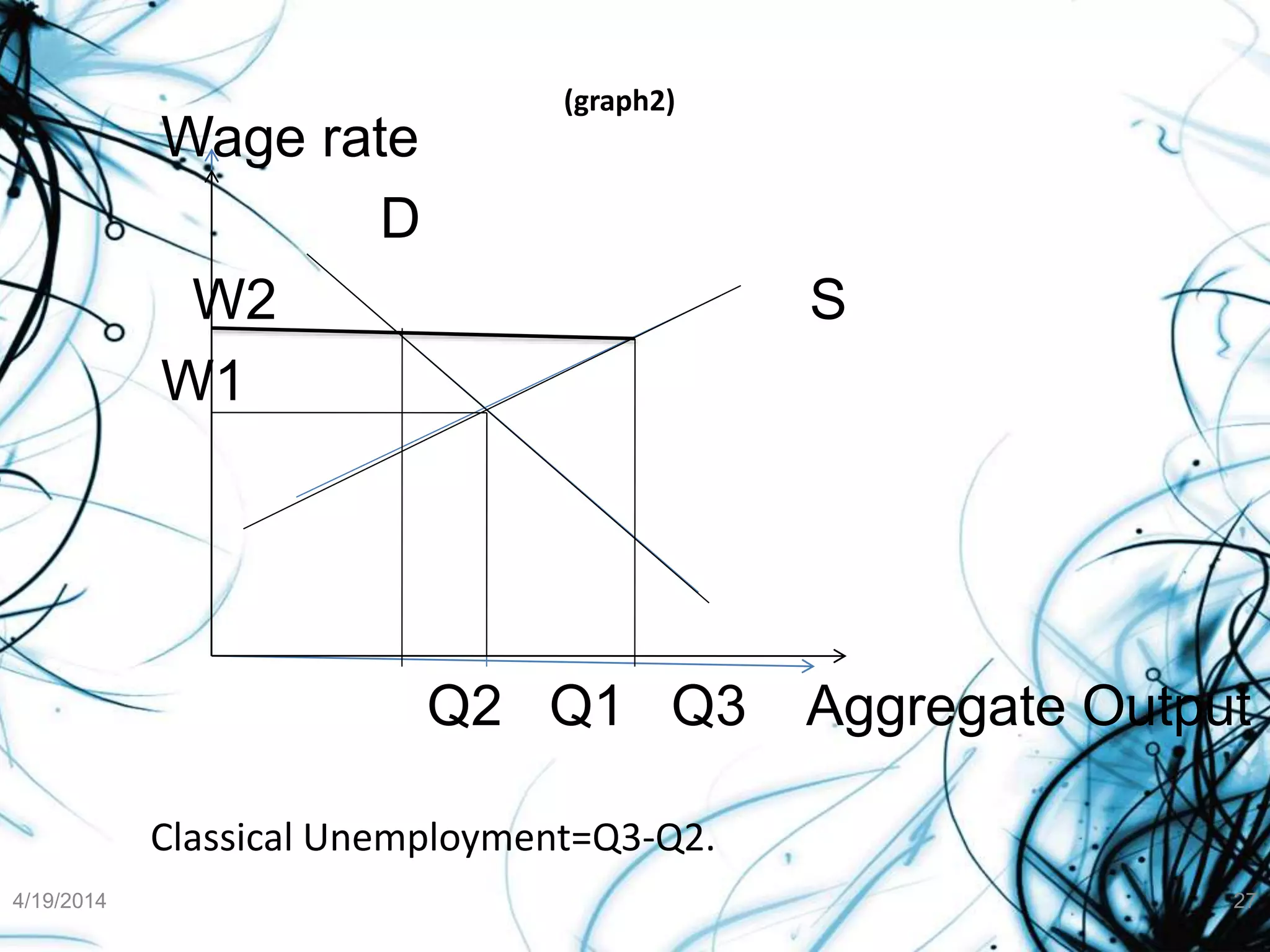
•Classical unemployment occurs when
real wages are kept above the market
clearing wage rate, leading to a surplus
of labor supplied
•Classical unemployment sometimes
known as real wage unemployment.
Because it refers to real wages being
too high.
4/19/2014 27
Wage rate
D
W2 S
W1
Q2 Q1 Q3 Aggregate Output
(graph2)
Classical Unemployment=Q3-Q2.
Keynesian debate on unemployment:
•The most forceful critic of the classical
model was John Maynard Keynes, a British
economist. His major work, entitled The
General Theory of Employment, Interest,
and Money, was first published in 1936.
4/19/2014 28
•Keynesian theory holds that
unemployment is the normal
state of the economy &
significant government
intervention is required if
employment/output targets are to
be reached.
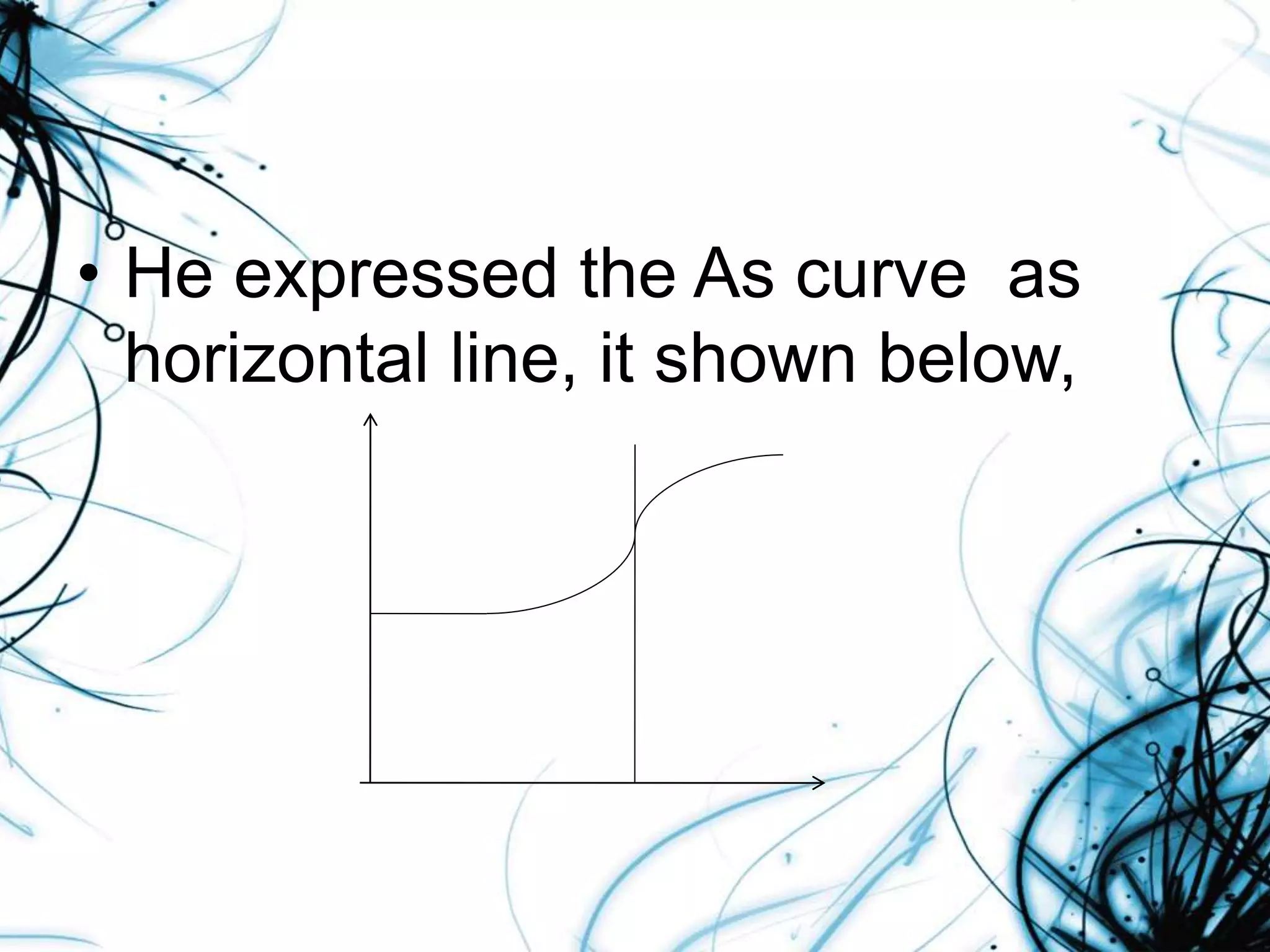
•In this view AS curve is Horizontal.
4/19/2014 30
•The classical economists argue that
if wages were more flexible then
most unemployment could be
solved.
4/19/2014 31
However, Keynesian
economists argue it is not as
straightforward. They argue the
problem may be a lack of AD
in the economy.
EX: If wages are cut, it could
lead to further fall in AD, as
workers have lower wages. In
this case, cutting wages may
be ineffective in solving
classical unemployment.
•Keynesian critique of classical theories:
1. Say’s law:
Whereas the classical economists
believed that supply created its own
demand, Keynes argued that causation
ran the other Way —from demand to
supply.
There are many ways to increase
Demand more effectively than to push
for more output to be produced.
4/19/2014 34
2. Abstinence theory:
Keynes argued that
investors & savers have
different motivations.
4/19/2014 36
•Central Keynesian conclusion:
1. AD determines real GDP
2. In short run, AD can be
adjusted to achieve target GDP
& unemployment levels with
prices not changing (fixed, flat
price)
PRICE STABILITY
• Keynesian different from classical.
• The classical assumed that full
employment of resources in the
economy.
• Keynesian assumed that there is
no full employment.
4/19/2014 37
According to them, if at anytime
there is deviation from this full
employment level, the wages,
interest and prices quickly and
automatically adjust/ change to
restore equilibrium at the full
employment level.
•
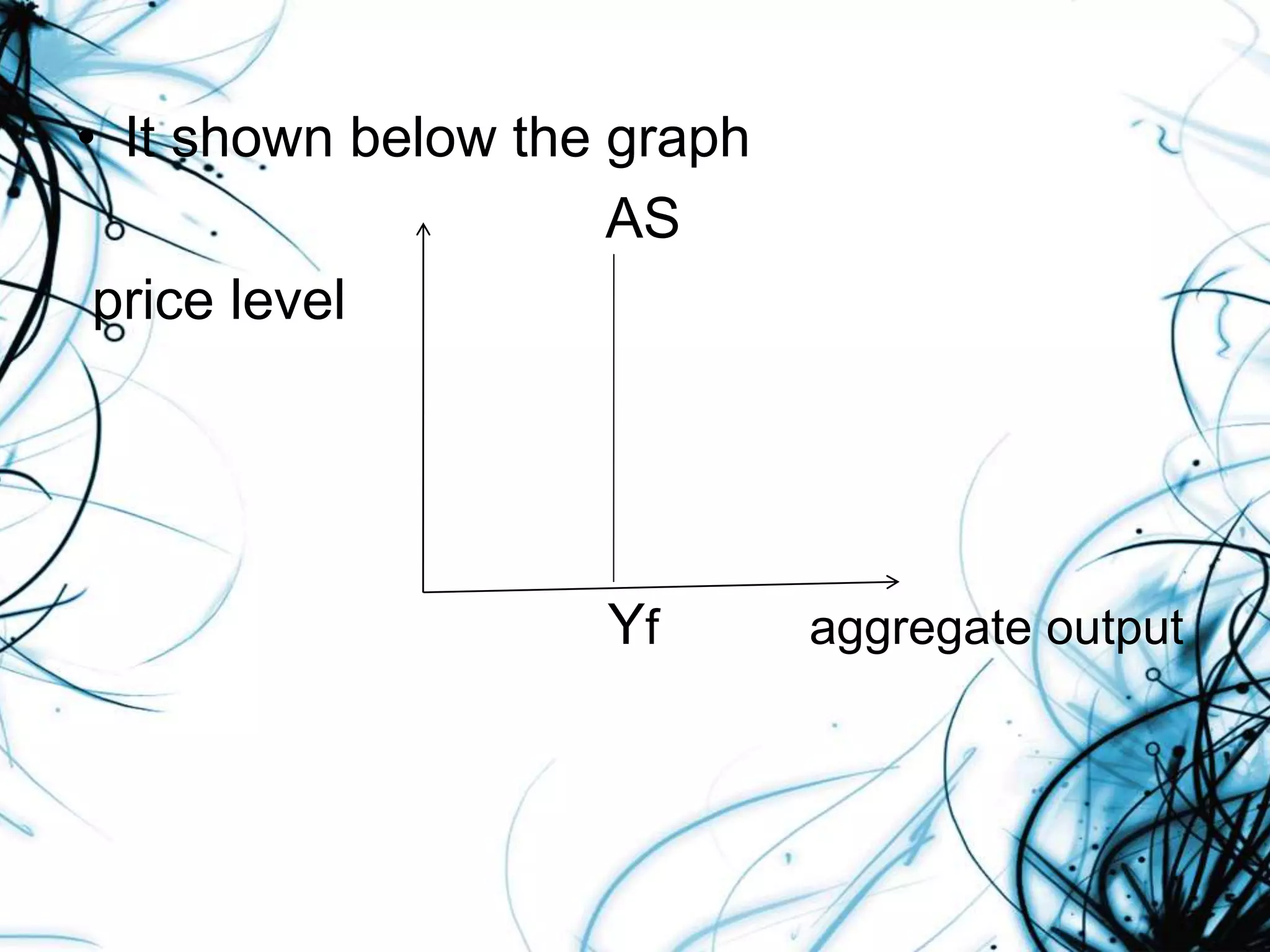
Thus ,in the classical theory the
as curve of output is perfectly
inelastic(vertical straight line)at
the output level corresponding
to full-employment level of
resources.
• It shown below the graph
AS
price level
Yf aggregate output
• Keynes consider the situation
of economic depression when
the economy was operating
before the level of full
employment of resources.
• He expressed the As curve as
horizontal line, it shown below,
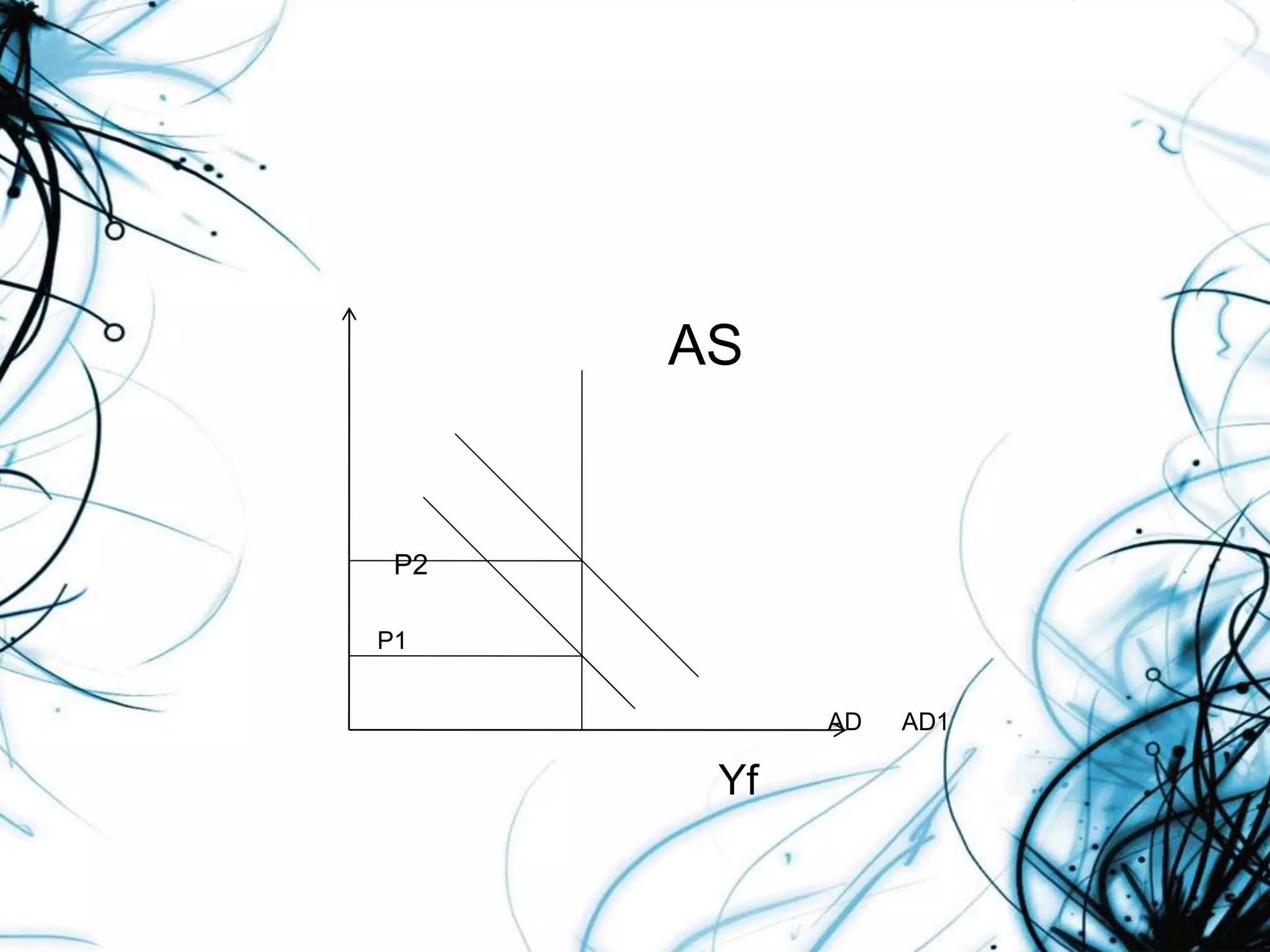
• The classical says if the economy
prevails in fullemployment.there is
an increasing in AD. so the price
level is automatically change. it
will goes up. because cannot be
further increasing in output.
AS
P2
P1
AD AD1
Yf
• But the Keynesian refused this. he
believed that there is no full
employment level. so to expand the
out put can utilized the more
resources. Therefore output level is
increased (o-y) without increasing
cost of production. So the price level
is not changed.
conclusion
• According to Keynes price
and wages are stable but
output and employment will
change
• The classical didn’t accepted
and they agree with flexible
prices. They said output and
employment are stable but
prices and wages will change.
Exchange Rate
• It is a one of the macro
Economics variables.
• It means the prices at which one
currency can purchased in terms
of some other currency is the
exchange rate between the two
countries.
• Macro economic variable
determines depends on the
choice of the underlying
macro Economic model
It has a two criteria
• 1. By recognizing that the existing
macro economic modal for open
economies are still rather simple
in comparison to those of a
closed economy.
• 2. One country model are used for
small open economies , Where
foreign variables are considered
as a given and two country model
are contracted. When domestic
and foreign macro economic
variable are interdependent.
• The open economy consist the
exchange rate model, include
the fixed and floating
exchange rates.
• Under the exchange rate we
observe the two approach.
1. Classical approach
2. Keynesian approach
Keynesian and classical frame works
are similar with respect to this
transmission mechanism.
Keynesian model consist
• The foreign country will realize a
decrease of it real national
income. There will be a rise in the
real exchange rate.
Classical Model Consist
• The foreign country will
observe a fall in its general
price level.
What factors effects the classical
and Keynesian exchange of
currency?
• Factors of classical exchange rate
of currency
• Own country want to import goods
from the abroad, they are
demanding foreign currency
• In order to get these foreign
currency , they have to sell own
currency
• Now the own country currency
value against the foreign currency
is low therefore . the imports will
be expensive ii. Investment in the
foreign country will be un
attractive iii. The demand for
foreign currency will be low and
will the supply of own country
• The exchange rate rises
imports will be more
attractive
• The own country will be
more interest rate in foreign
country investment
opportunities
• The quantity of foreign
currency demanded , thus the
quantity of own country
currency supplied will rise
Factors of Keynesian
exchange rate of currency
• The supply curve of own country
currency slopes upwards to the
right as do the supply curve for
most commodities. By similar
reasoning the demand curve for
own country currency slopes
down ward.
• As we said before, this is a simple
application of demand and supply
analysis. variations in exchange
rate are associated with variations
in quantity demanded and
supplied.
• There is an equilibrium
exchange rate at which the
quantity of a currency supplied
is equal to the quantity
demanded.
• One major cause of instability is a
divergence in monetary policy
between the countries
• The exchange rate often shows
periods of great instability with
large up and down movements.
• Above the situations are change
the exchange rate.
• The Keynesian two countries
model has been developed
mainly by Mundell (1968) and
popularized on a more
comprehensive level.
• He explained the exchange rate
according to the fiscal and monetary
policies.
• He explain through this instruments.
• When changing the government
expenditure ,changes in taxes and
changes in the interest rate are
changed the exchange rates
Macro economic policy debates

Macro economic policy debates

  • 1.
  • 2.
    Content….. • What’s macroeconomics • Introduction of macro economic policy debates • Classical & Keynesian view on;  unemployment Price stability Exchange rate • Conclusion 4/19/2014 2
  • 3.
    MACRO ECONOMICS • Macroeconomics concern with the behavior of the aggregate economy as a whole. Therefore it deals inter related broad system.
  • 4.
    Macroeconomics is abranch of economics dealing with the performance, structure, Behavior and decision-making of the whole economy. This includes a national, regional or global economy.
  • 5.
    Some Macro Economic Economists Classical economists: Adam Smith( Scottish philosopher) Alfred Marshall(British economist) Arthur Cecil Pigou (British economist) David Ricardo (British economist) JS.Mill Malthus
  • 6.
    Keynesian economists: • FrancisYsidro Edge Worth • Jean-Baptist Say • Paul Samuelson • John Maynard Keynes
  • 7.
  • 8.
    Macroeconomic policy debates inevitablyrevolve around discussion of fluctuations in key aggregate measures notably, national income, interest rates, inflation, unemployment, trade imbalances, exchange rates and various wealth series, 4/19/2014 8
  • 9.
    But here weonly discuss three things, a.Un employment b.Price stability c.Exchange rate 4/19/2014 9
  • 10.
    Macroeconomics emerged asa separate subject within economics in the 1930s, when the U.S. economy fell into the Great Depression. 4/19/2014 10
  • 11.
    Before the 1930s,economics was microeconomics (the study of partial-equilibrium supply and demand).
  • 12.
    After the 1930s,the study of the core of economic thinking was broken into two discrete areas: microeconomics, as before, and macroeconomics (the study of the economy in the aggregate).
  • 13.
    Macroeconomic policy debates havecentered on a struggle between two groups: Keynesian economists and Classical economists. 4/19/2014 13
  • 14.
    Classical economists generally opposegovernment intervention in the economy; they favor a laissez-faire policy.
  • 15.
    Keynesians are morelikely to favor govern government intervention in the economy. They feel a laissez-faire policy can sometimes lead to disaster. Both views represent reasonable economic positions.
  • 16.
    MACROECONOMIC OBJECTIVES We beginour discussion by focusing on the objectives of macro-economic policymaking. At the most general level, the goal of economic policy is to maximize long-run societal well-being in an equitable and sustainable manner. 4/19/2014 16
  • 17.
    Much of therecent discussion of economic policy has focused on intermediate variables, such as price stability or the balance of payments. 4/19/2014 17
  • 18.
    Their importance deriveslargely from their role as possible indicators of economic performance in terms of truly significant such as growth, development and equity. 4/19/2014 18
  • 19.
    The centre ofattention of macroeconomic policymaking should be on ‘real macroeconomics’ and the use of productive capacity—the employment of capital and labour at their highest potential level—and improvements in that productivity. 4/19/2014 19
  • 20.
    Macro economics policy debateson Unemployment Definition: •Unemployment is inability for willing workers to find gainful employment. •Unemployment occurs when a person who is actively searching for employment is unable to find work. •Unemployment occurs when people are without work & actively seeking work. 4/19/2014 20
  • 21.
    The Unemployment Rate: UnemploymentRate= Unemployed x100 Labor Force Types of unemployment: •Frictional Unemployment •Seasonal Unemployment •Cyclical Unemployment 4/19/2014 21
  • 22.
    Classical debates onunemployment: •According to classical economists the labor &the other resources are always fully employed. •General unemployment is assumed to be impossible. •If there is any unemployment, it is assumed to be temporary/ abnormal. •In the long run the economy will have full employment/natural rate of unemployment if wages & prices are flexible. 4/19/2014 22
  • 23.
    •Classical reasons forfull employment: 1. Say’s law: Supply creates its own demand. 2. Abstinence theory of interest: Interest rate influences people’s saving. 3. Classical theorists held that wages & prices would change proportionally •Graphically the pure classical theorists would have a vertical AS curve. That shows the same GDP associated with full employment, at each level in the economy. 4/19/2014 23
  • 24.
  • 25.
    •According to classicaleconomists the reasons for unemployment are: 1.Intervention by the government/private monopoly. 2. Wrong calculation by entrepreneurs & inaccurate decisions 3.Artificial resistance 4/19/2014 25
  • 26.
    •Classical unemployment occurswhen real wages are kept above the market clearing wage rate, leading to a surplus of labor supplied •Classical unemployment sometimes known as real wage unemployment. Because it refers to real wages being too high.
  • 27.
    4/19/2014 27 Wage rate D W2S W1 Q2 Q1 Q3 Aggregate Output (graph2) Classical Unemployment=Q3-Q2.
  • 28.
    Keynesian debate onunemployment: •The most forceful critic of the classical model was John Maynard Keynes, a British economist. His major work, entitled The General Theory of Employment, Interest, and Money, was first published in 1936. 4/19/2014 28
  • 29.
    •Keynesian theory holdsthat unemployment is the normal state of the economy & significant government intervention is required if employment/output targets are to be reached.
  • 30.
    •In this viewAS curve is Horizontal. 4/19/2014 30
  • 31.
    •The classical economistsargue that if wages were more flexible then most unemployment could be solved. 4/19/2014 31
  • 32.
    However, Keynesian economists argueit is not as straightforward. They argue the problem may be a lack of AD in the economy.
  • 33.
    EX: If wagesare cut, it could lead to further fall in AD, as workers have lower wages. In this case, cutting wages may be ineffective in solving classical unemployment.
  • 34.
    •Keynesian critique ofclassical theories: 1. Say’s law: Whereas the classical economists believed that supply created its own demand, Keynes argued that causation ran the other Way —from demand to supply. There are many ways to increase Demand more effectively than to push for more output to be produced. 4/19/2014 34
  • 35.
    2. Abstinence theory: Keynesargued that investors & savers have different motivations.
  • 36.
    4/19/2014 36 •Central Keynesianconclusion: 1. AD determines real GDP 2. In short run, AD can be adjusted to achieve target GDP & unemployment levels with prices not changing (fixed, flat price)
  • 37.
    PRICE STABILITY • Keynesiandifferent from classical. • The classical assumed that full employment of resources in the economy. • Keynesian assumed that there is no full employment. 4/19/2014 37
  • 38.
    According to them,if at anytime there is deviation from this full employment level, the wages, interest and prices quickly and automatically adjust/ change to restore equilibrium at the full employment level. •
  • 39.
    Thus ,in theclassical theory the as curve of output is perfectly inelastic(vertical straight line)at the output level corresponding to full-employment level of resources.
  • 40.
    • It shownbelow the graph AS price level Yf aggregate output
  • 41.
    • Keynes considerthe situation of economic depression when the economy was operating before the level of full employment of resources.
  • 42.
    • He expressedthe As curve as horizontal line, it shown below,
  • 43.
    • The classicalsays if the economy prevails in fullemployment.there is an increasing in AD. so the price level is automatically change. it will goes up. because cannot be further increasing in output.
  • 44.
  • 45.
    • But theKeynesian refused this. he believed that there is no full employment level. so to expand the out put can utilized the more resources. Therefore output level is increased (o-y) without increasing cost of production. So the price level is not changed.
  • 46.
    conclusion • According toKeynes price and wages are stable but output and employment will change
  • 47.
    • The classicaldidn’t accepted and they agree with flexible prices. They said output and employment are stable but prices and wages will change.
  • 48.
    Exchange Rate • Itis a one of the macro Economics variables. • It means the prices at which one currency can purchased in terms of some other currency is the exchange rate between the two countries.
  • 49.
    • Macro economicvariable determines depends on the choice of the underlying macro Economic model
  • 50.
    It has atwo criteria • 1. By recognizing that the existing macro economic modal for open economies are still rather simple in comparison to those of a closed economy.
  • 51.
    • 2. Onecountry model are used for small open economies , Where foreign variables are considered as a given and two country model are contracted. When domestic and foreign macro economic variable are interdependent.
  • 52.
    • The openeconomy consist the exchange rate model, include the fixed and floating exchange rates.
  • 53.
    • Under theexchange rate we observe the two approach. 1. Classical approach 2. Keynesian approach
  • 54.
    Keynesian and classicalframe works are similar with respect to this transmission mechanism. Keynesian model consist • The foreign country will realize a decrease of it real national income. There will be a rise in the real exchange rate.
  • 55.
    Classical Model Consist •The foreign country will observe a fall in its general price level.
  • 56.
    What factors effectsthe classical and Keynesian exchange of currency? • Factors of classical exchange rate of currency • Own country want to import goods from the abroad, they are demanding foreign currency • In order to get these foreign currency , they have to sell own currency
  • 57.
    • Now theown country currency value against the foreign currency is low therefore . the imports will be expensive ii. Investment in the foreign country will be un attractive iii. The demand for foreign currency will be low and will the supply of own country
  • 58.
    • The exchangerate rises imports will be more attractive
  • 59.
    • The owncountry will be more interest rate in foreign country investment opportunities
  • 60.
    • The quantityof foreign currency demanded , thus the quantity of own country currency supplied will rise
  • 61.
    Factors of Keynesian exchangerate of currency • The supply curve of own country currency slopes upwards to the right as do the supply curve for most commodities. By similar reasoning the demand curve for own country currency slopes down ward.
  • 62.
    • As wesaid before, this is a simple application of demand and supply analysis. variations in exchange rate are associated with variations in quantity demanded and supplied.
  • 63.
    • There isan equilibrium exchange rate at which the quantity of a currency supplied is equal to the quantity demanded.
  • 64.
    • One majorcause of instability is a divergence in monetary policy between the countries • The exchange rate often shows periods of great instability with large up and down movements.
  • 65.
    • Above thesituations are change the exchange rate. • The Keynesian two countries model has been developed mainly by Mundell (1968) and popularized on a more comprehensive level.
  • 66.
    • He explainedthe exchange rate according to the fiscal and monetary policies. • He explain through this instruments. • When changing the government expenditure ,changes in taxes and changes in the interest rate are changed the exchange rates