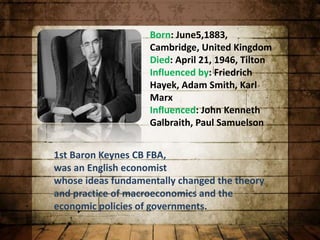







1st Baron Keynes CB FBA,
was an English economist
whose ideas fundamentally changed the theory
and practice of macroeconomics and the
economic policies of governments.
Born: June5,1883,
Cambridge, United Kingdom
Died: April 21, 1946, Tilton
Influenced by: Friedrich
Hayek, Adam Smith, Karl
Marx
Influenced: John Kenneth
Galbraith, Paul Samuelson
• John Maynard Keynes was
probably the most influential
economist of the first half of
the twentieth century.
• The son of a professor of
economics, John Neville Keynes,
and destined by family
connection to be influential in
the narrow British university
world.
• He studied at Cambridge
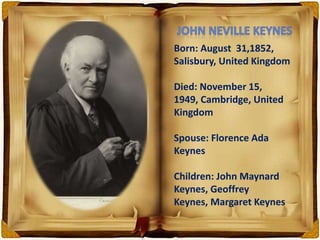
Born: August 31,1852,
Salisbury, United Kingdom
Died: November 15,
1949, Cambridge, United
Kingdom
Spouse: Florence Ada
Keynes
Children: John Maynard
Keynes, Geoffrey
Keynes, Margaret Keynes
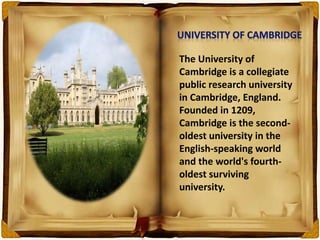
The University of
Cambridge is a collegiate
public research university
in Cambridge, England.
Founded in 1209,
Cambridge is the second-
oldest university in the
English-speaking world
and the world's fourth-
oldest surviving
university.
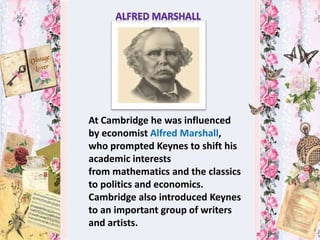
At Cambridge he was influenced
by economist Alfred Marshall,
who prompted Keynes to shift his
academic interests
from mathematics and the classics
to politics and economics.
Cambridge also introduced Keynes
to an important group of writers
and artists.
The Apostles is a secret society of
Cambridge University members that meets
to discuss and debate such topics as truth,
God, and ethics. The group, also known as
the Cambridge Conversazione Society, was
founded in 1820 by George Tomlinson.
Tomlinson went on to become the first
Bishop of Gibraltar.
Most Apostles came from the colleges of
St John's, Trinity and King's. Since the
1970s the Apostles have invited select
women to join the group. The origin of the
Apostles' nickname dates from the original
membership of 12.
The Bloomsbury Group—
or Bloomsbury Set—was an
influential group of
associated English writers,
intellectuals, philosophers and
artists, the best known members of
which included Virginia
Woolf, John Maynard Keynes,
E. M. Forster and Lytton Strachey.
This loose collective of friends and
relatives lived, worked or studied
together near Bloomsbury, London,
during the first half of the 20th
century.
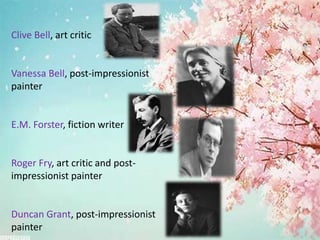
Clive Bell, art critic
Vanessa Bell, post-impressionist
painter
E.M. Forster, fiction writer
Roger Fry, art critic and post-
impressionist painter
Duncan Grant, post-impressionist
painter
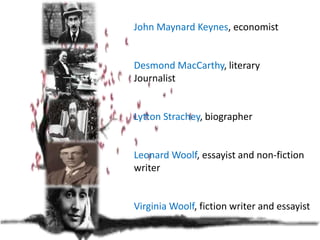
John Maynard Keynes, economist
Desmond MacCarthy, literary
Journalist
Lytton Strachey, biographer
Leonard Woolf, essayist and non-fiction
writer
Virginia Woolf, fiction writer and essayist
• Between the wars he worked with the
British treasury and increase the wealth
of the treasury by performing brilliant
international transactions.
• He was an economist who made
important contributions to probability
theory and mathematical economics.
He became a lecturer in economics at
Cambridge, where he was educated,
until the start of World War I when he
worked for the government.
• Keynes was on the staff of the British delegation
that negotiated peace after World War I, but he
regarded the terms as the seeds of disaster,
resigned in protest, and wrote his criticisms in
The Economic Consequences of the Peace (1919),
"...bursting" (as Schumpeter wrote) "into
international fame when men of equal insight but
less courage and men of equal courage but less
insight kept silent."
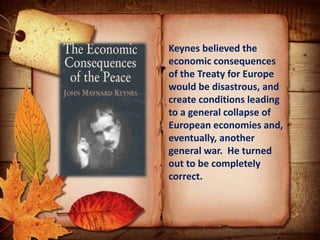
Keynes believed the
economic consequences
of the Treaty for Europe
would be disastrous, and
create conditions leading
to a general collapse of
European economies and,
eventually, another
general war. He turned
out to be completely
correct.
• The role of government is to stimulate
demand through spending in times of
economic slack.
• Policy makers should manipulate
government expenditures to achieve a
desirable level of aggregate demand.
• In times of economic downturn, this can
be achieved either through lowering tax
rates or increasing government expenditures.
• According to Keynes, governments
should incur deficits and borrow money in times
of downturn; these debts can be repaid
through higher taxation in times of
economic growth.
1. If the consumer is an
economic optimizer, he/she
must be unable to buy the
goods they planned to buy
because of some kind of
constraint—risk, convention,
social institutions, cash, or ...?
a) According to the classical
model, the consumer has
insatiable wants.
b) The consumer sells his/her
labor in exchange for enough
income to buy the goods.
c) The money value of the
incomes received must be equal
to the value of the output
produced.
2. (“Supply creates its
own demand.”)
a) If spending constraints
are in effect, then there
will be a difference
between (unlimited)
demand and “effective
demand”.
b) Actual (effective)
demand will usually be
“deficient” to purchase
total output.
3. Microeconomics and macroeconomics do not operate on the
same basis. One cannot assume that what is true for the
economic agent at the level of the individual consumer or
firm is true in aggregate. This amounts to the fallacy of
composition.
– In microeconomics, relative price effects dominate. This is
not true in macroeconomics. In macroeconomics, income
effects dominate, making income more important in
determining aggregate economic behavior.
4. Therefore, consumption
depends primarily upon
income, not interest rates.
– C  C(r), but rather C = C(Y)
– “People don’t change their standard
of living simply because the interest
rate changes a few points.”
5. Saving occurs as the result
of a habit, convention, or
social norm. People on
average set aside a certain
percentage of their income.
Saving is not a function of
interest rates.
 S  S(r), but rather S = S(Y)
6. Investment is related to
interest rates, but also to
businessmen’s expectations
for the future.
 That is, I = I(r,E).
7. If S = S(Y) and I = I(r,E), then there is no
coordinating variable to bring supply and
demand together in the loan able funds
(capital) market.
– There is no reason to assume that
supply equals demand in this market.
– There is no reason to believe that there
will be adequate funds available to
provide adequate investment demand.
– Since AD = C + I + G + NX, if
investment demand is deficient, then
AD < AS, and inventories may pile up,
with unemployment a natural outcome.
– Without the coordinating variable, this
will be the normal outcome, with AD
= AS only happening accidentally.
8. Investment is a large and long-
term commitment, and is based
on weakly supported expectations
about the future. This makes
investment very different from
consumption. Investment
decisions will be erratic and
emotional, and the risks associated
with investment are very high. As
a result, business decision makers
will tend to under-invest, further
worsening the problem of
deficient investment.
9. It may be a natural outcome of the
organization and institutions of
modern economies that prices and
wages may not be fully flexible.
This would result in markets (like
the labor and goods markets) being
unable to clear, leading to
unemployment and aggregate
supply exceeding demand.
10. Money plays a key role in the
economy. The use of money
leads to uncertainty, and makes
“piercing the veil” impossible.
A money economy is
fundamentally different from a
barter economy. The classical
dichotomy cannot hold.
Interest rates are established in
the money market.
People may rationally hoard
money, holding money for
purposes other then making
transactions.
11. Equilibrium is not
11. AD = AS. It is a state that
persists.
• The day isn't far off
when the economic
problem will take the
back seat where it
belongs, and the heart
and head will be
occupied or
reoccupied, by our
real problems of life
and of human
relations, of creation
and behavior and
religion.
• The difficulty lies, not in the
new ideas, but in escaping
from the old ones which ratify
. . . into every corner of our
minds.
• It is ideas, not vested
interests, which are
dangerous for good or evil.
• Most men love money and
security more, and
creation and construction
less, as they get older.
• I do not know which makes
a man more conservative --
to know nothing but the
present, or nothing but the
past.
John maynard keynes

John maynard keynes

  • 2.
    1st Baron KeynesCB FBA, was an English economist whose ideas fundamentally changed the theory and practice of macroeconomics and the economic policies of governments. Born: June5,1883, Cambridge, United Kingdom Died: April 21, 1946, Tilton Influenced by: Friedrich Hayek, Adam Smith, Karl Marx Influenced: John Kenneth Galbraith, Paul Samuelson
  • 3.
    • John MaynardKeynes was probably the most influential economist of the first half of the twentieth century. • The son of a professor of economics, John Neville Keynes, and destined by family connection to be influential in the narrow British university world. • He studied at Cambridge
  • 4.
    Born: August 31,1852, Salisbury,United Kingdom Died: November 15, 1949, Cambridge, United Kingdom Spouse: Florence Ada Keynes Children: John Maynard Keynes, Geoffrey Keynes, Margaret Keynes
  • 5.
    The University of Cambridgeis a collegiate public research university in Cambridge, England. Founded in 1209, Cambridge is the second- oldest university in the English-speaking world and the world's fourth- oldest surviving university.
  • 6.
    At Cambridge hewas influenced by economist Alfred Marshall, who prompted Keynes to shift his academic interests from mathematics and the classics to politics and economics. Cambridge also introduced Keynes to an important group of writers and artists.
  • 8.
    The Apostles isa secret society of Cambridge University members that meets to discuss and debate such topics as truth, God, and ethics. The group, also known as the Cambridge Conversazione Society, was founded in 1820 by George Tomlinson. Tomlinson went on to become the first Bishop of Gibraltar. Most Apostles came from the colleges of St John's, Trinity and King's. Since the 1970s the Apostles have invited select women to join the group. The origin of the Apostles' nickname dates from the original membership of 12.
  • 10.
    The Bloomsbury Group— orBloomsbury Set—was an influential group of associated English writers, intellectuals, philosophers and artists, the best known members of which included Virginia Woolf, John Maynard Keynes, E. M. Forster and Lytton Strachey. This loose collective of friends and relatives lived, worked or studied together near Bloomsbury, London, during the first half of the 20th century.
  • 11.
    Clive Bell, artcritic Vanessa Bell, post-impressionist painter E.M. Forster, fiction writer Roger Fry, art critic and post- impressionist painter Duncan Grant, post-impressionist painter
  • 12.
    John Maynard Keynes,economist Desmond MacCarthy, literary Journalist Lytton Strachey, biographer Leonard Woolf, essayist and non-fiction writer Virginia Woolf, fiction writer and essayist
  • 13.
    • Between thewars he worked with the British treasury and increase the wealth of the treasury by performing brilliant international transactions. • He was an economist who made important contributions to probability theory and mathematical economics. He became a lecturer in economics at Cambridge, where he was educated, until the start of World War I when he worked for the government.
  • 14.
    • Keynes wason the staff of the British delegation that negotiated peace after World War I, but he regarded the terms as the seeds of disaster, resigned in protest, and wrote his criticisms in The Economic Consequences of the Peace (1919), "...bursting" (as Schumpeter wrote) "into international fame when men of equal insight but less courage and men of equal courage but less insight kept silent."
  • 15.
    Keynes believed the economicconsequences of the Treaty for Europe would be disastrous, and create conditions leading to a general collapse of European economies and, eventually, another general war. He turned out to be completely correct.
  • 18.
    • The roleof government is to stimulate demand through spending in times of economic slack. • Policy makers should manipulate government expenditures to achieve a desirable level of aggregate demand. • In times of economic downturn, this can be achieved either through lowering tax rates or increasing government expenditures. • According to Keynes, governments should incur deficits and borrow money in times of downturn; these debts can be repaid through higher taxation in times of economic growth.
  • 20.
    1. If theconsumer is an economic optimizer, he/she must be unable to buy the goods they planned to buy because of some kind of constraint—risk, convention, social institutions, cash, or ...? a) According to the classical model, the consumer has insatiable wants. b) The consumer sells his/her labor in exchange for enough income to buy the goods. c) The money value of the incomes received must be equal to the value of the output produced.
  • 21.
    2. (“Supply createsits own demand.”) a) If spending constraints are in effect, then there will be a difference between (unlimited) demand and “effective demand”. b) Actual (effective) demand will usually be “deficient” to purchase total output.
  • 22.
    3. Microeconomics andmacroeconomics do not operate on the same basis. One cannot assume that what is true for the economic agent at the level of the individual consumer or firm is true in aggregate. This amounts to the fallacy of composition. – In microeconomics, relative price effects dominate. This is not true in macroeconomics. In macroeconomics, income effects dominate, making income more important in determining aggregate economic behavior.
  • 23.
    4. Therefore, consumption dependsprimarily upon income, not interest rates. – C  C(r), but rather C = C(Y) – “People don’t change their standard of living simply because the interest rate changes a few points.”
  • 24.
    5. Saving occursas the result of a habit, convention, or social norm. People on average set aside a certain percentage of their income. Saving is not a function of interest rates.  S  S(r), but rather S = S(Y) 6. Investment is related to interest rates, but also to businessmen’s expectations for the future.  That is, I = I(r,E).
  • 25.
    7. If S= S(Y) and I = I(r,E), then there is no coordinating variable to bring supply and demand together in the loan able funds (capital) market. – There is no reason to assume that supply equals demand in this market. – There is no reason to believe that there will be adequate funds available to provide adequate investment demand. – Since AD = C + I + G + NX, if investment demand is deficient, then AD < AS, and inventories may pile up, with unemployment a natural outcome. – Without the coordinating variable, this will be the normal outcome, with AD = AS only happening accidentally.
  • 26.
    8. Investment isa large and long- term commitment, and is based on weakly supported expectations about the future. This makes investment very different from consumption. Investment decisions will be erratic and emotional, and the risks associated with investment are very high. As a result, business decision makers will tend to under-invest, further worsening the problem of deficient investment.
  • 27.
    9. It maybe a natural outcome of the organization and institutions of modern economies that prices and wages may not be fully flexible. This would result in markets (like the labor and goods markets) being unable to clear, leading to unemployment and aggregate supply exceeding demand.
  • 28.
    10. Money playsa key role in the economy. The use of money leads to uncertainty, and makes “piercing the veil” impossible. A money economy is fundamentally different from a barter economy. The classical dichotomy cannot hold. Interest rates are established in the money market. People may rationally hoard money, holding money for purposes other then making transactions.
  • 29.
    11. Equilibrium isnot 11. AD = AS. It is a state that persists.
  • 31.
    • The dayisn't far off when the economic problem will take the back seat where it belongs, and the heart and head will be occupied or reoccupied, by our real problems of life and of human relations, of creation and behavior and religion.
  • 32.
    • The difficultylies, not in the new ideas, but in escaping from the old ones which ratify . . . into every corner of our minds. • It is ideas, not vested interests, which are dangerous for good or evil.
  • 33.
    • Most menlove money and security more, and creation and construction less, as they get older. • I do not know which makes a man more conservative -- to know nothing but the present, or nothing but the past.