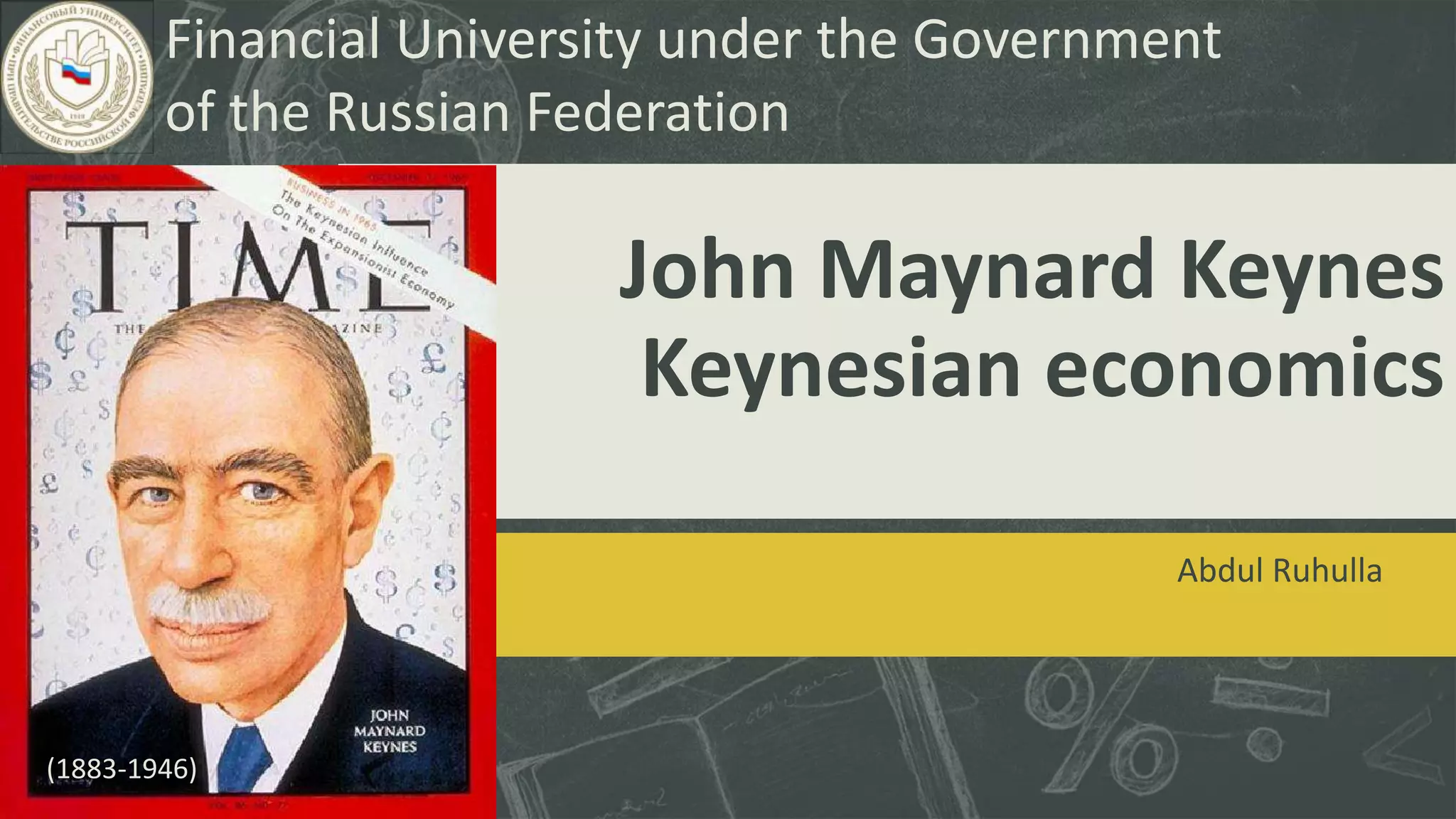
John Maynard Keynes
Keynesian economics
Abdul Ruhulla
Financial University under the Government
of the Russian Federation
(1883-1946)
The Early J. M. Keynes
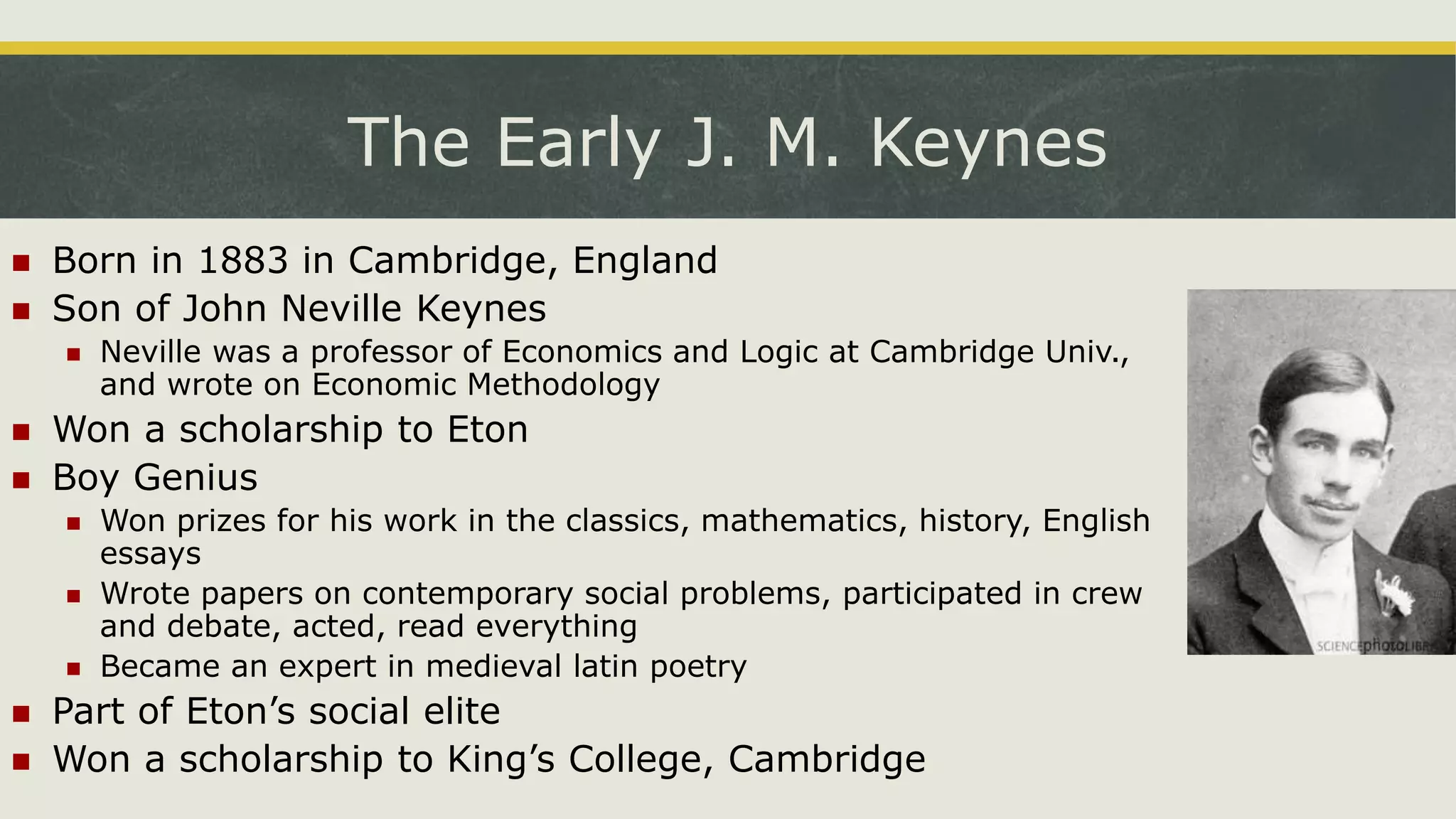
 Born in 1883 in Cambridge, England
 Son of John Neville Keynes
 Neville was a professor of Economics and Logic at Cambridge Univ.,
and wrote on Economic Methodology
 Won a scholarship to Eton
 Boy Genius
 Won prizes for his work in the classics, mathematics, history, English
essays
 Wrote papers on contemporary social problems, participated in crew
and debate, acted, read everything
 Became an expert in medieval latin poetry
 Part of Eton’s social elite
 Won a scholarship to King’s College, Cambridge
Keynes as a College Student
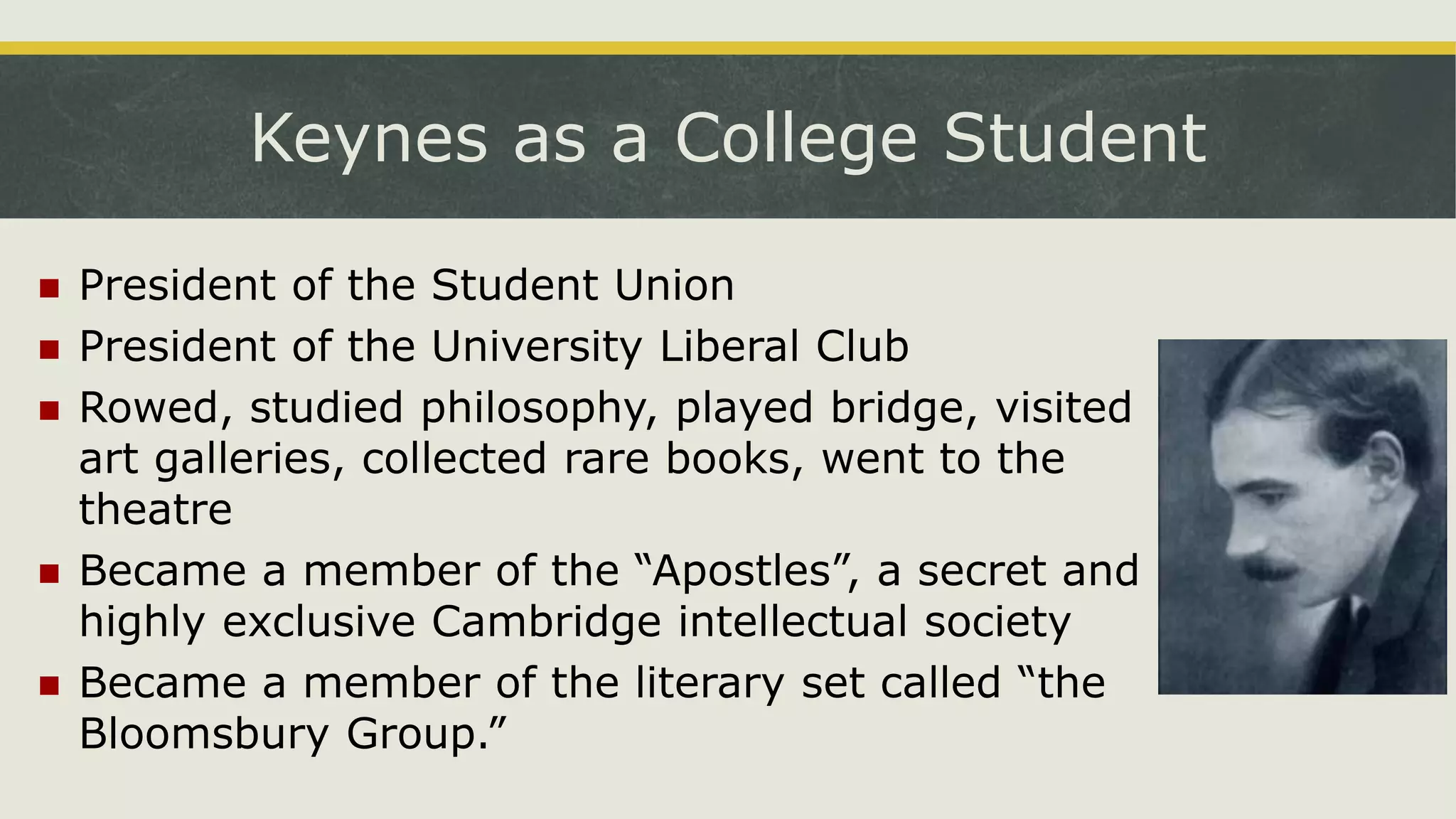
 President of the Student Union
 President of the University Liberal Club
 Rowed, studied philosophy, played bridge, visited
art galleries, collected rare books, went to the
theatre
 Became a member of the “Apostles”, a secret and
highly exclusive Cambridge intellectual society
 Became a member of the literary set called “the
Bloomsbury Group.”
Keynes After College
 Studied economics for perhaps 1 year, but did poorly
on his exams.
 Took a civil service exam and took a job at the India
Office for 2 years.
 1908, his father managed to get him a job as a
lecturer at King’s College. Later he became a Fellow.
 1911, he became editor of the Economic Journal.
 Worked at the Treasury during WWI.
 1921, he published A Treatise on Probability. This was
his dissertation. It won him a fellowship at King’s
College, Cambridge.
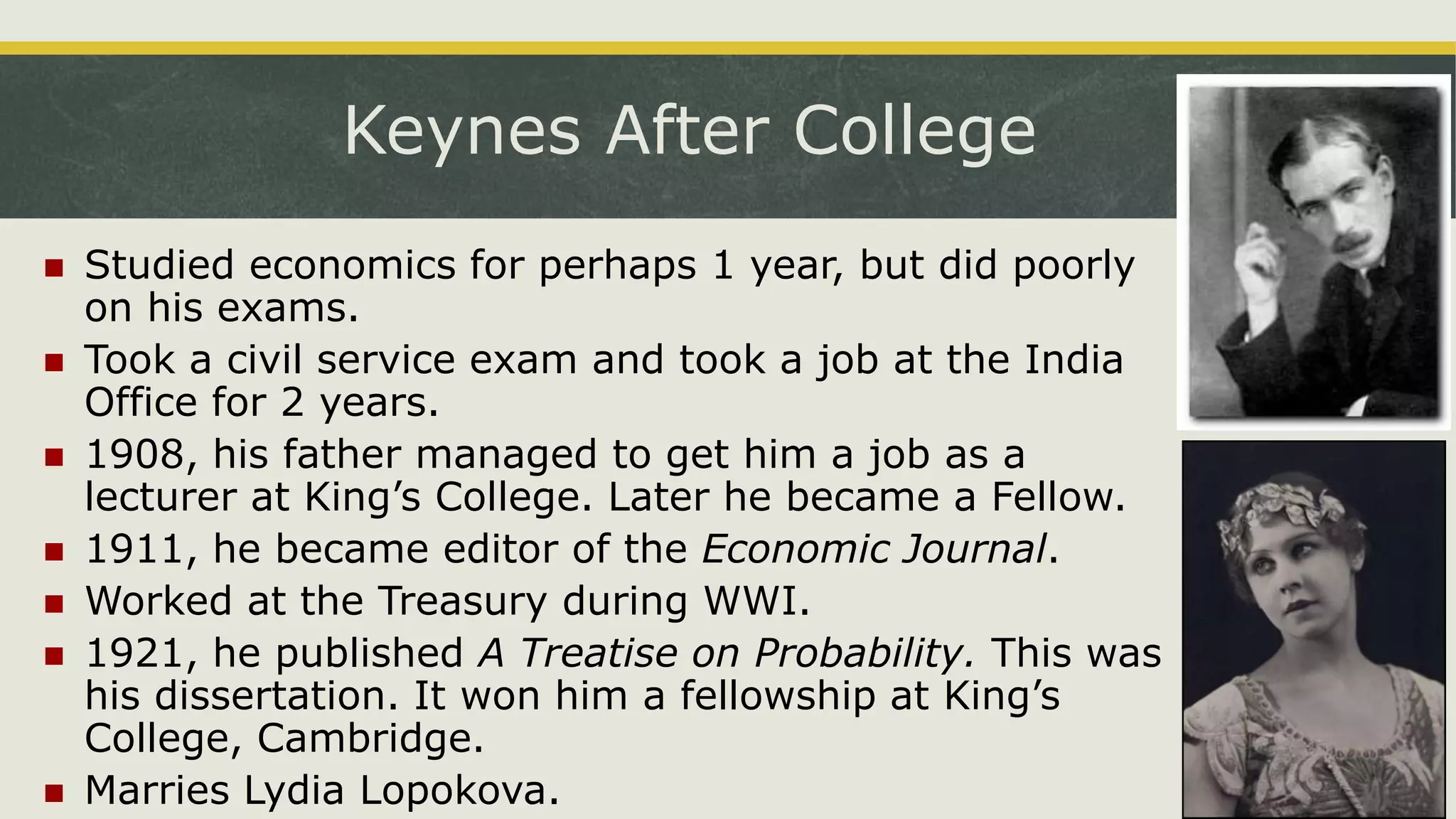
 Marries Lydia Lopokova.
Keynes, Inter-war Years
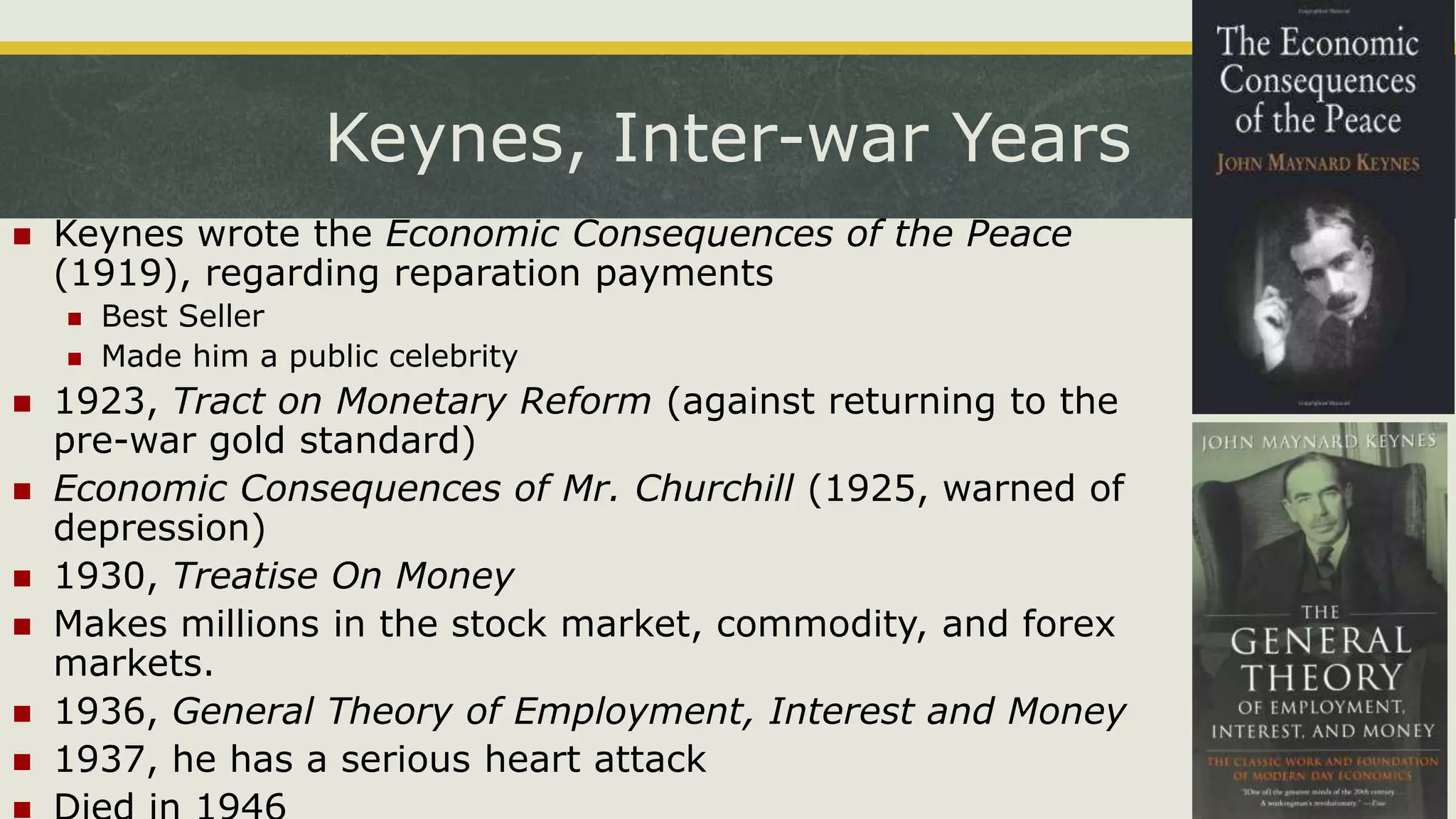
 Keynes wrote the Economic Consequences of the Peace
(1919), regarding reparation payments
 Best Seller
 Made him a public celebrity
 1923, Tract on Monetary Reform (against returning to the
pre-war gold standard)
 Economic Consequences of Mr. Churchill (1925, warned of
depression)
 1930, Treatise On Money
 Makes millions in the stock market, commodity, and forex
markets.
 1936, General Theory of Employment, Interest and Money
 1937, he has a serious heart attack
Keynesian Economics
The main ideas
Keynesian Economics
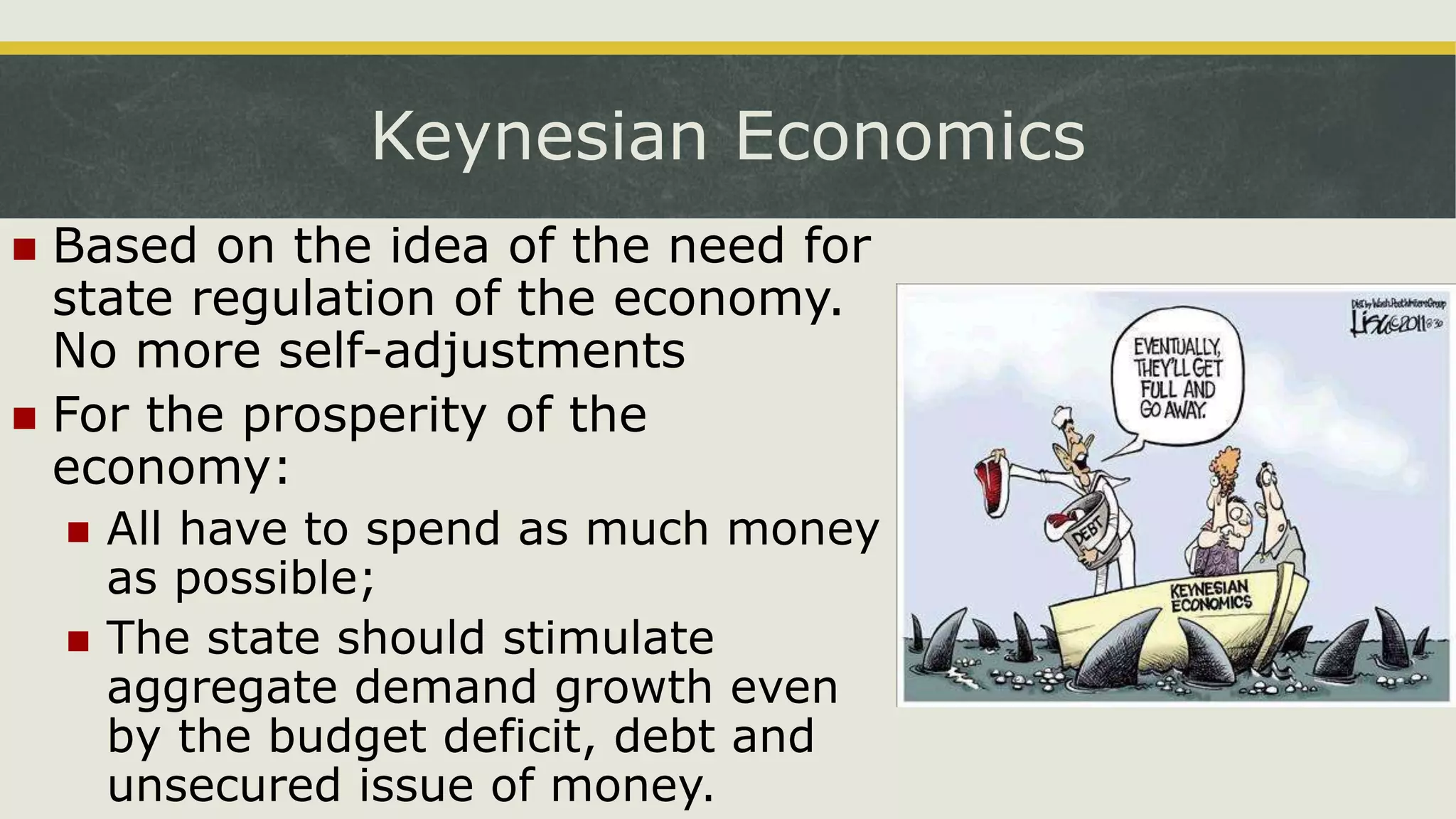
 Based on the idea of the need for
state regulation of the economy.
No more self-adjustments
 For the prosperity of the
economy:
 All have to spend as much money
as possible;
 The state should stimulate
aggregate demand growth even
by the budget deficit, debt and
unsecured issue of money.
Laissez-faire
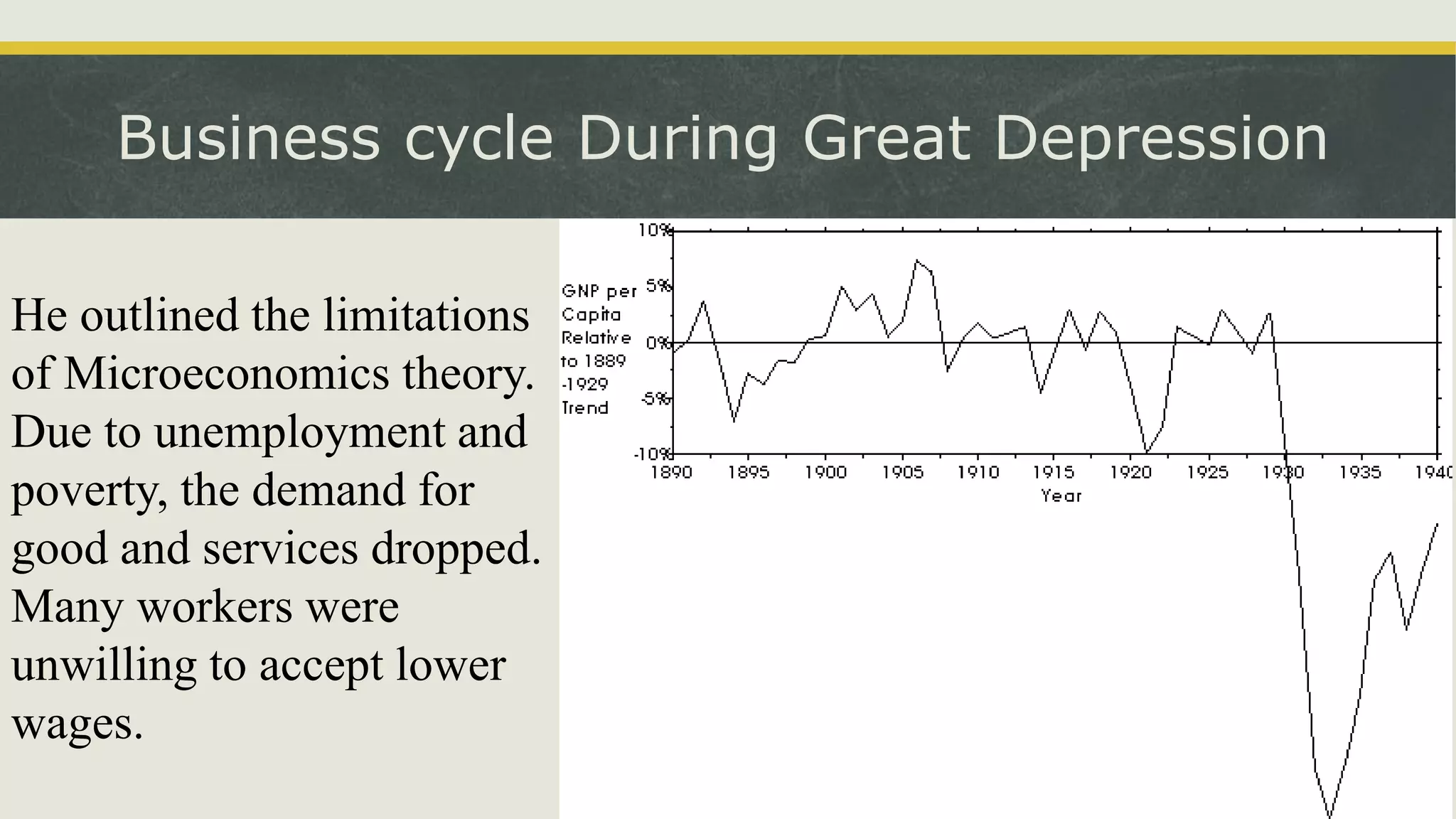
Business cycle During Great Depression
He outlined the limitations
of Microeconomics theory.
Due to unemployment and
poverty, the demand for
good and services dropped.
Many workers were
unwilling to accept lower
wages.
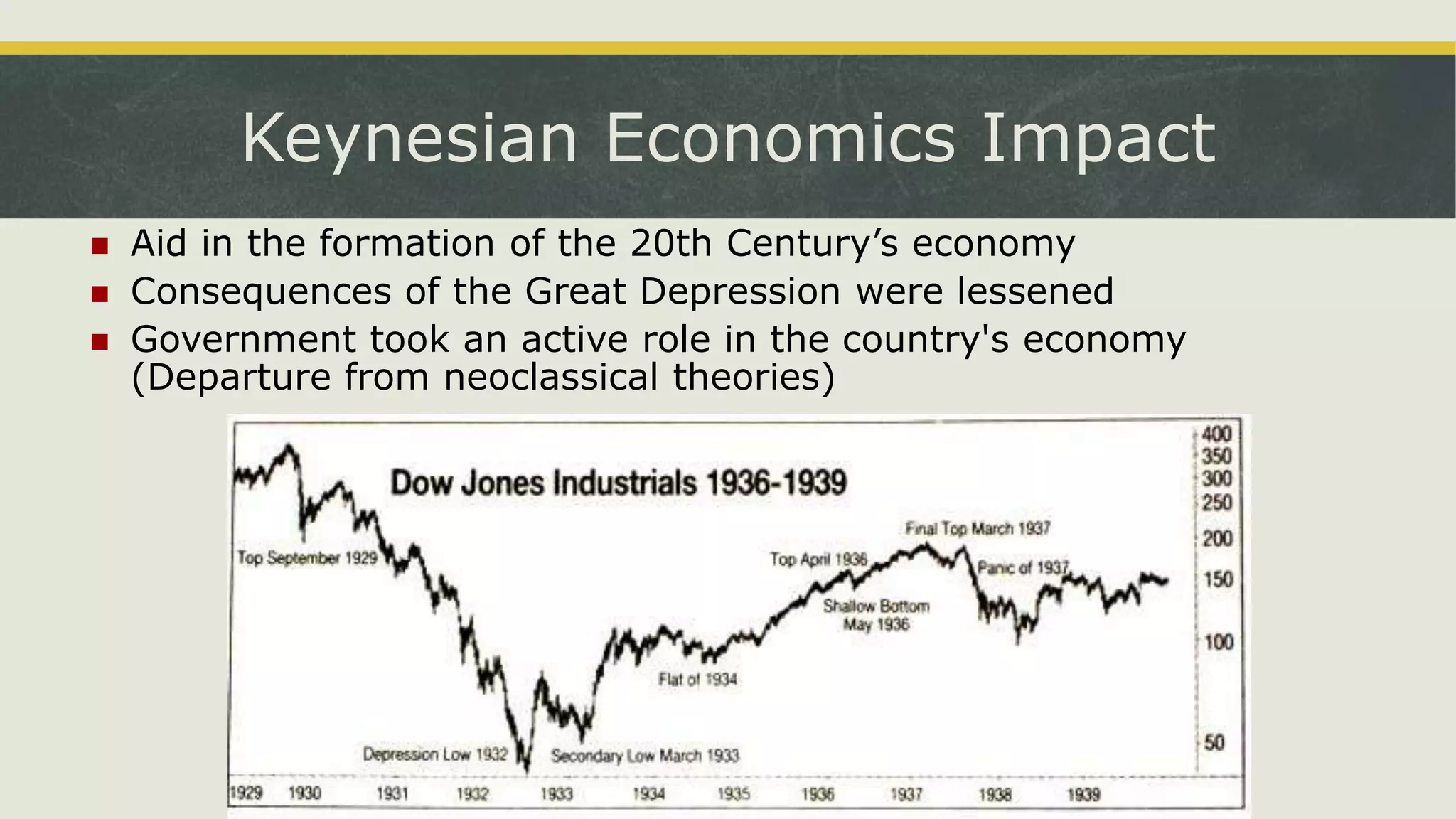
Keynesian Economics Impact
 Aid in the formation of the 20th Century’s economy
 Consequences of the Great Depression were lessened
 Government took an active role in the country's economy
(Departure from neoclassical theories)
Intro to Macroeconomic Theory
 High unemployment rate greatly influenced
the development of macroeconomics
 Challenged the established neoclassical
economics
 Introduced important concepts such as:
 Consumption
 Multiplier
 Marginal efficiency of capital
 Liquidity preference
 Government's responsibility is to
 Reach and maintain full employment
 Regulate markets and free trade
END OF
NEOCLASSICAL
THEORIES!
such as Laissez-faire
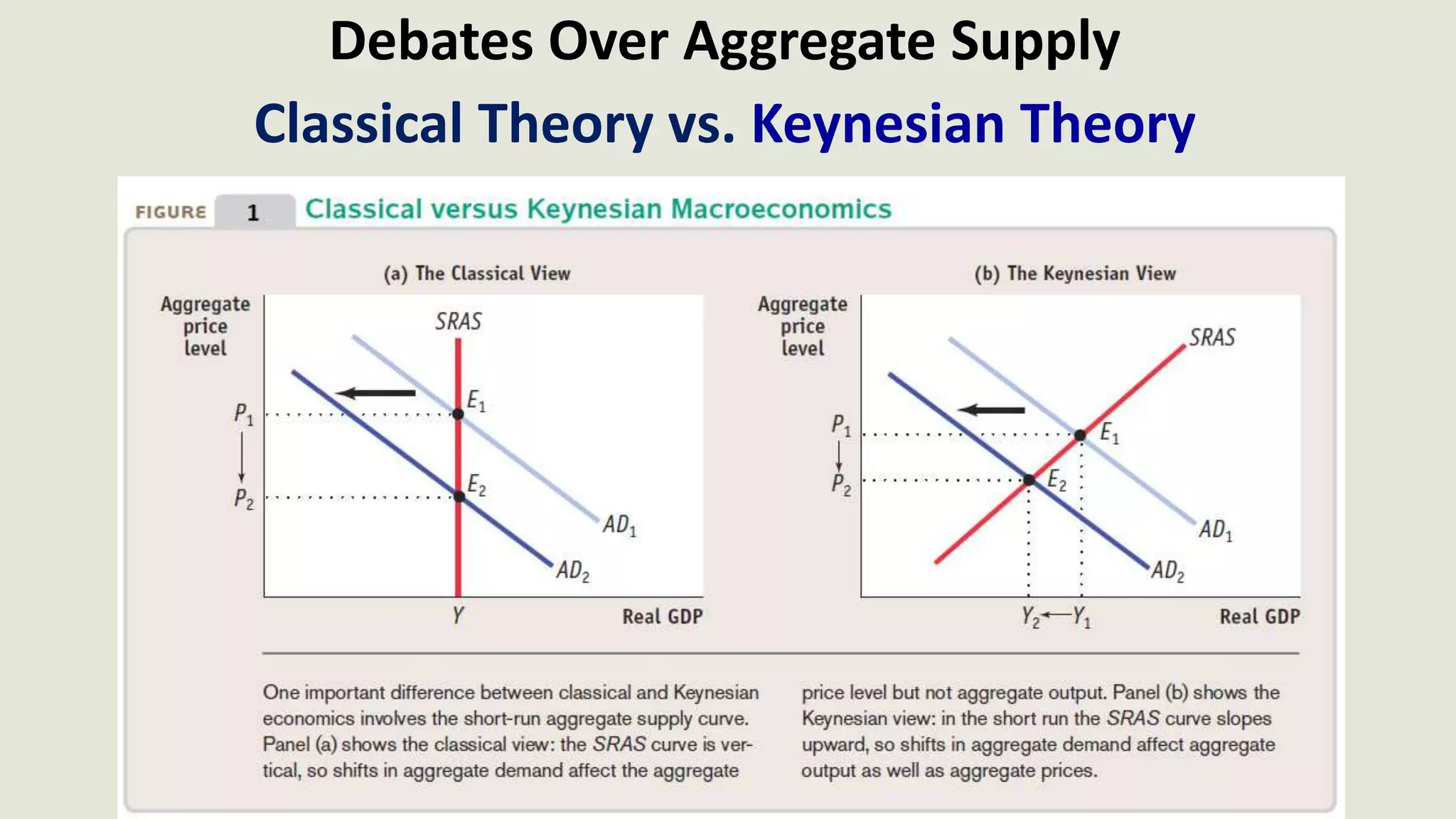
Debates Over Aggregate Supply
Classical Theory vs. Keynesian Theory
13
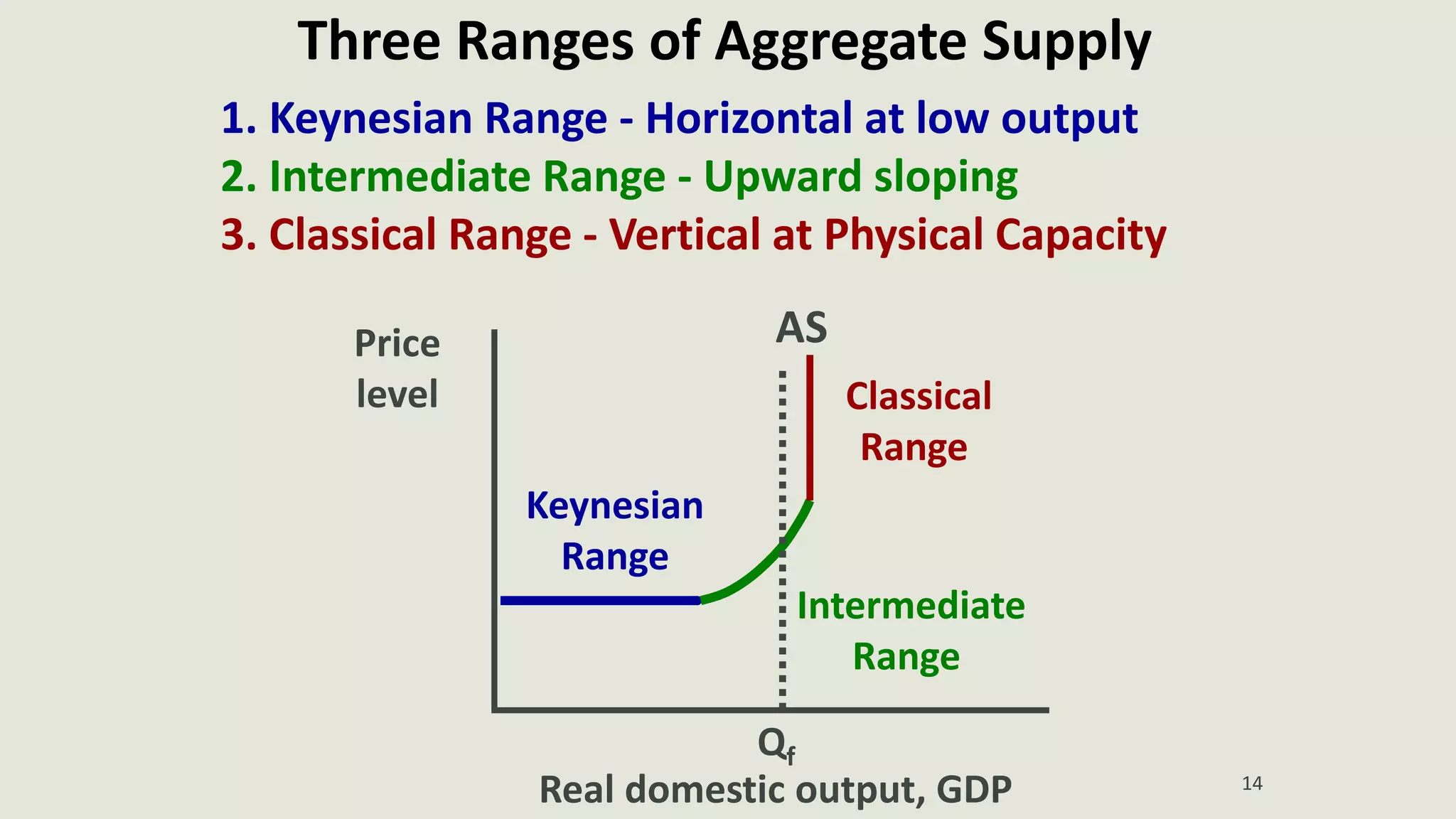
Three Ranges of Aggregate Supply
1. Keynesian Range - Horizontal at low output
2. Intermediate Range - Upward sloping
3. Classical Range - Vertical at Physical Capacity
Price
level
Real domestic output, GDP
AS
Qf
14
Keynesian
Range
Intermediate
Range
Classical
Range
Consumption Function
C0
Yd
C
c = mpc = C/Yd = marginal propensity to consume
C
Yd
C = C0 + mpc x Yd
M = 1/(1-mpc)
C = Consumer spending
A = Autonomous consumption
YD = Real disposable income
M - multiplier
Shows the relationship
between
real disposable
income and consumer
spending, the latter
variable being what
Keynes considered the
most important
determinant of short-
term demand in an
economy.
d
Planned
expenditure
exceeds
real GDP
Real GDP (trillions of 1992 dollars per year)
Aggregateplannedexpenditure
(trillionsof1992dollars/year)
4.0
6.0
8.0
10.0
0 2 4 6 8 10
a
b c
e
f
Real GDP exceeds
planned expenditure
45
o
line
Equilibrium
expenditure
I
G
C0
Total Expenditure
C+I+G
Income-Expenditure
model
Explains fluctuations in
production of goods
and services and
spending. The model
basically states that
we produce as many
goods as will sell on
the market and
fluctuations in
production and
expenditure are tied to
keep an economy
stable.
The General Theory
Microeconomics and macroeconomics do not operate
on the same basis. One cannot assume that what is
true for the economic agent at the level of the
individual consumer or firm is true in aggregate. This
amounts to the fallacy of composition.
 In microeconomics, relative price effects dominate.
This is not true in macroeconomics. In
macroeconomics, income effects dominate, making
income more important in determining aggregate
economic behavior.
The General Theory
Therefore, consumption depends primarily
upon income, not interest rates.
 C  C(r), but rather C = C(Y)
 “People don’t change their standard of living simply
because the interest rate changes a few points.”
The General Theory
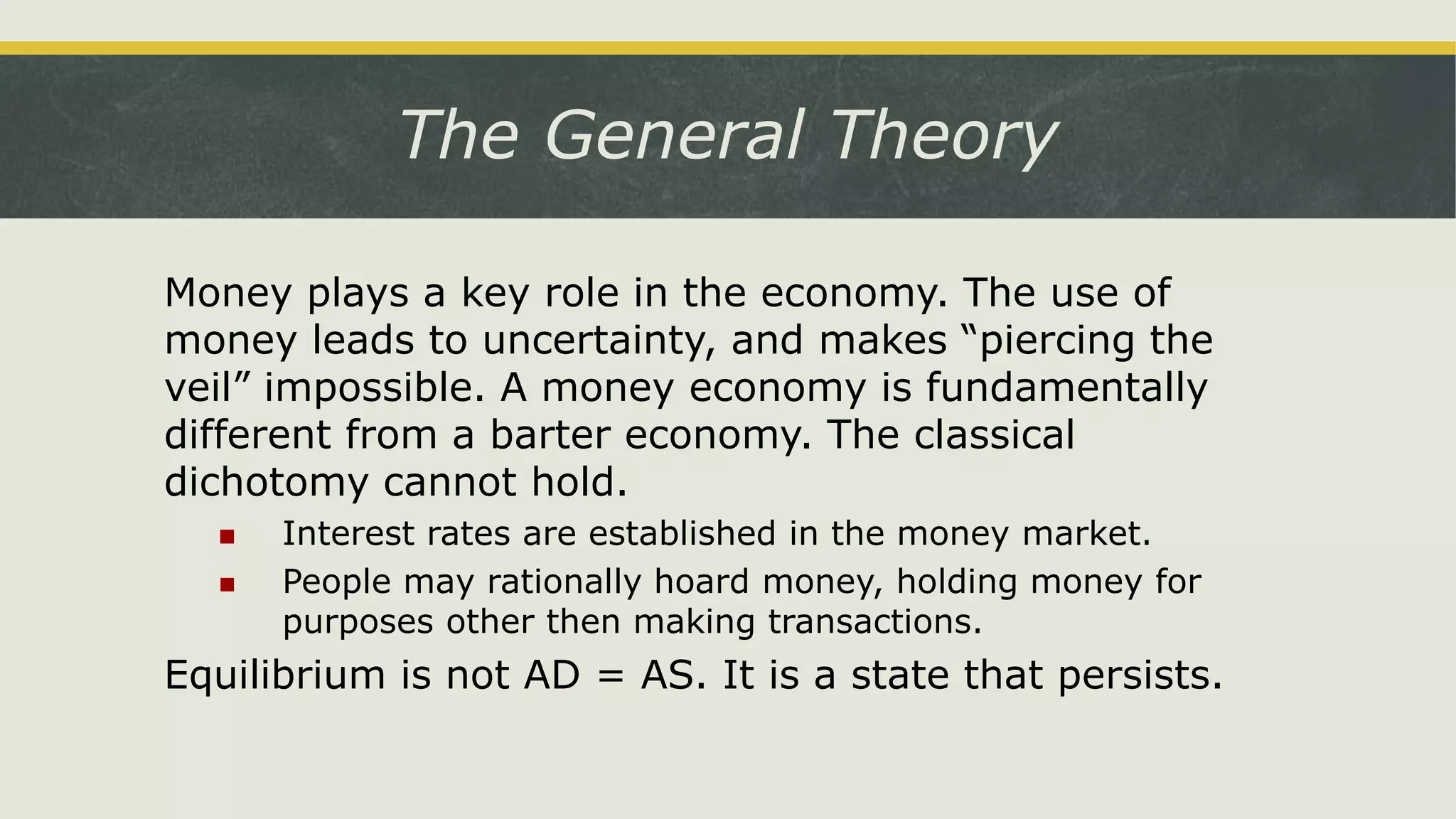
Money plays a key role in the economy. The use of
money leads to uncertainty, and makes “piercing the
veil” impossible. A money economy is fundamentally
different from a barter economy. The classical
dichotomy cannot hold.
 Interest rates are established in the money market.
 People may rationally hoard money, holding money for
purposes other then making transactions.
Equilibrium is not AD = AS. It is a state that persists.
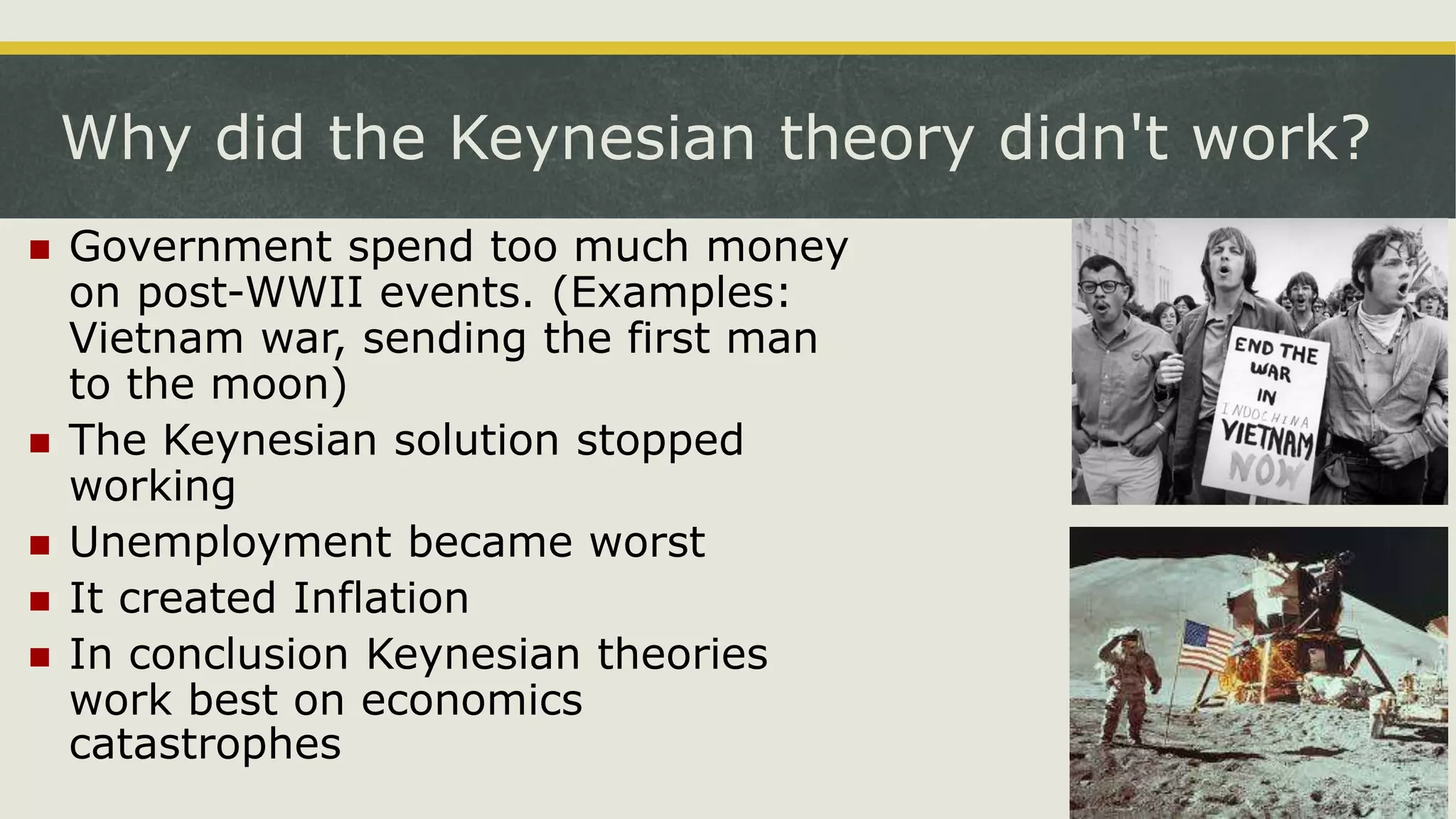
Why did the Keynesian theory didn't work?
 Government spend too much money
on post-WWII events. (Examples:
Vietnam war, sending the first man
to the moon)
 The Keynesian solution stopped
working
 Unemployment became worst
 It created Inflation
 In conclusion Keynesian theories
work best on economics
catastrophes
Thank you for
attention

John Maynard Keynes. Keynesian economics

  • 1.
    John Maynard Keynes Keynesianeconomics Abdul Ruhulla Financial University under the Government of the Russian Federation (1883-1946)
  • 2.
    The Early J.M. Keynes  Born in 1883 in Cambridge, England  Son of John Neville Keynes  Neville was a professor of Economics and Logic at Cambridge Univ., and wrote on Economic Methodology  Won a scholarship to Eton  Boy Genius  Won prizes for his work in the classics, mathematics, history, English essays  Wrote papers on contemporary social problems, participated in crew and debate, acted, read everything  Became an expert in medieval latin poetry  Part of Eton’s social elite  Won a scholarship to King’s College, Cambridge
  • 3.
    Keynes as aCollege Student  President of the Student Union  President of the University Liberal Club  Rowed, studied philosophy, played bridge, visited art galleries, collected rare books, went to the theatre  Became a member of the “Apostles”, a secret and highly exclusive Cambridge intellectual society  Became a member of the literary set called “the Bloomsbury Group.”
  • 4.
    Keynes After College Studied economics for perhaps 1 year, but did poorly on his exams.  Took a civil service exam and took a job at the India Office for 2 years.  1908, his father managed to get him a job as a lecturer at King’s College. Later he became a Fellow.  1911, he became editor of the Economic Journal.  Worked at the Treasury during WWI.  1921, he published A Treatise on Probability. This was his dissertation. It won him a fellowship at King’s College, Cambridge.  Marries Lydia Lopokova.
  • 5.
    Keynes, Inter-war Years Keynes wrote the Economic Consequences of the Peace (1919), regarding reparation payments  Best Seller  Made him a public celebrity  1923, Tract on Monetary Reform (against returning to the pre-war gold standard)  Economic Consequences of Mr. Churchill (1925, warned of depression)  1930, Treatise On Money  Makes millions in the stock market, commodity, and forex markets.  1936, General Theory of Employment, Interest and Money  1937, he has a serious heart attack
  • 6.
  • 7.
    Keynesian Economics  Basedon the idea of the need for state regulation of the economy. No more self-adjustments  For the prosperity of the economy:  All have to spend as much money as possible;  The state should stimulate aggregate demand growth even by the budget deficit, debt and unsecured issue of money.
  • 8.
  • 9.
    Business cycle DuringGreat Depression He outlined the limitations of Microeconomics theory. Due to unemployment and poverty, the demand for good and services dropped. Many workers were unwilling to accept lower wages.
  • 10.
    Keynesian Economics Impact Aid in the formation of the 20th Century’s economy  Consequences of the Great Depression were lessened  Government took an active role in the country's economy (Departure from neoclassical theories)
  • 12.
    Intro to MacroeconomicTheory  High unemployment rate greatly influenced the development of macroeconomics  Challenged the established neoclassical economics  Introduced important concepts such as:  Consumption  Multiplier  Marginal efficiency of capital  Liquidity preference  Government's responsibility is to  Reach and maintain full employment  Regulate markets and free trade END OF NEOCLASSICAL THEORIES! such as Laissez-faire
  • 13.
    Debates Over AggregateSupply Classical Theory vs. Keynesian Theory 13
  • 14.
    Three Ranges ofAggregate Supply 1. Keynesian Range - Horizontal at low output 2. Intermediate Range - Upward sloping 3. Classical Range - Vertical at Physical Capacity Price level Real domestic output, GDP AS Qf 14 Keynesian Range Intermediate Range Classical Range
  • 15.
    Consumption Function C0 Yd C c =mpc = C/Yd = marginal propensity to consume C Yd C = C0 + mpc x Yd M = 1/(1-mpc) C = Consumer spending A = Autonomous consumption YD = Real disposable income M - multiplier Shows the relationship between real disposable income and consumer spending, the latter variable being what Keynes considered the most important determinant of short- term demand in an economy.
  • 16.
    d Planned expenditure exceeds real GDP Real GDP(trillions of 1992 dollars per year) Aggregateplannedexpenditure (trillionsof1992dollars/year) 4.0 6.0 8.0 10.0 0 2 4 6 8 10 a b c e f Real GDP exceeds planned expenditure 45 o line Equilibrium expenditure I G C0 Total Expenditure C+I+G Income-Expenditure model Explains fluctuations in production of goods and services and spending. The model basically states that we produce as many goods as will sell on the market and fluctuations in production and expenditure are tied to keep an economy stable.
  • 17.
    The General Theory Microeconomicsand macroeconomics do not operate on the same basis. One cannot assume that what is true for the economic agent at the level of the individual consumer or firm is true in aggregate. This amounts to the fallacy of composition.  In microeconomics, relative price effects dominate. This is not true in macroeconomics. In macroeconomics, income effects dominate, making income more important in determining aggregate economic behavior.
  • 18.
    The General Theory Therefore,consumption depends primarily upon income, not interest rates.  C  C(r), but rather C = C(Y)  “People don’t change their standard of living simply because the interest rate changes a few points.”
  • 19.
    The General Theory Moneyplays a key role in the economy. The use of money leads to uncertainty, and makes “piercing the veil” impossible. A money economy is fundamentally different from a barter economy. The classical dichotomy cannot hold.  Interest rates are established in the money market.  People may rationally hoard money, holding money for purposes other then making transactions. Equilibrium is not AD = AS. It is a state that persists.
  • 20.
    Why did theKeynesian theory didn't work?  Government spend too much money on post-WWII events. (Examples: Vietnam war, sending the first man to the moon)  The Keynesian solution stopped working  Unemployment became worst  It created Inflation  In conclusion Keynesian theories work best on economics catastrophes
  • 21.