RISK FACTORS
UNDERLYING DISASTER
ACTIVITY 1!
Direction: Read the scenario below. Based
on your understanding of disaster from the
previous module, enumerate or list down
the risks that are reflected from the text.
ACTIVITY 1!
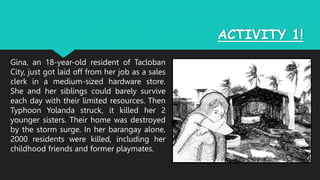
Gina, an 18-year-old resident of Tacloban
City, just got laid off from her job as a sales
clerk in a medium-sized hardware store.
She and her siblings could barely survive
each day with their limited resources. Then
Typhoon Yolanda struck, it killed her 2
younger sisters. Their home was destroyed
by the storm surge. In her barangay alone,
2000 residents were killed, including her
childhood friends and former playmates.
ACTIVITY 2!
Direction: Read the news article about an
earthquake. After you have read the article,
answer the guide questions.
ACTIVITY 2!
Guide Questions:
1. What risk/s can you identify from the
news article?
2. What do you think are the factors that
affect the disaster risks from the
preceding article?
PHYSICAL FACTORS
•would pertain to tangible objects or
infrastructure, like the availability
of fire exits, or the sturdiness of
the building, or the presence or
absence of objects that can harm
you or help you, etc.
PSYCHOLOGICAL FACTORS
•include state of mental capacity and
health (e.g. are we dealing with
babies? Kids? Adults? People with
special needs?), perception of self
(e.g. self-assessment of capability to
respond to disasters, fear), etc.
SOCIO-CULTURAL FACTORS
•include religion, social status,
traditions, perception by society, etc
ECONOMIC FACTORS
•include assets and liabilities,
income, economic class, etc.
POLITICAL FACTORS
•include government structure,
diplomatic issues, etc.
BIOLOGICAL FACTORS
•include flora and fauna in
environment, health, diseases, etc.
SEVERITY OF EXPOSURE
•The amount of exposure to the disaster
is highly related to risk of future mental
problems. At highest risk are those that
go through the disaster themselves. Next
are those in close contact with victims.
At lower risk of lasting impact are those
who only had indirect exposure, such as
news of the severe damage.
GENDER AND FAMILY
• Disaster recovery is more stressful when
children are present in the home. Women with
spouses also experience more distress during
recovery. Having a family member in the home
who is extremely distressed is related to more
stress for everyone. Marital stress has been
found to increase after disasters. Also,
conflicts between family members or lack of
support in the home make it harder to recover
from disasters.
AGE
• Adults who are in the range of 40 – 60 are
likely to be more distressed after disasters.
The thinking is that if one is in that age range,
he / she has more demands from job and
family. Research on how children react to
natural disasters is still limited at this point in
time. In general, children show more severe
distress after disasters than adults do. Higher
stress in the parents is related to worse
recovery in children.
OTHER FACTORS SPECIFIC TO THE SURVIVOR
oNot functioning well before the disaster.
oHave had no experience dealing with disasters.
oMust deal with other stressor disaster.
oHave poor self – esteem.
oThink they are uncared by others.
oThink they have little control happens to them.
oLack the capacity to manage stress
OTHER FACTORS
oBereavement (death of someone close).
oInjury to self or another family member.
oLife threat.
o Panic, horror, or feelings like that during the
disaster.
oBeing separated from family (especially among
youth).
oGreat loss of property.
oDisplacement (being force to leave home)
DEVELOPING COUNTRIES
•There is a strong body of evidence that these
risk factors can be made worse if the disaster
occurs in a developing country. Disasters in
developing countries, like Philippines, have
more severe mental health impact than
disasters in developed countries. This is true
even with less serious disasters.
LOW OR NEGATIVE SOCIAL SUPPORT
•the support of others can be both a
risk and a resilience factor. Social
support can weaken after disasters.
This may be due to stress and the
need for members of the support
network to get on with their own
lives.
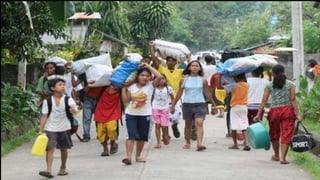
DISPLACED POPULATIONS
• One of the most immediate effects of natural
disasters is population displacement. When
countries are ravaged by earthquakes or other
powerful forces of nature like floods and super
typhoons, many people must abandon their
homes and seek shelter in other regions. A
large influx of refugees can disrupt
accessibility of health care and education, as
well as food supplies and clean water.
HEALTH RISKS
• Aside from the obvious immediate danger
that natural disasters present, the
secondary effects can be just as damaging.
• Severe flooding can result in stagnant water
that allows breeding of waterborne bacteria
and malaria-carrying mosquitoes. Dengue
fever is another serious health problem
cause by mosquitoes (aegis egypti).
FOOD SCARCITY
After natural disasters, food often becomes scarce.
Thousands of people around the world go hungry
because of destroyed crops and loss of agricultural
supplies, whether it happens suddenly in a storm or
gradually in a drought.
FOOD SCARCITY
As a result, food prices rise, reducing
families’ purchasing power and increasing the risk of
severe malnutrition. The impacts of hunger following
an earthquake, typhoon or hurricane can be
tremendous, cause lifelong damage to children’s
development.
EMOTIONAL AFTERSHOCKS
• Natural disasters can be particularly
traumatic for young children. Confronted
with scenes of destruction and the deaths of
friends and loved ones, many children
develop Post-Traumatic Stress Disorder
(PTSD), a serious psychological condition
resulting from extreme trauma. Left
untreated, children suffering from PTSD can
be prone to lasting psychological damage
and emotional distress.
PHYSICAL PERSPECTIVES
- describes observable objects in a building/infrastructure
which include durability of building, fire exits availability,
and absence or presence of an important objects that
would help or harm you in any ways. Example: houses and
environmental sources of living. Physical effects are the
most visible and quantifiable effects of a disaster. In
considered in data recording. Assessment of disaster is
focused on the following questions:
PHYSICAL PERSPECTIVES
How many families are affected? (displacement, injury, death)
How many houses are damaged or washed out? (in case of super
typhoon)
How many buildings collapsed or are damaged? (in case of an
earthquake)
How many roads, bridges, dams and other infrastructures are
damaged? (in case of floods, lahar flows and earthquakes)
What is the extent of damage in agricultural industry?
PSYCHOLOGICAL PERSPECTIVES
- pertains to the mental capacity and health of an
individual to deal with disasters. Age, perception, and
self-capacity are some of the point of considerations.
In other word, a disaster is something that could
happen within a hazard rather than the hazard itself.
Hence, one very important component of the recovery
phase, aside from relief services is debriefing of
psychological support system.
OTHER PSYCHOLOGICAL EFFECTS
OF A DISASTER ARE THE
FOLLOWING:
a.Emotional effects: Shock, terror, irritability, blame, anger, guilt, grief or
sadness, numbing, helplessness, loss of pleasure derived from
familiar activities, difficulty feeling happy, difficulty feeling loved.
b.Cognitive effects: impaired concentration, impaired decision-making
ability, memory
impairment, disbelief, confusion, nightmares, decreased self-esteem,
decreased self- efficacy, self-blame, intrusive thoughts, memories,
dissociation, (e.g.,tunnel vision, dreamlike or ‘spacey’ felling).
OTHER PSYCHOLOGICAL EFFECTS
OF A DISASTER ARE THE
FOLLOWING:
c.Physical effects: fatigue, exhaustion, insomnia, cardiovascular strain,
startle response, hyper arousal, increased physical pain, reduced
immune response, headaches, gastrointestinal upset, decreased
appetite, decreased libido, vulnerability to illness.
d.Interpersonal effects: Increased relational conflict, social withdrawal,
reduced relational intimacy, alienation, impaired work performance,
decreased satisfaction, distract, externalization of blame,
externalization of vulnerability, feeling abandoned.
SOCIO-CULTURAL
PERSPECTIVES
- What the people living at risk know and do about natural hazards
and disaster risks is mediated by a range of factors including
social conditions (such as age, gender, wealth, ethnicity) and
cultural settings (language, beliefs, traditions, customs). In most
places people are also more or less exposed by information and
ideas coming from the “outside”—the world outside their own
cultural setting. At the same time, the field of natural hazards and
disasters has developed its own debates, framework, and notions
such as vulnerability, resilience, and ‘risk’. But communities may
have different priorities and notions of natural hazards and
disaster risk. People’s socio-cultural background may affect their
response to disasters at the different stages of disaster
management.
ECONOMIC PERSPECTIVES
• it involves income, assets and liabilities, and economic
class of an individual or a community in the society.
From an economic perspective, a natural disaster can
be defined as a natural event that causes a
perturbation to the functioning of the economic
system, with a significant negative impact on assets,
production factors, output, employment, and
consumption. One salient component of assessing the
impact of disaster impact from this view is defining
direct economic cost and indirect losses.
POLITICAL PERSPECTIVES
• it involves structure of the government, issues in
diplomacy, etc. in dealing with disasters. From this
view, natural disasters are commonly thought to be
less politically contentious than armed conflicts.
Yet, a closer look reveals that politics are deeply
wedded to both the impact of a natural disaster and
the subsequent delivery of humanitarian assistance.
Political considerations before, during, and after a
natural disaster can determine who is most at risk,
who can intervene, what actions will be taken, and
who will benefit from those actions.
BIOLOGICAL PERSPECTIVES
– it involves the role of flora (plants) and fauna
(animals) in the environment, diseases, health, etc.
Disasters are not random an do not occur by accident.
They are the convergence of hazards and vulnerable
conditions. Disasters not only reveal underlying social,
economic, political, and environment problems, but
unfortunately contribute to worsening them. Such
events pose serious challenges to development, as they
erode hard-earned gains in terms of political, social and
educational progress, as well as infrastructure and
technological development.
DRRR-W2-RISK-FACTORS-UNDERLYING-DISASTER.pptx

DRRR-W2-RISK-FACTORS-UNDERLYING-DISASTER.pptx

  • 1.
  • 2.
    ACTIVITY 1! Direction: Readthe scenario below. Based on your understanding of disaster from the previous module, enumerate or list down the risks that are reflected from the text.
  • 3.
    ACTIVITY 1! Gina, an18-year-old resident of Tacloban City, just got laid off from her job as a sales clerk in a medium-sized hardware store. She and her siblings could barely survive each day with their limited resources. Then Typhoon Yolanda struck, it killed her 2 younger sisters. Their home was destroyed by the storm surge. In her barangay alone, 2000 residents were killed, including her childhood friends and former playmates.
  • 4.
    ACTIVITY 2! Direction: Readthe news article about an earthquake. After you have read the article, answer the guide questions.
  • 5.
    ACTIVITY 2! Guide Questions: 1.What risk/s can you identify from the news article? 2. What do you think are the factors that affect the disaster risks from the preceding article?
  • 6.
    PHYSICAL FACTORS •would pertainto tangible objects or infrastructure, like the availability of fire exits, or the sturdiness of the building, or the presence or absence of objects that can harm you or help you, etc.
  • 7.
    PSYCHOLOGICAL FACTORS •include stateof mental capacity and health (e.g. are we dealing with babies? Kids? Adults? People with special needs?), perception of self (e.g. self-assessment of capability to respond to disasters, fear), etc.
  • 8.
    SOCIO-CULTURAL FACTORS •include religion,social status, traditions, perception by society, etc
  • 9.
    ECONOMIC FACTORS •include assetsand liabilities, income, economic class, etc.
  • 10.
    POLITICAL FACTORS •include governmentstructure, diplomatic issues, etc.
  • 11.
    BIOLOGICAL FACTORS •include floraand fauna in environment, health, diseases, etc.
  • 13.
    SEVERITY OF EXPOSURE •Theamount of exposure to the disaster is highly related to risk of future mental problems. At highest risk are those that go through the disaster themselves. Next are those in close contact with victims. At lower risk of lasting impact are those who only had indirect exposure, such as news of the severe damage.
  • 14.
    GENDER AND FAMILY •Disaster recovery is more stressful when children are present in the home. Women with spouses also experience more distress during recovery. Having a family member in the home who is extremely distressed is related to more stress for everyone. Marital stress has been found to increase after disasters. Also, conflicts between family members or lack of support in the home make it harder to recover from disasters.
  • 15.
    AGE • Adults whoare in the range of 40 – 60 are likely to be more distressed after disasters. The thinking is that if one is in that age range, he / she has more demands from job and family. Research on how children react to natural disasters is still limited at this point in time. In general, children show more severe distress after disasters than adults do. Higher stress in the parents is related to worse recovery in children.
  • 17.
    OTHER FACTORS SPECIFICTO THE SURVIVOR oNot functioning well before the disaster. oHave had no experience dealing with disasters. oMust deal with other stressor disaster. oHave poor self – esteem. oThink they are uncared by others. oThink they have little control happens to them. oLack the capacity to manage stress
  • 18.
    OTHER FACTORS oBereavement (deathof someone close). oInjury to self or another family member. oLife threat. o Panic, horror, or feelings like that during the disaster. oBeing separated from family (especially among youth). oGreat loss of property. oDisplacement (being force to leave home)
  • 19.
    DEVELOPING COUNTRIES •There isa strong body of evidence that these risk factors can be made worse if the disaster occurs in a developing country. Disasters in developing countries, like Philippines, have more severe mental health impact than disasters in developed countries. This is true even with less serious disasters.
  • 20.
    LOW OR NEGATIVESOCIAL SUPPORT •the support of others can be both a risk and a resilience factor. Social support can weaken after disasters. This may be due to stress and the need for members of the support network to get on with their own lives.
  • 22.
    DISPLACED POPULATIONS • Oneof the most immediate effects of natural disasters is population displacement. When countries are ravaged by earthquakes or other powerful forces of nature like floods and super typhoons, many people must abandon their homes and seek shelter in other regions. A large influx of refugees can disrupt accessibility of health care and education, as well as food supplies and clean water.
  • 24.
    HEALTH RISKS • Asidefrom the obvious immediate danger that natural disasters present, the secondary effects can be just as damaging. • Severe flooding can result in stagnant water that allows breeding of waterborne bacteria and malaria-carrying mosquitoes. Dengue fever is another serious health problem cause by mosquitoes (aegis egypti).
  • 25.
    FOOD SCARCITY After naturaldisasters, food often becomes scarce. Thousands of people around the world go hungry because of destroyed crops and loss of agricultural supplies, whether it happens suddenly in a storm or gradually in a drought.
  • 26.
    FOOD SCARCITY As aresult, food prices rise, reducing families’ purchasing power and increasing the risk of severe malnutrition. The impacts of hunger following an earthquake, typhoon or hurricane can be tremendous, cause lifelong damage to children’s development.
  • 28.
    EMOTIONAL AFTERSHOCKS • Naturaldisasters can be particularly traumatic for young children. Confronted with scenes of destruction and the deaths of friends and loved ones, many children develop Post-Traumatic Stress Disorder (PTSD), a serious psychological condition resulting from extreme trauma. Left untreated, children suffering from PTSD can be prone to lasting psychological damage and emotional distress.
  • 30.
    PHYSICAL PERSPECTIVES - describesobservable objects in a building/infrastructure which include durability of building, fire exits availability, and absence or presence of an important objects that would help or harm you in any ways. Example: houses and environmental sources of living. Physical effects are the most visible and quantifiable effects of a disaster. In considered in data recording. Assessment of disaster is focused on the following questions:
  • 31.
    PHYSICAL PERSPECTIVES How manyfamilies are affected? (displacement, injury, death) How many houses are damaged or washed out? (in case of super typhoon) How many buildings collapsed or are damaged? (in case of an earthquake) How many roads, bridges, dams and other infrastructures are damaged? (in case of floods, lahar flows and earthquakes) What is the extent of damage in agricultural industry?
  • 32.
    PSYCHOLOGICAL PERSPECTIVES - pertainsto the mental capacity and health of an individual to deal with disasters. Age, perception, and self-capacity are some of the point of considerations. In other word, a disaster is something that could happen within a hazard rather than the hazard itself. Hence, one very important component of the recovery phase, aside from relief services is debriefing of psychological support system.
  • 34.
    OTHER PSYCHOLOGICAL EFFECTS OFA DISASTER ARE THE FOLLOWING: a.Emotional effects: Shock, terror, irritability, blame, anger, guilt, grief or sadness, numbing, helplessness, loss of pleasure derived from familiar activities, difficulty feeling happy, difficulty feeling loved. b.Cognitive effects: impaired concentration, impaired decision-making ability, memory impairment, disbelief, confusion, nightmares, decreased self-esteem, decreased self- efficacy, self-blame, intrusive thoughts, memories, dissociation, (e.g.,tunnel vision, dreamlike or ‘spacey’ felling).
  • 35.
    OTHER PSYCHOLOGICAL EFFECTS OFA DISASTER ARE THE FOLLOWING: c.Physical effects: fatigue, exhaustion, insomnia, cardiovascular strain, startle response, hyper arousal, increased physical pain, reduced immune response, headaches, gastrointestinal upset, decreased appetite, decreased libido, vulnerability to illness. d.Interpersonal effects: Increased relational conflict, social withdrawal, reduced relational intimacy, alienation, impaired work performance, decreased satisfaction, distract, externalization of blame, externalization of vulnerability, feeling abandoned.
  • 36.
    SOCIO-CULTURAL PERSPECTIVES - What thepeople living at risk know and do about natural hazards and disaster risks is mediated by a range of factors including social conditions (such as age, gender, wealth, ethnicity) and cultural settings (language, beliefs, traditions, customs). In most places people are also more or less exposed by information and ideas coming from the “outside”—the world outside their own cultural setting. At the same time, the field of natural hazards and disasters has developed its own debates, framework, and notions such as vulnerability, resilience, and ‘risk’. But communities may have different priorities and notions of natural hazards and disaster risk. People’s socio-cultural background may affect their response to disasters at the different stages of disaster management.
  • 37.
    ECONOMIC PERSPECTIVES • itinvolves income, assets and liabilities, and economic class of an individual or a community in the society. From an economic perspective, a natural disaster can be defined as a natural event that causes a perturbation to the functioning of the economic system, with a significant negative impact on assets, production factors, output, employment, and consumption. One salient component of assessing the impact of disaster impact from this view is defining direct economic cost and indirect losses.
  • 38.
    POLITICAL PERSPECTIVES • itinvolves structure of the government, issues in diplomacy, etc. in dealing with disasters. From this view, natural disasters are commonly thought to be less politically contentious than armed conflicts. Yet, a closer look reveals that politics are deeply wedded to both the impact of a natural disaster and the subsequent delivery of humanitarian assistance. Political considerations before, during, and after a natural disaster can determine who is most at risk, who can intervene, what actions will be taken, and who will benefit from those actions.
  • 39.
    BIOLOGICAL PERSPECTIVES – itinvolves the role of flora (plants) and fauna (animals) in the environment, diseases, health, etc. Disasters are not random an do not occur by accident. They are the convergence of hazards and vulnerable conditions. Disasters not only reveal underlying social, economic, political, and environment problems, but unfortunately contribute to worsening them. Such events pose serious challenges to development, as they erode hard-earned gains in terms of political, social and educational progress, as well as infrastructure and technological development.