SPECIFIC LEARNING OUTCOMES:
Define disaster and disaster risk.
Explain the risk factors underlying disasters.
State the effects of disaster on human life.
Stress how and when an event becomes a disaster.
Identify the different areas/locations exposed to hazards that
may lead to disaster.
Present disaster along physical, psychological, socio-cultural,
economic, political, and biological perspectives.
3.
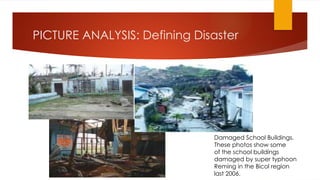
PICTURE ANALYSIS: DefiningDisaster
Damaged School Buildings.
These photos show some
of the school buildings
damaged by super typhoon
Reming in the Bicol region
last 2006.
4.
WHAT IS DISASTER?
A sudden calamitous event, bringing great damage, loss,
destruction and devastation to life and property (ADPC,
2012).
A serious disruption of the functioning of society , causing
widespread human, materials or environmental losses, which
exceed the ability of the affected people to cope, using
their human resources (Adelman, 2011).
5.
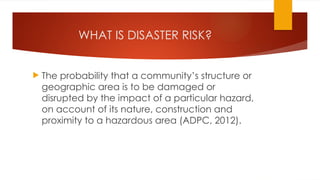
WHAT IS DISASTERRISK?
The probability that a community’s structure or
geographic area is to be damaged or
disrupted by the impact of a particular hazard,
on account of its nature, construction and
proximity to a hazardous area (ADPC, 2012).
6.
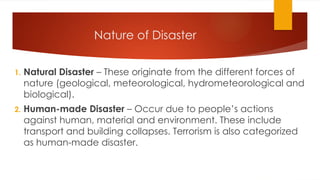
Nature of Disaster
1.Natural Disaster – These originate from the different forces of
nature (geological, meteorological, hydrometeorological and
biological).
2. Human-made Disaster – Occur due to people’s actions
against human, material and environment. These include
transport and building collapses. Terrorism is also categorized
as human-made disaster.
7.
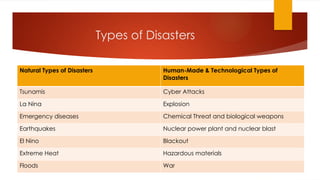
Types of Disasters
NaturalTypes of Disasters Human-Made & Technological Types of
Disasters
Tsunamis Cyber Attacks
La Nina Explosion
Emergency diseases Chemical Threat and biological weapons
Earthquakes Nuclear power plant and nuclear blast
El Nino Blackout
Extreme Heat Hazardous materials
Floods War
8.
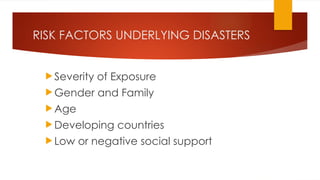
RISK FACTORS UNDERLYINGDISASTERS
Severity of Exposure
Gender and Family
Age
Developing countries
Low or negative social support
9.
EFFECTS OF NATURALDISASTER ON
HUMAN LIFE
Displaced Population
Health Risks
Food Scarcity
Emotional Aftershocks
10.
How and whenan event becomes a
Disaster?
An event, either human-made or natural,
becomes a disaster when it is SUDDEN or
PROGRESSIVE, causing widespread human,
material or environmental losses.
Disaster from differentperspectives
Economic perspective
Political perspective
Environmental perspective
13.
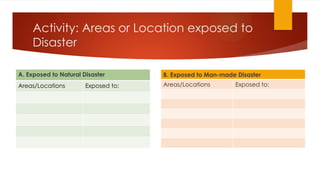
Activity: Areas orLocation exposed to
Disaster
A. Exposed to Natural Disaster
Areas/Locations Exposed to:
B. Exposed to Man-made Disaster
Areas/Locations Exposed to: