BANKER & CUSTOMER
RELATIONSHIP
DEFINITION OF BANKER
• According to sec 5 (b) of banking regulation
act banker is a body corporate that
• (a) accepts the deposits from public
• (b) lends
• (c) invests the money so collected by the way
of deposits
• (d) allows the withdrawals of deposits on
demand or by any other means
Definition of a customer
• It is generally believed that any individual or
an organisation which conducts the banking
transaction with the bank , is the customer of
bank
• The bank customers can be categorized in four
broad categories
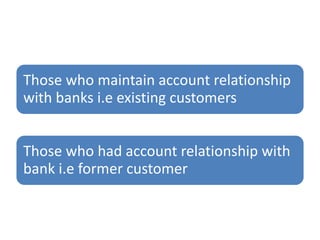
Those who maintain account relationship
with banks i.e existing customers
Those who had account relationship with
bank i.e former customer
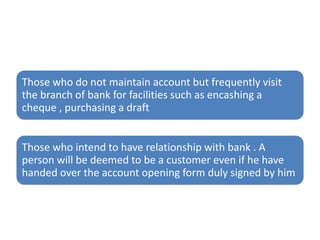
Those who do not maintain account but frequently visit
the branch of bank for facilities such as encashing a
cheque , purchasing a draft
Those who intend to have relationship with bank . A
person will be deemed to be a customer even if he have
handed over the account opening form duly signed by him
• With the implementation of core banking
solution the customer is the customer of bank
& not of a particular branch he can operate
his account from any branch of the bank
anywhere
GENERAL RELATIONSHIP BETWEEN
BANKER & CUSTOMER
• Debtor & creditor relationship : when a
customer opens a account with bank , he fills &
signs the account opening form . By signing the
form he enters into an agreement with the bank
• When the customer deposits money in his
account the bank becomes the debtor of the
customer & customer becomes the creditor of
bank
• The money deposited by the customer becomes
the bank’s property & bank has the right to use
the money as it likes
• The bank is not bound the to inform the
customer about the utilization of funds
• Bank does not give any security to the
depositor
• The bank has borrowed money & it is only
when the depositor demands banker pays &
demand has to be made at the branch where
the account exists in a proper manner &
during working days & working hours
• Creditor – debtor relationship- in case a
customer takes any loan from bank then the
banker becomes the creditor of the customer
.& customer becomes the debtor of the bank
• Bailee & bailor relationship : sec 148 of
Indian Contract Act , defines A ‘ bailement’ is
the delivery of goods by one person to
another person for some purpose , upon a
contract that they shall when the purpose is
accomplished , be returned or otherwise
dispose off according to the directions of the
person delivering them
• The person delivering the goods is “ bailor” &
to whom they are delivered is “ bailee”
• Banks secure their advances by obtaining
tangible securities . In some cases physical
possession of securities goods , bonds are
taken
• While taking physical possession of the
securities bank becomes bailee & customer
becomes bailor
• Agent & principal relationship : sec 182 of
Indian Contract Act defines “ agent “ as a person
employed to do any act for another or to
represent another in dealings with third person .
The person for whom such act is done is called as
“ principal”
• Bank collects cheques , bills ,& make payment to
the varoius authorities viz rent , telephone bills ,
insurance premium on behalf of customers , in all
such cases bank act as agent for customer
Special Relationship between banker &
Customer
• Right of General lien : A lien is the right to
retain possession of specific goods or
securities or other movables of which the
ownership vests in some other person &
possession can be retained till the owner
discharges the debt or obligation to
possessor
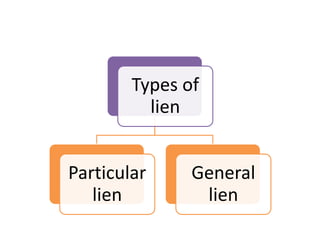
Types of
lien
Particular
lien
General
lien
• Particular lien
• It gives the right to
retain the possession
only of those goods of
which dues have arisen
• If a bank has obtained
a particular security for
a particular debt , then
banker’s right get
converted into
particular lien
• General lien
• It gives the right to
bank to retain the
possession of any
goods in legal
possession of creditor
until the whole of debt
due from debtor is paid
• Right of appropriation : it is the right of the
customers to direct his banker against which debt
( when more than one debt is outstanding ) the
payment made by him should be appropriated
• In case no such direction is given , the bank can
exercise its right of appropriation & apply it in
payment of any debt
• Section 59,60,61 of Indian Contract Act , 1872
lays down rules of appropriation
• Section 59 Application of payment where debt
discharged is indicated ( as per borrower
instruction )
• Section 60 Application of payment where debt
to be discharged is not indicated ( in absence
of express or implied intention of debtor )
Obligation of the banker :
• Obligation to honour cheques : bank is bound
to honour cheques provided following
conditions are fulfilled
• Sufficient funds
• Funds must be properly applicable
• Banker must be duly required to pay
• Obligation to maintain the secrecy of
accounts :
• Obligation to keep record of transactions
What is a garnishee order
• this is an order of court issued under order
21 rule 46 of the code of civil procedure 1908,
in case of debtor failure to pay debt
• Such order attaches the funds in the hand of
the third party who owes the judgement
debtor money warning the third party or the
banker , not to release the money attached
until directed by court to do so .
• The party for whom the order is given is called
judgement debtor & creditor against whom
the order is issued is called as judgement
creditor
• The third party on whom the order is served is
called garnishee
• Example if A OWES B rs 500& B being unable
to recover to amount sues A & obtains the
decree against A
• B comes to know that C may be bank owes
600 rs to A . B then obtains a garnishee order
from court whereby C will be directed to apy
to B 500rs out of the money held by him
belonging to A
Two parts of
Garnishee
order
Order Nisi
Order
Absolute
• Order Nisi- by this order court asks banker to
stop the payment out of all accounts of
judgement debtors .
• Order Absolute : by this order court directs
the banker to pay the either the whole or part
of funds lying in account against order nisi has
been issued to judgement creditors
Effects of garnishee order
• A garnishee order may either attach the entire
account or attach a specified amount only
with the banker . The effects of garnishee
order on various accounts are as follows :
• Joint accounts – a joint account which is
opened in the name of two or more persons ,
can be attached only when all joint account
holder are joint judgement debtors
• Partnership account : the personal account of a
partner can be attached for the payment of firm’
s debt . But firm’s account cannot be attached for
the payment of personal loan of an individual
partner
• Proprietorship accounts : if the customer is the
sole proprietor of the firm , the firm’s account is
attached by a garnishee order issued in names of
sole propietor only judgement debtor
Termination of banker & customer
relationship
• Voluntary closure of account : it is of two types
• (a) mutual agreement - if customer is not
satisfied with the services or behaviour of the
bank they may terminate the relationship by
mutual agreement
• (b) By prior notice – bank can close customer
account by giving notice to him . The customer
should be given sufficient time so that he may
open account in any other bank
• Notice can be given subject to the follwowing
conditions :
• When customer makes fraud
• When there is no minimum amount in the
account
• When he is declared criminal
• When he writes cheque irrespective of
minimum balance in the account
• Death of customer – if the customer gives
cheque to some other person before death &
cheque is presented to the bank then bank
will not clear the cheque . After death his legal
hier get the right on his account & banker has
to follow his order
• Insanity of customer : banker is not under
obligation to honour cheque if customer has
becoem insane
• Insolvency of customer : if customer becomes
insolvent then the relationship is terminated,
if any balance is standing in customer account
then it is paid according to the order of court
• Dissolution of company : when company is
dissolved the relationship is terminated . After
dissolution the liquidator of company gets the
right to operate the account of company
• Assignment of account balance by customer :
when the customer assign his account to
someone , the balance standing in the customer
name is transferred in the name of the person in
whose favour the assignment in done , then bank
enters into a new relationship with a new
customer
• Closing the business by bank : if any bank closes
or amalgamates with any other bank then the
banker customer relationship is terminated

BANKER CUSTOMER RELATIONSHIP.pptx

  • 1.
  • 2.
    DEFINITION OF BANKER •According to sec 5 (b) of banking regulation act banker is a body corporate that • (a) accepts the deposits from public • (b) lends • (c) invests the money so collected by the way of deposits • (d) allows the withdrawals of deposits on demand or by any other means
  • 3.
    Definition of acustomer • It is generally believed that any individual or an organisation which conducts the banking transaction with the bank , is the customer of bank • The bank customers can be categorized in four broad categories
  • 4.
    Those who maintainaccount relationship with banks i.e existing customers Those who had account relationship with bank i.e former customer
  • 5.
    Those who donot maintain account but frequently visit the branch of bank for facilities such as encashing a cheque , purchasing a draft Those who intend to have relationship with bank . A person will be deemed to be a customer even if he have handed over the account opening form duly signed by him
  • 6.
    • With theimplementation of core banking solution the customer is the customer of bank & not of a particular branch he can operate his account from any branch of the bank anywhere
  • 7.
    GENERAL RELATIONSHIP BETWEEN BANKER& CUSTOMER • Debtor & creditor relationship : when a customer opens a account with bank , he fills & signs the account opening form . By signing the form he enters into an agreement with the bank • When the customer deposits money in his account the bank becomes the debtor of the customer & customer becomes the creditor of bank • The money deposited by the customer becomes the bank’s property & bank has the right to use the money as it likes
  • 8.
    • The bankis not bound the to inform the customer about the utilization of funds • Bank does not give any security to the depositor • The bank has borrowed money & it is only when the depositor demands banker pays & demand has to be made at the branch where the account exists in a proper manner & during working days & working hours
  • 9.
    • Creditor –debtor relationship- in case a customer takes any loan from bank then the banker becomes the creditor of the customer .& customer becomes the debtor of the bank
  • 10.
    • Bailee &bailor relationship : sec 148 of Indian Contract Act , defines A ‘ bailement’ is the delivery of goods by one person to another person for some purpose , upon a contract that they shall when the purpose is accomplished , be returned or otherwise dispose off according to the directions of the person delivering them
  • 11.
    • The persondelivering the goods is “ bailor” & to whom they are delivered is “ bailee” • Banks secure their advances by obtaining tangible securities . In some cases physical possession of securities goods , bonds are taken • While taking physical possession of the securities bank becomes bailee & customer becomes bailor
  • 12.
    • Agent &principal relationship : sec 182 of Indian Contract Act defines “ agent “ as a person employed to do any act for another or to represent another in dealings with third person . The person for whom such act is done is called as “ principal” • Bank collects cheques , bills ,& make payment to the varoius authorities viz rent , telephone bills , insurance premium on behalf of customers , in all such cases bank act as agent for customer
  • 13.
    Special Relationship betweenbanker & Customer • Right of General lien : A lien is the right to retain possession of specific goods or securities or other movables of which the ownership vests in some other person & possession can be retained till the owner discharges the debt or obligation to possessor
  • 14.
  • 15.
    • Particular lien •It gives the right to retain the possession only of those goods of which dues have arisen • If a bank has obtained a particular security for a particular debt , then banker’s right get converted into particular lien • General lien • It gives the right to bank to retain the possession of any goods in legal possession of creditor until the whole of debt due from debtor is paid
  • 16.
    • Right ofappropriation : it is the right of the customers to direct his banker against which debt ( when more than one debt is outstanding ) the payment made by him should be appropriated • In case no such direction is given , the bank can exercise its right of appropriation & apply it in payment of any debt • Section 59,60,61 of Indian Contract Act , 1872 lays down rules of appropriation
  • 17.
    • Section 59Application of payment where debt discharged is indicated ( as per borrower instruction ) • Section 60 Application of payment where debt to be discharged is not indicated ( in absence of express or implied intention of debtor )
  • 18.
    Obligation of thebanker : • Obligation to honour cheques : bank is bound to honour cheques provided following conditions are fulfilled • Sufficient funds • Funds must be properly applicable • Banker must be duly required to pay
  • 19.
    • Obligation tomaintain the secrecy of accounts : • Obligation to keep record of transactions
  • 20.
    What is agarnishee order • this is an order of court issued under order 21 rule 46 of the code of civil procedure 1908, in case of debtor failure to pay debt • Such order attaches the funds in the hand of the third party who owes the judgement debtor money warning the third party or the banker , not to release the money attached until directed by court to do so .
  • 21.
    • The partyfor whom the order is given is called judgement debtor & creditor against whom the order is issued is called as judgement creditor • The third party on whom the order is served is called garnishee
  • 22.
    • Example ifA OWES B rs 500& B being unable to recover to amount sues A & obtains the decree against A • B comes to know that C may be bank owes 600 rs to A . B then obtains a garnishee order from court whereby C will be directed to apy to B 500rs out of the money held by him belonging to A
  • 23.
  • 24.
    • Order Nisi-by this order court asks banker to stop the payment out of all accounts of judgement debtors . • Order Absolute : by this order court directs the banker to pay the either the whole or part of funds lying in account against order nisi has been issued to judgement creditors
  • 25.
    Effects of garnisheeorder • A garnishee order may either attach the entire account or attach a specified amount only with the banker . The effects of garnishee order on various accounts are as follows : • Joint accounts – a joint account which is opened in the name of two or more persons , can be attached only when all joint account holder are joint judgement debtors
  • 26.
    • Partnership account: the personal account of a partner can be attached for the payment of firm’ s debt . But firm’s account cannot be attached for the payment of personal loan of an individual partner • Proprietorship accounts : if the customer is the sole proprietor of the firm , the firm’s account is attached by a garnishee order issued in names of sole propietor only judgement debtor
  • 27.
    Termination of banker& customer relationship • Voluntary closure of account : it is of two types • (a) mutual agreement - if customer is not satisfied with the services or behaviour of the bank they may terminate the relationship by mutual agreement • (b) By prior notice – bank can close customer account by giving notice to him . The customer should be given sufficient time so that he may open account in any other bank
  • 28.
    • Notice canbe given subject to the follwowing conditions : • When customer makes fraud • When there is no minimum amount in the account • When he is declared criminal • When he writes cheque irrespective of minimum balance in the account
  • 29.
    • Death ofcustomer – if the customer gives cheque to some other person before death & cheque is presented to the bank then bank will not clear the cheque . After death his legal hier get the right on his account & banker has to follow his order • Insanity of customer : banker is not under obligation to honour cheque if customer has becoem insane
  • 30.
    • Insolvency ofcustomer : if customer becomes insolvent then the relationship is terminated, if any balance is standing in customer account then it is paid according to the order of court • Dissolution of company : when company is dissolved the relationship is terminated . After dissolution the liquidator of company gets the right to operate the account of company
  • 31.
    • Assignment ofaccount balance by customer : when the customer assign his account to someone , the balance standing in the customer name is transferred in the name of the person in whose favour the assignment in done , then bank enters into a new relationship with a new customer • Closing the business by bank : if any bank closes or amalgamates with any other bank then the banker customer relationship is terminated