Module 1:
Introduction
to
Auditing
Dr. Hemal Vora
Asst. Professor
Gurukul College of Commerce,
Ghatkopar, Mumbai.
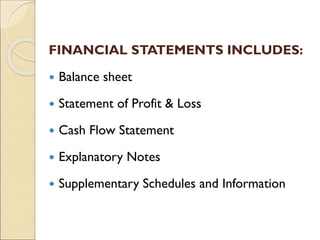
FINANCIAL STATEMENTS INCLUDES:
 Balance sheet
 Statement of Profit & Loss
 Cash Flow Statement
 Explanatory Notes
 Supplementary Schedules and Information
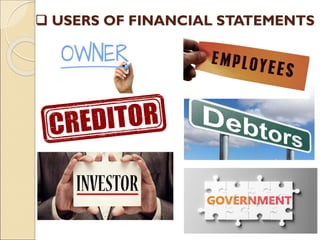
 USERS OF FINANCIAL STATEMENTS
Definition’s
According to Spicer & Pegler, “Auditing is such an
examinationof books of accounts and vouchers of business, as
will enable the auditor to satisfy himself that the balance-sheet
is properly drawn up, so as to give a true and fair view of the
state of affairs of business and that the Profit & loss Account
gives true and fair view of the Profit & loss for the financial
period, according to the best of information and explanation
given to him and as shown by the book, & if not, in what
respect he is not satisfied.”
 According to R.K.Mautz, “Auditing is concerned
with verification of accounting data, with
determining the accuracy and reliability of
accounting statement and Reports.”
Objectives of Auditing:
1. Primary Objective - True and FairView
2. Incidental Objective - Detection of Error & Fraud
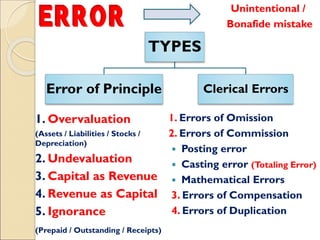
Unintentional /
Bonafide mistake
TYPES
Error of Principle Clerical Errors
1. Errors of Omission
2. Errors of Commission
 Posting error
 Casting error (Totaling Error)
 Mathematical Errors
3. Errors of Compensation
4. Errors of Duplication
1. Overvaluation
(Assets / Liabilities / Stocks /
Depreciation)
2. Undevaluation
3. Capital as Revenue
4. Revenue as Capital
5. Ignorance
(Prepaid / Outstanding / Receipts)
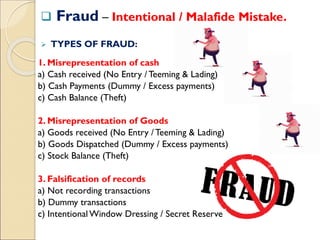
 Fraud – Intentional / Malafide Mistake.
 TYPES OF FRAUD:
1. Misrepresentation of cash
a) Cash received (No Entry / Teeming & Lading)
b) Cash Payments (Dummy / Excess payments)
c) Cash Balance (Theft)
2. Misrepresentation of Goods
a) Goods received (No Entry / Teeming & Lading)
b) Goods Dispatched (Dummy / Excess payments)
c) Stock Balance (Theft)
3. Falsification of records
a) Not recording transactions
b) Dummy transactions
c) Intentional Window Dressing / Secret Reserve
 Teeming & Lading
(iskiTopi Uske Sar)
1. An attempts to hide loss of cash received from
one customer by using cash received from another
customer to replace it.
2. This is also called short Banking / Lapping / delayed
accounting of money received.
3. A method to cover past frauds by present receipts.
 Window Dressing
Skill of presenting account in a way that
creates good impression. Showing better
position than actual position over stating
profits and net worth. Financial position seems
to be better in the market.
 Why ?
1. Mislead Investors
2. Hide Losses
3. Higher Commission
 How ?
1. Over statements of Assets
2. Under statements of
Liabilities
 Secret Reserves (only allowed to
banks)
Secret Reserve means Part of Profit Secretly reserve
for future use. It is not shown in the Balance Sheet. It
means Understating Net worth.
 Why ?
1. Mislead competitors
2. High abnormal profits
3. Banks only
How ?
1. Under Statement of
Assets
2. Over statements of
liabilities
 Objections
1. No true & FairView
2. Shareholder suffer
3. Hides Inefficiency of Management
4. Against Companies Act, 2013
 Auditors Duty
1. Disclose in Audit Report
2. Report to central Government
3. Verify Assets & Liabilities
4. Verify Incomes & Provisions
5. Verify Closing stock
6. Prevent Omission of liabilities
7. Disclose change in method of Accounting
 Advantages of Auditing
1. True and Fair views
2. Tally with the books of accounts
3. As per accounting standards and standards of
Auditing
4. Disclose all material facts
5. Detection and prevention of errors and fraud
6. Moral check on employee
7. Advise on system,Taxation and finance
 Disadvantages / Limitation of Auditing
1. Not possible to check each and every transaction
2. Evidence is not the conclusion
3. No assurance on future profitability and prospects or
efficiency of management
4. Intended dependability on documentation &
information
5. Auditors supposed to be Independent but may not be
6. Misstatements may remain undiscovered
 Principles of Audit (SA 200)
1. Integrity, Objectivity & Independence
2. Confidentiality
3. Skill & Competence
4. Work performed by others
5. Documentation
6. Planning
7. Evidence
8. Systems and Controls
9. Conclusion
10. Reporting
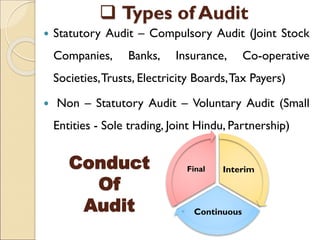
 Types of Audit
 Statutory Audit – Compulsory Audit (Joint Stock
Companies, Banks, Insurance, Co-operative
Societies,Trusts, Electricity Boards,Tax Payers)
 Non – Statutory Audit – Voluntary Audit (Small
Entities - Sole trading, Joint Hindu, Partnership)
Conduct
Of
Audit
Interim
Continuous
Final
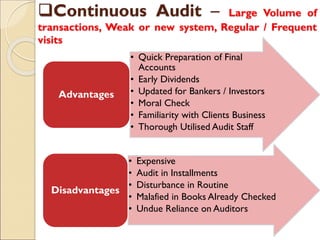
Continuous Audit – Large Volume of
transactions, Weak or new system, Regular / Frequent
visits
• Quick Preparation of Final
Accounts
• Early Dividends
• Updated for Bankers / Investors
• Moral Check
• Familiarity with Clients Business
• Thorough Utilised Audit Staff
Advantages
• Expensive
• Audit in Installments
• Disturbance in Routine
• Malafied in Books Already Checked
• Undue Reliance on Auditors
Disadvantages
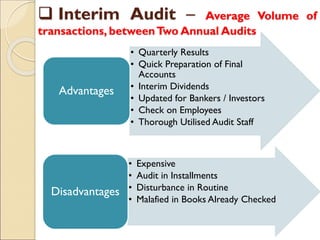
 Interim Audit – Average Volume of
transactions, betweenTwo Annual Audits
• Quarterly Results
• Quick Preparation of Final
Accounts
• Interim Dividends
• Updated for Bankers / Investors
• Check on Employees
• Thorough Utilised Audit Staff
Advantages
• Expensive
• Audit in Installments
• Disturbance in Routine
• Malafied in Books Already Checked
Disadvantages
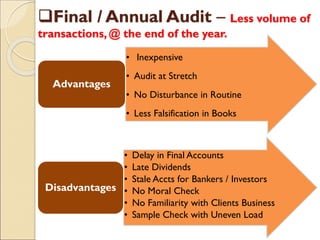
Final / Annual Audit – Less volume of
transactions, @ the end of the year.
• Inexpensive
• Audit at Stretch
• No Disturbance in Routine
• Less Falsification in Books
Advantages
• Delay in Final Accounts
• Late Dividends
• Stale Accts for Bankers / Investors
• No Moral Check
• No Familiarity with Clients Business
• Sample Check with Uneven Load
Disadvantages
Qualities of Auditor
 Chartered Accountant
 Skills and Competence
 Honest
 Knowledge of Business
 Confidential
 Watchdog but not Bloodhound
 Independent
 Judgement
 Methodical
 Materiality (SA-320)
Planning and Performance in conducting an
Audit, “Materiality means information and
matters relatively important for True
& Fair Presentation of financial
statements.”
Materiality
Legal
Requirements
Professional
Requirements
 Legal Requirements:
1. Material Items as per schedule 3 of Indian
Companies Act 2013
2. Non Recurring items
3. Previous year figures
4. Quantitative Information
5. Percentage Cutoffs
 Professional Requirements:
1. Extra ordinary Items as per A/S-5
2. Ordinary Items on the Profit & Loss statement
as per A/S-5
3. Prior period Items
4. Changes in Accounting Policies
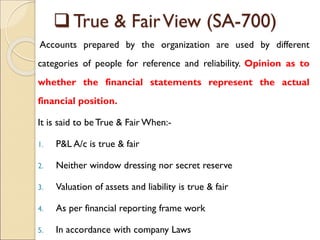
 True & FairView (SA-700)
Accounts prepared by the organization are used by different
categories of people for reference and reliability. Opinion as to
whether the financial statements represent the actual
financial position.
It is said to be True & Fair When:-
1. P&L A/c is true & fair
2. Neither window dressing nor secret reserve
3. Valuation of assets and liability is true & fair
4. As per financial reporting frame work
5. In accordance with company Laws

AUDIT MODULE 1 INTRODUCTION.pdf ह hhhhhhhhhhhh

  • 1.
    Module 1: Introduction to Auditing Dr. HemalVora Asst. Professor Gurukul College of Commerce, Ghatkopar, Mumbai.
  • 3.
    FINANCIAL STATEMENTS INCLUDES: Balance sheet  Statement of Profit & Loss  Cash Flow Statement  Explanatory Notes  Supplementary Schedules and Information
  • 4.
     USERS OFFINANCIAL STATEMENTS
  • 5.
    Definition’s According to Spicer& Pegler, “Auditing is such an examinationof books of accounts and vouchers of business, as will enable the auditor to satisfy himself that the balance-sheet is properly drawn up, so as to give a true and fair view of the state of affairs of business and that the Profit & loss Account gives true and fair view of the Profit & loss for the financial period, according to the best of information and explanation given to him and as shown by the book, & if not, in what respect he is not satisfied.”
  • 6.
     According toR.K.Mautz, “Auditing is concerned with verification of accounting data, with determining the accuracy and reliability of accounting statement and Reports.” Objectives of Auditing: 1. Primary Objective - True and FairView 2. Incidental Objective - Detection of Error & Fraud
  • 7.
    Unintentional / Bonafide mistake TYPES Errorof Principle Clerical Errors 1. Errors of Omission 2. Errors of Commission  Posting error  Casting error (Totaling Error)  Mathematical Errors 3. Errors of Compensation 4. Errors of Duplication 1. Overvaluation (Assets / Liabilities / Stocks / Depreciation) 2. Undevaluation 3. Capital as Revenue 4. Revenue as Capital 5. Ignorance (Prepaid / Outstanding / Receipts)
  • 8.
     Fraud –Intentional / Malafide Mistake.  TYPES OF FRAUD: 1. Misrepresentation of cash a) Cash received (No Entry / Teeming & Lading) b) Cash Payments (Dummy / Excess payments) c) Cash Balance (Theft) 2. Misrepresentation of Goods a) Goods received (No Entry / Teeming & Lading) b) Goods Dispatched (Dummy / Excess payments) c) Stock Balance (Theft) 3. Falsification of records a) Not recording transactions b) Dummy transactions c) Intentional Window Dressing / Secret Reserve
  • 9.
     Teeming &Lading (iskiTopi Uske Sar) 1. An attempts to hide loss of cash received from one customer by using cash received from another customer to replace it. 2. This is also called short Banking / Lapping / delayed accounting of money received. 3. A method to cover past frauds by present receipts.
  • 10.
     Window Dressing Skillof presenting account in a way that creates good impression. Showing better position than actual position over stating profits and net worth. Financial position seems to be better in the market.  Why ? 1. Mislead Investors 2. Hide Losses 3. Higher Commission  How ? 1. Over statements of Assets 2. Under statements of Liabilities
  • 11.
     Secret Reserves(only allowed to banks) Secret Reserve means Part of Profit Secretly reserve for future use. It is not shown in the Balance Sheet. It means Understating Net worth.  Why ? 1. Mislead competitors 2. High abnormal profits 3. Banks only How ? 1. Under Statement of Assets 2. Over statements of liabilities
  • 12.
     Objections 1. Notrue & FairView 2. Shareholder suffer 3. Hides Inefficiency of Management 4. Against Companies Act, 2013  Auditors Duty 1. Disclose in Audit Report 2. Report to central Government 3. Verify Assets & Liabilities 4. Verify Incomes & Provisions 5. Verify Closing stock 6. Prevent Omission of liabilities 7. Disclose change in method of Accounting
  • 13.
     Advantages ofAuditing 1. True and Fair views 2. Tally with the books of accounts 3. As per accounting standards and standards of Auditing 4. Disclose all material facts 5. Detection and prevention of errors and fraud 6. Moral check on employee 7. Advise on system,Taxation and finance
  • 14.
     Disadvantages /Limitation of Auditing 1. Not possible to check each and every transaction 2. Evidence is not the conclusion 3. No assurance on future profitability and prospects or efficiency of management 4. Intended dependability on documentation & information 5. Auditors supposed to be Independent but may not be 6. Misstatements may remain undiscovered
  • 15.
     Principles ofAudit (SA 200) 1. Integrity, Objectivity & Independence 2. Confidentiality 3. Skill & Competence 4. Work performed by others 5. Documentation 6. Planning 7. Evidence 8. Systems and Controls 9. Conclusion 10. Reporting
  • 16.
     Types ofAudit  Statutory Audit – Compulsory Audit (Joint Stock Companies, Banks, Insurance, Co-operative Societies,Trusts, Electricity Boards,Tax Payers)  Non – Statutory Audit – Voluntary Audit (Small Entities - Sole trading, Joint Hindu, Partnership) Conduct Of Audit Interim Continuous Final
  • 17.
    Continuous Audit –Large Volume of transactions, Weak or new system, Regular / Frequent visits • Quick Preparation of Final Accounts • Early Dividends • Updated for Bankers / Investors • Moral Check • Familiarity with Clients Business • Thorough Utilised Audit Staff Advantages • Expensive • Audit in Installments • Disturbance in Routine • Malafied in Books Already Checked • Undue Reliance on Auditors Disadvantages
  • 18.
     Interim Audit– Average Volume of transactions, betweenTwo Annual Audits • Quarterly Results • Quick Preparation of Final Accounts • Interim Dividends • Updated for Bankers / Investors • Check on Employees • Thorough Utilised Audit Staff Advantages • Expensive • Audit in Installments • Disturbance in Routine • Malafied in Books Already Checked Disadvantages
  • 19.
    Final / AnnualAudit – Less volume of transactions, @ the end of the year. • Inexpensive • Audit at Stretch • No Disturbance in Routine • Less Falsification in Books Advantages • Delay in Final Accounts • Late Dividends • Stale Accts for Bankers / Investors • No Moral Check • No Familiarity with Clients Business • Sample Check with Uneven Load Disadvantages
  • 20.
    Qualities of Auditor Chartered Accountant  Skills and Competence  Honest  Knowledge of Business  Confidential  Watchdog but not Bloodhound  Independent  Judgement  Methodical
  • 21.
     Materiality (SA-320) Planningand Performance in conducting an Audit, “Materiality means information and matters relatively important for True & Fair Presentation of financial statements.” Materiality Legal Requirements Professional Requirements
  • 22.
     Legal Requirements: 1.Material Items as per schedule 3 of Indian Companies Act 2013 2. Non Recurring items 3. Previous year figures 4. Quantitative Information 5. Percentage Cutoffs  Professional Requirements: 1. Extra ordinary Items as per A/S-5 2. Ordinary Items on the Profit & Loss statement as per A/S-5 3. Prior period Items 4. Changes in Accounting Policies
  • 23.
     True &FairView (SA-700) Accounts prepared by the organization are used by different categories of people for reference and reliability. Opinion as to whether the financial statements represent the actual financial position. It is said to be True & Fair When:- 1. P&L A/c is true & fair 2. Neither window dressing nor secret reserve 3. Valuation of assets and liability is true & fair 4. As per financial reporting frame work 5. In accordance with company Laws