Consolidation and Compressibility
Structures are built on soils. They transfer loads
to the subsoil through the foundations. The effect
of the loads is felt by the soil normally up to a
depth of about four times the width of the
foundation. The soil within this depth gets
compressed due to the imposed stresses. The
compression of the soil mass leads to the
decrease in the volume of the mass which results
in the settlement of the structure.
Introduction
3
If the settlement is not kept to tolerable limit,
the desire use of the structure may be
impaired and the design life of the structure
may be reduced
It is therefore important to have a mean of
predicting the amount of soil compression or
consolidation
Introduction
4
The total compression of soil under load is
composed of three components (i.e. elastic
settlement, primary consolidation settlement,
and secondary compression).
Compressibility
The settlement is defined as the compression of a
soil layer due to the loading applied at or near
its top surface.
5
There are three types of settlement:
1. Immediate or Elastic Settlement (Se): caused by
the elastic deformation of dry soil and of moist
and saturated soils without change in the moisture
content.
2. Primary Consolidation Settlement (Sc): volume
change in saturated cohesive soils as a result of
expulsion of the water that occupies the void
spaces.
Compressibility
6
3.Secondary Consolidation Settlement (Ss):
volume change due to the plastic adjustment of
soil fabrics under a constant effective stress (creep).
Coarse-grained soils do not undergo consolidation
settlement due to relatively high hydraulic
conductivity compared to clayey soils. Instead,
coarse-grained soils undergo immediate
settlement.
Compressibility
7
Consolidation settlement is the vertical
displacement of the surface corresponding to the
volume change in saturated cohesive soils as a
result of expulsion of the water that occupies the
void spaces.
•Consolidation settlement will result, for example,
if a structure is built over a layer of saturated
clay or if the water table is lowered permanently
in a stratum overlying a clay layer.
Consolidation
8
Consolidation
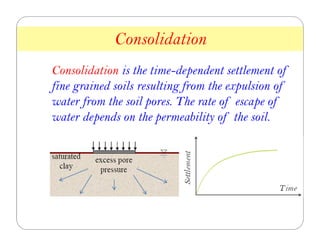
Consolidation is the time-dependent settlement of
fine grained soils resulting from the expulsion of
water from the soil pores. The rate of escape of
water depends on the permeability of the soil.
9
Consolidation
• Permeability of clay is low
• Drainage occurs slowly – therefore, the settlement is
delayed.
• Clayey soils undergo consolidation settlement not only
under the action of “external” loads (surcharge
loads) but also under its own weight or weight of
soils that exist above the clay (geostatic loads).
• Clayey soils also undergo settlement when dewatered
(e.g., ground water pumping) – because the effective
stress on the clay increases.
10
The amount of settlement is proportional to the
one-dimensional strain caused by variation in the
effective stress. The rate of settlement is a function
of the soil type, the geometry of the profile (in 1-
D consolidation, the length of the drainage path)
and a mathematical solution between a time factor
and the percent consolidation which has occurred.
Consolidation
11
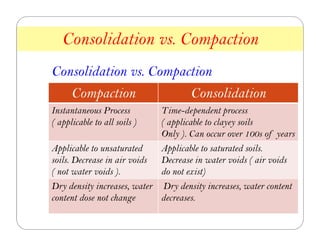
Consolidation vs. Compaction
Compaction Consolidation
Instantaneous Process
( applicable to all soils )
Time-dependent process
( applicable to clayey soils
Only ). Can occur over 100s of years
Applicable to unsaturated
soils. Decrease in air voids
( not water voids ).
Applicable to saturated soils.
Decrease in water voids ( air voids
do not exist)
Dry density increases, water
content dose not change
Dry density increases, water content
decreases.
Consolidation vs. Compaction
12
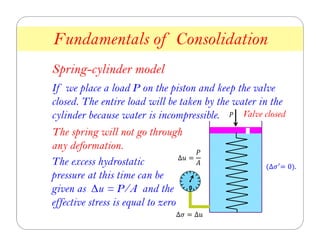
The time-dependent deformation of saturated clayey soil
can best understood by considering a simple model that
Fundamentals of Consolidation
0
Valve closed
∆ = 0
The cylinder is filled with
water and has a frictionless
watertight piston and valve.
Spring-cylinder model
consist of a cylinder with
a spring at its center.
17
If we place a load P on the piston and keep the valve
closed. The entire load will be taken by the water in the
cylinder because water is incompressible.
Fundamentals of Consolidation
0
The excess hydrostatic
pressure at this time can be
given as ∆u = P/A and the
effective stress is equal to zero
∆ =
(∆ = 0).
∆ = ∆
Valve closed
The spring will not go through
any deformation.
Spring-cylinder model
18
Fundamentals of Consolidation
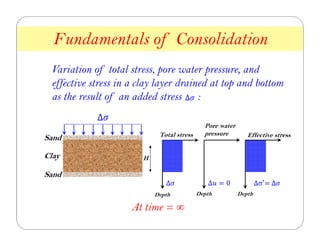
Variation of total stress, pore water pressure, and
effective stress in a clay layer drained at top and bottom
as the result of an added stress :
Sand
Sand
Clay H
Depth Depth Depth
Effective stress
Total stress
Pore water
pressure
∆
∆ ∆σ = 0
∆ = ∆
At time = 0
∆
19
If the valve is opened, the water will flow outward. This
flow will be accompanied by a reduction of the excess
hydrostatic pressure and an increase
in the compression of the spring.
Fundamentals of Consolidation
0
∆ > 0 and ∆ <
∆ = ∆ +	∆
∆ =
Valve open
∆ <
∆ = ∆ +	∆
Spring-cylinder model
20
Fundamentals of Consolidation
Variation of total stress, pore water pressure, and
effective stress in a clay layer drained at top and bottom
as the result of an added stress :
Sand
Sand
Clay H
Depth Depth Depth
Effective stress
Total stress
Pore water
pressure
∆
∆ ∆
At time 0 ˂ t ˂ ∞
∆ < ∆
∆σ <	∆
∆
∆
21
Fundamentals of Consolidation
0
∆ = 0
Valve
open
∆ = ∆
Spring-cylinder model
The spring is totally compressed with final value and
the load carried by water therefore now is zero and the
entire load is carried by the solids.
22
Fundamentals of Consolidation
Variation of total stress, pore water pressure, and
effective stress in a clay layer drained at top and bottom
as the result of an added stress :
Sand
Sand
Clay H
Depth Depth Depth
Effective stress
Total stress
Pore water
pressure
∆
∆ ∆σ = ∆
∆ = 0
At time = ∞
∆
23
Compressibility Parameters
5. Preconsolidation Pressure
Normally consolidated clay, whose present effective
overburden pressure is the maximum pressure that the soil
was subjected to in the past.
Overconsolidated, whose present effective overburden
pressure is less than that which the soil experienced in the
past. The maximum effective past pressure is called the
preconsolidation pressure.
42
Secondary Consolidation
Consolidated Settlement
Secondary consolidation settlement is more
important in the case of all organic and highly
compressible inorganic soils.
In overconsolidated inorganic clays, the
secondary compression index is very small and
of less practical significance.
60
2
Das, B., M. (2014), “ Principles of geotechnical
Engineering ” Eighth Edition, CENGAGE
Learning, ISBN-13: 978-0-495-41130-7.
Knappett, J. A. and Craig R. F. (2012), “ Craig’s Soil
Mechanics” Eighth Edition, Spon Press, ISBN: 978-
0-415-56125-9.
References
Consolidationandc ompressibility

Consolidationandc ompressibility

  • 1.
  • 2.
    Structures are builton soils. They transfer loads to the subsoil through the foundations. The effect of the loads is felt by the soil normally up to a depth of about four times the width of the foundation. The soil within this depth gets compressed due to the imposed stresses. The compression of the soil mass leads to the decrease in the volume of the mass which results in the settlement of the structure. Introduction 3
  • 3.
    If the settlementis not kept to tolerable limit, the desire use of the structure may be impaired and the design life of the structure may be reduced It is therefore important to have a mean of predicting the amount of soil compression or consolidation Introduction 4
  • 4.
    The total compressionof soil under load is composed of three components (i.e. elastic settlement, primary consolidation settlement, and secondary compression). Compressibility The settlement is defined as the compression of a soil layer due to the loading applied at or near its top surface. 5
  • 5.
    There are threetypes of settlement: 1. Immediate or Elastic Settlement (Se): caused by the elastic deformation of dry soil and of moist and saturated soils without change in the moisture content. 2. Primary Consolidation Settlement (Sc): volume change in saturated cohesive soils as a result of expulsion of the water that occupies the void spaces. Compressibility 6
  • 6.
    3.Secondary Consolidation Settlement(Ss): volume change due to the plastic adjustment of soil fabrics under a constant effective stress (creep). Coarse-grained soils do not undergo consolidation settlement due to relatively high hydraulic conductivity compared to clayey soils. Instead, coarse-grained soils undergo immediate settlement. Compressibility 7
  • 7.
    Consolidation settlement isthe vertical displacement of the surface corresponding to the volume change in saturated cohesive soils as a result of expulsion of the water that occupies the void spaces. •Consolidation settlement will result, for example, if a structure is built over a layer of saturated clay or if the water table is lowered permanently in a stratum overlying a clay layer. Consolidation 8
  • 8.
    Consolidation Consolidation is thetime-dependent settlement of fine grained soils resulting from the expulsion of water from the soil pores. The rate of escape of water depends on the permeability of the soil. 9
  • 9.
    Consolidation • Permeability ofclay is low • Drainage occurs slowly – therefore, the settlement is delayed. • Clayey soils undergo consolidation settlement not only under the action of “external” loads (surcharge loads) but also under its own weight or weight of soils that exist above the clay (geostatic loads). • Clayey soils also undergo settlement when dewatered (e.g., ground water pumping) – because the effective stress on the clay increases. 10
  • 10.
    The amount ofsettlement is proportional to the one-dimensional strain caused by variation in the effective stress. The rate of settlement is a function of the soil type, the geometry of the profile (in 1- D consolidation, the length of the drainage path) and a mathematical solution between a time factor and the percent consolidation which has occurred. Consolidation 11
  • 11.
    Consolidation vs. Compaction CompactionConsolidation Instantaneous Process ( applicable to all soils ) Time-dependent process ( applicable to clayey soils Only ). Can occur over 100s of years Applicable to unsaturated soils. Decrease in air voids ( not water voids ). Applicable to saturated soils. Decrease in water voids ( air voids do not exist) Dry density increases, water content dose not change Dry density increases, water content decreases. Consolidation vs. Compaction 12
  • 12.
    The time-dependent deformationof saturated clayey soil can best understood by considering a simple model that Fundamentals of Consolidation 0 Valve closed ∆ = 0 The cylinder is filled with water and has a frictionless watertight piston and valve. Spring-cylinder model consist of a cylinder with a spring at its center. 17
  • 13.
    If we placea load P on the piston and keep the valve closed. The entire load will be taken by the water in the cylinder because water is incompressible. Fundamentals of Consolidation 0 The excess hydrostatic pressure at this time can be given as ∆u = P/A and the effective stress is equal to zero ∆ = (∆ = 0). ∆ = ∆ Valve closed The spring will not go through any deformation. Spring-cylinder model 18
  • 14.
    Fundamentals of Consolidation Variationof total stress, pore water pressure, and effective stress in a clay layer drained at top and bottom as the result of an added stress : Sand Sand Clay H Depth Depth Depth Effective stress Total stress Pore water pressure ∆ ∆ ∆σ = 0 ∆ = ∆ At time = 0 ∆ 19
  • 15.
    If the valveis opened, the water will flow outward. This flow will be accompanied by a reduction of the excess hydrostatic pressure and an increase in the compression of the spring. Fundamentals of Consolidation 0 ∆ > 0 and ∆ < ∆ = ∆ + ∆ ∆ = Valve open ∆ < ∆ = ∆ + ∆ Spring-cylinder model 20
  • 16.
    Fundamentals of Consolidation Variationof total stress, pore water pressure, and effective stress in a clay layer drained at top and bottom as the result of an added stress : Sand Sand Clay H Depth Depth Depth Effective stress Total stress Pore water pressure ∆ ∆ ∆ At time 0 ˂ t ˂ ∞ ∆ < ∆ ∆σ < ∆ ∆ ∆ 21
  • 17.
    Fundamentals of Consolidation 0 ∆= 0 Valve open ∆ = ∆ Spring-cylinder model The spring is totally compressed with final value and the load carried by water therefore now is zero and the entire load is carried by the solids. 22
  • 18.
    Fundamentals of Consolidation Variationof total stress, pore water pressure, and effective stress in a clay layer drained at top and bottom as the result of an added stress : Sand Sand Clay H Depth Depth Depth Effective stress Total stress Pore water pressure ∆ ∆ ∆σ = ∆ ∆ = 0 At time = ∞ ∆ 23
  • 19.
    Compressibility Parameters 5. PreconsolidationPressure Normally consolidated clay, whose present effective overburden pressure is the maximum pressure that the soil was subjected to in the past. Overconsolidated, whose present effective overburden pressure is less than that which the soil experienced in the past. The maximum effective past pressure is called the preconsolidation pressure. 42
  • 20.
    Secondary Consolidation Consolidated Settlement Secondaryconsolidation settlement is more important in the case of all organic and highly compressible inorganic soils. In overconsolidated inorganic clays, the secondary compression index is very small and of less practical significance. 60
  • 21.
    2 Das, B., M.(2014), “ Principles of geotechnical Engineering ” Eighth Edition, CENGAGE Learning, ISBN-13: 978-0-495-41130-7. Knappett, J. A. and Craig R. F. (2012), “ Craig’s Soil Mechanics” Eighth Edition, Spon Press, ISBN: 978- 0-415-56125-9. References