




Chapter 5: 
Market Analysis 
Overview 
Market Analsis Overview | Page #1
In today’s globalized economy, the financial markets have become an important part of the world’s 
economy. Because of the interconnectivity between the various markets, traders can no longer confine 
their focus on just a single market when trading. Instead, they have to look over the whole spectrum of 
financial markets to see if there are ripple effects due to extraneous factors that can affect the course 
of their trades. 
Market Analsis Overview | Page #2
To remove as much uncertainty as possible during their 
decision making process, many financial experts have 
resorted to analyzing the markets for signs or clues as to 
how the markets will behave. In order to make accurate 
analysis of the markets, analysts rely on a wide array of tools 
at their disposal. To all new traders, the usefulness of proper 
market analysis cannot be understated. In fact, over the 
course of your trading experiences, you will find that the 
task of conducting a market analysis will take up the bulk of 
the time that you spent trading the markets. 
TWO MAIN TYPES OF FINANCIAL MARKET ANALYSIS 
Over the past few decades, market analysis has become a 
very specialized activity. However, it is possible to split this 
activity into 2 main groups based on the methods of analysis 
adopted. 
• Fundamental analysis 
• Technical Analysis 
Market Analsis Overview | Page #3
FUNDAMENTAL ANALYSIS 
The first type of market analysis adopted many traders is fundamental analysis. A fundamentalist looks 
at the quantitative and qualitative factors affecting a security and see if changes in these factors can 
affect the supply and demand for a security and consequently affect the price of the security. 
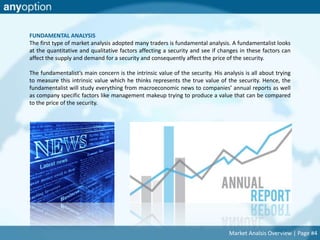
The fundamentalist’s main concern is the intrinsic value of the security. His analysis is all about trying 
to measure this intrinsic value which he thinks represents the true value of the security. Hence, the 
fundamentalist will study everything from macroeconomic news to companies’ annual reports as well 
as company specific factors like management makeup trying to produce a value that can be compared 
to the price of the security. 
Market Analsis Overview | Page #4
TECHNICAL ANALYSIS 
The other school of thought believes that one should analyse the markets using a method known as 
technical analysis. For a technical analyst, he is not concerned about the intrinsic value of a security. To 
him, the intrinsic value of the security has already been taken account into by the market and hence is 
reflected in its price. 
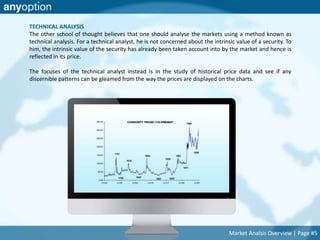
The focuses of the technical analyst instead is in the study of historical price data and see if any 
discernible patterns can be gleamed from the way the prices are displayed on the charts. 
Market Analsis Overview | Page #5
DIFFERENCES BETWEEN FUNDAMENTAL AND TECHNICAL ANALYSIS 
The differences between the fundamentalist and technical analyst is perhaps best demonstrated by the how they 
work. For example to decide whether to purchase a product or not, a fundamentalist will go to the store and study 
the product in detail before deciding to buy it or not. 
A technical analyst will approach the situation in a different manner. He will most probably sit outside the stores 
selling the products and observe the people coming in and out of the stores. His decision will most likely be based on 
the patterns that he observed. Perhaps, he might go to the store where he observed the most number of people 
going in and out from since that is indicative of popularity. 
FUNDAMENTALIST ANALYST TECHNICAL ANALYST 
It cannot be denied that as the world’s economy becomes more intertwined, the number of factors that can affect 
the markets direct and indirectly increase. With increased complexities, this will require us to dig in deeper into our 
analysis in order to see what circumstances can influence the financial markets. And to do this, we need a good 
foundation to build our analysis on. In the next 2 chapters, we go more in-depth into the realm of fundamental and 
technical analysis. 
Market Analsis Overview | Page #6
Market Analsis Overview | Page #7
CHAPTER 5: OVERVIEW OF MARKET ANALYSIS

CHAPTER 5: OVERVIEW OF MARKET ANALYSIS

  • 1.
    Chapter 5: MarketAnalysis Overview Market Analsis Overview | Page #1
  • 2.
    In today’s globalizedeconomy, the financial markets have become an important part of the world’s economy. Because of the interconnectivity between the various markets, traders can no longer confine their focus on just a single market when trading. Instead, they have to look over the whole spectrum of financial markets to see if there are ripple effects due to extraneous factors that can affect the course of their trades. Market Analsis Overview | Page #2
  • 3.
    To remove asmuch uncertainty as possible during their decision making process, many financial experts have resorted to analyzing the markets for signs or clues as to how the markets will behave. In order to make accurate analysis of the markets, analysts rely on a wide array of tools at their disposal. To all new traders, the usefulness of proper market analysis cannot be understated. In fact, over the course of your trading experiences, you will find that the task of conducting a market analysis will take up the bulk of the time that you spent trading the markets. TWO MAIN TYPES OF FINANCIAL MARKET ANALYSIS Over the past few decades, market analysis has become a very specialized activity. However, it is possible to split this activity into 2 main groups based on the methods of analysis adopted. • Fundamental analysis • Technical Analysis Market Analsis Overview | Page #3
  • 4.
    FUNDAMENTAL ANALYSIS Thefirst type of market analysis adopted many traders is fundamental analysis. A fundamentalist looks at the quantitative and qualitative factors affecting a security and see if changes in these factors can affect the supply and demand for a security and consequently affect the price of the security. The fundamentalist’s main concern is the intrinsic value of the security. His analysis is all about trying to measure this intrinsic value which he thinks represents the true value of the security. Hence, the fundamentalist will study everything from macroeconomic news to companies’ annual reports as well as company specific factors like management makeup trying to produce a value that can be compared to the price of the security. Market Analsis Overview | Page #4
  • 5.
    TECHNICAL ANALYSIS Theother school of thought believes that one should analyse the markets using a method known as technical analysis. For a technical analyst, he is not concerned about the intrinsic value of a security. To him, the intrinsic value of the security has already been taken account into by the market and hence is reflected in its price. The focuses of the technical analyst instead is in the study of historical price data and see if any discernible patterns can be gleamed from the way the prices are displayed on the charts. Market Analsis Overview | Page #5
  • 6.
    DIFFERENCES BETWEEN FUNDAMENTALAND TECHNICAL ANALYSIS The differences between the fundamentalist and technical analyst is perhaps best demonstrated by the how they work. For example to decide whether to purchase a product or not, a fundamentalist will go to the store and study the product in detail before deciding to buy it or not. A technical analyst will approach the situation in a different manner. He will most probably sit outside the stores selling the products and observe the people coming in and out of the stores. His decision will most likely be based on the patterns that he observed. Perhaps, he might go to the store where he observed the most number of people going in and out from since that is indicative of popularity. FUNDAMENTALIST ANALYST TECHNICAL ANALYST It cannot be denied that as the world’s economy becomes more intertwined, the number of factors that can affect the markets direct and indirectly increase. With increased complexities, this will require us to dig in deeper into our analysis in order to see what circumstances can influence the financial markets. And to do this, we need a good foundation to build our analysis on. In the next 2 chapters, we go more in-depth into the realm of fundamental and technical analysis. Market Analsis Overview | Page #6
  • 7.