Presented by
Parshuram (1734)
A great deal of information is available when making
an investment decision. There is market and
economic, data, stock charts, industry and company
characteristics, and a wealth of financial statistical
data. there are different branches of analysis which
helps to organize the information.
Introduction
Two major types of analysis for predicting the
performance of a company’s stock
1. Fundamental
2. Technical
 This involves a study of everything, other than the trading
on the securities markets, which can have an affect on a
security’s value: macroeconomic factors, industry
conditions, individual company financial conditions, and
qualitative factors such as management performance.
 Fundamental analysis pays attention to a company’s
debt/equity ratio, profit margins, dividend payout,
earnings per share, sales penetration, market share,
interest, asset and dividend coverage, product or marketing
innovation, and the quality of its management
 The most important single factor affecting the price of a
corporate security is the actual or expected profitability of
the issuer.
 E.g. :- Are profits sufficient to service debt, to pay current
dividends, or to pay larger dividends.
Technical Analysis
Studies historical stock prices and stock market behavior to
identify recurring patterns in the data. The process requires
large amounts of information, can be time consuming and
cumbersome.
 looks for peaks, bottoms, trends, patterns, and other
factors affecting a stock’s price movement .
 makes a buy/sell decision based on those factors.
Introduction
• The world of technical analysis is huge.
• Hundreds of different patterns and indicators
investors claim to be successful.
 Method of evaluating securities by analyzing statistics
generated by.
• Market activity
• Past Prices
• Volume
 Instead look for patterns and indicators on charts to
determine future performance.
 Technicians believe that securities move in very
predictable trends and patterns.
 Until that change takes place,
price levels are predictable.
 Most agree that technical analysis
is much more effective when
combined with fundamental
analysis.
 Studies historical stock prices and stock market behavior to
identify recurring patterns in the data. The process requires
large amounts of information, can be time consuming.
 Technical analysts study price movements, trading
volumes, and data on the number of rising and falling stock
issues over time looking for recurring patterns that will
allow them to predict future stock price movements.
 E.g.- Greed can force prices to rise to a level far higher than
warranted by anticipated earnings. Also, uncertainty can
cause investors to overreact to news and sell quickly,
causing prices to drop suddenly.
Unlike fundamental analysis, technical analysis is not
heavily dependent on financial accounting statements.
• Problems with accounting statements:
o Lack information needed by security analysts
o Many psychological and other non-quantifiable factors
do not show up in financial statements.
Fundamental analyst must process new information
and quickly determine a new intrinsic value, but
technical analyst merely has to recognize a movement
to a new equilibrium.
Technicians trade when a move to a
new equilibrium is underway but a
fundamental analyst finds
undervalued securities that may not
adjust to “correct” prices as quickly.
It does not involve data and
accounting problem.
 Challenges to basic assumptions
 Empirical tests of Efficient Market Hypothesis (EMH)
show that prices do not move in trends.
 Challenges to technical trading rules
• Rules that worked in the past may not be repeated
• Patterns may become self-fulfilling prophecies
• A successful rule will gain followers and become less
successful
• Rules all require subjective judgment.
 According to hypothetical performance, one of the
limitations is that it is commonly prepared with the
advantage of hindsight.
 In addition, Financial risk is not involve in
hypothetical trading and in actual trading there is no
trading record that can absolutely account for the
impact of financial risk.
 limitation is that the method of technical analysis
usually gives a lot of false signals.
 The market discounts the whole thing.
 Price moves in trends
 History has a tendency to repeat itself.
Types of Charts
1) Bar Chart
• It shows traders both the opening
and closing prices, as well as the
highs and the lows of that currency
pair.
• Represents the low & High price
point of day.
 Line is drawn from one closing price to the next.
 The price movement of a certain Currency pair over
a set period of time.
 Example for a EUR/USD line chart.
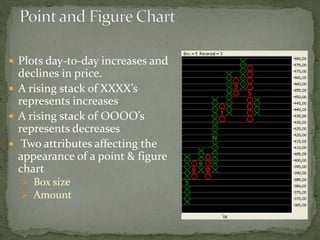
 Plots day-to-day increases and
declines in price.
 A rising stack of XXXX’s
represents increases
 A rising stack of OOOO’s
represents decreases
 Two attributes affecting the
appearance of a point & figure
chart
 Box size
 Amount
Fundamental of technical analysis

Fundamental of technical analysis

  • 1.
  • 2.
    A great dealof information is available when making an investment decision. There is market and economic, data, stock charts, industry and company characteristics, and a wealth of financial statistical data. there are different branches of analysis which helps to organize the information. Introduction Two major types of analysis for predicting the performance of a company’s stock 1. Fundamental 2. Technical
  • 3.
     This involvesa study of everything, other than the trading on the securities markets, which can have an affect on a security’s value: macroeconomic factors, industry conditions, individual company financial conditions, and qualitative factors such as management performance.  Fundamental analysis pays attention to a company’s debt/equity ratio, profit margins, dividend payout, earnings per share, sales penetration, market share, interest, asset and dividend coverage, product or marketing innovation, and the quality of its management
  • 4.
     The mostimportant single factor affecting the price of a corporate security is the actual or expected profitability of the issuer.  E.g. :- Are profits sufficient to service debt, to pay current dividends, or to pay larger dividends. Technical Analysis Studies historical stock prices and stock market behavior to identify recurring patterns in the data. The process requires large amounts of information, can be time consuming and cumbersome.
  • 5.
     looks forpeaks, bottoms, trends, patterns, and other factors affecting a stock’s price movement .  makes a buy/sell decision based on those factors. Introduction • The world of technical analysis is huge. • Hundreds of different patterns and indicators investors claim to be successful.
  • 6.
     Method ofevaluating securities by analyzing statistics generated by. • Market activity • Past Prices • Volume  Instead look for patterns and indicators on charts to determine future performance.  Technicians believe that securities move in very predictable trends and patterns.
  • 7.
     Until thatchange takes place, price levels are predictable.  Most agree that technical analysis is much more effective when combined with fundamental analysis.
  • 8.
     Studies historicalstock prices and stock market behavior to identify recurring patterns in the data. The process requires large amounts of information, can be time consuming.  Technical analysts study price movements, trading volumes, and data on the number of rising and falling stock issues over time looking for recurring patterns that will allow them to predict future stock price movements.  E.g.- Greed can force prices to rise to a level far higher than warranted by anticipated earnings. Also, uncertainty can cause investors to overreact to news and sell quickly, causing prices to drop suddenly.
  • 9.
    Unlike fundamental analysis,technical analysis is not heavily dependent on financial accounting statements. • Problems with accounting statements: o Lack information needed by security analysts o Many psychological and other non-quantifiable factors do not show up in financial statements. Fundamental analyst must process new information and quickly determine a new intrinsic value, but technical analyst merely has to recognize a movement to a new equilibrium.
  • 10.
    Technicians trade whena move to a new equilibrium is underway but a fundamental analyst finds undervalued securities that may not adjust to “correct” prices as quickly. It does not involve data and accounting problem.
  • 11.
     Challenges tobasic assumptions  Empirical tests of Efficient Market Hypothesis (EMH) show that prices do not move in trends.  Challenges to technical trading rules • Rules that worked in the past may not be repeated • Patterns may become self-fulfilling prophecies • A successful rule will gain followers and become less successful • Rules all require subjective judgment.
  • 12.
     According tohypothetical performance, one of the limitations is that it is commonly prepared with the advantage of hindsight.  In addition, Financial risk is not involve in hypothetical trading and in actual trading there is no trading record that can absolutely account for the impact of financial risk.  limitation is that the method of technical analysis usually gives a lot of false signals.
  • 13.
     The marketdiscounts the whole thing.  Price moves in trends  History has a tendency to repeat itself. Types of Charts 1) Bar Chart • It shows traders both the opening and closing prices, as well as the highs and the lows of that currency pair. • Represents the low & High price point of day.
  • 14.
     Line isdrawn from one closing price to the next.  The price movement of a certain Currency pair over a set period of time.  Example for a EUR/USD line chart.
  • 15.
     Plots day-to-dayincreases and declines in price.  A rising stack of XXXX’s represents increases  A rising stack of OOOO’s represents decreases  Two attributes affecting the appearance of a point & figure chart  Box size  Amount