
Chapter 6: 
Fundamental 
Analysis 
Fundamental Analysis | Page #1
To many investors, Fundamental analysis is the cornerstone of investing. For the investor, the goal of 
having fundamental analysis is to try to discern the intrinsic value of the security that he is interested 
to invest in and compare that value with the current market price of the security. 
If the comparison shows that the security is undervalued, then the right move would be to buy. 
However, if the comparison shows that the security is overvalued, then he should move to sell. 
Fundamental Analysis | Page #2
THE BASICS: QUALITATIVE & QUANTITATIVE FACTORS 
With the equity market in mind, at the very core, fundamental analysis involves researching everything that affects 
the wellbeing of a company as well as all those factors which can affect the wellbeing of the industry which the 
company is in. 
All the above mentioned factors that can affect the fundamentals of a company can be classified into qualitative 
and quantitative factors. Qualitative factors are all those factors which are related to the qualitative nature of a 
company. This may include the vision of the CEO or the value of the company’s brand etc. It can also relate to 
acquisitions made by the company which in turn could expand the company’s business or burden it with additional 
dead weight. 
As for quantitative factors, these include data that can be measured such as the cash flow, the liabilities, the profit 
earned by the company, in short the financial statements of the company. 
Fundamental Analysis | Page #3
QUALITATIVE VS. QUANTITATIVE 
While it is only natural to ask if qualitative or quantitative factors will give a fundamentalist a better picture of a 
company’s worth, most fundamental analysts do not make their analysis without considering both factors 
together. For example, when analyzing the value of Apple’s stock, the analyst will study the dividend paid out to 
the shareholders, the P/E ratio and earnings per share. But his analysis will be incomplete if he doesn’t take into 
account the value of the iPhone brand. 
Nowadays, there are hundreds if not thousands of companies around the world which are capable of producing 
smartphones. However, none of these companies can claim that their brand is as recognizable worldwide as the 
iPhone brand. Although it is difficult to put a numerical value to the iPhone brand, it cannot be denied that it is 
one of the main reasons why customers queue up for days to get their hands on the latest iPhone. 
Fundamental Analysis | Page #4
THE CONCEPT OF INTRINSIC VALUE 
One of the core assumptions of fundamental analysis is the belief that the stock market does not always reflect the 
true value of a stock. If the stock market was 100% efficient in the valuation of a stock, then it would be pointless to 
do anymore market analysis. But we know this is not always the case and hence the need to conduct a price analysis 
on the security that we are interested to invest in. 
The intrinsic value of stock is defined as the value of the stock after one has taken into account all the qualitative and 
quantitative factors that might affect its value. For example, the intrinsic value of Apple’s stock can be said to be 
when one takes into account the performance of the company as indicated by its financial statements and the 
perceived value of its brand worldwide. 
Fundamental Analysis | Page #5
Another core assumption about fundamental analysis is the belief that in the long run, the market will always reflect 
the fundamentals. The time scale can range from 2 years to even a decade. Nobody really knows how long the time 
line can be. 
The key point is when one invests based on the fundamentals; it should always be for a significant period of time. 
After all, there is no point investing in something when the market price does not reflect the intrinsic value. 
Fundamental Analysis | Page #6
FUNDAMENTAL ANALYSIS IN BINARY TRADING 
Once we understand the basic concepts of fundamental analysis, we can start to use this tool to help us 
analysis the market that we are interested to trade. Because binary trading covers 4 major asset classes, the 
fundamentals affecting each class of asset is different. For example, interest rates, GDP data and 
unemployment figures are the key quantitative factors which currency traders pay heed to. 
Fundamental Analysis | Page #7
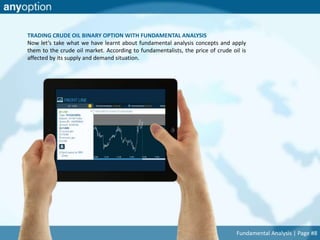
TRADING CRUDE OIL BINARY OPTION WITH FUNDAMENTAL ANALYSIS 
Now let’s take what we have learnt about fundamental analysis concepts and apply 
them to the crude oil market. According to fundamentalists, the price of crude oil is 
affected by its supply and demand situation. 
Fundamental Analysis | Page #8
In order to determine the total supply and demand in the crude oil market, what traders do is made a 
collective estimation as to what the likely supply and demand would be in the foreseeable future. So what are 
the factors which can affect this collective estimation? 
RELATED ECONOMIC NEWS 
The U.S Strategic Petroleum Reserve (SPR) 
holds roughly 700 million barrels of oil. 
Hence, when the White House recently 
announced that it was releasing 5 million 
barrels into the market, the news surprised 
the market and prompted oil prices to drop 
by $2/- (their lowest in 2 months) within 
days of the announcement. While the move 
by the White House may be seen by some 
analysts as applying political pressure on 
Russia following its annexation of Crimea, 
there is no doubt as to the economic effect 
that the news had on the crude oil market. 
Fundamental Analysis | Page #9
CHANGING CONSUMPTION PATTERNS 
Any report which concerns changes in the consumption pattern of crude will have a direct impact on the perceived 
demand for crude oil. Consequently, this will result in falling oil prices. 
For example, a survey shows that people nowadays prefer hybrid cars to fuel guzzling muscle cars or SUV. Since 
hybrid cars are more economical, this will result in falling demand for gasoline and ultimately crude oil. 
Fundamental Analysis | Page #10
GEOPOLITICAL UPHEAVAL 
Any geopolitical upheaval that involves oil producers will result in panic in the crude oil market and hence pushing 
demand up which will result in skyrocketing prices. 
For example, the Ukraine crisis and the fear that Russia, a major oil producer, might be affected by trade sanctions 
had helped push crude oil prices up in recent months. 
Fundamental Analysis | Page #11
TECHNOLOGICAL BREAKTHROUGH & ALTERNATIVE ENERGY 
While this might not have an immediate effect on crude oil prices, technological improvements which lower the cost 
of alternative energy such as solar power will definitely impact the future demand for crude oil. 
Fundamental Analysis | Page #12
ECONOMIC GROWTH REPORTS 
Since oil is the fuel which helps power economic growth, any slowdown in the economic growth of major economies 
such as China, Japan, India and U.S will result in the traders having to revise their estimations of future crude oil 
demand in the market. 
As you can see, from a fundamental analysis point of view, almost any factors can affect the price of crude oil. So as a 
beginner commodity trader, it is best that you focus on one particular asset class and preferably on one asset as well 
when you are trying to analyze the market using fundamental analysis. 
CHINA JAPAN INDIA U.S. 
Fundamental Analysis | Page #13
CONCLUSION 
At the end of the day, fundamental analysis is all about using data to value the worth of a security. For many investors, 
fundamental analysis plays a crucial in the success of their investment strategies making them extremely rich. One 
famous name within the financial circles that employs fundamental analysis in helping him to pick profitable 
investments is the “Oracle of Omaha”, Warren Buffett. From his track record, we know fundamental analysis is a topic 
that no aspiring financial trader can afford to ignore. 
Fundamental Analysis | Page #14
Fundamental Analysis | Page #15
CHAPTER 6: FUNDAMENTAL ANALYSIS IN BINARY TRADING

CHAPTER 6: FUNDAMENTAL ANALYSIS IN BINARY TRADING

  • 1.
    Chapter 6: Fundamental Analysis Fundamental Analysis | Page #1
  • 2.
    To many investors,Fundamental analysis is the cornerstone of investing. For the investor, the goal of having fundamental analysis is to try to discern the intrinsic value of the security that he is interested to invest in and compare that value with the current market price of the security. If the comparison shows that the security is undervalued, then the right move would be to buy. However, if the comparison shows that the security is overvalued, then he should move to sell. Fundamental Analysis | Page #2
  • 3.
    THE BASICS: QUALITATIVE& QUANTITATIVE FACTORS With the equity market in mind, at the very core, fundamental analysis involves researching everything that affects the wellbeing of a company as well as all those factors which can affect the wellbeing of the industry which the company is in. All the above mentioned factors that can affect the fundamentals of a company can be classified into qualitative and quantitative factors. Qualitative factors are all those factors which are related to the qualitative nature of a company. This may include the vision of the CEO or the value of the company’s brand etc. It can also relate to acquisitions made by the company which in turn could expand the company’s business or burden it with additional dead weight. As for quantitative factors, these include data that can be measured such as the cash flow, the liabilities, the profit earned by the company, in short the financial statements of the company. Fundamental Analysis | Page #3
  • 4.
    QUALITATIVE VS. QUANTITATIVE While it is only natural to ask if qualitative or quantitative factors will give a fundamentalist a better picture of a company’s worth, most fundamental analysts do not make their analysis without considering both factors together. For example, when analyzing the value of Apple’s stock, the analyst will study the dividend paid out to the shareholders, the P/E ratio and earnings per share. But his analysis will be incomplete if he doesn’t take into account the value of the iPhone brand. Nowadays, there are hundreds if not thousands of companies around the world which are capable of producing smartphones. However, none of these companies can claim that their brand is as recognizable worldwide as the iPhone brand. Although it is difficult to put a numerical value to the iPhone brand, it cannot be denied that it is one of the main reasons why customers queue up for days to get their hands on the latest iPhone. Fundamental Analysis | Page #4
  • 5.
    THE CONCEPT OFINTRINSIC VALUE One of the core assumptions of fundamental analysis is the belief that the stock market does not always reflect the true value of a stock. If the stock market was 100% efficient in the valuation of a stock, then it would be pointless to do anymore market analysis. But we know this is not always the case and hence the need to conduct a price analysis on the security that we are interested to invest in. The intrinsic value of stock is defined as the value of the stock after one has taken into account all the qualitative and quantitative factors that might affect its value. For example, the intrinsic value of Apple’s stock can be said to be when one takes into account the performance of the company as indicated by its financial statements and the perceived value of its brand worldwide. Fundamental Analysis | Page #5
  • 6.
    Another core assumptionabout fundamental analysis is the belief that in the long run, the market will always reflect the fundamentals. The time scale can range from 2 years to even a decade. Nobody really knows how long the time line can be. The key point is when one invests based on the fundamentals; it should always be for a significant period of time. After all, there is no point investing in something when the market price does not reflect the intrinsic value. Fundamental Analysis | Page #6
  • 7.
    FUNDAMENTAL ANALYSIS INBINARY TRADING Once we understand the basic concepts of fundamental analysis, we can start to use this tool to help us analysis the market that we are interested to trade. Because binary trading covers 4 major asset classes, the fundamentals affecting each class of asset is different. For example, interest rates, GDP data and unemployment figures are the key quantitative factors which currency traders pay heed to. Fundamental Analysis | Page #7
  • 8.
    TRADING CRUDE OILBINARY OPTION WITH FUNDAMENTAL ANALYSIS Now let’s take what we have learnt about fundamental analysis concepts and apply them to the crude oil market. According to fundamentalists, the price of crude oil is affected by its supply and demand situation. Fundamental Analysis | Page #8
  • 9.
    In order todetermine the total supply and demand in the crude oil market, what traders do is made a collective estimation as to what the likely supply and demand would be in the foreseeable future. So what are the factors which can affect this collective estimation? RELATED ECONOMIC NEWS The U.S Strategic Petroleum Reserve (SPR) holds roughly 700 million barrels of oil. Hence, when the White House recently announced that it was releasing 5 million barrels into the market, the news surprised the market and prompted oil prices to drop by $2/- (their lowest in 2 months) within days of the announcement. While the move by the White House may be seen by some analysts as applying political pressure on Russia following its annexation of Crimea, there is no doubt as to the economic effect that the news had on the crude oil market. Fundamental Analysis | Page #9
  • 10.
    CHANGING CONSUMPTION PATTERNS Any report which concerns changes in the consumption pattern of crude will have a direct impact on the perceived demand for crude oil. Consequently, this will result in falling oil prices. For example, a survey shows that people nowadays prefer hybrid cars to fuel guzzling muscle cars or SUV. Since hybrid cars are more economical, this will result in falling demand for gasoline and ultimately crude oil. Fundamental Analysis | Page #10
  • 11.
    GEOPOLITICAL UPHEAVAL Anygeopolitical upheaval that involves oil producers will result in panic in the crude oil market and hence pushing demand up which will result in skyrocketing prices. For example, the Ukraine crisis and the fear that Russia, a major oil producer, might be affected by trade sanctions had helped push crude oil prices up in recent months. Fundamental Analysis | Page #11
  • 12.
    TECHNOLOGICAL BREAKTHROUGH &ALTERNATIVE ENERGY While this might not have an immediate effect on crude oil prices, technological improvements which lower the cost of alternative energy such as solar power will definitely impact the future demand for crude oil. Fundamental Analysis | Page #12
  • 13.
    ECONOMIC GROWTH REPORTS Since oil is the fuel which helps power economic growth, any slowdown in the economic growth of major economies such as China, Japan, India and U.S will result in the traders having to revise their estimations of future crude oil demand in the market. As you can see, from a fundamental analysis point of view, almost any factors can affect the price of crude oil. So as a beginner commodity trader, it is best that you focus on one particular asset class and preferably on one asset as well when you are trying to analyze the market using fundamental analysis. CHINA JAPAN INDIA U.S. Fundamental Analysis | Page #13
  • 14.
    CONCLUSION At theend of the day, fundamental analysis is all about using data to value the worth of a security. For many investors, fundamental analysis plays a crucial in the success of their investment strategies making them extremely rich. One famous name within the financial circles that employs fundamental analysis in helping him to pick profitable investments is the “Oracle of Omaha”, Warren Buffett. From his track record, we know fundamental analysis is a topic that no aspiring financial trader can afford to ignore. Fundamental Analysis | Page #14
  • 15.