Chapter 3Chapter 3
The Financial InformationThe Financial Information
MarketplaceMarketplace
IntroductionIntroduction
 Sound financial decisions requireSound financial decisions require
adequate and reliableadequate and reliable financialfinancial
informationinformation
 Sources of information relied on bySources of information relied on by
financial decision makersfinancial decision makers
 Debt security prices and yieldsDebt security prices and yields
 Stock prices and dividend yieldsStock prices and dividend yields
 Information on security issuersInformation on security issuers
 General economic and financial conditionsGeneral economic and financial conditions
3-2
Efficient markets hypothesisEfficient markets hypothesis
(EMH )(EMH )
 It is built on random walk hypothesisIt is built on random walk hypothesis
(RWH)(RWH)
 RWH states that movements in security pricesRWH states that movements in security prices
do not have any set patterndo not have any set pattern
 These movements are independent from eachThese movements are independent from each
otherother
The Great Debate OverThe Great Debate Over
Efficient Markets & Asymmetric InformationEfficient Markets & Asymmetric Information
 Efficient markets hypothesis (EMH)Efficient markets hypothesis (EMH)
contends that information relevant to thecontends that information relevant to the
pricing (valuation) of loans, securities, andpricing (valuation) of loans, securities, and
other financial assets is readily available toother financial assets is readily available to
allall borrowers and lenders atborrowers and lenders at negligible costnegligible cost..
3-4
The Great Debate OverThe Great Debate Over
Efficient Markets & Asymmetric InformationEfficient Markets & Asymmetric Information
 The other view is asymmetric informationThe other view is asymmetric information
 Pockets of inefficiency in informationPockets of inefficiency in information
availabilityavailability
 Pockets of inefficiency in use of informationPockets of inefficiency in use of information
 Some market players possess betterSome market players possess better
informationinformation
 Can have special informationCan have special information
 Information may be costly for other partiesInformation may be costly for other parties
 Insiders can earn excess returns byInsiders can earn excess returns by
selectively trading financial assets based onselectively trading financial assets based on
special informationspecial information
3-5
The Great Debate OverThe Great Debate Over
Efficient Markets & Asymmetric InformationEfficient Markets & Asymmetric Information
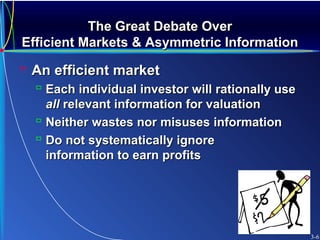
 An efficient marketAn efficient market
 Each individual investor will rationally useEach individual investor will rationally use
allall relevant information for valuationrelevant information for valuation
 Neither wastes nor misuses informationNeither wastes nor misuses information
 Do not systematically ignoreDo not systematically ignore
information to earn profitsinformation to earn profits
3-6
The Great Debate OverThe Great Debate Over
Efficient Markets & Asymmetric InformationEfficient Markets & Asymmetric Information
 Financial markets today may haveFinancial markets today may have
many profit-maximizing, well-informed,many profit-maximizing, well-informed,
intelligent investorsintelligent investors
 Won’t be profitable asset trades over timeWon’t be profitable asset trades over time
 No systematic mispricing of assetsNo systematic mispricing of assets
 Temporary deviation of actual returns fromTemporary deviation of actual returns from
expected should be quickly eliminatedexpected should be quickly eliminated
 Each financial asset will generate anEach financial asset will generate an
ordinary, normalordinary, normal oror expectedexpected rate of returnrate of return
commensurate with its level of riskcommensurate with its level of risk
3-7
In simple words EMH states that:In simple words EMH states that:
 Market consist of a large number ofMarket consist of a large number of
knowledgeable investorsknowledgeable investors
 Investors have an easy access to theInvestors have an easy access to the
informationinformation
 On the basis of this information investorsOn the basis of this information investors
make rational decisionsmake rational decisions
 And remove any mispricing caused byAnd remove any mispricing caused by
irrational investors through arbitrage.irrational investors through arbitrage.
Different Forms of the EMHDifferent Forms of the EMH
 TheThe weakweak form of the EMH argues that theform of the EMH argues that the
current price of a financial asset alreadycurrent price of a financial asset already
reflects all its price and trading volumereflects all its price and trading volume
history.history.
 TheThe semistrongsemistrong form contends that theform contends that the
current price of a financial asset alreadycurrent price of a financial asset already
reflects all publicly available and relevantreflects all publicly available and relevant
information.information.
 TheThe strongstrong form argues that the current priceform argues that the current price
of a financial asset already captures allof a financial asset already captures all
relevant public and private information.relevant public and private information.
3-9
Different Forms of the EMHDifferent Forms of the EMH
 EvidenceEvidence
 Subject to repeated research studiesSubject to repeated research studies
 Tend to support the weak and semistrongTend to support the weak and semistrong
formsforms
 The strong form has aroused the mostThe strong form has aroused the most
controversycontroversy
 Existence of insider trading activitiesExistence of insider trading activities
 Apparent presence of pockets of specialApparent presence of pockets of special
information asymmetrically scatteredinformation asymmetrically scattered
throughout the financial systemthroughout the financial system
3-10
Insiders & Insider TradingInsiders & Insider Trading
 InsidersInsiders
 People associated with the firmPeople associated with the firm
 Information superior to general marketInformation superior to general market
 Insider tradingInsider trading
 Buying or selling a financial assetBuying or selling a financial asset
 Superior inside knowledge or privilegesSuperior inside knowledge or privileges
 Manipulative or deceptive device in tradingManipulative or deceptive device in trading
forbiddenforbidden
 Insiders not prohibited from tradingInsiders not prohibited from trading
securitiessecurities 3-11
The Asymmetric InformationThe Asymmetric Information
Hypothesis (AIH)Hypothesis (AIH)
Alternate hypothesis: SomeAlternate hypothesis: Some
individuals and institutions haveindividuals and institutions have
access to pockets of informationaccess to pockets of information
concerning the true value and risk ofconcerning the true value and risk of
financial assets and others simply didfinancial assets and others simply did
notnot
3-12
The Asymmetric InformationThe Asymmetric Information
Hypothesis (AIH)Hypothesis (AIH)
Pockets of special informationPockets of special information
 ExpertiseExpertise
 ExperienceExperience
 LocationLocation
Inefficient incentivesInefficient incentives
 Incentive to misrepresent quality ofIncentive to misrepresent quality of
information soldinformation sold
 Information may lead to marketInformation may lead to market
inefficiencyinefficiency
 Inconsistent with strong form efficiencyInconsistent with strong form efficiency
3-13
Problems Asymmetries CanProblems Asymmetries Can
CreateCreate
 Lemons and PlumsLemons and Plums. A loan officer (buyer). A loan officer (buyer)
cannot be sure without incurring substantialcannot be sure without incurring substantial
costs whether his or her potential customercosts whether his or her potential customer
(seller) is a lemon (low quality) or plum(seller) is a lemon (low quality) or plum
(high quality).(high quality).
3-14
Problems InformationalProblems Informational
Asymmetries Can CreateAsymmetries Can Create
Lender does not know customer qualityLender does not know customer quality
Customer has incentive to misrepresent ifCustomer has incentive to misrepresent if
low qualitylow quality
Loan pricing reflects the likelihood of theLoan pricing reflects the likelihood of the
loan being low qualityloan being low quality
 The pricing is above what a high qualityThe pricing is above what a high quality
borrower should be chargedborrower should be charged
 High quality borrowers leave the marketHigh quality borrowers leave the market
Need a mechanism beyond pricing toNeed a mechanism beyond pricing to
optimally allocate resourcesoptimally allocate resources 3-15
Problems InformationalProblems Informational
Asymmetries Can CreateAsymmetries Can Create
 Adverse selectionAdverse selection
 Asymmetric information before a contractAsymmetric information before a contract
completedcompleted
 One party only chooses contracts that willOne party only chooses contracts that will
benefit selfbenefit self
3-16
Problems InformationalProblems Informational
Asymmetries Can CreateAsymmetries Can Create
Bank that sets one price for allBank that sets one price for all
checking account customerschecking account customers
 High-balance, low-activity (and henceHigh-balance, low-activity (and hence
most profitable) customers tend tomost profitable) customers tend to
overpay and avoid contractoverpay and avoid contract
 Low-balance, high-activity customersLow-balance, high-activity customers
tend to underpay and prefer contracttend to underpay and prefer contract
 Solution: Enable customer signaling viaSolution: Enable customer signaling via
a conditional price schedule for differenta conditional price schedule for different
account plansaccount plans
3-17
Problems InformationalProblems Informational
Asymmetries Can CreateAsymmetries Can Create
 Moral hazardMoral hazard
 Asymmetric information after agreeing to aAsymmetric information after agreeing to a
contractcontract
 One party in a contract may decide toOne party in a contract may decide to
pursue its own self-interest at the expensepursue its own self-interest at the expense
of the other partyof the other party
 Poorly drafted contractsPoorly drafted contracts
 Ineffective monitoring activityIneffective monitoring activity
 Solution: Draw contracts with theSolution: Draw contracts with the
appropriate incentivesappropriate incentives
3-18
Asymmetry, Efficiency, &Asymmetry, Efficiency, &
Real-World MarketsReal-World Markets
 All real-world markets have elements ofAll real-world markets have elements of
bothboth efficiency and asymmetryefficiency and asymmetry
 Perhaps real-world markets are splitPerhaps real-world markets are split
into segmentsinto segments
 Highly efficient segment with well-Highly efficient segment with well-
informed tradersinformed traders
 Less efficient segment with less-well-Less efficient segment with less-well-
informed small investors tradeinformed small investors trade
3-19
Behavioral FinanceBehavioral Finance
 Behavioral finance is a relatively new field thatBehavioral finance is a relatively new field that
seeks to combine behavioral and psychologicalseeks to combine behavioral and psychological
theory with conventional economics and financetheory with conventional economics and finance
to provide explanations for why people maketo provide explanations for why people make
irrational financial decisions.irrational financial decisions.
 Build on two pillars mainlyBuild on two pillars mainly
 Limits of ArbitrageLimits of Arbitrage
 Human PsychologyHuman Psychology
Rationality:Rationality: It refers to highly objective, logical andIt refers to highly objective, logical and
mechanical approach of thinking or decisionmechanical approach of thinking or decision
making; or a habit of performing independent ofmaking; or a habit of performing independent of
feelings, beliefs and any kind of instinct.feelings, beliefs and any kind of instinct.
Some Factors effecting Human PsychologySome Factors effecting Human Psychology
Winner’s CurseWinner’s Curse
Gambler's FallacyGambler's Fallacy
HerdingHerding
Overconfidence/ OptimismOverconfidence/ Optimism
Prospect TheoryProspect Theory
 Value changes not states
 Pain of loss is greater than the pleasure of gain
 Loss averse not risk averse
Changes not StatesChanges not States
Imagine that you are richer by Rs 200,000 than you areImagine that you are richer by Rs 200,000 than you are
today, and that you face a choice between options:today, and that you face a choice between options:
Receive Rs 50,000 orReceive Rs 50,000 or
A 50% chance to win Rs 100,000 and a 50% chance to winA 50% chance to win Rs 100,000 and a 50% chance to win
nothing.nothing.
Now imagine that you are richer by Rs 300,000 than you areNow imagine that you are richer by Rs 300,000 than you are
today, and that you are compelled to choose one of twotoday, and that you are compelled to choose one of two
options:options:
Lose Rs 50,000Lose Rs 50,000
A 50% chance to lose Rs 100,000 and a 50% chance to loseA 50% chance to lose Rs 100,000 and a 50% chance to lose
nothingnothing
Pain of LossPain of Loss
 Investor A owns a block of a stock, which he originally bought atInvestor A owns a block of a stock, which he originally bought at
Rs 100 per share. Investor B owns a block of the same stock forRs 100 per share. Investor B owns a block of the same stock for
which he paid Rs 200 per share. The value of the stock was Rs160which he paid Rs 200 per share. The value of the stock was Rs160
per share yesterday, and today it dropped to Rs 150 per share. Whoper share yesterday, and today it dropped to Rs 150 per share. Who
is more upset?is more upset?
Investor AInvestor A
Investor BInvestor B
Both EquallyBoth Equally
 Suppose you have two stocks A & B bought at Rs. 50 each. Stock ASuppose you have two stocks A & B bought at Rs. 50 each. Stock A
sold at Rs 100 experiencing a gain of Rs. 50. Stock B reached asold at Rs 100 experiencing a gain of Rs. 50. Stock B reached a
high of Rs 150 but you sold at Rs 100 experiencing a gain of Rs. 50.high of Rs 150 but you sold at Rs 100 experiencing a gain of Rs. 50.
Which is more favorable?Which is more favorable?
Sale of stock ASale of stock A □ Sale of stock B□ Sale of stock B
Both equallyBoth equally □ Can not say□ Can not say
Loss AverseLoss Averse
In case of loss positions in my portfolio IIn case of loss positions in my portfolio I
generally wait for a price rebound insteadgenerally wait for a price rebound instead
of selling those securitiesof selling those securities
I prefer to take profits instead of cuttingI prefer to take profits instead of cutting
losses when I am confronted withlosses when I am confronted with
unexpected liquidity demandsunexpected liquidity demands
Discovered PrincipalsDiscovered Principals
Investors do not always make rationalInvestors do not always make rational
decisionsdecisions
Only the best-informed tradersOnly the best-informed traders
appear to outperform less-informedappear to outperform less-informed
traderstraders
Investors who purchase marketInvestors who purchase market
research information do not, onresearch information do not, on
average, achieve greater net returnsaverage, achieve greater net returns
than investors who do notthan investors who do not
3-25
Sources of InformationSources of Information
 About bonds in Pakistan (Taurus SecuritiesAbout bonds in Pakistan (Taurus Securities
Limited), Bonds Automated Trading SystemLimited), Bonds Automated Trading System
(BATS) previously by Mutual Funds through(BATS) previously by Mutual Funds through
dealing systemdealing system
 Ratings from PACRA,Ratings from PACRA,
3-26
Sources of InformationSources of Information
Stock prices and dividend yieldsStock prices and dividend yields
 Data:Data: prices (year-high, year-low, day-high,prices (year-high, year-low, day-high,
day-low, closing), sales volume, most recentday-low, closing), sales volume, most recent
dividend, dividend yield, P-E ratio, stockdividend, dividend yield, P-E ratio, stock
price indexesprice indexes
 Sources:Sources: computer networks (e.g. Internet),computer networks (e.g. Internet),
financial press, television, radio, financialfinancial press, television, radio, financial
institutions (e.g. KSE, Business Recorder,institutions (e.g. KSE, Business Recorder,
CNBC)CNBC)
3-27
Sources of InformationSources of Information
Security issuersSecurity issuers
 Data:Data: firm history, principalfirm history, principal
products/services, key officers, recentproducts/services, key officers, recent
operation summary, financial statements,operation summary, financial statements,
credit ratings, industry performancecredit ratings, industry performance
indicatorsindicators
 Sources:Sources: regulatory agencies (e.g. SECP),regulatory agencies (e.g. SECP),
directories & databases, journals &directories & databases, journals &
magazines, credit bureausmagazines, credit bureaus
3-28
Sources of InformationSources of Information
Stock price indexes and foreign stock pricesStock price indexes and foreign stock prices
 Data: stock indicies, index composition,Data: stock indicies, index composition,
sector indicies, indicies by size, market-valuesector indicies, indicies by size, market-value
weighted indicies, international stockweighted indicies, international stock
markets, currency exchange ratesmarkets, currency exchange rates
 Sources: computer networks (e.g. internet),Sources: computer networks (e.g. internet),
financial press, television, radio, financialfinancial press, television, radio, financial
institutions (e.g. S&P, Wilshire), State Bank ofinstitutions (e.g. S&P, Wilshire), State Bank of
PakistanPakistan
3-29
Sources of InformationSources of Information
General economic and financial conditionsGeneral economic and financial conditions
 Data:Data: interest rates, money supply measures,interest rates, money supply measures,
industrial output, international transactions,industrial output, international transactions,
unemployment rate, inflation, forecastsunemployment rate, inflation, forecasts
 Sources:Sources: Central banks (e.g. SBP Pakistan),Central banks (e.g. SBP Pakistan),
Ministry of Finance (e.g. Economic Survey ofMinistry of Finance (e.g. Economic Survey of
Pakistan), financial pressPakistan), financial press
3-30

Emh lec#3

  • 1.
    Chapter 3Chapter 3 TheFinancial InformationThe Financial Information MarketplaceMarketplace
  • 2.
    IntroductionIntroduction  Sound financialdecisions requireSound financial decisions require adequate and reliableadequate and reliable financialfinancial informationinformation  Sources of information relied on bySources of information relied on by financial decision makersfinancial decision makers  Debt security prices and yieldsDebt security prices and yields  Stock prices and dividend yieldsStock prices and dividend yields  Information on security issuersInformation on security issuers  General economic and financial conditionsGeneral economic and financial conditions 3-2
  • 3.
    Efficient markets hypothesisEfficientmarkets hypothesis (EMH )(EMH )  It is built on random walk hypothesisIt is built on random walk hypothesis (RWH)(RWH)  RWH states that movements in security pricesRWH states that movements in security prices do not have any set patterndo not have any set pattern  These movements are independent from eachThese movements are independent from each otherother
  • 4.
    The Great DebateOverThe Great Debate Over Efficient Markets & Asymmetric InformationEfficient Markets & Asymmetric Information  Efficient markets hypothesis (EMH)Efficient markets hypothesis (EMH) contends that information relevant to thecontends that information relevant to the pricing (valuation) of loans, securities, andpricing (valuation) of loans, securities, and other financial assets is readily available toother financial assets is readily available to allall borrowers and lenders atborrowers and lenders at negligible costnegligible cost.. 3-4
  • 5.
    The Great DebateOverThe Great Debate Over Efficient Markets & Asymmetric InformationEfficient Markets & Asymmetric Information  The other view is asymmetric informationThe other view is asymmetric information  Pockets of inefficiency in informationPockets of inefficiency in information availabilityavailability  Pockets of inefficiency in use of informationPockets of inefficiency in use of information  Some market players possess betterSome market players possess better informationinformation  Can have special informationCan have special information  Information may be costly for other partiesInformation may be costly for other parties  Insiders can earn excess returns byInsiders can earn excess returns by selectively trading financial assets based onselectively trading financial assets based on special informationspecial information 3-5
  • 6.
    The Great DebateOverThe Great Debate Over Efficient Markets & Asymmetric InformationEfficient Markets & Asymmetric Information  An efficient marketAn efficient market  Each individual investor will rationally useEach individual investor will rationally use allall relevant information for valuationrelevant information for valuation  Neither wastes nor misuses informationNeither wastes nor misuses information  Do not systematically ignoreDo not systematically ignore information to earn profitsinformation to earn profits 3-6
  • 7.
    The Great DebateOverThe Great Debate Over Efficient Markets & Asymmetric InformationEfficient Markets & Asymmetric Information  Financial markets today may haveFinancial markets today may have many profit-maximizing, well-informed,many profit-maximizing, well-informed, intelligent investorsintelligent investors  Won’t be profitable asset trades over timeWon’t be profitable asset trades over time  No systematic mispricing of assetsNo systematic mispricing of assets  Temporary deviation of actual returns fromTemporary deviation of actual returns from expected should be quickly eliminatedexpected should be quickly eliminated  Each financial asset will generate anEach financial asset will generate an ordinary, normalordinary, normal oror expectedexpected rate of returnrate of return commensurate with its level of riskcommensurate with its level of risk 3-7
  • 8.
    In simple wordsEMH states that:In simple words EMH states that:  Market consist of a large number ofMarket consist of a large number of knowledgeable investorsknowledgeable investors  Investors have an easy access to theInvestors have an easy access to the informationinformation  On the basis of this information investorsOn the basis of this information investors make rational decisionsmake rational decisions  And remove any mispricing caused byAnd remove any mispricing caused by irrational investors through arbitrage.irrational investors through arbitrage.
  • 9.
    Different Forms ofthe EMHDifferent Forms of the EMH  TheThe weakweak form of the EMH argues that theform of the EMH argues that the current price of a financial asset alreadycurrent price of a financial asset already reflects all its price and trading volumereflects all its price and trading volume history.history.  TheThe semistrongsemistrong form contends that theform contends that the current price of a financial asset alreadycurrent price of a financial asset already reflects all publicly available and relevantreflects all publicly available and relevant information.information.  TheThe strongstrong form argues that the current priceform argues that the current price of a financial asset already captures allof a financial asset already captures all relevant public and private information.relevant public and private information. 3-9
  • 10.
    Different Forms ofthe EMHDifferent Forms of the EMH  EvidenceEvidence  Subject to repeated research studiesSubject to repeated research studies  Tend to support the weak and semistrongTend to support the weak and semistrong formsforms  The strong form has aroused the mostThe strong form has aroused the most controversycontroversy  Existence of insider trading activitiesExistence of insider trading activities  Apparent presence of pockets of specialApparent presence of pockets of special information asymmetrically scatteredinformation asymmetrically scattered throughout the financial systemthroughout the financial system 3-10
  • 11.
    Insiders & InsiderTradingInsiders & Insider Trading  InsidersInsiders  People associated with the firmPeople associated with the firm  Information superior to general marketInformation superior to general market  Insider tradingInsider trading  Buying or selling a financial assetBuying or selling a financial asset  Superior inside knowledge or privilegesSuperior inside knowledge or privileges  Manipulative or deceptive device in tradingManipulative or deceptive device in trading forbiddenforbidden  Insiders not prohibited from tradingInsiders not prohibited from trading securitiessecurities 3-11
  • 12.
    The Asymmetric InformationTheAsymmetric Information Hypothesis (AIH)Hypothesis (AIH) Alternate hypothesis: SomeAlternate hypothesis: Some individuals and institutions haveindividuals and institutions have access to pockets of informationaccess to pockets of information concerning the true value and risk ofconcerning the true value and risk of financial assets and others simply didfinancial assets and others simply did notnot 3-12
  • 13.
    The Asymmetric InformationTheAsymmetric Information Hypothesis (AIH)Hypothesis (AIH) Pockets of special informationPockets of special information  ExpertiseExpertise  ExperienceExperience  LocationLocation Inefficient incentivesInefficient incentives  Incentive to misrepresent quality ofIncentive to misrepresent quality of information soldinformation sold  Information may lead to marketInformation may lead to market inefficiencyinefficiency  Inconsistent with strong form efficiencyInconsistent with strong form efficiency 3-13
  • 14.
    Problems Asymmetries CanProblemsAsymmetries Can CreateCreate  Lemons and PlumsLemons and Plums. A loan officer (buyer). A loan officer (buyer) cannot be sure without incurring substantialcannot be sure without incurring substantial costs whether his or her potential customercosts whether his or her potential customer (seller) is a lemon (low quality) or plum(seller) is a lemon (low quality) or plum (high quality).(high quality). 3-14
  • 15.
    Problems InformationalProblems Informational AsymmetriesCan CreateAsymmetries Can Create Lender does not know customer qualityLender does not know customer quality Customer has incentive to misrepresent ifCustomer has incentive to misrepresent if low qualitylow quality Loan pricing reflects the likelihood of theLoan pricing reflects the likelihood of the loan being low qualityloan being low quality  The pricing is above what a high qualityThe pricing is above what a high quality borrower should be chargedborrower should be charged  High quality borrowers leave the marketHigh quality borrowers leave the market Need a mechanism beyond pricing toNeed a mechanism beyond pricing to optimally allocate resourcesoptimally allocate resources 3-15
  • 16.
    Problems InformationalProblems Informational AsymmetriesCan CreateAsymmetries Can Create  Adverse selectionAdverse selection  Asymmetric information before a contractAsymmetric information before a contract completedcompleted  One party only chooses contracts that willOne party only chooses contracts that will benefit selfbenefit self 3-16
  • 17.
    Problems InformationalProblems Informational AsymmetriesCan CreateAsymmetries Can Create Bank that sets one price for allBank that sets one price for all checking account customerschecking account customers  High-balance, low-activity (and henceHigh-balance, low-activity (and hence most profitable) customers tend tomost profitable) customers tend to overpay and avoid contractoverpay and avoid contract  Low-balance, high-activity customersLow-balance, high-activity customers tend to underpay and prefer contracttend to underpay and prefer contract  Solution: Enable customer signaling viaSolution: Enable customer signaling via a conditional price schedule for differenta conditional price schedule for different account plansaccount plans 3-17
  • 18.
    Problems InformationalProblems Informational AsymmetriesCan CreateAsymmetries Can Create  Moral hazardMoral hazard  Asymmetric information after agreeing to aAsymmetric information after agreeing to a contractcontract  One party in a contract may decide toOne party in a contract may decide to pursue its own self-interest at the expensepursue its own self-interest at the expense of the other partyof the other party  Poorly drafted contractsPoorly drafted contracts  Ineffective monitoring activityIneffective monitoring activity  Solution: Draw contracts with theSolution: Draw contracts with the appropriate incentivesappropriate incentives 3-18
  • 19.
    Asymmetry, Efficiency, &Asymmetry,Efficiency, & Real-World MarketsReal-World Markets  All real-world markets have elements ofAll real-world markets have elements of bothboth efficiency and asymmetryefficiency and asymmetry  Perhaps real-world markets are splitPerhaps real-world markets are split into segmentsinto segments  Highly efficient segment with well-Highly efficient segment with well- informed tradersinformed traders  Less efficient segment with less-well-Less efficient segment with less-well- informed small investors tradeinformed small investors trade 3-19
  • 20.
    Behavioral FinanceBehavioral Finance Behavioral finance is a relatively new field thatBehavioral finance is a relatively new field that seeks to combine behavioral and psychologicalseeks to combine behavioral and psychological theory with conventional economics and financetheory with conventional economics and finance to provide explanations for why people maketo provide explanations for why people make irrational financial decisions.irrational financial decisions.  Build on two pillars mainlyBuild on two pillars mainly  Limits of ArbitrageLimits of Arbitrage  Human PsychologyHuman Psychology Rationality:Rationality: It refers to highly objective, logical andIt refers to highly objective, logical and mechanical approach of thinking or decisionmechanical approach of thinking or decision making; or a habit of performing independent ofmaking; or a habit of performing independent of feelings, beliefs and any kind of instinct.feelings, beliefs and any kind of instinct.
  • 21.
    Some Factors effectingHuman PsychologySome Factors effecting Human Psychology Winner’s CurseWinner’s Curse Gambler's FallacyGambler's Fallacy HerdingHerding Overconfidence/ OptimismOverconfidence/ Optimism Prospect TheoryProspect Theory  Value changes not states  Pain of loss is greater than the pleasure of gain  Loss averse not risk averse
  • 22.
    Changes not StatesChangesnot States Imagine that you are richer by Rs 200,000 than you areImagine that you are richer by Rs 200,000 than you are today, and that you face a choice between options:today, and that you face a choice between options: Receive Rs 50,000 orReceive Rs 50,000 or A 50% chance to win Rs 100,000 and a 50% chance to winA 50% chance to win Rs 100,000 and a 50% chance to win nothing.nothing. Now imagine that you are richer by Rs 300,000 than you areNow imagine that you are richer by Rs 300,000 than you are today, and that you are compelled to choose one of twotoday, and that you are compelled to choose one of two options:options: Lose Rs 50,000Lose Rs 50,000 A 50% chance to lose Rs 100,000 and a 50% chance to loseA 50% chance to lose Rs 100,000 and a 50% chance to lose nothingnothing
  • 23.
    Pain of LossPainof Loss  Investor A owns a block of a stock, which he originally bought atInvestor A owns a block of a stock, which he originally bought at Rs 100 per share. Investor B owns a block of the same stock forRs 100 per share. Investor B owns a block of the same stock for which he paid Rs 200 per share. The value of the stock was Rs160which he paid Rs 200 per share. The value of the stock was Rs160 per share yesterday, and today it dropped to Rs 150 per share. Whoper share yesterday, and today it dropped to Rs 150 per share. Who is more upset?is more upset? Investor AInvestor A Investor BInvestor B Both EquallyBoth Equally  Suppose you have two stocks A & B bought at Rs. 50 each. Stock ASuppose you have two stocks A & B bought at Rs. 50 each. Stock A sold at Rs 100 experiencing a gain of Rs. 50. Stock B reached asold at Rs 100 experiencing a gain of Rs. 50. Stock B reached a high of Rs 150 but you sold at Rs 100 experiencing a gain of Rs. 50.high of Rs 150 but you sold at Rs 100 experiencing a gain of Rs. 50. Which is more favorable?Which is more favorable? Sale of stock ASale of stock A □ Sale of stock B□ Sale of stock B Both equallyBoth equally □ Can not say□ Can not say
  • 24.
    Loss AverseLoss Averse Incase of loss positions in my portfolio IIn case of loss positions in my portfolio I generally wait for a price rebound insteadgenerally wait for a price rebound instead of selling those securitiesof selling those securities I prefer to take profits instead of cuttingI prefer to take profits instead of cutting losses when I am confronted withlosses when I am confronted with unexpected liquidity demandsunexpected liquidity demands
  • 25.
    Discovered PrincipalsDiscovered Principals Investorsdo not always make rationalInvestors do not always make rational decisionsdecisions Only the best-informed tradersOnly the best-informed traders appear to outperform less-informedappear to outperform less-informed traderstraders Investors who purchase marketInvestors who purchase market research information do not, onresearch information do not, on average, achieve greater net returnsaverage, achieve greater net returns than investors who do notthan investors who do not 3-25
  • 26.
    Sources of InformationSourcesof Information  About bonds in Pakistan (Taurus SecuritiesAbout bonds in Pakistan (Taurus Securities Limited), Bonds Automated Trading SystemLimited), Bonds Automated Trading System (BATS) previously by Mutual Funds through(BATS) previously by Mutual Funds through dealing systemdealing system  Ratings from PACRA,Ratings from PACRA, 3-26
  • 27.
    Sources of InformationSourcesof Information Stock prices and dividend yieldsStock prices and dividend yields  Data:Data: prices (year-high, year-low, day-high,prices (year-high, year-low, day-high, day-low, closing), sales volume, most recentday-low, closing), sales volume, most recent dividend, dividend yield, P-E ratio, stockdividend, dividend yield, P-E ratio, stock price indexesprice indexes  Sources:Sources: computer networks (e.g. Internet),computer networks (e.g. Internet), financial press, television, radio, financialfinancial press, television, radio, financial institutions (e.g. KSE, Business Recorder,institutions (e.g. KSE, Business Recorder, CNBC)CNBC) 3-27
  • 28.
    Sources of InformationSourcesof Information Security issuersSecurity issuers  Data:Data: firm history, principalfirm history, principal products/services, key officers, recentproducts/services, key officers, recent operation summary, financial statements,operation summary, financial statements, credit ratings, industry performancecredit ratings, industry performance indicatorsindicators  Sources:Sources: regulatory agencies (e.g. SECP),regulatory agencies (e.g. SECP), directories & databases, journals &directories & databases, journals & magazines, credit bureausmagazines, credit bureaus 3-28
  • 29.
    Sources of InformationSourcesof Information Stock price indexes and foreign stock pricesStock price indexes and foreign stock prices  Data: stock indicies, index composition,Data: stock indicies, index composition, sector indicies, indicies by size, market-valuesector indicies, indicies by size, market-value weighted indicies, international stockweighted indicies, international stock markets, currency exchange ratesmarkets, currency exchange rates  Sources: computer networks (e.g. internet),Sources: computer networks (e.g. internet), financial press, television, radio, financialfinancial press, television, radio, financial institutions (e.g. S&P, Wilshire), State Bank ofinstitutions (e.g. S&P, Wilshire), State Bank of PakistanPakistan 3-29
  • 30.
    Sources of InformationSourcesof Information General economic and financial conditionsGeneral economic and financial conditions  Data:Data: interest rates, money supply measures,interest rates, money supply measures, industrial output, international transactions,industrial output, international transactions, unemployment rate, inflation, forecastsunemployment rate, inflation, forecasts  Sources:Sources: Central banks (e.g. SBP Pakistan),Central banks (e.g. SBP Pakistan), Ministry of Finance (e.g. Economic Survey ofMinistry of Finance (e.g. Economic Survey of Pakistan), financial pressPakistan), financial press 3-30