Chapter 3 
Relationships of Quantities: 
Percents, Ratios, and Proportions 
PowerPoint® Presentation to accompany: 
Math and Dosage Calculations for 
Healthcare Professionals 
Fourth Edition 
Booth, Whaley, Sienkiewicz, and Palmunen 
© 2012 The McGraw-Hill Companies, Inc. All rights reserved.
3-2 
Learning Outcomes 
3-1 Convert values to and from a percent. 
3-2 Convert values to and from a ratio. 
© 2012 The McGraw-Hill Companies, Inc. All rights reserved. 
3-3 Write proportions. 
3-4 Use proportions to solve for an unknown 
quantity.
3-3 
© 2012 The McGraw-Hill Companies, Inc. All rights reserved. 
Key Terms 
 Cross-multiplying 
 Means and 
extremes 
 Percent 
 Proportion 
 Ratio
3-4 
Introduction 
 For dosage calculation you must: 
 understand percents, ratios, and 
proportions ; 
 be able to find a unknown quantity in a 
proportion. 
© 2012 The McGraw-Hill Companies, Inc. All rights reserved.
3-5 
© 2012 The McGraw-Hill Companies, Inc. All rights reserved. 
Percents 
 Percents provide a way to express the 
relationship of parts to a whole. 
 Percent is indicated by the symbol %. 
 Percent means “per 100” or “divided by 100.”
3-6 
Percents (cont.) 
 A number < 1 is expressed as less than 
100 percent. 
 A number > 1 is expressed as greater than 
100 percent. 
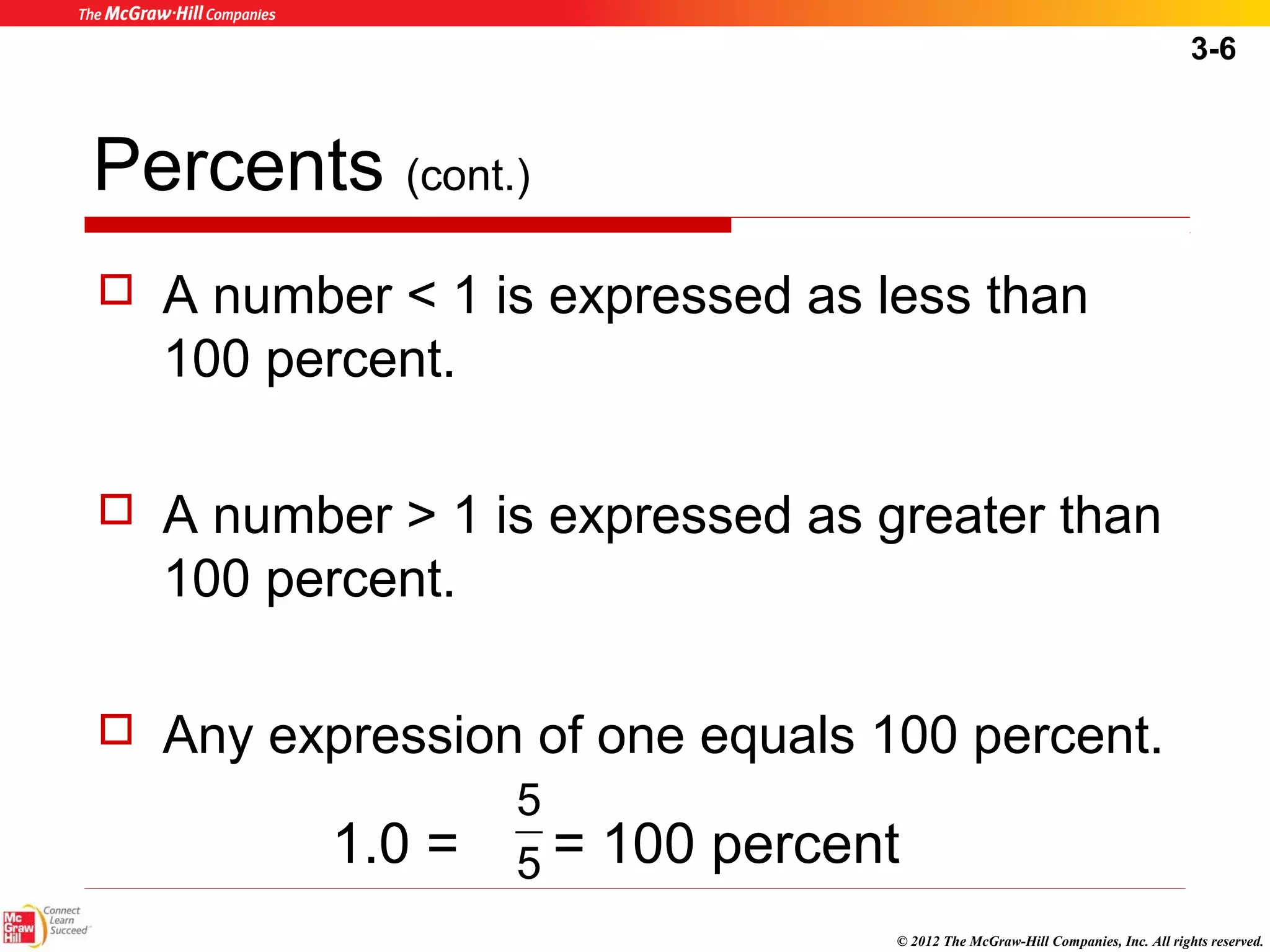
 Any expression of one equals 100 percent. 
1.0 = = 100 percent 
© 2012 The McGraw-Hill Companies, Inc. All rights reserved. 
5 
5
3-7 
Converting Values To and From a 
Percent 
RRuullee 33--11 
To convert a percent to a decimal, remove 
the percent symbol. Then divide the 
remaining number by 100. 
© 2012 The McGraw-Hill Companies, Inc. All rights reserved.
3-8 
Converting Values To and From 
a Percent (cont.) 
© 2012 The McGraw-Hill Companies, Inc. All rights reserved. 
EExxaammppllee 
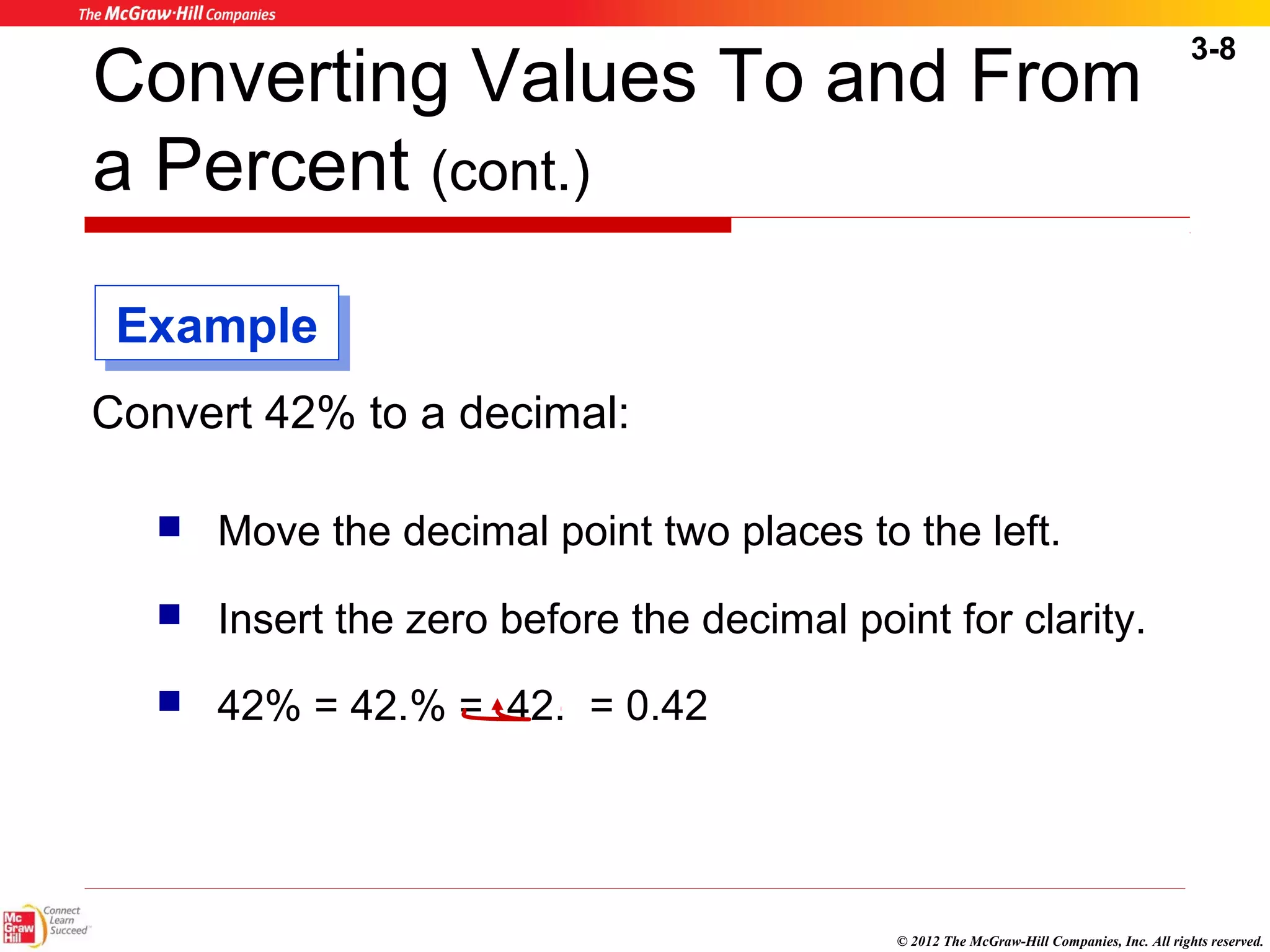
Convert 42% to a decimal: 
 Move the decimal point two places to the left. 
 Insert the zero before the decimal point for clarity. 
 42% = 42.% = .42. = 0.42
3-9 
RRuullee 33--22 
To convert a decimal to a percent, multiply 
the decimal by 100. Then add the 
percent symbol. 
© 2012 The McGraw-Hill Companies, Inc. All rights reserved. 
Converting Values To and 
from a Percent (cont.)
3-10 
Working with Percents (cont.) 
© 2012 The McGraw-Hill Companies, Inc. All rights reserved. 
EExxaammppllee 
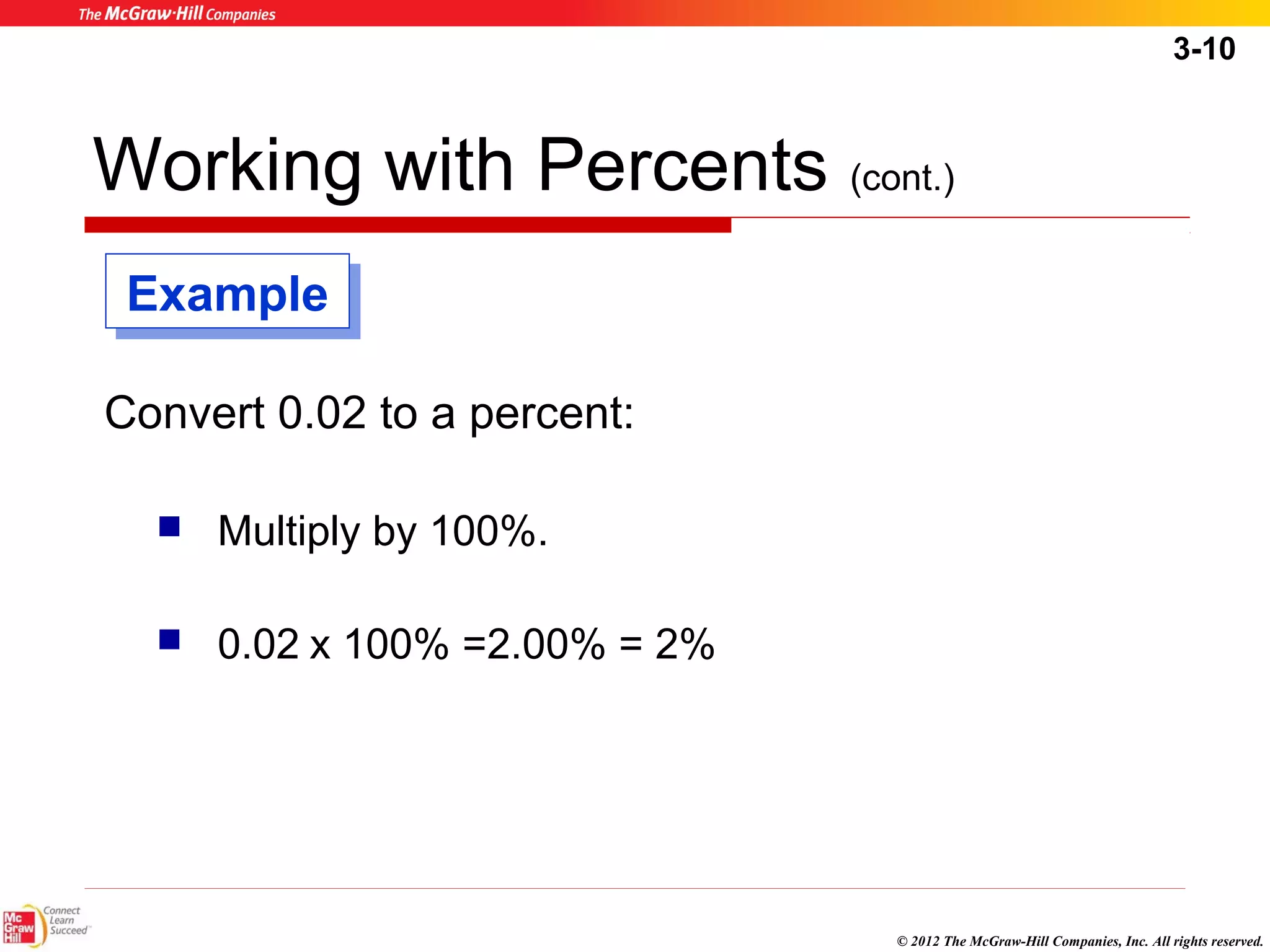
Convert 0.02 to a percent: 
 Multiply by 100%. 
 0.02 x 100% =2.00% = 2%
3-11 
Working with Percents (cont.) 
RRuullee 33--33 
To convert a percent to an equivalent 
fraction, write the value of the percent as the 
numerator and 100 as the denominator. 
Then reduce the fraction to its lowest term. 
© 2012 The McGraw-Hill Companies, Inc. All rights reserved.
3-12 
Working with Percents (cont.) 
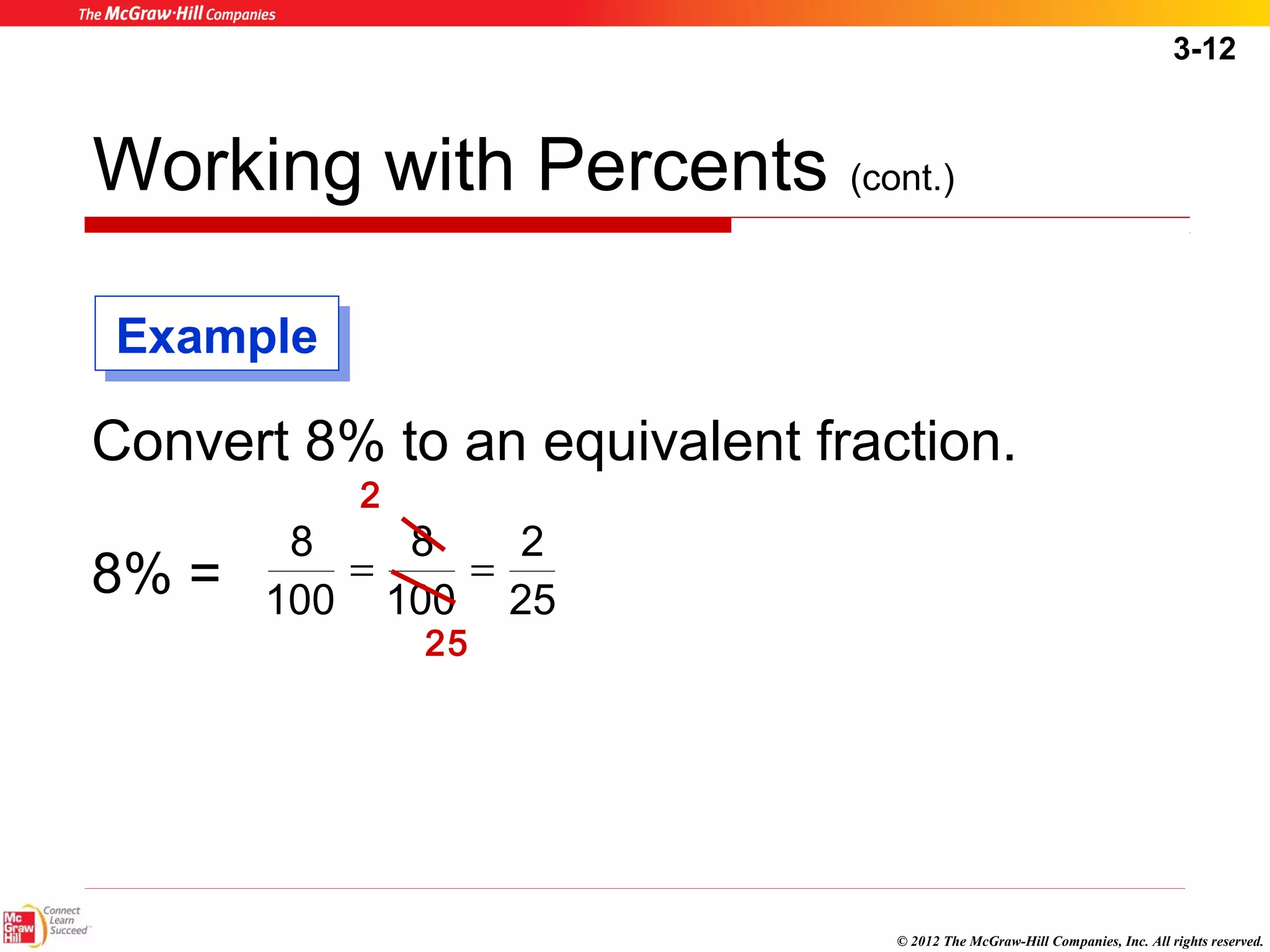
Convert 8% to an equivalent fraction. 
8% = 
© 2012 The McGraw-Hill Companies, Inc. All rights reserved. 
EExxaammppllee 
2 
25 
8 = 8 
= 
100 
100 
2 
25
3-13 
Converting Values To and from a 
Percent (cont.) 
RRuullee 33--44 To convert a fraction to a 
percent: 
1. convert the fraction to a decimal; 
2. round to the nearest hundredth; 
3. then follow the rule for converting a 
© 2012 The McGraw-Hill Companies, Inc. All rights reserved. 
decimal to a percent.
3-14 
Converting Values To and from a 
Percent (cont.) 
© 2012 The McGraw-Hill Companies, Inc. All rights reserved. 
EExxaammppllee 
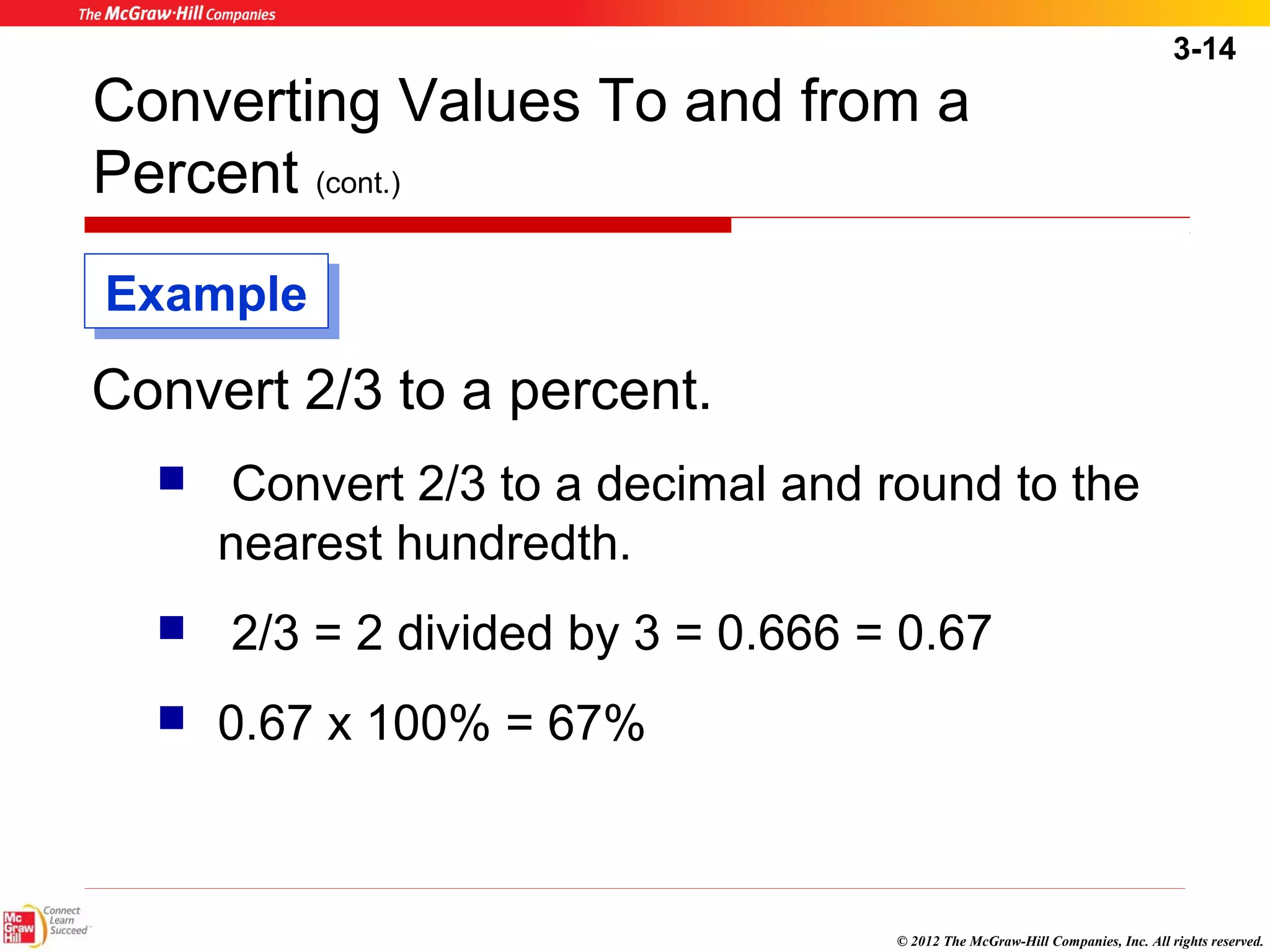
Convert 2/3 to a percent. 
 Convert 2/3 to a decimal and round to the 
nearest hundredth. 
 2/3 = 2 divided by 3 = 0.666 = 0.67 
 0.67 x 100% = 67%
3-15 
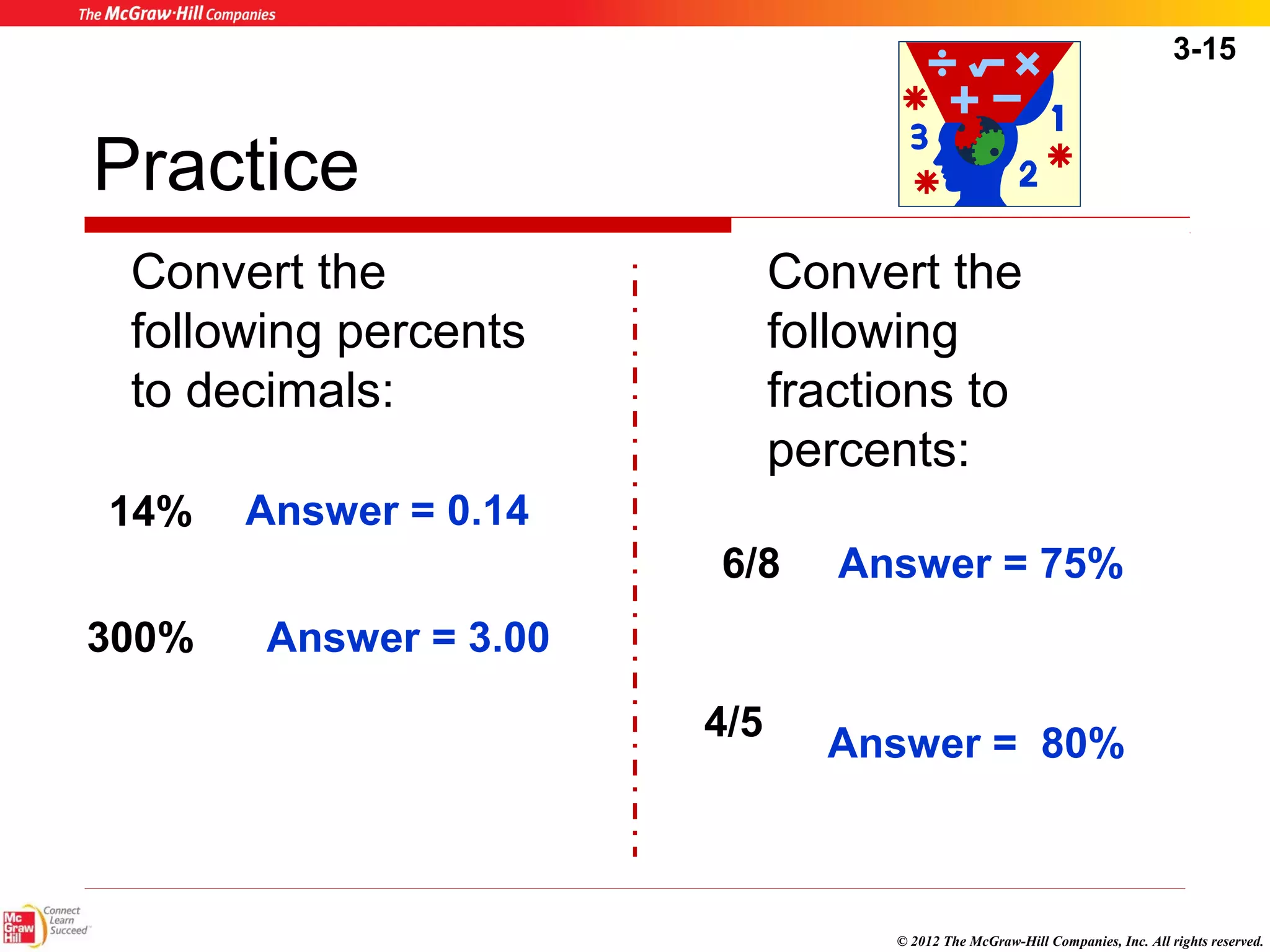
Answer = 75% 
© 2012 The McGraw-Hill Companies, Inc. All rights reserved. 
Practice 
Convert the 
following percents 
to decimals: 
Convert the 
following 
fractions to 
percents: 
Answer = 0.14 
14% 
300% Answer = 3.00 
6/8 
4/5 Answer = 80%
3-16 
© 2012 The McGraw-Hill Companies, Inc. All rights reserved. 
Ratios 
 The relationship of a part to the whole 
 relates a quantity of liquid drug to a quantity 
of solution; 
 is used to calculate dosages of dry 
medication such as tablets.
3-17 
© 2012 The McGraw-Hill Companies, Inc. All rights reserved. 
Ratios (cont.) 
 Like a fraction, a ratio has two parts. 
 The first part = numerator. 
 The second part = denominator. 
 The two parts are separated by a colon.
3-18 
Converting Values To and 
From a Ratio 
RRuullee 33--55 
Reduce a ratio as you would a fraction. 
Reduce 2:12 to its lowest terms. 
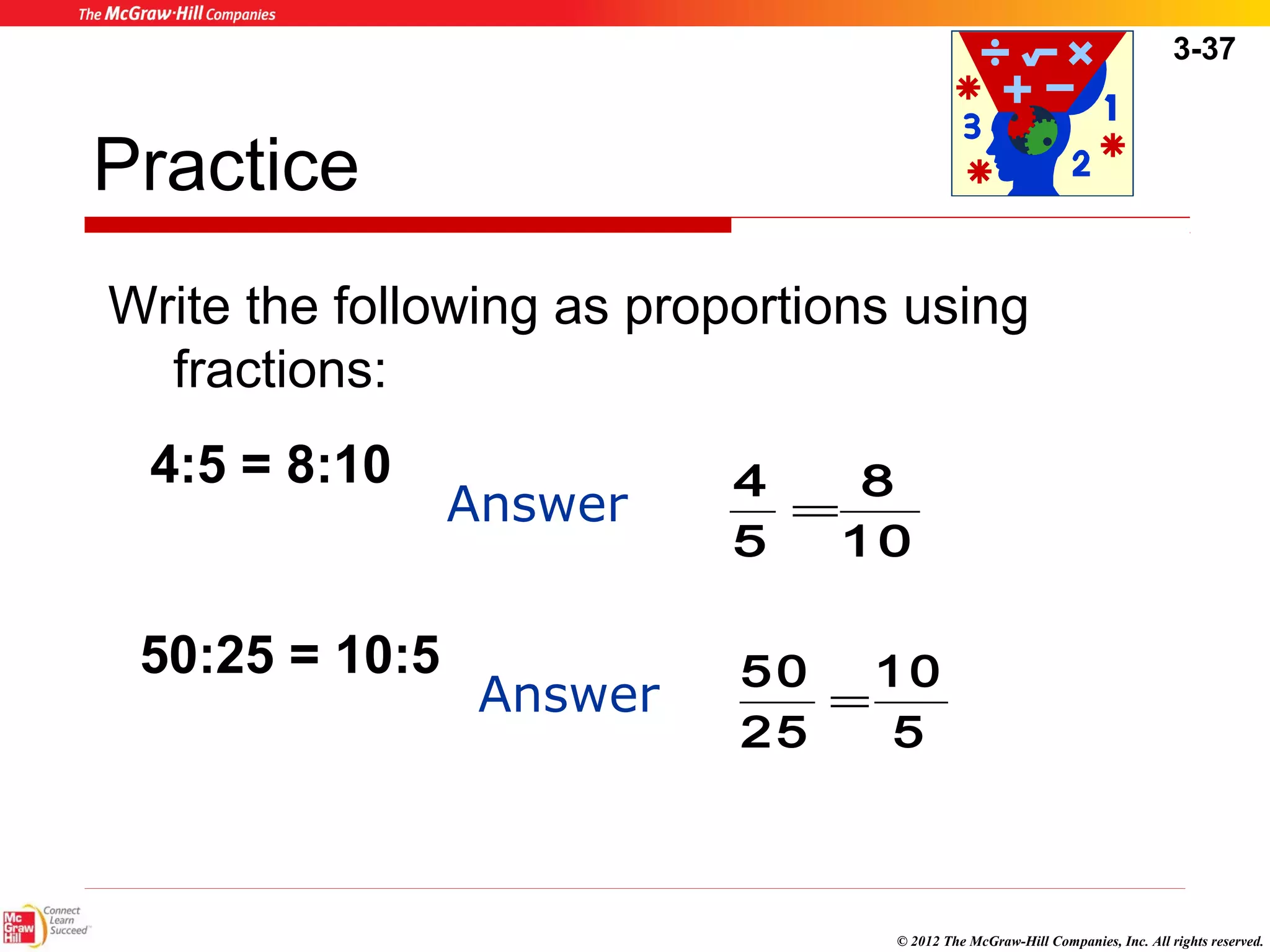
Both values 2 and 12 are divisible by 2. 
© 2012 The McGraw-Hill Companies, Inc. All rights reserved. 
2:12 is written 1:6 
EExxaammppllee
Converting Values To and 
From a Ratio. (cont.) 
RRuullee 33--66 
To convert a ratio to a fraction, write value A (1st 
3-19 
number) as the numerator and value B (2nd 
number) as the denominator, so that A:B = 
Convert the following ratio to a 
fraction: 
A 
4 
© 2012 The McGraw-Hill Companies, Inc. All rights reserved. 
4:5 = 
B 
5 
EExxaammppllee
3-20 
Converting Values To and 
From a Ratio.(cont.) 
RRuullee 33--77 
To convert a fraction to a ratio, write the 
numerator as the 1st value A and the 
denominator as the 2nd value B. 
© 2012 The McGraw-Hill Companies, Inc. All rights reserved. 
A 
= A:B B
3-21 
Converting Values To and 
From a Ratio (con’t) 
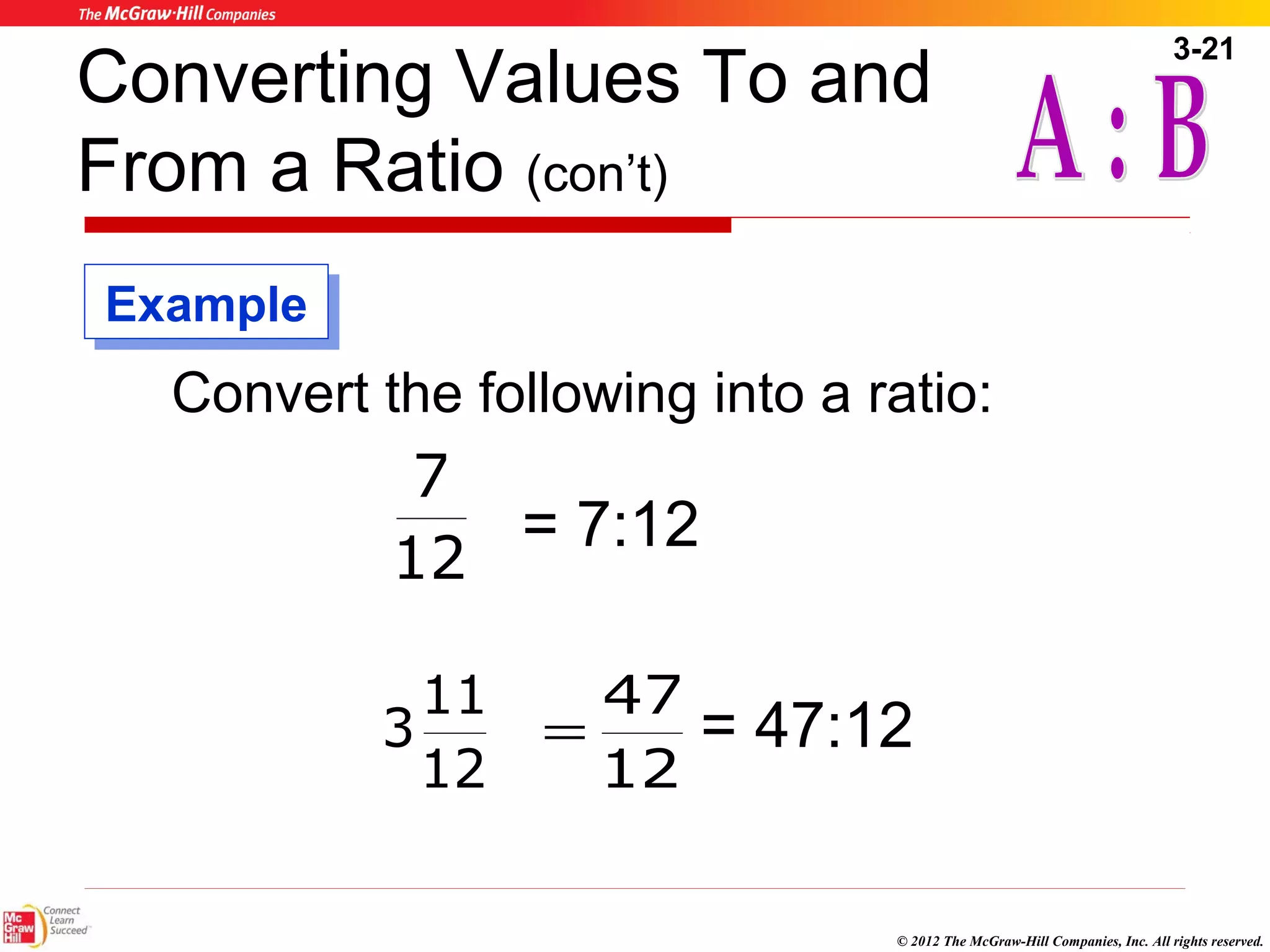
Convert the following into a ratio: 
11 
3 = 47:12 
© 2012 The McGraw-Hill Companies, Inc. All rights reserved. 
7 
12 = 7:12 
12 
EExxaammppllee 
47 
= 
12
3-22 
Converting Values To and 
From a Ratio. (cont.) 
RRuullee 33--88 To convert a ratio to a decimal: 
1. write the ratio as a fraction; 
2. convert the fraction to a decimal. 
© 2012 The McGraw-Hill Companies, Inc. All rights reserved.
3-23 
Converting Values To and From 
a Ratio (cont.) 
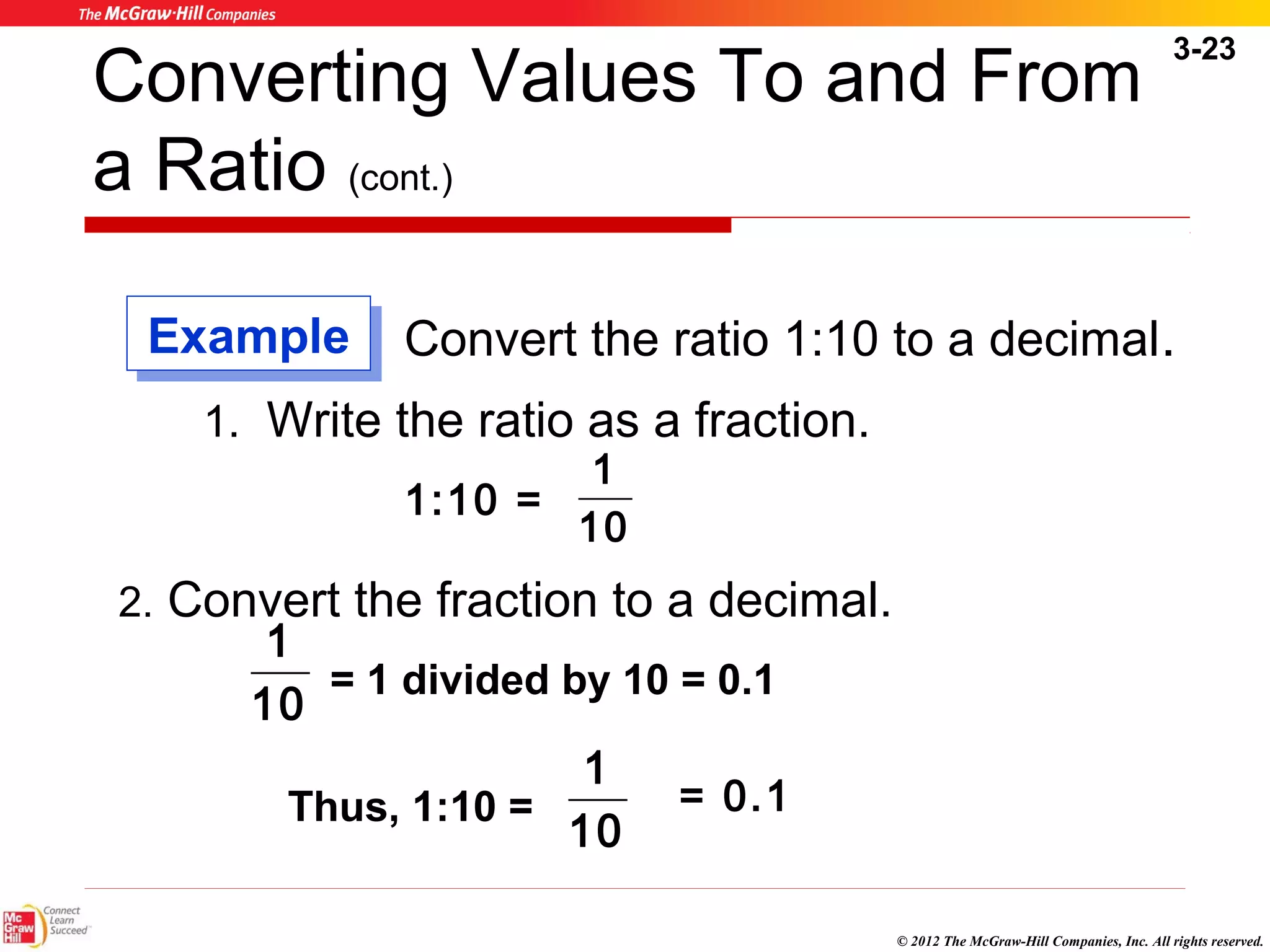
Convert the ratio 1:10 to a decimal. 
© 2012 The McGraw-Hill Companies, Inc. All rights reserved. 
1. Write the ratio as a fraction. 
1 
1:10 = 10 
EExxaammppllee 
2. Convert the fraction to a decimal. 
1 
10 
= 1 divided by 10 = 0.1 
1 = 0.1 
Thus, 1:10 = 10
3-24 
Converting Values To and 
From a Ratio (cont.) 
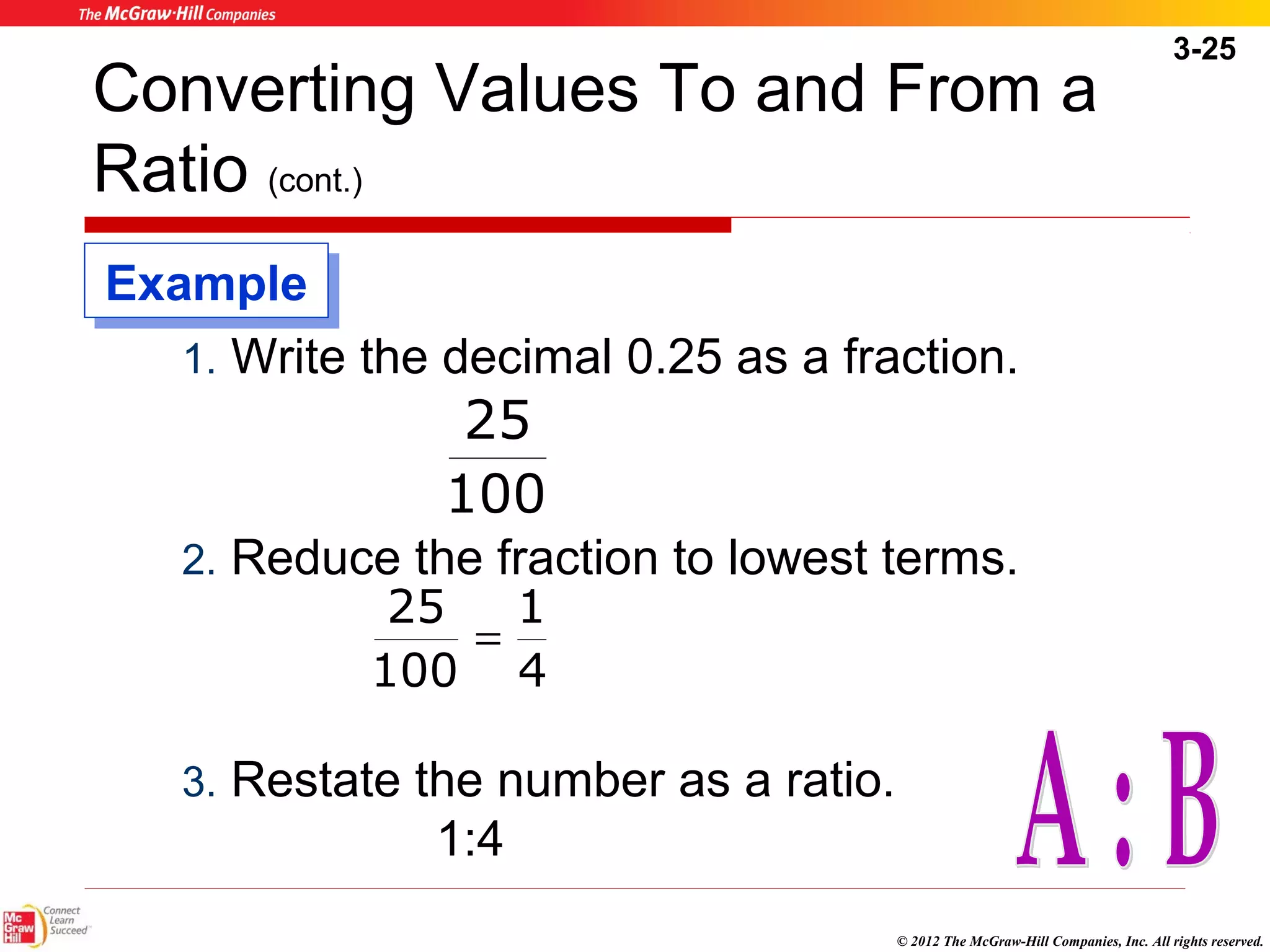
RRuullee 33--99 To convert a decimal to a ratio: 
1. write the decimal as a fraction; 
2. reduce the fraction to lowest terms; 
3. restate the fraction as ratio. 
© 2012 The McGraw-Hill Companies, Inc. All rights reserved.
3-25 
Converting Values To and From a 
Ratio (cont.) 
1. Write the decimal 0.25 as a fraction. 
25 
100 
2. Reduce the fraction to lowest terms. 
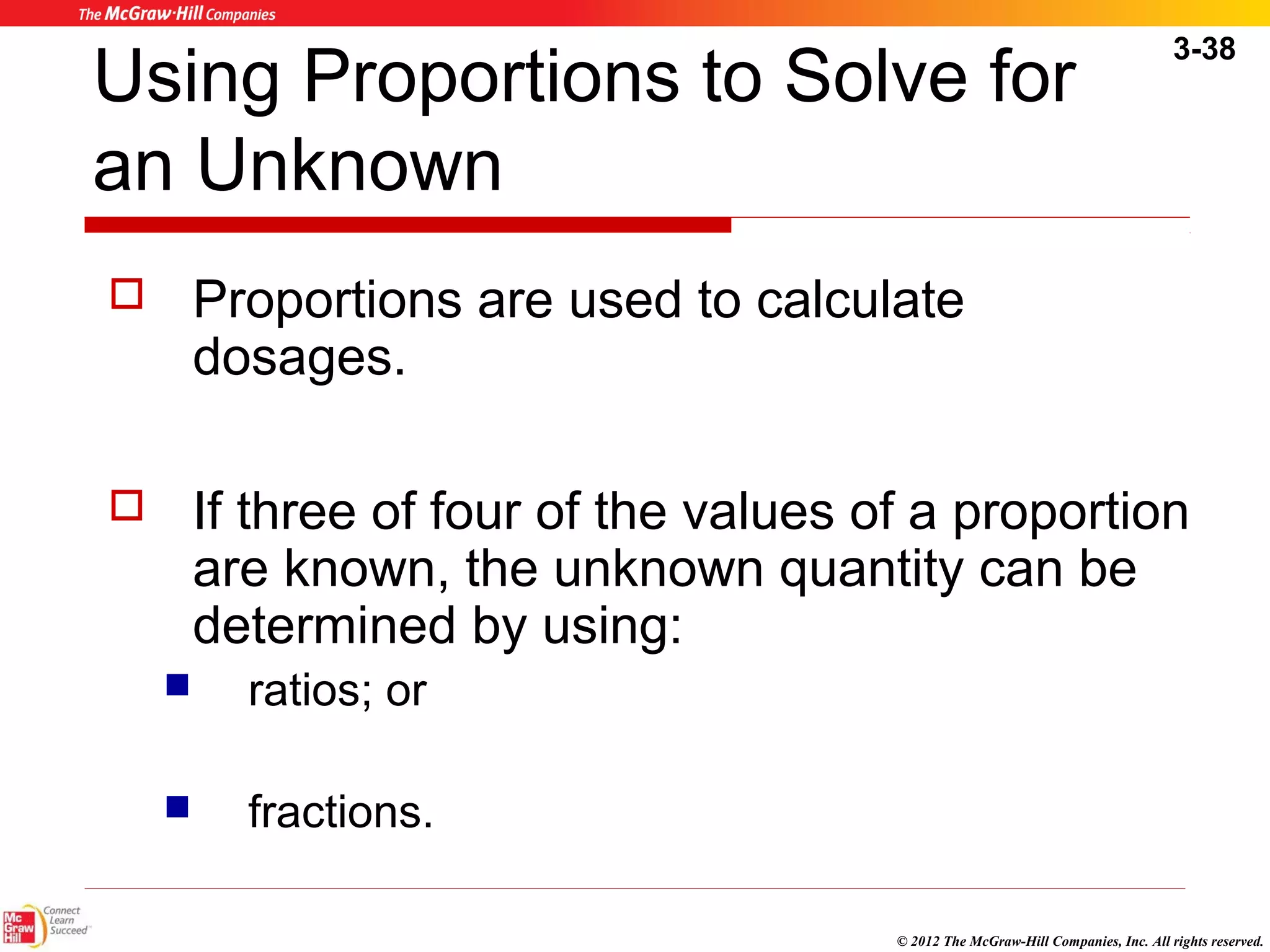
© 2012 The McGraw-Hill Companies, Inc. All rights reserved. 
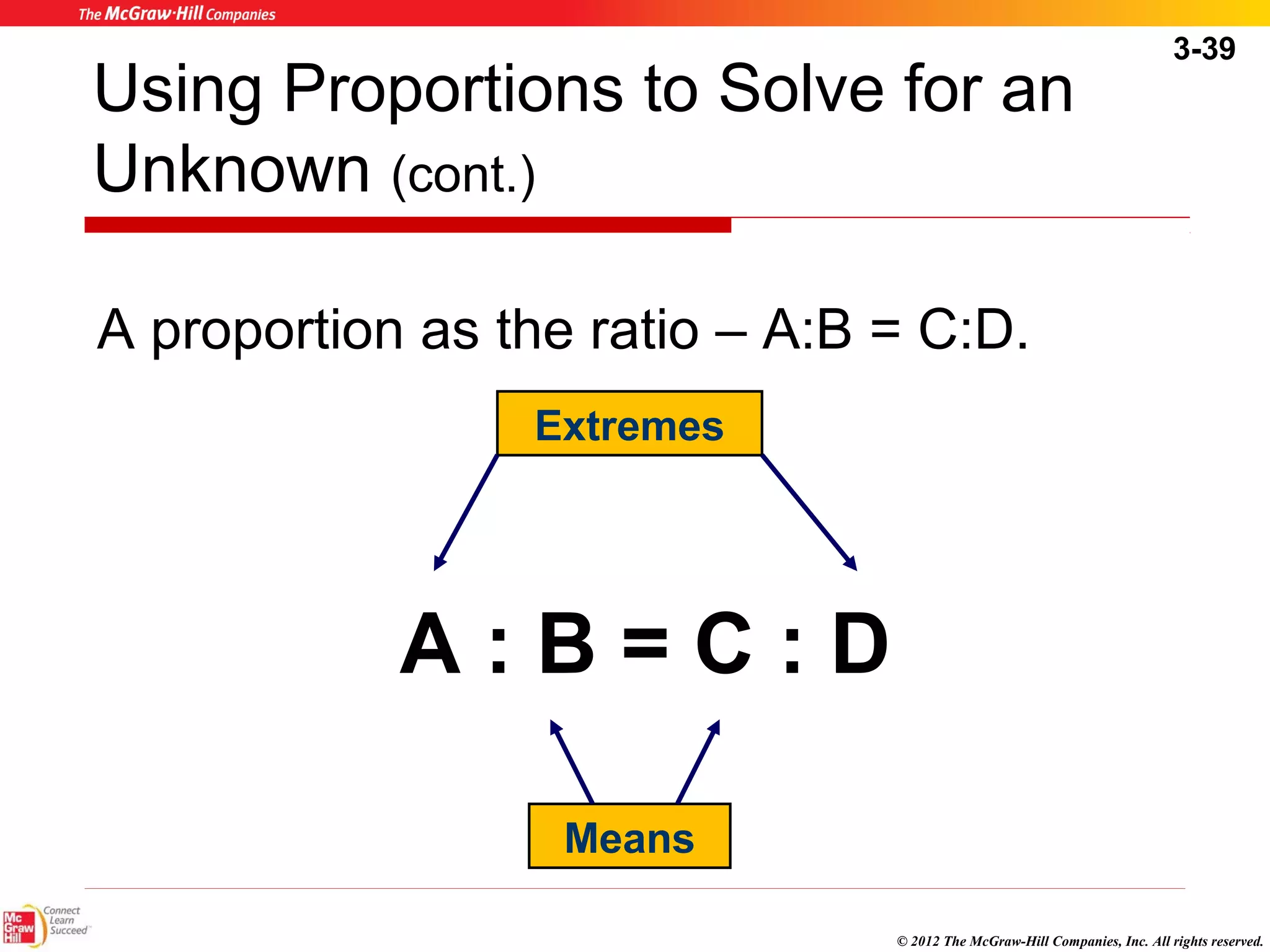
1 
25 
3. Restate the number as a ratio. 
1:4 
4 
100 
= 
EExxaammppllee
3-26 
Converting Values To 
and From a Ratio (cont.) 
RRuullee 33--1100 To convert a ratio to a percent: 
© 2012 The McGraw-Hill Companies, Inc. All rights reserved. 
1. convert the ratio to a decimal; 
2. write the decimal as a percent by multiplying 
the decimal by 100 and adding the % 
symbol.
3-27 
Converting Values To and 
From a Ratio (cont.) 
© 2012 The McGraw-Hill Companies, Inc. All rights reserved. 
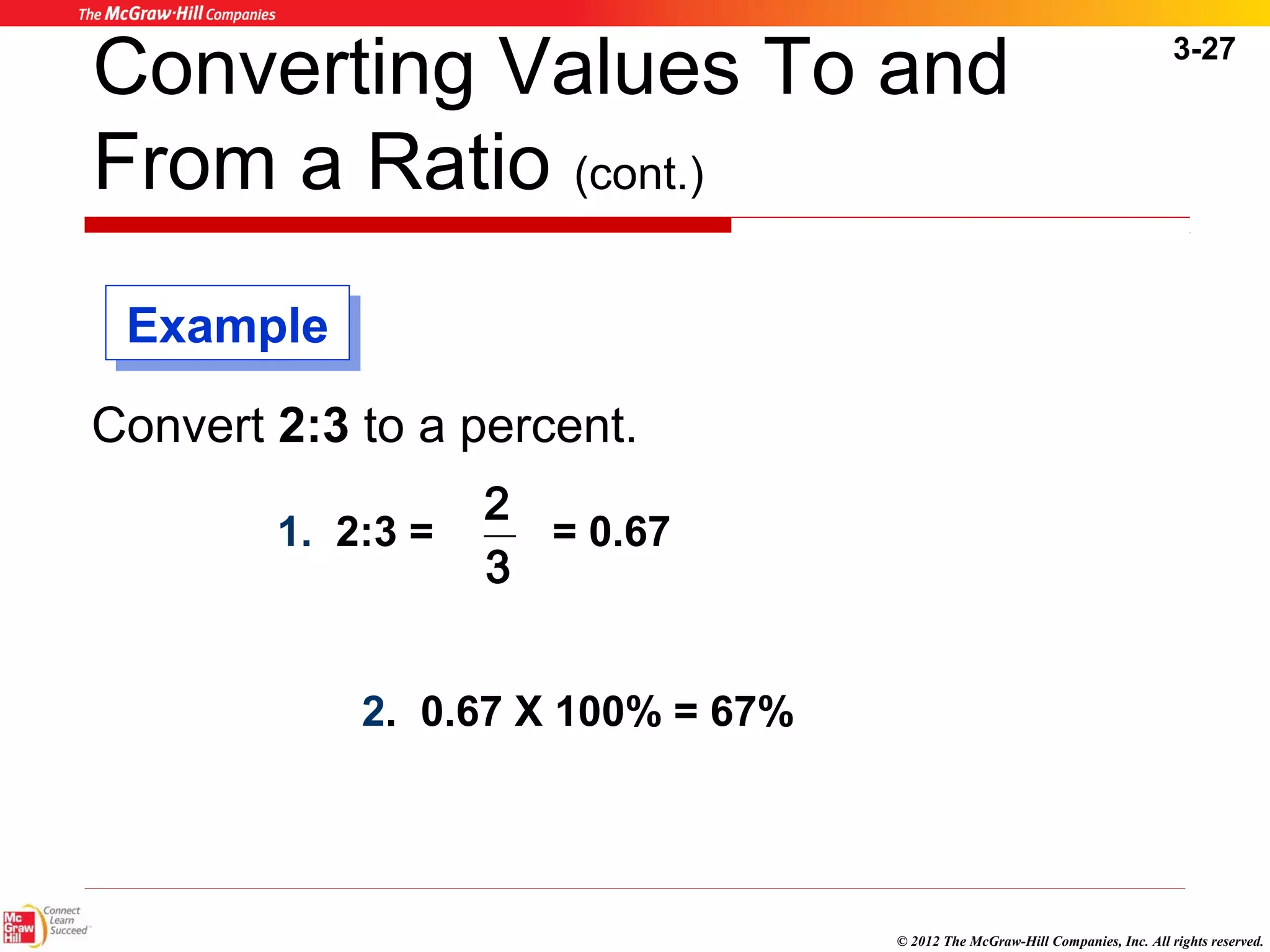
Convert 2:3 to a percent. 
1. 2:3 = 
2 = 0.67 
3 
2. 0.67 X 100% = 67% 
EExxaammppllee
3-28 
Converting Values To and From 
a Ratio (cont.) 
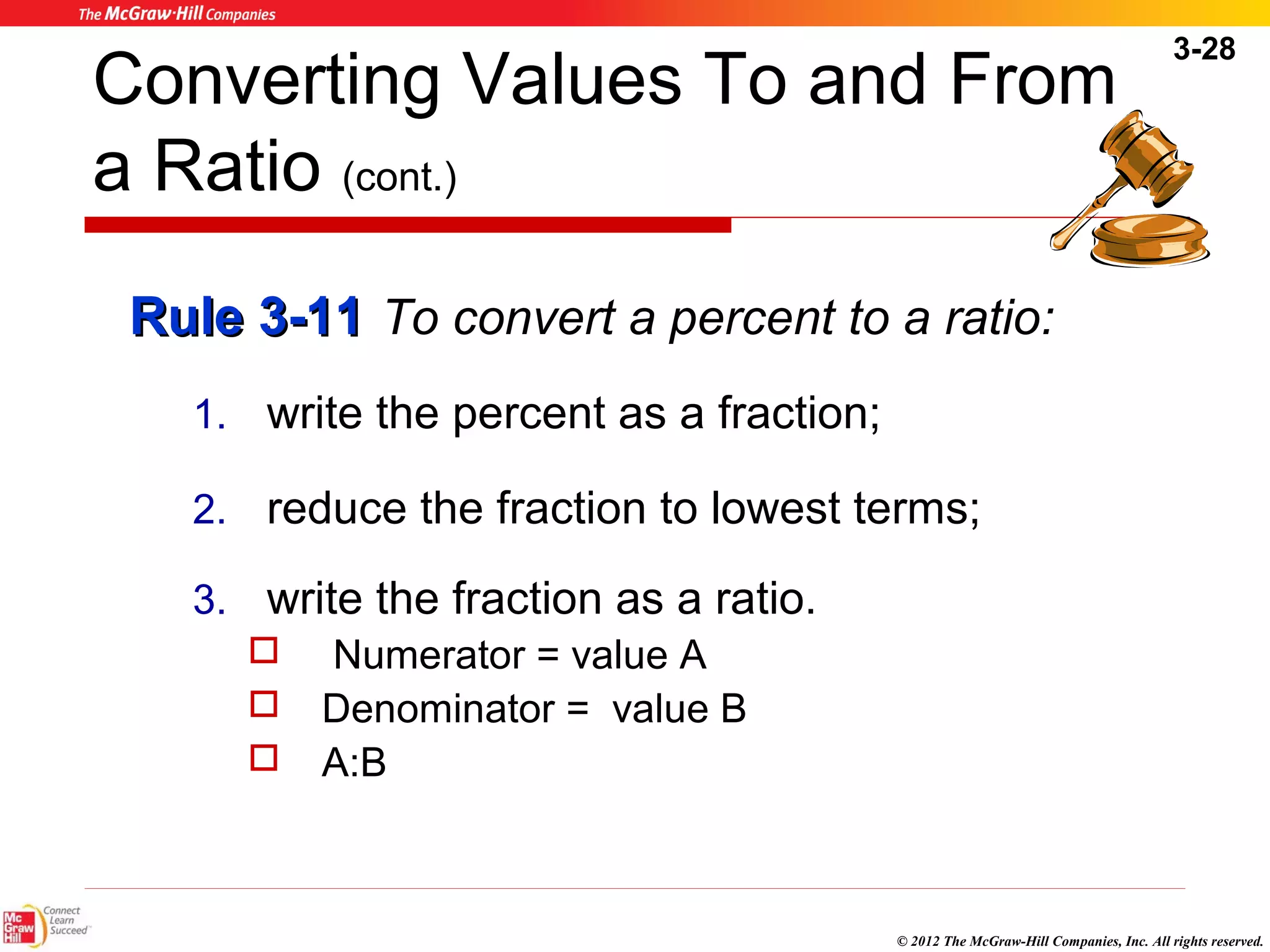
RRuullee 33--1111 To convert a percent to a ratio: 
1. write the percent as a fraction; 
2. reduce the fraction to lowest terms; 
3. write the fraction as a ratio. 
© 2012 The McGraw-Hill Companies, Inc. All rights reserved. 
 Numerator = value A 
 Denominator = value B 
 A:B
3-29 
Converting Values To and 
From a Ratio (cont.) 
© 2012 The McGraw-Hill Companies, Inc. All rights reserved. 
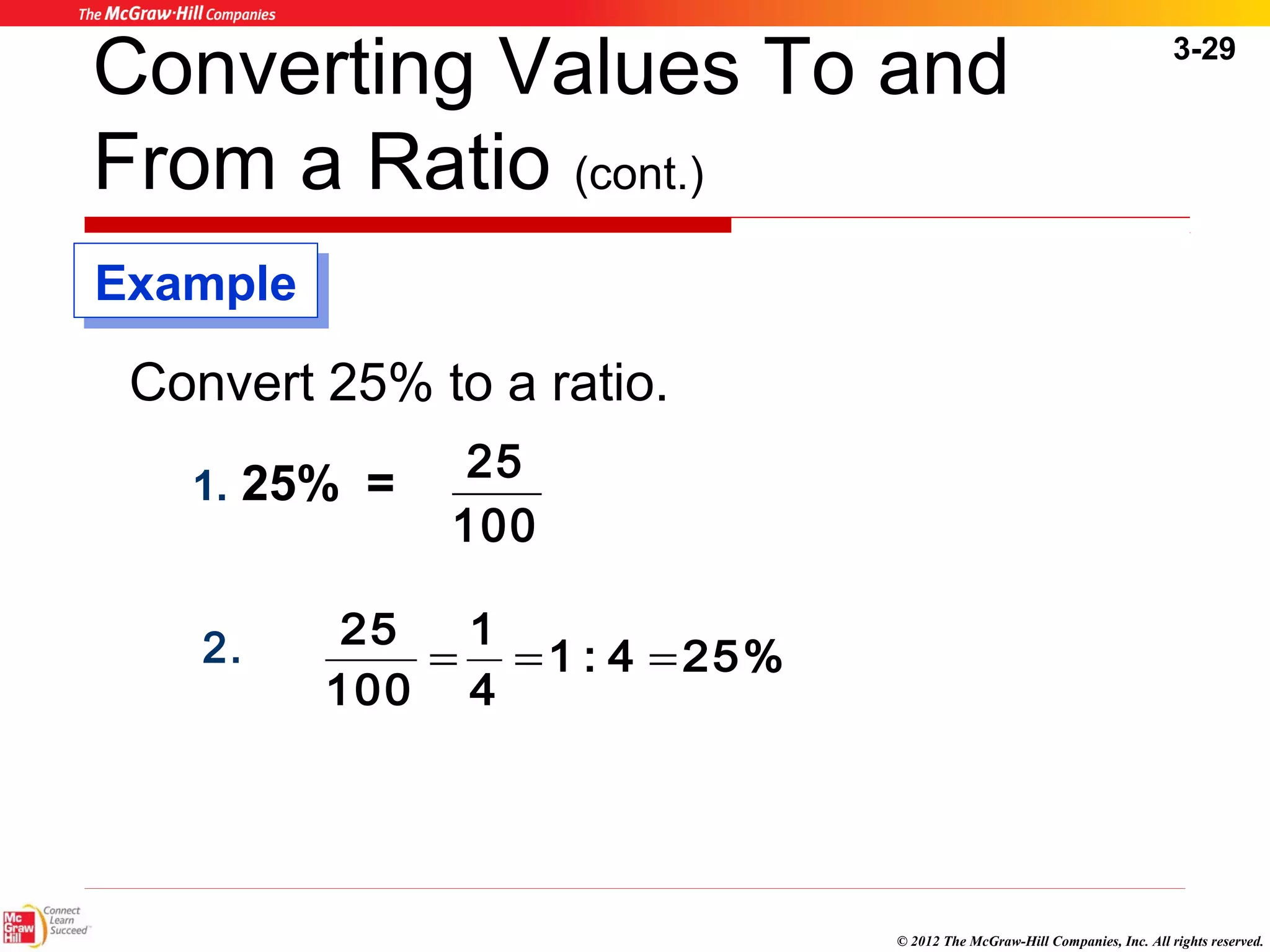
Convert 25% to a ratio. 
1. 25% = 
25 
100 
2. 25 = = = 
1 : 4 25% 
1 
4 
100 
EExxaammppllee
3-30 
Practice 
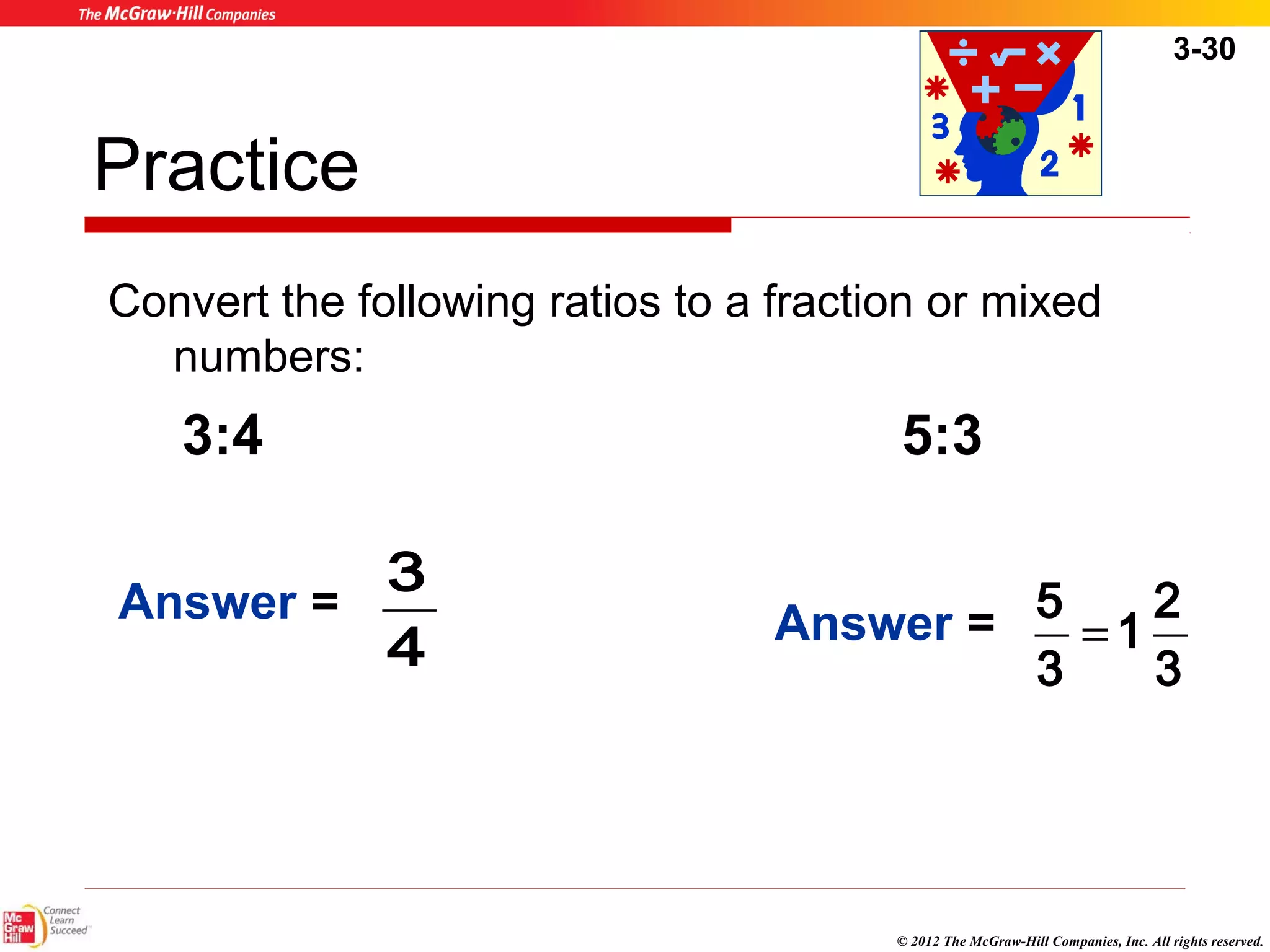
Convert the following ratios to a fraction or mixed 
numbers: 
3:4 5:3 
1 2 
5 = 
© 2012 The McGraw-Hill Companies, Inc. All rights reserved. 
Answer = 
3 
4 
Answer = 
3 
3
3-31 
Practice 
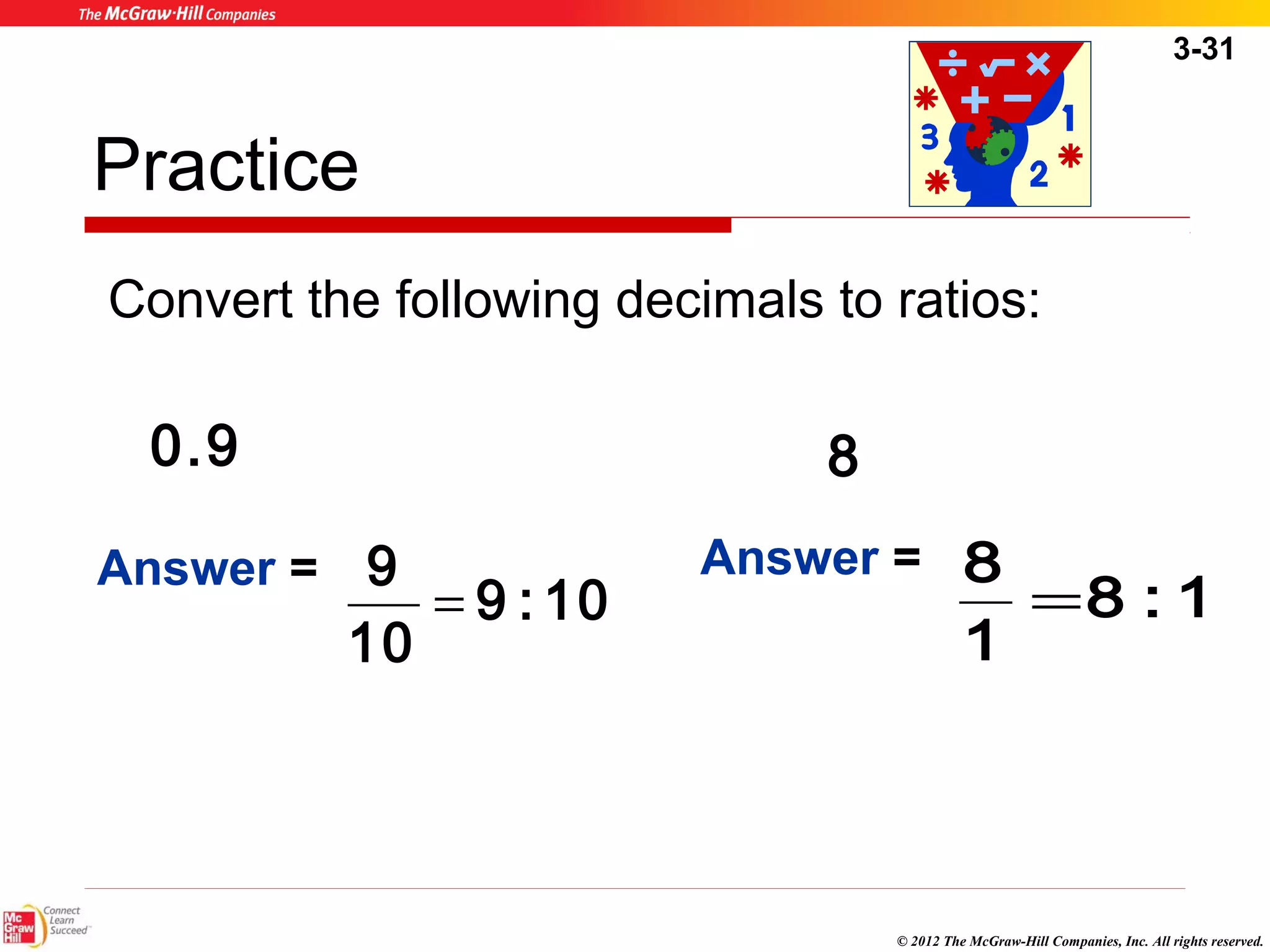
Convert the following decimals to ratios: 
0.9 8 
Answer = 9 : 10 
8 = 
© 2012 The McGraw-Hill Companies, Inc. All rights reserved. 
9 = 
10 
Answer = 8 : 1 
1
3-32 
Writing Proportions 
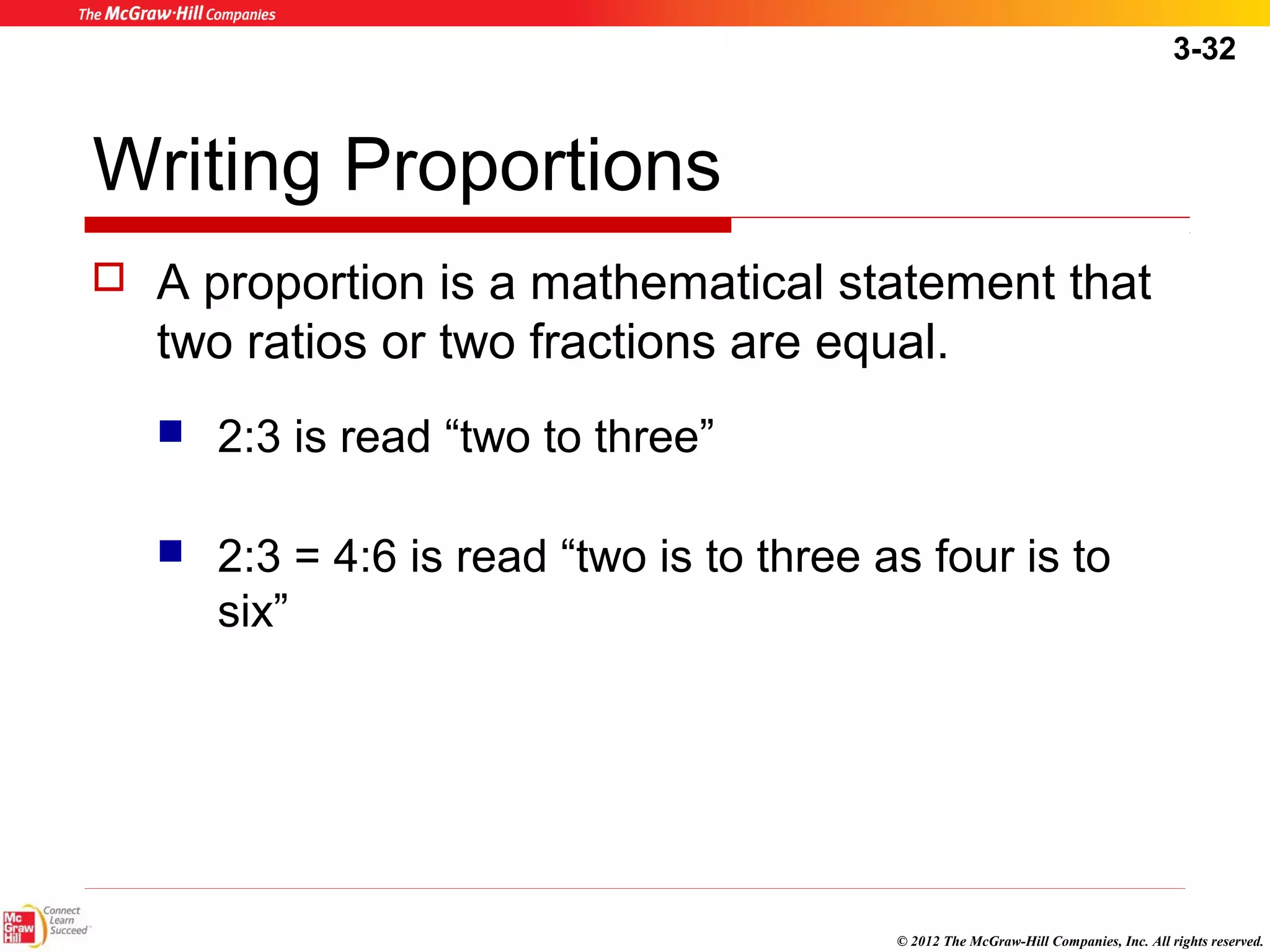
 A proportion is a mathematical statement that 
two ratios or two fractions are equal. 
© 2012 The McGraw-Hill Companies, Inc. All rights reserved. 
 2:3 is read “two to three” 
 2:3 = 4:6 is read “two is to three as four is to 
six”
3-33 
© 2012 The McGraw-Hill Companies, Inc. All rights reserved. 
Writing Proportions (cont.) 
RRuullee 33--1122 
To change a proportion from 
ratios to fractions, convert both 
ratios to fractions.
3-34 
50 
© 2012 The McGraw-Hill Companies, Inc. All rights reserved. 
Writing Proportions (cont.) 
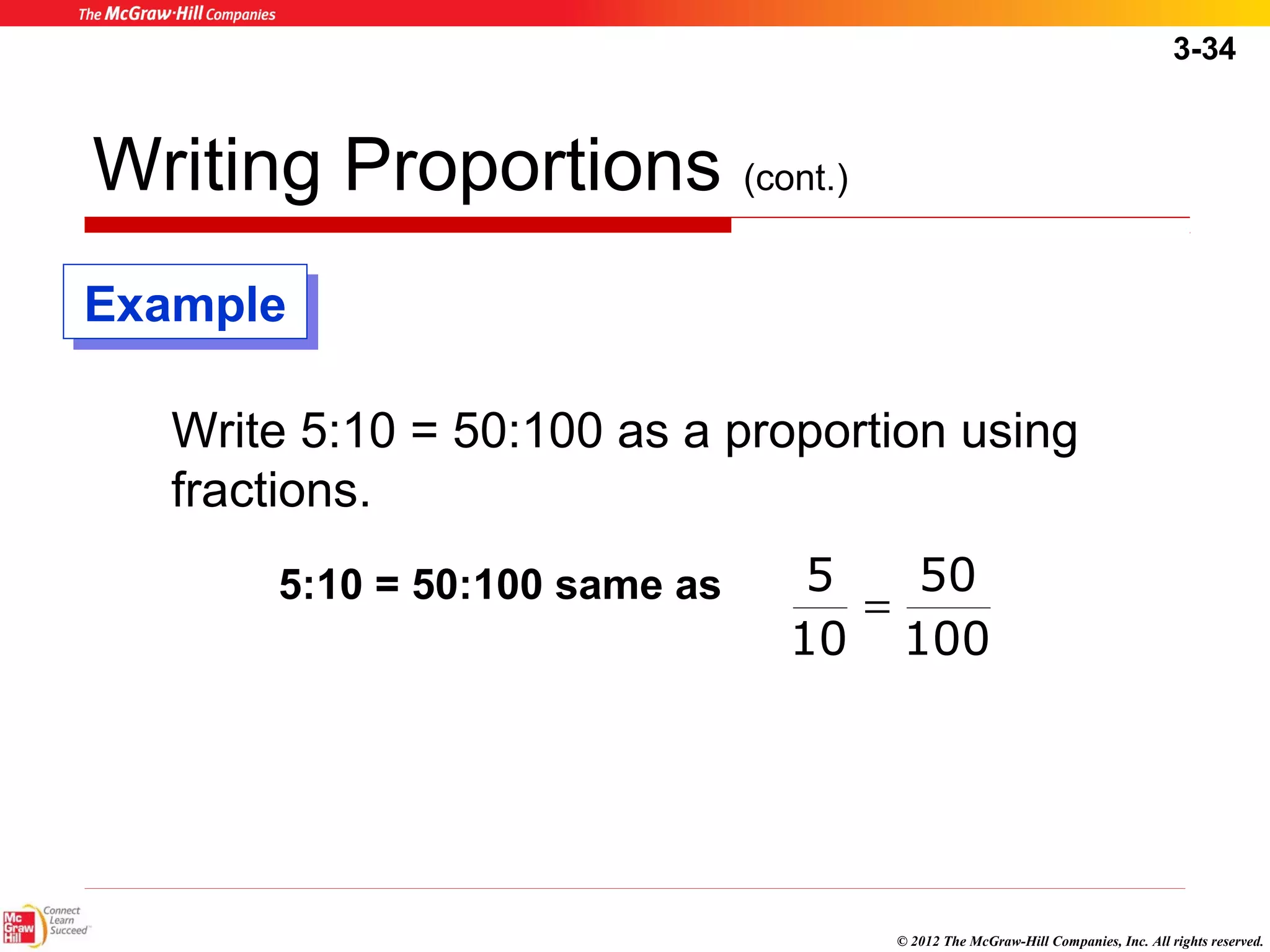
Write 5:10 = 50:100 as a proportion using 
fractions. 
100 
5 
5:10 = 50:100 same as = 
10 
EExxaammppllee
3-35 
© 2012 The McGraw-Hill Companies, Inc. All rights reserved. 
Writing Proportions (cont.) 
RRuullee 33--1133 
To change a proportion from 
fractions to ratios, convert each 
fraction to a ratio.
3-36 
© 2012 The McGraw-Hill Companies, Inc. All rights reserved. 
Writing Proportions (cont.) 
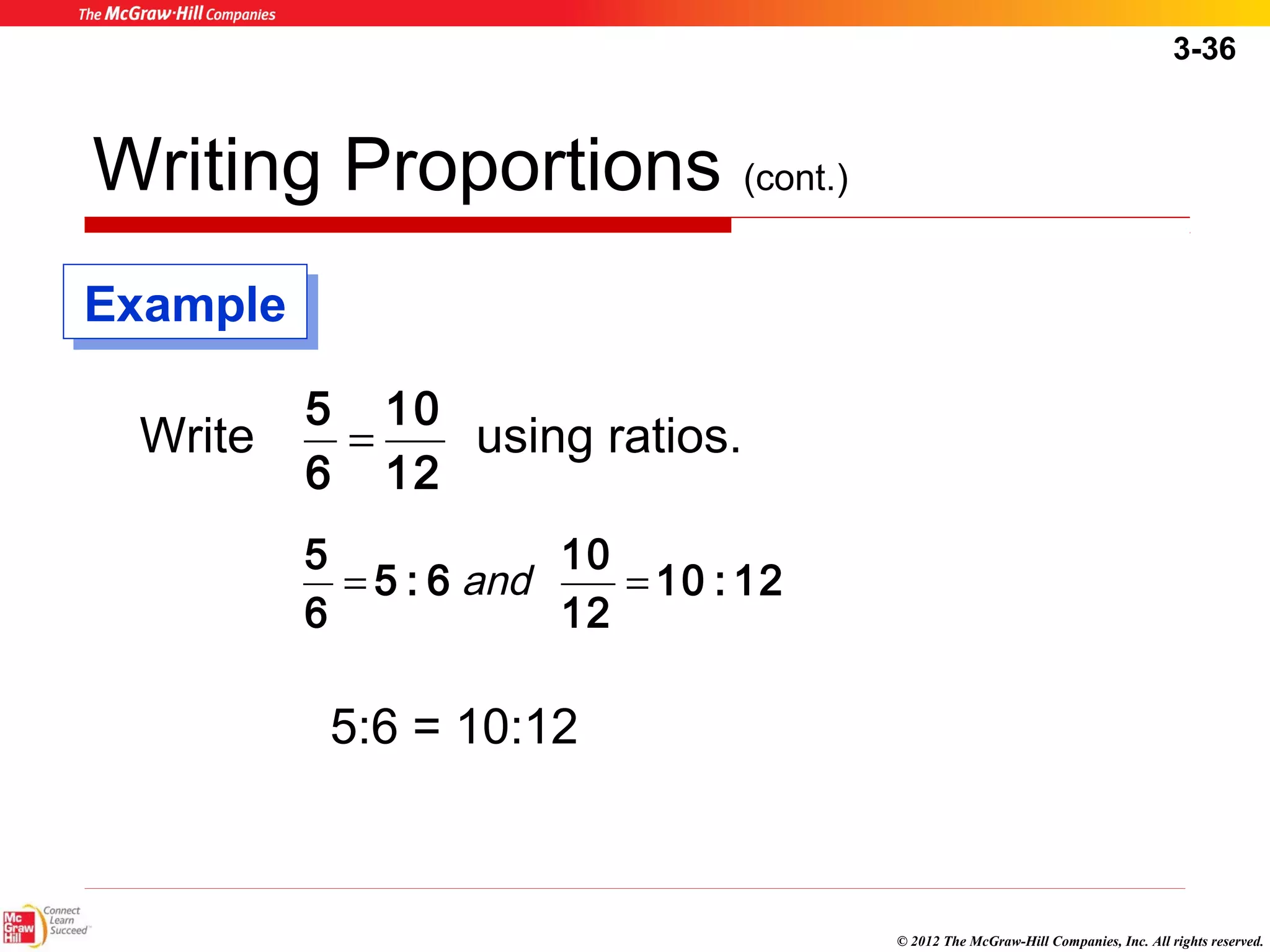
10 
5 = 
Write using ratios. 
12 
6 
10 : 12 
5 : 6 10 
12 
6 5 
= and = 
5:6 = 10:12 
EExxaammppllee
3-37 
Write the following as proportions using 
fractions: 
10 
© 2012 The McGraw-Hill Companies, Inc. All rights reserved. 
Practice 
4:5 = 8:10 Answer 
50:25 = 10:5 
8 
10 
4 = 
5 
Answer 
5 
50 = 
25
3-38 
Using Proportions to Solve for 
an Unknown 
 Proportions are used to calculate 
© 2012 The McGraw-Hill Companies, Inc. All rights reserved. 
dosages. 
 If three of four of the values of a proportion 
are known, the unknown quantity can be 
determined by using: 
 ratios; or 
 fractions.
3-39 
Using Proportions to Solve for an 
Unknown (cont.) 
A proportion as the ratio – A:B = C:D. 
© 2012 The McGraw-Hill Companies, Inc. All rights reserved. 
Extremes 
A : B = C : D 
Means
3-40 
Using Proportions to Solve for an 
Unknown (cont.) 
RRuullee 33--1144 To determine if a proportion is 
© 2012 The McGraw-Hill Companies, Inc. All rights reserved. 
true: 
1. multiply the means; 
2. multiply the extremes; 
3. compare the product of the means and the 
product of the extremes.
3-41 
Using Proportions to Solve for an 
Unknown (cont.) 
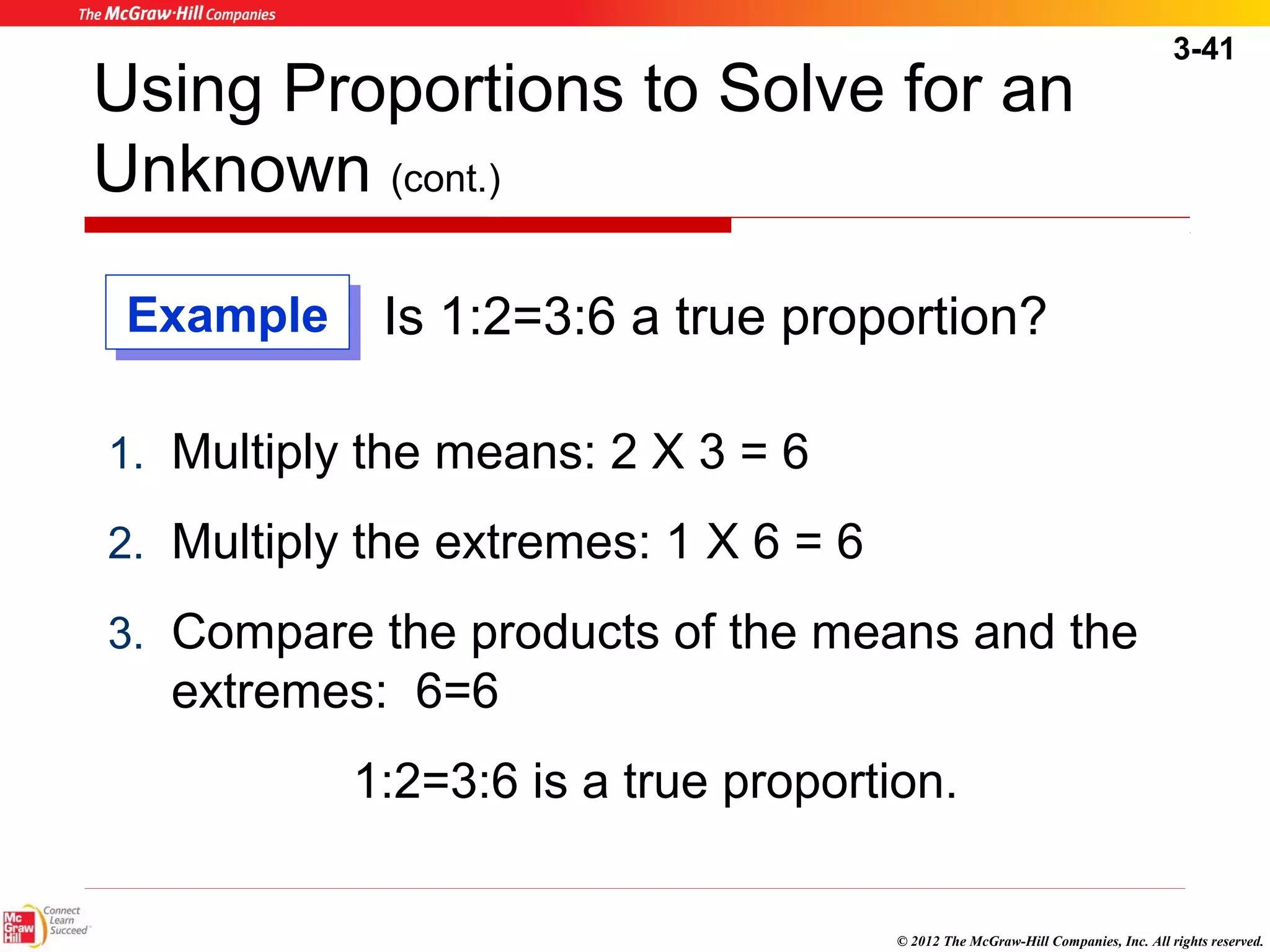
Is 1:2=3:6 a true proportion? 
1. Multiply the means: 2 X 3 = 6 
2. Multiply the extremes: 1 X 6 = 6 
3. Compare the products of the means and the 
extremes: 6=6 
1:2=3:6 is a true proportion. 
© 2012 The McGraw-Hill Companies, Inc. All rights reserved. 
EExxaammppllee
3-42 
Using Proportions to Solve for an 
Unknown (con’t) 
RRuullee 33--1155 To find the unknown quantity in 
© 2012 The McGraw-Hill Companies, Inc. All rights reserved. 
a proportion: 
1. Write an equation: 
product of the means = product of the 
extremes 
2. Solve for the unknown quantity.
3-43 
Using Proportions to Solve for 
an Unknown (con’t) 
RRuullee 33--1155 (cont.) 
3. Restate the proportion, inserting the unknown 
quantity. 
3. Check your work. Determine if the ratio 
proportion is true. 
© 2012 The McGraw-Hill Companies, Inc. All rights reserved.
3-44 
Using Proportions to Solve for an 
Unknown (cont.) 
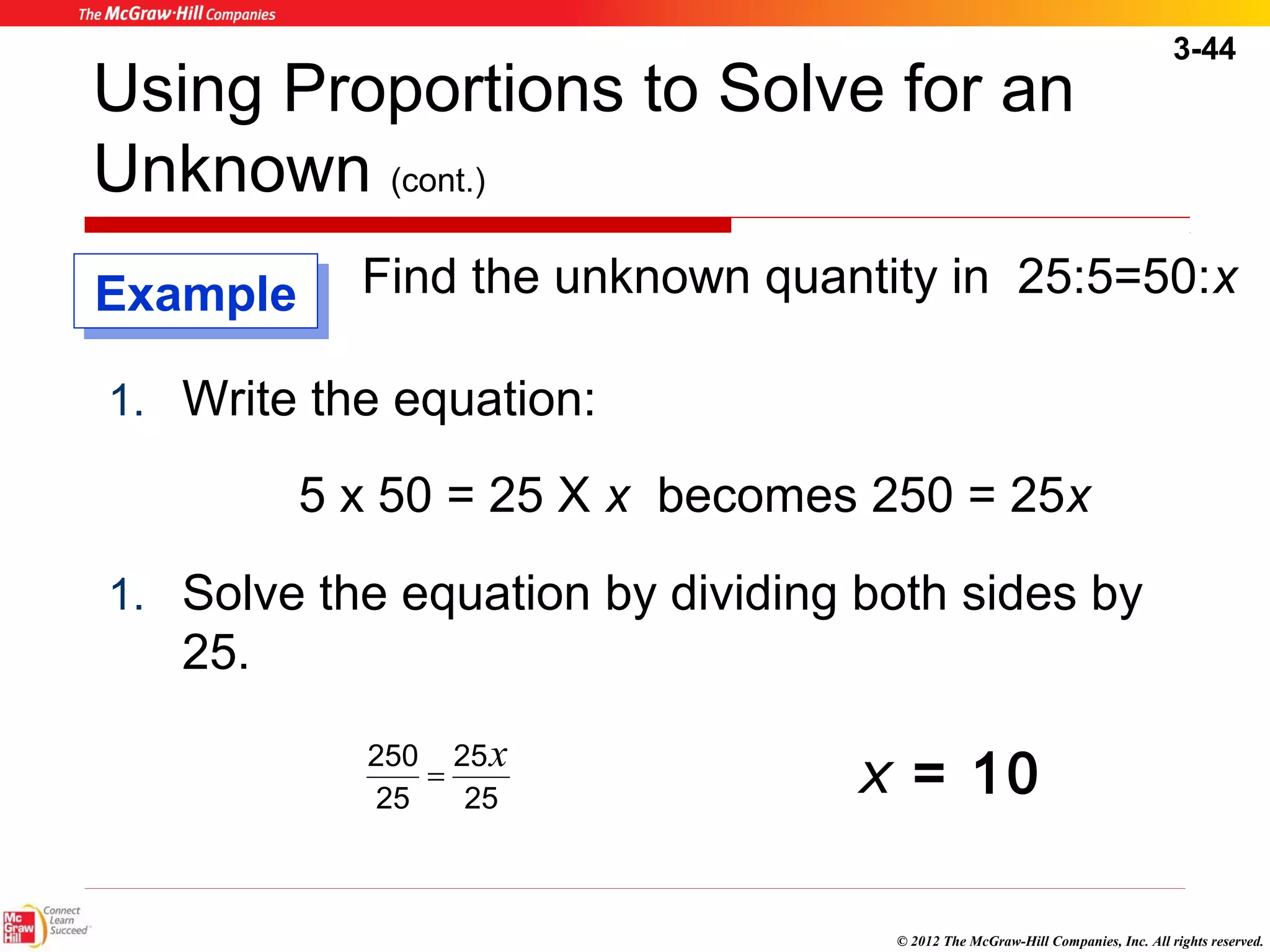
Find the unknown quantity in 25:5=50:x 
250 x = x = 10 
© 2012 The McGraw-Hill Companies, Inc. All rights reserved. 
1. Write the equation: 
5 x 50 = 25 X x becomes 250 = 25x 
1. Solve the equation by dividing both sides by 
25. 
25 
25 
25 
EExxaammppllee
3-45 
Using Proportions to Solve for 
an Unknown (cont.) 
EExxaammppllee ((ccoonntt..)) 
3. Restate the proportion, inserting the 
© 2012 The McGraw-Hill Companies, Inc. All rights reserved. 
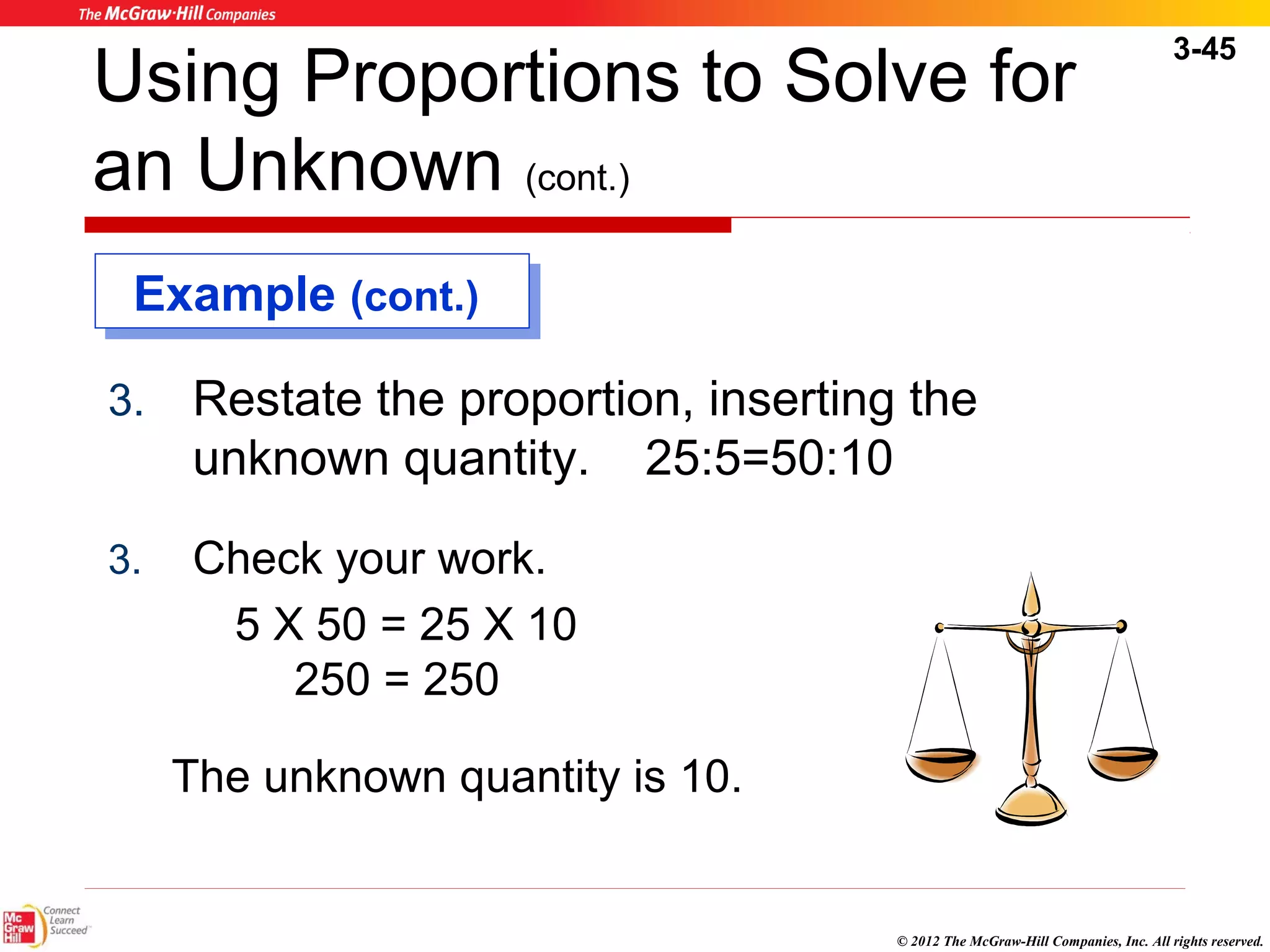
unknown quantity. 25:5=50:10 
3. Check your work. 
5 X 50 = 25 X 10 
250 = 250 
The unknown quantity is 10.
3-46 
© 2012 The McGraw-Hill Companies, Inc. All rights reserved. 
EERRRROORR AALLEERRTT!! 
 Do not forget the units of measurement. 
 Including units in the dosage strength will help 
you avoid errors.
3-47 
Canceling Units in Proportions 
(cont.) 
RRuullee 33--1166 
1. If the units in the first part of the ratio in 
a proportion are the same, they can be 
canceled. 
© 2012 The McGraw-Hill Companies, Inc. All rights reserved.
3-48 
Canceling Units in Proportions 
(cont.) 
RRuullee 33--1166 (cont.) 
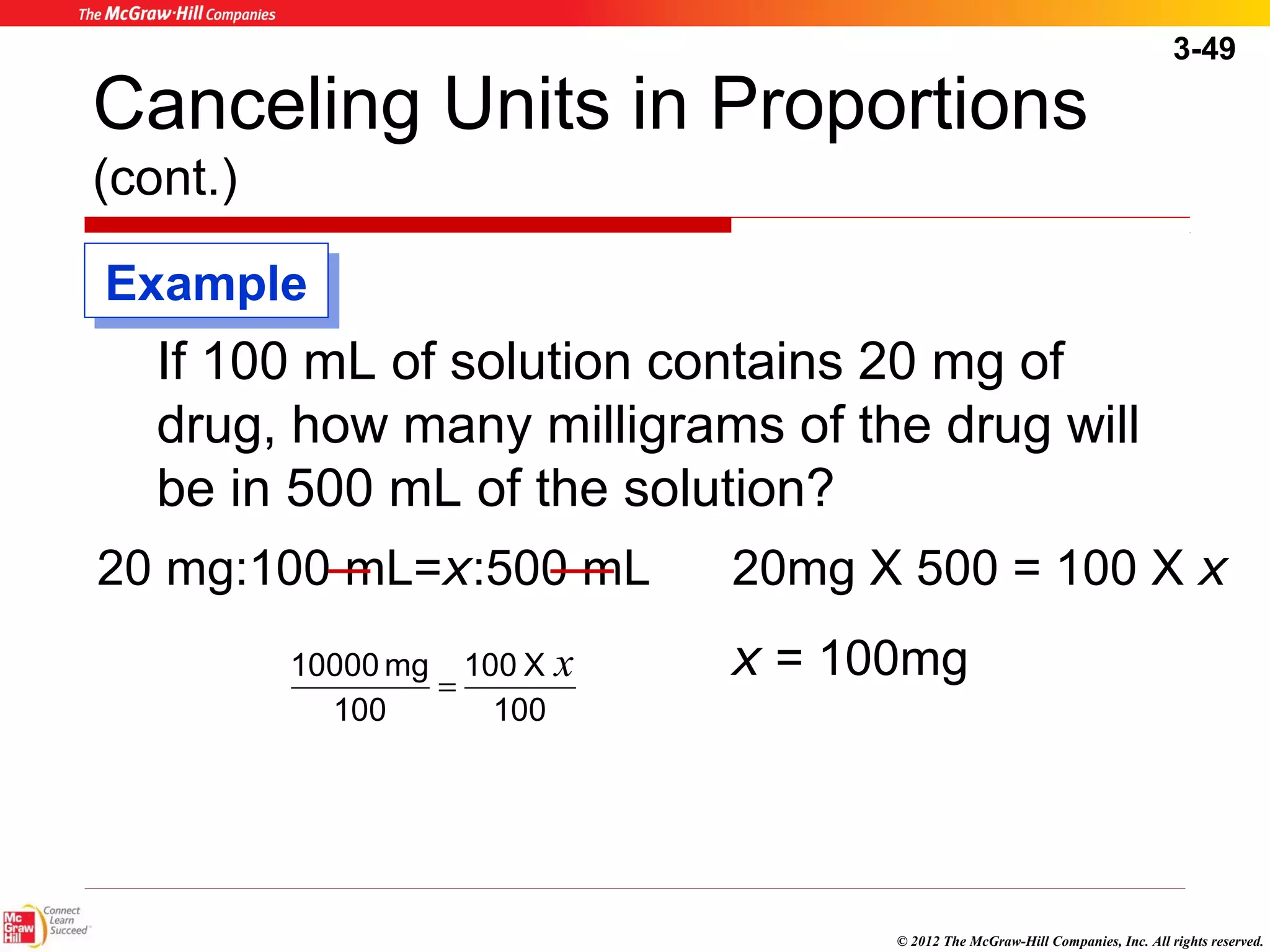
2. If the units in the second part of the ratio 
in a proportion are the same, they can 
be canceled. 
© 2012 The McGraw-Hill Companies, Inc. All rights reserved.
3-49 
Canceling Units in Proportions 
(cont.) 
If 100 mL of solution contains 20 mg of 
drug, how many milligrams of the drug will 
be in 500 mL of the solution? 
20 mg:100 mL=x:500 mL 20mg X 500 = 100 X x 
x = 100mg 
© 2012 The McGraw-Hill Companies, Inc. All rights reserved. 
10000 mg x = 
100 X 
100 
100 
EExxaammppllee
3-50 
Practice 
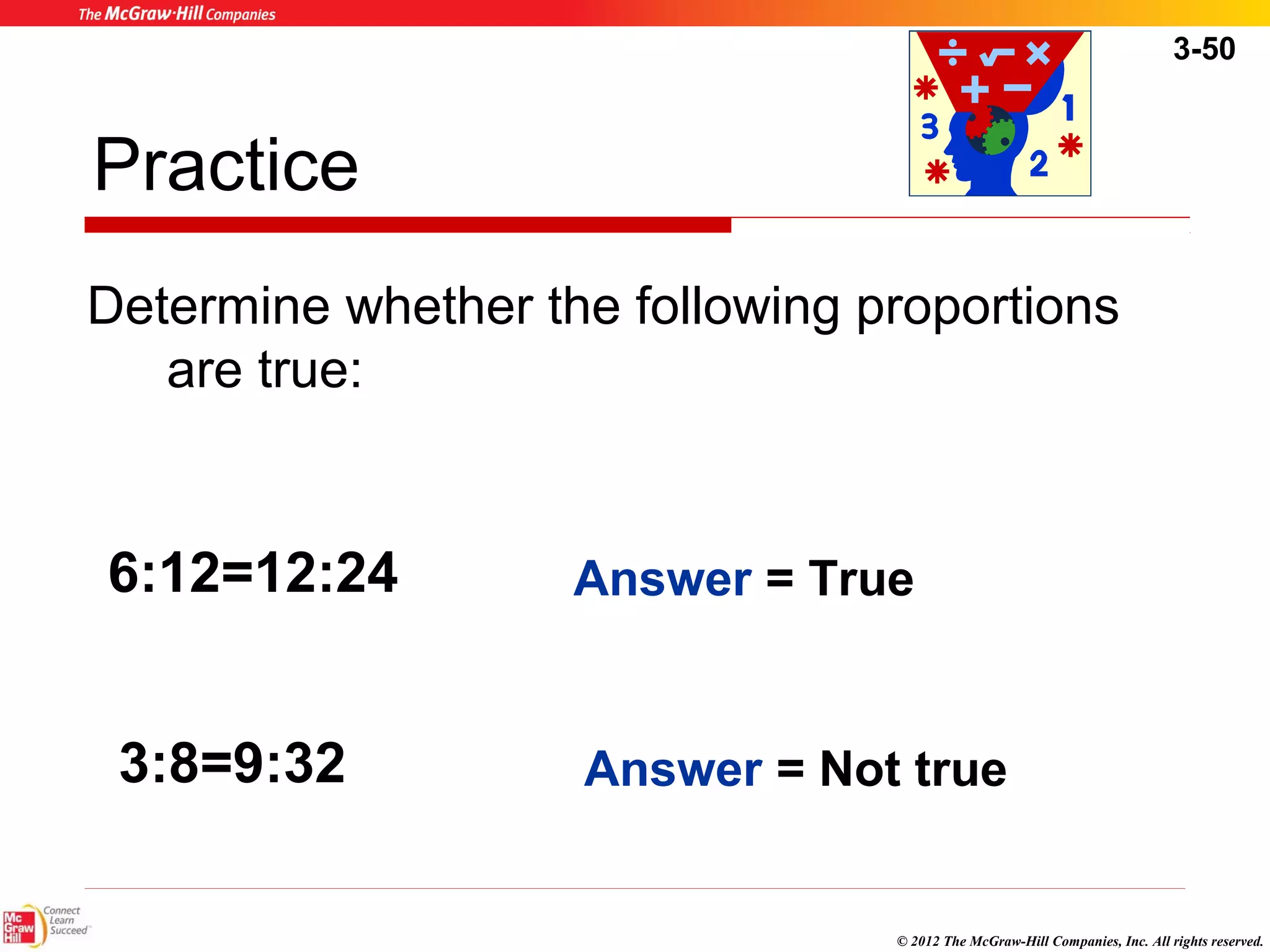
Determine whether the following proportions 
6:12=12:24 Answer = True 
© 2012 The McGraw-Hill Companies, Inc. All rights reserved. 
are true: 
3:8=9:32 
Answer = Not true
3-51 
© 2012 The McGraw-Hill Companies, Inc. All rights reserved. 
Practice 
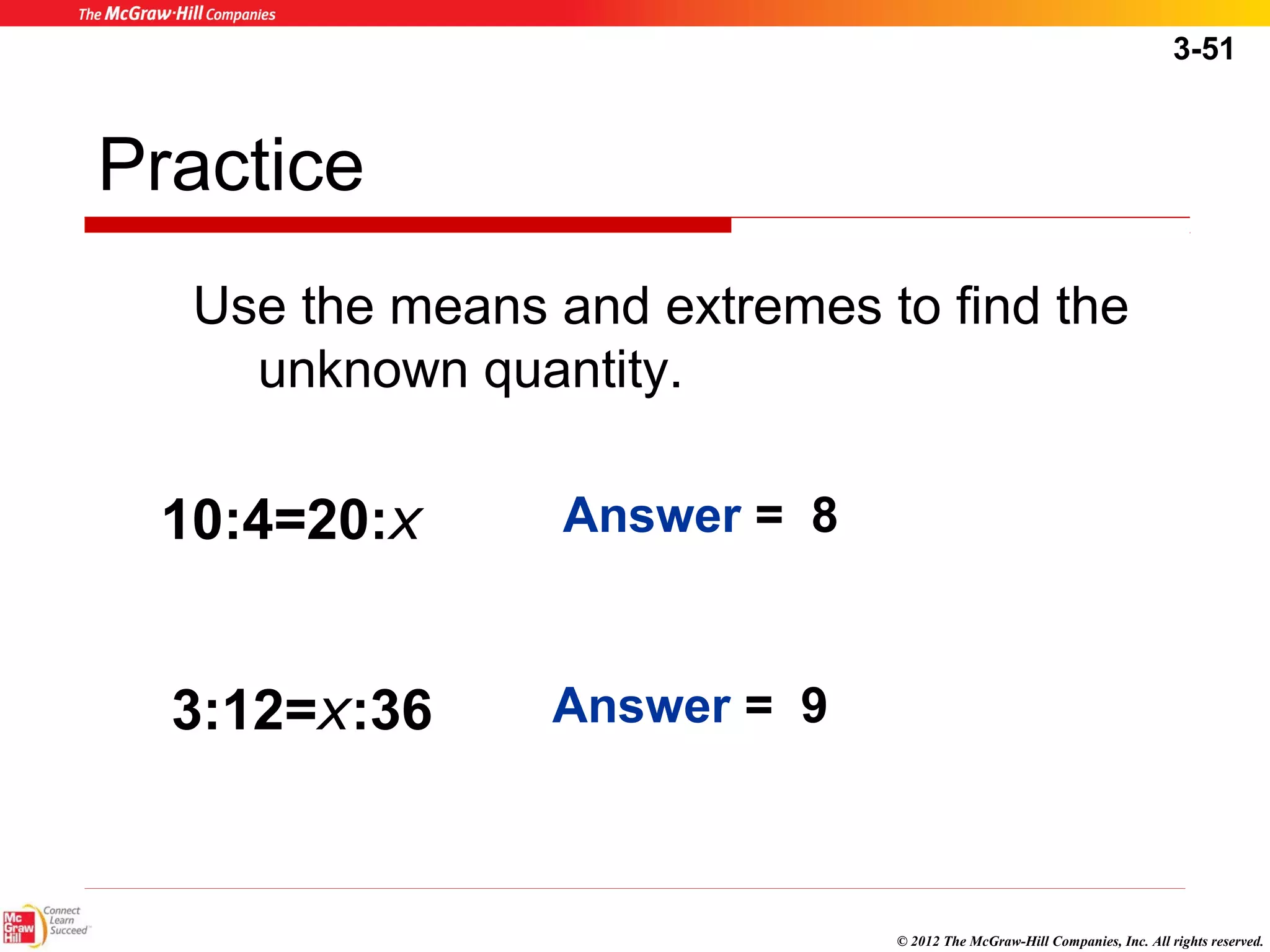
Use the means and extremes to find the 
unknown quantity. 
10:4=20:x Answer = 8 
3:12=x:36 
Answer = 9
3-52 
Using Proportions to Solve for an 
Unknown (cont.) 
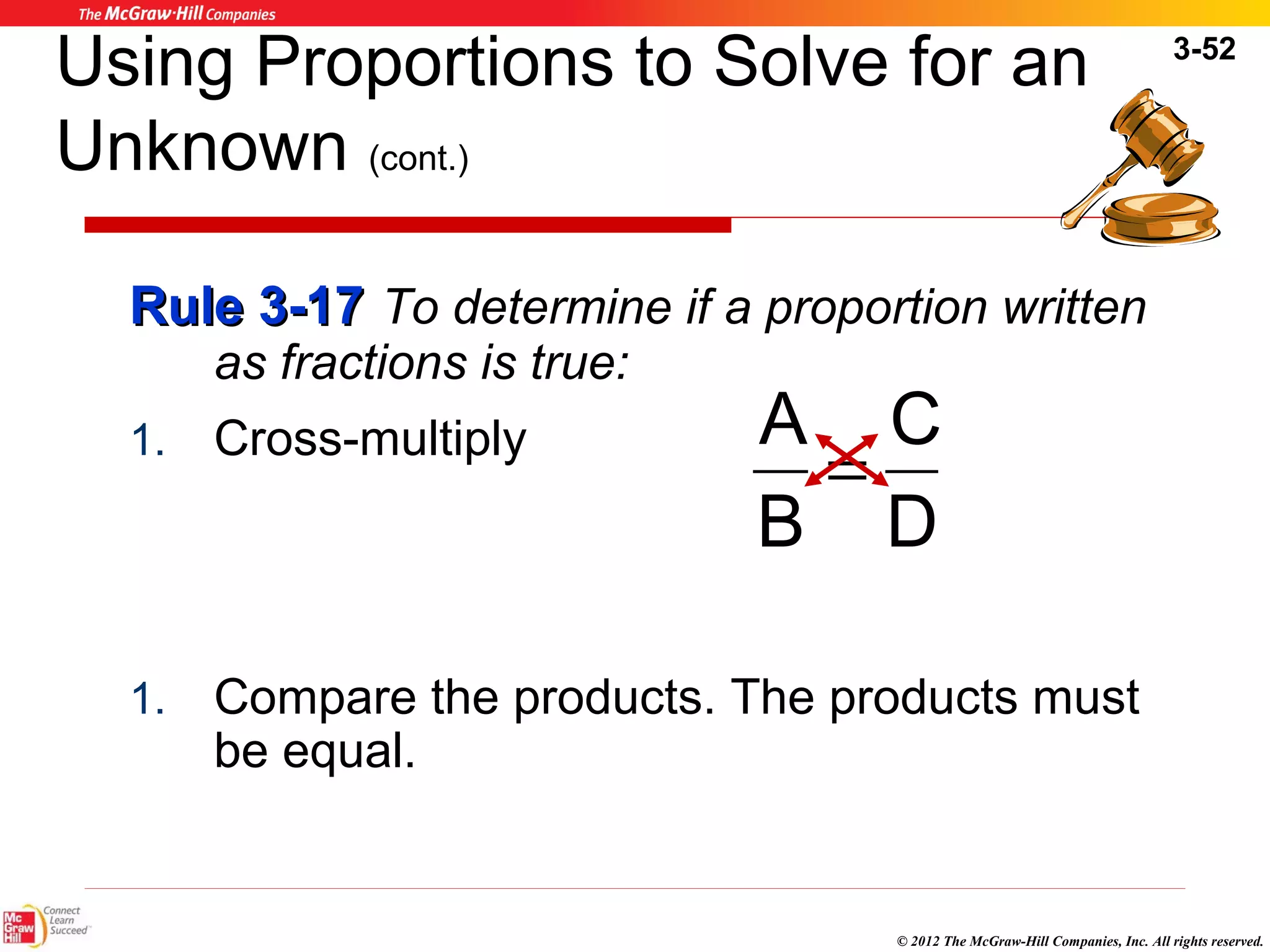
RRuullee 33--1177 To determine if a proportion written 
C 
© 2012 The McGraw-Hill Companies, Inc. All rights reserved. 
as fractions is true: 
1. Cross-multiply 
A = 
1. Compare the products. The products must 
be equal. 
D 
B
3-53 
Using Proportions to Solve for 
an Unknown (cont.) 
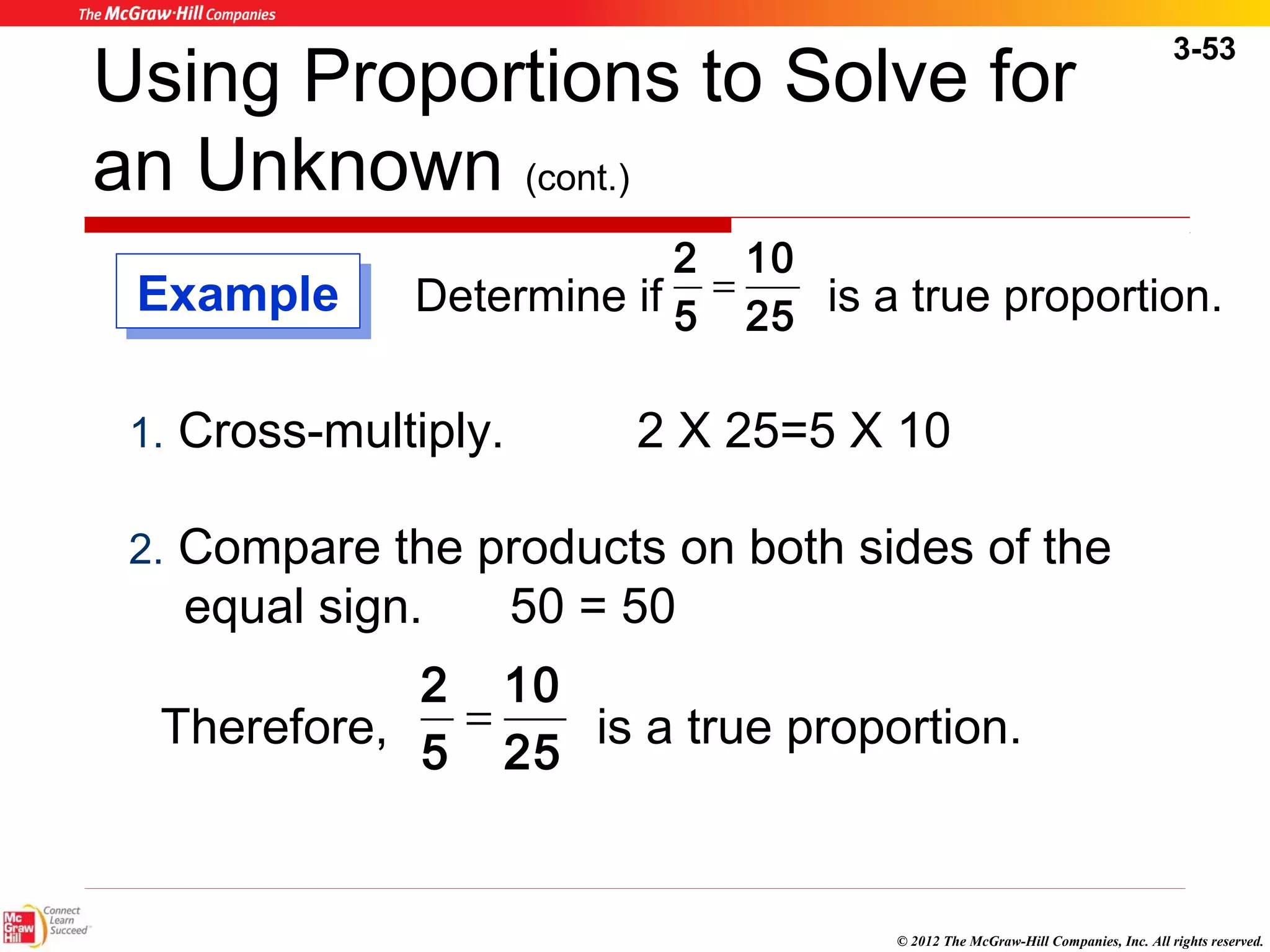
2 = 
Determine if 2 5 is a true proportion. 
© 2012 The McGraw-Hill Companies, Inc. All rights reserved. 
10 
5 
1. Cross-multiply. 2 X 25=5 X 10 
2. Compare the products on both sides of the 
equal sign. 50 = 50 
2 Therefore, = 
10 
5 
25 is a true proportion. 
EExxaammppllee
3-54 
Using Proportions to Solve for 
an Unknown (cont.) 
RRuullee 33--1188 To find the unknown quantity 
in a proportion written as fractions: 
© 2012 The McGraw-Hill Companies, Inc. All rights reserved. 
1. Cross-multiply. 
 Write an equation setting the products equal to 
each other. 
2. Solve the equation to find the unknown 
quantity.
3-55 
Using Proportions to Solve for 
an Unknown (cont.) 
RRuullee 33--1188 (cont.) 
3. Restate the proportion, inserting the unknown 
quantity. 
3. Check your work. 
© 2012 The McGraw-Hill Companies, Inc. All rights reserved.
3-56 
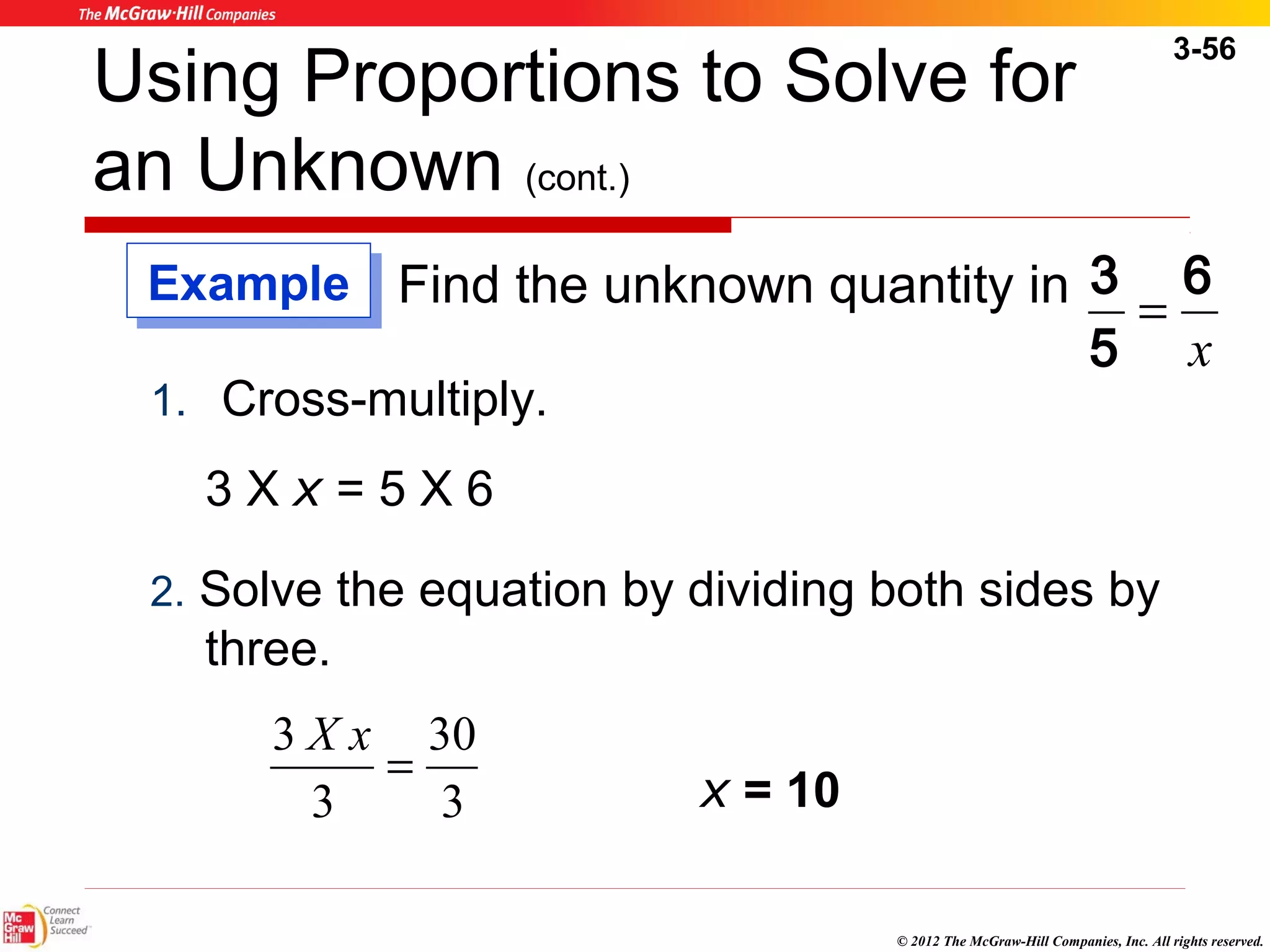
Using Proportions to Solve for 
an Unknown (cont.) 
Find the unknown quantity in 
6 
x 
3 = 
5 
EExxaammppllee 
1. Cross-multiply. 
3 X x = 5 X 6 
2. Solve the equation by dividing both sides by 
three. 
© 2012 The McGraw-Hill Companies, Inc. All rights reserved. 
30 
3 x = 10 
3 X x = 
3
3-57 
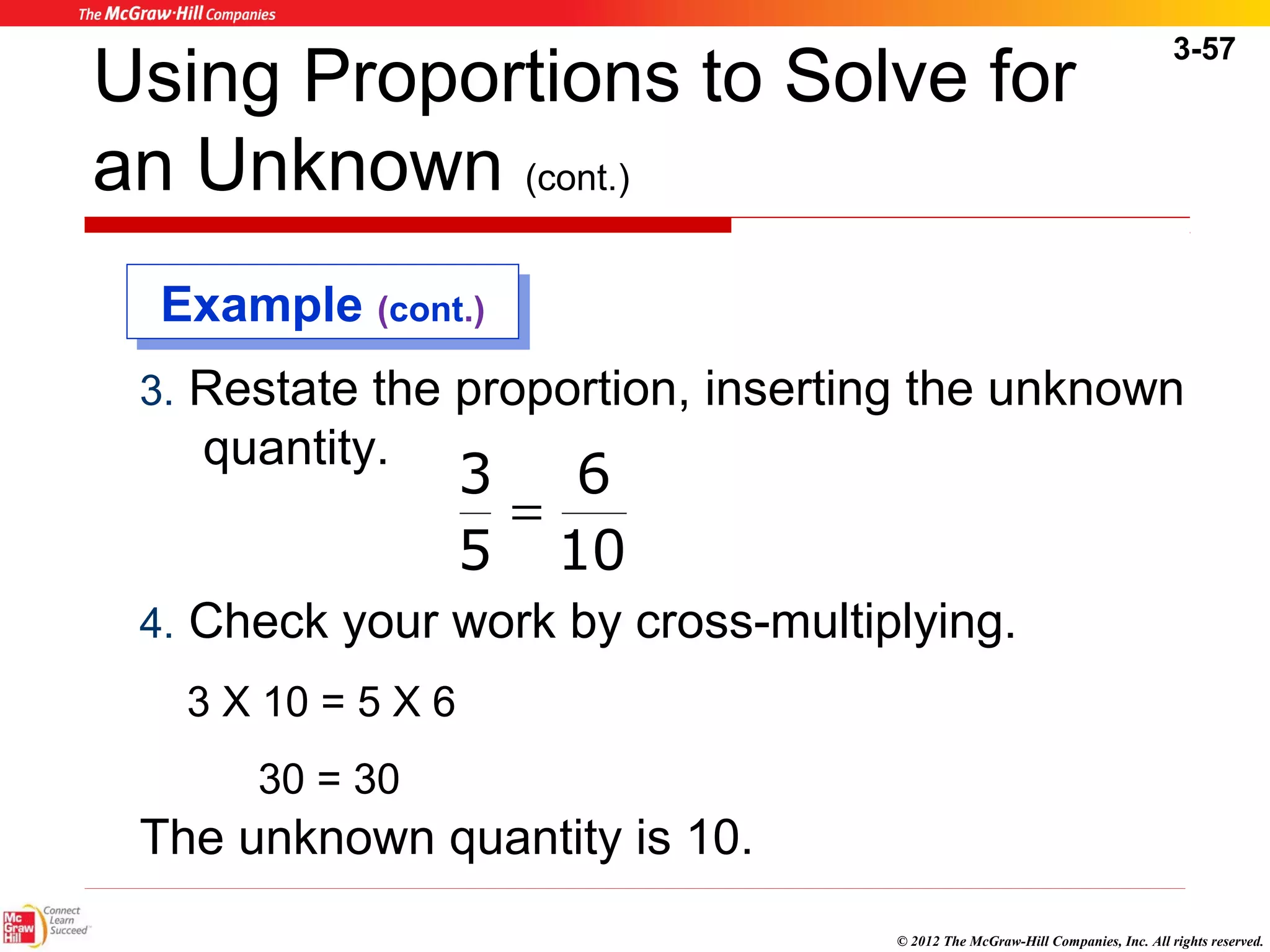
Using Proportions to Solve for 
an Unknown (cont.) 
EExxaammppllee ((ccoonntt.).) 
3. Restate the proportion, inserting the unknown 
quantity. 
6 
10 
3 
= 
5 
4. Check your work by cross-multiplying. 
3 X 10 = 5 X 6 
© 2012 The McGraw-Hill Companies, Inc. All rights reserved. 
30 = 30 
The unknown quantity is 10.
3-58 
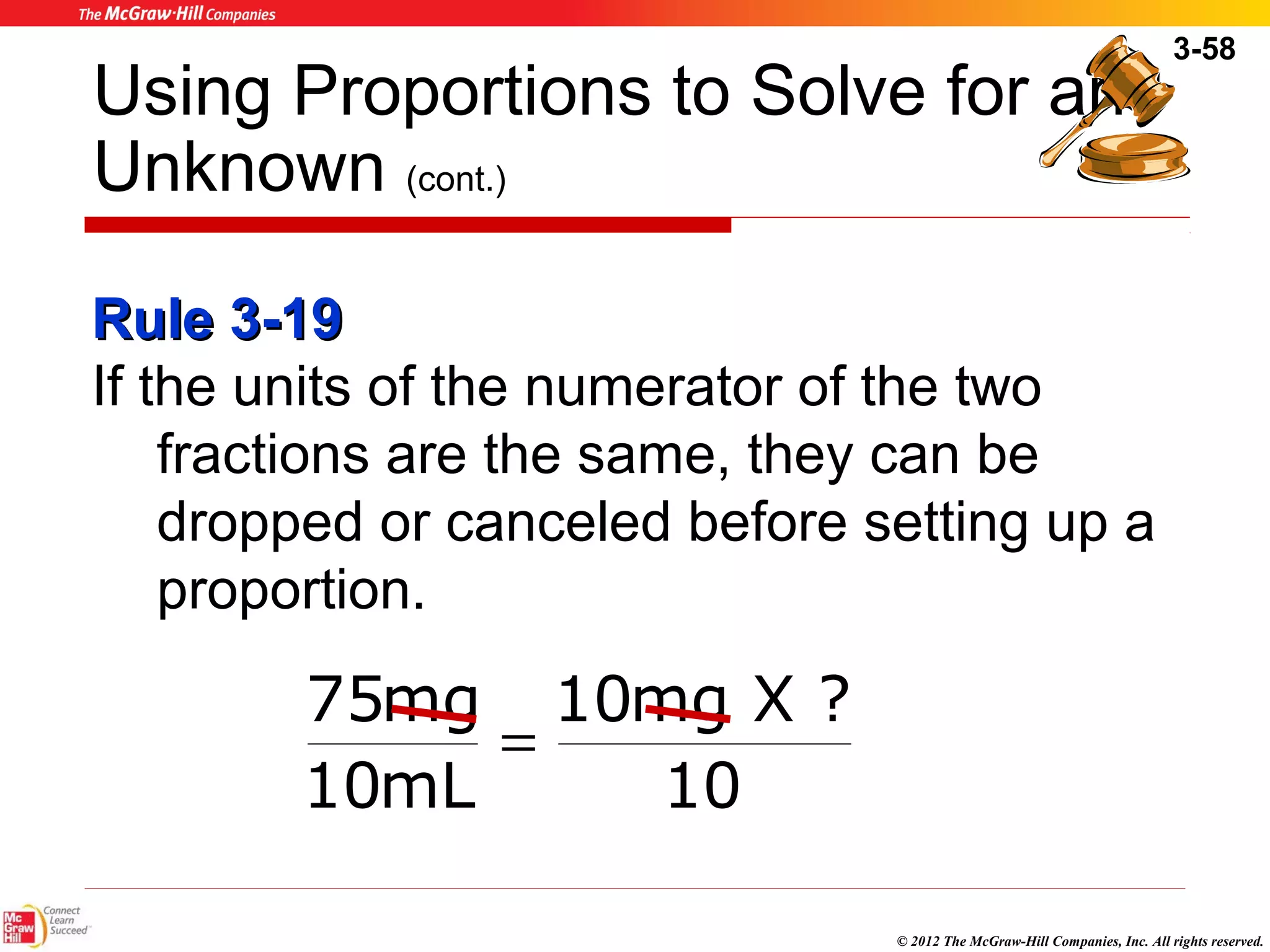
Using Proportions to Solve for an 
Unknown (cont.) 
RRuullee 33--1199 
If the units of the numerator of the two 
fractions are the same, they can be 
dropped or canceled before setting up a 
proportion. 
© 2012 The McGraw-Hill Companies, Inc. All rights reserved. 
10mg X ? 
10 
75mg 
10mL 
=
3-59 
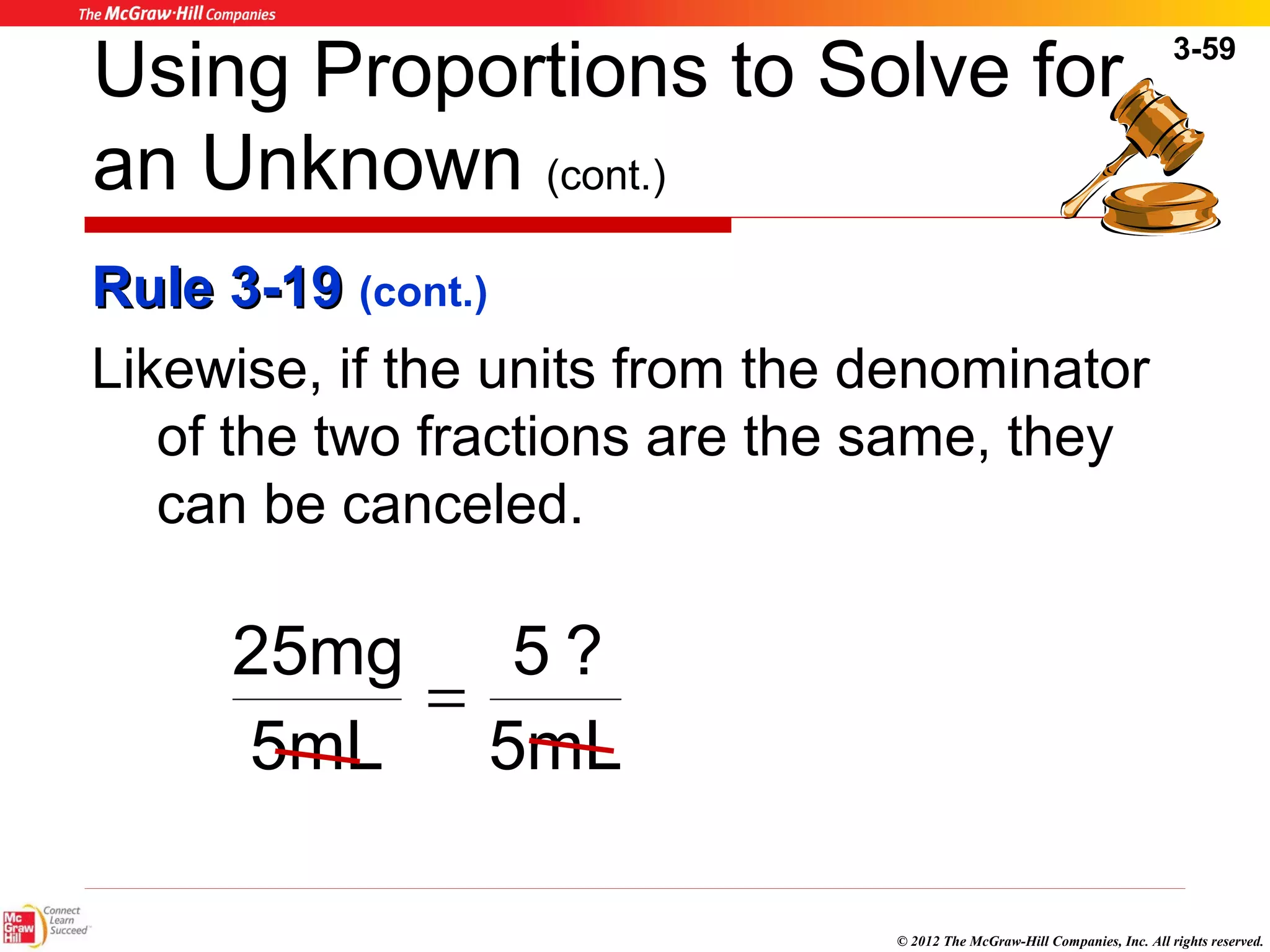
Using Proportions to Solve for 
an Unknown (cont.) 
RRuullee 33--1199 (cont.) 
Likewise, if the units from the denominator 
of the two fractions are the same, they 
can be canceled. 
© 2012 The McGraw-Hill Companies, Inc. All rights reserved. 
5 ? 
5mL 
25mg = 
5mL
3-60 
Using Proportions to Solve for an 
Unknown (cont.) 
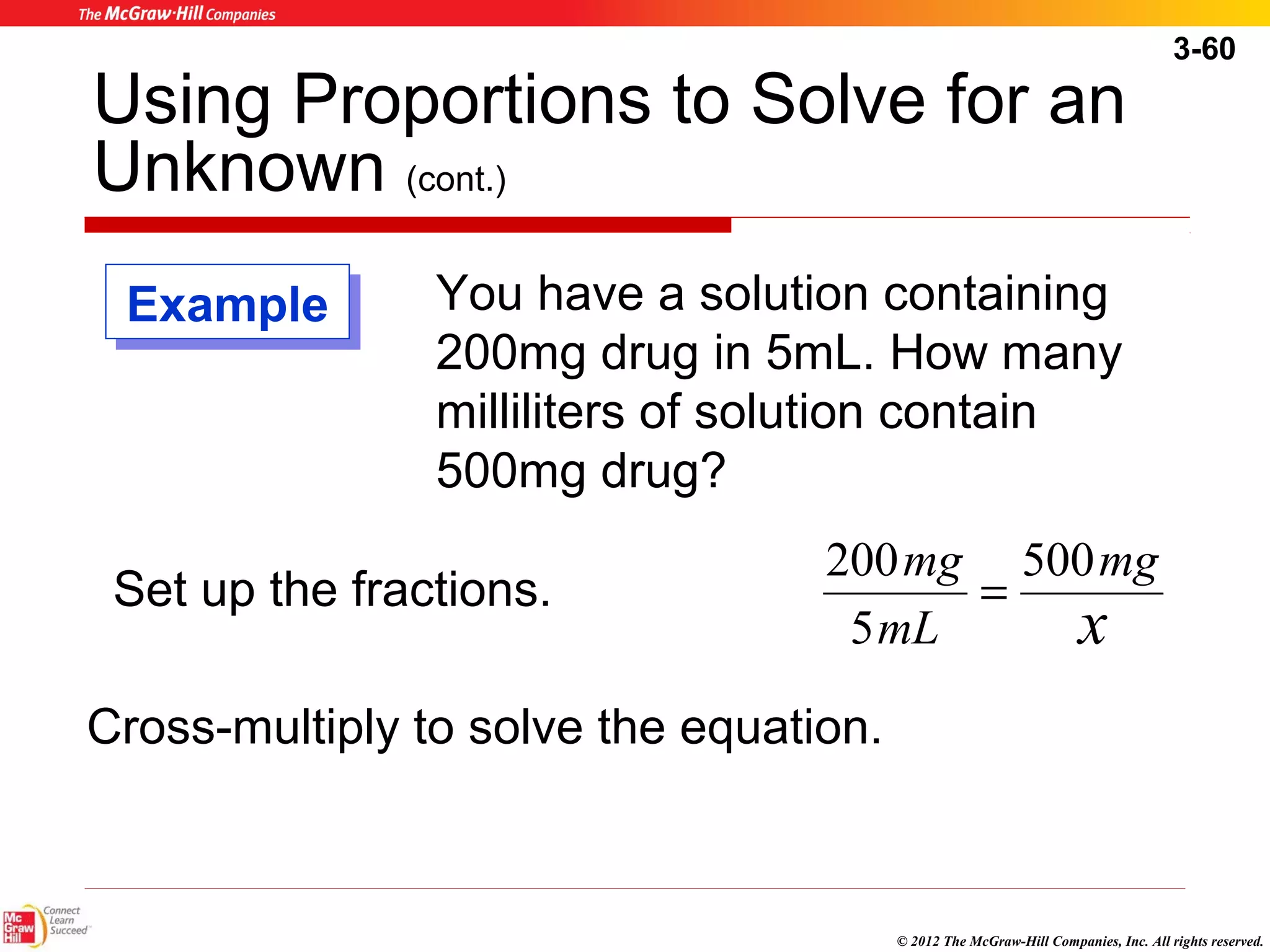
You have a solution containing 
200mg drug in 5mL. How many 
milliliters of solution contain 
500mg drug? 
mg 
mg 500 
5 
x 
200 = 
mL 
© 2012 The McGraw-Hill Companies, Inc. All rights reserved. 
EExxaammppllee 
Set up the fractions. 
Cross-multiply to solve the equation.
3-61 
Using Proportions to Solve for an 
Unknown (cont.) 
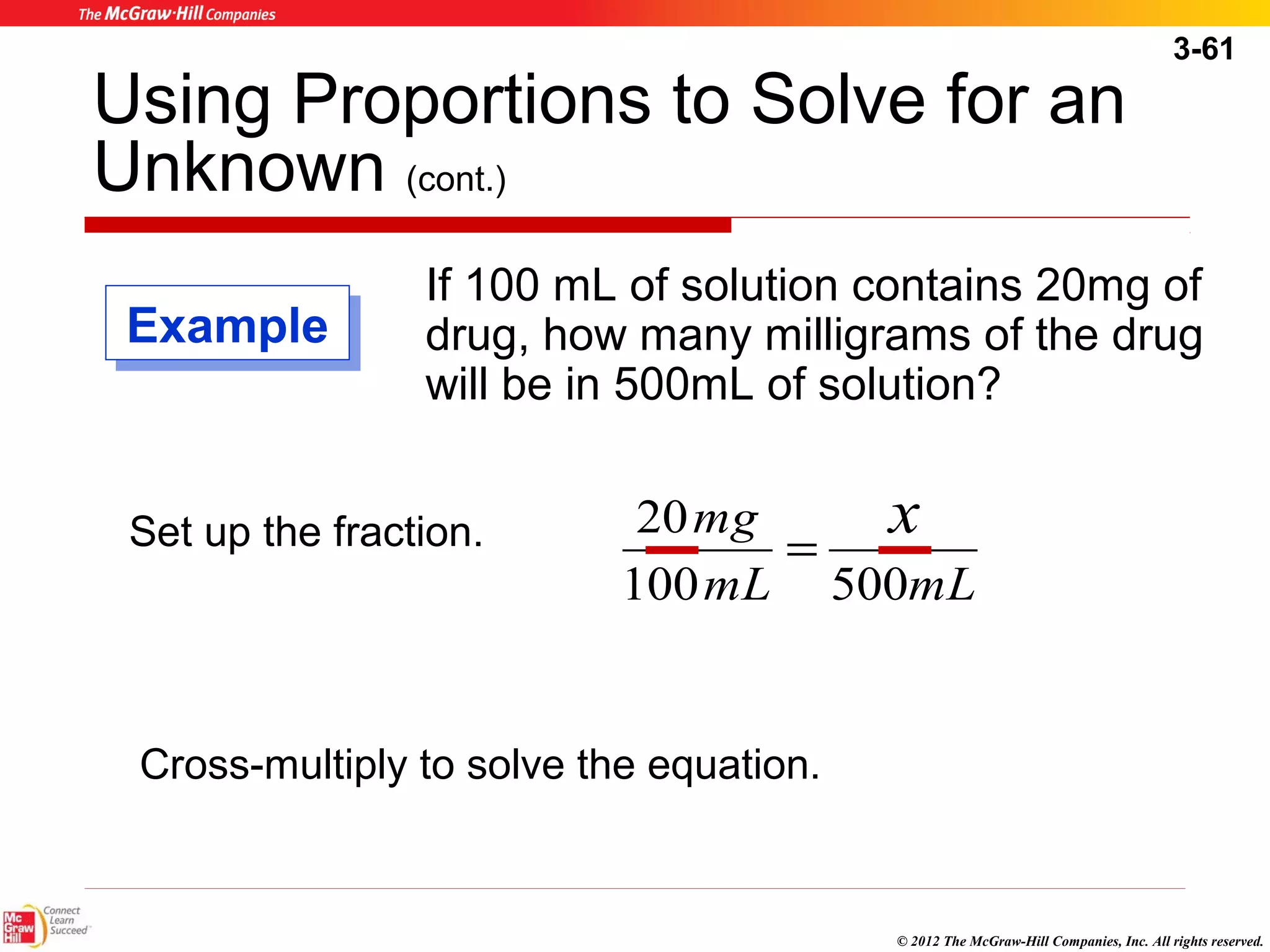
If 100 mL of solution contains 20mg of 
drug, how many milligrams of the drug 
will be in 500mL of solution? 
mg x 
mL mL 
100 500 
© 2012 The McGraw-Hill Companies, Inc. All rights reserved. 
EExxaammppllee 
Set up the fraction. 20 = 
Cross-multiply to solve the equation.
3-62 
Practice 
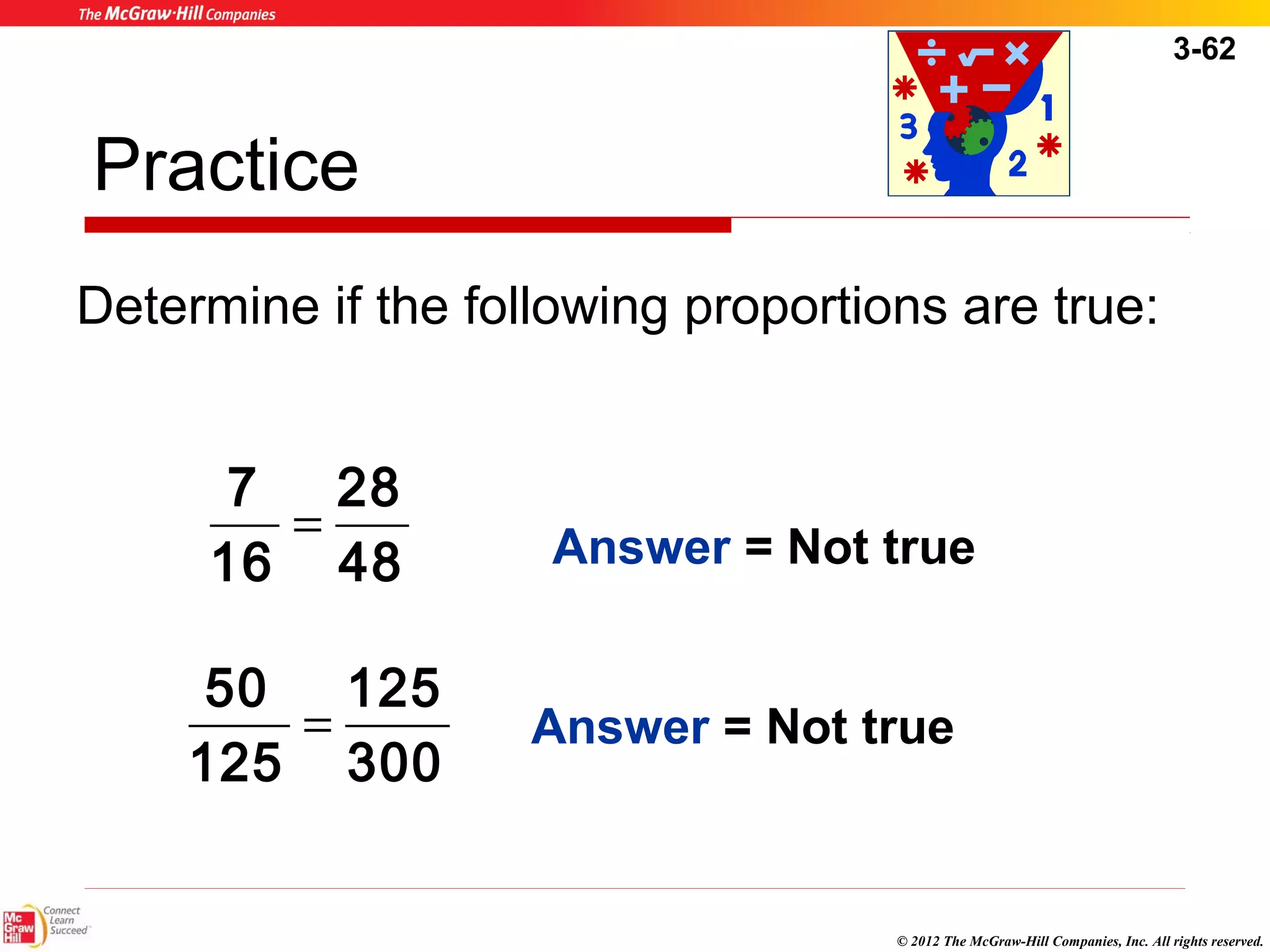
Determine if the following proportions are true: 
Answer = Not true 
Answer = Not true 
© 2012 The McGraw-Hill Companies, Inc. All rights reserved. 
28 
48 
7 = 
16 
125 
300 
50 = 
125
3-63 
Practice 
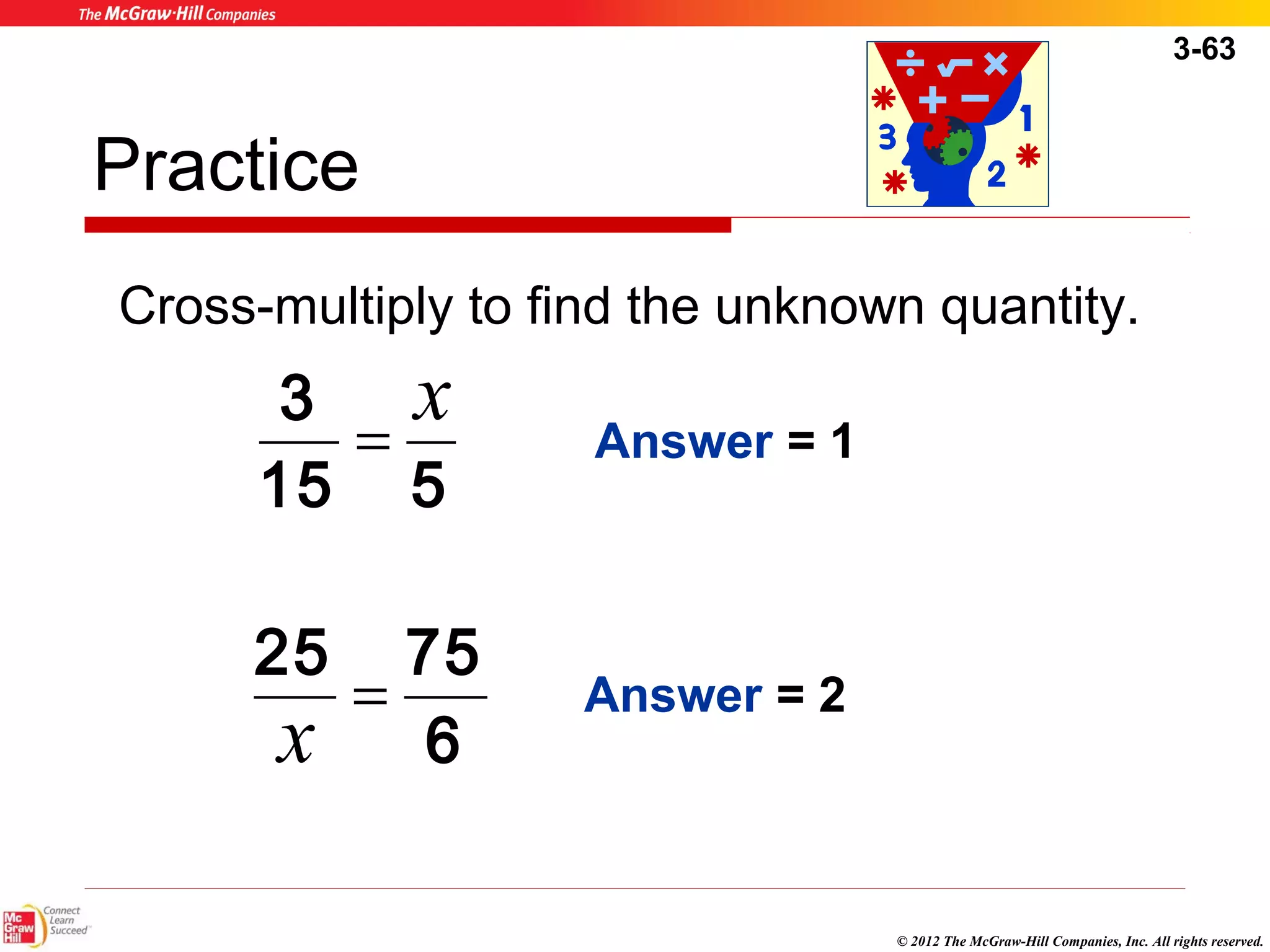
Cross-multiply to find the unknown quantity. 
© 2012 The McGraw-Hill Companies, Inc. All rights reserved. 
Answer = 1 
Answer = 2 
3 x = 
15 5 
25 = 75 x 
6
3-64 
Practice 
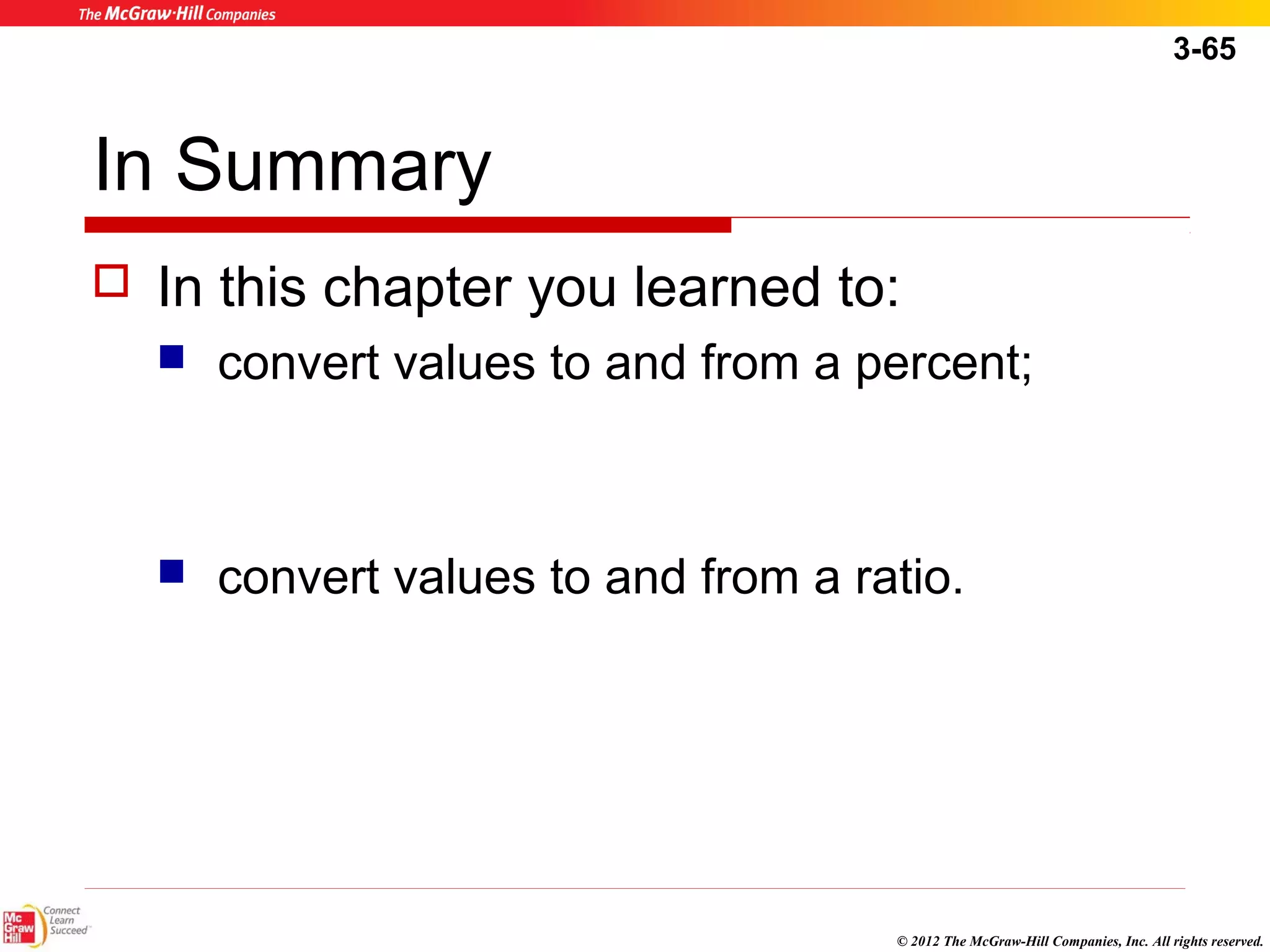
If 250 mL of solution contains 90 mg of drug, there 
would be 450 mg of drug in how many mL of 
solution? 
© 2012 The McGraw-Hill Companies, Inc. All rights reserved. 
mg 
mg 450 
x 
90 = 
mL 
250 
Answer = 1,250 mL
3-65 
In Summary 
 In this chapter you learned to: 
 convert values to and from a percent; 
 convert values to and from a ratio. 
© 2012 The McGraw-Hill Companies, Inc. All rights reserved.
3-66 
In Summary (cont.) 
 In this chapter you learned to: 
© 2012 The McGraw-Hill Companies, Inc. All rights reserved. 
 write proportions; 
 use proportions to solve for an unknown 
quantity.
3-67 
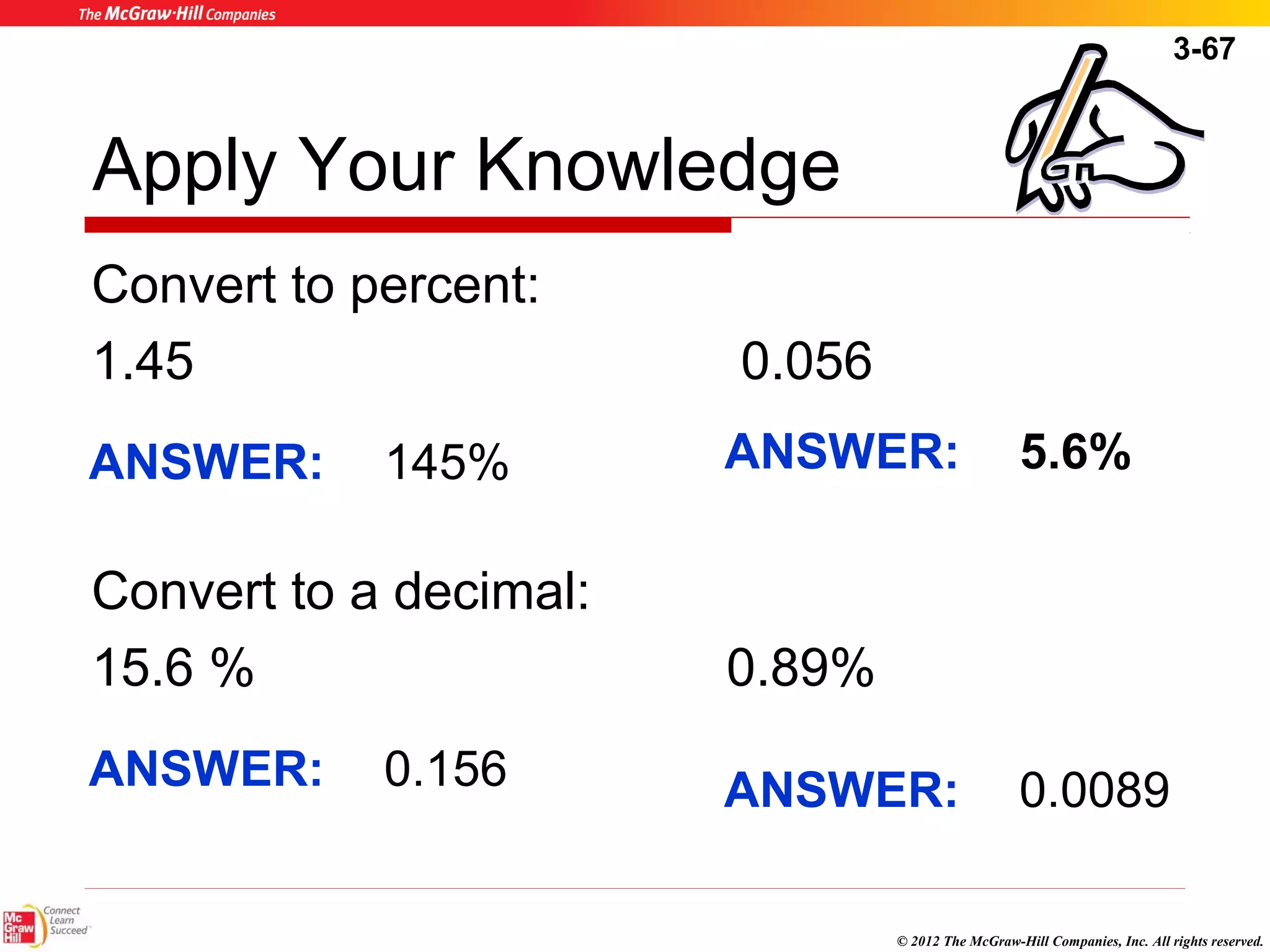
ANSWER: 145% ANSWER: 5.6% 
© 2012 The McGraw-Hill Companies, Inc. All rights reserved. 
Apply Your Knowledge 
Convert to percent: 
1.45 0.056 
Convert to a decimal: 
15.6 % 0.89% 
ANSWER: 0.156 ANSWER: 0.0089
3-68 
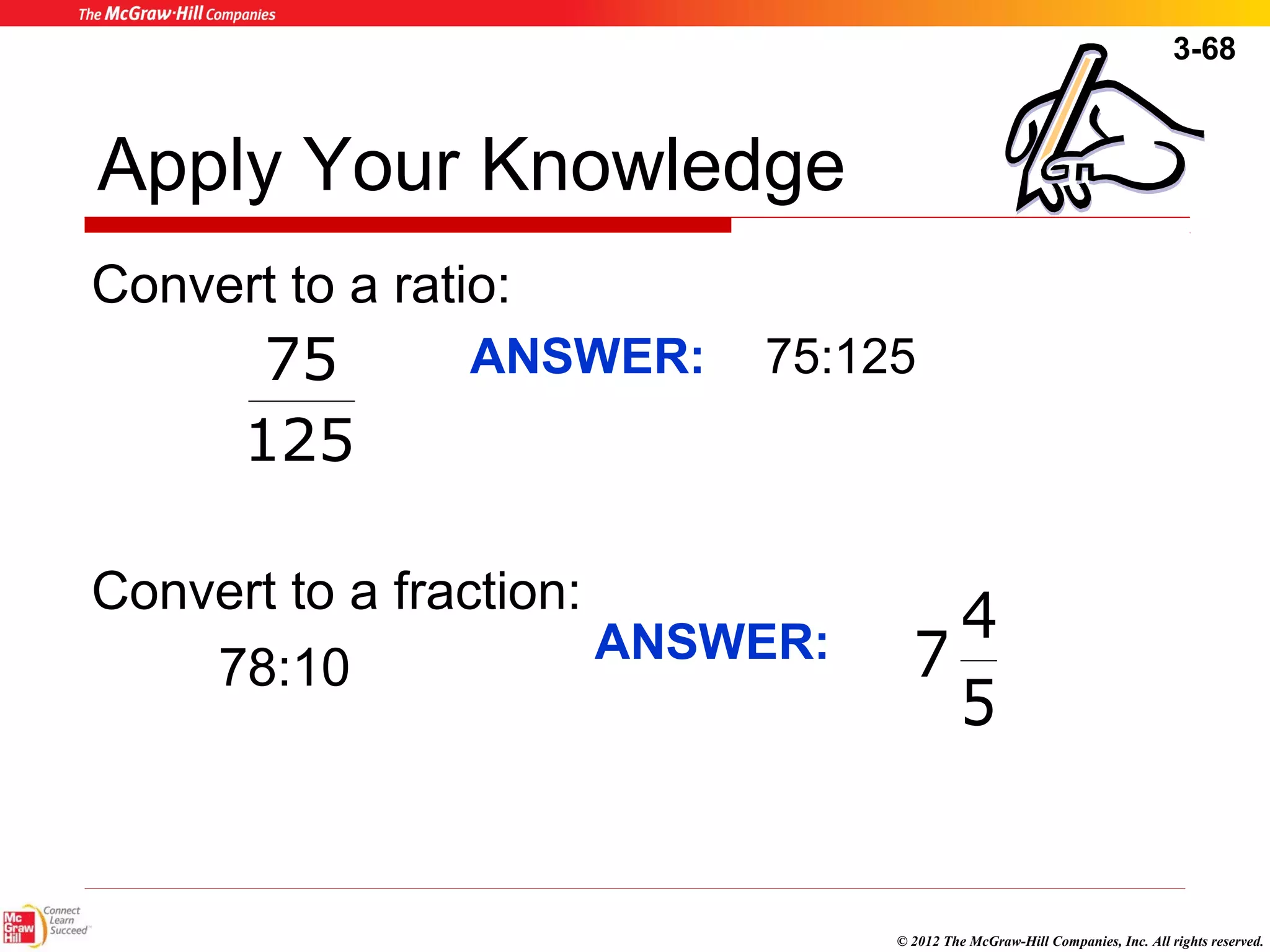
75 ANSWER: 75:125 
4 
© 2012 The McGraw-Hill Companies, Inc. All rights reserved. 
Apply Your Knowledge 
Convert to a ratio: 
125 
Convert to a fraction: 
78:10 
5 
ANSWER: 7
3-69 
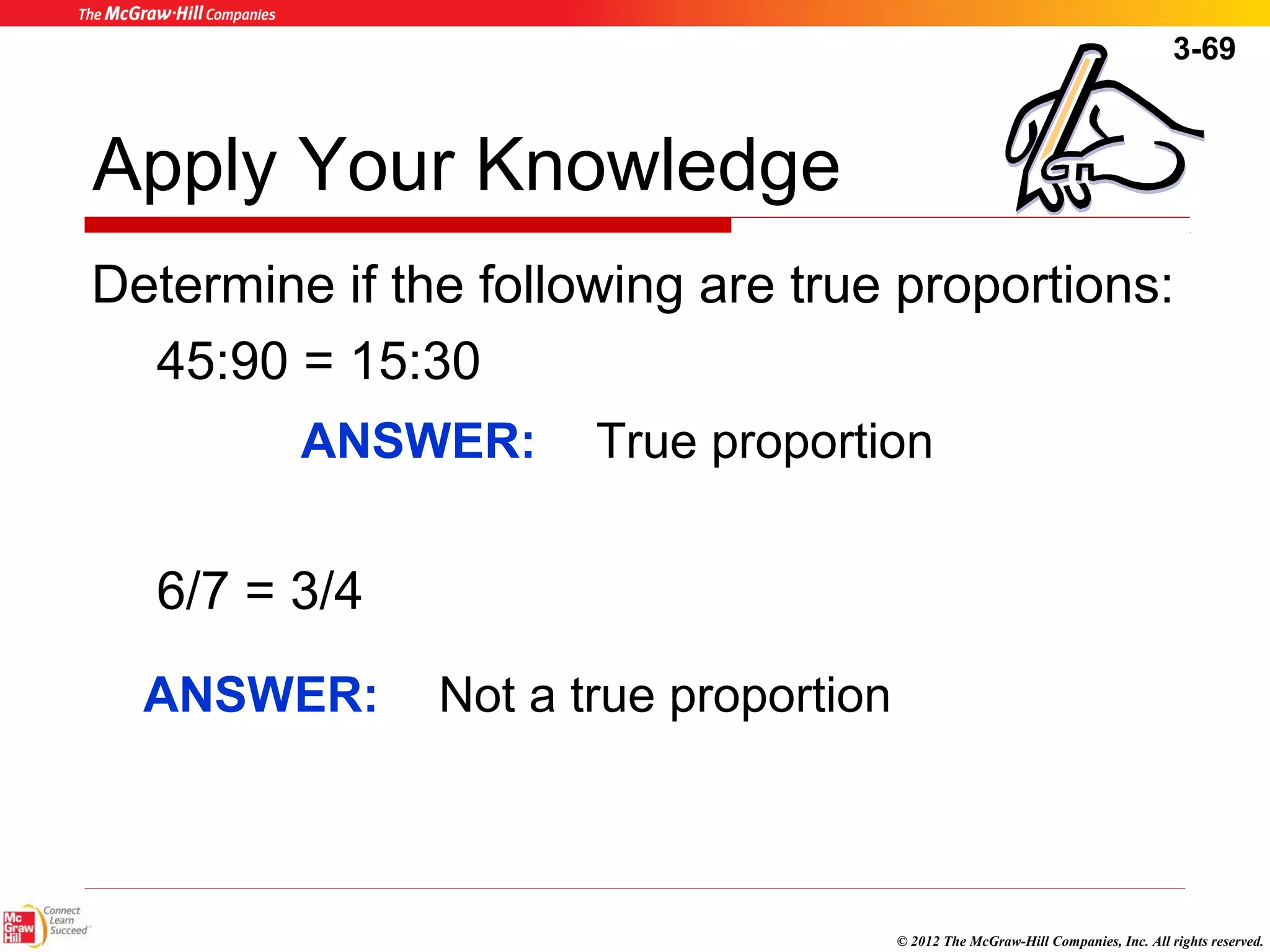
Apply Your Knowledge 
Determine if the following are true proportions: 
45:90 = 15:30 
ANSWER: True proportion 
© 2012 The McGraw-Hill Companies, Inc. All rights reserved. 
6/7 = 3/4 
ANSWER: Not a true proportion
3-70 
© 2012 The McGraw-Hill Companies, Inc. All rights reserved. 
Apply Your Knowledge 
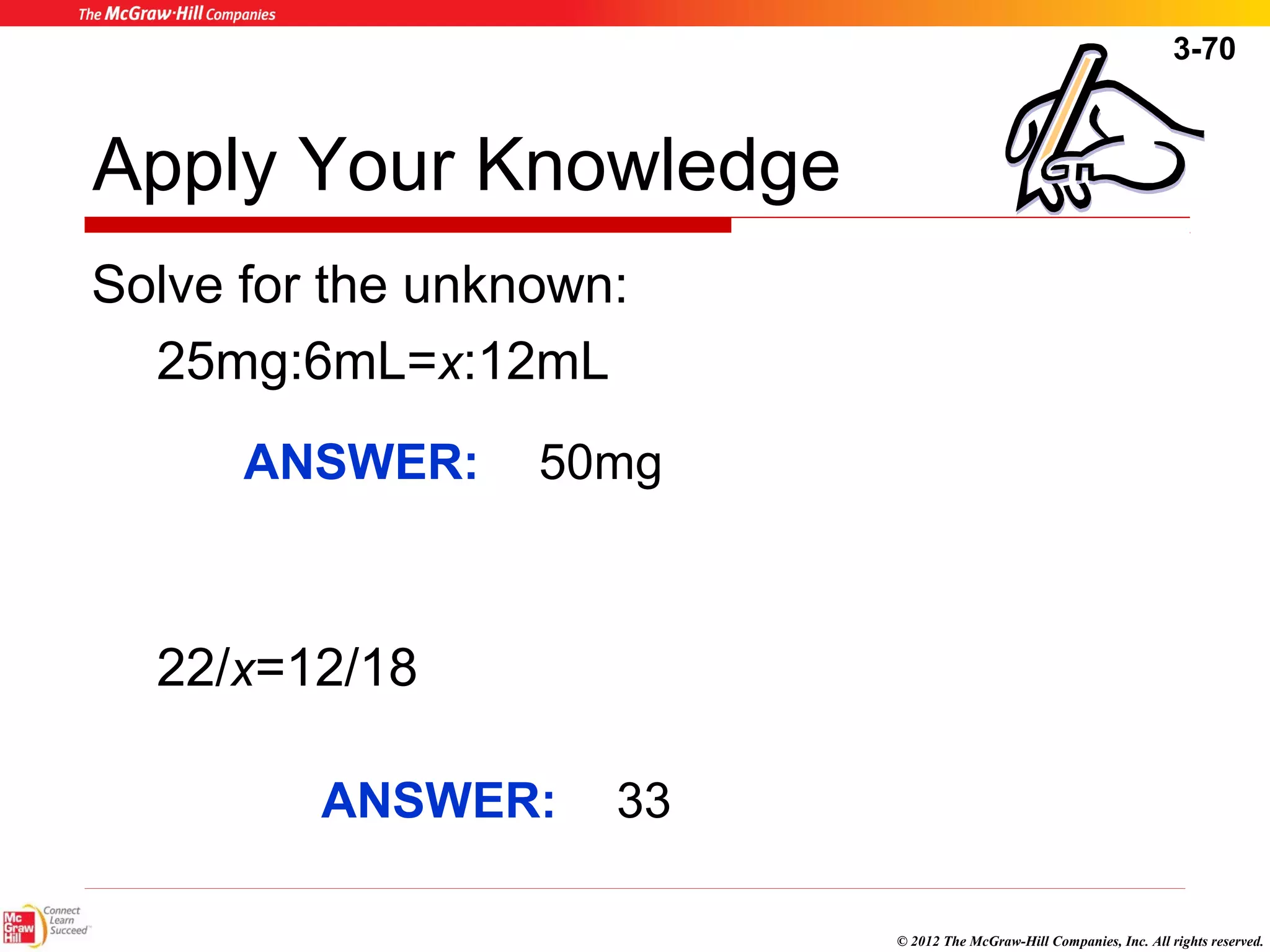
Solve for the unknown: 
25mg:6mL=x:12mL 
ANSWER: 50mg 
22/x=12/18 
ANSWER: 33
3-71 
© 2012 The McGraw-Hill Companies, Inc. All rights reserved. 
End of Chapter 3 
If what you're 
working for 
really matters, 
you'll give it all 
you've got. 
~ Nido Qubein

Chapter 3 Dosages and Calculations

  • 1.
    Chapter 3 Relationshipsof Quantities: Percents, Ratios, and Proportions PowerPoint® Presentation to accompany: Math and Dosage Calculations for Healthcare Professionals Fourth Edition Booth, Whaley, Sienkiewicz, and Palmunen © 2012 The McGraw-Hill Companies, Inc. All rights reserved.
  • 2.
    3-2 Learning Outcomes 3-1 Convert values to and from a percent. 3-2 Convert values to and from a ratio. © 2012 The McGraw-Hill Companies, Inc. All rights reserved. 3-3 Write proportions. 3-4 Use proportions to solve for an unknown quantity.
  • 3.
    3-3 © 2012The McGraw-Hill Companies, Inc. All rights reserved. Key Terms  Cross-multiplying  Means and extremes  Percent  Proportion  Ratio
  • 4.
    3-4 Introduction For dosage calculation you must:  understand percents, ratios, and proportions ;  be able to find a unknown quantity in a proportion. © 2012 The McGraw-Hill Companies, Inc. All rights reserved.
  • 5.
    3-5 © 2012The McGraw-Hill Companies, Inc. All rights reserved. Percents  Percents provide a way to express the relationship of parts to a whole.  Percent is indicated by the symbol %.  Percent means “per 100” or “divided by 100.”
  • 6.
    3-6 Percents (cont.)  A number < 1 is expressed as less than 100 percent.  A number > 1 is expressed as greater than 100 percent.  Any expression of one equals 100 percent. 1.0 = = 100 percent © 2012 The McGraw-Hill Companies, Inc. All rights reserved. 5 5
  • 7.
    3-7 Converting ValuesTo and From a Percent RRuullee 33--11 To convert a percent to a decimal, remove the percent symbol. Then divide the remaining number by 100. © 2012 The McGraw-Hill Companies, Inc. All rights reserved.
  • 8.
    3-8 Converting ValuesTo and From a Percent (cont.) © 2012 The McGraw-Hill Companies, Inc. All rights reserved. EExxaammppllee Convert 42% to a decimal:  Move the decimal point two places to the left.  Insert the zero before the decimal point for clarity.  42% = 42.% = .42. = 0.42
  • 9.
    3-9 RRuullee 33--22 To convert a decimal to a percent, multiply the decimal by 100. Then add the percent symbol. © 2012 The McGraw-Hill Companies, Inc. All rights reserved. Converting Values To and from a Percent (cont.)
  • 10.
    3-10 Working withPercents (cont.) © 2012 The McGraw-Hill Companies, Inc. All rights reserved. EExxaammppllee Convert 0.02 to a percent:  Multiply by 100%.  0.02 x 100% =2.00% = 2%
  • 11.
    3-11 Working withPercents (cont.) RRuullee 33--33 To convert a percent to an equivalent fraction, write the value of the percent as the numerator and 100 as the denominator. Then reduce the fraction to its lowest term. © 2012 The McGraw-Hill Companies, Inc. All rights reserved.
  • 12.
    3-12 Working withPercents (cont.) Convert 8% to an equivalent fraction. 8% = © 2012 The McGraw-Hill Companies, Inc. All rights reserved. EExxaammppllee 2 25 8 = 8 = 100 100 2 25
  • 13.
    3-13 Converting ValuesTo and from a Percent (cont.) RRuullee 33--44 To convert a fraction to a percent: 1. convert the fraction to a decimal; 2. round to the nearest hundredth; 3. then follow the rule for converting a © 2012 The McGraw-Hill Companies, Inc. All rights reserved. decimal to a percent.
  • 14.
    3-14 Converting ValuesTo and from a Percent (cont.) © 2012 The McGraw-Hill Companies, Inc. All rights reserved. EExxaammppllee Convert 2/3 to a percent.  Convert 2/3 to a decimal and round to the nearest hundredth.  2/3 = 2 divided by 3 = 0.666 = 0.67  0.67 x 100% = 67%
  • 15.
    3-15 Answer =75% © 2012 The McGraw-Hill Companies, Inc. All rights reserved. Practice Convert the following percents to decimals: Convert the following fractions to percents: Answer = 0.14 14% 300% Answer = 3.00 6/8 4/5 Answer = 80%
  • 16.
    3-16 © 2012The McGraw-Hill Companies, Inc. All rights reserved. Ratios  The relationship of a part to the whole  relates a quantity of liquid drug to a quantity of solution;  is used to calculate dosages of dry medication such as tablets.
  • 17.
    3-17 © 2012The McGraw-Hill Companies, Inc. All rights reserved. Ratios (cont.)  Like a fraction, a ratio has two parts.  The first part = numerator.  The second part = denominator.  The two parts are separated by a colon.
  • 18.
    3-18 Converting ValuesTo and From a Ratio RRuullee 33--55 Reduce a ratio as you would a fraction. Reduce 2:12 to its lowest terms. Both values 2 and 12 are divisible by 2. © 2012 The McGraw-Hill Companies, Inc. All rights reserved. 2:12 is written 1:6 EExxaammppllee
  • 19.
    Converting Values Toand From a Ratio. (cont.) RRuullee 33--66 To convert a ratio to a fraction, write value A (1st 3-19 number) as the numerator and value B (2nd number) as the denominator, so that A:B = Convert the following ratio to a fraction: A 4 © 2012 The McGraw-Hill Companies, Inc. All rights reserved. 4:5 = B 5 EExxaammppllee
  • 20.
    3-20 Converting ValuesTo and From a Ratio.(cont.) RRuullee 33--77 To convert a fraction to a ratio, write the numerator as the 1st value A and the denominator as the 2nd value B. © 2012 The McGraw-Hill Companies, Inc. All rights reserved. A = A:B B
  • 21.
    3-21 Converting ValuesTo and From a Ratio (con’t) Convert the following into a ratio: 11 3 = 47:12 © 2012 The McGraw-Hill Companies, Inc. All rights reserved. 7 12 = 7:12 12 EExxaammppllee 47 = 12
  • 22.
    3-22 Converting ValuesTo and From a Ratio. (cont.) RRuullee 33--88 To convert a ratio to a decimal: 1. write the ratio as a fraction; 2. convert the fraction to a decimal. © 2012 The McGraw-Hill Companies, Inc. All rights reserved.
  • 23.
    3-23 Converting ValuesTo and From a Ratio (cont.) Convert the ratio 1:10 to a decimal. © 2012 The McGraw-Hill Companies, Inc. All rights reserved. 1. Write the ratio as a fraction. 1 1:10 = 10 EExxaammppllee 2. Convert the fraction to a decimal. 1 10 = 1 divided by 10 = 0.1 1 = 0.1 Thus, 1:10 = 10
  • 24.
    3-24 Converting ValuesTo and From a Ratio (cont.) RRuullee 33--99 To convert a decimal to a ratio: 1. write the decimal as a fraction; 2. reduce the fraction to lowest terms; 3. restate the fraction as ratio. © 2012 The McGraw-Hill Companies, Inc. All rights reserved.
  • 25.
    3-25 Converting ValuesTo and From a Ratio (cont.) 1. Write the decimal 0.25 as a fraction. 25 100 2. Reduce the fraction to lowest terms. © 2012 The McGraw-Hill Companies, Inc. All rights reserved. 1 25 3. Restate the number as a ratio. 1:4 4 100 = EExxaammppllee
  • 26.
    3-26 Converting ValuesTo and From a Ratio (cont.) RRuullee 33--1100 To convert a ratio to a percent: © 2012 The McGraw-Hill Companies, Inc. All rights reserved. 1. convert the ratio to a decimal; 2. write the decimal as a percent by multiplying the decimal by 100 and adding the % symbol.
  • 27.
    3-27 Converting ValuesTo and From a Ratio (cont.) © 2012 The McGraw-Hill Companies, Inc. All rights reserved. Convert 2:3 to a percent. 1. 2:3 = 2 = 0.67 3 2. 0.67 X 100% = 67% EExxaammppllee
  • 28.
    3-28 Converting ValuesTo and From a Ratio (cont.) RRuullee 33--1111 To convert a percent to a ratio: 1. write the percent as a fraction; 2. reduce the fraction to lowest terms; 3. write the fraction as a ratio. © 2012 The McGraw-Hill Companies, Inc. All rights reserved.  Numerator = value A  Denominator = value B  A:B
  • 29.
    3-29 Converting ValuesTo and From a Ratio (cont.) © 2012 The McGraw-Hill Companies, Inc. All rights reserved. Convert 25% to a ratio. 1. 25% = 25 100 2. 25 = = = 1 : 4 25% 1 4 100 EExxaammppllee
  • 30.
    3-30 Practice Convertthe following ratios to a fraction or mixed numbers: 3:4 5:3 1 2 5 = © 2012 The McGraw-Hill Companies, Inc. All rights reserved. Answer = 3 4 Answer = 3 3
  • 31.
    3-31 Practice Convertthe following decimals to ratios: 0.9 8 Answer = 9 : 10 8 = © 2012 The McGraw-Hill Companies, Inc. All rights reserved. 9 = 10 Answer = 8 : 1 1
  • 32.
    3-32 Writing Proportions  A proportion is a mathematical statement that two ratios or two fractions are equal. © 2012 The McGraw-Hill Companies, Inc. All rights reserved.  2:3 is read “two to three”  2:3 = 4:6 is read “two is to three as four is to six”
  • 33.
    3-33 © 2012The McGraw-Hill Companies, Inc. All rights reserved. Writing Proportions (cont.) RRuullee 33--1122 To change a proportion from ratios to fractions, convert both ratios to fractions.
  • 34.
    3-34 50 ©2012 The McGraw-Hill Companies, Inc. All rights reserved. Writing Proportions (cont.) Write 5:10 = 50:100 as a proportion using fractions. 100 5 5:10 = 50:100 same as = 10 EExxaammppllee
  • 35.
    3-35 © 2012The McGraw-Hill Companies, Inc. All rights reserved. Writing Proportions (cont.) RRuullee 33--1133 To change a proportion from fractions to ratios, convert each fraction to a ratio.
  • 36.
    3-36 © 2012The McGraw-Hill Companies, Inc. All rights reserved. Writing Proportions (cont.) 10 5 = Write using ratios. 12 6 10 : 12 5 : 6 10 12 6 5 = and = 5:6 = 10:12 EExxaammppllee
  • 37.
    3-37 Write thefollowing as proportions using fractions: 10 © 2012 The McGraw-Hill Companies, Inc. All rights reserved. Practice 4:5 = 8:10 Answer 50:25 = 10:5 8 10 4 = 5 Answer 5 50 = 25
  • 38.
    3-38 Using Proportionsto Solve for an Unknown  Proportions are used to calculate © 2012 The McGraw-Hill Companies, Inc. All rights reserved. dosages.  If three of four of the values of a proportion are known, the unknown quantity can be determined by using:  ratios; or  fractions.
  • 39.
    3-39 Using Proportionsto Solve for an Unknown (cont.) A proportion as the ratio – A:B = C:D. © 2012 The McGraw-Hill Companies, Inc. All rights reserved. Extremes A : B = C : D Means
  • 40.
    3-40 Using Proportionsto Solve for an Unknown (cont.) RRuullee 33--1144 To determine if a proportion is © 2012 The McGraw-Hill Companies, Inc. All rights reserved. true: 1. multiply the means; 2. multiply the extremes; 3. compare the product of the means and the product of the extremes.
  • 41.
    3-41 Using Proportionsto Solve for an Unknown (cont.) Is 1:2=3:6 a true proportion? 1. Multiply the means: 2 X 3 = 6 2. Multiply the extremes: 1 X 6 = 6 3. Compare the products of the means and the extremes: 6=6 1:2=3:6 is a true proportion. © 2012 The McGraw-Hill Companies, Inc. All rights reserved. EExxaammppllee
  • 42.
    3-42 Using Proportionsto Solve for an Unknown (con’t) RRuullee 33--1155 To find the unknown quantity in © 2012 The McGraw-Hill Companies, Inc. All rights reserved. a proportion: 1. Write an equation: product of the means = product of the extremes 2. Solve for the unknown quantity.
  • 43.
    3-43 Using Proportionsto Solve for an Unknown (con’t) RRuullee 33--1155 (cont.) 3. Restate the proportion, inserting the unknown quantity. 3. Check your work. Determine if the ratio proportion is true. © 2012 The McGraw-Hill Companies, Inc. All rights reserved.
  • 44.
    3-44 Using Proportionsto Solve for an Unknown (cont.) Find the unknown quantity in 25:5=50:x 250 x = x = 10 © 2012 The McGraw-Hill Companies, Inc. All rights reserved. 1. Write the equation: 5 x 50 = 25 X x becomes 250 = 25x 1. Solve the equation by dividing both sides by 25. 25 25 25 EExxaammppllee
  • 45.
    3-45 Using Proportionsto Solve for an Unknown (cont.) EExxaammppllee ((ccoonntt..)) 3. Restate the proportion, inserting the © 2012 The McGraw-Hill Companies, Inc. All rights reserved. unknown quantity. 25:5=50:10 3. Check your work. 5 X 50 = 25 X 10 250 = 250 The unknown quantity is 10.
  • 46.
    3-46 © 2012The McGraw-Hill Companies, Inc. All rights reserved. EERRRROORR AALLEERRTT!!  Do not forget the units of measurement.  Including units in the dosage strength will help you avoid errors.
  • 47.
    3-47 Canceling Unitsin Proportions (cont.) RRuullee 33--1166 1. If the units in the first part of the ratio in a proportion are the same, they can be canceled. © 2012 The McGraw-Hill Companies, Inc. All rights reserved.
  • 48.
    3-48 Canceling Unitsin Proportions (cont.) RRuullee 33--1166 (cont.) 2. If the units in the second part of the ratio in a proportion are the same, they can be canceled. © 2012 The McGraw-Hill Companies, Inc. All rights reserved.
  • 49.
    3-49 Canceling Unitsin Proportions (cont.) If 100 mL of solution contains 20 mg of drug, how many milligrams of the drug will be in 500 mL of the solution? 20 mg:100 mL=x:500 mL 20mg X 500 = 100 X x x = 100mg © 2012 The McGraw-Hill Companies, Inc. All rights reserved. 10000 mg x = 100 X 100 100 EExxaammppllee
  • 50.
    3-50 Practice Determinewhether the following proportions 6:12=12:24 Answer = True © 2012 The McGraw-Hill Companies, Inc. All rights reserved. are true: 3:8=9:32 Answer = Not true
  • 51.
    3-51 © 2012The McGraw-Hill Companies, Inc. All rights reserved. Practice Use the means and extremes to find the unknown quantity. 10:4=20:x Answer = 8 3:12=x:36 Answer = 9
  • 52.
    3-52 Using Proportionsto Solve for an Unknown (cont.) RRuullee 33--1177 To determine if a proportion written C © 2012 The McGraw-Hill Companies, Inc. All rights reserved. as fractions is true: 1. Cross-multiply A = 1. Compare the products. The products must be equal. D B
  • 53.
    3-53 Using Proportionsto Solve for an Unknown (cont.) 2 = Determine if 2 5 is a true proportion. © 2012 The McGraw-Hill Companies, Inc. All rights reserved. 10 5 1. Cross-multiply. 2 X 25=5 X 10 2. Compare the products on both sides of the equal sign. 50 = 50 2 Therefore, = 10 5 25 is a true proportion. EExxaammppllee
  • 54.
    3-54 Using Proportionsto Solve for an Unknown (cont.) RRuullee 33--1188 To find the unknown quantity in a proportion written as fractions: © 2012 The McGraw-Hill Companies, Inc. All rights reserved. 1. Cross-multiply.  Write an equation setting the products equal to each other. 2. Solve the equation to find the unknown quantity.
  • 55.
    3-55 Using Proportionsto Solve for an Unknown (cont.) RRuullee 33--1188 (cont.) 3. Restate the proportion, inserting the unknown quantity. 3. Check your work. © 2012 The McGraw-Hill Companies, Inc. All rights reserved.
  • 56.
    3-56 Using Proportionsto Solve for an Unknown (cont.) Find the unknown quantity in 6 x 3 = 5 EExxaammppllee 1. Cross-multiply. 3 X x = 5 X 6 2. Solve the equation by dividing both sides by three. © 2012 The McGraw-Hill Companies, Inc. All rights reserved. 30 3 x = 10 3 X x = 3
  • 57.
    3-57 Using Proportionsto Solve for an Unknown (cont.) EExxaammppllee ((ccoonntt.).) 3. Restate the proportion, inserting the unknown quantity. 6 10 3 = 5 4. Check your work by cross-multiplying. 3 X 10 = 5 X 6 © 2012 The McGraw-Hill Companies, Inc. All rights reserved. 30 = 30 The unknown quantity is 10.
  • 58.
    3-58 Using Proportionsto Solve for an Unknown (cont.) RRuullee 33--1199 If the units of the numerator of the two fractions are the same, they can be dropped or canceled before setting up a proportion. © 2012 The McGraw-Hill Companies, Inc. All rights reserved. 10mg X ? 10 75mg 10mL =
  • 59.
    3-59 Using Proportionsto Solve for an Unknown (cont.) RRuullee 33--1199 (cont.) Likewise, if the units from the denominator of the two fractions are the same, they can be canceled. © 2012 The McGraw-Hill Companies, Inc. All rights reserved. 5 ? 5mL 25mg = 5mL
  • 60.
    3-60 Using Proportionsto Solve for an Unknown (cont.) You have a solution containing 200mg drug in 5mL. How many milliliters of solution contain 500mg drug? mg mg 500 5 x 200 = mL © 2012 The McGraw-Hill Companies, Inc. All rights reserved. EExxaammppllee Set up the fractions. Cross-multiply to solve the equation.
  • 61.
    3-61 Using Proportionsto Solve for an Unknown (cont.) If 100 mL of solution contains 20mg of drug, how many milligrams of the drug will be in 500mL of solution? mg x mL mL 100 500 © 2012 The McGraw-Hill Companies, Inc. All rights reserved. EExxaammppllee Set up the fraction. 20 = Cross-multiply to solve the equation.
  • 62.
    3-62 Practice Determineif the following proportions are true: Answer = Not true Answer = Not true © 2012 The McGraw-Hill Companies, Inc. All rights reserved. 28 48 7 = 16 125 300 50 = 125
  • 63.
    3-63 Practice Cross-multiplyto find the unknown quantity. © 2012 The McGraw-Hill Companies, Inc. All rights reserved. Answer = 1 Answer = 2 3 x = 15 5 25 = 75 x 6
  • 64.
    3-64 Practice If250 mL of solution contains 90 mg of drug, there would be 450 mg of drug in how many mL of solution? © 2012 The McGraw-Hill Companies, Inc. All rights reserved. mg mg 450 x 90 = mL 250 Answer = 1,250 mL
  • 65.
    3-65 In Summary  In this chapter you learned to:  convert values to and from a percent;  convert values to and from a ratio. © 2012 The McGraw-Hill Companies, Inc. All rights reserved.
  • 66.
    3-66 In Summary(cont.)  In this chapter you learned to: © 2012 The McGraw-Hill Companies, Inc. All rights reserved.  write proportions;  use proportions to solve for an unknown quantity.
  • 67.
    3-67 ANSWER: 145%ANSWER: 5.6% © 2012 The McGraw-Hill Companies, Inc. All rights reserved. Apply Your Knowledge Convert to percent: 1.45 0.056 Convert to a decimal: 15.6 % 0.89% ANSWER: 0.156 ANSWER: 0.0089
  • 68.
    3-68 75 ANSWER:75:125 4 © 2012 The McGraw-Hill Companies, Inc. All rights reserved. Apply Your Knowledge Convert to a ratio: 125 Convert to a fraction: 78:10 5 ANSWER: 7
  • 69.
    3-69 Apply YourKnowledge Determine if the following are true proportions: 45:90 = 15:30 ANSWER: True proportion © 2012 The McGraw-Hill Companies, Inc. All rights reserved. 6/7 = 3/4 ANSWER: Not a true proportion
  • 70.
    3-70 © 2012The McGraw-Hill Companies, Inc. All rights reserved. Apply Your Knowledge Solve for the unknown: 25mg:6mL=x:12mL ANSWER: 50mg 22/x=12/18 ANSWER: 33
  • 71.
    3-71 © 2012The McGraw-Hill Companies, Inc. All rights reserved. End of Chapter 3 If what you're working for really matters, you'll give it all you've got. ~ Nido Qubein

Editor's Notes

  • #4 Cross-multiplying – multiplying the numerator of the first fraction with the denominator of the second, then multiplying the denominator of the first fraction with the numerator of the second fraction; used to determine if a fraction proportion is true Means and extremes – In the ratio proportion A:B = C:D, the terms B and C are the means (middle), and the terms A and D are the extremes (ends). Percent – divided by 100; provides a way to express the relationship of parts to a whole Proportion – a mathematical statement that two ratios are equal Ratio – expresses the relationship of parts to a whole
  • #5 An understanding of percents, ratios, and proportions is necessary to determine the amount of drug in a quantity of a tablet or solution.
  • #6 Learning Outcome: 3-1 Convert values to and from a percent. The whole is always 100 units.
  • #7 Learning Outcome: 3-1 Convert values to and from a percent.
  • #8 Learning Outcome: 3-1 Convert values to and from a percent. When moving the decimal point, add zeros as necessary.
  • #9 Learning Outcome: 3-1 Convert values to and from a percent. When moving the decimal point, add zeros as necessary. Think!…Is It Reasonable?
  • #10 Learning Outcome: 3-1 Convert values to and from a percent. Insert zeros as needed.
  • #11 Learning Outcome: 3-1 Convert values to and from a percent. Think!…Is It Reasonable?
  • #12 Learning Outcome: 3-1 Convert values to and from a percent.
  • #13 Learning Outcome: 3-1 Convert values to and from a percent. You cannot reduce a fraction that contains a decimal point.
  • #14 Learning Outcome: 3-1 Convert values to and from a percent.
  • #15 Learning Outcome: 3-1 Convert values to and from a percent. Think!…Is It Reasonable?
  • #16 Learning Outcome: 3-1 Convert values to and from a percent.
  • #17 Learning Outcome: 3-2 Convert values to and from a ratio.
  • #18 Learning Outcome: 3-2 Convert values to and from a ratio. The first part of the ratio represents parts of the whole. The second part of the ratio represents the whole.
  • #19 Learning Outcome: 3-2 Convert values to and from a ratio. Find the largest whole number that divides evenly into both values A and B.
  • #20 Learning Outcome: 3-2 Convert values to and from a ratio.
  • #21 Learning Outcome: 3-2 Convert values to and from a ratio. Convert a mixed number to a ratio by first writing the mixed number as an improper fraction.
  • #22 Learning Outcome: 3-2 Convert values to and from a ratio. Remember to convert a mixed number to an improper fraction.
  • #23 Learning Outcome: 3-2 Convert values to and from a ratio. Refer to Chapter 2 for conversion of a fraction to a decimal.
  • #24 Learning Outcome: 3-2 Convert values to and from a ratio. Refer to Chapter 2 for conversion of a fraction to a decimal.
  • #25 Learning Outcome: 3-2 Convert values to and from a ratio. Restate the fraction as a ratio by writing the numerator as value A and the denominator as value B. Refer to Chapter 2 for conversion of a decimal to a fraction.
  • #26 Learning Outcome: 3-2 Convert values to and from a ratio. Think!…Is It Reasonable?
  • #27 Learning Outcome: 3-1 Convert values to and from a percent. Learning Outcome: 3-2 Convert values to and from a ratio.
  • #28 Learning Outcome: 3-2 Convert values to and from a ratio. Think!…Is It Reasonable?
  • #29 Learning Outcome: 3-1 Convert values to and from a percent. Learning Outcome: 3-2 Convert values to and from a ratio.
  • #30 Learning Outcome: 3-2 Convert values to and from a ratio. Think!…Is It Reasonable?
  • #31 Learning Outcome: 3-2 Convert values to and from a ratio. Think!…Is It Reasonable?
  • #32 Learning Outcome: 3-2 Convert values to and from a ratio. Think!…Is It Reasonable?
  • #33 Learning Outcome: 3-3 Write proportions. Do not reduce the ratios to their lowest terms. Proportions can be written as either ratios or fractions.
  • #34 Learning Outcome: 3-3 Write proportions.
  • #35 Learning Outcome: 3-3 Write proportions. Remember the first number of a ratio is the numerator of the fraction and the second number is the denominator. Think!…Is It Reasonable?
  • #36 Learning Outcome: 3-3 Write proportions.
  • #37 Learning Outcome: 3-3 Write proportions. Remember the first number of a ratio is the numerator of the fraction and the second number is the denominator. Think!…Is It Reasonable?
  • #38 Learning Outcome: 3-3 Write proportions. Think!…Is It Reasonable?
  • #39 Learning Outcome: 3-4 Use proportions to solve for an unknown quantity. The proportion must be set up correctly to determine the correct amount of medication.
  • #40 Learning Outcome: 3-4 Use proportions to solve for an unknown quantity. Use critical thinking skills to set up a proportion correctly. Extremes are on the ends, and means are in the middle.
  • #41 Learning Outcome: 3-4 Use proportions to solve for an unknown quantity. If the products are equal, the proportion is true.
  • #42 Learning Outcome: 3-4 Use proportions to solve for an unknown quantity. Think!…Is It Reasonable?
  • #43 Learning Outcome: 3-4 Use proportions to solve for an unknown quantity. Extremes and means can be used to find a unknown quantity in an equation.
  • #44 Learning Outcome: 3-4 Use proportions to solve for an unknown quantity.
  • #45 Learning Outcome: 3-4 Use proportions to solve for an unknown quantity. Think!…Is It Reasonable?
  • #46 Learning Outcome: 3-4 Use proportions to solve for an unknown quantity. Think!…Is It Reasonable?
  • #47 Learning Outcome: 3-4 Use proportions to solve for an unknown quantity.
  • #48 Learning Outcome: 3-4 Use proportions to solve for an unknown quantity.
  • #49 Learning Outcome: 3-4 Use proportions to solve for an unknown quantity.
  • #50 Learning Outcome: 3-4 Use proportions to solve for an unknown quantity. Cancel like units in the same part of both ratios. Divide both sides by 100.
  • #51 Learning Outcome: 3-3 Write proportions. Problem 1 Problem 2 Think!…Is It Reasonable?
  • #52 Learning Outcome: 3-4 Use proportions to solve for an unknown quantity. Problem 1 Problem 2 Think!…Is It Reasonable?
  • #53 Learning Outcome: 3-4 Use proportions to solve for an unknown quantity. Multiply the numerator of the first fraction with the denominator of the second fraction. Then multiply the denominator of the first fraction with the numerator of the second fraction.
  • #54 Learning Outcome: 3-4 Use proportions to solve for an unknown quantity. Think!…Is It Reasonable?
  • #55 Learning Outcome: 3-4 Use proportions to solve for an unknown quantity.
  • #56 Learning Outcome: 3-4 Use proportions to solve for an unknown quantity. Determine if the fraction proportion is true.
  • #57 Learning Outcome: 3-4 Use proportions to solve for an unknown quantity. Think!…Is It Reasonable?
  • #58 Learning Outcome: 3-4 Use proportions to solve for an unknown quantity. Think!…Is It Reasonable?
  • #59 Learning Outcome: 3-3 Write proportions. Learning Outcome: 3-4 Use proportions to solve for an unknown quantity.
  • #60 Learning Outcome: 3-3 Write proportions. Learning Outcome: 3-4 Use proportions to solve for an unknown quantity.
  • #61 Learning Outcome: 3-3 Write proportions. Learning Outcome: 3-4 Use proportions to solve for an unknown quantity. Think!…Is It Reasonable?
  • #62 Learning Outcome: 3-3 Write proportions. Learning Outcome: 3-4 Use proportions to solve for an unknown quantity. Solve for x, the unknown quantity. 100 X x = 20 mg X 500 Divide each side by 100. x = 100mg of drug in 500mL solution Think!…Is It Reasonable?
  • #63 Learning Outcome: 3-4 Use proportions to solve for an unknown quantity. Problem 1 Problem 2 Think!…Is It Reasonable?
  • #64 Learning Outcome: 3-4 Use proportions to solve for an unknown quantity. Problem 1 Problem 2 Think!…Is It Reasonable?
  • #65 Learning Outcome: 3-4 Use proportions to solve for an unknown quantity. Think!…Is It Reasonable?
  • #66 A value expressed as a percent represents the value divided by 100. Fractions can be converted to percents by dividing the numerator by the denominator, multiplying by 100, and then adding the percent sign. Decimals can be converted into a percent by multiplying them by 100 and then adding the percent sign. A ratio is another way to write a fraction. A ratio contains two numbers separated by a colon. The number before the colon is the numerator of the fraction, and the number after the colon is the denominator.
  • #67 Proportions state that two fractions or two ratios are equal to each other. Proportions can be written using either ratios or fractions. When 3 of the 4 values in a proportion are known, the unknown value can be calculated. Proportions using ratios are solved by multiplying means and extremes. Proportions using fractions are solved by cross-multiplying.
  • #68 Problem 1 1.45 x 100 = 145 = 145% Problem 2 0.056 x 100 = 5.6 = 5.6% Problem 3 Move decimal 2 places to left = 0.156 Problem 4 Move decimal 2 places to left = 0.0089 Think!…Is It Reasonable?
  • #69 The numerator is the first number in the ratio. The denominator is the second number in the ratio. Write the answer as a mixed number with the fraction reduced to simplest terms. Think!…Is It Reasonable?
  • #70 Problem 1 Reduce to lowest terms 45:90 = 1:2 15:30 = 1:2 1:2=1:2 Multiply means and extremes 2x1=2 and 1x2 = 2 2=2 Problem 2 Convert fraction to a ratio: 6:7=3:4 Multiply means and extremes 7x3 = 21 6x4 = 24 21 does not equal 24 Think!…Is It Reasonable?
  • #71 Problem 1 Cancel appropriate units = cancel mL on both sides of the proportion Write the equation of the products of the means and extremes 6 X x = 25mg x 12 6x = 300mg x = 50mg Problem 2 Reduce fraction to lowest terms: Cross-multiply fraction proportion 22 x 18 = x X 2 396 = x 12 x = 33 Think!…Is It Reasonable?