MMeeddiiccaall LLaanngguuaaggee 
IImmmmeerrssee YYoouurrsseellff 
THIRD EDITION 
CHAPTER 
Medical Language, Third Edition 
Susan M. Turley 
9 
Orthopedics 
Copyright © 2014, 2011, 2007 by Pearson Education, Inc. 
All Rights Reserved
LLeeaarrnniinngg OObbjjeeccttiivveess 
1. Identify the structures of the muscular 
Medical Language, Third Edition 
Susan M. Turley 
Copyright © 2014, 2011, 2007 by Pearson Education, Inc. 
All Rights Reserved 
system. 
2. Describe how muscles contract and 
produce movement. 
3. Describe common muscular diseases, 
laboratory and diagnostic procedures, 
medical and surgical procedures, and 
drug categories.
LLeeaarrnniinngg OObbjjeeccttiivveess 
4. Give the medical meaning of word 
parts and abbreviations related to the 
muscular system. 
5. Build muscular words from word parts 
and divide and define muscular words. 
6. Spell and pronounce muscular words. 
7. Analyze the medical content and 
meaning of an orthopedic report. 
Medical Language, Third Edition 
Susan M. Turley 
Copyright © 2014, 2011, 2007 by Pearson Education, Inc. 
All Rights Reserved
LLeeaarrnniinngg OObbjjeeccttiivveess 
8. Dive deeper into orthopedics 
(muscular) by reviewing the activities 
at the end of this chapter and online at 
www.MyMedicalTerminologyLab.com. 
Medical Language, Third Edition 
Susan M. Turley 
Copyright © 2014, 2011, 2007 by Pearson Education, Inc. 
All Rights Reserved
MMuullttiimmeeddiiaa DDiirreeccttoorryy 
Slide 25Muscles Animation 
Slide 35Elbow Flexion Movement Animation 
Slide 36Arm and Hand Pronation Movement Animation 
Slide 37Ankle Dorsiflexion Movement Animation 
Slide 38 Humerus Adduction Movement Animation 
Slide 39 Humerus Rotation Movement Animation 
Slide 40 Wrist Flexion Movement Animation 
Slide 65 Muscular Atrophy Video 
Slide 68 Muscular Dystrophy Video 
Slide 84 Massage Therapist Video 
Slide 85 Massage Therapy Changes Video 
Medical Language, Third Edition 
Susan M. Turley 
Copyright © 2014, 2011, 2007 by Pearson Education, Inc. 
All Rights Reserved
MMuullttiimmeeddiiaa DDiirreeccttoorryy 
Slide 86 Massage Therapy and Ethical Situations Video 
Slide 87 Chiropractor Video 
Medical Language, Third Edition 
Susan M. Turley 
Copyright © 2014, 2011, 2007 by Pearson Education, Inc. 
All Rights Reserved
Medical Language, Third Edition 
Susan M. Turley 
Copyright © 2014, 2011, 2007 by Pearson Education, Inc. 
All Rights Reserved 
OOrrtthhooppeeddiiccss 
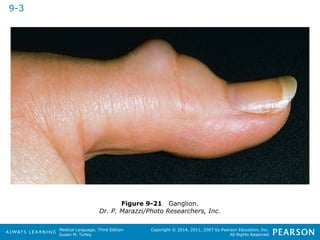
9-1 
• The medical specialty that studies the 
anatomy and physiology of the 
muscular and skeletal systems and 
uses diagnostic tests, medical and 
surgical procedures, and drugs to treat 
muscular and skeletal diseases.
Medical Language, Third Edition 
Susan M. Turley 
Copyright © 2014, 2011, 2007 by Pearson Education, Inc. 
All Rights Reserved 
Figure 9-1 Muscular system. 
9-1
AAnnaattoommyy aanndd PPhhyyssiioollooggyy 
• The muscular system moves the bony 
framework of the body. 
• There are approximately 700 skeletal 
muscles in the body, as well as tendons 
and other structures of the muscular 
system. 
• Some skeletal muscles are readily 
visible on the surface of the body, while 
others are located more deeply. 
Medical Language, Third Edition 
Susan M. Turley 
Copyright © 2014, 2011, 2007 by Pearson Education, Inc. 
All Rights Reserved 
9-1
AAnnaattoommyy aanndd PPhhyyssiioollooggyy 
• All of the muscles of the body (or the 
muscles in a particular part of the 
body) are referred to as the 
musculature. 
• The muscular system is also known as 
the musculoskeletal system because, 
without the muscles, the bones would 
not be able to move, and without the 
bones, the muscles would lack support. 
Medical Language, Third Edition 
Susan M. Turley 
Copyright © 2014, 2011, 2007 by Pearson Education, Inc. 
All Rights Reserved 
9-1
AAnnaattoommyy ooff tthhee MMuussccuullaarr SSyysstteemm 
• Types of Muscles: Skeletal muscles 
 Provide the means by which the body 
can move 
 Are voluntary muscles that contract and 
relax in response to conscious thought 
 Are striated, have multiple nuclei, and 
show bands of color when seen under 
the microscope 
Medical Language, Third Edition 
Susan M. Turley 
Copyright © 2014, 2011, 2007 by Pearson Education, Inc. 
All Rights Reserved 
9-1
AAnnaattoommyy ooff tthhee MMuussccuullaarr SSyysstteemm 
• Types of Muscles: Skeletal muscles 
 Of the three types of muscles, only 
skeletal muscle belongs to the muscular 
system. 
Medical Language, Third Edition 
Susan M. Turley 
Copyright © 2014, 2011, 2007 by Pearson Education, Inc. 
All Rights Reserved 
9-1
AAnnaattoommyy ooff tthhee MMuussccuullaarr SSyysstteemm 
• Types of Muscles: Cardiac Muscle 
 Cardiac muscle of the heart pumps 
blood through the circulatory system. 
 An involuntary muscle that is not under 
conscious control 
Medical Language, Third Edition 
Susan M. Turley 
Copyright © 2014, 2011, 2007 by Pearson Education, Inc. 
All Rights Reserved 
9-1
AAnnaattoommyy ooff tthhee MMuussccuullaarr SSyysstteemm 
• Types of Muscles: Smooth Muscles 
 Involuntary, nonstriated muscles 
 Form a continuous, thin layer around 
many organs and structures (blood 
vessels, intestines, etc.) 
Medical Language, Third Edition 
Susan M. Turley 
Copyright © 2014, 2011, 2007 by Pearson Education, Inc. 
All Rights Reserved 
9-1
Medical Language, Third Edition 
Susan M. Turley 
Copyright © 2014, 2011, 2007 by Pearson Education, Inc. 
All Rights Reserved 
Figure 9-2 Types of muscle. 
9-1
MMuussccllee OOrriiggiinnss,, IInnsseerrttiioonnss,, 
aanndd RReellaatteedd SSttrruuccttuurreess 
• A muscle is attached to a bone by a 
tendon, a cordlike, nonelastic, white 
fibrous band of connective tissue. 
• The origin or beginning of a muscle is 
where its tendon is attached to a 
stationary or nearly stationary bone. 
Medical Language, Third Edition 
Susan M. Turley 
Copyright © 2014, 2011, 2007 by Pearson Education, Inc. 
All Rights Reserved 
9-1
MMuussccllee OOrriiggiinnss,, IInnsseerrttiioonnss,, 
aanndd RReellaatteedd SSttrruuccttuurreess 
• The insertion or ending of a muscle is 
where its tendon is attached to the 
bone that moves when the muscle 
contracts and relaxes. 
• The belly of a muscle is where its mass 
is the greatest, usually midway 
between the origin and insertion. 
Medical Language, Third Edition 
Susan M. Turley 
Copyright © 2014, 2011, 2007 by Pearson Education, Inc. 
All Rights Reserved 
9-1
MMuussccllee OOrriiggiinnss,, IInnsseerrttiioonnss,, 
aanndd RReellaatteedd SSttrruuccttuurreess 
• A bursa, a thin sac of synovial 
membrane filled with synovial fluid, 
acts as a cushion to reduce friction 
where a tendon rubs against the bone. 
• Each muscle is wrapped in fascia, a thin 
connective tissue that joins to the 
tendon. 
Medical Language, Third Edition 
Susan M. Turley 
Copyright © 2014, 2011, 2007 by Pearson Education, Inc. 
All Rights Reserved 
9-1
MMuussccllee OOrriiggiinnss,, IInnsseerrttiioonnss,, 
aanndd RReellaatteedd SSttrruuccttuurreess 
• Aponeurosis is connective tissue that 
attaches a flat muscle to bone or to 
other, deeper muscles. 
• Retinaculum is a band of fibrous tissue 
and fascia that holds down the extensor 
and flexor tendons that cross the wrist 
and ankle 
Medical Language, Third Edition 
Susan M. Turley 
Copyright © 2014, 2011, 2007 by Pearson Education, Inc. 
All Rights Reserved 
9-1
Medical Language, Third Edition 
Susan M. Turley 
Copyright © 2014, 2011, 2007 by Pearson Education, Inc. 
All Rights Reserved 
Figure 9-3 Tendon. 
9-1
Figure 9-4 Origin and insertion of a muscle. 
Medical Language, Third Edition 
Susan M. Turley 
Copyright © 2014, 2011, 2007 by Pearson Education, Inc. 
All Rights Reserved 
9-1
Medical Language, Third Edition 
Susan M. Turley 
Copyright © 2014, 2011, 2007 by Pearson Education, Inc. 
All Rights Reserved 
MMuussccllee NNaammeess 
9-1 
• Muscle names are in Latin. 
• They describe where the muscle is 
located, its shape, its size, or what 
action it performs.
Table 9-1 Muscle Names and Their Meanings 
Medical Language, Third Edition 
Susan M. Turley 
Copyright © 2014, 2011, 2007 by Pearson Education, Inc. 
All Rights Reserved 
9-1
Table 9-1 (continued) Muscle Names and Their Meanings 
Medical Language, Third Edition 
Susan M. Turley 
Copyright © 2014, 2011, 2007 by Pearson Education, Inc. 
All Rights Reserved 
9-1
MMuusscclleess AAnniimmaattiioonn 
Click on the screenshot to view an animation on the topic of muscles. 
Medical Language, Third Edition 
Susan M. Turley 
Copyright © 2014, 2011, 2007 by Pearson Education, Inc. 
All Rights Reserved 
Back to Directory 
9-1
TTyyppeess ooff MMuussccllee MMoovveemmeenntt 
• Muscles function in antagonistic pairs to 
produce movement. 
• These are opposite movements 
controlled by muscle pairs: 
 Flexion and extension 
 Abduction and adduction 
 Rotation to the right and to the left 
 Supination and pronation 
 Eversion and inversion 
Medical Language, Third Edition 
Susan M. Turley 
Copyright © 2014, 2011, 2007 by Pearson Education, Inc. 
All Rights Reserved 
9-1
Medical Language, Third Edition 
Susan M. Turley 
Copyright © 2014, 2011, 2007 by Pearson Education, Inc. 
All Rights Reserved 
Table 9-2 Types of Muscle Movement 
9-1
Table 9-2 (continued) Types of Muscle Movement 
Medical Language, Third Edition 
Susan M. Turley 
Copyright © 2014, 2011, 2007 by Pearson Education, Inc. 
All Rights Reserved 
9-1
Table 9-2 (continued) Types of Muscle Movement 
Medical Language, Third Edition 
Susan M. Turley 
Copyright © 2014, 2011, 2007 by Pearson Education, Inc. 
All Rights Reserved 
9-1
Table 9-2 (continued) Types of Muscle Movement 
Medical Language, Third Edition 
Susan M. Turley 
Copyright © 2014, 2011, 2007 by Pearson Education, Inc. 
All Rights Reserved 
9-1
Figure 9-5 Extension, abduction, and dorsiflexion. 
Medical Language, Third Edition 
Susan M. Turley 
Copyright © 2014, 2011, 2007 by Pearson Education, Inc. 
All Rights Reserved 
Rubberball/Getty Images 
9-1
Figure 9-6 Extension, adduction, pronation, abduction, flexion, and plantar flexion. 
Medical Language, Third Edition 
Susan M. Turley 
Copyright © 2014, 2011, 2007 by Pearson Education, Inc. 
All Rights Reserved 
Mark Anderson/Getty Images 
9-1
Medical Language, Third Edition 
Susan M. Turley 
Copyright © 2014, 2011, 2007 by Pearson Education, Inc. 
All Rights Reserved 
Figure 9-7 Rotation. 
9-1
Figure 9-8 Extension, supination, abduction, flexion, and inversion. 
Medical Language, Third Edition 
Susan M. Turley 
Copyright © 2014, 2011, 2007 by Pearson Education, Inc. 
All Rights Reserved 
Anthony Saint James/Getty Images 
9-1
EEllbbooww FFlleexxiioonn MMoovveemmeenntt 
Medical Language, Third Edition 
Susan M. Turley 
Copyright © 2014, 2011, 2007 by Pearson Education, Inc. 
All Rights Reserved 
AAnniimmaattiioonn 
Click on the screenshot to view an animation on the movement of the elbow. 
Back to Directory 
9-1
AArrmm aanndd HHaanndd PPrroonnaattiioonn 
Medical Language, Third Edition 
Susan M. Turley 
Copyright © 2014, 2011, 2007 by Pearson Education, Inc. 
All Rights Reserved 
AAnniimmaattiioonn 
Click on the screenshot to view an animation on arm and hand pronation. 
Back to Directory 
9-1
AAnnkkllee DDoorrssiifflleexxiioonn MMoovveemmeenntt 
Medical Language, Third Edition 
Susan M. Turley 
Copyright © 2014, 2011, 2007 by Pearson Education, Inc. 
All Rights Reserved 
AAnniimmaattiioonn 
Click on the screenshot to view an animation on the movement of the ankle. 
Back to Directory 
9-1
HHuummeerruuss AAdddduuccttiioonn 
MMoovveemmeenntt AAnniimmaattiioonn 
Click on the screenshot to view an animation on the movement of the humerus. 
Medical Language, Third Edition 
Susan M. Turley 
Copyright © 2014, 2011, 2007 by Pearson Education, Inc. 
All Rights Reserved 
Back to Directory 
9-1
Humerus RRoottaattiioonn MMoovveemmeenntt 
Medical Language, Third Edition 
Susan M. Turley 
Copyright © 2014, 2011, 2007 by Pearson Education, Inc. 
All Rights Reserved 
AAnniimmaattiioonn 
Click on the screenshot to view an animation on the rotation of the humerus. 
Back to Directory 
9-1
Wrist FFlleexxiioonn MMoovveemmeenntt AAnniimmaattiioonn 
Click on the screenshot to view an animation on the movement of the wrist. 
Medical Language, Third Edition 
Susan M. Turley 
Copyright © 2014, 2011, 2007 by Pearson Education, Inc. 
All Rights Reserved 
Back to Directory 
9-1
MMuusscclleess ooff tthhee HHeeaadd aanndd NNeecckk 
Medical Language, Third Edition 
Susan M. Turley 
Copyright © 2014, 2011, 2007 by Pearson Education, Inc. 
All Rights Reserved 
9-1 
• Frontalis 
• Temporalis 
• Orbicularis oculi 
• Orbicularis oris 
• Masseter 
• Buccinator 
• Sternocleidomastoid 
• Platysma
Medical Language, Third Edition 
Susan M. Turley 
Copyright © 2014, 2011, 2007 by Pearson Education, Inc. 
All Rights Reserved 
Figure 9-9 Muscles of the head and neck. 
9-1
MMuusscclleess ooff tthhee SShhoouullddeerrss,, 
CChheesstt,, aanndd BBaacckk 
Medical Language, Third Edition 
Susan M. Turley 
Copyright © 2014, 2011, 2007 by Pearson Education, Inc. 
All Rights Reserved 
9-1 
• Deltoid 
• Pectoralis major 
• Intercostal muscles 
• Trapezius 
• Latissimus dorsi
Figure 9-10 Muscles of the shoulder and chest. 
Medical Language, Third Edition 
Susan M. Turley 
Copyright © 2014, 2011, 2007 by Pearson Education, Inc. 
All Rights Reserved 
9-1
Figure 9-11 Muscles of the shoulder and back. 
Medical Language, Third Edition 
Susan M. Turley 
Copyright © 2014, 2011, 2007 by Pearson Education, Inc. 
All Rights Reserved 
9-1
9-1 
Muscles ooff tthhee UUppppeerr EExxttrreemmiittyy 
Medical Language, Third Edition 
Susan M. Turley 
Copyright © 2014, 2011, 2007 by Pearson Education, Inc. 
All Rights Reserved 
• Biceps brachii 
• Triceps brachii 
• Brachioradialis 
• Thenar muscles
Figure 9-12 Muscles of the upper extremity. 
McMinn and Hutchings. McMinn’s Color Atlas of Human Anatomy, 2/e. Elsevier, 2002. 
Medical Language, Third Edition 
Susan M. Turley 
Copyright © 2014, 2011, 2007 by Pearson Education, Inc. 
All Rights Reserved 
9-1
Figure 9-13 Muscles of the forearm and the retinaculum. 
Medical Language, Third Edition 
Susan M. Turley 
Copyright © 2014, 2011, 2007 by Pearson Education, Inc. 
All Rights Reserved 
9-1
MMuusscclleess ooff tthhee AAbbddoommeenn 
Medical Language, Third Edition 
Susan M. Turley 
Copyright © 2014, 2011, 2007 by Pearson Education, Inc. 
All Rights Reserved 
9-1 
• External abdominal oblique 
• Internal abdominal oblique 
• Rectus abdominis
Medical Language, Third Edition 
Susan M. Turley 
Copyright © 2014, 2011, 2007 by Pearson Education, Inc. 
All Rights Reserved 
Figure 9-14 Muscles of the abdomen. 
9-1
Muscles ooff tthhee LLoowweerr EExxttrreemmiittyy 
Medical Language, Third Edition 
Susan M. Turley 
Copyright © 2014, 2011, 2007 by Pearson Education, Inc. 
All Rights Reserved 
• Anterior Leg 
 Rectus femoris 
 Sartorius 
 Vastus lateralis and vastus medialis 
 Peroneus longus 
 Tibialis anterior 
9-1
Muscles ooff tthhee LLoowweerr EExxttrreemmiittyy 
• Quadriceps femoris is a collective name 
for the group of four muscles on the 
anterior aspect of the thigh: 
 Rectus femoris 
 Vastus lateralis 
 Vastus intermedius (beneath the 
vastus lateralis) 
 Vastus medialis 
Medical Language, Third Edition 
Susan M. Turley 
Copyright © 2014, 2011, 2007 by Pearson Education, Inc. 
All Rights Reserved 
9-1
Muscles ooff tthhee LLoowweerr EExxttrreemmiittyy 
Medical Language, Third Edition 
Susan M. Turley 
Copyright © 2014, 2011, 2007 by Pearson Education, Inc. 
All Rights Reserved 
• Posterior Leg 
 Gluteus maximus 
 Biceps femoris 
 Semitendinosus and semimembranosus 
 Gastrocnemius 
9-1
Figure 9-15 Muscles of the lower extremity. 
Medical Language, Third Edition 
Susan M. Turley 
Copyright © 2014, 2011, 2007 by Pearson Education, Inc. 
All Rights Reserved 
9-1
Muscles ooff tthhee LLoowweerr EExxttrreemmiittyy 
• Hamstrings is a collective name for the 
group of three muscles on the posterior 
aspect of the thigh: 
Medical Language, Third Edition 
Susan M. Turley 
Copyright © 2014, 2011, 2007 by Pearson Education, Inc. 
All Rights Reserved 
 Biceps femoris 
 Semitendinosus 
 Semimembranosus 
9-1
Figure 9-16 Growth and development milestones. 
Medical Language, Third Edition 
Susan M. Turley 
Copyright © 2014, 2011, 2007 by Pearson Education, Inc. 
All Rights Reserved 
9-1
Physiology ooff aa MMuussccllee CCoonnttrraaccttiioonn 
• A muscle is composed of several 
muscle fascicles, each of which is 
wrapped in fascia. 
• Each muscle fascicle is a bundle of 
individual muscle fibers. 
Medical Language, Third Edition 
Susan M. Turley 
Copyright © 2014, 2011, 2007 by Pearson Education, Inc. 
All Rights Reserved 
9-2
Physiology ooff aa MMuussccllee CCoonnttrraaccttiioonn 
• These run parallel to each other so 
that, when they contract, they all pull 
in the same direction. 
• A muscle fiber (which is actually one 
long muscle cell) has hundreds of 
nuclei along its length to speed up the 
chemical processes that occur as it 
contracts. 
Medical Language, Third Edition 
Susan M. Turley 
Copyright © 2014, 2011, 2007 by Pearson Education, Inc. 
All Rights Reserved 
9-2
Physiology ooff aa MMuussccllee CCoonnttrraaccttiioonn 
• Each muscle fiber is composed of 
myofibrils that contain the proteins 
actin and myosin. 
• A muscle contracts in response to an 
electrical impulse from a nerve. 
• Each muscle fiber is connected to a 
single nerve cell at the neuromuscular 
junction. 
Medical Language, Third Edition 
Susan M. Turley 
Copyright © 2014, 2011, 2007 by Pearson Education, Inc. 
All Rights Reserved 
9-2
Physiology ooff aa MMuussccllee CCoonnttrraaccttiioonn 
• Acetylcholine is a chemical messenger 
that changes the permeability of the 
muscle fiber, which shortens the 
muscle and produces a muscle 
contraction. 
• Muscles are in a state of mild, partial 
contraction because of nerve impulses 
from the brain and spinal cord. 
Medical Language, Third Edition 
Susan M. Turley 
Copyright © 2014, 2011, 2007 by Pearson Education, Inc. 
All Rights Reserved 
9-2
Medical Language, Third Edition 
Susan M. Turley 
Copyright © 2014, 2011, 2007 by Pearson Education, Inc. 
All Rights Reserved 
Figure 9-17 Parts of a muscle. 
9-2
Medical Language, Third Edition 
Susan M. Turley 
Copyright © 2014, 2011, 2007 by Pearson Education, Inc. 
All Rights Reserved 
Figure 9-18 Muscle strength and size. 
9-2
Medical Language, Third Edition 
Susan M. Turley 
Copyright © 2014, 2011, 2007 by Pearson Education, Inc. 
All Rights Reserved 
DDiisseeaasseess 
• Diseases of the Muscles 
 Atrophy 
 Avulsion 
 Compartment syndrome 
 Contracture 
 Fibromyalgia 
9-3
Medical Language, Third Edition 
Susan M. Turley 
Copyright © 2014, 2011, 2007 by Pearson Education, Inc. 
All Rights Reserved 
Figure 9-19 Muscle contracture. 
9-3
MMuussccllee AAttrroopphhyy VViiddeeoo 
Click on the screenshot to view a video on the topic of muscular atrophy. 
Medical Language, Third Edition 
Susan M. Turley 
Copyright © 2014, 2011, 2007 by Pearson Education, Inc. 
All Rights Reserved 
Back to Directory 
9-3
Medical Language, Third Edition 
Susan M. Turley 
Copyright © 2014, 2011, 2007 by Pearson Education, Inc. 
All Rights Reserved 
DDiisseeaasseess 
• Diseases of the Muscles 
 Hyperextension-hyperflexion injury 
 Muscle contusion 
 Muscle spasm 
 Muscle strain 
 Muscular dystrophy 
9-3 
contus/o- 
-ion 
= brusing 
= action; 
condition
Medical Language, Third Edition 
Susan M. Turley 
Copyright © 2014, 2011, 2007 by Pearson Education, Inc. 
All Rights Reserved 
Figure 9-20 Muscular dystrophy. 
9-3
MMuussccuullaarr DDyyssttrroopphhyy VViiddeeoo 
Click on the screenshot to view a video on the topic of muscular dystrophy. 
Medical Language, Third Edition 
Susan M. Turley 
Copyright © 2014, 2011, 2007 by Pearson Education, Inc. 
All Rights Reserved 
Back to Directory 
9-3
Medical Language, Third Edition 
Susan M. Turley 
Copyright © 2014, 2011, 2007 by Pearson Education, Inc. 
All Rights Reserved 
DDiisseeaasseess 
• Diseases of the Muscles 
 Myalgia 
 Myasthenia gravis 
 Myopathy 
 Myositis 
 Repetitive strain injury (RSI) 
 Rhabdomyoma 
 Rhabdomyosarcoma 
 Rotator cuff tear 
9-3
Medical Language, Third Edition 
Susan M. Turley 
Copyright © 2014, 2011, 2007 by Pearson Education, Inc. 
All Rights Reserved 
DDiisseeaasseess 
• Movement Disorders 
 Ataxia 
 Bradykinesia 
 Dyskinesia 
 Hyperkinesis 
 Restless legs syndrome (RLS) 
 Tremor 
9-3
Medical Language, Third Edition 
Susan M. Turley 
Copyright © 2014, 2011, 2007 by Pearson Education, Inc. 
All Rights Reserved 
DDiisseeaasseess 
• Diseases of the Bursa, Fascia, or 
Tendon 
 Bursitis 
 Dupuytren’s contracture 
 Fasciitis 
 Ganglion 
 Pitcher’s elbow 
9-3
Medical Language, Third Edition 
Susan M. Turley 
ten/o- = tendon 
Copyright © 2014, 2011, 2007 by Pearson Education, Inc. 
All Rights Reserved 
DDiisseeaasseess 
• Diseases of the Bursa, Fascia, or 
Tendon 
 Shin splints 
 Tendinitis 
 Tennis elbow 
 Tenosynovitis 
9-3 
synov/o- 
-itis 
= synovium 
(membrane) 
= inflammation of; 
infection of
Medical Language, Third Edition 
Susan M. Turley 
Copyright © 2014, 2011, 2007 by Pearson Education, Inc. 
All Rights Reserved 
Figure 9-21 Ganglion. 
Dr. P. Marazzi/Photo Researchers, Inc. 
9-3
LLaabboorraattoorryy aanndd DDiiaaggnnoossttiicc 
Medical Language, Third Edition 
Susan M. Turley 
Copyright © 2014, 2011, 2007 by Pearson Education, Inc. 
All Rights Reserved 
PPrroocceedduurreess 
• Blood Tests 
 Acetylcholine receptor antibody 
 Creatine phosphokinase (CPK-MM) 
• Muscle Tests 
 Edrophonium test 
 Electromyography (EMG) 
9-3
MMeeddiiccaall aanndd SSuurrggiiccaall PPrroocceedduurreess 
Medical Language, Third Edition 
Susan M. Turley 
Copyright © 2014, 2011, 2007 by Pearson Education, Inc. 
All Rights Reserved 
• Medical Procedures 
 Braces and adaptive devices 
 Deep tendon reflexes (DTR) 
 Muscle strength test 
 Rehabilitation exercises 
 Trigger point injections 
9-3
Medical Language, Third Edition 
Susan M. Turley 
Copyright © 2014, 2011, 2007 by Pearson Education, Inc. 
All Rights Reserved 
Figure 9-22 Braces. 
K. Glaser & Associates/Custom Medical Stock Photo, Inc. 
9-3
Medical Language, Third Edition 
Susan M. Turley 
Copyright © 2014, 2011, 2007 by Pearson Education, Inc. 
All Rights Reserved 
Figure 9-23 Deep tendon reflex. 
PhotoAlto/Ale Ventura/Getty Images 
9-3
Medical Language, Third Edition 
Susan M. Turley 
Copyright © 2014, 2011, 2007 by Pearson Education, Inc. 
All Rights Reserved 
Figure 9-24 Active exercise. 
Alvis Upitis/Getty Images 
9-3
MMeeddiiccaall aanndd SSuurrggiiccaall 
Medical Language, Third Edition 
Susan M. Turley 
= muscle 
Copyright © 2014, 2011, 2007 by Pearson Education, Inc. 
All Rights Reserved 
PPrroocceedduurreess 
• Surgical Procedures 
 Fasciectomy 
 Fasciotomy 
 Ganglionectomy 
 Muscle biopsy 
 Myorrhaphy 
 Tenorrhaphy 
 Thymectomy 
9-3 
my/o- 
-rrhaphy 
= procedure of 
suturing
DDrruugg CCaatteeggoorriieess 
• These categories of drugs are used to 
treat muscular diseases and conditions: 
Medical Language, Third Edition 
Susan M. Turley 
Copyright © 2014, 2011, 2007 by Pearson Education, Inc. 
All Rights Reserved 
 Analgesic drugs 
 Beta-blocker drugs 
 Corticosteroid drugs 
 Dopamine stimulant drugs 
 Drugs for fibromyalgia 
 Drugs for myasthenia gravis 
9-3
DDrruugg CCaatteeggoorriieess 
• These categories of drugs are used to 
treat muscular diseases and conditions: 
 Muscle relaxant drugs 
 Neuromuscular blocker drugs 
 Nonsteroidal anti-inflammatory drugs 
(NSAIDs) 
Medical Language, Third Edition 
Susan M. Turley 
Copyright © 2014, 2011, 2007 by Pearson Education, Inc. 
All Rights Reserved 
9-3
Medical Language, Third Edition 
Susan M. Turley 
Copyright © 2014, 2011, 2007 by Pearson Education, Inc. 
All Rights Reserved 
Figure 9-25 Intramuscular injection. 
9-3
Medical Language, Third Edition 
Susan M. Turley 
Copyright © 2014, 2011, 2007 by Pearson Education, Inc. 
All Rights Reserved 
AAbbbbrreevviiaattiioonnss 
ADA Americans with Disabilities Act 
ADLs activities of daily living 
COTA certified occupational therapy assistant 
CPK-MM creatine phosphokinase-MM 
CTD cumulative trauma disorder 
D.C. Doctor of Chiropracty or Chiropractic 
Medicine 
DTRs deep tendon reflexes 
EMG electromyography 
IM intramuscular 
LLE left lower extremity 
LUE left upper extremity 
MD muscular dystrophy 
NSAID nonsteroidal anti-inflammatory drug 
OOB out of bed 
ortho orthopedics (slang) 
OSHA Occupational Safety and Health 
Administration 
OT occupational therapy or occupational therapist 
PM&R physical medicine and rehabilitation 
PT physical therapy or physical therapist 
rehab rehabilitation (slang) 
RICE rest, ice, compression, and elevation 
RLE right lower extremity 
ROM range of motion 
RUE right upper extremity 
RSI repetitive strain injury 
9-4
MMaassssaaggee TThheerraappiisstt VViiddeeoo 
Click on the screenshot to view a video on the topic of careers in massage therapy. 
Medical Language, Third Edition 
Susan M. Turley 
Copyright © 2014, 2011, 2007 by Pearson Education, Inc. 
All Rights Reserved 
Back to Directory 
9-8
MMaassssaaggee TThheerraappyy CChhaannggeess VViiddeeoo 
Click on the screenshot to view a video on the topic of changes in massage therapy. 
Medical Language, Third Edition 
Susan M. Turley 
Copyright © 2014, 2011, 2007 by Pearson Education, Inc. 
All Rights Reserved 
9-8 
Back to Directory
MMaassssaaggee TThheerraappyy aanndd 
EEtthhiiccaall SSiittuuaattiioonnss VViiddeeoo 
Click on the screenshot to view a video on the topic of ethical situations in massage 
Medical Language, Third Edition 
Susan M. Turley 
Copyright © 2014, 2011, 2007 by Pearson Education, Inc. 
All Rights Reserved 
therapy. 
9-8 
Back to Directory
CChhiirroopprraaccttoorr VViiddeeoo 
Click on the screenshot to view a video on the topic of chiropractors. 
Medical Language, Third Edition 
Susan M. Turley 
Copyright © 2014, 2011, 2007 by Pearson Education, Inc. 
All Rights Reserved 
Back to Directory 
9-8
CCoommbbiinniinngg FFoorrmmss MMaattcchh UUpp 
Medical Language, Third Edition 
Susan M. Turley 
Copyright © 2014, 2011, 2007 by Pearson Education, Inc. 
All Rights Reserved 
1. duct/o- 
2. extern/o- 
3. flex/o- 
4. my/o- 
5. vers/o-a. 
bending 
b. muscle 
c. to turn 
d. outside 
e. bring 
9-4

Turley ch09 lecture_nocrs

  • 1.
    MMeeddiiccaall LLaanngguuaaggee IImmmmeerrsseeYYoouurrsseellff THIRD EDITION CHAPTER Medical Language, Third Edition Susan M. Turley 9 Orthopedics Copyright © 2014, 2011, 2007 by Pearson Education, Inc. All Rights Reserved
  • 2.
    LLeeaarrnniinngg OObbjjeeccttiivveess 1.Identify the structures of the muscular Medical Language, Third Edition Susan M. Turley Copyright © 2014, 2011, 2007 by Pearson Education, Inc. All Rights Reserved system. 2. Describe how muscles contract and produce movement. 3. Describe common muscular diseases, laboratory and diagnostic procedures, medical and surgical procedures, and drug categories.
  • 3.
    LLeeaarrnniinngg OObbjjeeccttiivveess 4.Give the medical meaning of word parts and abbreviations related to the muscular system. 5. Build muscular words from word parts and divide and define muscular words. 6. Spell and pronounce muscular words. 7. Analyze the medical content and meaning of an orthopedic report. Medical Language, Third Edition Susan M. Turley Copyright © 2014, 2011, 2007 by Pearson Education, Inc. All Rights Reserved
  • 4.
    LLeeaarrnniinngg OObbjjeeccttiivveess 8.Dive deeper into orthopedics (muscular) by reviewing the activities at the end of this chapter and online at www.MyMedicalTerminologyLab.com. Medical Language, Third Edition Susan M. Turley Copyright © 2014, 2011, 2007 by Pearson Education, Inc. All Rights Reserved
  • 5.
    MMuullttiimmeeddiiaa DDiirreeccttoorryy Slide25Muscles Animation Slide 35Elbow Flexion Movement Animation Slide 36Arm and Hand Pronation Movement Animation Slide 37Ankle Dorsiflexion Movement Animation Slide 38 Humerus Adduction Movement Animation Slide 39 Humerus Rotation Movement Animation Slide 40 Wrist Flexion Movement Animation Slide 65 Muscular Atrophy Video Slide 68 Muscular Dystrophy Video Slide 84 Massage Therapist Video Slide 85 Massage Therapy Changes Video Medical Language, Third Edition Susan M. Turley Copyright © 2014, 2011, 2007 by Pearson Education, Inc. All Rights Reserved
  • 6.
    MMuullttiimmeeddiiaa DDiirreeccttoorryy Slide86 Massage Therapy and Ethical Situations Video Slide 87 Chiropractor Video Medical Language, Third Edition Susan M. Turley Copyright © 2014, 2011, 2007 by Pearson Education, Inc. All Rights Reserved
  • 7.
    Medical Language, ThirdEdition Susan M. Turley Copyright © 2014, 2011, 2007 by Pearson Education, Inc. All Rights Reserved OOrrtthhooppeeddiiccss 9-1 • The medical specialty that studies the anatomy and physiology of the muscular and skeletal systems and uses diagnostic tests, medical and surgical procedures, and drugs to treat muscular and skeletal diseases.
  • 8.
    Medical Language, ThirdEdition Susan M. Turley Copyright © 2014, 2011, 2007 by Pearson Education, Inc. All Rights Reserved Figure 9-1 Muscular system. 9-1
  • 9.
    AAnnaattoommyy aanndd PPhhyyssiioollooggyy • The muscular system moves the bony framework of the body. • There are approximately 700 skeletal muscles in the body, as well as tendons and other structures of the muscular system. • Some skeletal muscles are readily visible on the surface of the body, while others are located more deeply. Medical Language, Third Edition Susan M. Turley Copyright © 2014, 2011, 2007 by Pearson Education, Inc. All Rights Reserved 9-1
  • 10.
    AAnnaattoommyy aanndd PPhhyyssiioollooggyy • All of the muscles of the body (or the muscles in a particular part of the body) are referred to as the musculature. • The muscular system is also known as the musculoskeletal system because, without the muscles, the bones would not be able to move, and without the bones, the muscles would lack support. Medical Language, Third Edition Susan M. Turley Copyright © 2014, 2011, 2007 by Pearson Education, Inc. All Rights Reserved 9-1
  • 11.
    AAnnaattoommyy ooff tthheeMMuussccuullaarr SSyysstteemm • Types of Muscles: Skeletal muscles  Provide the means by which the body can move  Are voluntary muscles that contract and relax in response to conscious thought  Are striated, have multiple nuclei, and show bands of color when seen under the microscope Medical Language, Third Edition Susan M. Turley Copyright © 2014, 2011, 2007 by Pearson Education, Inc. All Rights Reserved 9-1
  • 12.
    AAnnaattoommyy ooff tthheeMMuussccuullaarr SSyysstteemm • Types of Muscles: Skeletal muscles  Of the three types of muscles, only skeletal muscle belongs to the muscular system. Medical Language, Third Edition Susan M. Turley Copyright © 2014, 2011, 2007 by Pearson Education, Inc. All Rights Reserved 9-1
  • 13.
    AAnnaattoommyy ooff tthheeMMuussccuullaarr SSyysstteemm • Types of Muscles: Cardiac Muscle  Cardiac muscle of the heart pumps blood through the circulatory system.  An involuntary muscle that is not under conscious control Medical Language, Third Edition Susan M. Turley Copyright © 2014, 2011, 2007 by Pearson Education, Inc. All Rights Reserved 9-1
  • 14.
    AAnnaattoommyy ooff tthheeMMuussccuullaarr SSyysstteemm • Types of Muscles: Smooth Muscles  Involuntary, nonstriated muscles  Form a continuous, thin layer around many organs and structures (blood vessels, intestines, etc.) Medical Language, Third Edition Susan M. Turley Copyright © 2014, 2011, 2007 by Pearson Education, Inc. All Rights Reserved 9-1
  • 15.
    Medical Language, ThirdEdition Susan M. Turley Copyright © 2014, 2011, 2007 by Pearson Education, Inc. All Rights Reserved Figure 9-2 Types of muscle. 9-1
  • 16.
    MMuussccllee OOrriiggiinnss,, IInnsseerrttiioonnss,, aanndd RReellaatteedd SSttrruuccttuurreess • A muscle is attached to a bone by a tendon, a cordlike, nonelastic, white fibrous band of connective tissue. • The origin or beginning of a muscle is where its tendon is attached to a stationary or nearly stationary bone. Medical Language, Third Edition Susan M. Turley Copyright © 2014, 2011, 2007 by Pearson Education, Inc. All Rights Reserved 9-1
  • 17.
    MMuussccllee OOrriiggiinnss,, IInnsseerrttiioonnss,, aanndd RReellaatteedd SSttrruuccttuurreess • The insertion or ending of a muscle is where its tendon is attached to the bone that moves when the muscle contracts and relaxes. • The belly of a muscle is where its mass is the greatest, usually midway between the origin and insertion. Medical Language, Third Edition Susan M. Turley Copyright © 2014, 2011, 2007 by Pearson Education, Inc. All Rights Reserved 9-1
  • 18.
    MMuussccllee OOrriiggiinnss,, IInnsseerrttiioonnss,, aanndd RReellaatteedd SSttrruuccttuurreess • A bursa, a thin sac of synovial membrane filled with synovial fluid, acts as a cushion to reduce friction where a tendon rubs against the bone. • Each muscle is wrapped in fascia, a thin connective tissue that joins to the tendon. Medical Language, Third Edition Susan M. Turley Copyright © 2014, 2011, 2007 by Pearson Education, Inc. All Rights Reserved 9-1
  • 19.
    MMuussccllee OOrriiggiinnss,, IInnsseerrttiioonnss,, aanndd RReellaatteedd SSttrruuccttuurreess • Aponeurosis is connective tissue that attaches a flat muscle to bone or to other, deeper muscles. • Retinaculum is a band of fibrous tissue and fascia that holds down the extensor and flexor tendons that cross the wrist and ankle Medical Language, Third Edition Susan M. Turley Copyright © 2014, 2011, 2007 by Pearson Education, Inc. All Rights Reserved 9-1
  • 20.
    Medical Language, ThirdEdition Susan M. Turley Copyright © 2014, 2011, 2007 by Pearson Education, Inc. All Rights Reserved Figure 9-3 Tendon. 9-1
  • 21.
    Figure 9-4 Originand insertion of a muscle. Medical Language, Third Edition Susan M. Turley Copyright © 2014, 2011, 2007 by Pearson Education, Inc. All Rights Reserved 9-1
  • 22.
    Medical Language, ThirdEdition Susan M. Turley Copyright © 2014, 2011, 2007 by Pearson Education, Inc. All Rights Reserved MMuussccllee NNaammeess 9-1 • Muscle names are in Latin. • They describe where the muscle is located, its shape, its size, or what action it performs.
  • 23.
    Table 9-1 MuscleNames and Their Meanings Medical Language, Third Edition Susan M. Turley Copyright © 2014, 2011, 2007 by Pearson Education, Inc. All Rights Reserved 9-1
  • 24.
    Table 9-1 (continued)Muscle Names and Their Meanings Medical Language, Third Edition Susan M. Turley Copyright © 2014, 2011, 2007 by Pearson Education, Inc. All Rights Reserved 9-1
  • 25.
    MMuusscclleess AAnniimmaattiioonn Clickon the screenshot to view an animation on the topic of muscles. Medical Language, Third Edition Susan M. Turley Copyright © 2014, 2011, 2007 by Pearson Education, Inc. All Rights Reserved Back to Directory 9-1
  • 26.
    TTyyppeess ooff MMuusscclleeMMoovveemmeenntt • Muscles function in antagonistic pairs to produce movement. • These are opposite movements controlled by muscle pairs:  Flexion and extension  Abduction and adduction  Rotation to the right and to the left  Supination and pronation  Eversion and inversion Medical Language, Third Edition Susan M. Turley Copyright © 2014, 2011, 2007 by Pearson Education, Inc. All Rights Reserved 9-1
  • 27.
    Medical Language, ThirdEdition Susan M. Turley Copyright © 2014, 2011, 2007 by Pearson Education, Inc. All Rights Reserved Table 9-2 Types of Muscle Movement 9-1
  • 28.
    Table 9-2 (continued)Types of Muscle Movement Medical Language, Third Edition Susan M. Turley Copyright © 2014, 2011, 2007 by Pearson Education, Inc. All Rights Reserved 9-1
  • 29.
    Table 9-2 (continued)Types of Muscle Movement Medical Language, Third Edition Susan M. Turley Copyright © 2014, 2011, 2007 by Pearson Education, Inc. All Rights Reserved 9-1
  • 30.
    Table 9-2 (continued)Types of Muscle Movement Medical Language, Third Edition Susan M. Turley Copyright © 2014, 2011, 2007 by Pearson Education, Inc. All Rights Reserved 9-1
  • 31.
    Figure 9-5 Extension,abduction, and dorsiflexion. Medical Language, Third Edition Susan M. Turley Copyright © 2014, 2011, 2007 by Pearson Education, Inc. All Rights Reserved Rubberball/Getty Images 9-1
  • 32.
    Figure 9-6 Extension,adduction, pronation, abduction, flexion, and plantar flexion. Medical Language, Third Edition Susan M. Turley Copyright © 2014, 2011, 2007 by Pearson Education, Inc. All Rights Reserved Mark Anderson/Getty Images 9-1
  • 33.
    Medical Language, ThirdEdition Susan M. Turley Copyright © 2014, 2011, 2007 by Pearson Education, Inc. All Rights Reserved Figure 9-7 Rotation. 9-1
  • 34.
    Figure 9-8 Extension,supination, abduction, flexion, and inversion. Medical Language, Third Edition Susan M. Turley Copyright © 2014, 2011, 2007 by Pearson Education, Inc. All Rights Reserved Anthony Saint James/Getty Images 9-1
  • 35.
    EEllbbooww FFlleexxiioonn MMoovveemmeenntt Medical Language, Third Edition Susan M. Turley Copyright © 2014, 2011, 2007 by Pearson Education, Inc. All Rights Reserved AAnniimmaattiioonn Click on the screenshot to view an animation on the movement of the elbow. Back to Directory 9-1
  • 36.
    AArrmm aanndd HHaannddPPrroonnaattiioonn Medical Language, Third Edition Susan M. Turley Copyright © 2014, 2011, 2007 by Pearson Education, Inc. All Rights Reserved AAnniimmaattiioonn Click on the screenshot to view an animation on arm and hand pronation. Back to Directory 9-1
  • 37.
    AAnnkkllee DDoorrssiifflleexxiioonn MMoovveemmeenntt Medical Language, Third Edition Susan M. Turley Copyright © 2014, 2011, 2007 by Pearson Education, Inc. All Rights Reserved AAnniimmaattiioonn Click on the screenshot to view an animation on the movement of the ankle. Back to Directory 9-1
  • 38.
    HHuummeerruuss AAdddduuccttiioonn MMoovveemmeennttAAnniimmaattiioonn Click on the screenshot to view an animation on the movement of the humerus. Medical Language, Third Edition Susan M. Turley Copyright © 2014, 2011, 2007 by Pearson Education, Inc. All Rights Reserved Back to Directory 9-1
  • 39.
    Humerus RRoottaattiioonn MMoovveemmeenntt Medical Language, Third Edition Susan M. Turley Copyright © 2014, 2011, 2007 by Pearson Education, Inc. All Rights Reserved AAnniimmaattiioonn Click on the screenshot to view an animation on the rotation of the humerus. Back to Directory 9-1
  • 40.
    Wrist FFlleexxiioonn MMoovveemmeennttAAnniimmaattiioonn Click on the screenshot to view an animation on the movement of the wrist. Medical Language, Third Edition Susan M. Turley Copyright © 2014, 2011, 2007 by Pearson Education, Inc. All Rights Reserved Back to Directory 9-1
  • 41.
    MMuusscclleess ooff tthheeHHeeaadd aanndd NNeecckk Medical Language, Third Edition Susan M. Turley Copyright © 2014, 2011, 2007 by Pearson Education, Inc. All Rights Reserved 9-1 • Frontalis • Temporalis • Orbicularis oculi • Orbicularis oris • Masseter • Buccinator • Sternocleidomastoid • Platysma
  • 42.
    Medical Language, ThirdEdition Susan M. Turley Copyright © 2014, 2011, 2007 by Pearson Education, Inc. All Rights Reserved Figure 9-9 Muscles of the head and neck. 9-1
  • 43.
    MMuusscclleess ooff tthheeSShhoouullddeerrss,, CChheesstt,, aanndd BBaacckk Medical Language, Third Edition Susan M. Turley Copyright © 2014, 2011, 2007 by Pearson Education, Inc. All Rights Reserved 9-1 • Deltoid • Pectoralis major • Intercostal muscles • Trapezius • Latissimus dorsi
  • 44.
    Figure 9-10 Musclesof the shoulder and chest. Medical Language, Third Edition Susan M. Turley Copyright © 2014, 2011, 2007 by Pearson Education, Inc. All Rights Reserved 9-1
  • 45.
    Figure 9-11 Musclesof the shoulder and back. Medical Language, Third Edition Susan M. Turley Copyright © 2014, 2011, 2007 by Pearson Education, Inc. All Rights Reserved 9-1
  • 46.
    9-1 Muscles oofftthhee UUppppeerr EExxttrreemmiittyy Medical Language, Third Edition Susan M. Turley Copyright © 2014, 2011, 2007 by Pearson Education, Inc. All Rights Reserved • Biceps brachii • Triceps brachii • Brachioradialis • Thenar muscles
  • 47.
    Figure 9-12 Musclesof the upper extremity. McMinn and Hutchings. McMinn’s Color Atlas of Human Anatomy, 2/e. Elsevier, 2002. Medical Language, Third Edition Susan M. Turley Copyright © 2014, 2011, 2007 by Pearson Education, Inc. All Rights Reserved 9-1
  • 48.
    Figure 9-13 Musclesof the forearm and the retinaculum. Medical Language, Third Edition Susan M. Turley Copyright © 2014, 2011, 2007 by Pearson Education, Inc. All Rights Reserved 9-1
  • 49.
    MMuusscclleess ooff tthheeAAbbddoommeenn Medical Language, Third Edition Susan M. Turley Copyright © 2014, 2011, 2007 by Pearson Education, Inc. All Rights Reserved 9-1 • External abdominal oblique • Internal abdominal oblique • Rectus abdominis
  • 50.
    Medical Language, ThirdEdition Susan M. Turley Copyright © 2014, 2011, 2007 by Pearson Education, Inc. All Rights Reserved Figure 9-14 Muscles of the abdomen. 9-1
  • 51.
    Muscles ooff tthheeLLoowweerr EExxttrreemmiittyy Medical Language, Third Edition Susan M. Turley Copyright © 2014, 2011, 2007 by Pearson Education, Inc. All Rights Reserved • Anterior Leg  Rectus femoris  Sartorius  Vastus lateralis and vastus medialis  Peroneus longus  Tibialis anterior 9-1
  • 52.
    Muscles ooff tthheeLLoowweerr EExxttrreemmiittyy • Quadriceps femoris is a collective name for the group of four muscles on the anterior aspect of the thigh:  Rectus femoris  Vastus lateralis  Vastus intermedius (beneath the vastus lateralis)  Vastus medialis Medical Language, Third Edition Susan M. Turley Copyright © 2014, 2011, 2007 by Pearson Education, Inc. All Rights Reserved 9-1
  • 53.
    Muscles ooff tthheeLLoowweerr EExxttrreemmiittyy Medical Language, Third Edition Susan M. Turley Copyright © 2014, 2011, 2007 by Pearson Education, Inc. All Rights Reserved • Posterior Leg  Gluteus maximus  Biceps femoris  Semitendinosus and semimembranosus  Gastrocnemius 9-1
  • 54.
    Figure 9-15 Musclesof the lower extremity. Medical Language, Third Edition Susan M. Turley Copyright © 2014, 2011, 2007 by Pearson Education, Inc. All Rights Reserved 9-1
  • 55.
    Muscles ooff tthheeLLoowweerr EExxttrreemmiittyy • Hamstrings is a collective name for the group of three muscles on the posterior aspect of the thigh: Medical Language, Third Edition Susan M. Turley Copyright © 2014, 2011, 2007 by Pearson Education, Inc. All Rights Reserved  Biceps femoris  Semitendinosus  Semimembranosus 9-1
  • 56.
    Figure 9-16 Growthand development milestones. Medical Language, Third Edition Susan M. Turley Copyright © 2014, 2011, 2007 by Pearson Education, Inc. All Rights Reserved 9-1
  • 57.
    Physiology ooff aaMMuussccllee CCoonnttrraaccttiioonn • A muscle is composed of several muscle fascicles, each of which is wrapped in fascia. • Each muscle fascicle is a bundle of individual muscle fibers. Medical Language, Third Edition Susan M. Turley Copyright © 2014, 2011, 2007 by Pearson Education, Inc. All Rights Reserved 9-2
  • 58.
    Physiology ooff aaMMuussccllee CCoonnttrraaccttiioonn • These run parallel to each other so that, when they contract, they all pull in the same direction. • A muscle fiber (which is actually one long muscle cell) has hundreds of nuclei along its length to speed up the chemical processes that occur as it contracts. Medical Language, Third Edition Susan M. Turley Copyright © 2014, 2011, 2007 by Pearson Education, Inc. All Rights Reserved 9-2
  • 59.
    Physiology ooff aaMMuussccllee CCoonnttrraaccttiioonn • Each muscle fiber is composed of myofibrils that contain the proteins actin and myosin. • A muscle contracts in response to an electrical impulse from a nerve. • Each muscle fiber is connected to a single nerve cell at the neuromuscular junction. Medical Language, Third Edition Susan M. Turley Copyright © 2014, 2011, 2007 by Pearson Education, Inc. All Rights Reserved 9-2
  • 60.
    Physiology ooff aaMMuussccllee CCoonnttrraaccttiioonn • Acetylcholine is a chemical messenger that changes the permeability of the muscle fiber, which shortens the muscle and produces a muscle contraction. • Muscles are in a state of mild, partial contraction because of nerve impulses from the brain and spinal cord. Medical Language, Third Edition Susan M. Turley Copyright © 2014, 2011, 2007 by Pearson Education, Inc. All Rights Reserved 9-2
  • 61.
    Medical Language, ThirdEdition Susan M. Turley Copyright © 2014, 2011, 2007 by Pearson Education, Inc. All Rights Reserved Figure 9-17 Parts of a muscle. 9-2
  • 62.
    Medical Language, ThirdEdition Susan M. Turley Copyright © 2014, 2011, 2007 by Pearson Education, Inc. All Rights Reserved Figure 9-18 Muscle strength and size. 9-2
  • 63.
    Medical Language, ThirdEdition Susan M. Turley Copyright © 2014, 2011, 2007 by Pearson Education, Inc. All Rights Reserved DDiisseeaasseess • Diseases of the Muscles  Atrophy  Avulsion  Compartment syndrome  Contracture  Fibromyalgia 9-3
  • 64.
    Medical Language, ThirdEdition Susan M. Turley Copyright © 2014, 2011, 2007 by Pearson Education, Inc. All Rights Reserved Figure 9-19 Muscle contracture. 9-3
  • 65.
    MMuussccllee AAttrroopphhyy VViiddeeoo Click on the screenshot to view a video on the topic of muscular atrophy. Medical Language, Third Edition Susan M. Turley Copyright © 2014, 2011, 2007 by Pearson Education, Inc. All Rights Reserved Back to Directory 9-3
  • 66.
    Medical Language, ThirdEdition Susan M. Turley Copyright © 2014, 2011, 2007 by Pearson Education, Inc. All Rights Reserved DDiisseeaasseess • Diseases of the Muscles  Hyperextension-hyperflexion injury  Muscle contusion  Muscle spasm  Muscle strain  Muscular dystrophy 9-3 contus/o- -ion = brusing = action; condition
  • 67.
    Medical Language, ThirdEdition Susan M. Turley Copyright © 2014, 2011, 2007 by Pearson Education, Inc. All Rights Reserved Figure 9-20 Muscular dystrophy. 9-3
  • 68.
    MMuussccuullaarr DDyyssttrroopphhyy VViiddeeoo Click on the screenshot to view a video on the topic of muscular dystrophy. Medical Language, Third Edition Susan M. Turley Copyright © 2014, 2011, 2007 by Pearson Education, Inc. All Rights Reserved Back to Directory 9-3
  • 69.
    Medical Language, ThirdEdition Susan M. Turley Copyright © 2014, 2011, 2007 by Pearson Education, Inc. All Rights Reserved DDiisseeaasseess • Diseases of the Muscles  Myalgia  Myasthenia gravis  Myopathy  Myositis  Repetitive strain injury (RSI)  Rhabdomyoma  Rhabdomyosarcoma  Rotator cuff tear 9-3
  • 70.
    Medical Language, ThirdEdition Susan M. Turley Copyright © 2014, 2011, 2007 by Pearson Education, Inc. All Rights Reserved DDiisseeaasseess • Movement Disorders  Ataxia  Bradykinesia  Dyskinesia  Hyperkinesis  Restless legs syndrome (RLS)  Tremor 9-3
  • 71.
    Medical Language, ThirdEdition Susan M. Turley Copyright © 2014, 2011, 2007 by Pearson Education, Inc. All Rights Reserved DDiisseeaasseess • Diseases of the Bursa, Fascia, or Tendon  Bursitis  Dupuytren’s contracture  Fasciitis  Ganglion  Pitcher’s elbow 9-3
  • 72.
    Medical Language, ThirdEdition Susan M. Turley ten/o- = tendon Copyright © 2014, 2011, 2007 by Pearson Education, Inc. All Rights Reserved DDiisseeaasseess • Diseases of the Bursa, Fascia, or Tendon  Shin splints  Tendinitis  Tennis elbow  Tenosynovitis 9-3 synov/o- -itis = synovium (membrane) = inflammation of; infection of
  • 73.
    Medical Language, ThirdEdition Susan M. Turley Copyright © 2014, 2011, 2007 by Pearson Education, Inc. All Rights Reserved Figure 9-21 Ganglion. Dr. P. Marazzi/Photo Researchers, Inc. 9-3
  • 74.
    LLaabboorraattoorryy aanndd DDiiaaggnnoossttiicc Medical Language, Third Edition Susan M. Turley Copyright © 2014, 2011, 2007 by Pearson Education, Inc. All Rights Reserved PPrroocceedduurreess • Blood Tests  Acetylcholine receptor antibody  Creatine phosphokinase (CPK-MM) • Muscle Tests  Edrophonium test  Electromyography (EMG) 9-3
  • 75.
    MMeeddiiccaall aanndd SSuurrggiiccaallPPrroocceedduurreess Medical Language, Third Edition Susan M. Turley Copyright © 2014, 2011, 2007 by Pearson Education, Inc. All Rights Reserved • Medical Procedures  Braces and adaptive devices  Deep tendon reflexes (DTR)  Muscle strength test  Rehabilitation exercises  Trigger point injections 9-3
  • 76.
    Medical Language, ThirdEdition Susan M. Turley Copyright © 2014, 2011, 2007 by Pearson Education, Inc. All Rights Reserved Figure 9-22 Braces. K. Glaser & Associates/Custom Medical Stock Photo, Inc. 9-3
  • 77.
    Medical Language, ThirdEdition Susan M. Turley Copyright © 2014, 2011, 2007 by Pearson Education, Inc. All Rights Reserved Figure 9-23 Deep tendon reflex. PhotoAlto/Ale Ventura/Getty Images 9-3
  • 78.
    Medical Language, ThirdEdition Susan M. Turley Copyright © 2014, 2011, 2007 by Pearson Education, Inc. All Rights Reserved Figure 9-24 Active exercise. Alvis Upitis/Getty Images 9-3
  • 79.
    MMeeddiiccaall aanndd SSuurrggiiccaall Medical Language, Third Edition Susan M. Turley = muscle Copyright © 2014, 2011, 2007 by Pearson Education, Inc. All Rights Reserved PPrroocceedduurreess • Surgical Procedures  Fasciectomy  Fasciotomy  Ganglionectomy  Muscle biopsy  Myorrhaphy  Tenorrhaphy  Thymectomy 9-3 my/o- -rrhaphy = procedure of suturing
  • 80.
    DDrruugg CCaatteeggoorriieess •These categories of drugs are used to treat muscular diseases and conditions: Medical Language, Third Edition Susan M. Turley Copyright © 2014, 2011, 2007 by Pearson Education, Inc. All Rights Reserved  Analgesic drugs  Beta-blocker drugs  Corticosteroid drugs  Dopamine stimulant drugs  Drugs for fibromyalgia  Drugs for myasthenia gravis 9-3
  • 81.
    DDrruugg CCaatteeggoorriieess •These categories of drugs are used to treat muscular diseases and conditions:  Muscle relaxant drugs  Neuromuscular blocker drugs  Nonsteroidal anti-inflammatory drugs (NSAIDs) Medical Language, Third Edition Susan M. Turley Copyright © 2014, 2011, 2007 by Pearson Education, Inc. All Rights Reserved 9-3
  • 82.
    Medical Language, ThirdEdition Susan M. Turley Copyright © 2014, 2011, 2007 by Pearson Education, Inc. All Rights Reserved Figure 9-25 Intramuscular injection. 9-3
  • 83.
    Medical Language, ThirdEdition Susan M. Turley Copyright © 2014, 2011, 2007 by Pearson Education, Inc. All Rights Reserved AAbbbbrreevviiaattiioonnss ADA Americans with Disabilities Act ADLs activities of daily living COTA certified occupational therapy assistant CPK-MM creatine phosphokinase-MM CTD cumulative trauma disorder D.C. Doctor of Chiropracty or Chiropractic Medicine DTRs deep tendon reflexes EMG electromyography IM intramuscular LLE left lower extremity LUE left upper extremity MD muscular dystrophy NSAID nonsteroidal anti-inflammatory drug OOB out of bed ortho orthopedics (slang) OSHA Occupational Safety and Health Administration OT occupational therapy or occupational therapist PM&R physical medicine and rehabilitation PT physical therapy or physical therapist rehab rehabilitation (slang) RICE rest, ice, compression, and elevation RLE right lower extremity ROM range of motion RUE right upper extremity RSI repetitive strain injury 9-4
  • 84.
    MMaassssaaggee TThheerraappiisstt VViiddeeoo Click on the screenshot to view a video on the topic of careers in massage therapy. Medical Language, Third Edition Susan M. Turley Copyright © 2014, 2011, 2007 by Pearson Education, Inc. All Rights Reserved Back to Directory 9-8
  • 85.
    MMaassssaaggee TThheerraappyy CChhaannggeessVViiddeeoo Click on the screenshot to view a video on the topic of changes in massage therapy. Medical Language, Third Edition Susan M. Turley Copyright © 2014, 2011, 2007 by Pearson Education, Inc. All Rights Reserved 9-8 Back to Directory
  • 86.
    MMaassssaaggee TThheerraappyy aanndd EEtthhiiccaall SSiittuuaattiioonnss VViiddeeoo Click on the screenshot to view a video on the topic of ethical situations in massage Medical Language, Third Edition Susan M. Turley Copyright © 2014, 2011, 2007 by Pearson Education, Inc. All Rights Reserved therapy. 9-8 Back to Directory
  • 87.
    CChhiirroopprraaccttoorr VViiddeeoo Clickon the screenshot to view a video on the topic of chiropractors. Medical Language, Third Edition Susan M. Turley Copyright © 2014, 2011, 2007 by Pearson Education, Inc. All Rights Reserved Back to Directory 9-8
  • 88.
    CCoommbbiinniinngg FFoorrmmss MMaattcchhUUpp Medical Language, Third Edition Susan M. Turley Copyright © 2014, 2011, 2007 by Pearson Education, Inc. All Rights Reserved 1. duct/o- 2. extern/o- 3. flex/o- 4. my/o- 5. vers/o-a. bending b. muscle c. to turn d. outside e. bring 9-4