Chapter 2 Decimals 
PowerPoint® Presentation to accompany: 
Math and Dosage Calculations 
for Healthcare Professionals 
© 2012 The McGraw-Hill Companies, Inc. All rights reserved. 
Fourth Edition 
Booth, Whaley, Sienkiewicz, and Palmunen
2-2 
© 2012 The McGraw-Hill Companies, Inc. All rights reserved. 
Learning Outcomes 
2-1 Write decimals and compare their value. 
2-2 Apply the rules for rounding decimals. 
2-3 Convert fractions into decimals. 
2-4 Convert decimals into fractions.
2-3 
© 2012 The McGraw-Hill Companies, Inc. All rights reserved. 
Learning Outcomes (cont.) 
2-5 Add and subtract decimals. 
2-6 Multiply decimals. 
2-7 Divide decimals.
2-4 
© 2012 The McGraw-Hill Companies, Inc. All rights reserved. 
Key Terms 
 Divisor 
 Dividend 
 Quotient
2-5 
Introduction 
 Many of the math skills used for fractions 
are used for numbers containing decimals. 
 It is important to be comfortable working 
with decimals when performing dosage 
calculations. 
© 2012 The McGraw-Hill Companies, Inc. All rights reserved.
2-6 
Decimals 
 Decimals are another way to represent 
whole numbers and their fractional parts. 
 They are used daily by Healthcare 
practitioners. 
© 2012 The McGraw-Hill Companies, Inc. All rights reserved. 
 The Metric System 
 is decimal based; 
 is used in dosage calculations, calibrations, and 
charting.
2-7 
 The location of a digit relative to the 
decimal point determines its value. 
 The decimal point separates the whole 
number from the decimal fraction. 
© 2012 The McGraw-Hill Companies, Inc. All rights reserved. 
Decimals (cont.)
2-8 
Decimals (cont.) 
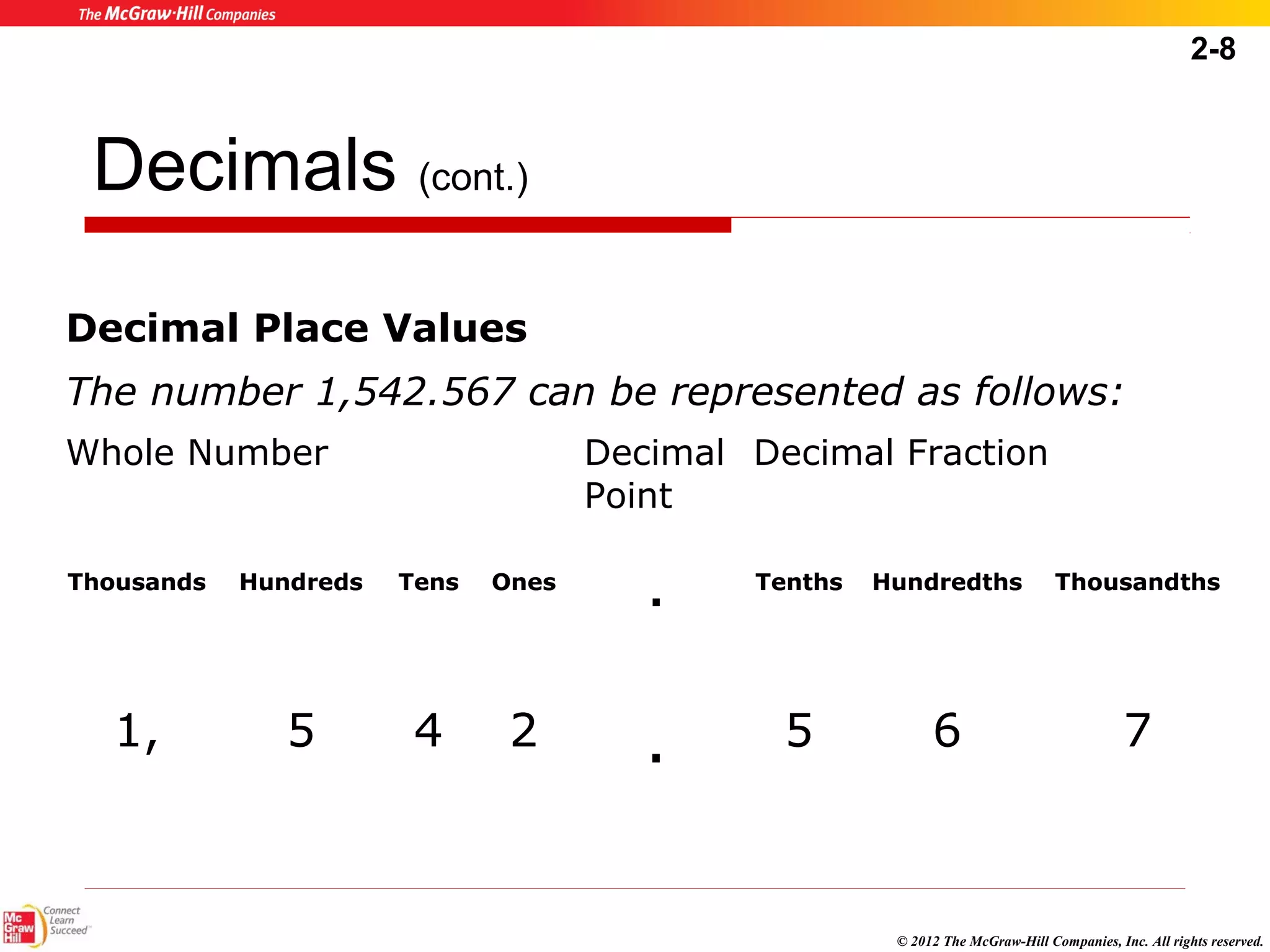
Decimal Place Values 
The number 1,542.567 can be represented as follows: 
Whole Number Decimal 
© 2012 The McGraw-Hill Companies, Inc. All rights reserved. 
Point 
Decimal Fraction 
Thousands Hundreds Tens Ones . Tenths Hundredths Thousandths 
1, 5 4 2 . 5 6 7
2-9 
© 2012 The McGraw-Hill Companies, Inc. All rights reserved. 
Decimal (cont.) 
The number 1,542.567 is read: 
(1) – one thousand 
(5) – five hundred 
(42) – forty two and 
(0.5) – five hundred 
(0.067) – sixty-seven thousandths 
One thousand five hundred forty two and five 
hundred sixty-seven thousandths
2-10 
Writing Decimals 
RRuullee 22--11 When writing a decimal number: 
1. Write the whole number part to the left 
of the decimal point. 
2. Write the decimal fraction part to the 
right of the decimal point. 
© 2012 The McGraw-Hill Companies, Inc. All rights reserved.
2-11 
Writing Decimals 
RRuullee 22--11 When writing a decimal number: 
3. Use zero as a placeholder to the right of 
the decimal point. 
© 2012 The McGraw-Hill Companies, Inc. All rights reserved. 
 Example: 0.201
2-12 
Writing Decimals (cont.) 
RRuullee 22--22 Always write a zero to the left of 
the decimal point when the decimal 
number has no whole number part. 
 This helps to prevent errors caused by 
© 2012 The McGraw-Hill Companies, Inc. All rights reserved. 
illegible handwriting.
2-13 
Comparing Decimals 
RRuullee 22--33 To compare values of a group of 
decimal numbers: 
1. The decimal with the greatest whole number is 
© 2012 The McGraw-Hill Companies, Inc. All rights reserved. 
the greatest decimal number. 
2. If the whole numbers are equal, compare the 
digits in the tenths place.
2-14 
Comparing Decimals 
RRuullee 22--33 To compare values of a group 
of decimal numbers: (cont.) 
3. If the tenths place digits are equal, compare 
the hundredths place digits. 
4. Continue moving to the right comparing digits 
until one is greater than the other. 
© 2012 The McGraw-Hill Companies, Inc. All rights reserved.
2-15 
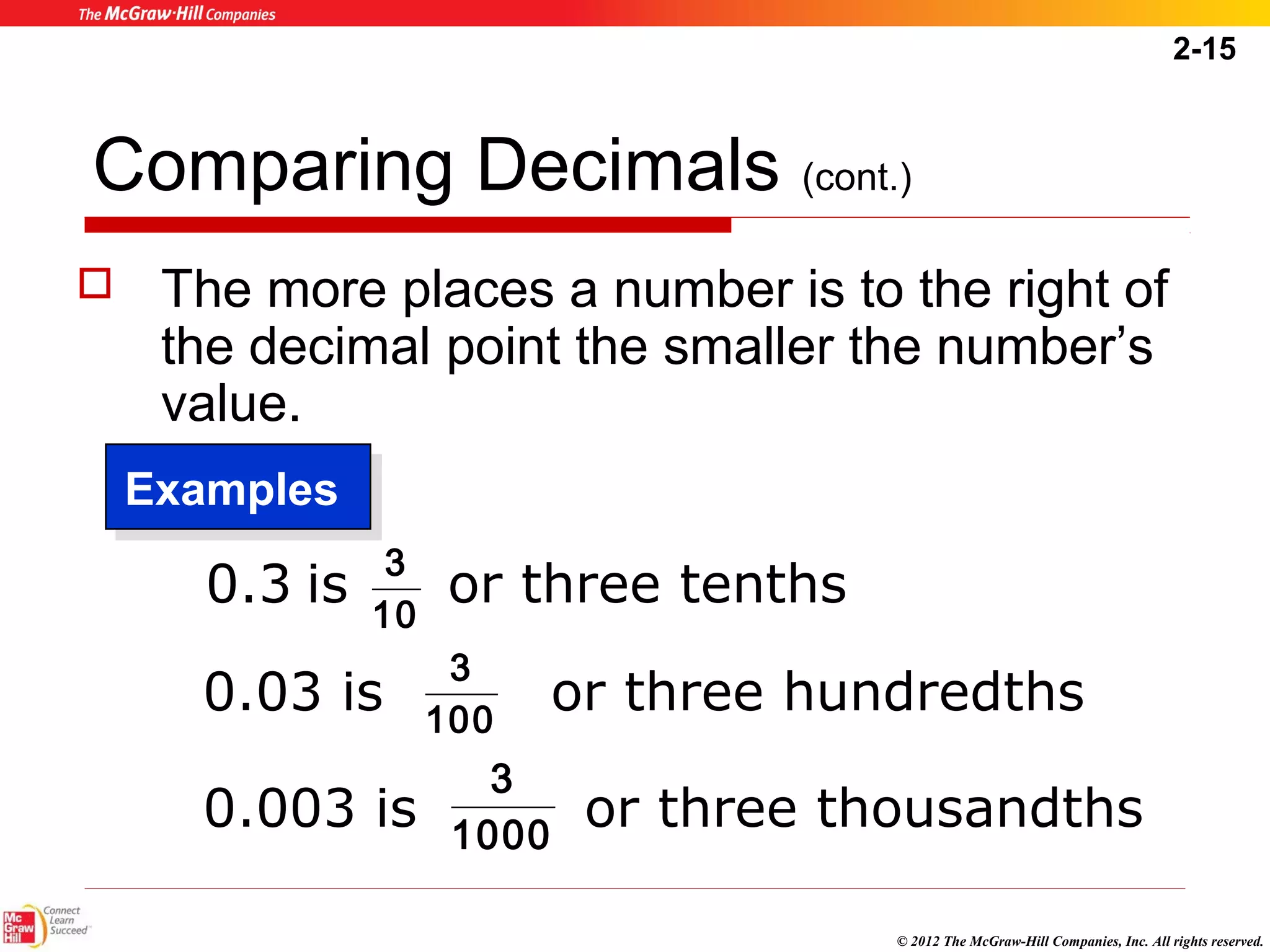
Comparing Decimals (cont.) 
 The more places a number is to the right of 
the decimal point the smaller the number’s 
value. 
© 2012 The McGraw-Hill Companies, Inc. All rights reserved. 
3 
EExxaammpplleess 
0.3 is or three tenths 
10 
3 
0.03 is or three hundredths 100 
3 
0.003 is 1 0 0 0 or three thousandths
2-16 
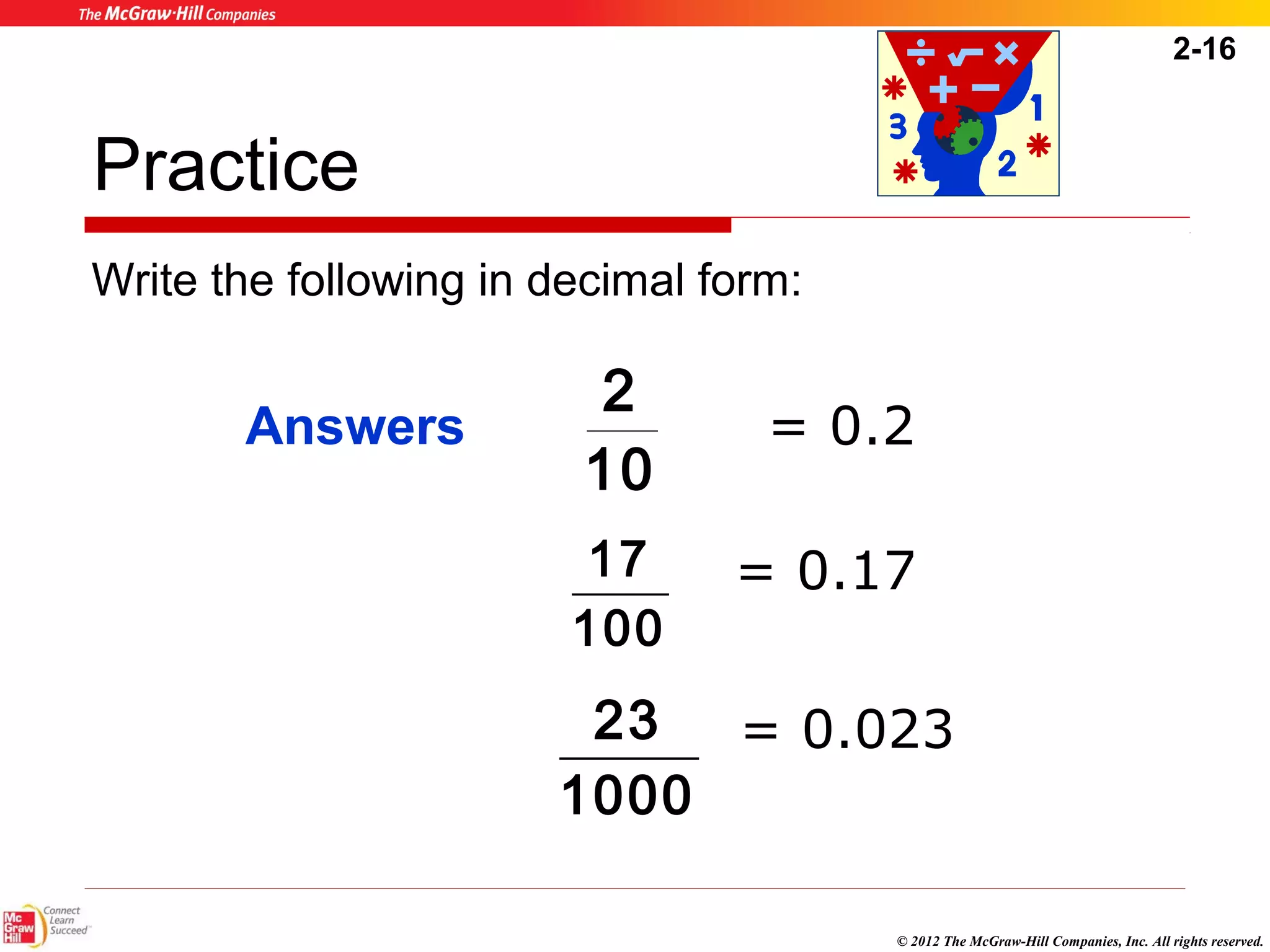
Answers = 0.2 
© 2012 The McGraw-Hill Companies, Inc. All rights reserved. 
Practice 
Write the following in decimal form: 
2 
10 
17 
100 
23 
1000 
= 0.17 
= 0.023
2-17 
© 2012 The McGraw-Hill Companies, Inc. All rights reserved. 
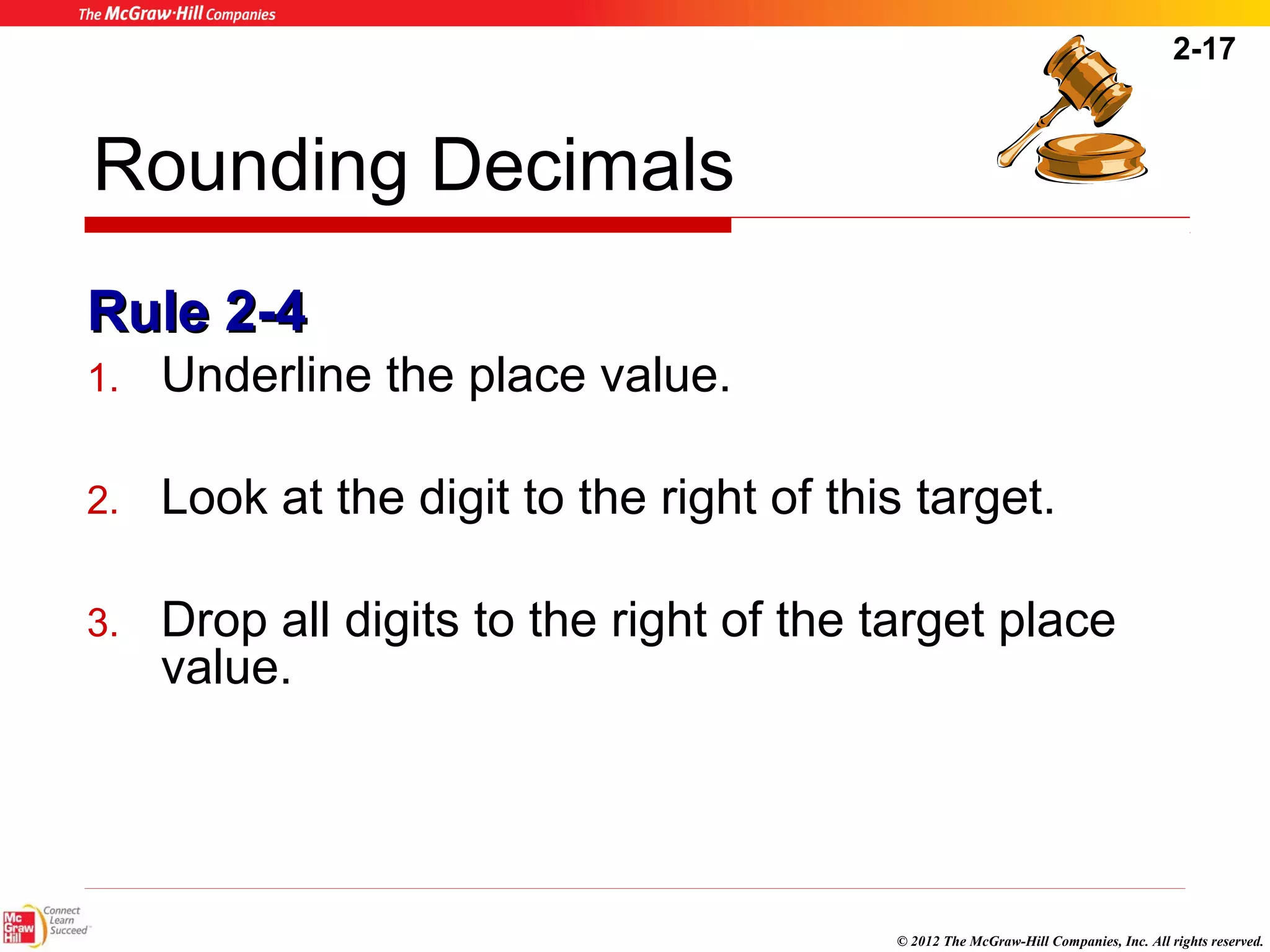
Rounding Decimals 
RRuullee 22--44 
1. Underline the place value. 
2. Look at the digit to the right of this target. 
3. Drop all digits to the right of the target place 
value.
2-18 
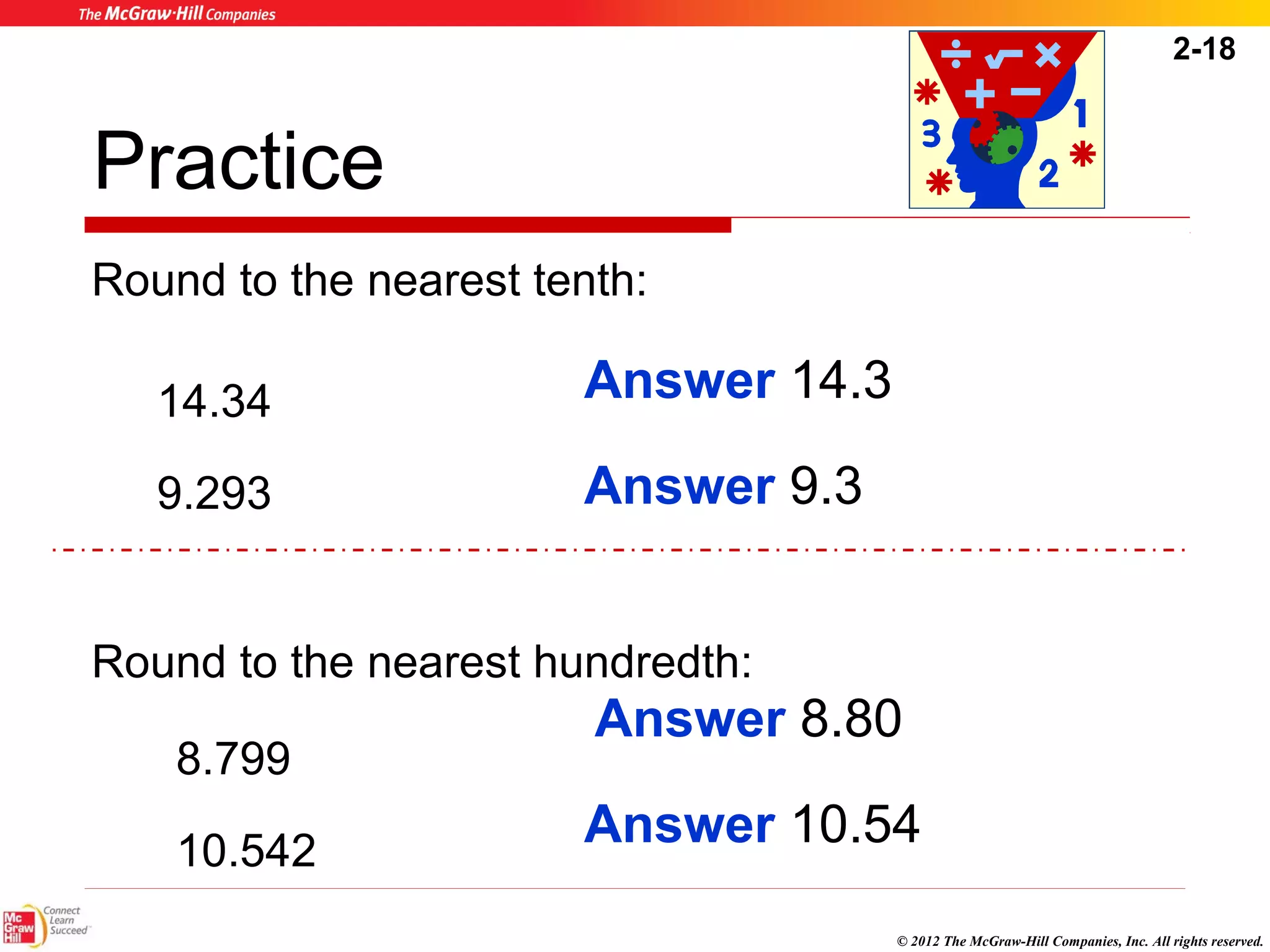
Answer 8.80 
© 2012 The McGraw-Hill Companies, Inc. All rights reserved. 
Practice 
Round to the nearest tenth: 
14.34 
9.293 
Answer 14.3 
Round to the nearest hundredth: 
8.799 
10.542 
Answer 9.3 
Answer 10.54
2-19 
Converting Fractions into 
Decimals 
RRuullee 22--55 
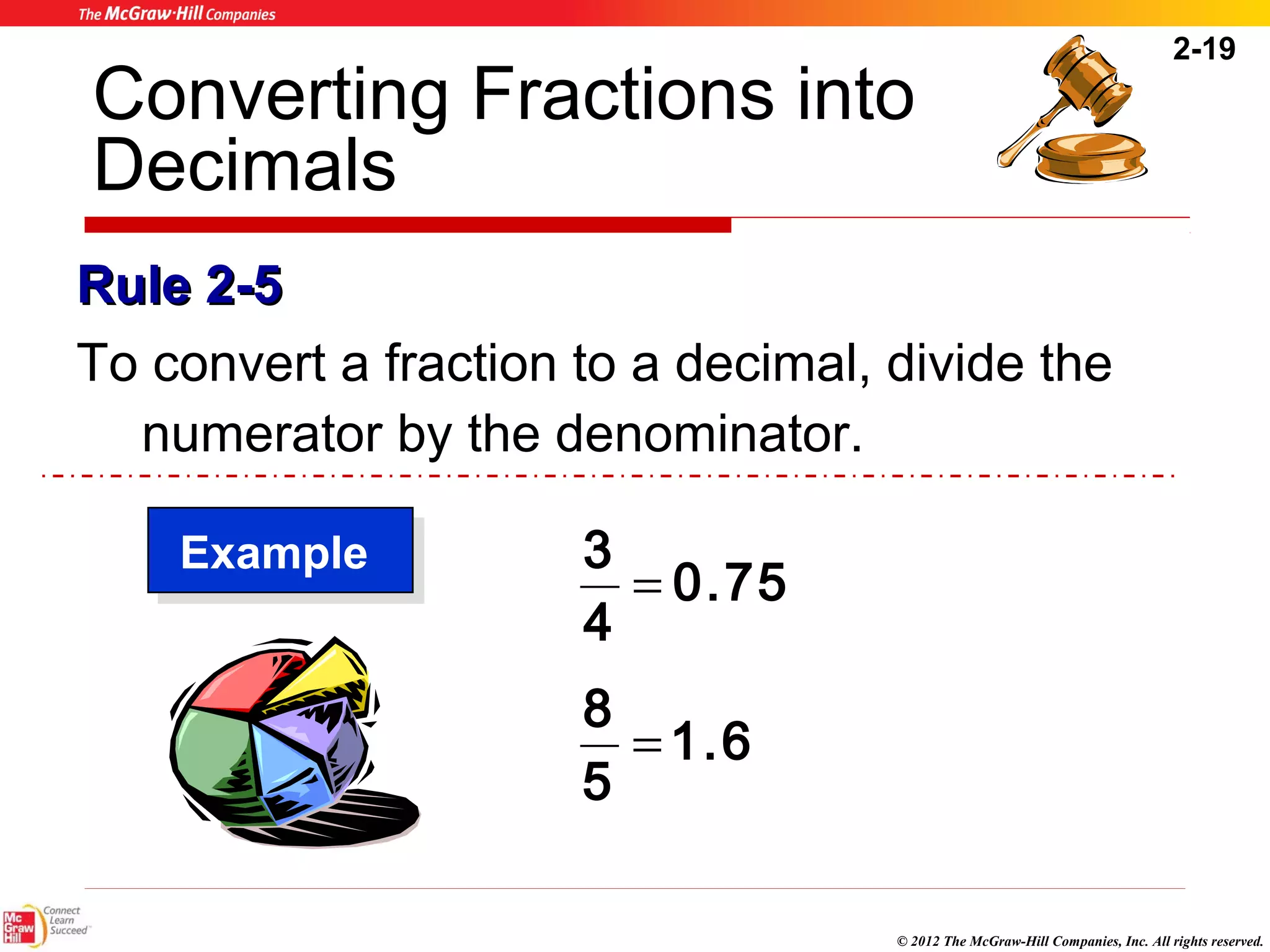
To convert a fraction to a decimal, divide the 
numerator by the denominator. 
© 2012 The McGraw-Hill Companies, Inc. All rights reserved. 
0.75 
3 = 
4 
1.6 
8 = 
5 
EExxaammppllee
2-20 
Converting Decimals into 
Fractions (cont.) 
RRuullee 22--66 
1. Write the number to the left of the decimal 
© 2012 The McGraw-Hill Companies, Inc. All rights reserved. 
point as the whole number. 
2. Write the number to the right of the decimal 
point as the numerator of the fraction.
2-21 
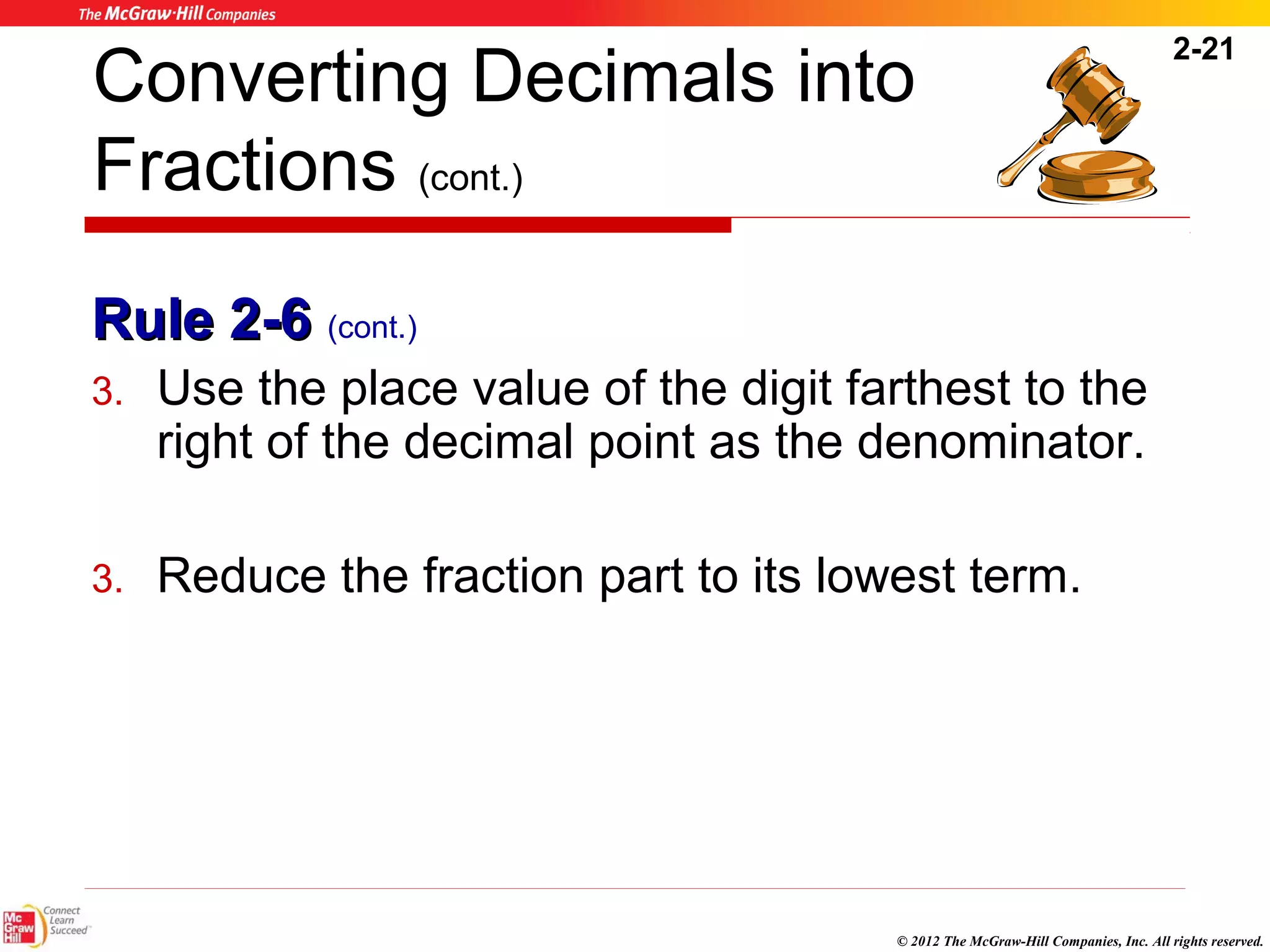
Converting Decimals into 
Fractions (cont.) 
RRuullee 22--66 (cont.) 
3. Use the place value of the digit farthest to the 
right of the decimal point as the denominator. 
3. Reduce the fraction part to its lowest term. 
© 2012 The McGraw-Hill Companies, Inc. All rights reserved.
2-22 
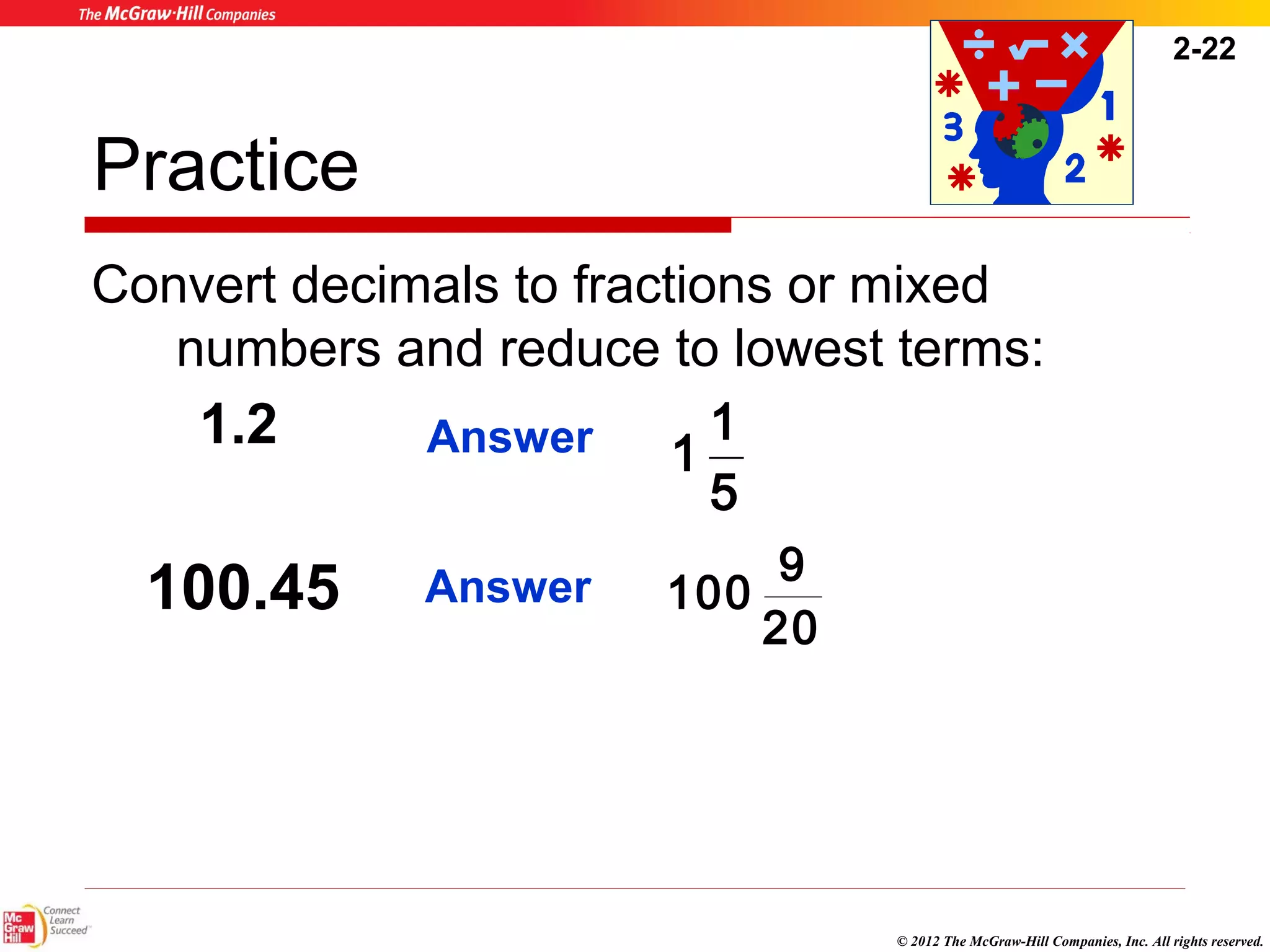
Practice 
Convert decimals to fractions or mixed 
numbers and reduce to lowest terms: 
© 2012 The McGraw-Hill Companies, Inc. All rights reserved. 
1.2 Answer 
100.45 
1 1 or 
5 
Answer 
100 9 or 
20
2-23 
Adding and Subtracting 
Decimals 
RRuullee 22--77 
1. Write the problem vertically. Align the decimal 
© 2012 The McGraw-Hill Companies, Inc. All rights reserved. 
points. 
2. Add or subtract starting from the right. Include 
the decimal point in your answer. 
2.47 
+ 0.39 
2.86
2-24 
© 2012 The McGraw-Hill Companies, Inc. All rights reserved. 
Adding and Subtracting 
Decimals (cont.) 
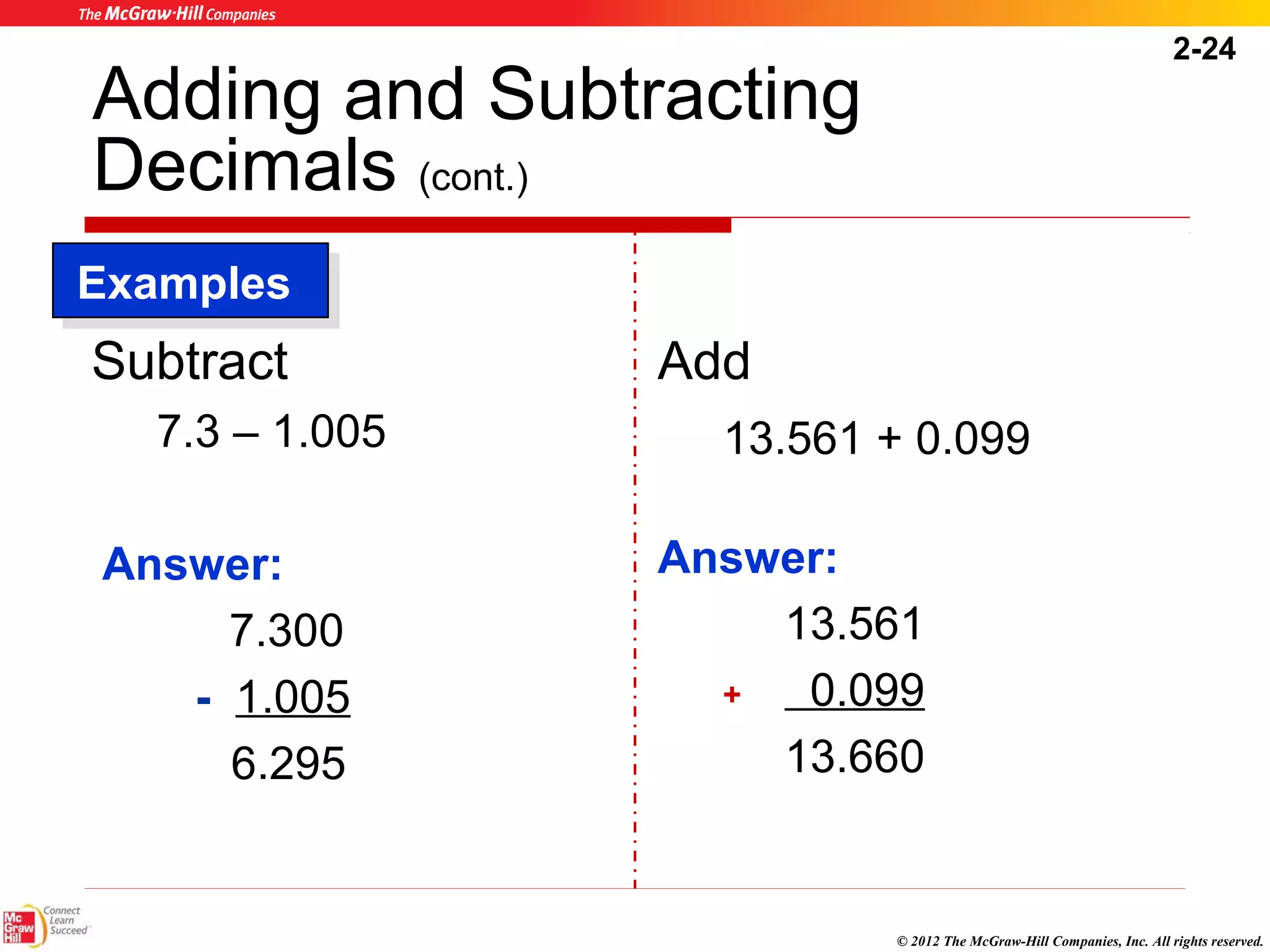
Subtract 
7.3 – 1.005 
Answer: 
7.300 
- 1.005 
6.295 
Add 
13.561 + 0.099 
Answer: 
13.561 
+ 0.099 
13.660 
EExxaammpplleess
2-25 
Practice 
Add or subtract the following pair of numbers: 
Answer 48.75 
© 2012 The McGraw-Hill Companies, Inc. All rights reserved. 
48.669 + 0.081 
Answer 14.625 
16.25 – 1.625
2-26 
Multiplying Decimals 
RRuullee 22--88 (cont.) 
1. First, multiply without considering the decimal 
points, as if the numbers were whole 
numbers. 
2. Count the total number of places to the right 
of the decimal point in both factors. 
© 2012 The McGraw-Hill Companies, Inc. All rights reserved.
2-27 
© 2012 The McGraw-Hill Companies, Inc. All rights reserved. 
Multiplying Decimals 
RRuullee 22--88 (cont.) 
3. To place the decimal point in the product, 
start at its right end and move the it to the left 
the same number of places.
2-28 
© 2012 The McGraw-Hill Companies, Inc. All rights reserved. 
Multiplying Decimals (cont.) 
EExxaammppllee 
Multiply 3.42 x 2.5 
3.42 
X 2.5 
1710 
684 
8550 
There are three decimal places, so place the 
decimal point between 8 and 5. 
Answer: 8.55
2-29 
Practice 
A patient is given 7.5 milliliters of liquid medication 5 
times a day. How may milliliters does she receive 
per day? 
© 2012 The McGraw-Hill Companies, Inc. All rights reserved. 
Answer 7.5 x 5 
7.5 
X 5 
37.5
2-30 
© 2012 The McGraw-Hill Companies, Inc. All rights reserved. 
Dividing Decimals 
RRuullee 22--99 
1. Move the decimal point to the right the same 
number of places in both the divisor and 
dividend until the divisor is a whole number.
2-31 
Dividing Decimals 
RRuullee 22--99 (cont.) 
2. Complete the division as you would with whole 
© 2012 The McGraw-Hill Companies, Inc. All rights reserved. 
numbers. 
 Align the decimal point of the quotient with the 
decimal point of the numerator.
2-32 
© 2012 The McGraw-Hill Companies, Inc. All rights reserved. 
Dividing Decimals (cont.) 
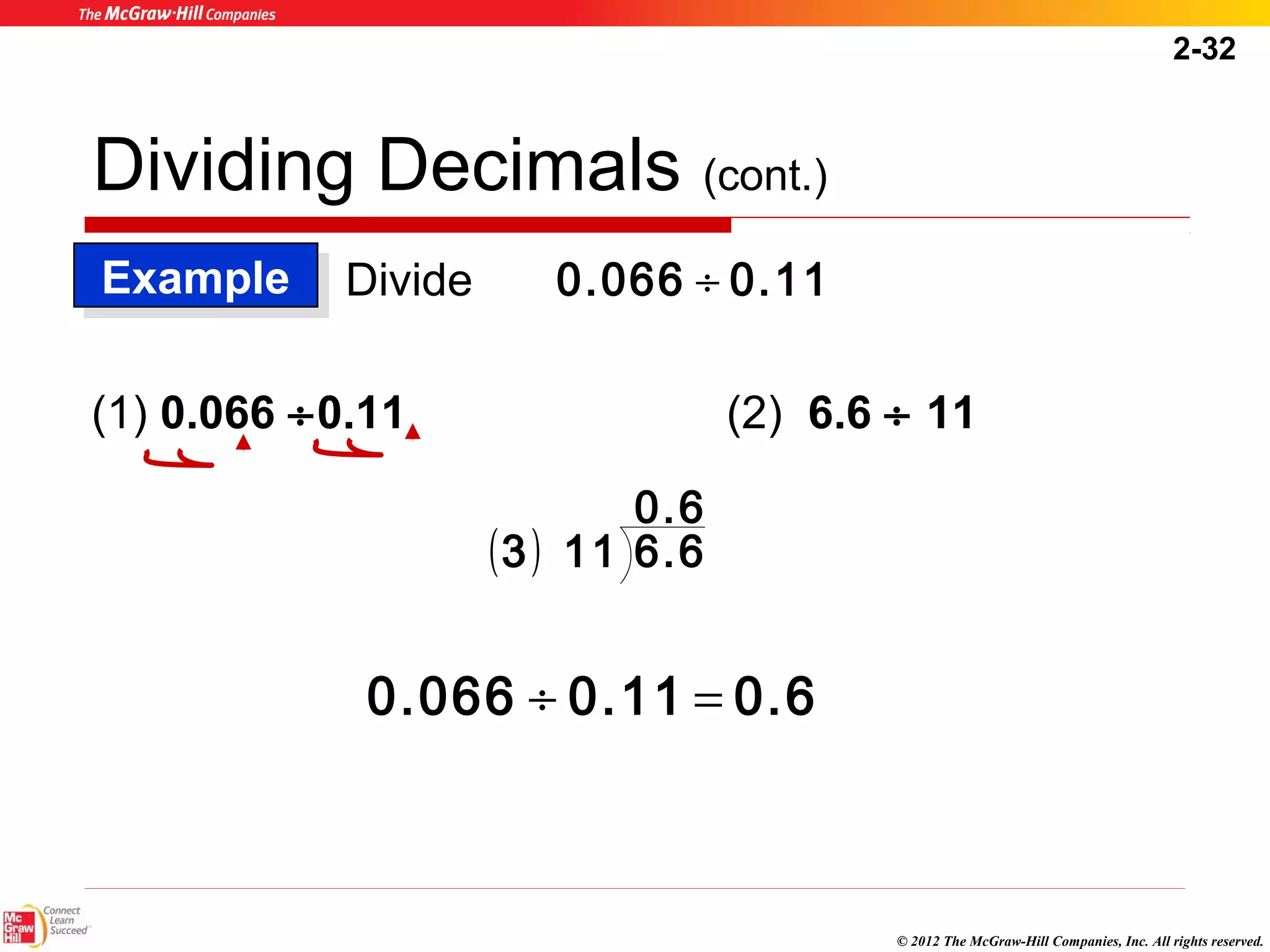
EExxaammppllee Divide 
0.066 ¸ 0.11 
(1) 0.066 ¸0.11 (2) 6.6 ¸ 11 
( ) 
0.6 
3 11 6.6 
0.066 ¸ 0.11 = 0.6
2-33 
© 2012 The McGraw-Hill Companies, Inc. All rights reserved. 
Practice 
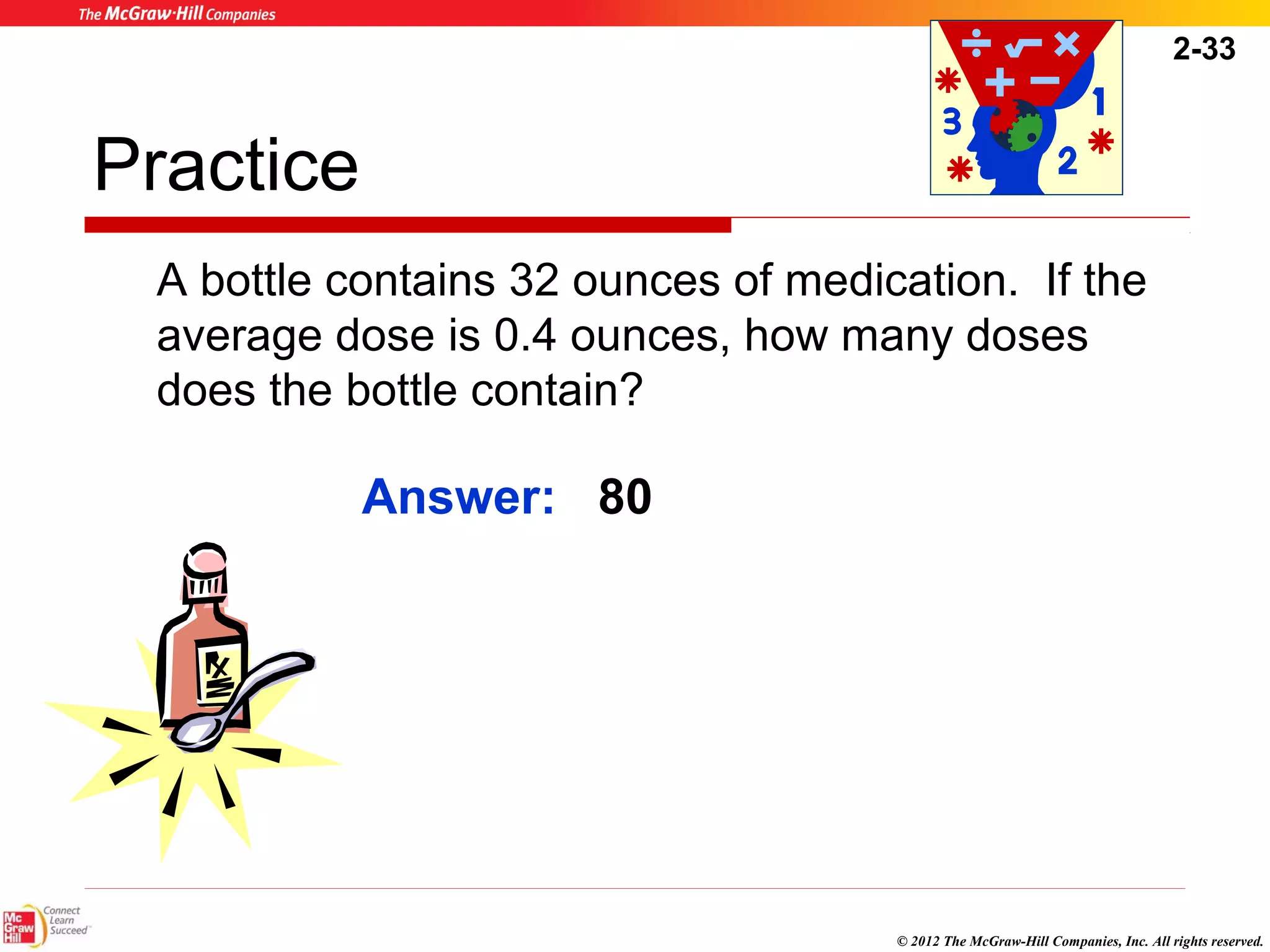
A bottle contains 32 ounces of medication. If the 
average dose is 0.4 ounces, how many doses 
does the bottle contain? 
Answer: 80
2-34 
© 2012 The McGraw-Hill Companies, Inc. All rights reserved. 
In Summary 
 In this chapter you learned to: 
 write decimals and compare their value; 
 apply rules for rounding decimals; 
 convert fractions to decimals.
2-35 
© 2012 The McGraw-Hill Companies, Inc. All rights reserved. 
In Summary (cont.) 
 In this chapter you learned to: 
 convert decimals into fractions; 
 add and subtract decimals; 
 multiply decimals; 
 divide decimals.
2-36 
© 2012 The McGraw-Hill Companies, Inc. All rights reserved. 
Apply Your Knowledge 
Round to the nearest tenth: 
7.091 
Answer 7.1
2-37 
© 2012 The McGraw-Hill Companies, Inc. All rights reserved. 
Apply Your Knowledge 
Add the following: 7.23 + 12.38 
Answer 19.61 
Multiply the following: 12.01 x 1.005 
Answer 12.07005
2-38 
© 2012 The McGraw-Hill Companies, Inc. All rights reserved. 
End of Chapter 2 
Learning is not 
attained by 
chance, 
it must be sought 
for with ardor 
and attended to 
with diligence. 
-Abigail Adams

Chapter 2 PowerPoint Dosages and Calculations

  • 1.
    Chapter 2 Decimals PowerPoint® Presentation to accompany: Math and Dosage Calculations for Healthcare Professionals © 2012 The McGraw-Hill Companies, Inc. All rights reserved. Fourth Edition Booth, Whaley, Sienkiewicz, and Palmunen
  • 2.
    2-2 © 2012The McGraw-Hill Companies, Inc. All rights reserved. Learning Outcomes 2-1 Write decimals and compare their value. 2-2 Apply the rules for rounding decimals. 2-3 Convert fractions into decimals. 2-4 Convert decimals into fractions.
  • 3.
    2-3 © 2012The McGraw-Hill Companies, Inc. All rights reserved. Learning Outcomes (cont.) 2-5 Add and subtract decimals. 2-6 Multiply decimals. 2-7 Divide decimals.
  • 4.
    2-4 © 2012The McGraw-Hill Companies, Inc. All rights reserved. Key Terms  Divisor  Dividend  Quotient
  • 5.
    2-5 Introduction Many of the math skills used for fractions are used for numbers containing decimals.  It is important to be comfortable working with decimals when performing dosage calculations. © 2012 The McGraw-Hill Companies, Inc. All rights reserved.
  • 6.
    2-6 Decimals Decimals are another way to represent whole numbers and their fractional parts.  They are used daily by Healthcare practitioners. © 2012 The McGraw-Hill Companies, Inc. All rights reserved.  The Metric System  is decimal based;  is used in dosage calculations, calibrations, and charting.
  • 7.
    2-7  Thelocation of a digit relative to the decimal point determines its value.  The decimal point separates the whole number from the decimal fraction. © 2012 The McGraw-Hill Companies, Inc. All rights reserved. Decimals (cont.)
  • 8.
    2-8 Decimals (cont.) Decimal Place Values The number 1,542.567 can be represented as follows: Whole Number Decimal © 2012 The McGraw-Hill Companies, Inc. All rights reserved. Point Decimal Fraction Thousands Hundreds Tens Ones . Tenths Hundredths Thousandths 1, 5 4 2 . 5 6 7
  • 9.
    2-9 © 2012The McGraw-Hill Companies, Inc. All rights reserved. Decimal (cont.) The number 1,542.567 is read: (1) – one thousand (5) – five hundred (42) – forty two and (0.5) – five hundred (0.067) – sixty-seven thousandths One thousand five hundred forty two and five hundred sixty-seven thousandths
  • 10.
    2-10 Writing Decimals RRuullee 22--11 When writing a decimal number: 1. Write the whole number part to the left of the decimal point. 2. Write the decimal fraction part to the right of the decimal point. © 2012 The McGraw-Hill Companies, Inc. All rights reserved.
  • 11.
    2-11 Writing Decimals RRuullee 22--11 When writing a decimal number: 3. Use zero as a placeholder to the right of the decimal point. © 2012 The McGraw-Hill Companies, Inc. All rights reserved.  Example: 0.201
  • 12.
    2-12 Writing Decimals(cont.) RRuullee 22--22 Always write a zero to the left of the decimal point when the decimal number has no whole number part.  This helps to prevent errors caused by © 2012 The McGraw-Hill Companies, Inc. All rights reserved. illegible handwriting.
  • 13.
    2-13 Comparing Decimals RRuullee 22--33 To compare values of a group of decimal numbers: 1. The decimal with the greatest whole number is © 2012 The McGraw-Hill Companies, Inc. All rights reserved. the greatest decimal number. 2. If the whole numbers are equal, compare the digits in the tenths place.
  • 14.
    2-14 Comparing Decimals RRuullee 22--33 To compare values of a group of decimal numbers: (cont.) 3. If the tenths place digits are equal, compare the hundredths place digits. 4. Continue moving to the right comparing digits until one is greater than the other. © 2012 The McGraw-Hill Companies, Inc. All rights reserved.
  • 15.
    2-15 Comparing Decimals(cont.)  The more places a number is to the right of the decimal point the smaller the number’s value. © 2012 The McGraw-Hill Companies, Inc. All rights reserved. 3 EExxaammpplleess 0.3 is or three tenths 10 3 0.03 is or three hundredths 100 3 0.003 is 1 0 0 0 or three thousandths
  • 16.
    2-16 Answers =0.2 © 2012 The McGraw-Hill Companies, Inc. All rights reserved. Practice Write the following in decimal form: 2 10 17 100 23 1000 = 0.17 = 0.023
  • 17.
    2-17 © 2012The McGraw-Hill Companies, Inc. All rights reserved. Rounding Decimals RRuullee 22--44 1. Underline the place value. 2. Look at the digit to the right of this target. 3. Drop all digits to the right of the target place value.
  • 18.
    2-18 Answer 8.80 © 2012 The McGraw-Hill Companies, Inc. All rights reserved. Practice Round to the nearest tenth: 14.34 9.293 Answer 14.3 Round to the nearest hundredth: 8.799 10.542 Answer 9.3 Answer 10.54
  • 19.
    2-19 Converting Fractionsinto Decimals RRuullee 22--55 To convert a fraction to a decimal, divide the numerator by the denominator. © 2012 The McGraw-Hill Companies, Inc. All rights reserved. 0.75 3 = 4 1.6 8 = 5 EExxaammppllee
  • 20.
    2-20 Converting Decimalsinto Fractions (cont.) RRuullee 22--66 1. Write the number to the left of the decimal © 2012 The McGraw-Hill Companies, Inc. All rights reserved. point as the whole number. 2. Write the number to the right of the decimal point as the numerator of the fraction.
  • 21.
    2-21 Converting Decimalsinto Fractions (cont.) RRuullee 22--66 (cont.) 3. Use the place value of the digit farthest to the right of the decimal point as the denominator. 3. Reduce the fraction part to its lowest term. © 2012 The McGraw-Hill Companies, Inc. All rights reserved.
  • 22.
    2-22 Practice Convertdecimals to fractions or mixed numbers and reduce to lowest terms: © 2012 The McGraw-Hill Companies, Inc. All rights reserved. 1.2 Answer 100.45 1 1 or 5 Answer 100 9 or 20
  • 23.
    2-23 Adding andSubtracting Decimals RRuullee 22--77 1. Write the problem vertically. Align the decimal © 2012 The McGraw-Hill Companies, Inc. All rights reserved. points. 2. Add or subtract starting from the right. Include the decimal point in your answer. 2.47 + 0.39 2.86
  • 24.
    2-24 © 2012The McGraw-Hill Companies, Inc. All rights reserved. Adding and Subtracting Decimals (cont.) Subtract 7.3 – 1.005 Answer: 7.300 - 1.005 6.295 Add 13.561 + 0.099 Answer: 13.561 + 0.099 13.660 EExxaammpplleess
  • 25.
    2-25 Practice Addor subtract the following pair of numbers: Answer 48.75 © 2012 The McGraw-Hill Companies, Inc. All rights reserved. 48.669 + 0.081 Answer 14.625 16.25 – 1.625
  • 26.
    2-26 Multiplying Decimals RRuullee 22--88 (cont.) 1. First, multiply without considering the decimal points, as if the numbers were whole numbers. 2. Count the total number of places to the right of the decimal point in both factors. © 2012 The McGraw-Hill Companies, Inc. All rights reserved.
  • 27.
    2-27 © 2012The McGraw-Hill Companies, Inc. All rights reserved. Multiplying Decimals RRuullee 22--88 (cont.) 3. To place the decimal point in the product, start at its right end and move the it to the left the same number of places.
  • 28.
    2-28 © 2012The McGraw-Hill Companies, Inc. All rights reserved. Multiplying Decimals (cont.) EExxaammppllee Multiply 3.42 x 2.5 3.42 X 2.5 1710 684 8550 There are three decimal places, so place the decimal point between 8 and 5. Answer: 8.55
  • 29.
    2-29 Practice Apatient is given 7.5 milliliters of liquid medication 5 times a day. How may milliliters does she receive per day? © 2012 The McGraw-Hill Companies, Inc. All rights reserved. Answer 7.5 x 5 7.5 X 5 37.5
  • 30.
    2-30 © 2012The McGraw-Hill Companies, Inc. All rights reserved. Dividing Decimals RRuullee 22--99 1. Move the decimal point to the right the same number of places in both the divisor and dividend until the divisor is a whole number.
  • 31.
    2-31 Dividing Decimals RRuullee 22--99 (cont.) 2. Complete the division as you would with whole © 2012 The McGraw-Hill Companies, Inc. All rights reserved. numbers.  Align the decimal point of the quotient with the decimal point of the numerator.
  • 32.
    2-32 © 2012The McGraw-Hill Companies, Inc. All rights reserved. Dividing Decimals (cont.) EExxaammppllee Divide 0.066 ¸ 0.11 (1) 0.066 ¸0.11 (2) 6.6 ¸ 11 ( ) 0.6 3 11 6.6 0.066 ¸ 0.11 = 0.6
  • 33.
    2-33 © 2012The McGraw-Hill Companies, Inc. All rights reserved. Practice A bottle contains 32 ounces of medication. If the average dose is 0.4 ounces, how many doses does the bottle contain? Answer: 80
  • 34.
    2-34 © 2012The McGraw-Hill Companies, Inc. All rights reserved. In Summary  In this chapter you learned to:  write decimals and compare their value;  apply rules for rounding decimals;  convert fractions to decimals.
  • 35.
    2-35 © 2012The McGraw-Hill Companies, Inc. All rights reserved. In Summary (cont.)  In this chapter you learned to:  convert decimals into fractions;  add and subtract decimals;  multiply decimals;  divide decimals.
  • 36.
    2-36 © 2012The McGraw-Hill Companies, Inc. All rights reserved. Apply Your Knowledge Round to the nearest tenth: 7.091 Answer 7.1
  • 37.
    2-37 © 2012The McGraw-Hill Companies, Inc. All rights reserved. Apply Your Knowledge Add the following: 7.23 + 12.38 Answer 19.61 Multiply the following: 12.01 x 1.005 Answer 12.07005
  • 38.
    2-38 © 2012The McGraw-Hill Companies, Inc. All rights reserved. End of Chapter 2 Learning is not attained by chance, it must be sought for with ardor and attended to with diligence. -Abigail Adams

Editor's Notes

  • #5 Divisor – The number you are dividing by. Dividend – The number you are dividing into. Quotient – The answer when dividing.
  • #7 Learning Outcome: 2-1 Write decimals and compare their value. It is important for the medical assistant to be able to work with decimals and convert fractions and mixed numbers to decimals.
  • #8 Learning Outcome: 2-1 Write decimals and compare their value.
  • #9 Learning Outcome: 2-1 Write decimals and compare their value. Each position of a decimal number has a place value. The places to the right of a decimal point represent fractions.
  • #10 Learning Outcome: 2-1 Write decimals and compare their value.
  • #11 Learning Outcome: 2-1 Write decimals and compare their value. Decimal fractions are equivalent to fractions that have denominators of 10, 100, 1000, and so forth. A zero is used as a place holder if there is no whole number.
  • #12 Learning Outcome: 2-1 Write decimals and compare their value. A zero is used as a place holder if there is no whole number.
  • #13 Learning Outcome: 2-1 Write decimals and compare their value. Always write 0.5 not .5 Do not write 5.0 The leading zero makes the decimal point more noticeable.
  • #14 Learning Outcome: 2-1 Write decimals and compare their value.
  • #15 Learning Outcome: 2-1 Write decimals and compare their value.
  • #16 Learning Outcome: 2-1 Write decimals and compare their value.
  • #17 Learning Outcome: 2-1 Write decimals and compare their value.
  • #18 Learning Outcome: 2-2 Apply the rules for rounding decimals. 2. If the digit to the right of the target is 4 or less, do not change the digit; if it is 5 or more, round up one unit. Decimals are usually rounded to the nearest tenth or hundredth.
  • #19 Learning Outcome: 2-2 Apply the rules for rounding decimals. Problem 1 The target place value is the tenths place. The digit to the right of this is a 4, so the 3 in the tenths place does not change value. Problem 2 The target place value is the tenths place. The digit to the right of this is a 9, so the 2 in the tenths place becomes a 3. Problem 3 The target place value is the hundredths place . The digit to the right of this is a 9, so the 9 in the hundredths is increased to 10 and the one is carried back to the tenths place where the 7 becomes an 8. Problem 4 The target place value is the hundredths place. The digit to the right of this is a 2 so the 4 does not change. Think!…Is It Reasonable?
  • #20 Learning Outcome: 2-3 Convert fractions into decimals. Think of the fraction as a division problem. Reducing the fraction first may make the problem easier. Think!…Is It Reasonable?
  • #21 Learning Outcome: 2-4 Convert decimals into fractions.
  • #22 Learning Outcome: 2-4 Convert decimals into fractions.
  • #23 Learning Outcome: 2-4 Convert decimals into fractions. Problem 1 The 2 is in the tenths place. 1.2 = 1 2/10 = 1 1/5 Problem 2 The 5 is in the hundredths place. 100.45 = 100 45/100 = 100 9/20 Think!…Is It Reasonable?
  • #24 Learning Outcome: 2-5 Add and subtract decimals.
  • #25 Learning Outcome: 2-5 Add and subtract decimals. Think!…Is It Reasonable?
  • #26 Learning Outcome: 2-5 Add and subtract decimals. Problem 1 48.669 + 0.081 48.750 Problem 2 16.250 - 1.625 14.625 Think!…Is It Reasonable?
  • #27 Learning Outcome: 2-6 Multiply decimals. Multiplication of decimals is similar to multiplying whole numbers. However, you must determine the proper position of the decimal place.
  • #28 Learning Outcome: 2-6 Multiply decimals.
  • #29 Learning Outcome: 2-6 Multiply decimals. Think!…Is It Reasonable?
  • #30 Learning Outcome: 2-6 Multiply decimals. 7.5 mL X 5 times daily 375 There is 1 decimal place in the problem, so the decimal is place between the 7 and 5. Think! !…Is It Reasonable?
  • #31 Learning Outcome: 2-7 Divide decimals. The dividend is the number you are dividing into. The divisor is the number you are dividing by. Insert zeros as needed.
  • #32 Learning Outcome: 2-7 Divide decimals.
  • #33 Learning Outcome: 2-7 Divide decimals. 1 – Move the decimal point the same number of places to the right in both the divisor and dividend until the divisor is a whole number. Think!…Is It Reasonable?
  • #34 Learning Outcome: 2-7 Divide decimals. 32  0.4 = 320  4 = 80 Think!…Is It Reasonable?
  • #35 The places to the right of a decimal represent fractions, and each position has a place value. First compare the value of the numbers to the left of the decimal. When the numbers to the left of the decimal are the same, compare values to the right of the decimal, moving one place at a time until finding one value greater than another. When rounding, look at the first digit to the right of the place value that you are rounding to. If this digit is 5 or more, round up. If it is less than 5, round down. To convert a fraction to a decimal, divide the numerator by the denominator.
  • #36 To convert a decimal to a fraction, write the numbers to the right of the decimal as the numerator and the place value of the number furthest to the right as the denominator. To add and subtract decimals, it is first necessary to align the decimals vertically before adding or subtracting. To multiply decimals, first multiply the numbers, then determine the position of the decimal. The decimal in your answer should be placed so that the number of digits to the right of the decimal is equal to the total number of decimal places in the numbers that were multiplied. To divide decimals, write the problem as a fraction with the dividend as the numerator and the divisor as the denominator. Move the decimal to the right in both parts of the fraction until the denominator is a whole number, and then perform the division.
  • #37 Learning Outcome: 2-2 Apply the rules for rounding decimals. The number to the right of the selected place value is > 5, so the number in the selected place value is increased. Think!…Is It Reasonable?
  • #38 Learning Outcome: 2-5 Add and subtract decimals. Learning Outcome: 2-6 Multiply decimals. Problem 1 7.23 +12.38 19.61 Problem 2 12.01 X 1.005 6005 1201000 1207005 Count the number of decimal places = 5 Answer = 12.07005 Think!…Is It Reasonable?