BBPP1103 
Principles of Management
4. Organisation Design 
LO: 
1. Explain the concept of organisational 
structure 
2. Identify the four factors that influence 
organisational structure 
3. Compare the different types of 
organisational structure 
4. Describe the concept of authority in 
organisations 
5. Differentiate between the concepts of 
centralisation and decentralisation 
6. Evaluate the different types of work design 
7. Discuss the emerging organisational designs
4.0 Introduction 
OS refers to organisation’s functions that are 
grouped and coordinated formally. 
A system that connects the duties, workflow and 
communication channels between individuals 
and the various work groups 
to simplify the use of each resource and 
individual collectively as a management system 
usually displayed in graphical form = 
organisational chart 
Typically in a pyramid chart
4.1 Factors that influence OS 
Organisational Strategy Size of Organisation 
OS supports and facilitate the overall 
organisational strategies to achieve the 
objectives. 
When strategies change, structure tend to 
change too. 
Small = lesser work specialisation, less 
standardisation and more centralisation of 
decision making. 
Large = specialisation, standardisation and 
decentralised decision making 
Size measure = sales /manpower 
Technology Environment 
Technology is subject to routine and non-routine 
activities. 
Routine = departmentalisation structures 
(centralised), work specialisation and 
complying to rules 
Non-routine = depends on expertise, thus 
more decentralised, less specialisation and 
don not need to comply to strict rules 
external influences = environmental 
influences 
Some face static, some face dynamic 
environment 
Dynamic = more uncertainties, thus best to 
reduce threats 
Hence, OS may be altered according to the 
uncertanties in its environment.
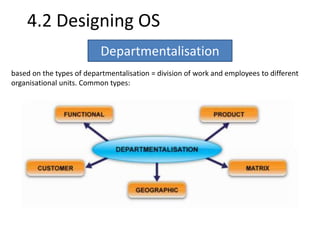
4.2 Designing OS 
Departmentalisation 
based on the types of departmentalisation = division of work and employees to different 
organisational units. Common types:
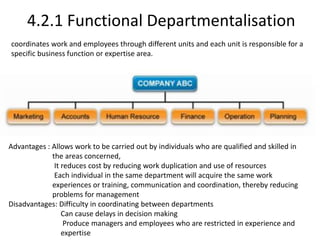
4.2.1 Functional Departmentalisation 
coordinates work and employees through different units and each unit is responsible for a 
specific business function or expertise area. 
Advantages : Allows work to be carried out by individuals who are qualified and skilled in 
the areas concerned, 
It reduces cost by reducing work duplication and use of resources 
Each individual in the same department will acquire the same work 
experiences or training, communication and coordination, thereby reducing 
problems for management 
Disadvantages: Difficulty in coordinating between departments 
Can cause delays in decision making 
Produce managers and employees who are restricted in experience and 
expertise
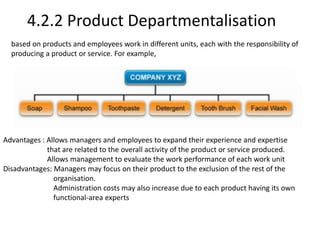
4.2.2 Product Departmentalisation 
based on products and employees work in different units, each with the responsibility of 
producing a product or service. For example, 
Advantages : Allows managers and employees to expand their experience and expertise 
that are related to the overall activity of the product or service produced. 
Allows management to evaluate the work performance of each work unit 
Disadvantages: Managers may focus on their product to the exclusion of the rest of the 
organisation. 
Administration costs may also increase due to each product having its own 
functional-area experts
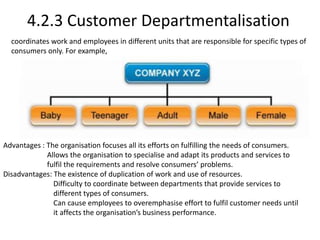
4.2.3 Customer Departmentalisation 
coordinates work and employees in different units that are responsible for specific types of 
consumers only. For example, 
Advantages : The organisation focuses all its efforts on fulfilling the needs of consumers. 
Allows the organisation to specialise and adapt its products and services to 
fulfil the requirements and resolve consumers’ problems. 
Disadvantages: The existence of duplication of work and use of resources. 
Difficulty to coordinate between departments that provide services to 
different types of consumers. 
Can cause employees to overemphasise effort to fulfil customer needs until 
it affects the organisation’s business performance.
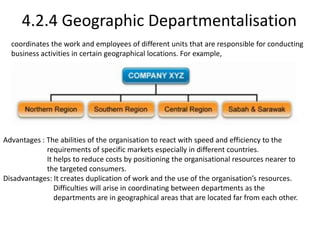
4.2.4 Geographic Departmentalisation 
coordinates the work and employees of different units that are responsible for conducting 
business activities in certain geographical locations. For example, 
Advantages : The abilities of the organisation to react with speed and efficiency to the 
requirements of specific markets especially in different countries. 
It helps to reduce costs by positioning the organisational resources nearer to 
the targeted consumers. 
Disadvantages: It creates duplication of work and the use of the organisation’s resources. 
Difficulties will arise in coordinating between departments as the 
departments are in geographical areas that are located far from each other.
4.2.5 Matrix Departmentalisation 
Combines two or more types of departmentalisation at the same 
time. The employees report to two different supervisors or 
managers. It leads to cross interactive functions that cannot be done 
in the other types of departmentalisation. 
Advantages : It allows the organisation to manage efficiently the 
projects or activities that are large scale and complex. 
Disadvantages: It requires a higher level of coordination to manage 
the complexity involved. 
Tend to focus on the conflict of authority. 
Can cause confusion among employees who have to 
report to more than one supervisor or manager. 
Requires higher-level management skills
4.3 Authority 
The right to give directives, take actions and make decisions related to 
activities to achieve the organisation’s objectives. 
Normally channelled from top to bottom. 
The right exists based on the formal position in an organisation 
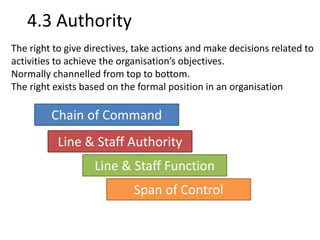
Chain of Command 
Line & Staff Authority 
Line & Staff Function 
Span of Control
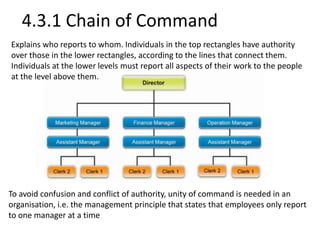
4.3.1 Chain of Command 
Explains who reports to whom. Individuals in the top rectangles have authority 
over those in the lower rectangles, according to the lines that connect them. 
Individuals at the lower levels must report all aspects of their work to the people 
at the level above them. 
To avoid confusion and conflict of authority, unity of command is needed in an 
organisation, i.e. the management principle that states that employees only report 
to one manager at a time
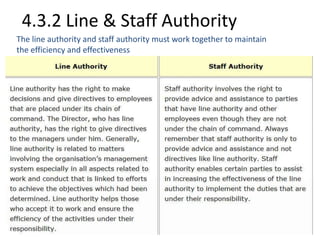
4.3.2 Line & Staff Authority 
The line authority and staff authority must work together to maintain 
the efficiency and effectiveness
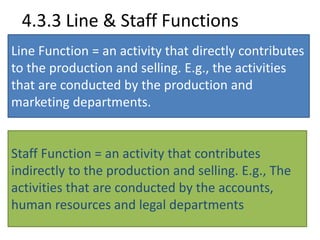
4.3.3 Line & Staff Functions 
Line Function = an activity that directly contributes 
to the production and selling. E.g., the activities 
that are conducted by the production and 
marketing departments. 
Staff Function = an activity that contributes 
indirectly to the production and selling. E.g., The 
activities that are conducted by the accounts, 
human resources and legal departments
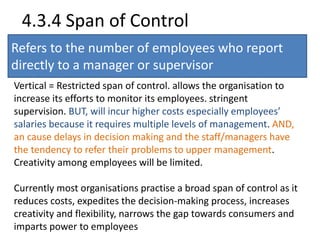
4.3.4 Span of Control 
Refers to the number of employees who report 
directly to a manager or supervisor 
Vertical = Restricted span of control. allows the organisation to 
increase its efforts to monitor its employees. stringent 
supervision. BUT, will incur higher costs especially employees’ 
salaries because it requires multiple levels of management. AND, 
an cause delays in decision making and the staff/managers have 
the tendency to refer their problems to upper management. 
Creativity among employees will be limited. 
Currently most organisations practise a broad span of control as it 
reduces costs, expedites the decision-making process, increases 
creativity and flexibility, narrows the gap towards consumers and 
imparts power to employees
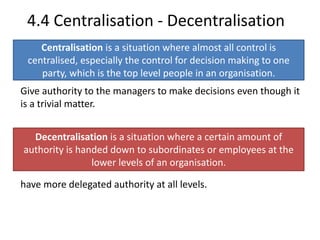
4.4 Centralisation - Decentralisation 
Centralisation is a situation where almost all control is 
centralised, especially the control for decision making to one 
party, which is the top level people in an organisation. 
Give authority to the managers to make decisions even though it 
is a trivial matter. 
Decentralisation is a situation where a certain amount of 
authority is handed down to subordinates or employees at the 
lower levels of an organisation. 
have more delegated authority at all levels.
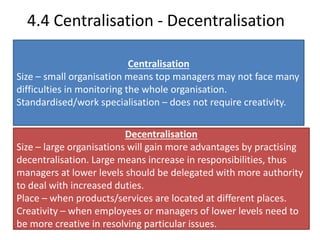
4.4 Centralisation - Decentralisation 
Centralisation 
Size – small organisation means top managers may not face many 
difficulties in monitoring the whole organisation. 
Standardised/work specialisation – does not require creativity. 
Decentralisation 
Size – large organisations will gain more advantages by practising 
decentralisation. Large means increase in responsibilities, thus 
managers at lower levels should be delegated with more authority 
to deal with increased duties. 
Place – when products/services are located at different places. 
Creativity – when employees or managers of lower levels need to 
be more creative in resolving particular issues.
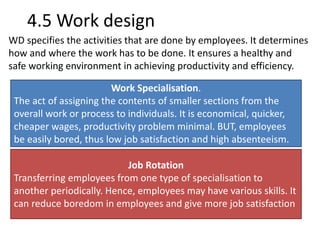
4.5 Work design 
WD specifies the activities that are done by employees. It determines 
how and where the work has to be done. It ensures a healthy and 
safe working environment in achieving productivity and efficiency. 
Work Specialisation. 
The act of assigning the contents of smaller sections from the 
overall work or process to individuals. It is economical, quicker, 
cheaper wages, productivity problem minimal. BUT, employees 
be easily bored, thus low job satisfaction and high absenteeism. 
Job Rotation 
Transferring employees from one type of specialisation to 
another periodically. Hence, employees may have various skills. It 
can reduce boredom in employees and give more job satisfaction
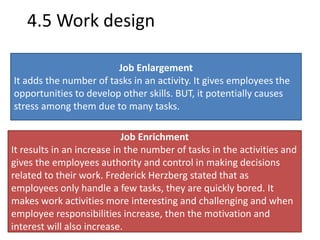
4.5 Work design 
Job Enlargement 
It adds the number of tasks in an activity. It gives employees the 
opportunities to develop other skills. BUT, it potentially causes 
stress among them due to many tasks. 
Job Enrichment 
It results in an increase in the number of tasks in the activities and 
gives the employees authority and control in making decisions 
related to their work. Frederick Herzberg stated that as 
employees only handle a few tasks, they are quickly bored. It 
makes work activities more interesting and challenging and when 
employee responsibilities increase, then the motivation and 
interest will also increase.
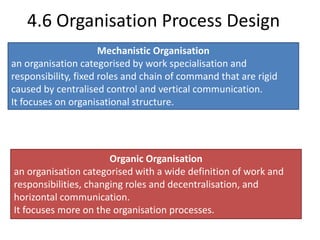
4.6 Organisation Process Design 
Mechanistic Organisation 
an organisation categorised by work specialisation and 
responsibility, fixed roles and chain of command that are rigid 
caused by centralised control and vertical communication. 
It focuses on organisational structure. 
Organic Organisation 
an organisation categorised with a wide definition of work and 
responsibilities, changing roles and decentralisation, and 
horizontal communication. 
It focuses more on the organisation processes.
4.6.1 Emerging Design 
Team Structure 
Disintegration of departments and the decentralisation of 
decision making to the level of work teams. 
Allows the organisation to achieve efficient standardisation that 
is practised by bureaucracy. 
Encourage flexibility that comes with the team structure. 
Modular Organisation 
It outsources business activities to other organisations, suppliers, 
experts or consultants. business activities can be bought from 
other organisations for the purpose of adding activities and can be 
dropped when they are no longer required. 
Can be cheap and able to focus on its own tasks.
4.6.1 Emerging Design 
Virtual Organisation 
An organisation that has become a part of the business network. 
Virtual organisations exist is in a network that shares expertise, 
costs, capabilities, markets and customers collectively to resolve 
customers’ problems or producing certain products and services. 
It allows organisations that are involved in the network to share 
all costs involved 
Borderless Organisation 
An organisation that tries to eradicate the chain of command and 
to replace departmentalisation with team authority. This means 
the organisation is trying to eradicate borders whether vertically 
or horizontally in an organisation. 
Able to utilise its knowledge, expertise and capabilities of 
employees in a better way.
5. Human Resource 
Management 
LO: 
1. Describe human resource management 
2. Clarify the needs of human resources 
3. Identify the methods for capturing the 
interests of qualified candidates 
4. Explain the methods for developing qualified 
employees 
5. Identify methods for maintaining qualified 
employees in the organisation
5.0 Introduction 
HRM = a process of obtaining, developing 
and maintaining a sufficient number of 
qualified employees in order to achieve goals 
that have been set
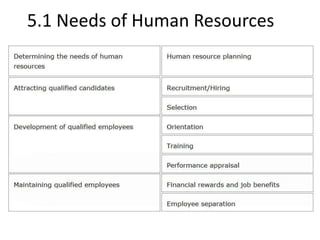
5.1 Needs of Human Resources
5.1 Needs of Human Resources 
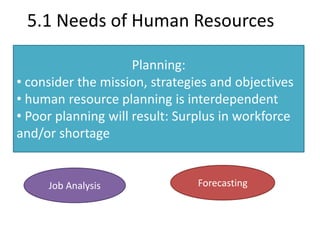
Planning: 
• consider the mission, strategies and objectives 
• human resource planning is interdependent 
• Poor planning will result: Surplus in workforce 
and/or shortage 
Job Analysis Forecasting
5.1.1 Job Analysis 
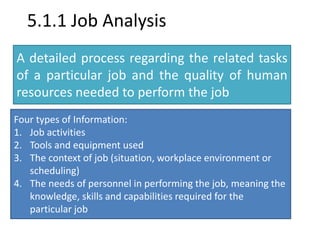
A detailed process regarding the related tasks 
of a particular job and the quality of human 
resources needed to perform the job 
Four types of Information: 
1. Job activities 
2. Tools and equipment used 
3. The context of job (situation, workplace environment or 
scheduling) 
4. The needs of personnel in performing the job, meaning the 
knowledge, skills and capabilities required for the 
particular job
5.1.1 Job Analysis 
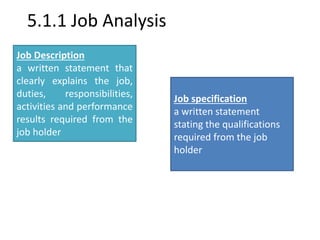
Job Description 
a written statement that 
clearly explains the job, 
duties, responsibilities, 
activities and performance 
results required from the 
job holder 
Job specification 
a written statement 
stating the qualifications 
required from the job 
holder
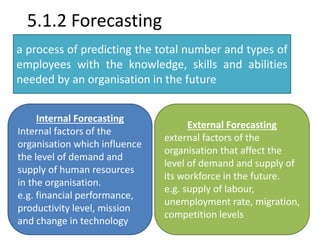
5.1.2 Forecasting 
a process of predicting the total number and types of 
employees with the knowledge, skills and abilities 
needed by an organisation in the future 
Internal Forecasting 
Internal factors of the 
organisation which influence 
the level of demand and 
supply of human resources 
in the organisation. 
e.g. financial performance, 
productivity level, mission 
and change in technology 
External Forecasting 
external factors of the 
organisation that affect the 
level of demand and supply of 
its workforce in the future. 
e.g. supply of labour, 
unemployment rate, migration, 
competition levels
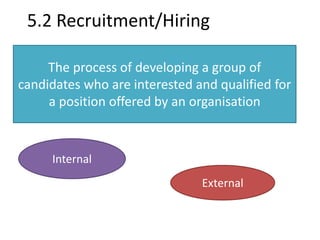
5.2 Recruitment/Hiring 
The process of developing a group of 
candidates who are interested and qualified for 
a position offered by an organisation 
Internal 
External
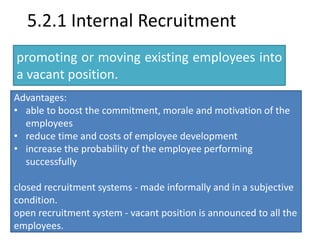
5.2.1 Internal Recruitment 
promoting or moving existing employees into 
a vacant position. 
Advantages: 
• able to boost the commitment, morale and motivation of the 
employees 
• reduce time and costs of employee development 
• increase the probability of the employee performing 
successfully 
closed recruitment systems - made informally and in a subjective 
condition. 
open recruitment system - vacant position is announced to all the 
employees.
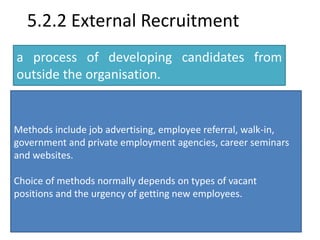
5.2.2 External Recruitment 
a process of developing candidates from 
outside the organisation. 
Methods include job advertising, employee referral, walk-in, 
government and private employment agencies, career seminars 
and websites. 
Choice of methods normally depends on types of vacant 
positions and the urgency of getting new employees.
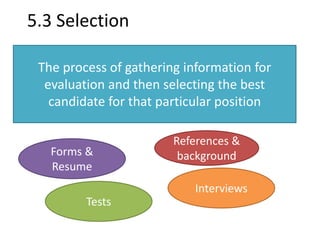
5.3 Selection 
The process of gathering information for 
evaluation and then selecting the best 
candidate for that particular position 
Forms & 
Resume 
References & 
background 
Tests 
Interviews
5.3.1 Application forms & resume 
Both contain the same information about the candidate such as 
personal information, academic background, working experience 
application forms prepared by the organisation itself 
resume is prepared by the candidate
5.3.2 References & Background 
Checking 
job references such as former employer or colleagues, teacher or 
lecturers 
to obtain validity and accuracy of the information provided 
double check any particular information, negative matters or 
job-related background 
conducted with learning centres, former employers, court 
records, police records and government agencies
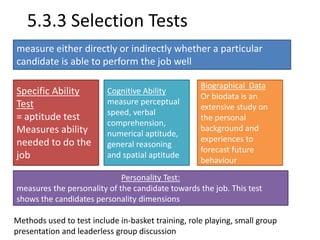
5.3.3 Selection Tests 
measure either directly or indirectly whether a particular 
candidate is able to perform the job well 
Specific Ability 
Test 
= aptitude test 
Measures ability 
needed to do the 
job 
Cognitive Ability 
measure perceptual 
speed, verbal 
comprehension, 
numerical aptitude, 
general reasoning 
and spatial aptitude 
Biographical Data 
Or biodata is an 
extensive study on 
the personal 
background and 
experiences to 
forecast future 
behaviour 
Personality Test: 
measures the personality of the candidate towards the job. This test 
shows the candidates personality dimensions 
Methods used to test include in-basket training, role playing, small group 
presentation and leaderless group discussion
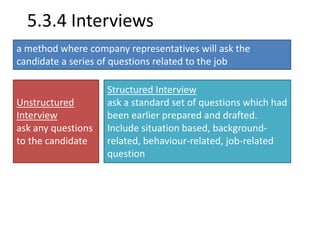
5.3.4 Interviews 
a method where company representatives will ask the 
candidate a series of questions related to the job 
Unstructured 
Interview 
ask any questions 
to the candidate 
Structured Interview 
ask a standard set of questions which had 
been earlier prepared and drafted. 
Include situation based, background-related, 
behaviour-related, job-related 
question
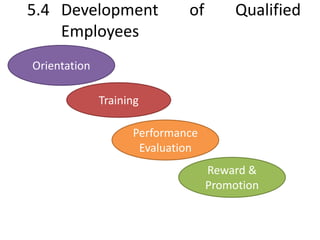
5.4 Development of Qualified 
Employees 
Orientation 
Training 
Reward & 
Promotion 
Performance 
Evaluation
5.4.1 Orientation 
the process of introducing new employees to the programmes, 
policies and culture of the organisation 
provide guidelines to succeed with the organisation 
to ensure that new employees have the basic knowledge and 
skills needed
5.4.2 Training 
provides opportunity for employees to develop working skills, 
experience and knowledge they need in order to perform their 
job or upgrading their job performance 
Both new and existing employees 
Not only lower-level employees but also by middle and higher 
level management
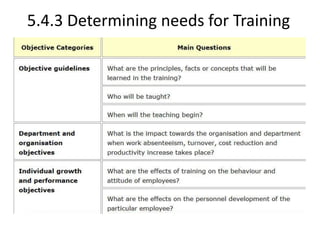
5.4.3 Determining needs for Training 
Training can be costly, so conduct when really need it. 
Determining the needs is a process of identifying and giving 
priority to the learning needs of the employees. 
Can be known via identifying performance ineffectiveness, 
listening to complaints from customers, making observations on 
employees and managers, or assessing the skills and knowledge 
of employees. 
The selection of candidates for training must be based on 
information related to a particular job area
5.4.3 Determining needs for Training
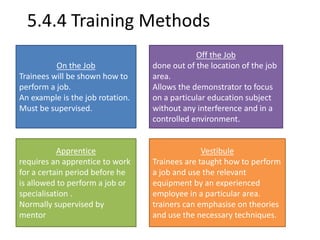
5.4.4 Training Methods 
On the Job 
Trainees will be shown how to 
perform a job. 
An example is the job rotation. 
Must be supervised. 
Off the Job 
done out of the location of the job 
area. 
Allows the demonstrator to focus 
on a particular education subject 
without any interference and in a 
controlled environment. 
Apprentice 
requires an apprentice to work 
for a certain period before he 
is allowed to perform a job or 
specialisation . 
Normally supervised by 
mentor 
Vestibule 
Trainees are taught how to perform 
a job and use the relevant 
equipment by an experienced 
employee in a particular area. 
trainers can emphasise on theories 
and use the necessary techniques.
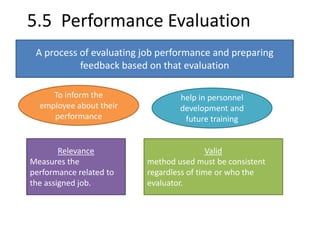
5.5 Performance Evaluation 
A process of evaluating job performance and preparing 
feedback based on that evaluation 
To inform the 
employee about their 
performance 
help in personnel 
development and 
future training 
Relevance 
Measures the 
performance related to 
the assigned job. 
Valid 
method used must be consistent 
regardless of time or who the 
evaluator.
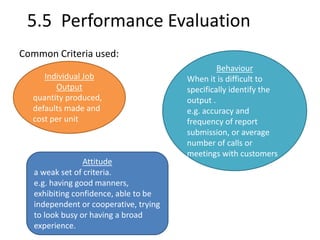
5.5 Performance Evaluation 
Individual Job 
Output 
quantity produced, 
defaults made and 
cost per unit 
Behaviour 
When it is difficult to 
specifically identify the 
output . 
e.g. accuracy and 
frequency of report 
submission, or average 
number of calls or 
meetings with customers 
Common Criteria used: 
Attitude 
a weak set of criteria. 
e.g. having good manners, 
exhibiting confidence, able to be 
independent or cooperative, trying 
to look busy or having a broad 
experience.
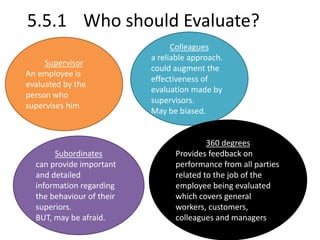
5.5.1 Who should Evaluate? 
Supervisor 
An employee is 
evaluated by the 
person who 
supervises him 
Colleagues 
a reliable approach. 
could augment the 
effectiveness of 
evaluation made by 
supervisors. 
May be biased. 
Subordinates 
can provide important 
and detailed 
information regarding 
the behaviour of their 
superiors. 
BUT, may be afraid. 
360 degrees 
Provides feedback on 
performance from all parties 
related to the job of the 
employee being evaluated 
which covers general 
workers, customers, 
colleagues and managers
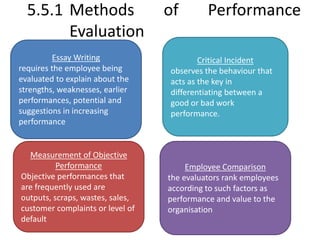
5.5.1 Methods of Performance 
Evaluation 
Essay Writing 
requires the employee being 
evaluated to explain about the 
strengths, weaknesses, earlier 
performances, potential and 
suggestions in increasing 
performance 
Critical Incident 
observes the behaviour that 
acts as the key in 
differentiating between a 
good or bad work 
performance. 
Measurement of Objective 
Performance 
Objective performances that 
are frequently used are 
outputs, scraps, wastes, sales, 
customer complaints or level of 
default 
Employee Comparison 
the evaluators rank employees 
according to such factors as 
performance and value to the 
organisation
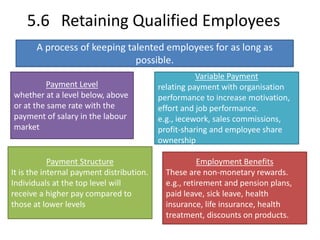
5.6 Retaining Qualified Employees 
A process of keeping talented employees for as long as 
possible. 
Payment Level 
whether at a level below, above 
or at the same rate with the 
payment of salary in the labour 
market 
Payment Structure 
It is the internal payment distribution. 
Individuals at the top level will 
receive a higher pay compared to 
those at lower levels 
Variable Payment 
relating payment with organisation 
performance to increase motivation, 
effort and job performance. 
e.g., iecework, sales commissions, 
profit-sharing and employee share 
ownership 
Employment Benefits 
These are non-monetary rewards. 
e.g., retirement and pension plans, 
paid leave, sick leave, health 
insurance, life insurance, health 
treatment, discounts on products.
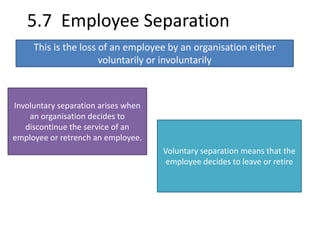
5.7 Employee Separation 
This is the loss of an employee by an organisation either 
voluntarily or involuntarily 
Involuntary separation arises when 
an organisation decides to 
discontinue the service of an 
employee or retrench an employee. 
Voluntary separation means that the 
employee decides to leave or retire
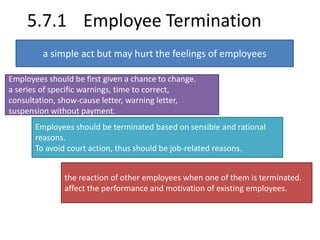
5.7.1 Employee Termination 
a simple act but may hurt the feelings of employees 
Employees should be first given a chance to change. 
a series of specific warnings, time to correct, 
consultation, show-cause letter, warning letter, 
suspension without payment. 
Employees should be terminated based on sensible and rational 
reasons. 
To avoid court action, thus should be job-related reasons. 
the reaction of other employees when one of them is terminated. 
affect the performance and motivation of existing employees.
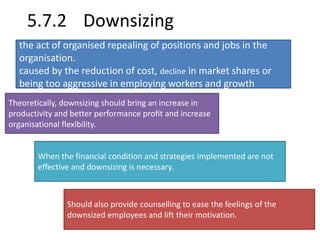
5.7.2 Downsizing 
the act of organised repealing of positions and jobs in the 
organisation. 
caused by the reduction of cost, decline in market shares or 
being too aggressive in employing workers and growth 
Theoretically, downsizing should bring an increase in 
productivity and better performance profit and increase 
organisational flexibility. 
When the financial condition and strategies implemented are not 
effective and downsizing is necessary. 
Should also provide counselling to ease the feelings of the 
downsized employees and lift their motivation.
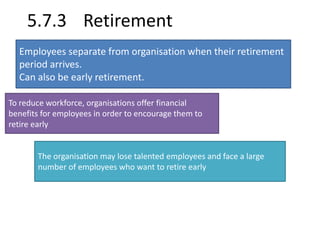
5.7.3 Retirement 
Employees separate from organisation when their retirement 
period arrives. 
Can also be early retirement. 
To reduce workforce, organisations offer financial 
benefits for employees in order to encourage them to 
retire early 
The organisation may lose talented employees and face a large 
number of employees who want to retire early
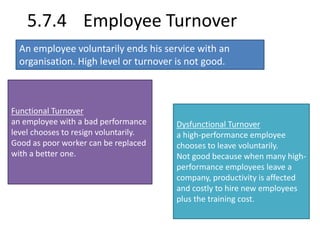
5.7.4 Employee Turnover 
An employee voluntarily ends his service with an 
organisation. High level or turnover is not good. 
Functional Turnover 
an employee with a bad performance 
level chooses to resign voluntarily. 
Good as poor worker can be replaced 
with a better one. 
Dysfunctional Turnover 
a high-performance employee 
chooses to leave voluntarily. 
Not good because when many high-performance 
employees leave a 
company, productivity is affected 
and costly to hire new employees 
plus the training cost.

Bbpp1103 t2

  • 1.
  • 2.
    4. Organisation Design LO: 1. Explain the concept of organisational structure 2. Identify the four factors that influence organisational structure 3. Compare the different types of organisational structure 4. Describe the concept of authority in organisations 5. Differentiate between the concepts of centralisation and decentralisation 6. Evaluate the different types of work design 7. Discuss the emerging organisational designs
  • 3.
    4.0 Introduction OSrefers to organisation’s functions that are grouped and coordinated formally. A system that connects the duties, workflow and communication channels between individuals and the various work groups to simplify the use of each resource and individual collectively as a management system usually displayed in graphical form = organisational chart Typically in a pyramid chart
  • 4.
    4.1 Factors thatinfluence OS Organisational Strategy Size of Organisation OS supports and facilitate the overall organisational strategies to achieve the objectives. When strategies change, structure tend to change too. Small = lesser work specialisation, less standardisation and more centralisation of decision making. Large = specialisation, standardisation and decentralised decision making Size measure = sales /manpower Technology Environment Technology is subject to routine and non-routine activities. Routine = departmentalisation structures (centralised), work specialisation and complying to rules Non-routine = depends on expertise, thus more decentralised, less specialisation and don not need to comply to strict rules external influences = environmental influences Some face static, some face dynamic environment Dynamic = more uncertainties, thus best to reduce threats Hence, OS may be altered according to the uncertanties in its environment.
  • 5.
    4.2 Designing OS Departmentalisation based on the types of departmentalisation = division of work and employees to different organisational units. Common types:
  • 6.
    4.2.1 Functional Departmentalisation coordinates work and employees through different units and each unit is responsible for a specific business function or expertise area. Advantages : Allows work to be carried out by individuals who are qualified and skilled in the areas concerned, It reduces cost by reducing work duplication and use of resources Each individual in the same department will acquire the same work experiences or training, communication and coordination, thereby reducing problems for management Disadvantages: Difficulty in coordinating between departments Can cause delays in decision making Produce managers and employees who are restricted in experience and expertise
  • 7.
    4.2.2 Product Departmentalisation based on products and employees work in different units, each with the responsibility of producing a product or service. For example, Advantages : Allows managers and employees to expand their experience and expertise that are related to the overall activity of the product or service produced. Allows management to evaluate the work performance of each work unit Disadvantages: Managers may focus on their product to the exclusion of the rest of the organisation. Administration costs may also increase due to each product having its own functional-area experts
  • 8.
    4.2.3 Customer Departmentalisation coordinates work and employees in different units that are responsible for specific types of consumers only. For example, Advantages : The organisation focuses all its efforts on fulfilling the needs of consumers. Allows the organisation to specialise and adapt its products and services to fulfil the requirements and resolve consumers’ problems. Disadvantages: The existence of duplication of work and use of resources. Difficulty to coordinate between departments that provide services to different types of consumers. Can cause employees to overemphasise effort to fulfil customer needs until it affects the organisation’s business performance.
  • 9.
    4.2.4 Geographic Departmentalisation coordinates the work and employees of different units that are responsible for conducting business activities in certain geographical locations. For example, Advantages : The abilities of the organisation to react with speed and efficiency to the requirements of specific markets especially in different countries. It helps to reduce costs by positioning the organisational resources nearer to the targeted consumers. Disadvantages: It creates duplication of work and the use of the organisation’s resources. Difficulties will arise in coordinating between departments as the departments are in geographical areas that are located far from each other.
  • 10.
    4.2.5 Matrix Departmentalisation Combines two or more types of departmentalisation at the same time. The employees report to two different supervisors or managers. It leads to cross interactive functions that cannot be done in the other types of departmentalisation. Advantages : It allows the organisation to manage efficiently the projects or activities that are large scale and complex. Disadvantages: It requires a higher level of coordination to manage the complexity involved. Tend to focus on the conflict of authority. Can cause confusion among employees who have to report to more than one supervisor or manager. Requires higher-level management skills
  • 11.
    4.3 Authority Theright to give directives, take actions and make decisions related to activities to achieve the organisation’s objectives. Normally channelled from top to bottom. The right exists based on the formal position in an organisation Chain of Command Line & Staff Authority Line & Staff Function Span of Control
  • 12.
    4.3.1 Chain ofCommand Explains who reports to whom. Individuals in the top rectangles have authority over those in the lower rectangles, according to the lines that connect them. Individuals at the lower levels must report all aspects of their work to the people at the level above them. To avoid confusion and conflict of authority, unity of command is needed in an organisation, i.e. the management principle that states that employees only report to one manager at a time
  • 13.
    4.3.2 Line &Staff Authority The line authority and staff authority must work together to maintain the efficiency and effectiveness
  • 14.
    4.3.3 Line &Staff Functions Line Function = an activity that directly contributes to the production and selling. E.g., the activities that are conducted by the production and marketing departments. Staff Function = an activity that contributes indirectly to the production and selling. E.g., The activities that are conducted by the accounts, human resources and legal departments
  • 15.
    4.3.4 Span ofControl Refers to the number of employees who report directly to a manager or supervisor Vertical = Restricted span of control. allows the organisation to increase its efforts to monitor its employees. stringent supervision. BUT, will incur higher costs especially employees’ salaries because it requires multiple levels of management. AND, an cause delays in decision making and the staff/managers have the tendency to refer their problems to upper management. Creativity among employees will be limited. Currently most organisations practise a broad span of control as it reduces costs, expedites the decision-making process, increases creativity and flexibility, narrows the gap towards consumers and imparts power to employees
  • 16.
    4.4 Centralisation -Decentralisation Centralisation is a situation where almost all control is centralised, especially the control for decision making to one party, which is the top level people in an organisation. Give authority to the managers to make decisions even though it is a trivial matter. Decentralisation is a situation where a certain amount of authority is handed down to subordinates or employees at the lower levels of an organisation. have more delegated authority at all levels.
  • 17.
    4.4 Centralisation -Decentralisation Centralisation Size – small organisation means top managers may not face many difficulties in monitoring the whole organisation. Standardised/work specialisation – does not require creativity. Decentralisation Size – large organisations will gain more advantages by practising decentralisation. Large means increase in responsibilities, thus managers at lower levels should be delegated with more authority to deal with increased duties. Place – when products/services are located at different places. Creativity – when employees or managers of lower levels need to be more creative in resolving particular issues.
  • 18.
    4.5 Work design WD specifies the activities that are done by employees. It determines how and where the work has to be done. It ensures a healthy and safe working environment in achieving productivity and efficiency. Work Specialisation. The act of assigning the contents of smaller sections from the overall work or process to individuals. It is economical, quicker, cheaper wages, productivity problem minimal. BUT, employees be easily bored, thus low job satisfaction and high absenteeism. Job Rotation Transferring employees from one type of specialisation to another periodically. Hence, employees may have various skills. It can reduce boredom in employees and give more job satisfaction
  • 19.
    4.5 Work design Job Enlargement It adds the number of tasks in an activity. It gives employees the opportunities to develop other skills. BUT, it potentially causes stress among them due to many tasks. Job Enrichment It results in an increase in the number of tasks in the activities and gives the employees authority and control in making decisions related to their work. Frederick Herzberg stated that as employees only handle a few tasks, they are quickly bored. It makes work activities more interesting and challenging and when employee responsibilities increase, then the motivation and interest will also increase.
  • 20.
    4.6 Organisation ProcessDesign Mechanistic Organisation an organisation categorised by work specialisation and responsibility, fixed roles and chain of command that are rigid caused by centralised control and vertical communication. It focuses on organisational structure. Organic Organisation an organisation categorised with a wide definition of work and responsibilities, changing roles and decentralisation, and horizontal communication. It focuses more on the organisation processes.
  • 21.
    4.6.1 Emerging Design Team Structure Disintegration of departments and the decentralisation of decision making to the level of work teams. Allows the organisation to achieve efficient standardisation that is practised by bureaucracy. Encourage flexibility that comes with the team structure. Modular Organisation It outsources business activities to other organisations, suppliers, experts or consultants. business activities can be bought from other organisations for the purpose of adding activities and can be dropped when they are no longer required. Can be cheap and able to focus on its own tasks.
  • 22.
    4.6.1 Emerging Design Virtual Organisation An organisation that has become a part of the business network. Virtual organisations exist is in a network that shares expertise, costs, capabilities, markets and customers collectively to resolve customers’ problems or producing certain products and services. It allows organisations that are involved in the network to share all costs involved Borderless Organisation An organisation that tries to eradicate the chain of command and to replace departmentalisation with team authority. This means the organisation is trying to eradicate borders whether vertically or horizontally in an organisation. Able to utilise its knowledge, expertise and capabilities of employees in a better way.
  • 23.
    5. Human Resource Management LO: 1. Describe human resource management 2. Clarify the needs of human resources 3. Identify the methods for capturing the interests of qualified candidates 4. Explain the methods for developing qualified employees 5. Identify methods for maintaining qualified employees in the organisation
  • 24.
    5.0 Introduction HRM= a process of obtaining, developing and maintaining a sufficient number of qualified employees in order to achieve goals that have been set
  • 25.
    5.1 Needs ofHuman Resources
  • 26.
    5.1 Needs ofHuman Resources Planning: • consider the mission, strategies and objectives • human resource planning is interdependent • Poor planning will result: Surplus in workforce and/or shortage Job Analysis Forecasting
  • 27.
    5.1.1 Job Analysis A detailed process regarding the related tasks of a particular job and the quality of human resources needed to perform the job Four types of Information: 1. Job activities 2. Tools and equipment used 3. The context of job (situation, workplace environment or scheduling) 4. The needs of personnel in performing the job, meaning the knowledge, skills and capabilities required for the particular job
  • 28.
    5.1.1 Job Analysis Job Description a written statement that clearly explains the job, duties, responsibilities, activities and performance results required from the job holder Job specification a written statement stating the qualifications required from the job holder
  • 29.
    5.1.2 Forecasting aprocess of predicting the total number and types of employees with the knowledge, skills and abilities needed by an organisation in the future Internal Forecasting Internal factors of the organisation which influence the level of demand and supply of human resources in the organisation. e.g. financial performance, productivity level, mission and change in technology External Forecasting external factors of the organisation that affect the level of demand and supply of its workforce in the future. e.g. supply of labour, unemployment rate, migration, competition levels
  • 30.
    5.2 Recruitment/Hiring Theprocess of developing a group of candidates who are interested and qualified for a position offered by an organisation Internal External
  • 31.
    5.2.1 Internal Recruitment promoting or moving existing employees into a vacant position. Advantages: • able to boost the commitment, morale and motivation of the employees • reduce time and costs of employee development • increase the probability of the employee performing successfully closed recruitment systems - made informally and in a subjective condition. open recruitment system - vacant position is announced to all the employees.
  • 32.
    5.2.2 External Recruitment a process of developing candidates from outside the organisation. Methods include job advertising, employee referral, walk-in, government and private employment agencies, career seminars and websites. Choice of methods normally depends on types of vacant positions and the urgency of getting new employees.
  • 33.
    5.3 Selection Theprocess of gathering information for evaluation and then selecting the best candidate for that particular position Forms & Resume References & background Tests Interviews
  • 34.
    5.3.1 Application forms& resume Both contain the same information about the candidate such as personal information, academic background, working experience application forms prepared by the organisation itself resume is prepared by the candidate
  • 35.
    5.3.2 References &Background Checking job references such as former employer or colleagues, teacher or lecturers to obtain validity and accuracy of the information provided double check any particular information, negative matters or job-related background conducted with learning centres, former employers, court records, police records and government agencies
  • 36.
    5.3.3 Selection Tests measure either directly or indirectly whether a particular candidate is able to perform the job well Specific Ability Test = aptitude test Measures ability needed to do the job Cognitive Ability measure perceptual speed, verbal comprehension, numerical aptitude, general reasoning and spatial aptitude Biographical Data Or biodata is an extensive study on the personal background and experiences to forecast future behaviour Personality Test: measures the personality of the candidate towards the job. This test shows the candidates personality dimensions Methods used to test include in-basket training, role playing, small group presentation and leaderless group discussion
  • 37.
    5.3.4 Interviews amethod where company representatives will ask the candidate a series of questions related to the job Unstructured Interview ask any questions to the candidate Structured Interview ask a standard set of questions which had been earlier prepared and drafted. Include situation based, background-related, behaviour-related, job-related question
  • 38.
    5.4 Development ofQualified Employees Orientation Training Reward & Promotion Performance Evaluation
  • 39.
    5.4.1 Orientation theprocess of introducing new employees to the programmes, policies and culture of the organisation provide guidelines to succeed with the organisation to ensure that new employees have the basic knowledge and skills needed
  • 40.
    5.4.2 Training providesopportunity for employees to develop working skills, experience and knowledge they need in order to perform their job or upgrading their job performance Both new and existing employees Not only lower-level employees but also by middle and higher level management
  • 41.
    5.4.3 Determining needsfor Training Training can be costly, so conduct when really need it. Determining the needs is a process of identifying and giving priority to the learning needs of the employees. Can be known via identifying performance ineffectiveness, listening to complaints from customers, making observations on employees and managers, or assessing the skills and knowledge of employees. The selection of candidates for training must be based on information related to a particular job area
  • 42.
  • 43.
    5.4.4 Training Methods On the Job Trainees will be shown how to perform a job. An example is the job rotation. Must be supervised. Off the Job done out of the location of the job area. Allows the demonstrator to focus on a particular education subject without any interference and in a controlled environment. Apprentice requires an apprentice to work for a certain period before he is allowed to perform a job or specialisation . Normally supervised by mentor Vestibule Trainees are taught how to perform a job and use the relevant equipment by an experienced employee in a particular area. trainers can emphasise on theories and use the necessary techniques.
  • 44.
    5.5 Performance Evaluation A process of evaluating job performance and preparing feedback based on that evaluation To inform the employee about their performance help in personnel development and future training Relevance Measures the performance related to the assigned job. Valid method used must be consistent regardless of time or who the evaluator.
  • 45.
    5.5 Performance Evaluation Individual Job Output quantity produced, defaults made and cost per unit Behaviour When it is difficult to specifically identify the output . e.g. accuracy and frequency of report submission, or average number of calls or meetings with customers Common Criteria used: Attitude a weak set of criteria. e.g. having good manners, exhibiting confidence, able to be independent or cooperative, trying to look busy or having a broad experience.
  • 46.
    5.5.1 Who shouldEvaluate? Supervisor An employee is evaluated by the person who supervises him Colleagues a reliable approach. could augment the effectiveness of evaluation made by supervisors. May be biased. Subordinates can provide important and detailed information regarding the behaviour of their superiors. BUT, may be afraid. 360 degrees Provides feedback on performance from all parties related to the job of the employee being evaluated which covers general workers, customers, colleagues and managers
  • 47.
    5.5.1 Methods ofPerformance Evaluation Essay Writing requires the employee being evaluated to explain about the strengths, weaknesses, earlier performances, potential and suggestions in increasing performance Critical Incident observes the behaviour that acts as the key in differentiating between a good or bad work performance. Measurement of Objective Performance Objective performances that are frequently used are outputs, scraps, wastes, sales, customer complaints or level of default Employee Comparison the evaluators rank employees according to such factors as performance and value to the organisation
  • 48.
    5.6 Retaining QualifiedEmployees A process of keeping talented employees for as long as possible. Payment Level whether at a level below, above or at the same rate with the payment of salary in the labour market Payment Structure It is the internal payment distribution. Individuals at the top level will receive a higher pay compared to those at lower levels Variable Payment relating payment with organisation performance to increase motivation, effort and job performance. e.g., iecework, sales commissions, profit-sharing and employee share ownership Employment Benefits These are non-monetary rewards. e.g., retirement and pension plans, paid leave, sick leave, health insurance, life insurance, health treatment, discounts on products.
  • 49.
    5.7 Employee Separation This is the loss of an employee by an organisation either voluntarily or involuntarily Involuntary separation arises when an organisation decides to discontinue the service of an employee or retrench an employee. Voluntary separation means that the employee decides to leave or retire
  • 50.
    5.7.1 Employee Termination a simple act but may hurt the feelings of employees Employees should be first given a chance to change. a series of specific warnings, time to correct, consultation, show-cause letter, warning letter, suspension without payment. Employees should be terminated based on sensible and rational reasons. To avoid court action, thus should be job-related reasons. the reaction of other employees when one of them is terminated. affect the performance and motivation of existing employees.
  • 51.
    5.7.2 Downsizing theact of organised repealing of positions and jobs in the organisation. caused by the reduction of cost, decline in market shares or being too aggressive in employing workers and growth Theoretically, downsizing should bring an increase in productivity and better performance profit and increase organisational flexibility. When the financial condition and strategies implemented are not effective and downsizing is necessary. Should also provide counselling to ease the feelings of the downsized employees and lift their motivation.
  • 52.
    5.7.3 Retirement Employeesseparate from organisation when their retirement period arrives. Can also be early retirement. To reduce workforce, organisations offer financial benefits for employees in order to encourage them to retire early The organisation may lose talented employees and face a large number of employees who want to retire early
  • 53.
    5.7.4 Employee Turnover An employee voluntarily ends his service with an organisation. High level or turnover is not good. Functional Turnover an employee with a bad performance level chooses to resign voluntarily. Good as poor worker can be replaced with a better one. Dysfunctional Turnover a high-performance employee chooses to leave voluntarily. Not good because when many high-performance employees leave a company, productivity is affected and costly to hire new employees plus the training cost.