Chapter 4
The effect of profit or loss on
capital and the double entry
system for expenses and revenues
Frank Wood’s
Business Accounting 1
1
Learning objectives
After finishing this chapter, you will be able to:
 Calculate profit by comparing revenue with
expenses.
 Explain how the accounting equation is used
to show the effects of changes in assets and
liabilities upon capital after goods or services
have been traded.
 Explain why separate accounts are used for
each type of expense and revenue.
2
Learning objectives (Continued)
 Explain why an expense is entered as a debit in
the appropriate expense account.
 Explain why an item of revenue is entered as a
credit in the appropriate revenue account.
 Enter a series of expense and revenue
transactions into the appropriate T-accounts.
 Explain how the use of business cash and
business goods for the owner’s own purposes
are dealt with in the accounting records.
3
The nature of profit or loss
 Profit means the amount by which revenue is
greater than expenses for a set of transactions,
where:
 Revenue means the sales value of goods and
services that have been supplied to customers.
 Expenses means the cost value of all the
assets that have been used up to obtain these
revenues.
4
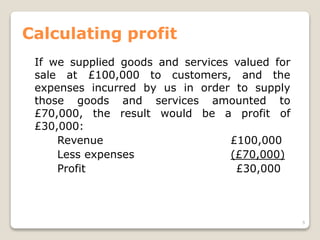
Calculating profit
If we supplied goods and services valued for
sale at £100,000 to customers, and the
expenses incurred by us in order to supply
those goods and services amounted to
£70,000, the result would be a profit of
£30,000:
Revenue £100,000
Less expenses (£70,000)
Profit £30,000
5
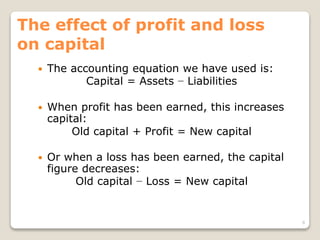
The effect of profit and loss
on capital
 The accounting equation we have used is:
Capital = Assets − Liabilities
 When profit has been earned, this increases
capital:
Old capital + Profit = New capital
 Or when a loss has been earned, the capital
figure decreases:
Old capital − Loss = New capital
6
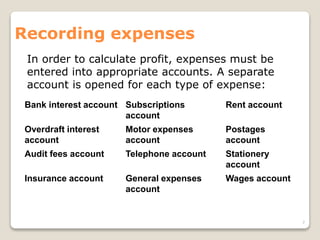
Recording expenses
In order to calculate profit, expenses must be
entered into appropriate accounts. A separate
account is opened for each type of expense:
Bank interest account Subscriptions
account
Rent account
Overdraft interest
account
Motor expenses
account
Postages
account
Audit fees account Telephone account Stationery
account
Insurance account General expenses
account
Wages account
7
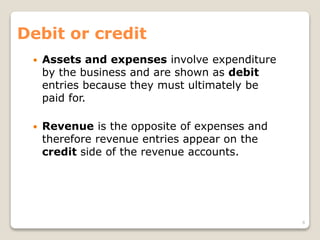
Debit or credit
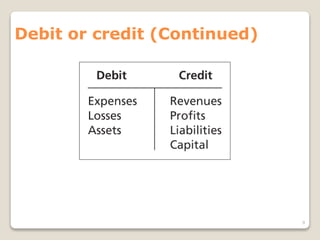
 Assets and expenses involve expenditure
by the business and are shown as debit
entries because they must ultimately be
paid for.
 Revenue is the opposite of expenses and
therefore revenue entries appear on the
credit side of the revenue accounts.
8
Debit or credit (Continued)
9
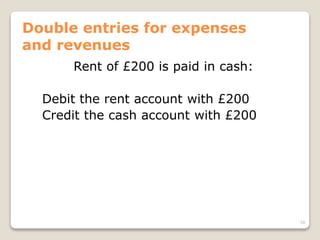
Double entries for expenses
and revenues
Rent of £200 is paid in cash:
Debit the rent account with £200
Credit the cash account with £200
10
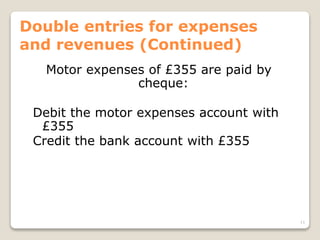
Double entries for expenses
and revenues (Continued)
Motor expenses of £355 are paid by
cheque:
Debit the motor expenses account with
£355
Credit the bank account with £355
11
Double entries for expenses
and revenues (Continued)
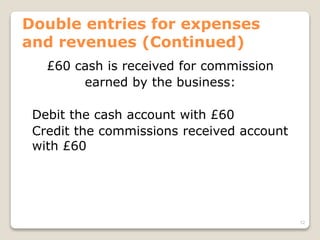
£60 cash is received for commission
earned by the business:
Debit the cash account with £60
Credit the commissions received account
with £60
12
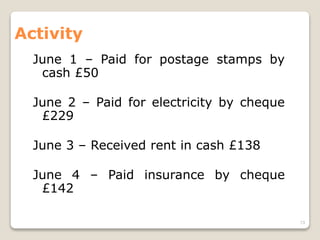
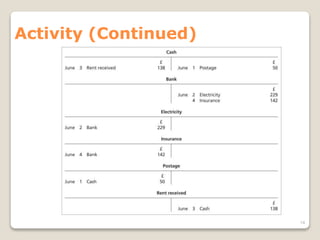
Activity
June 1 – Paid for postage stamps by
cash £50
June 2 – Paid for electricity by cheque
£229
June 3 – Received rent in cash £138
June 4 – Paid insurance by cheque
£142
13
Activity (Continued)
14
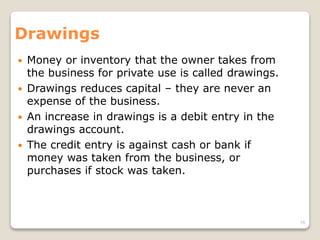
Drawings
 Money or inventory that the owner takes from
the business for private use is called drawings.
 Drawings reduces capital – they are never an
expense of the business.
 An increase in drawings is a debit entry in the
drawings account.
 The credit entry is against cash or bank if
money was taken from the business, or
purchases if stock was taken.
15
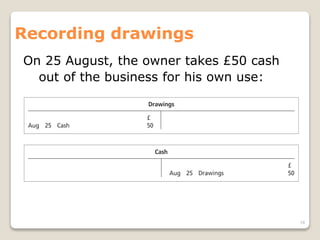
Recording drawings
On 25 August, the owner takes £50 cash
out of the business for his own use:
16
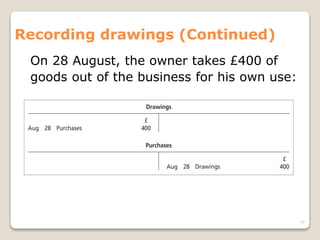
Recording drawings (Continued)
On 28 August, the owner takes £400 of
goods out of the business for his own use:
17

Chap04_Expenses _ Revenue.ppt

  • 1.
    Chapter 4 The effectof profit or loss on capital and the double entry system for expenses and revenues Frank Wood’s Business Accounting 1 1
  • 2.
    Learning objectives After finishingthis chapter, you will be able to:  Calculate profit by comparing revenue with expenses.  Explain how the accounting equation is used to show the effects of changes in assets and liabilities upon capital after goods or services have been traded.  Explain why separate accounts are used for each type of expense and revenue. 2
  • 3.
    Learning objectives (Continued) Explain why an expense is entered as a debit in the appropriate expense account.  Explain why an item of revenue is entered as a credit in the appropriate revenue account.  Enter a series of expense and revenue transactions into the appropriate T-accounts.  Explain how the use of business cash and business goods for the owner’s own purposes are dealt with in the accounting records. 3
  • 4.
    The nature ofprofit or loss  Profit means the amount by which revenue is greater than expenses for a set of transactions, where:  Revenue means the sales value of goods and services that have been supplied to customers.  Expenses means the cost value of all the assets that have been used up to obtain these revenues. 4
  • 5.
    Calculating profit If wesupplied goods and services valued for sale at £100,000 to customers, and the expenses incurred by us in order to supply those goods and services amounted to £70,000, the result would be a profit of £30,000: Revenue £100,000 Less expenses (£70,000) Profit £30,000 5
  • 6.
    The effect ofprofit and loss on capital  The accounting equation we have used is: Capital = Assets − Liabilities  When profit has been earned, this increases capital: Old capital + Profit = New capital  Or when a loss has been earned, the capital figure decreases: Old capital − Loss = New capital 6
  • 7.
    Recording expenses In orderto calculate profit, expenses must be entered into appropriate accounts. A separate account is opened for each type of expense: Bank interest account Subscriptions account Rent account Overdraft interest account Motor expenses account Postages account Audit fees account Telephone account Stationery account Insurance account General expenses account Wages account 7
  • 8.
    Debit or credit Assets and expenses involve expenditure by the business and are shown as debit entries because they must ultimately be paid for.  Revenue is the opposite of expenses and therefore revenue entries appear on the credit side of the revenue accounts. 8
  • 9.
    Debit or credit(Continued) 9
  • 10.
    Double entries forexpenses and revenues Rent of £200 is paid in cash: Debit the rent account with £200 Credit the cash account with £200 10
  • 11.
    Double entries forexpenses and revenues (Continued) Motor expenses of £355 are paid by cheque: Debit the motor expenses account with £355 Credit the bank account with £355 11
  • 12.
    Double entries forexpenses and revenues (Continued) £60 cash is received for commission earned by the business: Debit the cash account with £60 Credit the commissions received account with £60 12
  • 13.
    Activity June 1 –Paid for postage stamps by cash £50 June 2 – Paid for electricity by cheque £229 June 3 – Received rent in cash £138 June 4 – Paid insurance by cheque £142 13
  • 14.
  • 15.
    Drawings  Money orinventory that the owner takes from the business for private use is called drawings.  Drawings reduces capital – they are never an expense of the business.  An increase in drawings is a debit entry in the drawings account.  The credit entry is against cash or bank if money was taken from the business, or purchases if stock was taken. 15
  • 16.
    Recording drawings On 25August, the owner takes £50 cash out of the business for his own use: 16
  • 17.
    Recording drawings (Continued) On28 August, the owner takes £400 of goods out of the business for his own use: 17