Frank Wood and Alan Sangster, Frank Wood’s Business Accounting 1, 14th Edition, © Pearson Education Limited 2018
Slide 6.1
Chapter 6
The trial balance
Frank Wood’s
Business Accounting 1
Frank Wood and Alan Sangster, Frank Wood’s Business Accounting 1, 14th Edition, © Pearson Education Limited 2018
Slide 6.2
Learning objectives
After finishing this chapter, you will be able to:
 Prepare a trial balance from a set of accounts;
 Explain why the debit and credit trial balance
totals should equal one another;
 Explain why some of the possible errors that can
be made when double entries are being entered
in the accounts do not prevent the trial balance
from ‘balancing’;
 Describe uses for a trial balance other than to
check for double entry errors.
Frank Wood and Alan Sangster, Frank Wood’s Business Accounting 1, 14th Edition, © Pearson Education Limited 2018
Slide 6.3
Review of
double entry bookkeeping
 For each debit entry, there is a credit entry and
for each credit entry, there is a debit entry.
 The total of all the items recorded in all the
accounts on the debit side should equal the total
of all the items recorded on the credit side of the
accounts.
 To check that there is a matching credit entry for
every debit entry, we prepare a trial balance.
Frank Wood and Alan Sangster, Frank Wood’s Business Accounting 1, 14th Edition, © Pearson Education Limited 2018
Slide 6.4
The trial balance
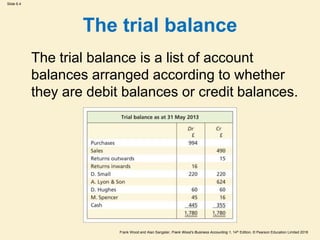
The trial balance is a list of account
balances arranged according to whether
they are debit balances or credit balances.
Frank Wood and Alan Sangster, Frank Wood’s Business Accounting 1, 14th Edition, © Pearson Education Limited 2018
Slide 6.5
Drawing up a trial balance
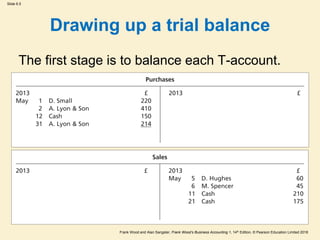
The first stage is to balance each T-account.
Frank Wood and Alan Sangster, Frank Wood’s Business Accounting 1, 14th Edition, © Pearson Education Limited 2018
Slide 6.6
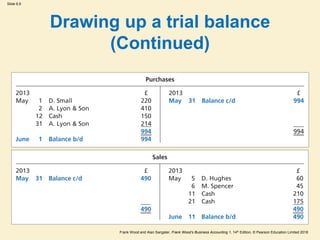
Drawing up a trial balance
(Continued)
Frank Wood and Alan Sangster, Frank Wood’s Business Accounting 1, 14th Edition, © Pearson Education Limited 2018
Slide 6.7
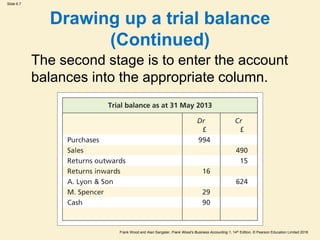
The second stage is to enter the account
balances into the appropriate column.
Drawing up a trial balance
(Continued)
Frank Wood and Alan Sangster, Frank Wood’s Business Accounting 1, 14th Edition, © Pearson Education Limited 2018
Slide 6.8
Drawing up a trial balance
(Continued)
Frank Wood and Alan Sangster, Frank Wood’s Business Accounting 1, 14th Edition, © Pearson Education Limited 2018
Slide 6.9
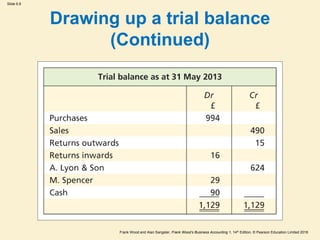
 The trial balance always has the date of the last
day of the accounting period to which it relates. It
is a snapshot of the balances on the ledger
accounts at that date.
 The totals of the two columns must always
match.
 A trial balance can be drawn up at any time but it
is normal practice to prepare one at the end of an
accounting period before preparing an income
statement and statement of financial position.
Drawing up a trial balance
(Continued)
Frank Wood and Alan Sangster, Frank Wood’s Business Accounting 1, 14th Edition, © Pearson Education Limited 2018
Slide 6.10
Trial balances and errors
 It is easy to assume that if the trial balance
balances, the entries in the accounts must be
correct. However, there are several types of
error that will not affect the balancing of a trial
balance.
 Errors that are revealed include: addition
errors; using one figure for the debit entry
and another for the credit entry; entering only
one side of the transaction.
Frank Wood and Alan Sangster, Frank Wood’s Business Accounting 1, 14th Edition, © Pearson Education Limited 2018
Slide 6.11
Inventory in the trial balance
 The closing inventory figure is not found in an
account in the ledger and so does not appear
in the trial balance. It is noted underneath the
total figure and incorporated into the financial
statements later.
 Opening inventory is recorded in a ledger
account and so would be included in a trial
balance prepared.
Frank Wood and Alan Sangster, Frank Wood’s Business Accounting 1, 14th Edition, © Pearson Education Limited 2018
Slide 6.12
Learning outcomes
You should have now learnt:
1. How to prepare a trial balance.
2. That trial balances are one form of checking
the accuracy of entries in the accounts.
3. That errors can be made in the entries to the
accounts that will not be shown up by the trial
balance.
4. That the trial balance is used as the basis for
preparing income statements and statement of
financial position.

Chap06_Trial balance.pptx

  • 1.
    Frank Wood andAlan Sangster, Frank Wood’s Business Accounting 1, 14th Edition, © Pearson Education Limited 2018 Slide 6.1 Chapter 6 The trial balance Frank Wood’s Business Accounting 1
  • 2.
    Frank Wood andAlan Sangster, Frank Wood’s Business Accounting 1, 14th Edition, © Pearson Education Limited 2018 Slide 6.2 Learning objectives After finishing this chapter, you will be able to:  Prepare a trial balance from a set of accounts;  Explain why the debit and credit trial balance totals should equal one another;  Explain why some of the possible errors that can be made when double entries are being entered in the accounts do not prevent the trial balance from ‘balancing’;  Describe uses for a trial balance other than to check for double entry errors.
  • 3.
    Frank Wood andAlan Sangster, Frank Wood’s Business Accounting 1, 14th Edition, © Pearson Education Limited 2018 Slide 6.3 Review of double entry bookkeeping  For each debit entry, there is a credit entry and for each credit entry, there is a debit entry.  The total of all the items recorded in all the accounts on the debit side should equal the total of all the items recorded on the credit side of the accounts.  To check that there is a matching credit entry for every debit entry, we prepare a trial balance.
  • 4.
    Frank Wood andAlan Sangster, Frank Wood’s Business Accounting 1, 14th Edition, © Pearson Education Limited 2018 Slide 6.4 The trial balance The trial balance is a list of account balances arranged according to whether they are debit balances or credit balances.
  • 5.
    Frank Wood andAlan Sangster, Frank Wood’s Business Accounting 1, 14th Edition, © Pearson Education Limited 2018 Slide 6.5 Drawing up a trial balance The first stage is to balance each T-account.
  • 6.
    Frank Wood andAlan Sangster, Frank Wood’s Business Accounting 1, 14th Edition, © Pearson Education Limited 2018 Slide 6.6 Drawing up a trial balance (Continued)
  • 7.
    Frank Wood andAlan Sangster, Frank Wood’s Business Accounting 1, 14th Edition, © Pearson Education Limited 2018 Slide 6.7 The second stage is to enter the account balances into the appropriate column. Drawing up a trial balance (Continued)
  • 8.
    Frank Wood andAlan Sangster, Frank Wood’s Business Accounting 1, 14th Edition, © Pearson Education Limited 2018 Slide 6.8 Drawing up a trial balance (Continued)
  • 9.
    Frank Wood andAlan Sangster, Frank Wood’s Business Accounting 1, 14th Edition, © Pearson Education Limited 2018 Slide 6.9  The trial balance always has the date of the last day of the accounting period to which it relates. It is a snapshot of the balances on the ledger accounts at that date.  The totals of the two columns must always match.  A trial balance can be drawn up at any time but it is normal practice to prepare one at the end of an accounting period before preparing an income statement and statement of financial position. Drawing up a trial balance (Continued)
  • 10.
    Frank Wood andAlan Sangster, Frank Wood’s Business Accounting 1, 14th Edition, © Pearson Education Limited 2018 Slide 6.10 Trial balances and errors  It is easy to assume that if the trial balance balances, the entries in the accounts must be correct. However, there are several types of error that will not affect the balancing of a trial balance.  Errors that are revealed include: addition errors; using one figure for the debit entry and another for the credit entry; entering only one side of the transaction.
  • 11.
    Frank Wood andAlan Sangster, Frank Wood’s Business Accounting 1, 14th Edition, © Pearson Education Limited 2018 Slide 6.11 Inventory in the trial balance  The closing inventory figure is not found in an account in the ledger and so does not appear in the trial balance. It is noted underneath the total figure and incorporated into the financial statements later.  Opening inventory is recorded in a ledger account and so would be included in a trial balance prepared.
  • 12.
    Frank Wood andAlan Sangster, Frank Wood’s Business Accounting 1, 14th Edition, © Pearson Education Limited 2018 Slide 6.12 Learning outcomes You should have now learnt: 1. How to prepare a trial balance. 2. That trial balances are one form of checking the accuracy of entries in the accounts. 3. That errors can be made in the entries to the accounts that will not be shown up by the trial balance. 4. That the trial balance is used as the basis for preparing income statements and statement of financial position.