Frank Wood and Alan Sangster, Frank Wood’s Business Accounting 1, 14th Edition, © Pearson Education Limited 2018
Slide 3.1
Chapter 3
Recording inventory
Frank Wood’s
Business Accounting 1
Frank Wood and Alan Sangster, Frank Wood’s Business Accounting 1, 14th Edition, © Pearson Education Limited 2018
Slide 3.2
Learning objectives
After finishing this chapter, you will be able
to:
 Explain why it is inappropriate to use an
inventory account to record increases and
decreases in inventory;
 Describe the two causes of inventory
increasing;
 Describe the two causes of inventory
decreasing;
Frank Wood and Alan Sangster, Frank Wood’s Business Accounting 1, 14th Edition, © Pearson Education Limited 2018
Slide 3.3
Learning objectives (Continued)
 Explain the difference between a purchase
account and a return inwards account;
 Explain the difference between a sales
account and a return outwards account;
 Explain the meanings of the terms
‘purchases’ and ‘sales’ as used in
accounting;
Frank Wood and Alan Sangster, Frank Wood’s Business Accounting 1, 14th Edition, © Pearson Education Limited 2018
Slide 3.4
Learning objectives (Continued)
 Explain the differences in recording
purchases on credit as compared to
recording purchases that are paid for
immediately in cash;
 Explain the differences in recording sales
on credit as compared to recording sales
that are paid for immediately in cash.
Frank Wood and Alan Sangster, Frank Wood’s Business Accounting 1, 14th Edition, © Pearson Education Limited 2018
Slide 3.5
Inventory
Normally, goods and services are sold
above cost price, the difference being
profit.
When goods and services are sold for less
than their cost, the difference is
a loss.
Frank Wood and Alan Sangster, Frank Wood’s Business Accounting 1, 14th Edition, © Pearson Education Limited 2018
Slide 3.6
An increase in inventory
An increase in inventory can be due to one
of two causes:
 The purchase of additional goods.
 The return in to the business of goods
previously sold.
Frank Wood and Alan Sangster, Frank Wood’s Business Accounting 1, 14th Edition, © Pearson Education Limited 2018
Slide 3.7
An increase in inventory (Continued)
To distinguish the two aspects of the
increase of inventory, two accounts are
opened:
 A purchases account, in which purchases
of goods are entered.
 A return inwards account, in which goods
being returned into the business are
entered.
Frank Wood and Alan Sangster, Frank Wood’s Business Accounting 1, 14th Edition, © Pearson Education Limited 2018
Slide 3.8
A decrease in inventory
A decrease in inventory can be due to one
of two causes:
 The sale of goods.
 Goods previously bought by the business
now being returned to the supplier.
Frank Wood and Alan Sangster, Frank Wood’s Business Accounting 1, 14th Edition, © Pearson Education Limited 2018
Slide 3.9
A decrease in inventory (Continued)
To distinguish the two aspects of the
decrease of inventory, two accounts are
opened:
 A sales account, in which sales of goods
are entered.
 A return outwards account, in which goods
being returned out to a supplier are
entered.
Frank Wood and Alan Sangster, Frank Wood’s Business Accounting 1, 14th Edition, © Pearson Education Limited 2018
Slide 3.10
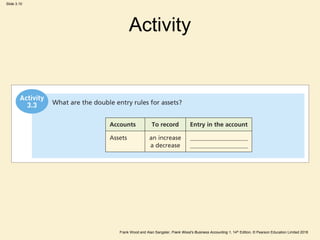
Activity
Frank Wood and Alan Sangster, Frank Wood’s Business Accounting 1, 14th Edition, © Pearson Education Limited 2018
Slide 3.11
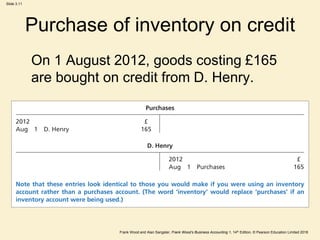
Purchase of inventory on credit
On 1 August 2012, goods costing £165
are bought on credit from D. Henry.
Frank Wood and Alan Sangster, Frank Wood’s Business Accounting 1, 14th Edition, © Pearson Education Limited 2018
Slide 3.12
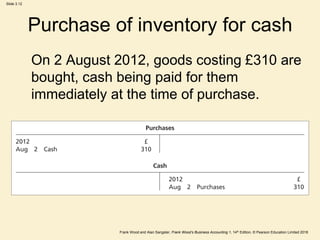
Purchase of inventory for cash
On 2 August 2012, goods costing £310 are
bought, cash being paid for them
immediately at the time of purchase.
Frank Wood and Alan Sangster, Frank Wood’s Business Accounting 1, 14th Edition, © Pearson Education Limited 2018
Slide 3.13
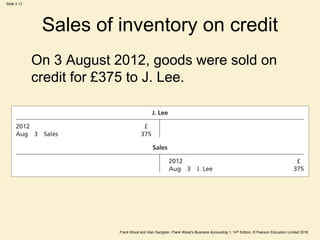
Sales of inventory on credit
On 3 August 2012, goods were sold on
credit for £375 to J. Lee.
Frank Wood and Alan Sangster, Frank Wood’s Business Accounting 1, 14th Edition, © Pearson Education Limited 2018
Slide 3.14
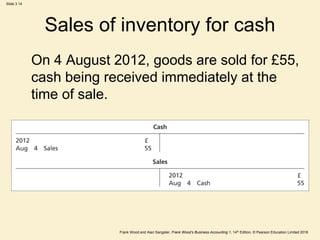
Sales of inventory for cash
On 4 August 2012, goods are sold for £55,
cash being received immediately at the
time of sale.
Frank Wood and Alan Sangster, Frank Wood’s Business Accounting 1, 14th Edition, © Pearson Education Limited 2018
Slide 3.15
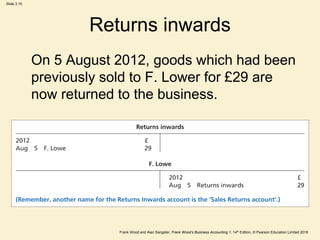
Returns inwards
On 5 August 2012, goods which had been
previously sold to F. Lower for £29 are
now returned to the business.
Frank Wood and Alan Sangster, Frank Wood’s Business Accounting 1, 14th Edition, © Pearson Education Limited 2018
Slide 3.16
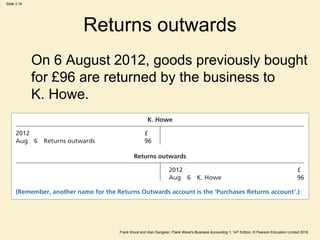
Returns outwards
On 6 August 2012, goods previously bought
for £96 are returned by the business to
K. Howe.
Frank Wood and Alan Sangster, Frank Wood’s Business Accounting 1, 14th Edition, © Pearson Education Limited 2018
Slide 3.17
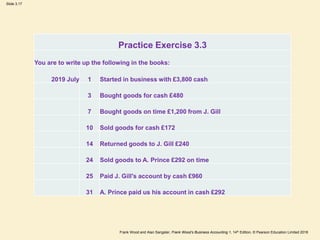
Practice Exercise 3.3
You are to write up the following in the books:
2019 July 1 Started in business with £3,800 cash
3 Bought goods for cash £480
7 Bought goods on time £1,200 from J. Gill
10 Sold goods for cash £172
14 Returned goods to J. Gill £240
24 Sold goods to A. Prince £292 on time
25 Paid J. Gill's account by cash £960
31 A. Prince paid us his account in cash £292
Frank Wood and Alan Sangster, Frank Wood’s Business Accounting 1, 14th Edition, © Pearson Education Limited 2018
Slide 3.18
Special meaning of ‘sales’ and ‘purchases’
 Both ‘sales’ and ‘purchases’ have a
special meaning in accounting.
 Purchases means the purchase of those
goods which the business buys with the
sole intention of selling.
 Sales means the sale of those goods in
which the business normally deals and
which were bought with the prime intention
of resale.
Frank Wood and Alan Sangster, Frank Wood’s Business Accounting 1, 14th Edition, © Pearson Education Limited 2018
Slide 3.19
Learning outcomes
You should have now learnt:
 That it is not appropriate to use an
inventory account to record increases and
decreases in inventory because inventory
is normally sold at a price greater than its
cost.
 That inventory increases either because
some inventory has been purchases or
because the inventory that was sold has
been returned by the buyer.
Frank Wood and Alan Sangster, Frank Wood’s Business Accounting 1, 14th Edition, © Pearson Education Limited 2018
Slide 3.20
Learning outcomes (Continued)
 That inventory decreases either because
some inventory has been sold or because
inventory previously purchased has been
returned to the supplier.
 That a purchase account is used to record
purchases of inventory (as debit entries in
the account) and that a return inwards
account is used to record inventory
returned by customers (as debit entries in
the account).
Frank Wood and Alan Sangster, Frank Wood’s Business Accounting 1, 14th Edition, © Pearson Education Limited 2018
Slide 3.21
Learning outcomes (Continued)
 That a sales account is used to record
sales of inventory (as credit entries in the
account) and that a return outwards
account is used to record inventory
returned to suppliers (as credit entries in
the account).
Frank Wood and Alan Sangster, Frank Wood’s Business Accounting 1, 14th Edition, © Pearson Education Limited 2018
Slide 3.22
Learning outcomes (Continued)
 That in accounting, the term ‘purchases’
refers to purchases of inventory. Acquisitions
of any other assets, such as vans, equipment
and buildings, are never described as
purchases.
 That in accounting, the term ‘sales’ refers to
sales of inventory. Disposals of any other
assets, such as vans, equipment and
buildings, are never described as sales.
 That purchases for cash are never entered in
the supplier’s account.
Frank Wood and Alan Sangster, Frank Wood’s Business Accounting 1, 14th Edition, © Pearson Education Limited 2018
Slide 3.23
Learning outcomes (Continued)
 That purchases on credit are always
entered in the supplier’s (creditor’s)
account.
 That sales for cash are never entered in
the customer’s account.
 That sales on credit are always entered in
the customer’s (debtor’s) account.

Chap03_Recording inventory.pptx

  • 1.
    Frank Wood andAlan Sangster, Frank Wood’s Business Accounting 1, 14th Edition, © Pearson Education Limited 2018 Slide 3.1 Chapter 3 Recording inventory Frank Wood’s Business Accounting 1
  • 2.
    Frank Wood andAlan Sangster, Frank Wood’s Business Accounting 1, 14th Edition, © Pearson Education Limited 2018 Slide 3.2 Learning objectives After finishing this chapter, you will be able to:  Explain why it is inappropriate to use an inventory account to record increases and decreases in inventory;  Describe the two causes of inventory increasing;  Describe the two causes of inventory decreasing;
  • 3.
    Frank Wood andAlan Sangster, Frank Wood’s Business Accounting 1, 14th Edition, © Pearson Education Limited 2018 Slide 3.3 Learning objectives (Continued)  Explain the difference between a purchase account and a return inwards account;  Explain the difference between a sales account and a return outwards account;  Explain the meanings of the terms ‘purchases’ and ‘sales’ as used in accounting;
  • 4.
    Frank Wood andAlan Sangster, Frank Wood’s Business Accounting 1, 14th Edition, © Pearson Education Limited 2018 Slide 3.4 Learning objectives (Continued)  Explain the differences in recording purchases on credit as compared to recording purchases that are paid for immediately in cash;  Explain the differences in recording sales on credit as compared to recording sales that are paid for immediately in cash.
  • 5.
    Frank Wood andAlan Sangster, Frank Wood’s Business Accounting 1, 14th Edition, © Pearson Education Limited 2018 Slide 3.5 Inventory Normally, goods and services are sold above cost price, the difference being profit. When goods and services are sold for less than their cost, the difference is a loss.
  • 6.
    Frank Wood andAlan Sangster, Frank Wood’s Business Accounting 1, 14th Edition, © Pearson Education Limited 2018 Slide 3.6 An increase in inventory An increase in inventory can be due to one of two causes:  The purchase of additional goods.  The return in to the business of goods previously sold.
  • 7.
    Frank Wood andAlan Sangster, Frank Wood’s Business Accounting 1, 14th Edition, © Pearson Education Limited 2018 Slide 3.7 An increase in inventory (Continued) To distinguish the two aspects of the increase of inventory, two accounts are opened:  A purchases account, in which purchases of goods are entered.  A return inwards account, in which goods being returned into the business are entered.
  • 8.
    Frank Wood andAlan Sangster, Frank Wood’s Business Accounting 1, 14th Edition, © Pearson Education Limited 2018 Slide 3.8 A decrease in inventory A decrease in inventory can be due to one of two causes:  The sale of goods.  Goods previously bought by the business now being returned to the supplier.
  • 9.
    Frank Wood andAlan Sangster, Frank Wood’s Business Accounting 1, 14th Edition, © Pearson Education Limited 2018 Slide 3.9 A decrease in inventory (Continued) To distinguish the two aspects of the decrease of inventory, two accounts are opened:  A sales account, in which sales of goods are entered.  A return outwards account, in which goods being returned out to a supplier are entered.
  • 10.
    Frank Wood andAlan Sangster, Frank Wood’s Business Accounting 1, 14th Edition, © Pearson Education Limited 2018 Slide 3.10 Activity
  • 11.
    Frank Wood andAlan Sangster, Frank Wood’s Business Accounting 1, 14th Edition, © Pearson Education Limited 2018 Slide 3.11 Purchase of inventory on credit On 1 August 2012, goods costing £165 are bought on credit from D. Henry.
  • 12.
    Frank Wood andAlan Sangster, Frank Wood’s Business Accounting 1, 14th Edition, © Pearson Education Limited 2018 Slide 3.12 Purchase of inventory for cash On 2 August 2012, goods costing £310 are bought, cash being paid for them immediately at the time of purchase.
  • 13.
    Frank Wood andAlan Sangster, Frank Wood’s Business Accounting 1, 14th Edition, © Pearson Education Limited 2018 Slide 3.13 Sales of inventory on credit On 3 August 2012, goods were sold on credit for £375 to J. Lee.
  • 14.
    Frank Wood andAlan Sangster, Frank Wood’s Business Accounting 1, 14th Edition, © Pearson Education Limited 2018 Slide 3.14 Sales of inventory for cash On 4 August 2012, goods are sold for £55, cash being received immediately at the time of sale.
  • 15.
    Frank Wood andAlan Sangster, Frank Wood’s Business Accounting 1, 14th Edition, © Pearson Education Limited 2018 Slide 3.15 Returns inwards On 5 August 2012, goods which had been previously sold to F. Lower for £29 are now returned to the business.
  • 16.
    Frank Wood andAlan Sangster, Frank Wood’s Business Accounting 1, 14th Edition, © Pearson Education Limited 2018 Slide 3.16 Returns outwards On 6 August 2012, goods previously bought for £96 are returned by the business to K. Howe.
  • 17.
    Frank Wood andAlan Sangster, Frank Wood’s Business Accounting 1, 14th Edition, © Pearson Education Limited 2018 Slide 3.17 Practice Exercise 3.3 You are to write up the following in the books: 2019 July 1 Started in business with £3,800 cash 3 Bought goods for cash £480 7 Bought goods on time £1,200 from J. Gill 10 Sold goods for cash £172 14 Returned goods to J. Gill £240 24 Sold goods to A. Prince £292 on time 25 Paid J. Gill's account by cash £960 31 A. Prince paid us his account in cash £292
  • 18.
    Frank Wood andAlan Sangster, Frank Wood’s Business Accounting 1, 14th Edition, © Pearson Education Limited 2018 Slide 3.18 Special meaning of ‘sales’ and ‘purchases’  Both ‘sales’ and ‘purchases’ have a special meaning in accounting.  Purchases means the purchase of those goods which the business buys with the sole intention of selling.  Sales means the sale of those goods in which the business normally deals and which were bought with the prime intention of resale.
  • 19.
    Frank Wood andAlan Sangster, Frank Wood’s Business Accounting 1, 14th Edition, © Pearson Education Limited 2018 Slide 3.19 Learning outcomes You should have now learnt:  That it is not appropriate to use an inventory account to record increases and decreases in inventory because inventory is normally sold at a price greater than its cost.  That inventory increases either because some inventory has been purchases or because the inventory that was sold has been returned by the buyer.
  • 20.
    Frank Wood andAlan Sangster, Frank Wood’s Business Accounting 1, 14th Edition, © Pearson Education Limited 2018 Slide 3.20 Learning outcomes (Continued)  That inventory decreases either because some inventory has been sold or because inventory previously purchased has been returned to the supplier.  That a purchase account is used to record purchases of inventory (as debit entries in the account) and that a return inwards account is used to record inventory returned by customers (as debit entries in the account).
  • 21.
    Frank Wood andAlan Sangster, Frank Wood’s Business Accounting 1, 14th Edition, © Pearson Education Limited 2018 Slide 3.21 Learning outcomes (Continued)  That a sales account is used to record sales of inventory (as credit entries in the account) and that a return outwards account is used to record inventory returned to suppliers (as credit entries in the account).
  • 22.
    Frank Wood andAlan Sangster, Frank Wood’s Business Accounting 1, 14th Edition, © Pearson Education Limited 2018 Slide 3.22 Learning outcomes (Continued)  That in accounting, the term ‘purchases’ refers to purchases of inventory. Acquisitions of any other assets, such as vans, equipment and buildings, are never described as purchases.  That in accounting, the term ‘sales’ refers to sales of inventory. Disposals of any other assets, such as vans, equipment and buildings, are never described as sales.  That purchases for cash are never entered in the supplier’s account.
  • 23.
    Frank Wood andAlan Sangster, Frank Wood’s Business Accounting 1, 14th Edition, © Pearson Education Limited 2018 Slide 3.23 Learning outcomes (Continued)  That purchases on credit are always entered in the supplier’s (creditor’s) account.  That sales for cash are never entered in the customer’s account.  That sales on credit are always entered in the customer’s (debtor’s) account.