Banking in Japan
Japanese Main Banking
• Japanese banking characterized by long term
  relationship described as Main Banking.
• Companies in Keiretsu get financing from the bank
  and the bank owns much of the stock of member
  companies.
• Virtually all companies had a main bank which
  closely monitored borrowers for long periods.
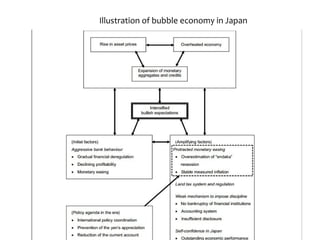
Illustration of bubble economy in Japan
M
  ar


           0.0%
                  1.0%
                         2.0%
                                3.0%
                                       4.0%
                                              5.0%
                                                     6.0%
                                                            7.0%
                                                                   8.0%
                                                                          9.0%
                                                                                 10.0%
    -9
       8
 Ju
   l-9
No 8
   v-
     9
M 8
  ar
    -9
       9
 Ju
   l-9
No 9
   v-
     9
M 9
  ar
    -0
       0
 Ju
   l-0
No 0
   v-
     0
M 0
  ar
    -0
       1
 Ju
   l-0
No 1
   v-
     0
M 1
  ar
    -0
       2
 Ju
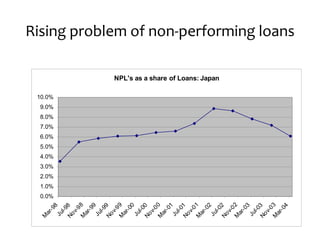
                                                                                         NPL's as a share of Loans: Japan


   l-0
No 2
   v-
     0
M 2
  ar
    -0
       3
 Ju
   l-0
No 3
   v-
     0
M 3
  ar
    -0
       4
                                                                                                                            Rising problem of non-performing loans
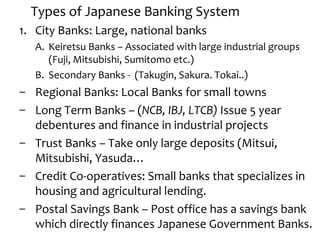
Types of Japanese Banking System
1. City Banks: Large, national banks
   A. Keiretsu Banks – Associated with large industrial groups
      (Fuji, Mitsubishi, Sumitomo etc.)
   B. Secondary Banks - (Takugin, Sakura. Tokai..)
– Regional Banks: Local Banks for small towns
– Long Term Banks – (NCB, IBJ, LTCB) Issue 5 year
  debentures and finance in industrial projects
– Trust Banks – Take only large deposits (Mitsui,
  Mitsubishi, Yasuda…
– Credit Co-operatives: Small banks that specializes in
  housing and agricultural lending.
– Postal Savings Bank – Post office has a savings bank
  which directly finances Japanese Government Banks.
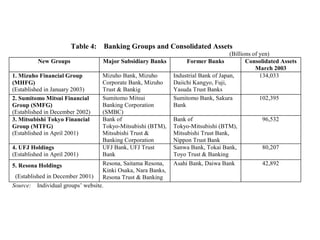
Table 4: Banking Groups and Consolidated Assets
                                                                                    (Billions of yen)
          New Groups              Major Subsidiary Banks          Former Banks             Consolidated Assets
                                                                                               March 2003
1. Mizuho Financial Group         Mizuho Bank, Mizuho        Industrial Bank of Japan,             End
                                                                                                 134,033
                                                                                                     (a)
(MHFG)                            Corporate Bank, Mizuho     Daiichi Kangyo, Fuji,
(Established in January 2003)     Trust & Bankig             Yasuda Trust Banks
2. Sumitomo Mitsui Financial      Sumitomo Mitsui            Sumitomo Bank, Sakura               102,395
Group (SMFG)                      Banking Corporation        Bank
(Established in December 2002)    (SMBC)
3. Mitsubishi Tokyo Financial     Bank of                    Bank of                            96,532
Group (MTFG)                      Tokyo-Mitsubishi (BTM),    Tokyo-Mitsubishi (BTM),
(Established in April 2001)       Mitsubishi Trust &         Mitsubishi Trust Bank,
                                  Banking Corporation        Nippon Trust Bank
4. UFJ Holdings                   UFJ Bank, UFJ Trust        Sanwa Bank, Tokai Bank,            80,207
(Established in April 2001)       Bank                       Toyo Trust & Banking
5. Resona Holdings                Resona, Saitama Resona,    Asahi Bank, Daiwa Bank             42,892
                                  Kinki Osaka, Nara Banks,
 (Established in December 2001)   Resona Trust & Banking
Source: Individual groups’ website.
Public Financial
  Institutions
Development Bank of Japan
 • a Japanese corporation incorporated on 1 October 2008 under the
   Development Bank of Japan Inc. Law

 • According to its corporate philosophy of "applying financial expertise to
   design the future," the new DBJ Mission is "to build customer trust and
   realize an affluent society by problem-solving through creative financial
   activities

 • Based on the New DBJ Law, the Bank will provide integrated
   investment and loan services to domestic and international clients.

 • Total Asset : 14.0174 Trillion Yen (or 153.88 Billion USD)
   Lending Balance : 12.0266 Trillion Yen (or 132.03 Billion USD)
   Capital Ratio (BIS) : 18.69%
   [Exchange Rate: 1 USD vs 91.09 Yen (on 18 September 2008)]
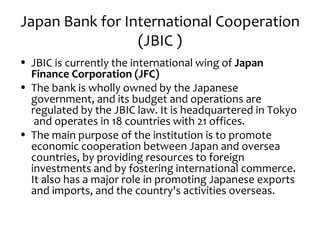
Japan Bank for International Cooperation
                 (JBIC )
• JBIC is currently the international wing of Japan
  Finance Corporation (JFC)
• The bank is wholly owned by the Japanese
  government, and its budget and operations are
  regulated by the JBIC law. It is headquartered in Tokyo
   and operates in 18 countries with 21 offices.
• The main purpose of the institution is to promote
  economic cooperation between Japan and oversea
  countries, by providing resources to foreign
  investments and by fostering international commerce.
  It also has a major role in promoting Japanese exports
  and imports, and the country's activities overseas.
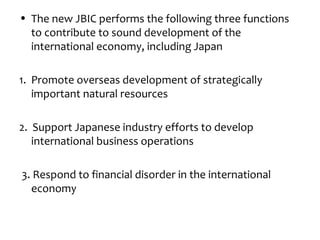
• The new JBIC performs the following three functions
  to contribute to sound development of the
  international economy, including Japan

1. Promote overseas development of strategically
   important natural resources

2. Support Japanese industry efforts to develop
   international business operations

3. Respond to financial disorder in the international
  economy
National Life Finance Corporation

 was a governmental institution of Japan , which
provided business loans to small enterprises that have
difficulty obtaining loans from private financial institutions.

 On October 1, 2008, NLFC was dissolved and merged
into Japan Finance Corporation(JFC)

 Established: June 1, 1949
 Branch Offices: 152
 Capital:(100% funded by the government) ¥369 billion
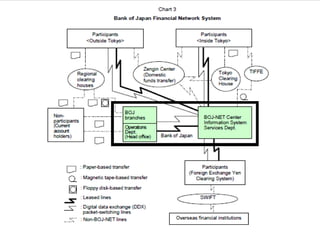
Interbank Payment Systems
There are four major interbank payment systems in
Japan:

1. Bill and cheque clearing systems(BCCSs);

2. The Zengin Data Telecommunication System
(Zengin System);

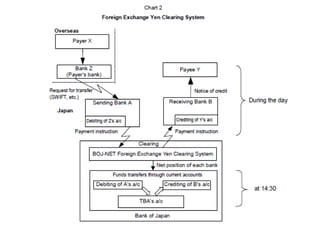
3. The Foreign Exchange Yen Clearing System
(FXYCS); and

4. The BOJ-NET Funds Transfer System
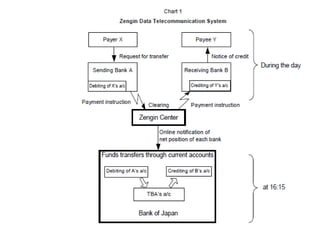
In January 2001, the Zengin System
introduced a set of new risk management
measures to accommodate the Bank of
Japan’s introduction of a new RTGS
system. Under the new scheme, the TBA
acts as the central counterparty (CCP), and
the obligations between participants are
replaced with those between participants
and the TBA.
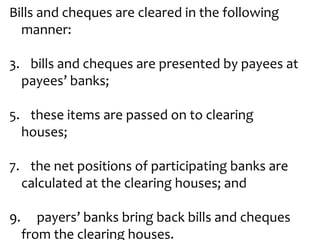
Bills and cheques are cleared in the following
  manner:

3. bills and cheques are presented by payees at
  payees’ banks;

5. these items are passed on to clearing
  houses;

7. the net positions of participating banks are
  calculated at the clearing houses; and

9.      payers’ banks bring back bills and cheques
     from the clearing houses.
The first clearing house in Japan was set up in
Osaka in 1879; the Tokyo Clearing House was
established in 1887. As of December 2001, there
were 540 bill and cheque clearing houses
throughout Japan, of which 173 were designated by
the Minister of Justice.


According to the Bill Law and the Cheque
Law, presentation of bills and cheques at
designated clearing houses is deemed a
means of presentation for payment.
In 2001, the average value per transaction for bills and
 cheques cleared by the Tokyo Clearing House was JPY
 9 million (USD 74,000), for the Zengin System JPY 2
 million (USD 16,000), for the FXYCS JPY 720 million
 (USD 6 million) and for the BOJ-NET Funds Transfer
 System JPY 3.8 billion (USD 31 million).


As of December 2001, 421 institutions
participated in the Tokyo Clearing House, of
which 121 were direct participants
BALANCE SHEET FEATURES
   AND PERFORMANCE
•The balance sheet and performance features
of the Japanese banking system have been
severely affected by the recession in the
economy as well as the financial sector crises
that occured in 1997and 1998.
• In 1995 when both Japanese monetory and fiscal
  policy turned expansionary. Despite the initially low
  levels of interest rates stock prices rise by fifty
  percent, the decline of land prices decelerated the
  general price level stopped falling and the yen
  depreciated.The result was an economic recovery
  with a growth in real GdP of over 3 percent in 1996.
   The Japanese experience in the 1995-97
  period suggest that macroeconomic policies
  by themselves will not do enough to restore
  balance sheets.
• In 1997 tax increase which was implemented
  to restore fiscal balance .Currency economic
  projection from organizations forecast real
  gdp as declining in 1998,with only moderate
  growth in 1999.
• The most important factor influencing
  Japanese bank performance has been their
  enormous levels of bad loans.According to
  official figures from Japan’s Financial
  Services Agency,the cumulative amount of
  loses by way of bad debts for all Japanese
  banks amounted to 100000billion yen in
  2005.In fact around 8.8 per cent of total
  loans were considered non-performing by
  2003 although this had fallen to 5.5 per cent
  by September 2004.
• Major Japanese banks’ capital ratios stiil remain
  below international standarts, although capital
  positions have improved slightly over 2004/05 and
  the large regional banks have higher capital ratios
  compared to their city banks competitors.

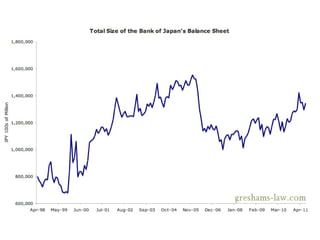
• After the fall of 2008 the Bank of Japan introduced
  new-funds supplying operations and expanded
  them,while continuing to provide substantial funds
  through existing operations.These developments
  were reflected in the Bank’s balance sheet.With
  the implementation of various measures,the
  balance sheet expanded through the end of fiscal
  2008.
Banking Crisis in Japan
Three facts about Japan’s
           banking crisis
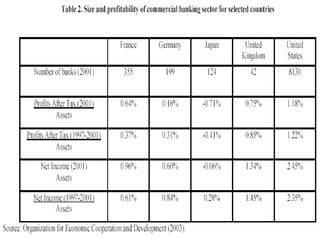
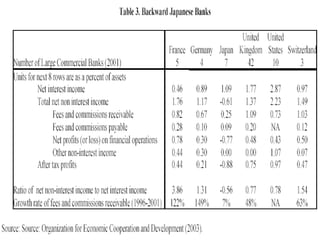
• Japanese banks remain the largest in the
  world.

• Japanese banks are amongst the least
  profitable in the world.

• It is not clear how or why the situation will
  improve.
Problems confronting Japanese
             banks
The banking problems are defined to be
over once the banks :

    Are well capitalized

    Stop ever-greening non-performing loans

    Are earning rate of return comparable to
    their global competitors
Regulations of Japan Banking
Who is the regulator?
• The banking regulator in Japan is the
  Financial Services Agency (FSA), which also
  regulates securities, insurance and other
  financial service industries.
• The Bank of Japan (BOJ) is the central bank
  and the lender of the last resort.
• The BOJ is not a regulator but its objectives
  include “contributing to the maintenance of
  an orderly financial system”.
Establishment of Financial Services Agency
                    (FSA)


• The time was then more than ripe for a
  major overhaul and strengthening of
  the regulatory structure, and the
  regulatory power was placed with the
  newly established FSA.
FSA and the financial crisis
• The deflation of the late 1990s through the
  early 2000s added to the problem because
  the value of collateral real estate kept
  falling.
• The deflationary economic environment
  made the situation even worse.
• It is only natural that the crisis Japan
  experienced in the late 1990s and early
  2000s was very Japanese in its nature, its
  cause and the way in which it was overcome.
Financial Regulation After The
             Crisis
• The blanket guarantee of deposits was
  removed in 2002 and 2005 in two steps.
• A majority of the capital injected into
  the major banks has been collected.
• A large regional bank with more than 4
  trillion yen of deposits that was
  nationalized in 2003, was
  denationalized this year.
BANK OF JAPAN
           (NIPPON GINKO)
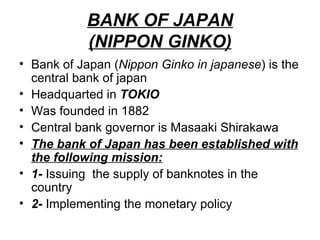
• Bank of Japan (Nippon Ginko in japanese) is the
  central bank of japan
• Headquarted in TOKIO
• Was founded in 1882
• Central bank governor is Masaaki Shirakawa
• The bank of Japan has been established with
  the following mission:
• 1- Issuing the supply of banknotes in the
  country
• 2- Implementing the monetary policy
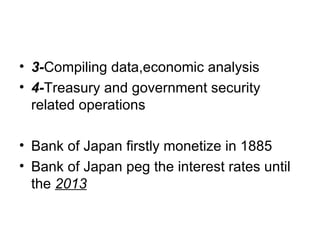
• 3-Compiling data,economic analysis
• 4-Treasury and government security
  related operations

• Bank of Japan firstly monetize in 1885
• Bank of Japan peg the interest rates until
  the 2013
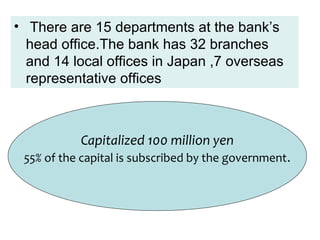
• There are 15 departments at the bank’s
  head office.The bank has 32 branches
  and 14 local offices in Japan ,7 overseas
  representative offices


           Capitalized 100 million yen
 55% of the capital is subscribed by the government.
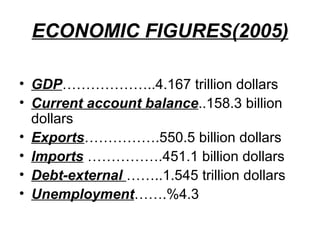
ECONOMIC FIGURES(2005)

• GDP………………..4.167 trillion dollars
• Current account balance..158.3 billion
  dollars
• Exports…………….550.5 billion dollars
• Imports …………….451.1 billion dollars
• Debt-external ……..1.545 trillion dollars
• Unemployment…….%4.3
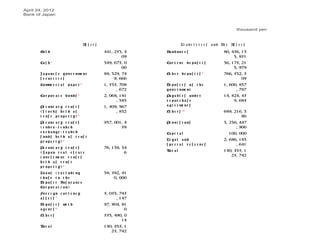
April 24, 2012
Bank of Japan


                                                                                                                   thousand yen


                                       As s e t s                             Li a b i l i t i e s   a nd N t
                                                                                                           e     A s ets
                                                                                                                  s
       Go l d                                       441 , 253, 4   B n k no t e s
                                                                    a                                      80, 456, 1 3
                                                             09                                                 3, 851
       Ca s h 1                                     349, 675, 0    Cu r r e n t    de pos i t s            36, 1 75, 21
                                                            00                                                   3, 979
       J a p a ne s e g o v e r n me n t            89, 329, 74    O he r de pos i t s
                                                                    t                         9
                                                                                                           766, 532, 5
       s e c ur i t i e s                                9, 666                                                    09
       Co mme r c i a l    pape r 2                 1 , 535, 708   De p o s i t s o f     t he             1 , 600, 837
                                                           , 672   g o v e r n me nt                              , 787
       Co r p o r a t e b o nd s   3
                                                    2, 068, 1 81   Pa y a b l e s u n d e r                1 4, 824, 45
                                                          , 383    r e pur c ha s e                              9, 684
       Pe c u ni a r y t r us t s                   1 , 409, 967   a g r e e me n t s
       ( s t oc ks he l d a s                              , 832   O he r s
                                                                    t         10
                                                                                                           689, 21 6, 3
       t r us t pr op e r t y) 4                                                                                    86
       Pe c u ni a r y t r us t s                   937, 001 , 4   Pr o v i s i o ns                       3, 236, 447
       ( i nd e x - l i nke d                                58                                                  , 900
       e x c ha nge - t r a de d                                   Ca p i t a l                                 1 00, 000
       f u n d s h e l d a s t r us t
                                                                   Le g a l a n d                          2, 686, 1 83
       pr ope r t y) 5
                                                                   s pe c i a l r e s e r ve s                   , 641
       Pe c u ni a r y t r us t s                   76, 1 38, 34
       ( J a pan r e a l e s t a t e                           6   To t a l                                1 40, 435, 1
       i n v e s t me nt t r u s t s                                                                           25, 742
       h e l d a s t r us t
       pr ope r t y) 6
       Lo a n s ( e x c l u d i n g                 38, 582, 41
       t hos e t o t he                                  0, 000
       De p o s i t In s u r a nc e
       Co r p o r a t i o n )
       Fo r e i g n c u r r e n c y                 5, 053, 745
       as s e t s 7                                       , 1 47
       De p o s i t s   wi t h                      97, 804, 81
       a ge nt s 8                                            0
       O he r s
        t                                           553, 490, 0
                                                            14
       To t a l                                     1 40, 435, 1
                                                        25, 742
appreciate for your attention
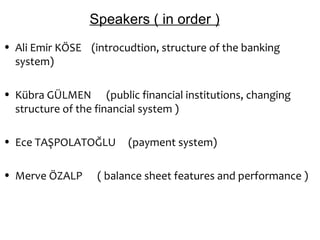
Speakers ( in order )
• Ali Emir KÖSE (introcudtion, structure of the banking
  system)

• Kübra GÜLMEN (public financial institutions, changing
  structure of the financial system )

• Ece TAŞPOLATOĞLU      (payment system)

• Merve ÖZALP     ( balance sheet features and performance )
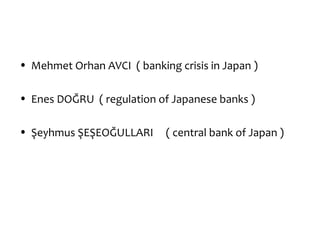
• Mehmet Orhan AVCI ( banking crisis in Japan )

• Enes DOĞRU ( regulation of Japanese banks )

• Şeyhmus ŞEŞEOĞULLARI      ( central bank of Japan )
Sources
•   http://en.wikipedia.org/wiki/Main_Page
•   http://www.boj.or.jp/en/
•   http://www.zenginkyo.or.jp/en/
•   http://www.ft.com/cms/s/0/502a2ad4-d2ce-11de-
    af63-00144feabdc0.html#axzz1uUWd4Pq9
•   http://www.bis.org/publ/bppdf/bispap06.htm
•   http://www.shinkin-central-bank.jp/index_e.html
•   http://en.wikipedia.org/wiki/List_of_banks_in_Japan
•   http://www.jp-bank.japanpost.jp/en_index.html
•   http://en.wikipedia.org/wiki/Bank_of_Japan
•   http://www2.lse.ac.uk/fmg/documents/specialPapers/2002/sp139.pd
    f
•   http://www.eaber.org/sites/default/files/documents/PRI_Fujiwara_20
    06.pdf
•   http://www.mizuho-sc.com/english/ebond/institutions/chart.html
• http://www.irma-international.org/viewtitle/54704/
• http://www.bis.org/cpss/paysys/JapanComp.pdf

• + Course book

Banking in Japan ( final edit)

  • 1.
  • 2.
    Japanese Main Banking •Japanese banking characterized by long term relationship described as Main Banking. • Companies in Keiretsu get financing from the bank and the bank owns much of the stock of member companies. • Virtually all companies had a main bank which closely monitored borrowers for long periods.
  • 3.
    Illustration of bubbleeconomy in Japan
  • 4.
    M ar 0.0% 1.0% 2.0% 3.0% 4.0% 5.0% 6.0% 7.0% 8.0% 9.0% 10.0% -9 8 Ju l-9 No 8 v- 9 M 8 ar -9 9 Ju l-9 No 9 v- 9 M 9 ar -0 0 Ju l-0 No 0 v- 0 M 0 ar -0 1 Ju l-0 No 1 v- 0 M 1 ar -0 2 Ju NPL's as a share of Loans: Japan l-0 No 2 v- 0 M 2 ar -0 3 Ju l-0 No 3 v- 0 M 3 ar -0 4 Rising problem of non-performing loans
  • 5.
    Types of JapaneseBanking System 1. City Banks: Large, national banks A. Keiretsu Banks – Associated with large industrial groups (Fuji, Mitsubishi, Sumitomo etc.) B. Secondary Banks - (Takugin, Sakura. Tokai..) – Regional Banks: Local Banks for small towns – Long Term Banks – (NCB, IBJ, LTCB) Issue 5 year debentures and finance in industrial projects – Trust Banks – Take only large deposits (Mitsui, Mitsubishi, Yasuda… – Credit Co-operatives: Small banks that specializes in housing and agricultural lending. – Postal Savings Bank – Post office has a savings bank which directly finances Japanese Government Banks.
  • 6.
    Table 4: BankingGroups and Consolidated Assets (Billions of yen) New Groups Major Subsidiary Banks Former Banks Consolidated Assets March 2003 1. Mizuho Financial Group Mizuho Bank, Mizuho Industrial Bank of Japan, End 134,033 (a) (MHFG) Corporate Bank, Mizuho Daiichi Kangyo, Fuji, (Established in January 2003) Trust & Bankig Yasuda Trust Banks 2. Sumitomo Mitsui Financial Sumitomo Mitsui Sumitomo Bank, Sakura 102,395 Group (SMFG) Banking Corporation Bank (Established in December 2002) (SMBC) 3. Mitsubishi Tokyo Financial Bank of Bank of 96,532 Group (MTFG) Tokyo-Mitsubishi (BTM), Tokyo-Mitsubishi (BTM), (Established in April 2001) Mitsubishi Trust & Mitsubishi Trust Bank, Banking Corporation Nippon Trust Bank 4. UFJ Holdings UFJ Bank, UFJ Trust Sanwa Bank, Tokai Bank, 80,207 (Established in April 2001) Bank Toyo Trust & Banking 5. Resona Holdings Resona, Saitama Resona, Asahi Bank, Daiwa Bank 42,892 Kinki Osaka, Nara Banks, (Established in December 2001) Resona Trust & Banking Source: Individual groups’ website.
  • 7.
    Public Financial Institutions
  • 8.
    Development Bank ofJapan • a Japanese corporation incorporated on 1 October 2008 under the Development Bank of Japan Inc. Law • According to its corporate philosophy of "applying financial expertise to design the future," the new DBJ Mission is "to build customer trust and realize an affluent society by problem-solving through creative financial activities • Based on the New DBJ Law, the Bank will provide integrated investment and loan services to domestic and international clients. • Total Asset : 14.0174 Trillion Yen (or 153.88 Billion USD) Lending Balance : 12.0266 Trillion Yen (or 132.03 Billion USD) Capital Ratio (BIS) : 18.69% [Exchange Rate: 1 USD vs 91.09 Yen (on 18 September 2008)]
  • 9.
    Japan Bank forInternational Cooperation (JBIC ) • JBIC is currently the international wing of Japan Finance Corporation (JFC) • The bank is wholly owned by the Japanese government, and its budget and operations are regulated by the JBIC law. It is headquartered in Tokyo and operates in 18 countries with 21 offices. • The main purpose of the institution is to promote economic cooperation between Japan and oversea countries, by providing resources to foreign investments and by fostering international commerce. It also has a major role in promoting Japanese exports and imports, and the country's activities overseas.
  • 10.
    • The newJBIC performs the following three functions to contribute to sound development of the international economy, including Japan 1. Promote overseas development of strategically important natural resources 2. Support Japanese industry efforts to develop international business operations 3. Respond to financial disorder in the international economy
  • 11.
    National Life FinanceCorporation  was a governmental institution of Japan , which provided business loans to small enterprises that have difficulty obtaining loans from private financial institutions.  On October 1, 2008, NLFC was dissolved and merged into Japan Finance Corporation(JFC)  Established: June 1, 1949 Branch Offices: 152 Capital:(100% funded by the government) ¥369 billion
  • 12.
  • 13.
    There are fourmajor interbank payment systems in Japan: 1. Bill and cheque clearing systems(BCCSs); 2. The Zengin Data Telecommunication System (Zengin System); 3. The Foreign Exchange Yen Clearing System (FXYCS); and 4. The BOJ-NET Funds Transfer System
  • 14.
    In January 2001,the Zengin System introduced a set of new risk management measures to accommodate the Bank of Japan’s introduction of a new RTGS system. Under the new scheme, the TBA acts as the central counterparty (CCP), and the obligations between participants are replaced with those between participants and the TBA.
  • 16.
    Bills and chequesare cleared in the following manner: 3. bills and cheques are presented by payees at payees’ banks; 5. these items are passed on to clearing houses; 7. the net positions of participating banks are calculated at the clearing houses; and 9. payers’ banks bring back bills and cheques from the clearing houses.
  • 17.
    The first clearinghouse in Japan was set up in Osaka in 1879; the Tokyo Clearing House was established in 1887. As of December 2001, there were 540 bill and cheque clearing houses throughout Japan, of which 173 were designated by the Minister of Justice. According to the Bill Law and the Cheque Law, presentation of bills and cheques at designated clearing houses is deemed a means of presentation for payment.
  • 19.
    In 2001, theaverage value per transaction for bills and cheques cleared by the Tokyo Clearing House was JPY 9 million (USD 74,000), for the Zengin System JPY 2 million (USD 16,000), for the FXYCS JPY 720 million (USD 6 million) and for the BOJ-NET Funds Transfer System JPY 3.8 billion (USD 31 million). As of December 2001, 421 institutions participated in the Tokyo Clearing House, of which 121 were direct participants
  • 21.
    BALANCE SHEET FEATURES AND PERFORMANCE
  • 23.
    •The balance sheetand performance features of the Japanese banking system have been severely affected by the recession in the economy as well as the financial sector crises that occured in 1997and 1998.
  • 24.
    • In 1995when both Japanese monetory and fiscal policy turned expansionary. Despite the initially low levels of interest rates stock prices rise by fifty percent, the decline of land prices decelerated the general price level stopped falling and the yen depreciated.The result was an economic recovery with a growth in real GdP of over 3 percent in 1996.
  • 25.
    The Japanese experience in the 1995-97 period suggest that macroeconomic policies by themselves will not do enough to restore balance sheets. • In 1997 tax increase which was implemented to restore fiscal balance .Currency economic projection from organizations forecast real gdp as declining in 1998,with only moderate growth in 1999.
  • 26.
    • The mostimportant factor influencing Japanese bank performance has been their enormous levels of bad loans.According to official figures from Japan’s Financial Services Agency,the cumulative amount of loses by way of bad debts for all Japanese banks amounted to 100000billion yen in 2005.In fact around 8.8 per cent of total loans were considered non-performing by 2003 although this had fallen to 5.5 per cent by September 2004.
  • 27.
    • Major Japanesebanks’ capital ratios stiil remain below international standarts, although capital positions have improved slightly over 2004/05 and the large regional banks have higher capital ratios compared to their city banks competitors. • After the fall of 2008 the Bank of Japan introduced new-funds supplying operations and expanded them,while continuing to provide substantial funds through existing operations.These developments were reflected in the Bank’s balance sheet.With the implementation of various measures,the balance sheet expanded through the end of fiscal 2008.
  • 28.
  • 29.
    Three facts aboutJapan’s banking crisis • Japanese banks remain the largest in the world. • Japanese banks are amongst the least profitable in the world. • It is not clear how or why the situation will improve.
  • 30.
    Problems confronting Japanese banks The banking problems are defined to be over once the banks : Are well capitalized Stop ever-greening non-performing loans Are earning rate of return comparable to their global competitors
  • 33.
  • 34.
    Who is theregulator? • The banking regulator in Japan is the Financial Services Agency (FSA), which also regulates securities, insurance and other financial service industries. • The Bank of Japan (BOJ) is the central bank and the lender of the last resort. • The BOJ is not a regulator but its objectives include “contributing to the maintenance of an orderly financial system”.
  • 35.
    Establishment of FinancialServices Agency (FSA) • The time was then more than ripe for a major overhaul and strengthening of the regulatory structure, and the regulatory power was placed with the newly established FSA.
  • 36.
    FSA and thefinancial crisis • The deflation of the late 1990s through the early 2000s added to the problem because the value of collateral real estate kept falling. • The deflationary economic environment made the situation even worse. • It is only natural that the crisis Japan experienced in the late 1990s and early 2000s was very Japanese in its nature, its cause and the way in which it was overcome.
  • 37.
    Financial Regulation AfterThe Crisis • The blanket guarantee of deposits was removed in 2002 and 2005 in two steps. • A majority of the capital injected into the major banks has been collected. • A large regional bank with more than 4 trillion yen of deposits that was nationalized in 2003, was denationalized this year.
  • 38.
    BANK OF JAPAN (NIPPON GINKO) • Bank of Japan (Nippon Ginko in japanese) is the central bank of japan • Headquarted in TOKIO • Was founded in 1882 • Central bank governor is Masaaki Shirakawa • The bank of Japan has been established with the following mission: • 1- Issuing the supply of banknotes in the country • 2- Implementing the monetary policy
  • 39.
    • 3-Compiling data,economicanalysis • 4-Treasury and government security related operations • Bank of Japan firstly monetize in 1885 • Bank of Japan peg the interest rates until the 2013
  • 40.
    • There are15 departments at the bank’s head office.The bank has 32 branches and 14 local offices in Japan ,7 overseas representative offices Capitalized 100 million yen 55% of the capital is subscribed by the government.
  • 41.
    ECONOMIC FIGURES(2005) • GDP………………..4.167trillion dollars • Current account balance..158.3 billion dollars • Exports…………….550.5 billion dollars • Imports …………….451.1 billion dollars • Debt-external ……..1.545 trillion dollars • Unemployment…….%4.3
  • 42.
    April 24, 2012 Bankof Japan thousand yen As s e t s Li a b i l i t i e s a nd N t e A s ets s Go l d 441 , 253, 4 B n k no t e s a 80, 456, 1 3 09 3, 851 Ca s h 1 349, 675, 0 Cu r r e n t de pos i t s 36, 1 75, 21 00 3, 979 J a p a ne s e g o v e r n me n t 89, 329, 74 O he r de pos i t s t 9 766, 532, 5 s e c ur i t i e s 9, 666 09 Co mme r c i a l pape r 2 1 , 535, 708 De p o s i t s o f t he 1 , 600, 837 , 672 g o v e r n me nt , 787 Co r p o r a t e b o nd s 3 2, 068, 1 81 Pa y a b l e s u n d e r 1 4, 824, 45 , 383 r e pur c ha s e 9, 684 Pe c u ni a r y t r us t s 1 , 409, 967 a g r e e me n t s ( s t oc ks he l d a s , 832 O he r s t 10 689, 21 6, 3 t r us t pr op e r t y) 4 86 Pe c u ni a r y t r us t s 937, 001 , 4 Pr o v i s i o ns 3, 236, 447 ( i nd e x - l i nke d 58 , 900 e x c ha nge - t r a de d Ca p i t a l 1 00, 000 f u n d s h e l d a s t r us t Le g a l a n d 2, 686, 1 83 pr ope r t y) 5 s pe c i a l r e s e r ve s , 641 Pe c u ni a r y t r us t s 76, 1 38, 34 ( J a pan r e a l e s t a t e 6 To t a l 1 40, 435, 1 i n v e s t me nt t r u s t s 25, 742 h e l d a s t r us t pr ope r t y) 6 Lo a n s ( e x c l u d i n g 38, 582, 41 t hos e t o t he 0, 000 De p o s i t In s u r a nc e Co r p o r a t i o n ) Fo r e i g n c u r r e n c y 5, 053, 745 as s e t s 7 , 1 47 De p o s i t s wi t h 97, 804, 81 a ge nt s 8 0 O he r s t 553, 490, 0 14 To t a l 1 40, 435, 1 25, 742
  • 43.
  • 44.
    Speakers ( inorder ) • Ali Emir KÖSE (introcudtion, structure of the banking system) • Kübra GÜLMEN (public financial institutions, changing structure of the financial system ) • Ece TAŞPOLATOĞLU (payment system) • Merve ÖZALP ( balance sheet features and performance )
  • 45.
    • Mehmet OrhanAVCI ( banking crisis in Japan ) • Enes DOĞRU ( regulation of Japanese banks ) • Şeyhmus ŞEŞEOĞULLARI ( central bank of Japan )
  • 46.
    Sources • http://en.wikipedia.org/wiki/Main_Page • http://www.boj.or.jp/en/ • http://www.zenginkyo.or.jp/en/ • http://www.ft.com/cms/s/0/502a2ad4-d2ce-11de- af63-00144feabdc0.html#axzz1uUWd4Pq9 • http://www.bis.org/publ/bppdf/bispap06.htm • http://www.shinkin-central-bank.jp/index_e.html • http://en.wikipedia.org/wiki/List_of_banks_in_Japan • http://www.jp-bank.japanpost.jp/en_index.html • http://en.wikipedia.org/wiki/Bank_of_Japan • http://www2.lse.ac.uk/fmg/documents/specialPapers/2002/sp139.pd f • http://www.eaber.org/sites/default/files/documents/PRI_Fujiwara_20 06.pdf • http://www.mizuho-sc.com/english/ebond/institutions/chart.html
  • 47.