PRINCIPLES OF ACCOUNTING - I
CHAPTER- 2 (Part 1)
Accounting for a Service organization
(2.1 The Recording Phase)
2.1 THE RECORDING PHASE
2.1.1 Basic Accounting Records
1. Introduction - In chapter one, we were recording effects of business transactions using the
accounting equation format. This, however, is not cost-and time-effective when an organization has
large volume of transactions to process and several asset, liability, capital, revenue and expense
items. As a result, as the volume of transactions grows and the number of specific elements of the
financial statements increases, it will be necessary to design and use systematic way of processing
transactions and generating accounting information. The following sections discuss an improved
system of transforming business transactions into useful accounting information.
2. Basic accounting records - refer to records organizations use in transforming business transactions
into useful accounting information and include Accounts, Ledgers and Journals.
2.1.2 Nature and Classification of Accounts
1. Definition - an account is the basic storage unit for accounting data. It is used to classify transactions
in terms of their effects on specific asset, liability, capital, revenue and expense items. Thus, a
separate account is kept to record and accumulate/store monetary effects of transactions on such
specific items that appear on the financial statements as Cash, Supplies, Accounts Payable, Bank
Loan Payable, Owner’s equity (Capital) , Service revenue (Fees Earned), Rent Income, Salary
Expense and Supplies Expense.
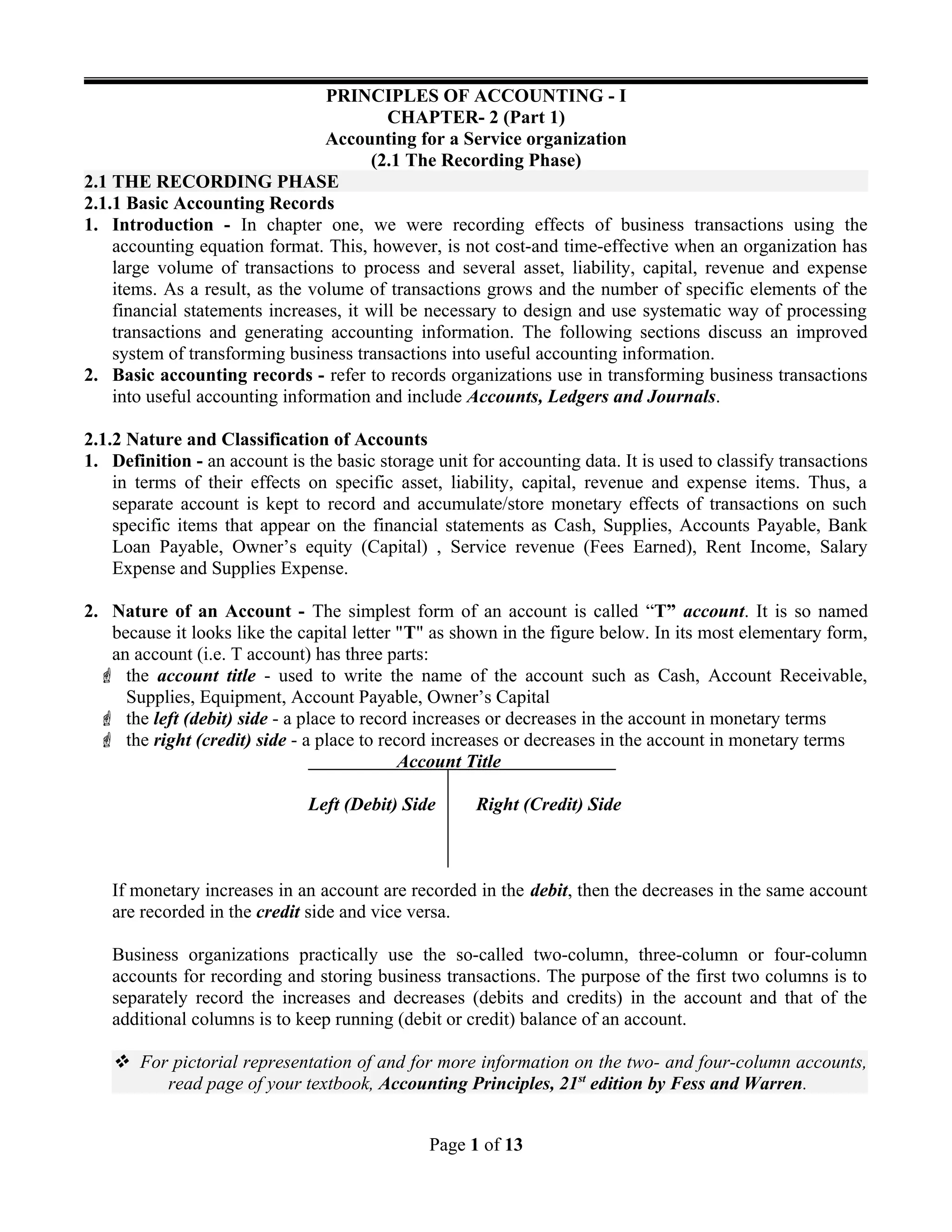
2. Nature of an Account - The simplest form of an account is called “T” account. It is so named
because it looks like the capital letter "T" as shown in the figure below. In its most elementary form,
an account (i.e. T account) has three parts:
 the account title - used to write the name of the account such as Cash, Account Receivable,
Supplies, Equipment, Account Payable, Owner’s Capital
 the left (debit) side - a place to record increases or decreases in the account in monetary terms
 the right (credit) side - a place to record increases or decreases in the account in monetary terms
Account Title
Left (Debit) Side Right (Credit) Side
If monetary increases in an account are recorded in the debit, then the decreases in the same account
are recorded in the credit side and vice versa.
Business organizations practically use the so-called two-column, three-column or four-column
accounts for recording and storing business transactions. The purpose of the first two columns is to
separately record the increases and decreases (debits and credits) in the account and that of the
additional columns is to keep running (debit or credit) balance of an account.
 For pictorial representation of and for more information on the two- and four-column accounts,
read page of your textbook, Accounting Principles, 21st
edition by Fess and Warren.
Page 1 of 13
3. Classification of Accounts - accounts may be classified into two major root categories: Balance
Sheet and Income Statement accounts.
i. Balance sheet accounts - refer to accounts that appear on the balance sheet. They include assets,
liabilities and owner's equity accounts. These accounts (except drawing and income summary
accounts) are also called permanent or real accounts.
They are named as permanent (real) because their balances will not be closed at the end of
each accounting period rather are carried forward from period to period so long as business
activities continue.
a. Assets - include any tangible and intangible items that have monetary value to and owned by a
business. Assets are further divided into current and non-current.
oCurrent assets - include cash and other assets that are expected to be converted into cash, sold or
consumed within a very short period of time usually one year or less.
Examples include:
 Cash - coins and paper money on hand or deposited at bank.
 Accounts Receivable - claims against customers (debtors) for goods and services sold on
credit. They are based on oral promise or good faith rather than supported by written
evidences.
 Notes Receivable - claims against customers supported by written evidences.
 Merchandise Inventory - finished goods held for resale.
 Prepaid Expenses (assets) - include consumable items such as supplies and advance
payments for such items as insurance (Prepaid Insurance) and rent (Prepaid Rent).
oNon-current assets - also called fixed/plant assets refer to assets with the potential to provide
benefit to the business for relatively long period of time, at least more than a year. They
include land, buildings, vehicles, machinery, equipment, patent, furniture, fixtures and long-
term receivables. All non-current assets held for use in operations, except land held for
purposes other than agriculture, lose their usefulness with the passage of time or as a result of
usage. Such decline in usefulness is called depreciation or amortization and is a business
expense identified as Depreciation or Amortization Expense.
b. Liabilities - refer to obligations of a business to pay cash, perform service or deliver goods to its
creditor. Liabilities are further divided into current and non-current.
o Current liabilities - refer to obligations that must be paid/settled within one year or less.
They include Accounts Payable, Notes Payable, Salary Payable, Income/Sales Tax Payable
and Rent Payable.
o Non-current liabilities - also called long-term liabilities refer to obligations that are expected
to be settled over an extended period of time usually more than a year. Examples include
Mortgage Notes Payable and Bonds Payable. A part of a long-term debt, which is due within
a year or less, is reclassified and reported as current liability.
c. Owner’s Equity - refers to residual claim of the owner against the assets of a business. For sole
proprietorship and partnership forms of businesses, owner’s equity accounts include:
o Capital - used to accumulate investments made by the owner/partner and profit earned by the
business but not withdrawn by the owner/partner. Capital account is identified by the name
of the owner/partner and the word capital. E.g. Alemu, Capital.
Page 2 of 13
o Drawing - used to accumulate money or other assets taken out of the business by the
owner/partner for personal consumption. Drawing decreases capital of a business. Like
capital, drawing account is identified by the name of the owner/partner and the word
drawing. E.g. Alemu, Drawing.
o Income Summary - used to summarize effects of revenues and expenses on the capital of
business.
ii. Income statement accounts - refer to accounts that appear on the income statement. They
include revenue and expense accounts. These accounts are used to temporarily accumulate
effects of revenue and expense transactions on capital of a business. These accounts, together
with drawing and income summary accounts, are also called temporary or nominal accounts.
They are so named temporary, because their balances will be closed to zero by the end of an
accounting period thus will not be carried forward from period to period. By the end of the
accounting period, balances of such accounts are summarized and transferred to the capital
account. Thus, these accounts exist for only one accounting period.
a. Revenues - refer to gross increases in owner’s equity as a result of inflows of cash or any other
assets in exchange for inventories sold, services rendered, properties leased, money lend or any
other activity performed by the business to generate income. Revenues include:
o Sales - from sales of inventories
o Fees Earned - from performing services
o Rent/Royalty Income - from letting others use ones own properties such as building and
machinery
o Interest Income - from lending money
b. Expenses - refer to expired cost of goods and services consumed in generating revenues or
carrying out the day-to-day affairs of a business. Expenses include:
o Cost of Goods Sold - expired cost of inventories sold to customers
o Salary/Wages Expense - cost of services received from employees
o Utilities Expenses - cost of utility services consumed, such as telephone, electricity and
water services.
o Depreciation Expense - expired cost of tangible non-current assets as a result of usage or
passage of time.
4. Rules of Debit and Credit - are conventions/principles for recording increases and decreases in an
account. According to these principles
 Increases in an asset account are recorded on the debit side while decreases are recorded on the
credit side.
 Increases in a liability account are recorded on the credit side while decreases are recorded on the
debit side.
 Increases in an owner’s equity account are recorded on the credit side while decreases are
recorded on the debit side.
 For revenues represent increases in owner’s equity, increases in a revenue account are recorded on
the credit side while decreases, if any, are recorded on the debit side.
 For expenses and drawings represent decreases in owner’s equity, increases in expense and
drawing accounts are recorded in the debit side while decreases, if any, are recorded in the credit
side.
Page 3 of 13
5. Normal balance of an Account - Account balance refers to the difference between total increase
and total decrease recorded in an account. Total increase recorded in an account is usually greater
than the total decrease recorded in the same account.
Thus, the usual (normal) balance of an account is positive. This implies that the normal balance of an
asset, an expense or a drawing account is debit while that of a liability, capital or revenue account is
credit. Abnormal balance in an account may arise as a result of:
 Recording errors - for any account
 Bank overdraft (over-drawing bank account) - for cash at bank account
 Over-collection - for receivable accounts
 Overpayment - for payable accounts
 Reversing entries - for revenue and expense accounts
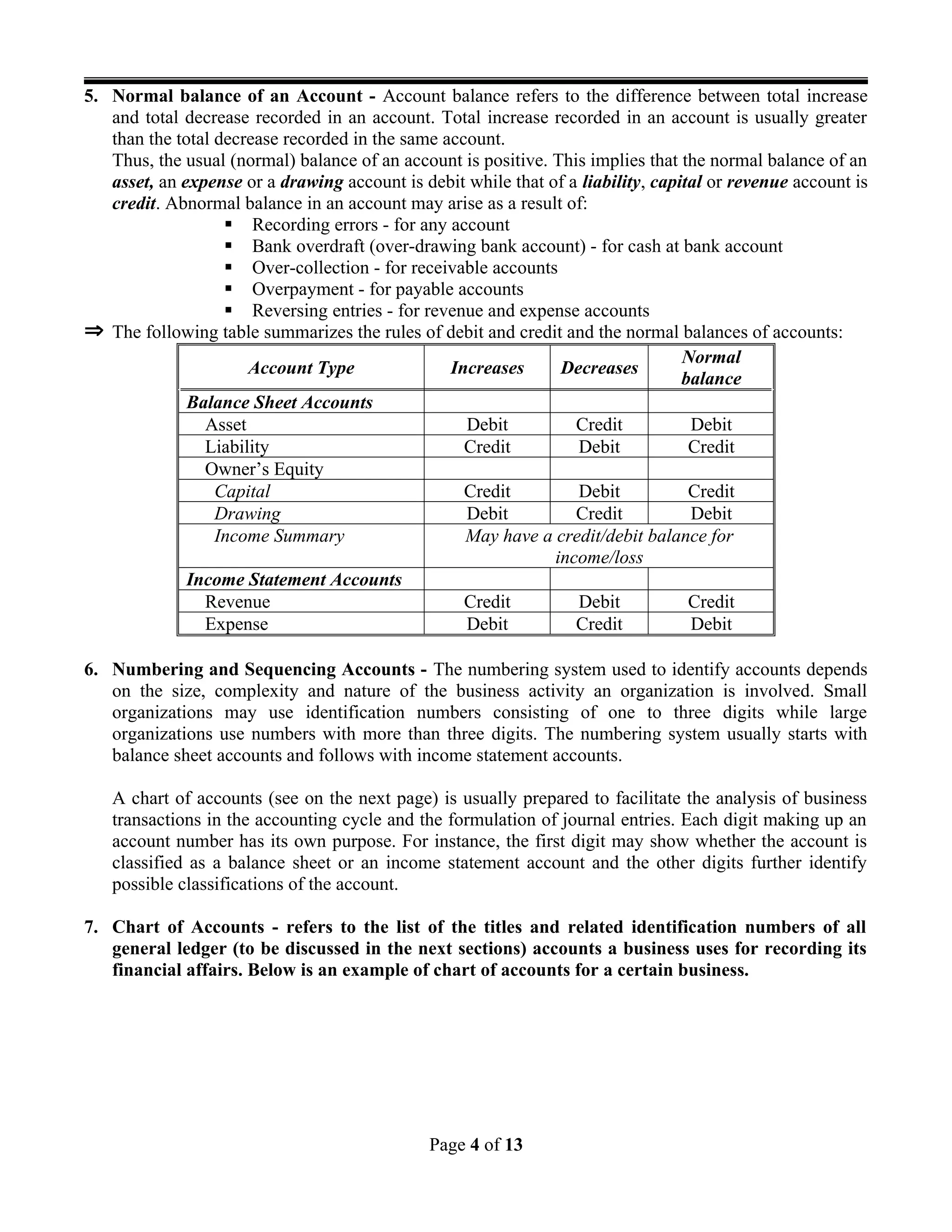
 The following table summarizes the rules of debit and credit and the normal balances of accounts:
Account Type Increases Decreases
Normal
balance
Balance Sheet Accounts
Asset Debit Credit Debit
Liability Credit Debit Credit
Owner’s Equity
Capital Credit Debit Credit
Drawing Debit Credit Debit
Income Summary May have a credit/debit balance for
income/loss
Income Statement Accounts
Revenue Credit Debit Credit
Expense Debit Credit Debit
6. Numbering and Sequencing Accounts - The numbering system used to identify accounts depends
on the size, complexity and nature of the business activity an organization is involved. Small
organizations may use identification numbers consisting of one to three digits while large
organizations use numbers with more than three digits. The numbering system usually starts with
balance sheet accounts and follows with income statement accounts.
A chart of accounts (see on the next page) is usually prepared to facilitate the analysis of business
transactions in the accounting cycle and the formulation of journal entries. Each digit making up an
account number has its own purpose. For instance, the first digit may show whether the account is
classified as a balance sheet or an income statement account and the other digits further identify
possible classifications of the account.
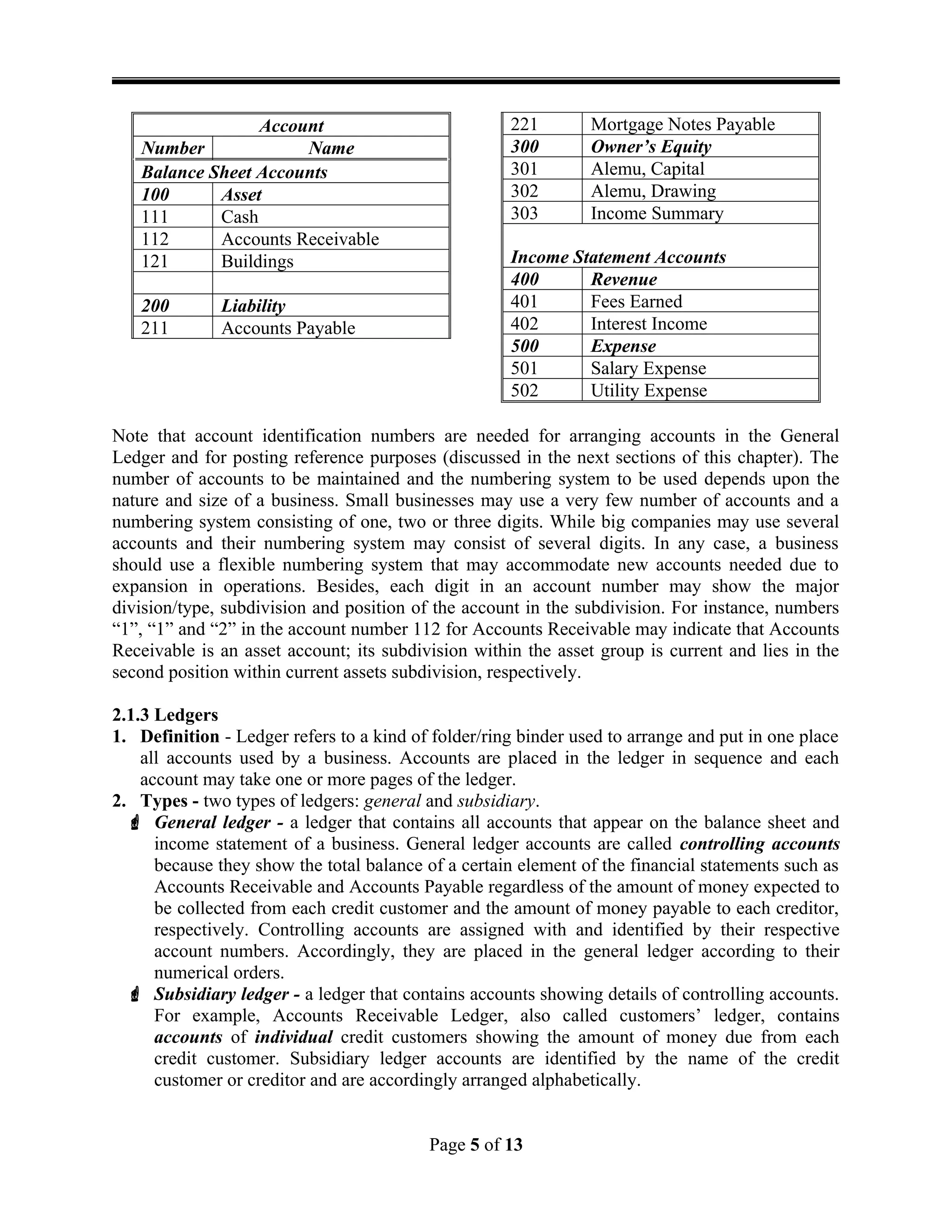
7. Chart of Accounts - refers to the list of the titles and related identification numbers of all
general ledger (to be discussed in the next sections) accounts a business uses for recording its
financial affairs. Below is an example of chart of accounts for a certain business.
Page 4 of 13
Account
Number Name
Balance Sheet Accounts
100 Asset
111 Cash
112 Accounts Receivable
121 Buildings
200 Liability
211 Accounts Payable
221 Mortgage Notes Payable
300 Owner’s Equity
301 Alemu, Capital
302 Alemu, Drawing
303 Income Summary
Income Statement Accounts
400 Revenue
401 Fees Earned
402 Interest Income
500 Expense
501 Salary Expense
502 Utility Expense
Note that account identification numbers are needed for arranging accounts in the General
Ledger and for posting reference purposes (discussed in the next sections of this chapter). The
number of accounts to be maintained and the numbering system to be used depends upon the
nature and size of a business. Small businesses may use a very few number of accounts and a
numbering system consisting of one, two or three digits. While big companies may use several
accounts and their numbering system may consist of several digits. In any case, a business
should use a flexible numbering system that may accommodate new accounts needed due to
expansion in operations. Besides, each digit in an account number may show the major
division/type, subdivision and position of the account in the subdivision. For instance, numbers
“1”, “1” and “2” in the account number 112 for Accounts Receivable may indicate that Accounts
Receivable is an asset account; its subdivision within the asset group is current and lies in the
second position within current assets subdivision, respectively.
2.1.3 Ledgers
1. Definition - Ledger refers to a kind of folder/ring binder used to arrange and put in one place
all accounts used by a business. Accounts are placed in the ledger in sequence and each
account may take one or more pages of the ledger.
2. Types - two types of ledgers: general and subsidiary.
 General ledger - a ledger that contains all accounts that appear on the balance sheet and
income statement of a business. General ledger accounts are called controlling accounts
because they show the total balance of a certain element of the financial statements such as
Accounts Receivable and Accounts Payable regardless of the amount of money expected to
be collected from each credit customer and the amount of money payable to each creditor,
respectively. Controlling accounts are assigned with and identified by their respective
account numbers. Accordingly, they are placed in the general ledger according to their
numerical orders.
 Subsidiary ledger - a ledger that contains accounts showing details of controlling accounts.
For example, Accounts Receivable Ledger, also called customers’ ledger, contains
accounts of individual credit customers showing the amount of money due from each
credit customer. Subsidiary ledger accounts are identified by the name of the credit
customer or creditor and are accordingly arranged alphabetically.
Page 5 of 13
Note that a business may set up both general and subsidiary ledgers not only for Accounts
Receivable and Accounts Payable but also for any account for which the business wants to
have detailed information about.
2.1.4 Journals
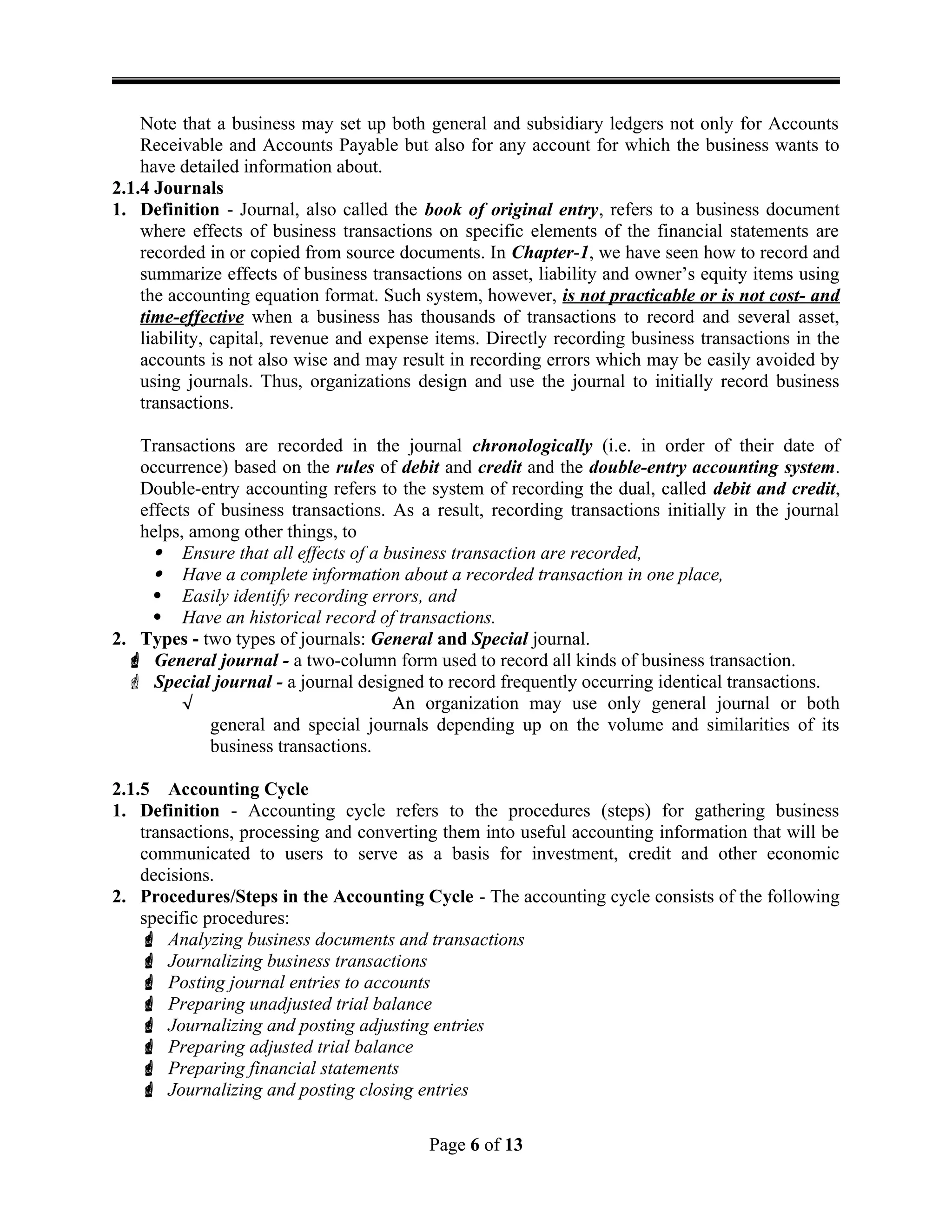
1. Definition - Journal, also called the book of original entry, refers to a business document
where effects of business transactions on specific elements of the financial statements are
recorded in or copied from source documents. In Chapter-1, we have seen how to record and
summarize effects of business transactions on asset, liability and owner’s equity items using
the accounting equation format. Such system, however, is not practicable or is not cost- and
time-effective when a business has thousands of transactions to record and several asset,
liability, capital, revenue and expense items. Directly recording business transactions in the
accounts is not also wise and may result in recording errors which may be easily avoided by
using journals. Thus, organizations design and use the journal to initially record business
transactions.
Transactions are recorded in the journal chronologically (i.e. in order of their date of
occurrence) based on the rules of debit and credit and the double-entry accounting system.
Double-entry accounting refers to the system of recording the dual, called debit and credit,
effects of business transactions. As a result, recording transactions initially in the journal
helps, among other things, to
 Ensure that all effects of a business transaction are recorded,
 Have a complete information about a recorded transaction in one place,
 Easily identify recording errors, and
 Have an historical record of transactions.
2. Types - two types of journals: General and Special journal.
 General journal - a two-column form used to record all kinds of business transaction.
 Special journal - a journal designed to record frequently occurring identical transactions.
 An organization may use only general journal or both
general and special journals depending up on the volume and similarities of its
business transactions.
2.1.5 Accounting Cycle
1. Definition - Accounting cycle refers to the procedures (steps) for gathering business
transactions, processing and converting them into useful accounting information that will be
communicated to users to serve as a basis for investment, credit and other economic
decisions.
2. Procedures/Steps in the Accounting Cycle - The accounting cycle consists of the following
specific procedures:
 Analyzing business documents and transactions
 Journalizing business transactions
 Posting journal entries to accounts
 Preparing unadjusted trial balance
 Journalizing and posting adjusting entries
 Preparing adjusted trial balance
 Preparing financial statements
 Journalizing and posting closing entries
Page 6 of 13
 Preparing post-closing trial balance
 Journalizing and posting reversing entries (optional)
 The aforementioned procedures are discussed in the following major sections:
2.1.6 Journalizing
1. Definition - Journalizing refers to the process of recording business transactions in journals.
2. Steps - The following steps may be carried out to journalize business transactions:
 Collect source documents - Source documents show that a transaction has really occurred
and give complete information about the transaction such as date of the transaction,
parties involved and amount of money, terms of payment, etc.
 Analyze transactions - This involves determining specific accounts affected (cash, fees
earned, etc) by the transaction, classification of the accounts affected (asset, liability, etc),
direction of the effect (increase or decrease), monetary amount of the effect ($400, $100,
etc) and how to record the increase and decrease (debit or credit).
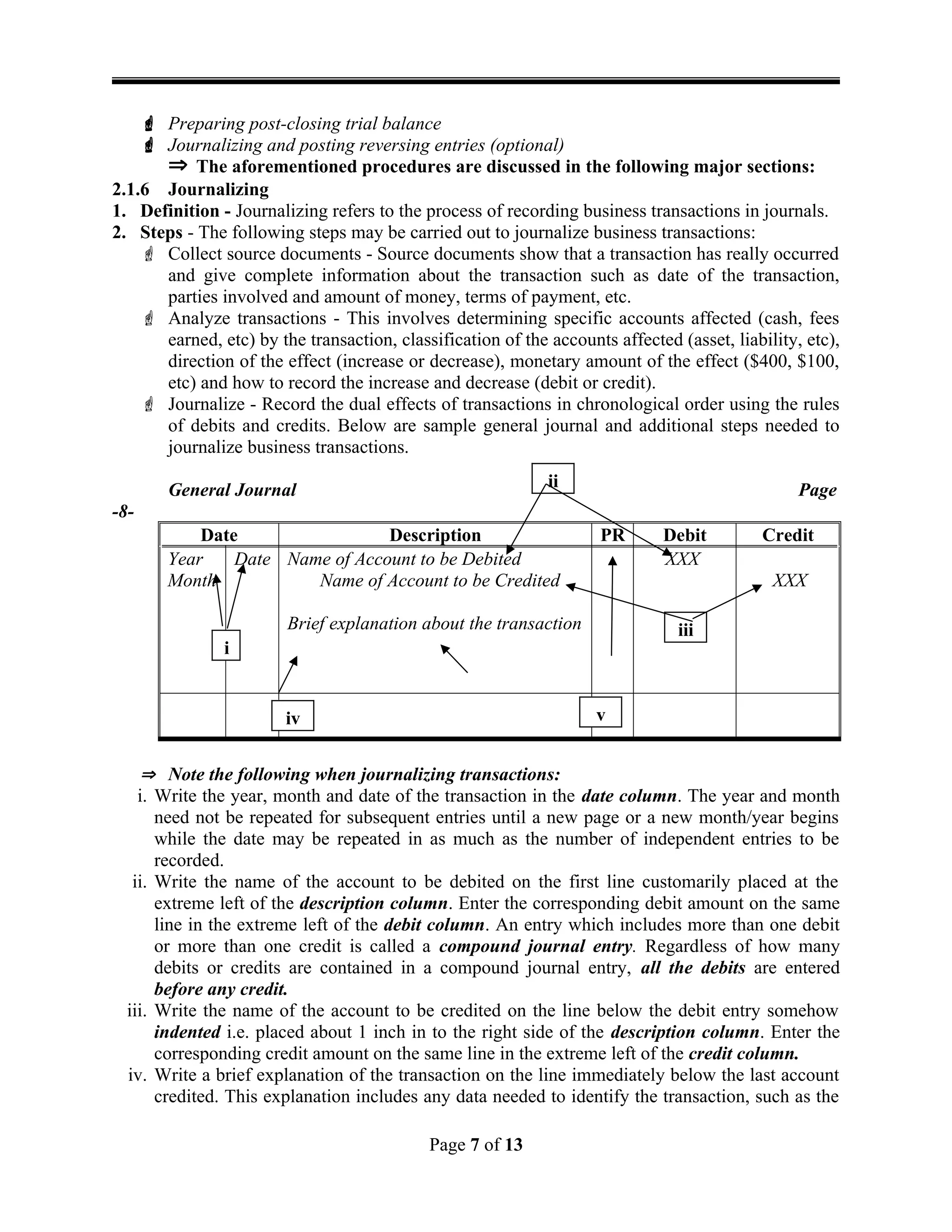
 Journalize - Record the dual effects of transactions in chronological order using the rules
of debits and credits. Below are sample general journal and additional steps needed to
journalize business transactions.
General Journal Page
-8-
Date Description PR Debit Credit
Year
Month
Date Name of Account to be Debited
Name of Account to be Credited
Brief explanation about the transaction
XXX
XXX
 Note the following when journalizing transactions:
i. Write the year, month and date of the transaction in the date column. The year and month
need not be repeated for subsequent entries until a new page or a new month/year begins
while the date may be repeated in as much as the number of independent entries to be
recorded.
ii. Write the name of the account to be debited on the first line customarily placed at the
extreme left of the description column. Enter the corresponding debit amount on the same
line in the extreme left of the debit column. An entry which includes more than one debit
or more than one credit is called a compound journal entry. Regardless of how many
debits or credits are contained in a compound journal entry, all the debits are entered
before any credit.
iii. Write the name of the account to be credited on the line below the debit entry somehow
indented i.e. placed about 1 inch in to the right side of the description column. Enter the
corresponding credit amount on the same line in the extreme left of the credit column.
iv. Write a brief explanation of the transaction on the line immediately below the last account
credited. This explanation includes any data needed to identify the transaction, such as the
Page 7 of 13
i
ii
iii
iv v
name of the customer or supplier. The explanation needs not to be indented.
v. Leave the PR (which stands for posting reference) column blank at the time of making the
journal entry. When the debits and credits are later transferred to accounts in the ledger, the
identification numbers of the accounts which the entries are posted to will be listed in this
column to provide a cross reference with the ledger.
 Whether a transaction results in single or compound entry, equal dollar amounts of
debits and credits should be recorded.
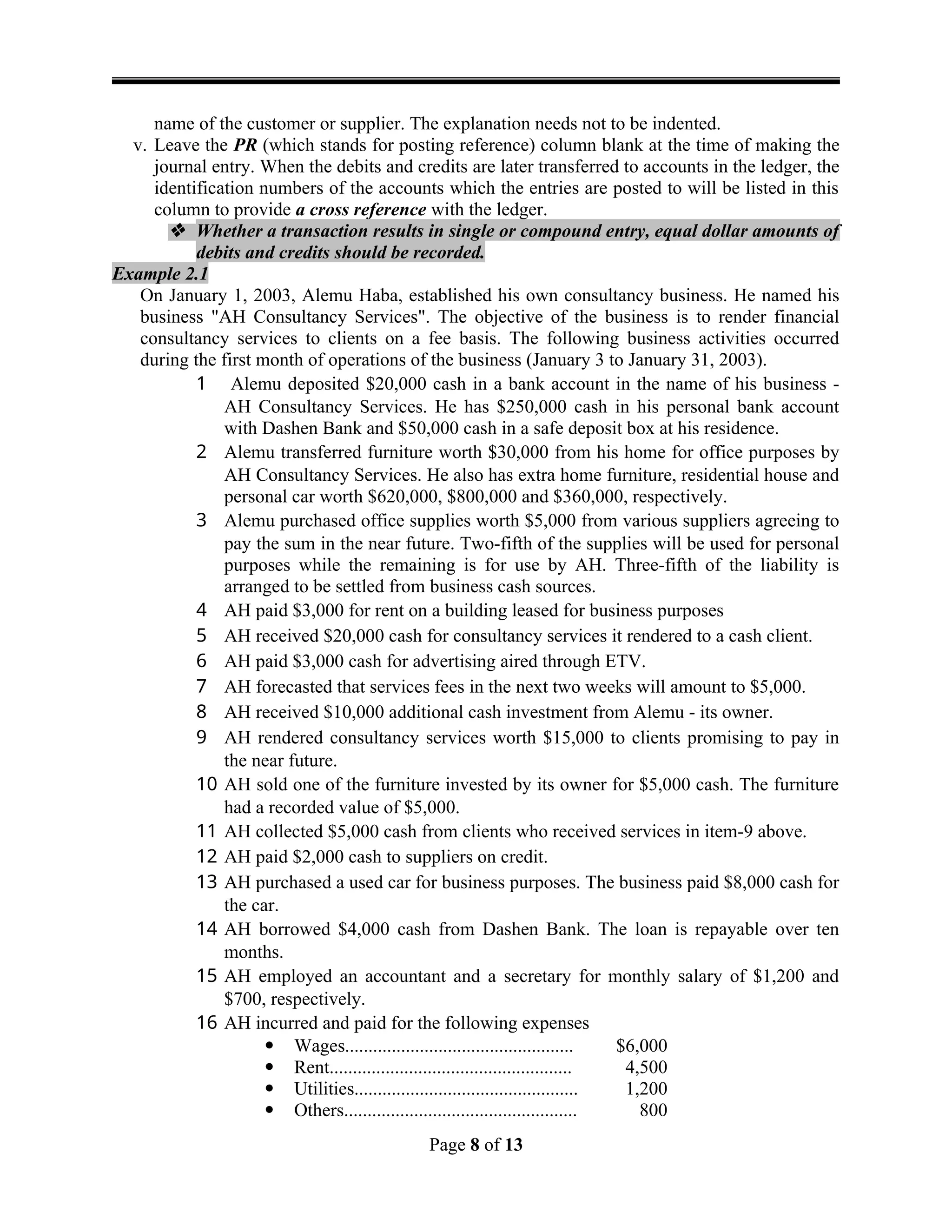
Example 2.1
On January 1, 2003, Alemu Haba, established his own consultancy business. He named his
business "AH Consultancy Services". The objective of the business is to render financial
consultancy services to clients on a fee basis. The following business activities occurred
during the first month of operations of the business (January 3 to January 31, 2003).
1 Alemu deposited $20,000 cash in a bank account in the name of his business -
AH Consultancy Services. He has $250,000 cash in his personal bank account
with Dashen Bank and $50,000 cash in a safe deposit box at his residence.
2 Alemu transferred furniture worth $30,000 from his home for office purposes by
AH Consultancy Services. He also has extra home furniture, residential house and
personal car worth $620,000, $800,000 and $360,000, respectively.
3 Alemu purchased office supplies worth $5,000 from various suppliers agreeing to
pay the sum in the near future. Two-fifth of the supplies will be used for personal
purposes while the remaining is for use by AH. Three-fifth of the liability is
arranged to be settled from business cash sources.
4 AH paid $3,000 for rent on a building leased for business purposes
5 AH received $20,000 cash for consultancy services it rendered to a cash client.
6 AH paid $3,000 cash for advertising aired through ETV.
7 AH forecasted that services fees in the next two weeks will amount to $5,000.
8 AH received $10,000 additional cash investment from Alemu - its owner.
9 AH rendered consultancy services worth $15,000 to clients promising to pay in
the near future.
10 AH sold one of the furniture invested by its owner for $5,000 cash. The furniture
had a recorded value of $5,000.
11 AH collected $5,000 cash from clients who received services in item-9 above.
12 AH paid $2,000 cash to suppliers on credit.
13 AH purchased a used car for business purposes. The business paid $8,000 cash for
the car.
14 AH borrowed $4,000 cash from Dashen Bank. The loan is repayable over ten
months.
15 AH employed an accountant and a secretary for monthly salary of $1,200 and
$700, respectively.
16 AH incurred and paid for the following expenses
 Wages................................................. $6,000
 Rent.................................................... 4,500
 Utilities................................................ 1,200
 Others.................................................. 800
Page 8 of 13
17 AH paid $450 cash to Dashen Bank consisting of $400 principal and $50 one
month interest on the loan due in January.
18 AH paid its owner $5,000 cash for personal uses (to pay house utility expenses).
Required:
a) Journalize the above transactions in a two-column journal
b) Post the journal entries to “T” accounts
c) Prepare and complete a worksheet based on the following additional information
i. Cost of supplies remained unconsumed on January 31 is $ 1,300
ii. The amount paid on January 3 is for a three-month rent
iii. The amounts of depreciation for Truck and office equipment are estimated to be
$560 and $1,900 respectively
iv. The salary of an employee during the month and unpaid is $1,000
v. Interest on bank loan accrued but not paid on January 31 total $100
d) Prepare financial statements for the month
e) Journalize and post adjusting entries
f) Journalize and post closing entries
g) Prepare post-closing trial balance
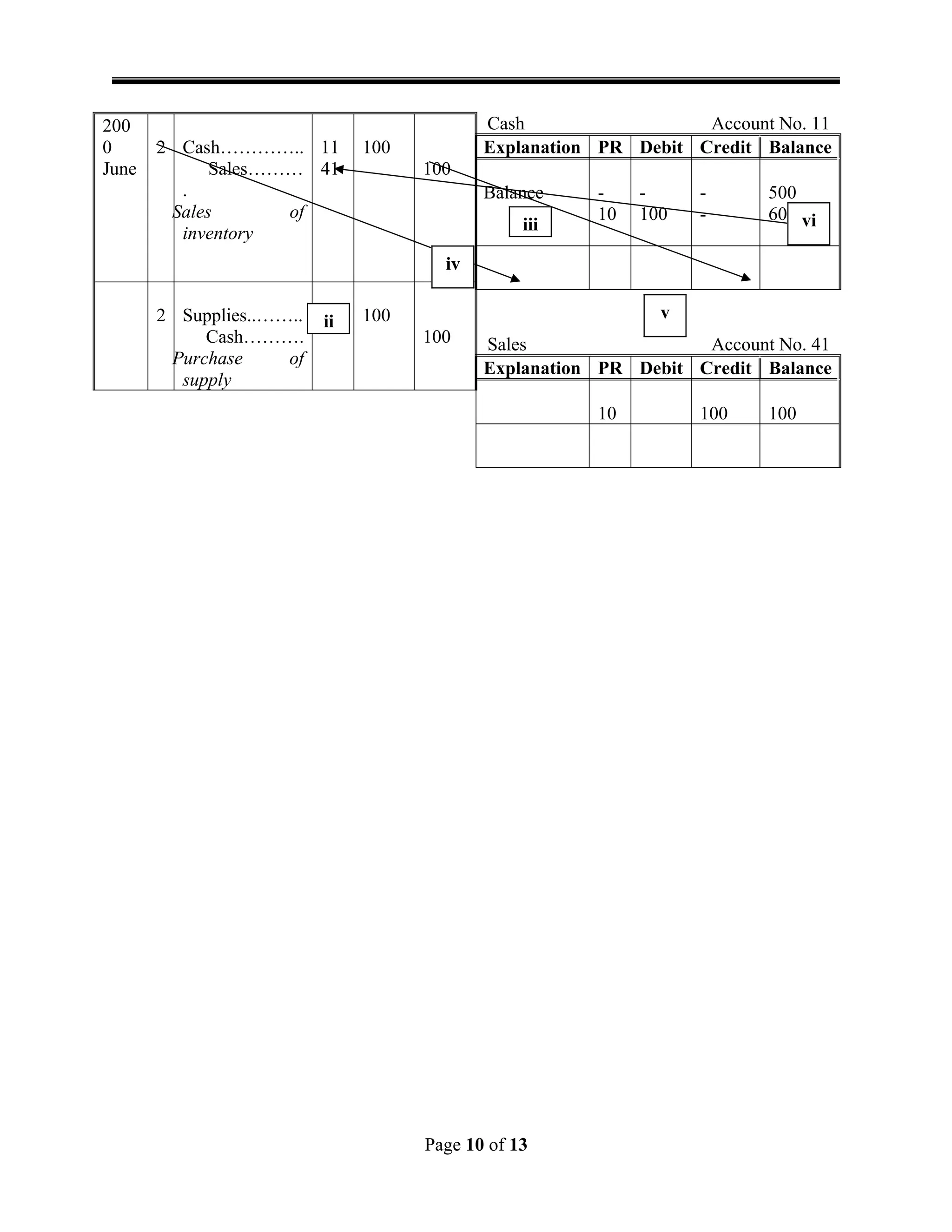
2.1.7 Posting
1. Definition - Posting refers to the process transferring monetary amounts of debit and credit
entries from the general journal to the accounts in the ledger which are affected by the debit
and credit entries. Posting is necessary to classify and group similar business transactions in
terms of their effects on specific asset, liability, capital, revenue and expense items.
2. Steps – The following steps may be carried out in posting journal entries to general ledger
accounts:
i. Locate in the general ledger the first account debited in the first general journal entry.
ii. Copy the date (i.e. year, month and date) of the entry to be posted from the journal to
the date column of the general ledger account.
iii. Copy the debit amount from the general journal to the debit column of the particular
account affected in the general ledger.
iv. Record the general journal page in the posting reference column of the account debited
in the general ledger.
v. Record the identification number of the account debited in the posting reference
column of the general journal from which the debit amount is copied to indicate that
the debit amount is posted to the appropriate account in the general ledger.
vi. Determine and write the balance of the account in its balance column if available.
vii. The explanation column of the account is used to give description of special entries
such as adjusting, closing, reversing and correcting entries posted to the account.
Entries recording normal and recurring transactions need no explanation.
viii. Repeat the above posting procedures for the credit portion of the journal entry.
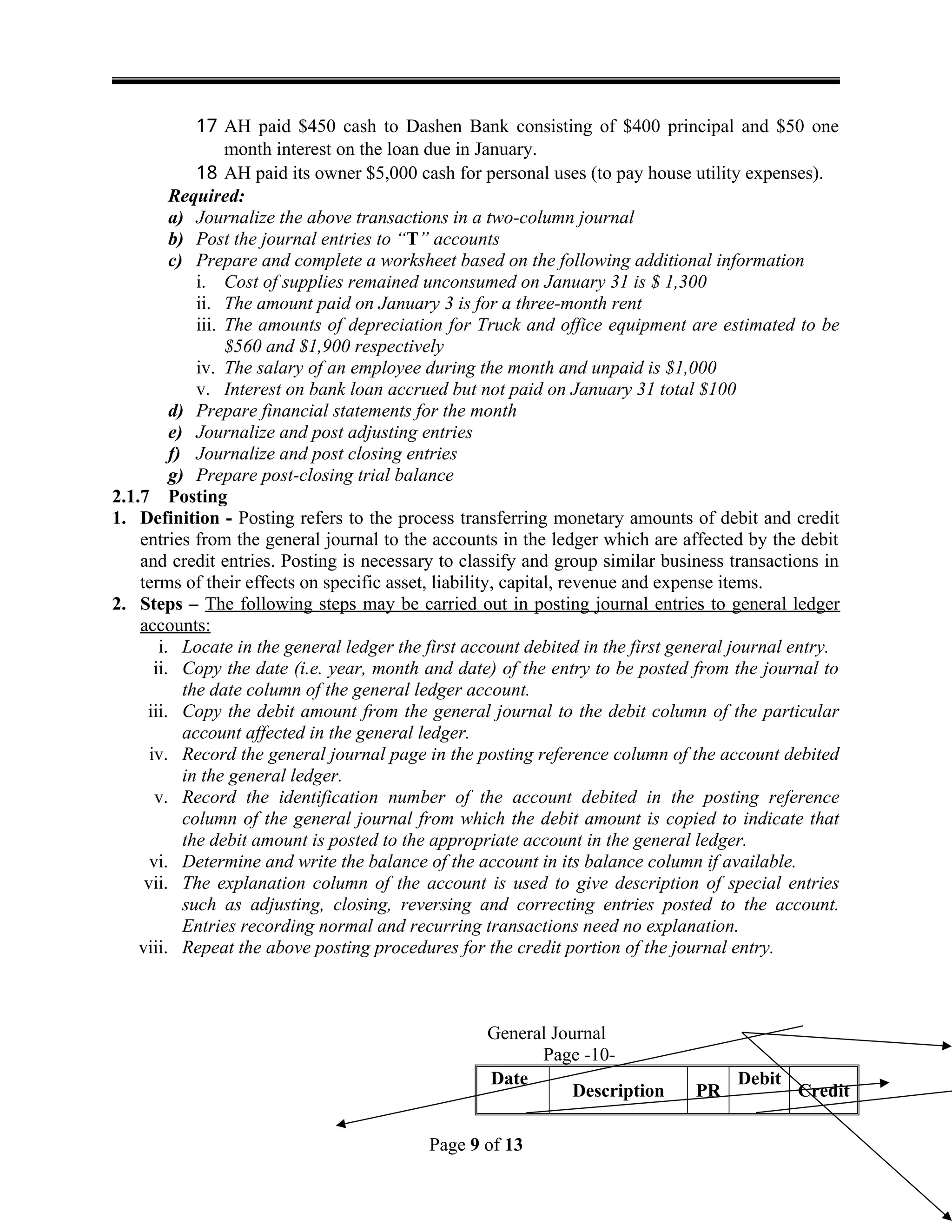
General Journal
Page -10-
Date
Description PR
Debit
Credit
Page 9 of 13
200
0
June
2 Cash…………..
Sales………
.
Sales of
inventory
11
41
100
100
2 Supplies..……..
Cash……….
Purchase of
supply
100
100
Cash Account No. 11
Explanation PR Debit Credit Balance
Balance -
10
-
100
-
-
500
600
Sales Account No. 41
Explanation PR Debit Credit Balance
10 100 100
Page 10 of 13
ii
iii
iv
v
vi
Example 2-2
Required: Complete requirement “b” of example 2-1.
2.1.8 Trial Balance
1. Definition - Trial balance refers to list of all general ledger accounts and their respective balances.
2. Types - Three types:
 Unadjusted Trial Balance - prepared before account balances are adjusted
 Adjusted Trial Balance - prepared after account balances are adjusted
 Post-closing Trial Balance - prepared after temporary accounts are closed.
3. Purpose - Regardless of its type, trial balance is prepared in order to check whether total dollar
amounts of debits and credits recorded in the general ledger accounts are equal. If the total debit and
total credit are equal, the ledger is said to be in balance. The agreement of the debit and credit totals
of the trial balance gives assurance that:
 Equal debits and credits have been recorded for each internal and external transaction.
 The debit or credit balance of each account has been correctly calculated.
 The determination of total debit and credit balances of the trial balance has been correctly
performed.
Example 2-3
Required: Based on your answers for requirements “a” and “b” of example 2-1, prepare unadjusted
trial balance.
4. Errors and The Trial Balance - If the trial balance does not balance, it indicates that there is an
error or are errors somewhere in the accounting process which should be discovered and corrected.
Errors that may possibly result in disagreement between the two totals of a trial balance include:
 Posting unequal debit and credit amounts for an entry;
 Posting a debit entry as a credit or vice versa;
 Arithmetic mistakes in balancing accounts;
 Clerical errors in copying account balances into the trial balance;
 Listing a debit balance in the credit column of the trial balance or vice versa; and
 Errors in determining the debit and credit totals of the trial balance.
 Equality of the total debits and total credits on the trial balance, however, does not imply that
transactions are correctly analyzed and recorded.
Below are examples of errors which cannot be discovered/detected by preparing a trial balance:
 Failure to journalize and/or post a transaction
 Journalizing and/or posting the same transaction more than once
 Journalizing and/or posting a transaction correctly but in or to the wrong account
 Journalizing and/or posting erroneous but equal dollar amounts of debits and credits
Despite these limitations, the trial balance is a useful device. It not only provides assurance that the
ledger is in balance, but it also serves as a convenient springboard for the preparation of financial
statements. The trial balance, however, is merely a working paper, useful to the accountant but not
intended for distribution to users of accounting information.
5. Procedures to locate errors - As a matter of fact, there is no one best way of locating errors.
However, the following procedures, done sequentially, may save considerable time and effort in
locating errors.
i. Recalculate the debit and credit totals of the trial balance.
ii. Compare amounts listed on the trial balance with the related account balances in the ledger.
iii. Recalculate account balances in the ledger.
iv. Check accuracy of posting from the journal to the ledger.
v. Check the equality of dollar amounts of debit and credit entries in the journal.
The difference between the total debit and total credit balances may indicate the nature and location
of the error, thus, avoid the need for sequentially performing all the aforementioned procedures. For
example,
 A difference of 10; 100; 1000; etc, indicates addition error. In this case, you need to perform
procedures (i) and (iii) to discover the error.
 A difference divisible evenly by 2 indicates posting to the ledger a debit entry or listing on
the trial balance a debit balance as credit or vice versa or omission of a debit or credit entry
posting to the ledger or listing a debit or credit balance of an account on the trial balance. In
such cases, you need to perform procedures (ii) and (iv).
 A difference divisible evenly by 9 indicates slide or transposition error. Slide error refers to
error in placing decimal point, for example, writing 22.50 as 2.25 or 225. While
transposition error refers misplacement of digits, for example, writing 225 as 252 or 522.
Such errors may happen in any step in the accounting process, thus, you need to perform all
the procedures needed to locate an error without discrimination.
6. Correcting errors - Once an error is discovered, it has to be corrected. Ways of correcting errors
depend upon the nature of and the place in the accounting process the error is located.
 Drawing a single line over an erroneous amount/incorrect account name and writing the
correct amount/account title is a common way of correcting simple errors due to incorrect
journal entries not yet posted to the accounts in the ledger and posting incorrect debit/credit
part of an entry.
 Journalizing and posting correcting entries is another and perhaps the best way of
correcting errors commonly used to correct complex errors due to incorrect journal entries
posted to the accounts in the ledger.
Example 2-4
Purchase of office supplies not yet consumed for $4,000 cash was erroneously recorded as a
debit to Rent Expense and credit to Accounts Payable accounts.
Required: Prepare journal entries to correct the above error.
Principles of Accounting I For pictorial representation of and for more information on the two- and four-column accounts

Principles of Accounting I For pictorial representation of and for more information on the two- and four-column accounts

  • 1.
    PRINCIPLES OF ACCOUNTING- I CHAPTER- 2 (Part 1) Accounting for a Service organization (2.1 The Recording Phase) 2.1 THE RECORDING PHASE 2.1.1 Basic Accounting Records 1. Introduction - In chapter one, we were recording effects of business transactions using the accounting equation format. This, however, is not cost-and time-effective when an organization has large volume of transactions to process and several asset, liability, capital, revenue and expense items. As a result, as the volume of transactions grows and the number of specific elements of the financial statements increases, it will be necessary to design and use systematic way of processing transactions and generating accounting information. The following sections discuss an improved system of transforming business transactions into useful accounting information. 2. Basic accounting records - refer to records organizations use in transforming business transactions into useful accounting information and include Accounts, Ledgers and Journals. 2.1.2 Nature and Classification of Accounts 1. Definition - an account is the basic storage unit for accounting data. It is used to classify transactions in terms of their effects on specific asset, liability, capital, revenue and expense items. Thus, a separate account is kept to record and accumulate/store monetary effects of transactions on such specific items that appear on the financial statements as Cash, Supplies, Accounts Payable, Bank Loan Payable, Owner’s equity (Capital) , Service revenue (Fees Earned), Rent Income, Salary Expense and Supplies Expense. 2. Nature of an Account - The simplest form of an account is called “T” account. It is so named because it looks like the capital letter "T" as shown in the figure below. In its most elementary form, an account (i.e. T account) has three parts:  the account title - used to write the name of the account such as Cash, Account Receivable, Supplies, Equipment, Account Payable, Owner’s Capital  the left (debit) side - a place to record increases or decreases in the account in monetary terms  the right (credit) side - a place to record increases or decreases in the account in monetary terms Account Title Left (Debit) Side Right (Credit) Side If monetary increases in an account are recorded in the debit, then the decreases in the same account are recorded in the credit side and vice versa. Business organizations practically use the so-called two-column, three-column or four-column accounts for recording and storing business transactions. The purpose of the first two columns is to separately record the increases and decreases (debits and credits) in the account and that of the additional columns is to keep running (debit or credit) balance of an account.  For pictorial representation of and for more information on the two- and four-column accounts, read page of your textbook, Accounting Principles, 21st edition by Fess and Warren. Page 1 of 13
  • 2.
    3. Classification ofAccounts - accounts may be classified into two major root categories: Balance Sheet and Income Statement accounts. i. Balance sheet accounts - refer to accounts that appear on the balance sheet. They include assets, liabilities and owner's equity accounts. These accounts (except drawing and income summary accounts) are also called permanent or real accounts. They are named as permanent (real) because their balances will not be closed at the end of each accounting period rather are carried forward from period to period so long as business activities continue. a. Assets - include any tangible and intangible items that have monetary value to and owned by a business. Assets are further divided into current and non-current. oCurrent assets - include cash and other assets that are expected to be converted into cash, sold or consumed within a very short period of time usually one year or less. Examples include:  Cash - coins and paper money on hand or deposited at bank.  Accounts Receivable - claims against customers (debtors) for goods and services sold on credit. They are based on oral promise or good faith rather than supported by written evidences.  Notes Receivable - claims against customers supported by written evidences.  Merchandise Inventory - finished goods held for resale.  Prepaid Expenses (assets) - include consumable items such as supplies and advance payments for such items as insurance (Prepaid Insurance) and rent (Prepaid Rent). oNon-current assets - also called fixed/plant assets refer to assets with the potential to provide benefit to the business for relatively long period of time, at least more than a year. They include land, buildings, vehicles, machinery, equipment, patent, furniture, fixtures and long- term receivables. All non-current assets held for use in operations, except land held for purposes other than agriculture, lose their usefulness with the passage of time or as a result of usage. Such decline in usefulness is called depreciation or amortization and is a business expense identified as Depreciation or Amortization Expense. b. Liabilities - refer to obligations of a business to pay cash, perform service or deliver goods to its creditor. Liabilities are further divided into current and non-current. o Current liabilities - refer to obligations that must be paid/settled within one year or less. They include Accounts Payable, Notes Payable, Salary Payable, Income/Sales Tax Payable and Rent Payable. o Non-current liabilities - also called long-term liabilities refer to obligations that are expected to be settled over an extended period of time usually more than a year. Examples include Mortgage Notes Payable and Bonds Payable. A part of a long-term debt, which is due within a year or less, is reclassified and reported as current liability. c. Owner’s Equity - refers to residual claim of the owner against the assets of a business. For sole proprietorship and partnership forms of businesses, owner’s equity accounts include: o Capital - used to accumulate investments made by the owner/partner and profit earned by the business but not withdrawn by the owner/partner. Capital account is identified by the name of the owner/partner and the word capital. E.g. Alemu, Capital. Page 2 of 13
  • 3.
    o Drawing -used to accumulate money or other assets taken out of the business by the owner/partner for personal consumption. Drawing decreases capital of a business. Like capital, drawing account is identified by the name of the owner/partner and the word drawing. E.g. Alemu, Drawing. o Income Summary - used to summarize effects of revenues and expenses on the capital of business. ii. Income statement accounts - refer to accounts that appear on the income statement. They include revenue and expense accounts. These accounts are used to temporarily accumulate effects of revenue and expense transactions on capital of a business. These accounts, together with drawing and income summary accounts, are also called temporary or nominal accounts. They are so named temporary, because their balances will be closed to zero by the end of an accounting period thus will not be carried forward from period to period. By the end of the accounting period, balances of such accounts are summarized and transferred to the capital account. Thus, these accounts exist for only one accounting period. a. Revenues - refer to gross increases in owner’s equity as a result of inflows of cash or any other assets in exchange for inventories sold, services rendered, properties leased, money lend or any other activity performed by the business to generate income. Revenues include: o Sales - from sales of inventories o Fees Earned - from performing services o Rent/Royalty Income - from letting others use ones own properties such as building and machinery o Interest Income - from lending money b. Expenses - refer to expired cost of goods and services consumed in generating revenues or carrying out the day-to-day affairs of a business. Expenses include: o Cost of Goods Sold - expired cost of inventories sold to customers o Salary/Wages Expense - cost of services received from employees o Utilities Expenses - cost of utility services consumed, such as telephone, electricity and water services. o Depreciation Expense - expired cost of tangible non-current assets as a result of usage or passage of time. 4. Rules of Debit and Credit - are conventions/principles for recording increases and decreases in an account. According to these principles  Increases in an asset account are recorded on the debit side while decreases are recorded on the credit side.  Increases in a liability account are recorded on the credit side while decreases are recorded on the debit side.  Increases in an owner’s equity account are recorded on the credit side while decreases are recorded on the debit side.  For revenues represent increases in owner’s equity, increases in a revenue account are recorded on the credit side while decreases, if any, are recorded on the debit side.  For expenses and drawings represent decreases in owner’s equity, increases in expense and drawing accounts are recorded in the debit side while decreases, if any, are recorded in the credit side. Page 3 of 13
  • 4.
    5. Normal balanceof an Account - Account balance refers to the difference between total increase and total decrease recorded in an account. Total increase recorded in an account is usually greater than the total decrease recorded in the same account. Thus, the usual (normal) balance of an account is positive. This implies that the normal balance of an asset, an expense or a drawing account is debit while that of a liability, capital or revenue account is credit. Abnormal balance in an account may arise as a result of:  Recording errors - for any account  Bank overdraft (over-drawing bank account) - for cash at bank account  Over-collection - for receivable accounts  Overpayment - for payable accounts  Reversing entries - for revenue and expense accounts  The following table summarizes the rules of debit and credit and the normal balances of accounts: Account Type Increases Decreases Normal balance Balance Sheet Accounts Asset Debit Credit Debit Liability Credit Debit Credit Owner’s Equity Capital Credit Debit Credit Drawing Debit Credit Debit Income Summary May have a credit/debit balance for income/loss Income Statement Accounts Revenue Credit Debit Credit Expense Debit Credit Debit 6. Numbering and Sequencing Accounts - The numbering system used to identify accounts depends on the size, complexity and nature of the business activity an organization is involved. Small organizations may use identification numbers consisting of one to three digits while large organizations use numbers with more than three digits. The numbering system usually starts with balance sheet accounts and follows with income statement accounts. A chart of accounts (see on the next page) is usually prepared to facilitate the analysis of business transactions in the accounting cycle and the formulation of journal entries. Each digit making up an account number has its own purpose. For instance, the first digit may show whether the account is classified as a balance sheet or an income statement account and the other digits further identify possible classifications of the account. 7. Chart of Accounts - refers to the list of the titles and related identification numbers of all general ledger (to be discussed in the next sections) accounts a business uses for recording its financial affairs. Below is an example of chart of accounts for a certain business. Page 4 of 13
  • 5.
    Account Number Name Balance SheetAccounts 100 Asset 111 Cash 112 Accounts Receivable 121 Buildings 200 Liability 211 Accounts Payable 221 Mortgage Notes Payable 300 Owner’s Equity 301 Alemu, Capital 302 Alemu, Drawing 303 Income Summary Income Statement Accounts 400 Revenue 401 Fees Earned 402 Interest Income 500 Expense 501 Salary Expense 502 Utility Expense Note that account identification numbers are needed for arranging accounts in the General Ledger and for posting reference purposes (discussed in the next sections of this chapter). The number of accounts to be maintained and the numbering system to be used depends upon the nature and size of a business. Small businesses may use a very few number of accounts and a numbering system consisting of one, two or three digits. While big companies may use several accounts and their numbering system may consist of several digits. In any case, a business should use a flexible numbering system that may accommodate new accounts needed due to expansion in operations. Besides, each digit in an account number may show the major division/type, subdivision and position of the account in the subdivision. For instance, numbers “1”, “1” and “2” in the account number 112 for Accounts Receivable may indicate that Accounts Receivable is an asset account; its subdivision within the asset group is current and lies in the second position within current assets subdivision, respectively. 2.1.3 Ledgers 1. Definition - Ledger refers to a kind of folder/ring binder used to arrange and put in one place all accounts used by a business. Accounts are placed in the ledger in sequence and each account may take one or more pages of the ledger. 2. Types - two types of ledgers: general and subsidiary.  General ledger - a ledger that contains all accounts that appear on the balance sheet and income statement of a business. General ledger accounts are called controlling accounts because they show the total balance of a certain element of the financial statements such as Accounts Receivable and Accounts Payable regardless of the amount of money expected to be collected from each credit customer and the amount of money payable to each creditor, respectively. Controlling accounts are assigned with and identified by their respective account numbers. Accordingly, they are placed in the general ledger according to their numerical orders.  Subsidiary ledger - a ledger that contains accounts showing details of controlling accounts. For example, Accounts Receivable Ledger, also called customers’ ledger, contains accounts of individual credit customers showing the amount of money due from each credit customer. Subsidiary ledger accounts are identified by the name of the credit customer or creditor and are accordingly arranged alphabetically. Page 5 of 13
  • 6.
    Note that abusiness may set up both general and subsidiary ledgers not only for Accounts Receivable and Accounts Payable but also for any account for which the business wants to have detailed information about. 2.1.4 Journals 1. Definition - Journal, also called the book of original entry, refers to a business document where effects of business transactions on specific elements of the financial statements are recorded in or copied from source documents. In Chapter-1, we have seen how to record and summarize effects of business transactions on asset, liability and owner’s equity items using the accounting equation format. Such system, however, is not practicable or is not cost- and time-effective when a business has thousands of transactions to record and several asset, liability, capital, revenue and expense items. Directly recording business transactions in the accounts is not also wise and may result in recording errors which may be easily avoided by using journals. Thus, organizations design and use the journal to initially record business transactions. Transactions are recorded in the journal chronologically (i.e. in order of their date of occurrence) based on the rules of debit and credit and the double-entry accounting system. Double-entry accounting refers to the system of recording the dual, called debit and credit, effects of business transactions. As a result, recording transactions initially in the journal helps, among other things, to  Ensure that all effects of a business transaction are recorded,  Have a complete information about a recorded transaction in one place,  Easily identify recording errors, and  Have an historical record of transactions. 2. Types - two types of journals: General and Special journal.  General journal - a two-column form used to record all kinds of business transaction.  Special journal - a journal designed to record frequently occurring identical transactions.  An organization may use only general journal or both general and special journals depending up on the volume and similarities of its business transactions. 2.1.5 Accounting Cycle 1. Definition - Accounting cycle refers to the procedures (steps) for gathering business transactions, processing and converting them into useful accounting information that will be communicated to users to serve as a basis for investment, credit and other economic decisions. 2. Procedures/Steps in the Accounting Cycle - The accounting cycle consists of the following specific procedures:  Analyzing business documents and transactions  Journalizing business transactions  Posting journal entries to accounts  Preparing unadjusted trial balance  Journalizing and posting adjusting entries  Preparing adjusted trial balance  Preparing financial statements  Journalizing and posting closing entries Page 6 of 13
  • 7.
     Preparing post-closingtrial balance  Journalizing and posting reversing entries (optional)  The aforementioned procedures are discussed in the following major sections: 2.1.6 Journalizing 1. Definition - Journalizing refers to the process of recording business transactions in journals. 2. Steps - The following steps may be carried out to journalize business transactions:  Collect source documents - Source documents show that a transaction has really occurred and give complete information about the transaction such as date of the transaction, parties involved and amount of money, terms of payment, etc.  Analyze transactions - This involves determining specific accounts affected (cash, fees earned, etc) by the transaction, classification of the accounts affected (asset, liability, etc), direction of the effect (increase or decrease), monetary amount of the effect ($400, $100, etc) and how to record the increase and decrease (debit or credit).  Journalize - Record the dual effects of transactions in chronological order using the rules of debits and credits. Below are sample general journal and additional steps needed to journalize business transactions. General Journal Page -8- Date Description PR Debit Credit Year Month Date Name of Account to be Debited Name of Account to be Credited Brief explanation about the transaction XXX XXX  Note the following when journalizing transactions: i. Write the year, month and date of the transaction in the date column. The year and month need not be repeated for subsequent entries until a new page or a new month/year begins while the date may be repeated in as much as the number of independent entries to be recorded. ii. Write the name of the account to be debited on the first line customarily placed at the extreme left of the description column. Enter the corresponding debit amount on the same line in the extreme left of the debit column. An entry which includes more than one debit or more than one credit is called a compound journal entry. Regardless of how many debits or credits are contained in a compound journal entry, all the debits are entered before any credit. iii. Write the name of the account to be credited on the line below the debit entry somehow indented i.e. placed about 1 inch in to the right side of the description column. Enter the corresponding credit amount on the same line in the extreme left of the credit column. iv. Write a brief explanation of the transaction on the line immediately below the last account credited. This explanation includes any data needed to identify the transaction, such as the Page 7 of 13 i ii iii iv v
  • 8.
    name of thecustomer or supplier. The explanation needs not to be indented. v. Leave the PR (which stands for posting reference) column blank at the time of making the journal entry. When the debits and credits are later transferred to accounts in the ledger, the identification numbers of the accounts which the entries are posted to will be listed in this column to provide a cross reference with the ledger.  Whether a transaction results in single or compound entry, equal dollar amounts of debits and credits should be recorded. Example 2.1 On January 1, 2003, Alemu Haba, established his own consultancy business. He named his business "AH Consultancy Services". The objective of the business is to render financial consultancy services to clients on a fee basis. The following business activities occurred during the first month of operations of the business (January 3 to January 31, 2003). 1 Alemu deposited $20,000 cash in a bank account in the name of his business - AH Consultancy Services. He has $250,000 cash in his personal bank account with Dashen Bank and $50,000 cash in a safe deposit box at his residence. 2 Alemu transferred furniture worth $30,000 from his home for office purposes by AH Consultancy Services. He also has extra home furniture, residential house and personal car worth $620,000, $800,000 and $360,000, respectively. 3 Alemu purchased office supplies worth $5,000 from various suppliers agreeing to pay the sum in the near future. Two-fifth of the supplies will be used for personal purposes while the remaining is for use by AH. Three-fifth of the liability is arranged to be settled from business cash sources. 4 AH paid $3,000 for rent on a building leased for business purposes 5 AH received $20,000 cash for consultancy services it rendered to a cash client. 6 AH paid $3,000 cash for advertising aired through ETV. 7 AH forecasted that services fees in the next two weeks will amount to $5,000. 8 AH received $10,000 additional cash investment from Alemu - its owner. 9 AH rendered consultancy services worth $15,000 to clients promising to pay in the near future. 10 AH sold one of the furniture invested by its owner for $5,000 cash. The furniture had a recorded value of $5,000. 11 AH collected $5,000 cash from clients who received services in item-9 above. 12 AH paid $2,000 cash to suppliers on credit. 13 AH purchased a used car for business purposes. The business paid $8,000 cash for the car. 14 AH borrowed $4,000 cash from Dashen Bank. The loan is repayable over ten months. 15 AH employed an accountant and a secretary for monthly salary of $1,200 and $700, respectively. 16 AH incurred and paid for the following expenses  Wages................................................. $6,000  Rent.................................................... 4,500  Utilities................................................ 1,200  Others.................................................. 800 Page 8 of 13
  • 9.
    17 AH paid$450 cash to Dashen Bank consisting of $400 principal and $50 one month interest on the loan due in January. 18 AH paid its owner $5,000 cash for personal uses (to pay house utility expenses). Required: a) Journalize the above transactions in a two-column journal b) Post the journal entries to “T” accounts c) Prepare and complete a worksheet based on the following additional information i. Cost of supplies remained unconsumed on January 31 is $ 1,300 ii. The amount paid on January 3 is for a three-month rent iii. The amounts of depreciation for Truck and office equipment are estimated to be $560 and $1,900 respectively iv. The salary of an employee during the month and unpaid is $1,000 v. Interest on bank loan accrued but not paid on January 31 total $100 d) Prepare financial statements for the month e) Journalize and post adjusting entries f) Journalize and post closing entries g) Prepare post-closing trial balance 2.1.7 Posting 1. Definition - Posting refers to the process transferring monetary amounts of debit and credit entries from the general journal to the accounts in the ledger which are affected by the debit and credit entries. Posting is necessary to classify and group similar business transactions in terms of their effects on specific asset, liability, capital, revenue and expense items. 2. Steps – The following steps may be carried out in posting journal entries to general ledger accounts: i. Locate in the general ledger the first account debited in the first general journal entry. ii. Copy the date (i.e. year, month and date) of the entry to be posted from the journal to the date column of the general ledger account. iii. Copy the debit amount from the general journal to the debit column of the particular account affected in the general ledger. iv. Record the general journal page in the posting reference column of the account debited in the general ledger. v. Record the identification number of the account debited in the posting reference column of the general journal from which the debit amount is copied to indicate that the debit amount is posted to the appropriate account in the general ledger. vi. Determine and write the balance of the account in its balance column if available. vii. The explanation column of the account is used to give description of special entries such as adjusting, closing, reversing and correcting entries posted to the account. Entries recording normal and recurring transactions need no explanation. viii. Repeat the above posting procedures for the credit portion of the journal entry. General Journal Page -10- Date Description PR Debit Credit Page 9 of 13
  • 10.
    200 0 June 2 Cash………….. Sales……… . Sales of inventory 11 41 100 100 2Supplies..…….. Cash………. Purchase of supply 100 100 Cash Account No. 11 Explanation PR Debit Credit Balance Balance - 10 - 100 - - 500 600 Sales Account No. 41 Explanation PR Debit Credit Balance 10 100 100 Page 10 of 13 ii iii iv v vi
  • 11.
    Example 2-2 Required: Completerequirement “b” of example 2-1. 2.1.8 Trial Balance 1. Definition - Trial balance refers to list of all general ledger accounts and their respective balances. 2. Types - Three types:  Unadjusted Trial Balance - prepared before account balances are adjusted  Adjusted Trial Balance - prepared after account balances are adjusted  Post-closing Trial Balance - prepared after temporary accounts are closed. 3. Purpose - Regardless of its type, trial balance is prepared in order to check whether total dollar amounts of debits and credits recorded in the general ledger accounts are equal. If the total debit and total credit are equal, the ledger is said to be in balance. The agreement of the debit and credit totals of the trial balance gives assurance that:  Equal debits and credits have been recorded for each internal and external transaction.  The debit or credit balance of each account has been correctly calculated.  The determination of total debit and credit balances of the trial balance has been correctly performed. Example 2-3 Required: Based on your answers for requirements “a” and “b” of example 2-1, prepare unadjusted trial balance. 4. Errors and The Trial Balance - If the trial balance does not balance, it indicates that there is an error or are errors somewhere in the accounting process which should be discovered and corrected. Errors that may possibly result in disagreement between the two totals of a trial balance include:  Posting unequal debit and credit amounts for an entry;  Posting a debit entry as a credit or vice versa;  Arithmetic mistakes in balancing accounts;  Clerical errors in copying account balances into the trial balance;  Listing a debit balance in the credit column of the trial balance or vice versa; and  Errors in determining the debit and credit totals of the trial balance.  Equality of the total debits and total credits on the trial balance, however, does not imply that transactions are correctly analyzed and recorded. Below are examples of errors which cannot be discovered/detected by preparing a trial balance:  Failure to journalize and/or post a transaction  Journalizing and/or posting the same transaction more than once  Journalizing and/or posting a transaction correctly but in or to the wrong account  Journalizing and/or posting erroneous but equal dollar amounts of debits and credits Despite these limitations, the trial balance is a useful device. It not only provides assurance that the ledger is in balance, but it also serves as a convenient springboard for the preparation of financial statements. The trial balance, however, is merely a working paper, useful to the accountant but not intended for distribution to users of accounting information. 5. Procedures to locate errors - As a matter of fact, there is no one best way of locating errors. However, the following procedures, done sequentially, may save considerable time and effort in locating errors.
  • 12.
    i. Recalculate thedebit and credit totals of the trial balance. ii. Compare amounts listed on the trial balance with the related account balances in the ledger. iii. Recalculate account balances in the ledger. iv. Check accuracy of posting from the journal to the ledger. v. Check the equality of dollar amounts of debit and credit entries in the journal. The difference between the total debit and total credit balances may indicate the nature and location of the error, thus, avoid the need for sequentially performing all the aforementioned procedures. For example,  A difference of 10; 100; 1000; etc, indicates addition error. In this case, you need to perform procedures (i) and (iii) to discover the error.  A difference divisible evenly by 2 indicates posting to the ledger a debit entry or listing on the trial balance a debit balance as credit or vice versa or omission of a debit or credit entry posting to the ledger or listing a debit or credit balance of an account on the trial balance. In such cases, you need to perform procedures (ii) and (iv).  A difference divisible evenly by 9 indicates slide or transposition error. Slide error refers to error in placing decimal point, for example, writing 22.50 as 2.25 or 225. While transposition error refers misplacement of digits, for example, writing 225 as 252 or 522. Such errors may happen in any step in the accounting process, thus, you need to perform all the procedures needed to locate an error without discrimination. 6. Correcting errors - Once an error is discovered, it has to be corrected. Ways of correcting errors depend upon the nature of and the place in the accounting process the error is located.  Drawing a single line over an erroneous amount/incorrect account name and writing the correct amount/account title is a common way of correcting simple errors due to incorrect journal entries not yet posted to the accounts in the ledger and posting incorrect debit/credit part of an entry.  Journalizing and posting correcting entries is another and perhaps the best way of correcting errors commonly used to correct complex errors due to incorrect journal entries posted to the accounts in the ledger. Example 2-4 Purchase of office supplies not yet consumed for $4,000 cash was erroneously recorded as a debit to Rent Expense and credit to Accounts Payable accounts. Required: Prepare journal entries to correct the above error.