INANCING
oring
RECEIVABLE
F
F
Pledge, Assignment and Factoring
G
Technical Knowledge
To Know the accounting for pledge of accounts receivable
To know the accounting for assignment of accounts Receivable
To understand factoring of accounts receivable
To know the classification and presentation of pledged, assigned and
factored accounts receivable
During a general
business decline, an
entity may find itself in
tight cash position
because sale decrease
and customers are not
paying their accounts
on time
But the entity’s
current accounts
and notes payable
must continue to be
paid if its credit
standing is not to
suffer.
RECEIVABLE
FINANCING
Receivable
financing is the
financial flexibility or
capability of an
entity to raise money
out of its receivable
RECEIVABLE
FINANCING
The entity then would be
in financial distress as
collections of receivable
are delayed but cash
payments for obligations
must be maintained
Under these circumstances,
if the situation becomes
very critical the entity may
be forced to look for cash
by financing its receivables
The common forms of
receivable financing are
pledge of accounts
receivable, assignment of
accounts receivable,
factoring of accounts
receivable and
discounting of notes
receivable
PLEDGE
OF
ACCOUNT
RECEIVABLE
• When Loans are obtained from the bank or any lending institution, the
accounts receivable may be pledged as collateral security for the payment of
loan
• Normally the borrower makes the collection of the pledged accounts BUT
may required to turn over the collections to the bank satisfaction for the loan
• NO complex problem are in this form of financing except the accounting for
the loan
• The loan is recorded by debiting cash and discount on note payable if loan is
discounted, and crediting note payable
• The subsequent payment of the loan is recorded by debiting note payable
and crediting cash
• With respect to the pledged accounts, no entry would be necessary. Its is
sufficient that disclosure thereof is made in a note to financial statement
Face Amount of loan
Interest deducted in advance (1,000,000 x 12%)
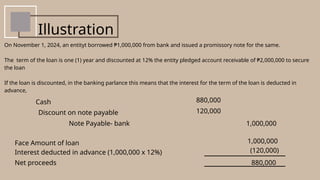
On November 1, 2024, an entityt borrowed ₱1,000,000 from bank and issued a promissory note for the same.
The term of the loan is one (1) year and discounted at 12% the entity pledged account receivable of ₱2,000,000 to secure
the loan
If the loan is discounted, in the banking parlance this means that the interest for the term of the loan is deducted in
advance,
Illustration
Cash
Discount on note payable
Note Payable- bank
Net proceeds
880,000
120,000
1,000,000
1,000,000
(120,000)
880,000
Illustration
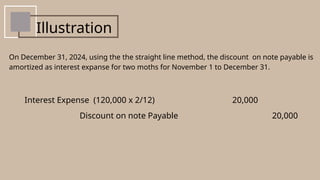
On December 31, 2024, using the the straight line method, the discount on note payable is
amortized as interest expanse for two moths for November 1 to December 31.
Interest Expense (120,000 x 2/12)
Discount on note Payable
20,000
20,000
1,000,000
(100,000)
Illustration
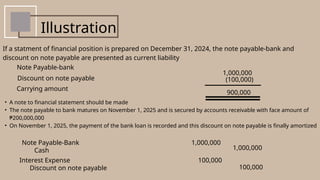
If a statment of financial position is prepared on December 31, 2024, the note payable-bank and
discount on note payable are presented as current liability
Note Payable-bank
Discount on note payable
Carrying amount
• A note to financial statement should be made
• The note payable to bank matures on November 1, 2025 and is secured by accounts receivable with face amount of
₱200,000,000
• On November 1, 2025, the payment of the bank loan is recorded and this discount on note payable is finally amortized
Note Payable-Bank
Cash
Interest Expense
Discount on note payable
900,000
1,000,000
1,000,000
100,000
100,000
• Assignment of accounts receivable means that the borrower called the assignor Transfers right in some
accounts receivable to a lender called the assignee in consideration for a loan
• Actually, Assignment is more formal type of pledging of accounts receivable. Secured borrowing
evidenced by a financing agreement and promissory note both of which the assignor signs
• However, pledging is general because all accounts receivable serves as collateral security for the loan
• On other hand, assignment is specific because specific accounts receivable serves as collateral security
for the loan
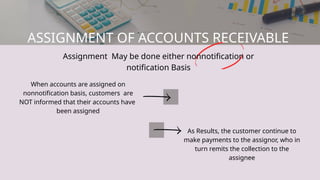
ASSIGNMENT OF ACCOUNTS RECEIVABLE
Assignment May be done either nonnotification or
notification Basis
When accounts are assigned on
nonnotification basis, customers are
NOT informed that their accounts have
been assigned
As Results, the customer continue to
make payments to the assignor, who in
turn remits the collection to the
assignee
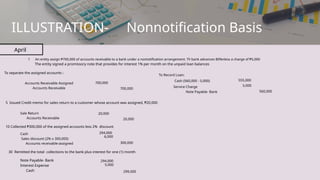
ILLUSTRATION- Nonnotification Basis
April
1 An entity assign ₱700,000 of accounts receivable to a bank under a nontotification arrangement. Th bank advances 80%nless a charge of ₱5,000
Accounts Receivable Assigned
Accounts Receivable
To Record Loan:
Cash (560,000 - 5,000)
Service Charge
Note Payable- Bank
5 Issued Credit memo for sales return to a customer whose account was assigned, ₱20,000
The entity signed a promissory note that provides for interest 1% per month on the unpaid loan balances
To separate the assigned accounts :
Sale Return
Accounts Receivable
10 Collected ₱300,000 of the assigned accounts less 2% discount
Cash
Sales discount (2% x 300,000)
Accounts receivable-assigned
30 Remitted the total collections to the bank plus interest for one (1) month
Note Payable- Bank
Interest Expense
Cash
700,000
700,000
555,000
5,000
560,000
20,000
20,000
294,000
6,000
300,000
294,000
5,000
299,000
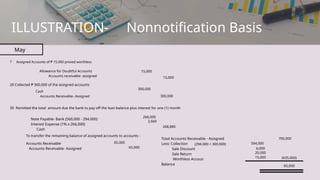
ILLUSTRATION- Nonnotification Basis
May
7 Assigned Accounts of ₱ 15,000 proved worthless
Allowance for Doubtful Accounts
Accounts receivable- assigned
15,000
15,000
20 Collected ₱ 300,000 of the assigned accounts
Cash
Accounts Receivable- Assigned
300,000
300,000
30 Remitted the total amount due the bank to pay off the loan balance plus interest for one (1) month
Note Payable- Bank (560,000 - 294.000)
Interest Expense (1% x 266,000)
Cash
266,000
To transfer the remaining balance of assigned accounts to accounts :
Accounts Receivable
Accounts Receivable- Assigned
65,000
65,000
Total Accounts Receivable - Assigned
Less: Collection
Sale Discount
Sale Return
Worthless Accoun
Balance
2,660
268,880
700,000
65,000
594,000
(294,000 + 300,000)
6,000
20,000
15,000 (635,000)
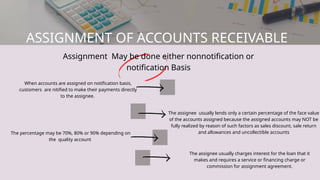
ASSIGNMENT OF ACCOUNTS RECEIVABLE
Assignment May be done either nonnotification or
notification Basis
When accounts are assigned on notification basis,
customers are nitified to make their payments directly
to the assignee.
The assignee usually lends only a certain percentage of the face value
of the accounts assigned because the assigned accounts may NOT be
fully realized by reason of such factors as sales discount, sale return
and allowances and uncollectible accounts
The percentage may be 70%, 80% or 90% depending on
the quality account
The assignee usually charges interest for the loan that it
makes and requires a service or financing charge or
commission for assignment agreement.
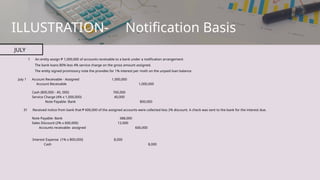
ILLUSTRATION- Notification Basis
JULY
1 An entity assign ₱ 1,000,000 of accounts receivable to a bank under a notification arrangement
The bank loans 80% less 4% service charge on the gross amount assigned.
The entity signed promissory note the provides for 1% interest per moth on the unpaid loan balance
July 1 Account Receivable - Assigned 1,000,000
Account Receivable 1,000,000
Cash (800,000 - 40, 000) 760,000
Service Charge (4% x 1,000,000) 40,000
Note Payable- Bank 800,000
31 Received notice from bank that ₱ 600,000 of the assigned accounts were collected less 2% discount. A check was sent to the bank for the interest due.
Note Payable- Bank 588,000
Sales Discount (2% x 600,000) 12,000
Accounts receivable- assigned 600,000
Interest Expense (1% x 800,000) 8,000
Cash 8,000
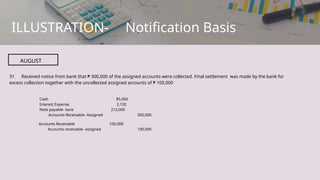
ILLUSTRATION- Notification Basis
AUGUST
31 Received notice from bank that ₱ 300,000 of the assigned accounts were collected. Final settlement was made by the bank for
excess collection together with the uncollected assigned accounts of ₱ 100,000
Cash 85,000
Interest Expense 2,120
Note payable- bank 212,000
Accounts Receivable- Assigned 300,000
Accounts Receivable 100,000
Accounts receivable- assigned 100,000
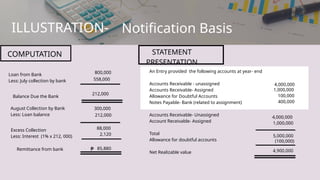
An Entry provided the following accounts at year- end
Accounts Receivable - unassigned
Accounts Receivable- Assigned
Allowance for Doubtful Accounts
Notes Payable- Bank (related to assignment)
Accounts Receivable- Unassigned
Account Receivable- Assigned
Total
Allowance for doubtful accounts
Net Realizable value
STATEMENT
PRESENTATION
ILLUSTRATION- Notification Basis
COMPUTATION
Loan from Bank
Less: July collection by bank
Balance Due the Bank
August Collection by Bank
Less: Loan balance
Excess Collection
Less: Interest (1% x 212, 000)
Remittance from bank
800,000
558,000
212,000
300,000
212,000
88,000
2,120
85,880
₱
4,000,000
1,000,000
100,000
400,000
4,000,000
1,000,000
5,000,000
(100,000)
4,900,000
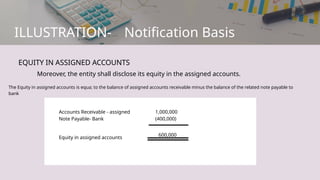
EQUITY IN ASSIGNED ACCOUNTS
ILLUSTRATION- Notification Basis
Moreover, the entity shall disclose its equity in the assigned accounts.
The Equity in assigned accounts is equa; to the balance of assigned accounts receivable minus the balance of the related note payable to
bank
Accounts Receivable - assigned
Note Payable- Bank
Equity in assigned accounts
1,000,000
(400,000)
600,000
FACTORING
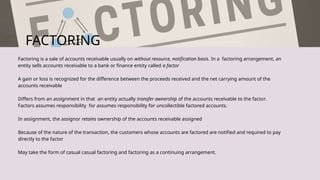
Factoring is a sale of accounts receivable usually on without resource, notification basis. In a factoring arrangement, an
entity sells accounts receivable to a bank or finance entity called a factor
A gain or loss is recognized for the difference between the proceeds received and the net carrying amount of the
accounts receivable
Differs from an assignment in that an entity actually transfer ownership of the accounts receivable to the factor.
Factors assumes responsibility for assumes responsibility for uncollectible factored accounts.
In assignment, the assignor retains ownership of the accounts receivable assigned
Because of the nature of the transaction, the customers whose accounts are factored are notified and required to pay
directly to the factor
May take the form of casual casual factoring and factoring as a continuing arrangement.
CASUAL FACTORING
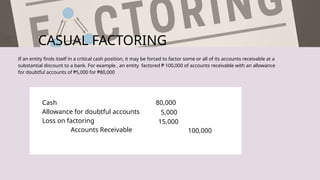
If an entity finds itself in a critical cash position, it may be forced to factor some or all of its accounts receivable at a
substantial discount to a bank. For example , an entity factored ₱ 100,000 of accounts receivable with an allowance
for doubtful accounts of ₱5,000 for ₱80,000
Cash
Allowance for doubtful accounts
Loss on factoring
Accounts Receivable
80,000
5,000
15,000
100,000
FACTORING AS A CONTINUING AGEREEMENT
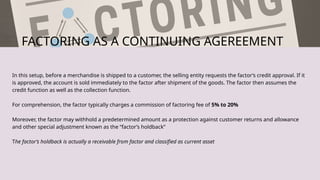
In this setup, before a merchandise is shipped to a customer, the selling entity requests the factor’s credit approval. If it
is approved, the account is sold immediately to the factor after shipment of the goods. The factor then assumes the
credit function as well as the collection function.
For comprehension, the factor typically charges a commission of factoring fee of 5% to 20%
Moreover, the factor may withhold a predetermined amount as a protection against customer returns and allowance
and other special adjustment known as the “factor’s holdback”
The factor’s holdback is actually a receivable from factor and classified as current asset
ILLUSTRATION
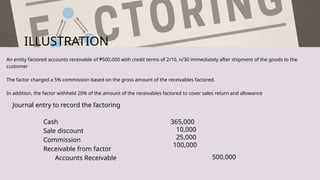
An entity factored accounts receivable of ₱500,000 with credit terms of 2/10, n/30 immediately after shipment of the goods to the
customer
The factor charged a 5% commission based on the gross amount of the receivables factored.
In addition, the factor withheld 20% of the amount of the receivables factored to cover sales return and allowance
Journal entry to record the factoring
Cash
Sale discount
Commission
Receivable from factor
Accounts Receivable
365,000
10,000
25,000
100,000
500,000
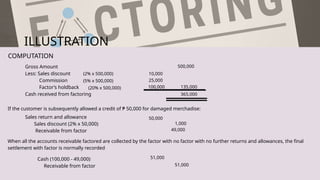
ILLUSTRATION
COMPUTATION
Gross Amount
Less: Sales discount
Commission
Factor’s holdback
Cash received from factoring
(2% x 500,000)
(5% x 500,000)
(20% x 500,000)
If the customer is subsequently allowed a credit of ₱ 50,000 for damaged merchadise:
Sales return and allowance
Sales discount (2% x 50,000)
Receivable from factor
When all the accounts receivable factored are collected by the factor with no factor with no further returns and allowances, the final
settlement with factor is normally recorded
Cash (100,000 - 49,000)
Receivable from factor
500,000
10,000
25,000
100,000 135,000
365,000
50,000
1,000
49,000
51,000
51,000
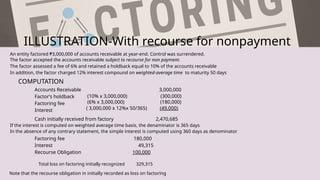
ILLUSTRATION-With recourse for nonpayment
COMPUTATION
An entity factored ₱3,000,000 of accounts receivable at year-end. Control was surrendered.
The factor accepted the accounts receivable subject to recourse for non payment.
The factor assessed a fee of 6% and retained a holdback equal to 10% of the accounts receivable
In addition, the factor charged 12% interest compound on weighted-average time to maturity 50 days
Accounts Receivable 3,000,000
Factor’s holdback
Factoring fee
Interest
(10% x 3,000,000) (300,000)
(6% x 3,000,000) (180,000)
( 3,000,000 x 12%x 50/365) (49,000)
Cash initially received from factory 2,470,685
If the interest is computed on weighted average time basis, the denaminator is 365 days
In the absence of any contrary statement, the simple interest is computed using 360 days as denominator
Factoring fee 180,000
Interest 49,315
Recourse Obligation 100,000
Total loss on factoring initially recognized 329,315
Note that the recourse obligation in initially recorded as loss on factoring
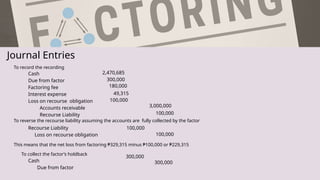
Journal Entries
To record the recording
To reverse the recourse liability assuming the accounts are fully collected by the factor
Cash
Due from factor
Factoring fee
Interest expense
Loss on recourse obligation
Accounts receivable
Recourse Liability
Recourse Liability
Loss on recourse obligation
This means that the net loss from factoring ₱329,315 minus ₱100,000 or ₱229,315
Cash
Due from factor
To collect the factor’s holdback
2,470,685
300,000
180,000
49,315
100,000
3,000,000
100,000
100,000
100,000
300,000
300,000
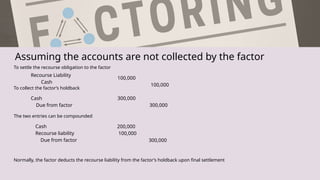
Assuming the accounts are not collected by the factor
To settle the recourse obligation to the factor
Recourse Liability
Cash
To collect the factor’s holdback
Cash
Due from factor
The two entries can be compounded
Cash
Recourse liability
Due from factor
Normally, the factor deducts the recourse liability from the factor’s holdback upon final settlement
100,000
100,000
300,000
300,000
200,000
100,000
300,000
Credit Card
A Credit Card is a plastic card which enables the holder to obtain credit up to predetermined limit from the
issuer of the card for the purchase of goods and services
The credit card has enabled retailers and other businesses to continue to sell goods and services where
the customers obtain possession of the goods immediately but do not have to pay for the goods for about
one month
Most banks offer credit cards to their depositor. The major credit cards in the Philippines Security bank
card, BDO Card, Metrobank Card, BPI Express Credit, Dinners Club, American Express, VISA and
MasterCard
These entities are generally responsible for approving the credit of customers and collecting the accounts
receivable for service fee from 1% to 5% of the credit sales.
Generally, if a customers buys good and uses a credit card, the credit card receipt must be forwarded by
the retailer the appropriate amount minus the credit service charge
Two entries are necessary , one entry at the time of sale and another entry when payment is received
from card issuer
Illustration
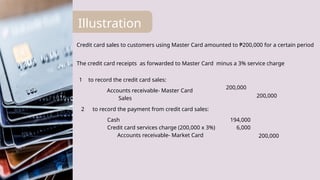
Credit card sales to customers using Master Card amounted to ₱200,000 for a certain period
The credit card receipts as forwarded to Master Card minus a 3% service charge
1 to record the credit card sales:
Accounts receivable- Master Card
Sales
to record the payment from credit card sales:
2
Cash
Credit card services charge (200,000 x 3%)
Accounts receivable- Market Card
200,000
200,000
200,000
194,000
6,000
THANK
YOU
Prof. Justiniano L. Santos, CPA, MBA

Chapter-7-Receivable-Financing.pptx. .

  • 1.
  • 2.
    Technical Knowledge To Knowthe accounting for pledge of accounts receivable To know the accounting for assignment of accounts Receivable To understand factoring of accounts receivable To know the classification and presentation of pledged, assigned and factored accounts receivable
  • 3.
    During a general businessdecline, an entity may find itself in tight cash position because sale decrease and customers are not paying their accounts on time But the entity’s current accounts and notes payable must continue to be paid if its credit standing is not to suffer. RECEIVABLE FINANCING Receivable financing is the financial flexibility or capability of an entity to raise money out of its receivable
  • 4.
    RECEIVABLE FINANCING The entity thenwould be in financial distress as collections of receivable are delayed but cash payments for obligations must be maintained Under these circumstances, if the situation becomes very critical the entity may be forced to look for cash by financing its receivables The common forms of receivable financing are pledge of accounts receivable, assignment of accounts receivable, factoring of accounts receivable and discounting of notes receivable
  • 5.
    PLEDGE OF ACCOUNT RECEIVABLE • When Loansare obtained from the bank or any lending institution, the accounts receivable may be pledged as collateral security for the payment of loan • Normally the borrower makes the collection of the pledged accounts BUT may required to turn over the collections to the bank satisfaction for the loan • NO complex problem are in this form of financing except the accounting for the loan • The loan is recorded by debiting cash and discount on note payable if loan is discounted, and crediting note payable • The subsequent payment of the loan is recorded by debiting note payable and crediting cash • With respect to the pledged accounts, no entry would be necessary. Its is sufficient that disclosure thereof is made in a note to financial statement
  • 6.
    Face Amount ofloan Interest deducted in advance (1,000,000 x 12%) On November 1, 2024, an entityt borrowed ₱1,000,000 from bank and issued a promissory note for the same. The term of the loan is one (1) year and discounted at 12% the entity pledged account receivable of ₱2,000,000 to secure the loan If the loan is discounted, in the banking parlance this means that the interest for the term of the loan is deducted in advance, Illustration Cash Discount on note payable Note Payable- bank Net proceeds 880,000 120,000 1,000,000 1,000,000 (120,000) 880,000
  • 7.
    Illustration On December 31,2024, using the the straight line method, the discount on note payable is amortized as interest expanse for two moths for November 1 to December 31. Interest Expense (120,000 x 2/12) Discount on note Payable 20,000 20,000
  • 8.
    1,000,000 (100,000) Illustration If a statmentof financial position is prepared on December 31, 2024, the note payable-bank and discount on note payable are presented as current liability Note Payable-bank Discount on note payable Carrying amount • A note to financial statement should be made • The note payable to bank matures on November 1, 2025 and is secured by accounts receivable with face amount of ₱200,000,000 • On November 1, 2025, the payment of the bank loan is recorded and this discount on note payable is finally amortized Note Payable-Bank Cash Interest Expense Discount on note payable 900,000 1,000,000 1,000,000 100,000 100,000
  • 9.
    • Assignment ofaccounts receivable means that the borrower called the assignor Transfers right in some accounts receivable to a lender called the assignee in consideration for a loan • Actually, Assignment is more formal type of pledging of accounts receivable. Secured borrowing evidenced by a financing agreement and promissory note both of which the assignor signs • However, pledging is general because all accounts receivable serves as collateral security for the loan • On other hand, assignment is specific because specific accounts receivable serves as collateral security for the loan ASSIGNMENT OF ACCOUNTS RECEIVABLE
  • 10.
    ASSIGNMENT OF ACCOUNTSRECEIVABLE Assignment May be done either nonnotification or notification Basis When accounts are assigned on nonnotification basis, customers are NOT informed that their accounts have been assigned As Results, the customer continue to make payments to the assignor, who in turn remits the collection to the assignee
  • 11.
    ILLUSTRATION- Nonnotification Basis April 1An entity assign ₱700,000 of accounts receivable to a bank under a nontotification arrangement. Th bank advances 80%nless a charge of ₱5,000 Accounts Receivable Assigned Accounts Receivable To Record Loan: Cash (560,000 - 5,000) Service Charge Note Payable- Bank 5 Issued Credit memo for sales return to a customer whose account was assigned, ₱20,000 The entity signed a promissory note that provides for interest 1% per month on the unpaid loan balances To separate the assigned accounts : Sale Return Accounts Receivable 10 Collected ₱300,000 of the assigned accounts less 2% discount Cash Sales discount (2% x 300,000) Accounts receivable-assigned 30 Remitted the total collections to the bank plus interest for one (1) month Note Payable- Bank Interest Expense Cash 700,000 700,000 555,000 5,000 560,000 20,000 20,000 294,000 6,000 300,000 294,000 5,000 299,000
  • 12.
    ILLUSTRATION- Nonnotification Basis May 7Assigned Accounts of ₱ 15,000 proved worthless Allowance for Doubtful Accounts Accounts receivable- assigned 15,000 15,000 20 Collected ₱ 300,000 of the assigned accounts Cash Accounts Receivable- Assigned 300,000 300,000 30 Remitted the total amount due the bank to pay off the loan balance plus interest for one (1) month Note Payable- Bank (560,000 - 294.000) Interest Expense (1% x 266,000) Cash 266,000 To transfer the remaining balance of assigned accounts to accounts : Accounts Receivable Accounts Receivable- Assigned 65,000 65,000 Total Accounts Receivable - Assigned Less: Collection Sale Discount Sale Return Worthless Accoun Balance 2,660 268,880 700,000 65,000 594,000 (294,000 + 300,000) 6,000 20,000 15,000 (635,000)
  • 13.
    ASSIGNMENT OF ACCOUNTSRECEIVABLE Assignment May be done either nonnotification or notification Basis When accounts are assigned on notification basis, customers are nitified to make their payments directly to the assignee. The assignee usually lends only a certain percentage of the face value of the accounts assigned because the assigned accounts may NOT be fully realized by reason of such factors as sales discount, sale return and allowances and uncollectible accounts The percentage may be 70%, 80% or 90% depending on the quality account The assignee usually charges interest for the loan that it makes and requires a service or financing charge or commission for assignment agreement.
  • 14.
    ILLUSTRATION- Notification Basis JULY 1An entity assign ₱ 1,000,000 of accounts receivable to a bank under a notification arrangement The bank loans 80% less 4% service charge on the gross amount assigned. The entity signed promissory note the provides for 1% interest per moth on the unpaid loan balance July 1 Account Receivable - Assigned 1,000,000 Account Receivable 1,000,000 Cash (800,000 - 40, 000) 760,000 Service Charge (4% x 1,000,000) 40,000 Note Payable- Bank 800,000 31 Received notice from bank that ₱ 600,000 of the assigned accounts were collected less 2% discount. A check was sent to the bank for the interest due. Note Payable- Bank 588,000 Sales Discount (2% x 600,000) 12,000 Accounts receivable- assigned 600,000 Interest Expense (1% x 800,000) 8,000 Cash 8,000
  • 15.
    ILLUSTRATION- Notification Basis AUGUST 31Received notice from bank that ₱ 300,000 of the assigned accounts were collected. Final settlement was made by the bank for excess collection together with the uncollected assigned accounts of ₱ 100,000 Cash 85,000 Interest Expense 2,120 Note payable- bank 212,000 Accounts Receivable- Assigned 300,000 Accounts Receivable 100,000 Accounts receivable- assigned 100,000
  • 16.
    An Entry providedthe following accounts at year- end Accounts Receivable - unassigned Accounts Receivable- Assigned Allowance for Doubtful Accounts Notes Payable- Bank (related to assignment) Accounts Receivable- Unassigned Account Receivable- Assigned Total Allowance for doubtful accounts Net Realizable value STATEMENT PRESENTATION ILLUSTRATION- Notification Basis COMPUTATION Loan from Bank Less: July collection by bank Balance Due the Bank August Collection by Bank Less: Loan balance Excess Collection Less: Interest (1% x 212, 000) Remittance from bank 800,000 558,000 212,000 300,000 212,000 88,000 2,120 85,880 ₱ 4,000,000 1,000,000 100,000 400,000 4,000,000 1,000,000 5,000,000 (100,000) 4,900,000
  • 17.
    EQUITY IN ASSIGNEDACCOUNTS ILLUSTRATION- Notification Basis Moreover, the entity shall disclose its equity in the assigned accounts. The Equity in assigned accounts is equa; to the balance of assigned accounts receivable minus the balance of the related note payable to bank Accounts Receivable - assigned Note Payable- Bank Equity in assigned accounts 1,000,000 (400,000) 600,000
  • 18.
    FACTORING Factoring is asale of accounts receivable usually on without resource, notification basis. In a factoring arrangement, an entity sells accounts receivable to a bank or finance entity called a factor A gain or loss is recognized for the difference between the proceeds received and the net carrying amount of the accounts receivable Differs from an assignment in that an entity actually transfer ownership of the accounts receivable to the factor. Factors assumes responsibility for assumes responsibility for uncollectible factored accounts. In assignment, the assignor retains ownership of the accounts receivable assigned Because of the nature of the transaction, the customers whose accounts are factored are notified and required to pay directly to the factor May take the form of casual casual factoring and factoring as a continuing arrangement.
  • 19.
    CASUAL FACTORING If anentity finds itself in a critical cash position, it may be forced to factor some or all of its accounts receivable at a substantial discount to a bank. For example , an entity factored ₱ 100,000 of accounts receivable with an allowance for doubtful accounts of ₱5,000 for ₱80,000 Cash Allowance for doubtful accounts Loss on factoring Accounts Receivable 80,000 5,000 15,000 100,000
  • 20.
    FACTORING AS ACONTINUING AGEREEMENT In this setup, before a merchandise is shipped to a customer, the selling entity requests the factor’s credit approval. If it is approved, the account is sold immediately to the factor after shipment of the goods. The factor then assumes the credit function as well as the collection function. For comprehension, the factor typically charges a commission of factoring fee of 5% to 20% Moreover, the factor may withhold a predetermined amount as a protection against customer returns and allowance and other special adjustment known as the “factor’s holdback” The factor’s holdback is actually a receivable from factor and classified as current asset
  • 21.
    ILLUSTRATION An entity factoredaccounts receivable of ₱500,000 with credit terms of 2/10, n/30 immediately after shipment of the goods to the customer The factor charged a 5% commission based on the gross amount of the receivables factored. In addition, the factor withheld 20% of the amount of the receivables factored to cover sales return and allowance Journal entry to record the factoring Cash Sale discount Commission Receivable from factor Accounts Receivable 365,000 10,000 25,000 100,000 500,000
  • 22.
    ILLUSTRATION COMPUTATION Gross Amount Less: Salesdiscount Commission Factor’s holdback Cash received from factoring (2% x 500,000) (5% x 500,000) (20% x 500,000) If the customer is subsequently allowed a credit of ₱ 50,000 for damaged merchadise: Sales return and allowance Sales discount (2% x 50,000) Receivable from factor When all the accounts receivable factored are collected by the factor with no factor with no further returns and allowances, the final settlement with factor is normally recorded Cash (100,000 - 49,000) Receivable from factor 500,000 10,000 25,000 100,000 135,000 365,000 50,000 1,000 49,000 51,000 51,000
  • 23.
    ILLUSTRATION-With recourse fornonpayment COMPUTATION An entity factored ₱3,000,000 of accounts receivable at year-end. Control was surrendered. The factor accepted the accounts receivable subject to recourse for non payment. The factor assessed a fee of 6% and retained a holdback equal to 10% of the accounts receivable In addition, the factor charged 12% interest compound on weighted-average time to maturity 50 days Accounts Receivable 3,000,000 Factor’s holdback Factoring fee Interest (10% x 3,000,000) (300,000) (6% x 3,000,000) (180,000) ( 3,000,000 x 12%x 50/365) (49,000) Cash initially received from factory 2,470,685 If the interest is computed on weighted average time basis, the denaminator is 365 days In the absence of any contrary statement, the simple interest is computed using 360 days as denominator Factoring fee 180,000 Interest 49,315 Recourse Obligation 100,000 Total loss on factoring initially recognized 329,315 Note that the recourse obligation in initially recorded as loss on factoring
  • 24.
    Journal Entries To recordthe recording To reverse the recourse liability assuming the accounts are fully collected by the factor Cash Due from factor Factoring fee Interest expense Loss on recourse obligation Accounts receivable Recourse Liability Recourse Liability Loss on recourse obligation This means that the net loss from factoring ₱329,315 minus ₱100,000 or ₱229,315 Cash Due from factor To collect the factor’s holdback 2,470,685 300,000 180,000 49,315 100,000 3,000,000 100,000 100,000 100,000 300,000 300,000
  • 25.
    Assuming the accountsare not collected by the factor To settle the recourse obligation to the factor Recourse Liability Cash To collect the factor’s holdback Cash Due from factor The two entries can be compounded Cash Recourse liability Due from factor Normally, the factor deducts the recourse liability from the factor’s holdback upon final settlement 100,000 100,000 300,000 300,000 200,000 100,000 300,000
  • 26.
    Credit Card A CreditCard is a plastic card which enables the holder to obtain credit up to predetermined limit from the issuer of the card for the purchase of goods and services The credit card has enabled retailers and other businesses to continue to sell goods and services where the customers obtain possession of the goods immediately but do not have to pay for the goods for about one month Most banks offer credit cards to their depositor. The major credit cards in the Philippines Security bank card, BDO Card, Metrobank Card, BPI Express Credit, Dinners Club, American Express, VISA and MasterCard These entities are generally responsible for approving the credit of customers and collecting the accounts receivable for service fee from 1% to 5% of the credit sales. Generally, if a customers buys good and uses a credit card, the credit card receipt must be forwarded by the retailer the appropriate amount minus the credit service charge Two entries are necessary , one entry at the time of sale and another entry when payment is received from card issuer
  • 27.
    Illustration Credit card salesto customers using Master Card amounted to ₱200,000 for a certain period The credit card receipts as forwarded to Master Card minus a 3% service charge 1 to record the credit card sales: Accounts receivable- Master Card Sales to record the payment from credit card sales: 2 Cash Credit card services charge (200,000 x 3%) Accounts receivable- Market Card 200,000 200,000 200,000 194,000 6,000
  • 28.