Books of Accounts
GENERAL JOURNAL
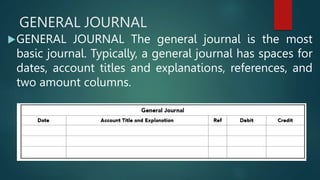
GENERAL JOURNAL The general journal is the most
basic journal. Typically, a general journal has spaces for
dates, account titles and explanations, references, and
two amount columns.
GENERAL JOURNAL
The journal makes several significant contributions to
the recording process:
• It discloses in one place the complete effects of a
transaction.
• It provides a chronological record of transactions.
• It helps to prevent or locate errors because the debit
and credit amounts for each entry can be easily
compared.
GENERAL JOURNAL
• September 1, 2015 Mr. Ben Mabait invested
PHP500,000 in a restaurant business by opening an
account with SuperBank.
GENERAL JOURNAL
• September 5, 2015 purchased kitchen appliances for
his business amounting to PHP100,000 by issuing a
check.
GENERAL JOURNAL
• September 6, 2015 started his operations a made a
sales for that day amounting to PHP20,000.
GENERAL JOURNAL
On September 7, 2015, Mr. Mabait purchased a motorcycle
costing PHP80,000. He pays PHP30,000 cash and agrees to
pay the remaining PHP50,000 on account (to be paid later).
(compound entry)
SPECIAL JOURNAL
Some businesses encounter voluminous quantities of similar
and recurring transactions which may create congestion if
these transactions are recorded repeatedly in a single day or
a month in the general journal. Take the case of our example
above, if Mr. Mabait will record the sales per day using the
Official Receipt or Cash Sales Invoice issued, it would be
unnecessary and impractical to credit “sales” account
repeatedly. In order to facilitate efficient and practical
recording of similar and recurring transactions, a special
journal is used
SPECIAL JOURNAL
The following are the commonly used special journals:
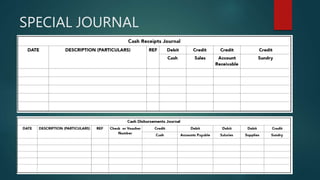
• Cash Receipts Journal – used to record all cash that has
been received
• Cash Disbursements Journal – used to record all

transactions involving cash payments
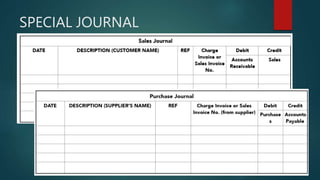
• Sales Journal (Sales on Account Journal) – used to record
all sales on credit (on account)
• Purchase Journal (Purchase on Account Journal) – used to
record all purchases of inventory on credit (or on account)
SPECIAL JOURNAL
SPECIAL JOURNAL
LEDGER
The ledger refers to the accounting book in which the
accounts and their related amounts as recorded in the journal
are posted periodically. The ledger is also called the ‘book of
final entry’ because all the balances in the ledger are used in
the preparation of financial statements. This is also referred
to as the T-Account because the basic form of a ledger is like
the letter ‘T’.
There are two kinds of ledgers, namely; the general ledger
and the subsidiary ledgers.
GENERAL LEDGER
The general ledger (commonly referred by accounting
professionals as GL) is a grouping of all accounts used in the
preparation of financial statements. The GL is a controlling
account because it summarizes all the activities that have
taken place as recorded in its subsidiary ledger.
GENERAL LEDGER
• The account portion refers to the account title for example: cash, accounts
receivable.
• The account number is an assigned number for each account title to facilitate
ease in recording and cross-referencing.
• The Date column identifies when the transaction happened.
• The item represents the source journal and the nature of the transactions
• The Reference identifies the page number of the general our special journal
from which the information was taken.
• The Debit and Credit columns are used in recording the amount of
transactions from the general journal or special journal.
• The Balance Column represents the running balance of the Account after
considering the debit and credit amounts. If the running balance amount is
positive, the account has a debit balance whereas if it has a negative running
balance, the accounts has a credit balance.
SUBSIDIARY LEDGER
A subsidiary ledger is a group of like accounts that contains
the independent data of a specific general ledger. A
subsidiary ledger is created or maintained if individualized
data is needed for a specific general ledger account. An
example of a subsidiary ledger is the individual record of
various payables to suppliers. The total amount of these
subsidiary ledgers should equal the balance in the Accounts
Payable general ledger.
SUBSIDIARY LEDGER
A subsidiary ledger is a group of like accounts that contains
the independent data of a specific general ledger. A
subsidiary ledger is created or maintained if individualized
data is needed for a specific general ledger account. An
example of a subsidiary ledger is the individual record of
various payables to suppliers. The total amount of these
subsidiary ledgers should equal the balance in the Accounts
Payable general ledger.
SUMMARY
1. Types of transactions recorded in the cash receipts journal:
• cash received from a charge (on account) customer
• cash received from a charges (on account) customer less a
cash discount
• cash sales
• cash received from sale of other assets.
• all other transactions that require the issuance of a Cash
receipt or Official Receipt document
SUMMARY
2. A sales journal is used when two conditions are met:
• merchandise is sold
• the sale is on account
3. A cash disbursements journal (cash payments journal) is
used to record the following transactions:
• purchase of merchandise for cash
• payment to creditor, vendors or suppliers
• all cash payments
QUIZ:
1. Enumerate all special journals.
2. Why do companies use special journals? (or What are the
advantages of using a special journal)
3. Identify the appropriate special journal to be used for
every source document listed below:
a•Official Receipt issued by the company
b•Charge Invoice issued by the company
c•Charge Invoice from a supplier
d•Official receipt from a supplier as proof of payment of
account

Books-of-Accounts.pptx

  • 1.
  • 2.
    GENERAL JOURNAL GENERAL JOURNALThe general journal is the most basic journal. Typically, a general journal has spaces for dates, account titles and explanations, references, and two amount columns.
  • 3.
    GENERAL JOURNAL The journalmakes several significant contributions to the recording process: • It discloses in one place the complete effects of a transaction. • It provides a chronological record of transactions. • It helps to prevent or locate errors because the debit and credit amounts for each entry can be easily compared.
  • 4.
    GENERAL JOURNAL • September1, 2015 Mr. Ben Mabait invested PHP500,000 in a restaurant business by opening an account with SuperBank.
  • 5.
    GENERAL JOURNAL • September5, 2015 purchased kitchen appliances for his business amounting to PHP100,000 by issuing a check.
  • 6.
    GENERAL JOURNAL • September6, 2015 started his operations a made a sales for that day amounting to PHP20,000.
  • 7.
    GENERAL JOURNAL On September7, 2015, Mr. Mabait purchased a motorcycle costing PHP80,000. He pays PHP30,000 cash and agrees to pay the remaining PHP50,000 on account (to be paid later). (compound entry)
  • 8.
    SPECIAL JOURNAL Some businessesencounter voluminous quantities of similar and recurring transactions which may create congestion if these transactions are recorded repeatedly in a single day or a month in the general journal. Take the case of our example above, if Mr. Mabait will record the sales per day using the Official Receipt or Cash Sales Invoice issued, it would be unnecessary and impractical to credit “sales” account repeatedly. In order to facilitate efficient and practical recording of similar and recurring transactions, a special journal is used
  • 9.
    SPECIAL JOURNAL The followingare the commonly used special journals: • Cash Receipts Journal – used to record all cash that has been received • Cash Disbursements Journal – used to record all transactions involving cash payments • Sales Journal (Sales on Account Journal) – used to record all sales on credit (on account) • Purchase Journal (Purchase on Account Journal) – used to record all purchases of inventory on credit (or on account)

  • 10.
  • 11.
  • 12.
    LEDGER The ledger refersto the accounting book in which the accounts and their related amounts as recorded in the journal are posted periodically. The ledger is also called the ‘book of final entry’ because all the balances in the ledger are used in the preparation of financial statements. This is also referred to as the T-Account because the basic form of a ledger is like the letter ‘T’. There are two kinds of ledgers, namely; the general ledger and the subsidiary ledgers.
  • 13.
    GENERAL LEDGER The generalledger (commonly referred by accounting professionals as GL) is a grouping of all accounts used in the preparation of financial statements. The GL is a controlling account because it summarizes all the activities that have taken place as recorded in its subsidiary ledger.
  • 14.
    GENERAL LEDGER • Theaccount portion refers to the account title for example: cash, accounts receivable. • The account number is an assigned number for each account title to facilitate ease in recording and cross-referencing. • The Date column identifies when the transaction happened. • The item represents the source journal and the nature of the transactions • The Reference identifies the page number of the general our special journal from which the information was taken. • The Debit and Credit columns are used in recording the amount of transactions from the general journal or special journal. • The Balance Column represents the running balance of the Account after considering the debit and credit amounts. If the running balance amount is positive, the account has a debit balance whereas if it has a negative running balance, the accounts has a credit balance.
  • 15.
    SUBSIDIARY LEDGER A subsidiaryledger is a group of like accounts that contains the independent data of a specific general ledger. A subsidiary ledger is created or maintained if individualized data is needed for a specific general ledger account. An example of a subsidiary ledger is the individual record of various payables to suppliers. The total amount of these subsidiary ledgers should equal the balance in the Accounts Payable general ledger.
  • 16.
    SUBSIDIARY LEDGER A subsidiaryledger is a group of like accounts that contains the independent data of a specific general ledger. A subsidiary ledger is created or maintained if individualized data is needed for a specific general ledger account. An example of a subsidiary ledger is the individual record of various payables to suppliers. The total amount of these subsidiary ledgers should equal the balance in the Accounts Payable general ledger.
  • 17.
    SUMMARY 1. Types oftransactions recorded in the cash receipts journal: • cash received from a charge (on account) customer • cash received from a charges (on account) customer less a cash discount • cash sales • cash received from sale of other assets. • all other transactions that require the issuance of a Cash receipt or Official Receipt document
  • 18.
    SUMMARY 2. A salesjournal is used when two conditions are met: • merchandise is sold • the sale is on account 3. A cash disbursements journal (cash payments journal) is used to record the following transactions: • purchase of merchandise for cash • payment to creditor, vendors or suppliers • all cash payments
  • 19.
    QUIZ: 1. Enumerate allspecial journals. 2. Why do companies use special journals? (or What are the advantages of using a special journal) 3. Identify the appropriate special journal to be used for every source document listed below: a•Official Receipt issued by the company b•Charge Invoice issued by the company c•Charge Invoice from a supplier d•Official receipt from a supplier as proof of payment of account