3.1

Business Communication
MBA – II
CIIT
Course Coordinator:

Ayyaz Qadeer

To accompany Excellence in Business Communication, 5e , Thill and Bovée © 2002 Prentice-Hall
3.2

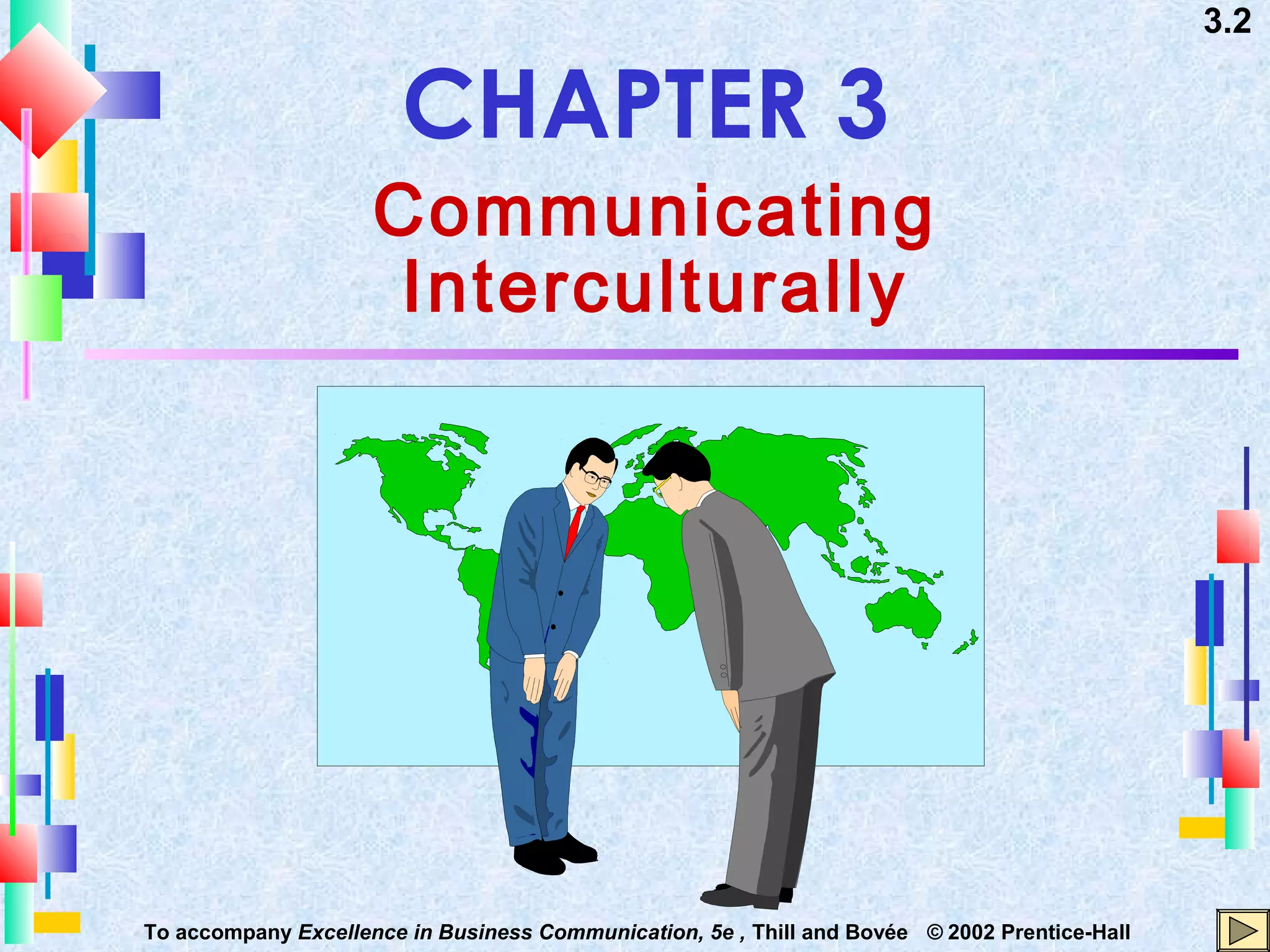
CHAPTER 3
Communicating
Interculturally

To accompany Excellence in Business Communication, 5e , Thill and Bovée © 2002 Prentice-Hall
3.3

Chapter 3 Objectives
 Discuss trends that have made

intercultural business
communications so important.
 Discuss culture and subculture and
culture’s four basic characteristics.
 Delineate the differences between
high-context and low context cultures.
 Recognize cultural differences.
 Discuss ethnocentrism and
stereotyping.
To accompany Excellence in Business Communication, 5e , Thill and Bovée © 2002 Prentice-Hall
3.4

Chapter 3 Objectives

continued

 Discuss three ways to improve

communication with people who speak
English as a second language; then
discuss three ways to improve
communication with people who do not
speak your language at all.
 Explain why studying other cultures
helps you communicate more
effectively.
 Illustrate how word choice affects
communication among people from
other cultures.
To accompany Excellence in Business Communication, 5e , Thill and Bovée © 2002 Prentice-Hall
Quick
Quiz

3.5

Some Key Definitions

Define each of the following terms:
Intercultural communication
Market globalization
Cultural diversity
Cultural diversity
Culture
Culture
Subculture
Subculture
To accompany Excellence in Business Communication, 5e , Thill and Bovée © 2002 Prentice-Hall
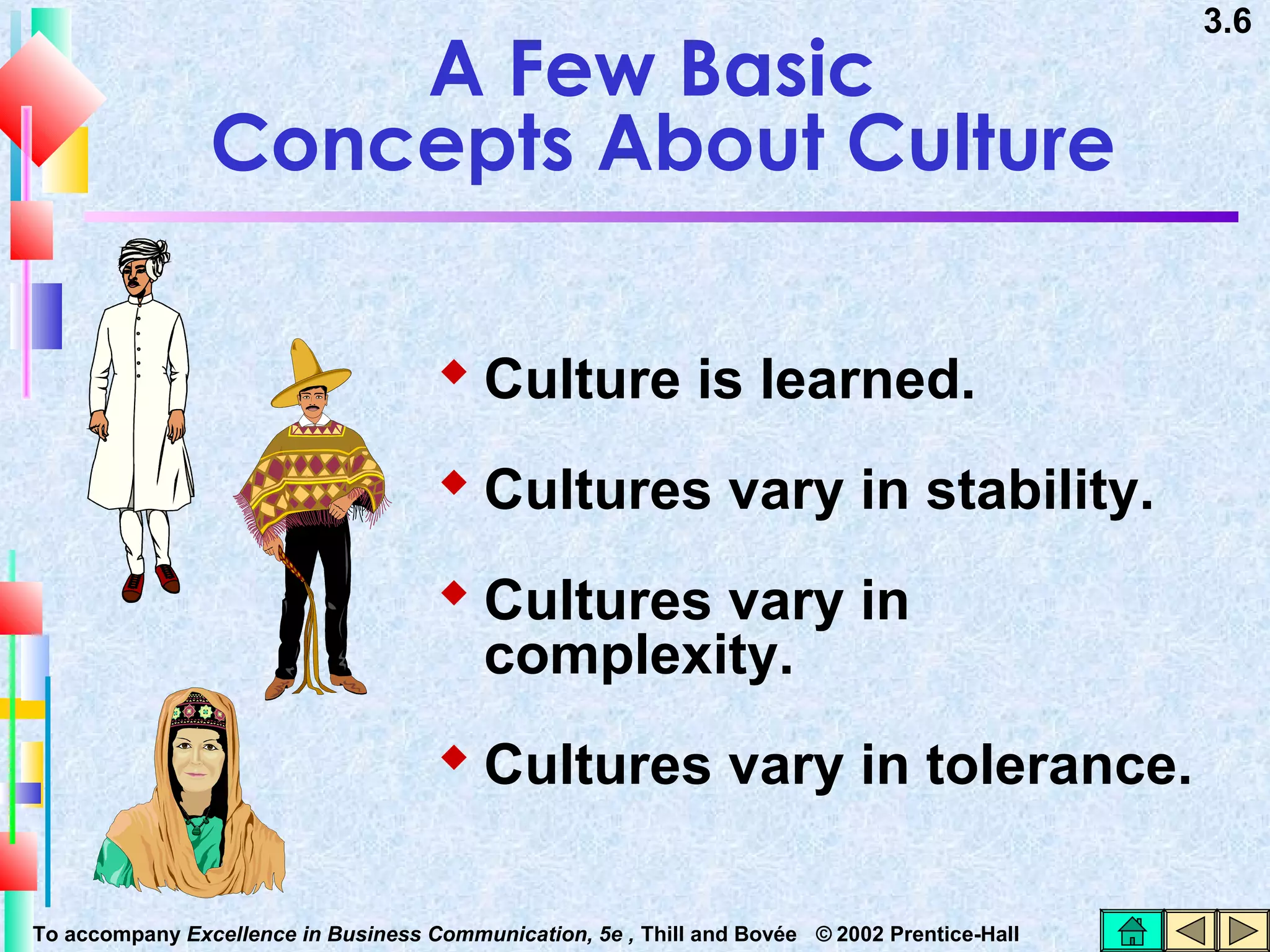
A Few Basic
Concepts About Culture
 Culture is learned.
 Cultures vary in stability.
 Cultures vary in
complexity.

 Cultures vary in tolerance.
To accompany Excellence in Business Communication, 5e , Thill and Bovée © 2002 Prentice-Hall

3.6
3.7

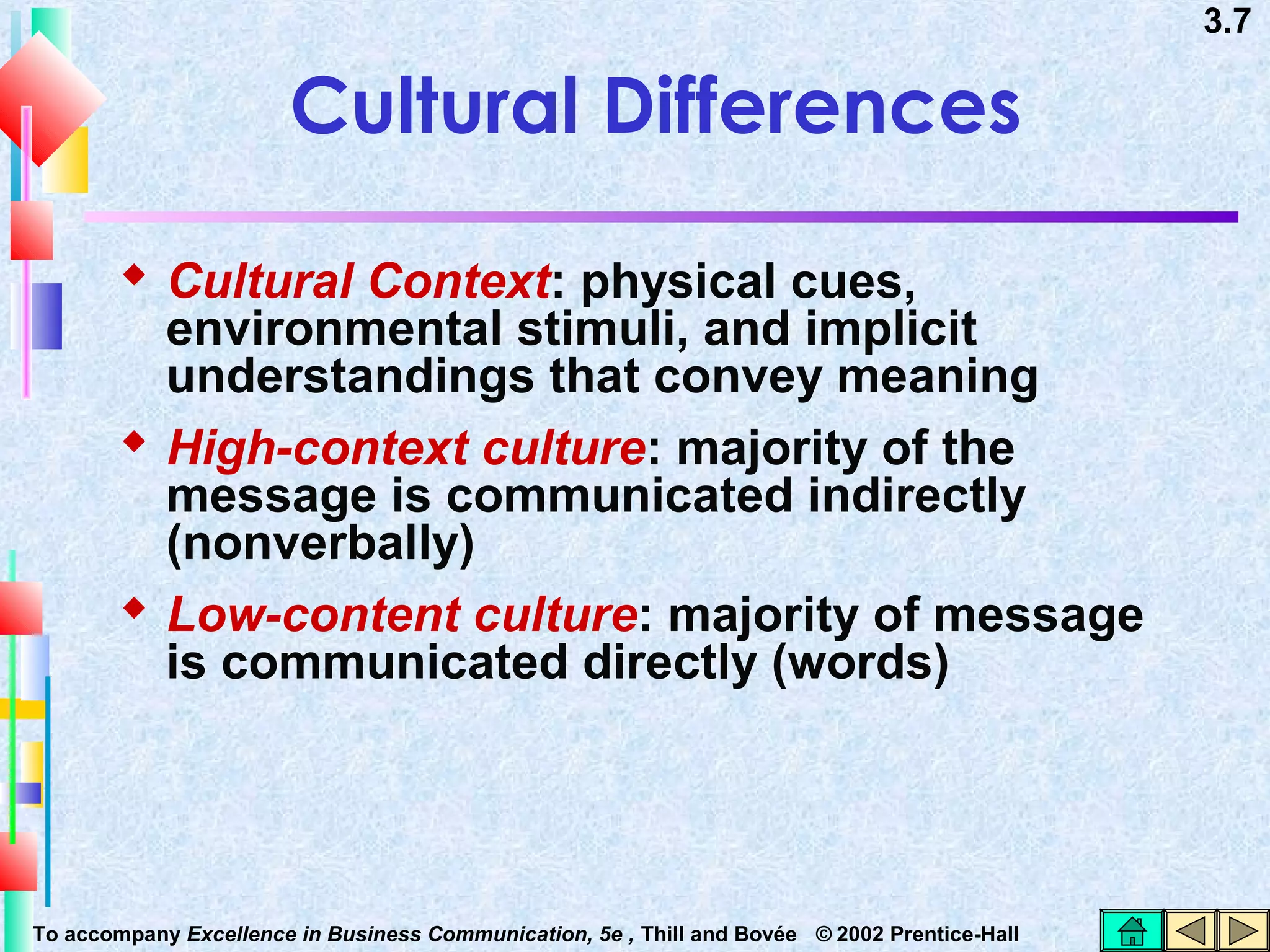
Cultural Differences
 Cultural Context: physical cues,

environmental stimuli, and implicit
understandings that convey meaning
 High-context culture: majority of the
message is communicated indirectly
(nonverbally)
 Low-content culture: majority of message
is communicated directly (words)

To accompany Excellence in Business Communication, 5e , Thill and Bovée © 2002 Prentice-Hall
3.8

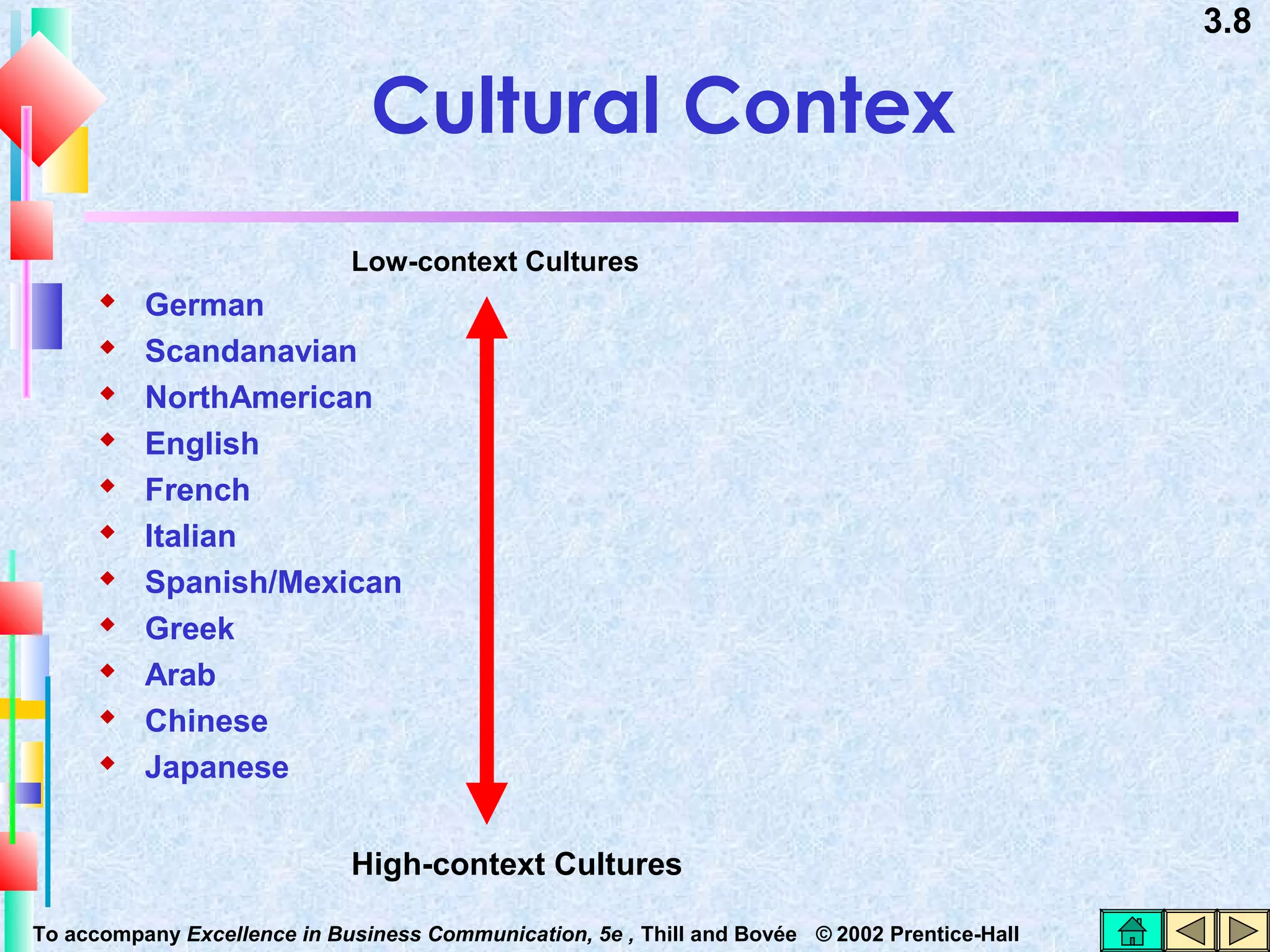
Cultural Contex
Low-context Cultures













German
Scandanavian
NorthAmerican
English
French
Italian
Spanish/Mexican
Greek
Arab
Chinese
Japanese
High-context Cultures

To accompany Excellence in Business Communication, 5e , Thill and Bovée © 2002 Prentice-Hall
3.9

Creating Ethical Messages
When communicating across cultures,
apply these four basic principles:
Seek mutual ground to allow clearest
possible exchange of information.
Send and receive messages
without judgment.
without judgment.
Send messages that are honest.
Show respect for cultural differences.
To accompany Excellence in Business Communication, 5e , Thill and Bovée © 2002 Prentice-Hall
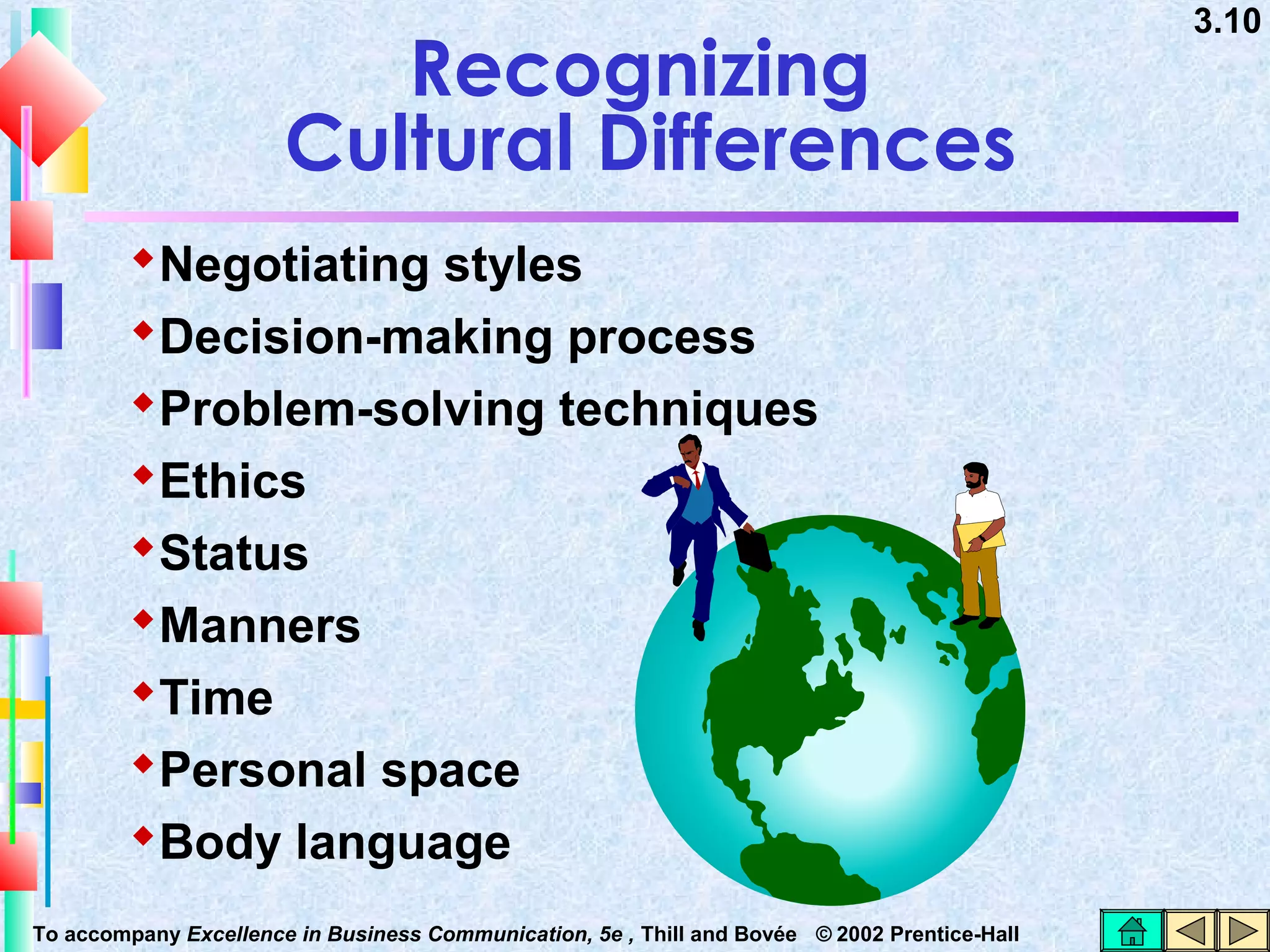
Recognizing
Cultural Differences
Negotiating styles
Decision-making process
Problem-solving techniques
Ethics
Status
Manners
Time
Personal space
Body language
To accompany Excellence in Business Communication, 5e , Thill and Bovée © 2002 Prentice-Hall

3.10
3.11

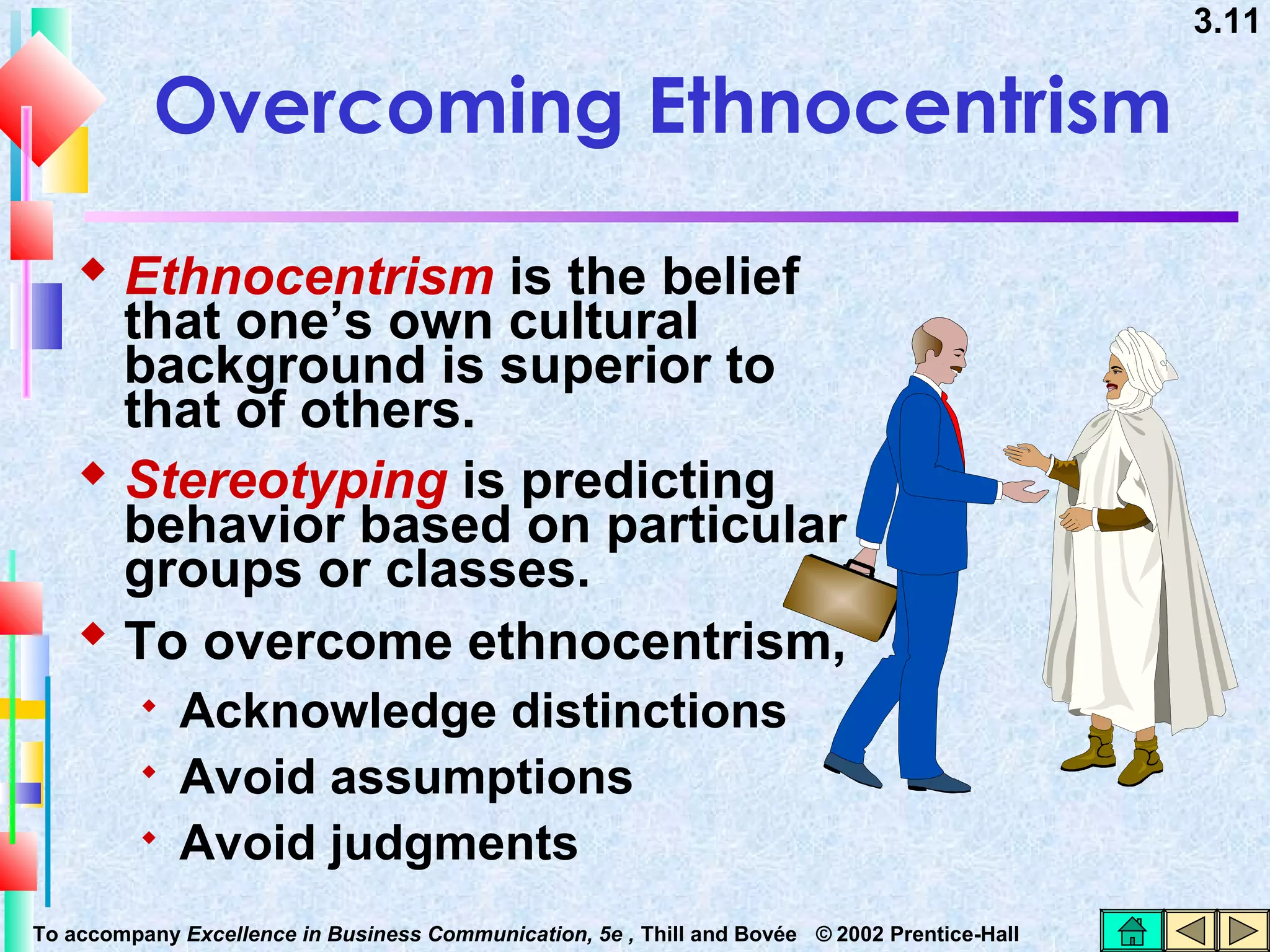
Overcoming Ethnocentrism
 Ethnocentrism is the belief

that one’s own cultural
background is superior to
that of others.
 Stereotyping is predicting
behavior based on particular
groups or classes.
 To overcome ethnocentrism,




Acknowledge distinctions
Avoid assumptions
Avoid judgments

To accompany Excellence in Business Communication, 5e , Thill and Bovée © 2002 Prentice-Hall
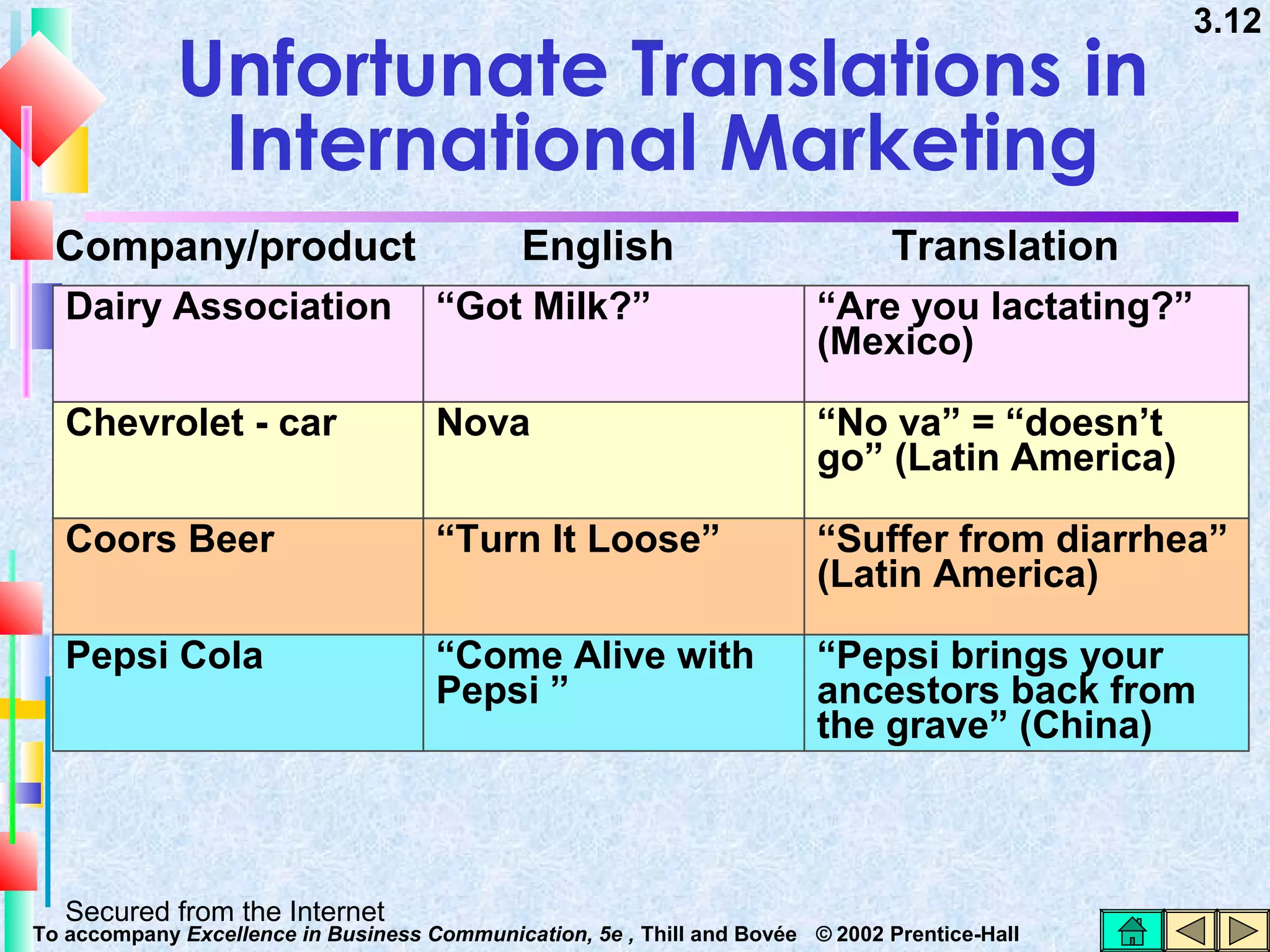
Unfortunate Translations in
International Marketing
Company/product

English

3.12

Translation

Dairy Association

“Got Milk?”

“Are you lactating?”
(Mexico)

Chevrolet - car

Nova

“No va” = “doesn’t
go” (Latin America)

Coors Beer

“Turn It Loose”

“Suffer from diarrhea”
(Latin America)

Pepsi Cola

“Come Alive with
Pepsi ”

“Pepsi brings your
ancestors back from
the grave” (China)

Secured from the Internet

To accompany Excellence in Business Communication, 5e , Thill and Bovée © 2002 Prentice-Hall
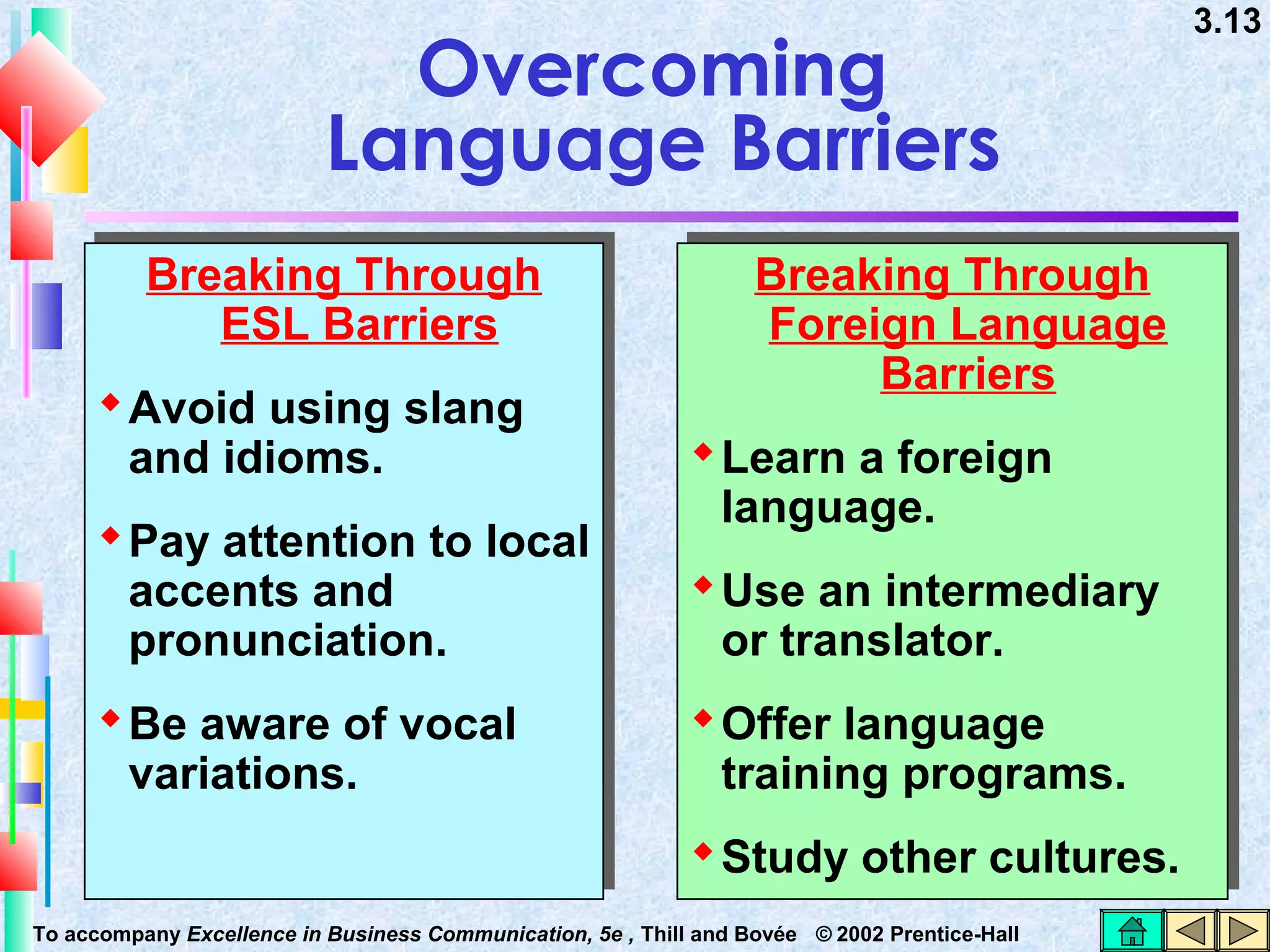
Overcoming
Language Barriers
Breaking Through
Breaking Through
ESL Barriers
ESL Barriers
 Avoid using slang
 Avoid using slang
and idioms.
and idioms.
 Pay attention to local
accents and
accents and
pronunciation.
pronunciation.
 Be aware of vocal
 Be aware of vocal
variations.
variations.

Breaking Through
Breaking Through
Foreign Language
Foreign Language
Barriers
Barriers
 Learn a foreign
 Learn a foreign
language.
language.
 Use an intermediary
or translator.
or translator.
 Offer language
 Offer language
training programs.
training programs.
 Study other cultures.

To accompany Excellence in Business Communication, 5e , Thill and Bovée © 2002 Prentice-Hall

3.13
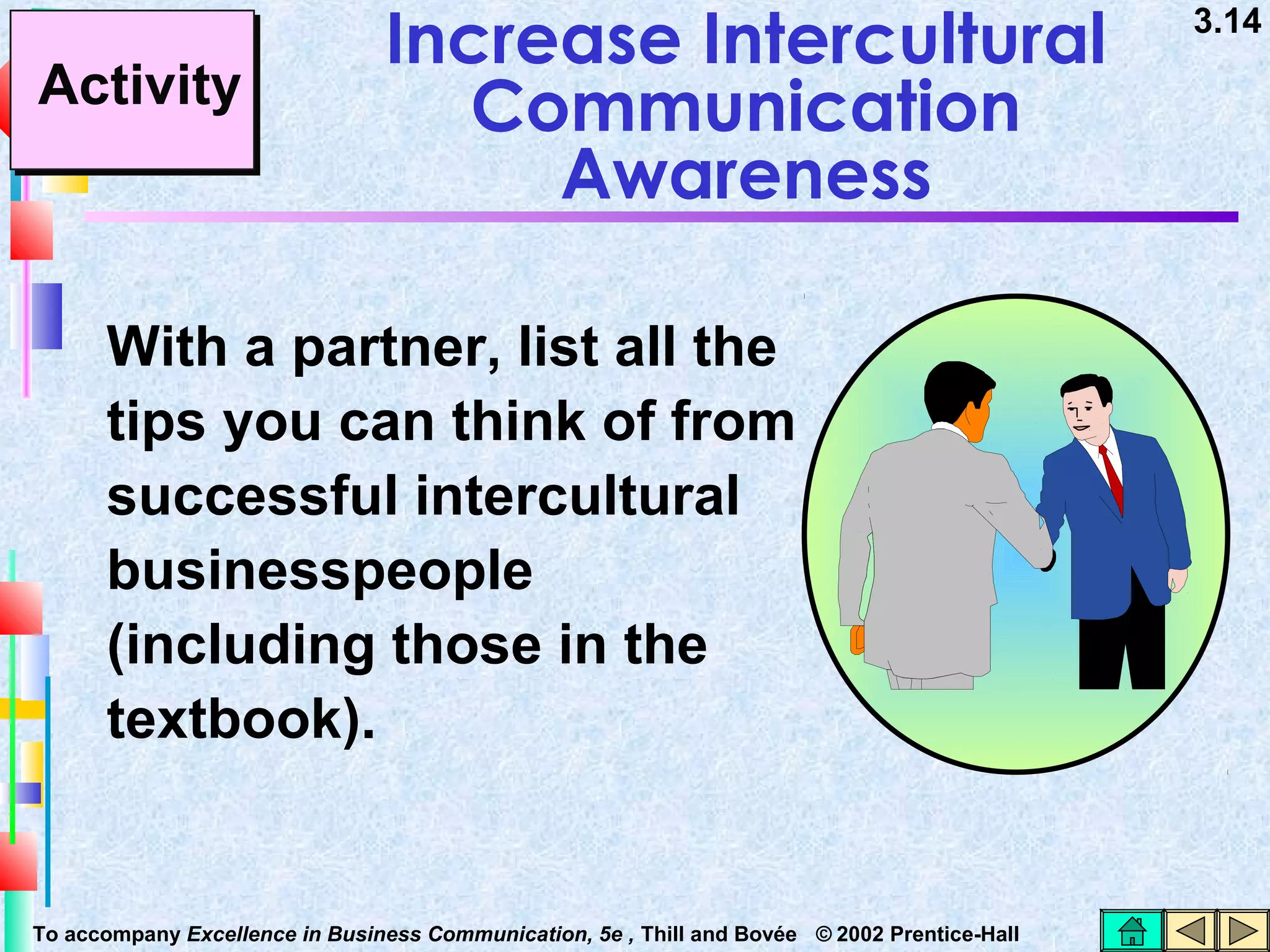
Activity

Increase Intercultural
Communication
Awareness

With a partner, list all the
tips you can think of from
successful intercultural
businesspeople
(including those in the
textbook).

To accompany Excellence in Business Communication, 5e , Thill and Bovée © 2002 Prentice-Hall

3.14
Developing Intercultural
Communication Skills
• Assume differences.

• Be flexible.

• Take responsibility.

3.15

• Emphasize some

• Withhold judgment.
• Show respect.
• Empathize.
• Tolerate ambiguity.
• Recognize bias.
• Learn patience and

persistence.

common ground.

• Send clear messages.
• Deal with the individual.
• Know when to be direct.
• Avoid the superficial.
• Evaluate feedback to

assess your hypothesis.

To accompany Excellence in Business Communication, 5e , Thill and Bovée © 2002 Prentice-Hall
3.16

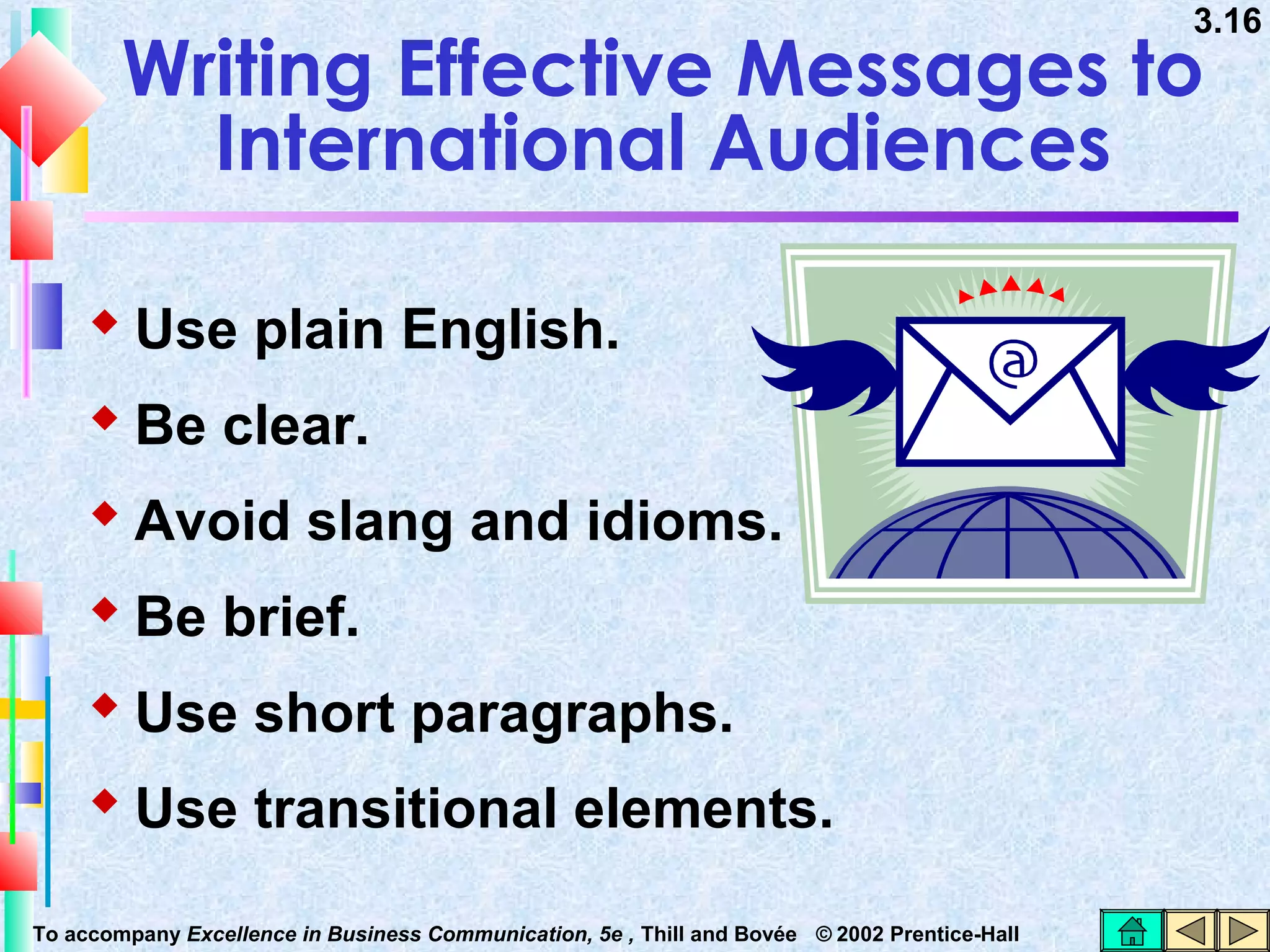
Writing Effective Messages to
International Audiences
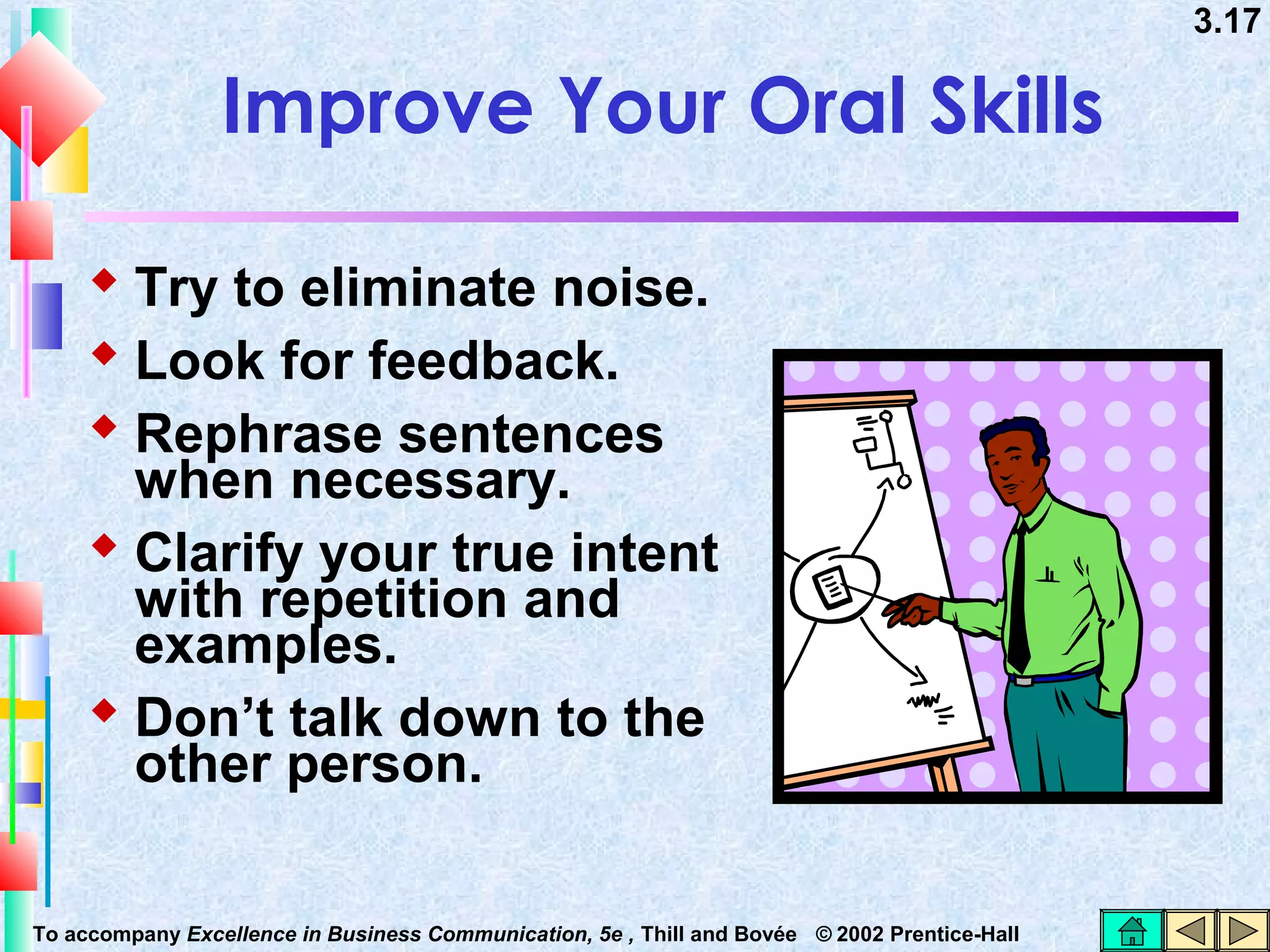
 Use plain English.
 Be clear.
 Avoid slang and idioms.
 Be brief.
 Use short paragraphs.
 Use transitional elements.
To accompany Excellence in Business Communication, 5e , Thill and Bovée © 2002 Prentice-Hall
3.17

Improve Your Oral Skills
 Try to eliminate noise.
 Look for feedback.
 Rephrase sentences

when necessary.
 Clarify your true intent
with repetition and
examples.
 Don’t talk down to the
other person.
To accompany Excellence in Business Communication, 5e , Thill and Bovée © 2002 Prentice-Hall
3.18

Improve Your Oral Skills
continued

 Use objective, accurate language.
 Listen carefully and patiently.
 Adapt your conversation style to
the other person’s.
 Clarify what will happen next.

To accompany Excellence in Business Communication, 5e , Thill and Bovée © 2002 Prentice-Hall
Let’s
Discuss

Test Your
Knowledge

 How have market globalization and

cultural diversity contributed to the
increased importance of intercultural
communication?
 What is the relationship between
culture and subculture?
 What are the four basic
characteristics of culture?

To accompany Excellence in Business Communication, 5e , Thill and Bovée © 2002 Prentice-Hall

3.19
Let’s
Discuss

Test Your
Knowledge

3.20

continued

 How do high-context cultures differ

from low-context cultures?
 In addition to the contextual
differences, what other categories of
cultural differences exist?
 What four principles apply to ethical
intercultural communication?
 What is ethnocentrism, and how can it
be overcome in communication?
To accompany Excellence in Business Communication, 5e , Thill and Bovée © 2002 Prentice-Hall
Let’s
Discuss

Test Your
Knowledge

3.21

continued

 Why is it a good idea to avoid slang

and idioms when addressing a
multicultural audience?
 What are some ways to improve oral
skills when communicating with people
of other cultures?
 What is the purpose of back-translation
when preparing a message in another
language?
To accompany Excellence in Business Communication, 5e , Thill and Bovée © 2002 Prentice-Hall

Chap03 excellence in bc

  • 1.
    3.1 Business Communication MBA –II CIIT Course Coordinator: Ayyaz Qadeer To accompany Excellence in Business Communication, 5e , Thill and Bovée © 2002 Prentice-Hall
  • 2.
    3.2 CHAPTER 3 Communicating Interculturally To accompanyExcellence in Business Communication, 5e , Thill and Bovée © 2002 Prentice-Hall
  • 3.
    3.3 Chapter 3 Objectives Discuss trends that have made intercultural business communications so important.  Discuss culture and subculture and culture’s four basic characteristics.  Delineate the differences between high-context and low context cultures.  Recognize cultural differences.  Discuss ethnocentrism and stereotyping. To accompany Excellence in Business Communication, 5e , Thill and Bovée © 2002 Prentice-Hall
  • 4.
    3.4 Chapter 3 Objectives continued Discuss three ways to improve communication with people who speak English as a second language; then discuss three ways to improve communication with people who do not speak your language at all.  Explain why studying other cultures helps you communicate more effectively.  Illustrate how word choice affects communication among people from other cultures. To accompany Excellence in Business Communication, 5e , Thill and Bovée © 2002 Prentice-Hall
  • 5.
    Quick Quiz 3.5 Some Key Definitions Defineeach of the following terms: Intercultural communication Intercultural communication Market globalization Market globalization Cultural diversity Cultural diversity Culture Culture Subculture Subculture To accompany Excellence in Business Communication, 5e , Thill and Bovée © 2002 Prentice-Hall
  • 6.
    A Few Basic ConceptsAbout Culture  Culture is learned.  Cultures vary in stability.  Cultures vary in complexity.  Cultures vary in tolerance. To accompany Excellence in Business Communication, 5e , Thill and Bovée © 2002 Prentice-Hall 3.6
  • 7.
    3.7 Cultural Differences  CulturalContext: physical cues, environmental stimuli, and implicit understandings that convey meaning  High-context culture: majority of the message is communicated indirectly (nonverbally)  Low-content culture: majority of message is communicated directly (words) To accompany Excellence in Business Communication, 5e , Thill and Bovée © 2002 Prentice-Hall
  • 8.
  • 9.
    3.9 Creating Ethical Messages Whencommunicating across cultures, apply these four basic principles: Seek mutual ground to allow clearest Seek mutual ground to allow clearest possible exchange of information. possible exchange of information. Send and receive messages Send and receive messages without judgment. without judgment. Send messages that are honest. Send messages that are honest. Show respect for cultural differences. Show respect for cultural differences. To accompany Excellence in Business Communication, 5e , Thill and Bovée © 2002 Prentice-Hall
  • 10.
    Recognizing Cultural Differences Negotiating styles Decision-makingprocess Problem-solving techniques Ethics Status Manners Time Personal space Body language To accompany Excellence in Business Communication, 5e , Thill and Bovée © 2002 Prentice-Hall 3.10
  • 11.
    3.11 Overcoming Ethnocentrism  Ethnocentrismis the belief that one’s own cultural background is superior to that of others.  Stereotyping is predicting behavior based on particular groups or classes.  To overcome ethnocentrism,    Acknowledge distinctions Avoid assumptions Avoid judgments To accompany Excellence in Business Communication, 5e , Thill and Bovée © 2002 Prentice-Hall
  • 12.
    Unfortunate Translations in InternationalMarketing Company/product English 3.12 Translation Dairy Association “Got Milk?” “Are you lactating?” (Mexico) Chevrolet - car Nova “No va” = “doesn’t go” (Latin America) Coors Beer “Turn It Loose” “Suffer from diarrhea” (Latin America) Pepsi Cola “Come Alive with Pepsi ” “Pepsi brings your ancestors back from the grave” (China) Secured from the Internet To accompany Excellence in Business Communication, 5e , Thill and Bovée © 2002 Prentice-Hall
  • 13.
    Overcoming Language Barriers Breaking Through BreakingThrough ESL Barriers ESL Barriers  Avoid using slang  Avoid using slang and idioms. and idioms.  Pay attention to local  Pay attention to local accents and accents and pronunciation. pronunciation.  Be aware of vocal  Be aware of vocal variations. variations. Breaking Through Breaking Through Foreign Language Foreign Language Barriers Barriers  Learn a foreign  Learn a foreign language. language.  Use an intermediary  Use an intermediary or translator. or translator.  Offer language  Offer language training programs. training programs.  Study other cultures.  Study other cultures. To accompany Excellence in Business Communication, 5e , Thill and Bovée © 2002 Prentice-Hall 3.13
  • 14.
    Activity Increase Intercultural Communication Awareness With apartner, list all the tips you can think of from successful intercultural businesspeople (including those in the textbook). To accompany Excellence in Business Communication, 5e , Thill and Bovée © 2002 Prentice-Hall 3.14
  • 15.
    Developing Intercultural Communication Skills •Assume differences. • Be flexible. • Take responsibility. 3.15 • Emphasize some • Withhold judgment. • Show respect. • Empathize. • Tolerate ambiguity. • Recognize bias. • Learn patience and persistence. common ground. • Send clear messages. • Deal with the individual. • Know when to be direct. • Avoid the superficial. • Evaluate feedback to assess your hypothesis. To accompany Excellence in Business Communication, 5e , Thill and Bovée © 2002 Prentice-Hall
  • 16.
    3.16 Writing Effective Messagesto International Audiences  Use plain English.  Be clear.  Avoid slang and idioms.  Be brief.  Use short paragraphs.  Use transitional elements. To accompany Excellence in Business Communication, 5e , Thill and Bovée © 2002 Prentice-Hall
  • 17.
    3.17 Improve Your OralSkills  Try to eliminate noise.  Look for feedback.  Rephrase sentences when necessary.  Clarify your true intent with repetition and examples.  Don’t talk down to the other person. To accompany Excellence in Business Communication, 5e , Thill and Bovée © 2002 Prentice-Hall
  • 18.
    3.18 Improve Your OralSkills continued  Use objective, accurate language.  Listen carefully and patiently.  Adapt your conversation style to the other person’s.  Clarify what will happen next. To accompany Excellence in Business Communication, 5e , Thill and Bovée © 2002 Prentice-Hall
  • 19.
    Let’s Discuss Test Your Knowledge  Howhave market globalization and cultural diversity contributed to the increased importance of intercultural communication?  What is the relationship between culture and subculture?  What are the four basic characteristics of culture? To accompany Excellence in Business Communication, 5e , Thill and Bovée © 2002 Prentice-Hall 3.19
  • 20.
    Let’s Discuss Test Your Knowledge 3.20 continued  Howdo high-context cultures differ from low-context cultures?  In addition to the contextual differences, what other categories of cultural differences exist?  What four principles apply to ethical intercultural communication?  What is ethnocentrism, and how can it be overcome in communication? To accompany Excellence in Business Communication, 5e , Thill and Bovée © 2002 Prentice-Hall
  • 21.
    Let’s Discuss Test Your Knowledge 3.21 continued  Whyis it a good idea to avoid slang and idioms when addressing a multicultural audience?  What are some ways to improve oral skills when communicating with people of other cultures?  What is the purpose of back-translation when preparing a message in another language? To accompany Excellence in Business Communication, 5e , Thill and Bovée © 2002 Prentice-Hall