Teaching Business English:  aspects to consider Prof. Diana Cristina Porto
Business English vs. General English Programmes Focus on developing: accuracy fluency Focus on developing : general language knowledge general communication skills.   Focus on developing: accuracy fluency effectiveness Focus on developing: general and specialist  language knowledge general and professional communication skills
Business English vs. General English SYLLABUS   Often determined by choice of textbook and end-of-term examination. Wide ranging syllabus: vocabulary from different areas and different styles   Set courses with fixed objectives and syllabus. Special courses with special syllabus. One-to-one courses may develop syllabus and content on an ongoing basis.
Business English vs. General English COURSE OBJECTIVES   Individual objectives: culture, traveling abroad, obtaining a better job. Examination courses: fixed pre-determined objectives   Defined precisely according to the needs analysis
Business English vs. General English METHODOLOGY   Communicative ELT methodology Communicative ELT methodology Communication skills training
Business English vs. General English TRAINERS   Need the following mix of knowledge and skills: ELT methodology Need the following mix of knowledge and skills: ELT methodology Communicative skills training Knowledge of business content
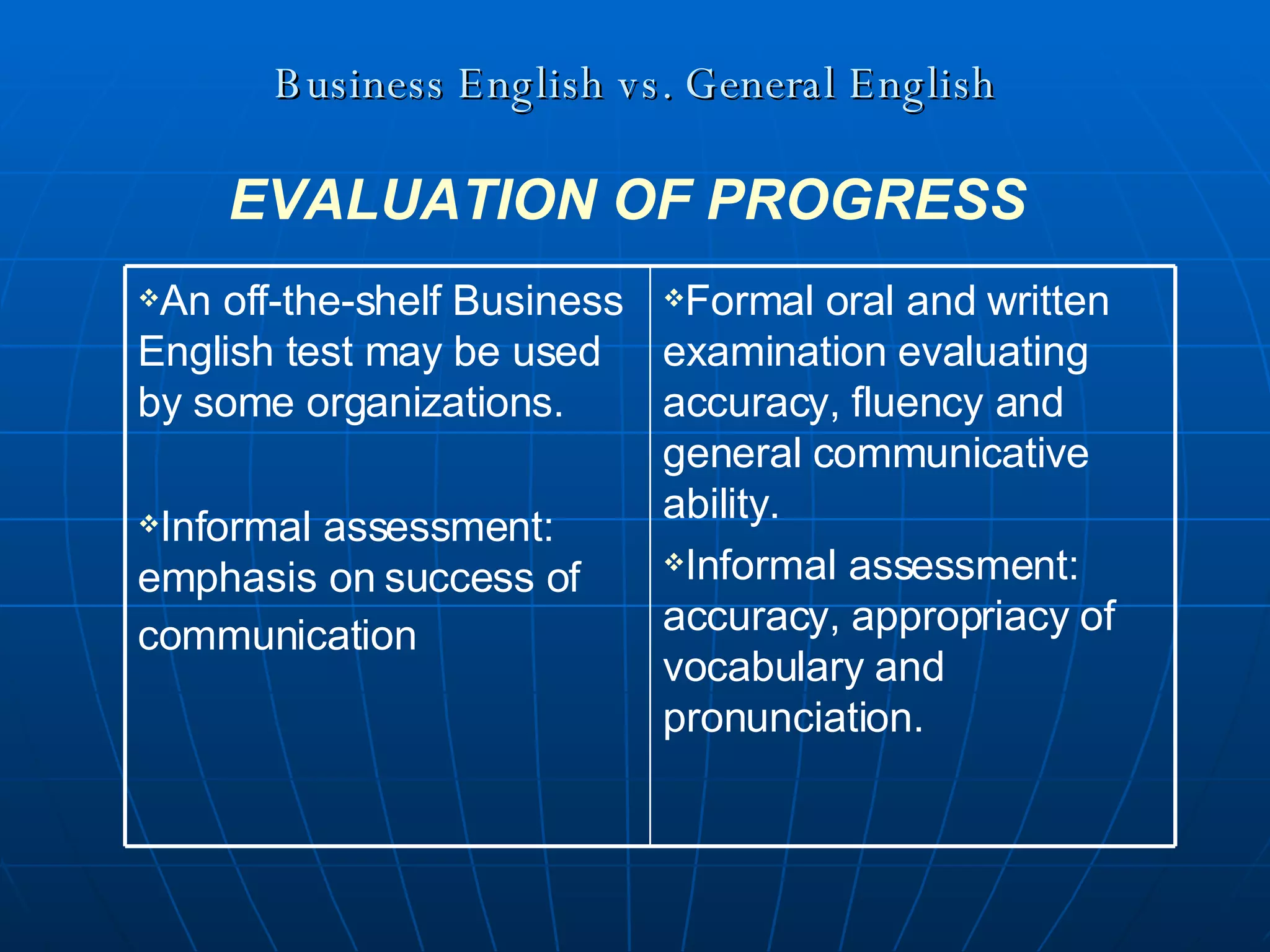
Business English vs. General English EVALUATION OF PROGRESS   Formal oral and written examination evaluating accuracy, fluency and general communicative ability. Informal assessment: accuracy, appropriacy of vocabulary and pronunciation.  An off-the-shelf Business English test may be used by some organizations. Informal assessment: emphasis on success of communication
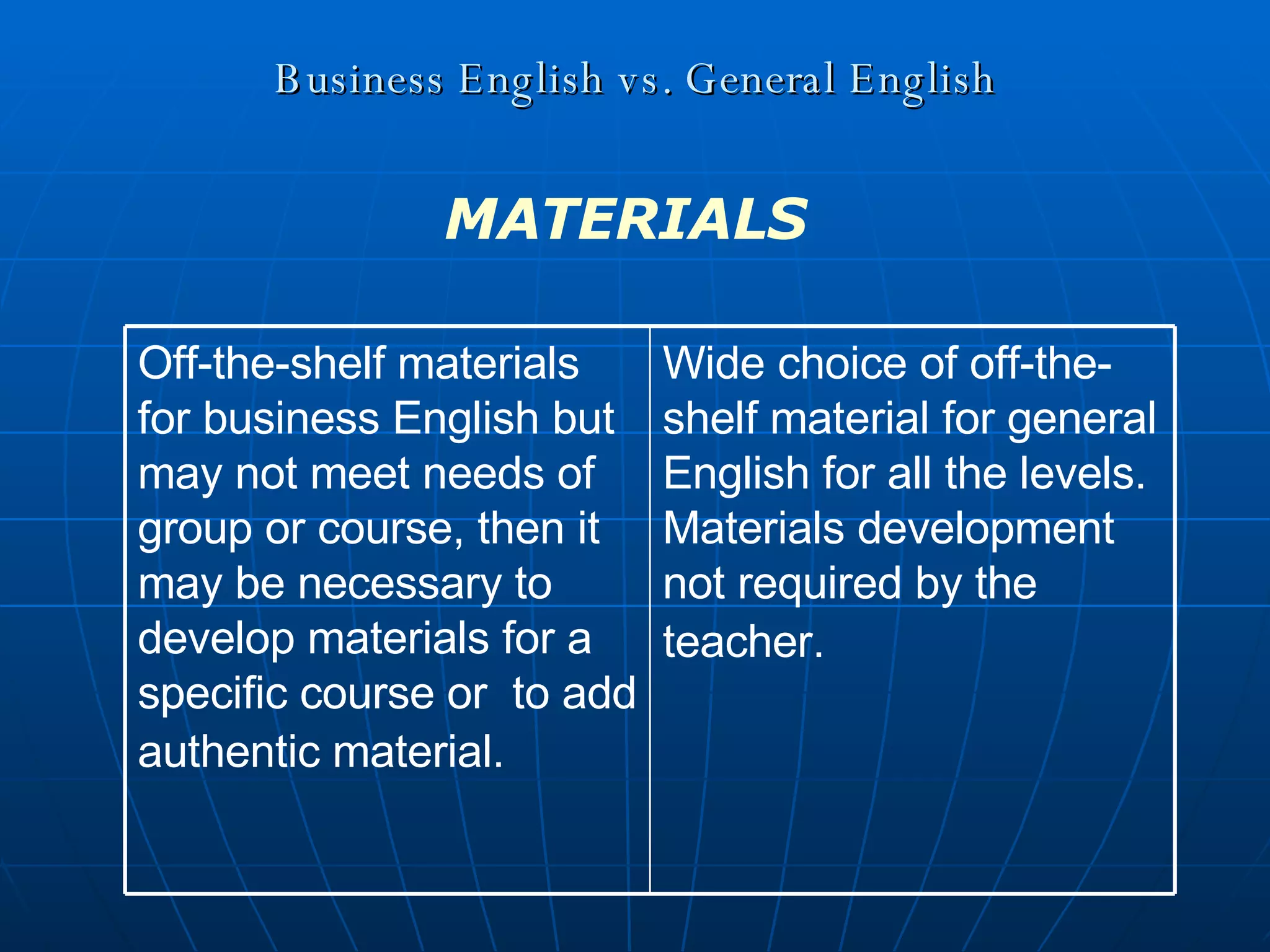
Business English vs. General English MATERIALS   Wide choice of off-the-shelf material for general English for all the levels. Materials development not required by the teacher.   Off-the-shelf materials for business English but may not meet needs of group or course, then it may be necessary to develop materials for a specific course or  to add authentic material.
Business English LANGUAGE KNOWLEDGE COMMUNICATION SKILLS GRAMMAR VOCABULARY PRONUNCIATION PRESENTATIONS MEETINGS TELEPHONING WRITTEN REPORTS
Business English LANGUAGE KNOWLEDGE GRAMMAR Clear rules Some cases of ambiguity BrE or AmE   VOCABULARY Specialist/Specialist Specialist/non-Spec. Generalist/Generalist PRONUNCIATION Some SS have a real need No off-the-shelf materials for BS
Business English COMMUNICATION SKILLS PRESENTATIONS MEETINGS TELEPHONING WRITTEN DOCUMENTATION
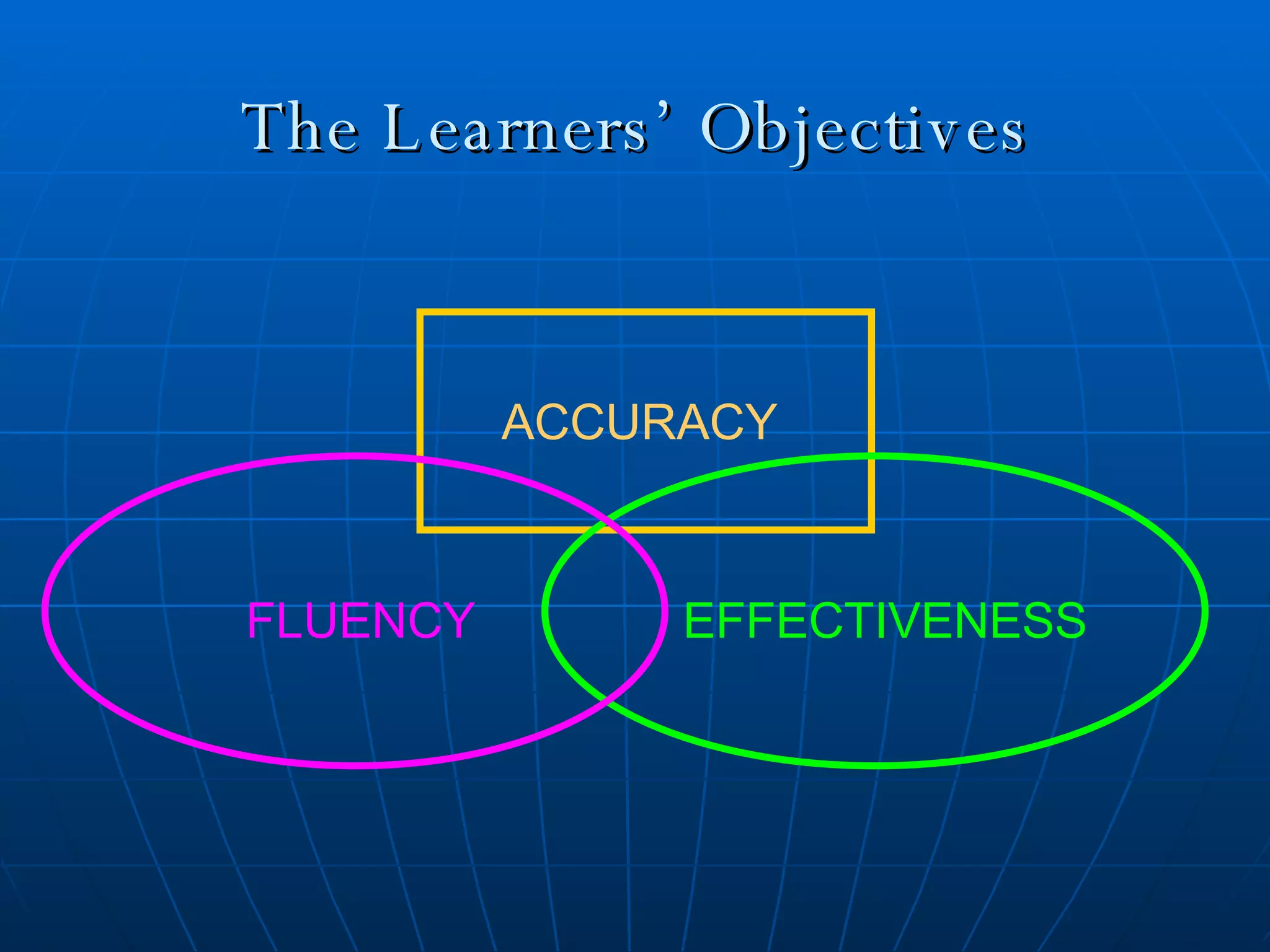
The Learners’ Objectives ACCURACY EFFECTIVENESS FLUENCY
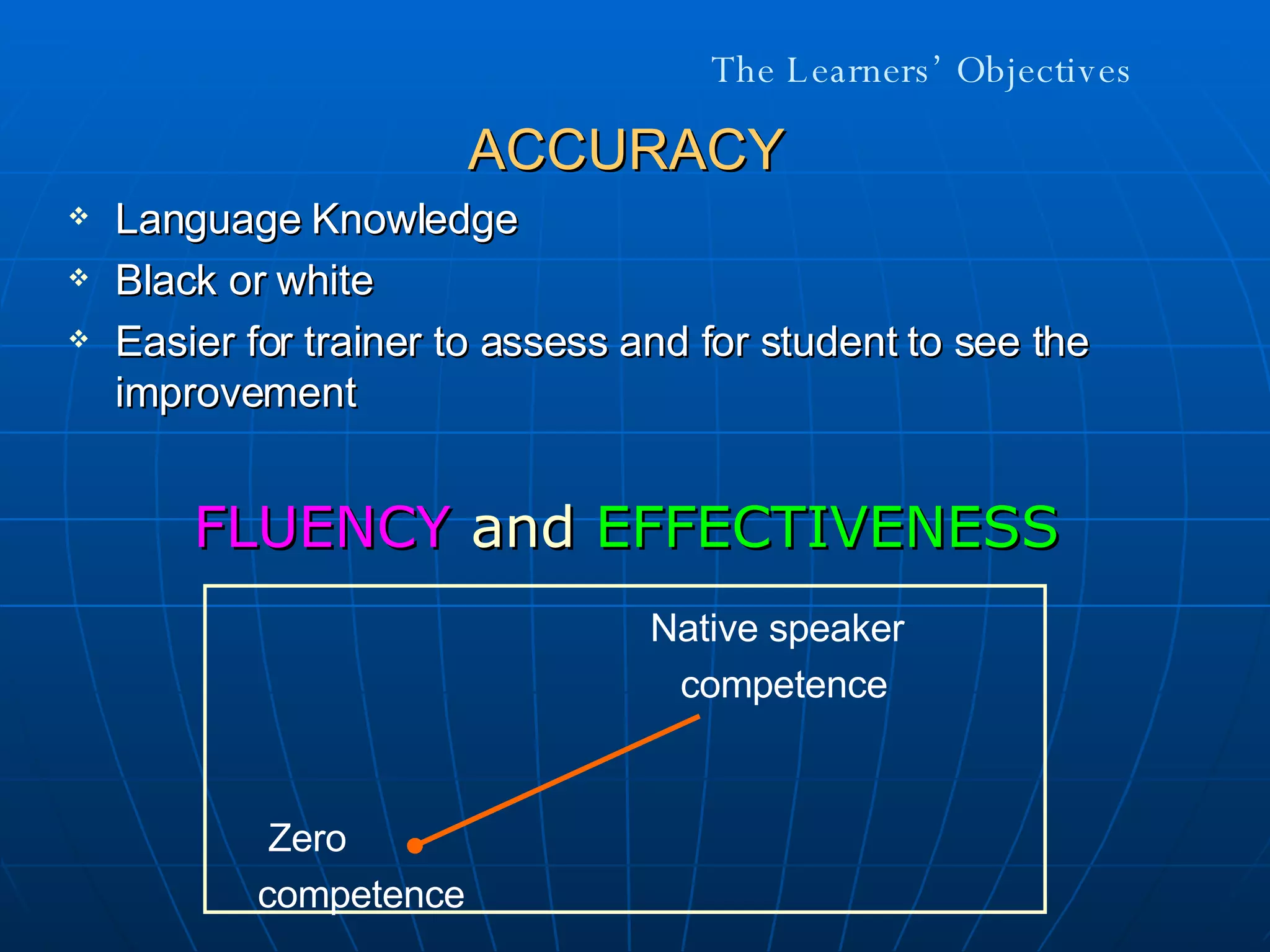
The Learners’ Objectives ACCURACY Language Knowledge Black or white Easier for trainer to assess and for student to see the improvement FLUENCY  and  EFFECTIVENESS Native speaker competence Zero  competence
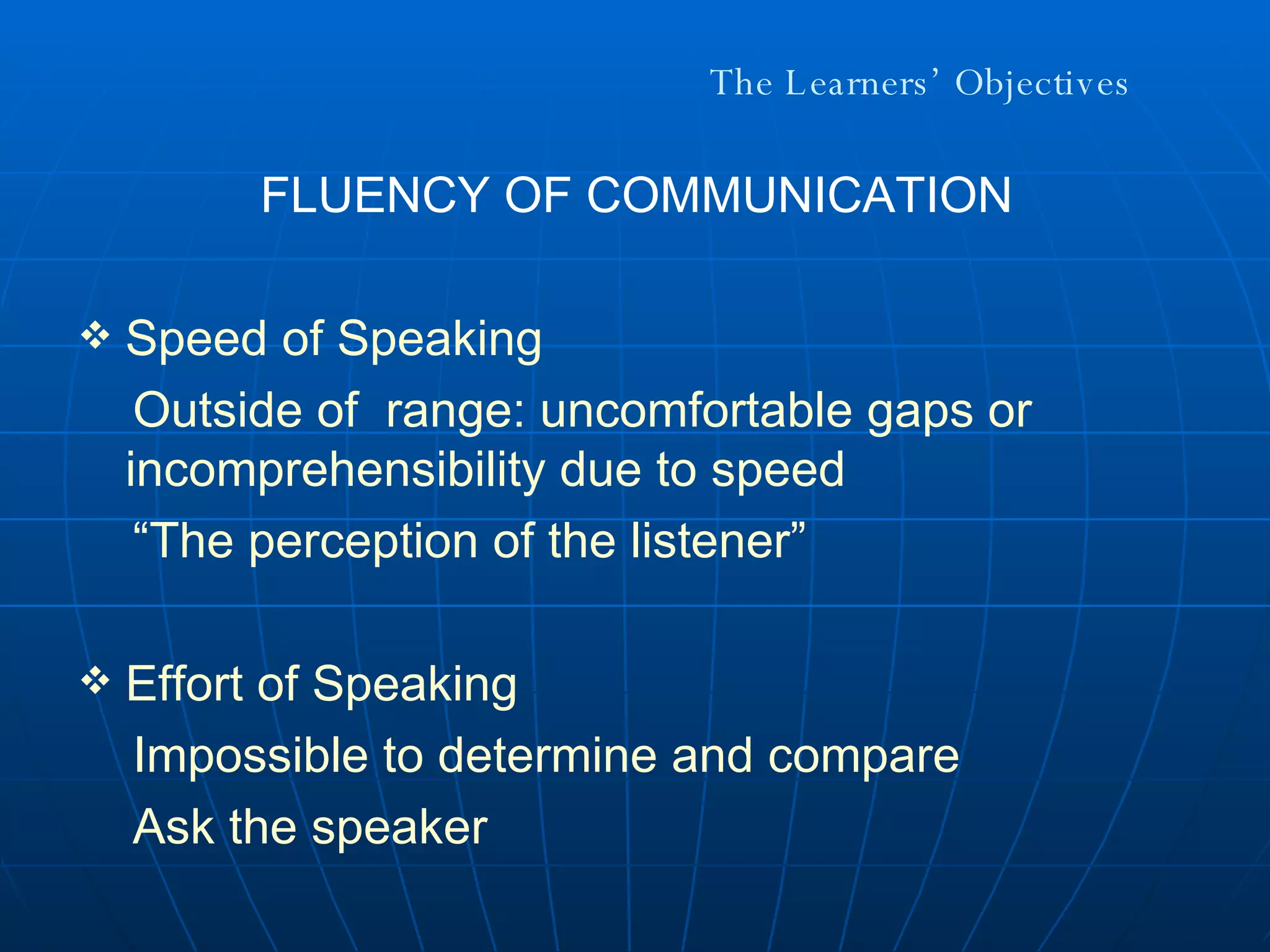
The Learners’ Objectives FLUENCY OF COMMUNICATION Speed of Speaking Outside of  range: uncomfortable gaps or incomprehensibility due to speed “ The perception of the listener” Effort of Speaking Impossible to determine and compare Ask the speaker
The Learners’ Objectives EFFECTIVENESS Impact – Variety – Conciseness Stylistic feature Part of the media, part of the message Behavioural features contributing  the use of hand and arm gestures the use of eye contact the use of vocal variety the use of visual aids moving within the audience area handling questions handling difficult audiences
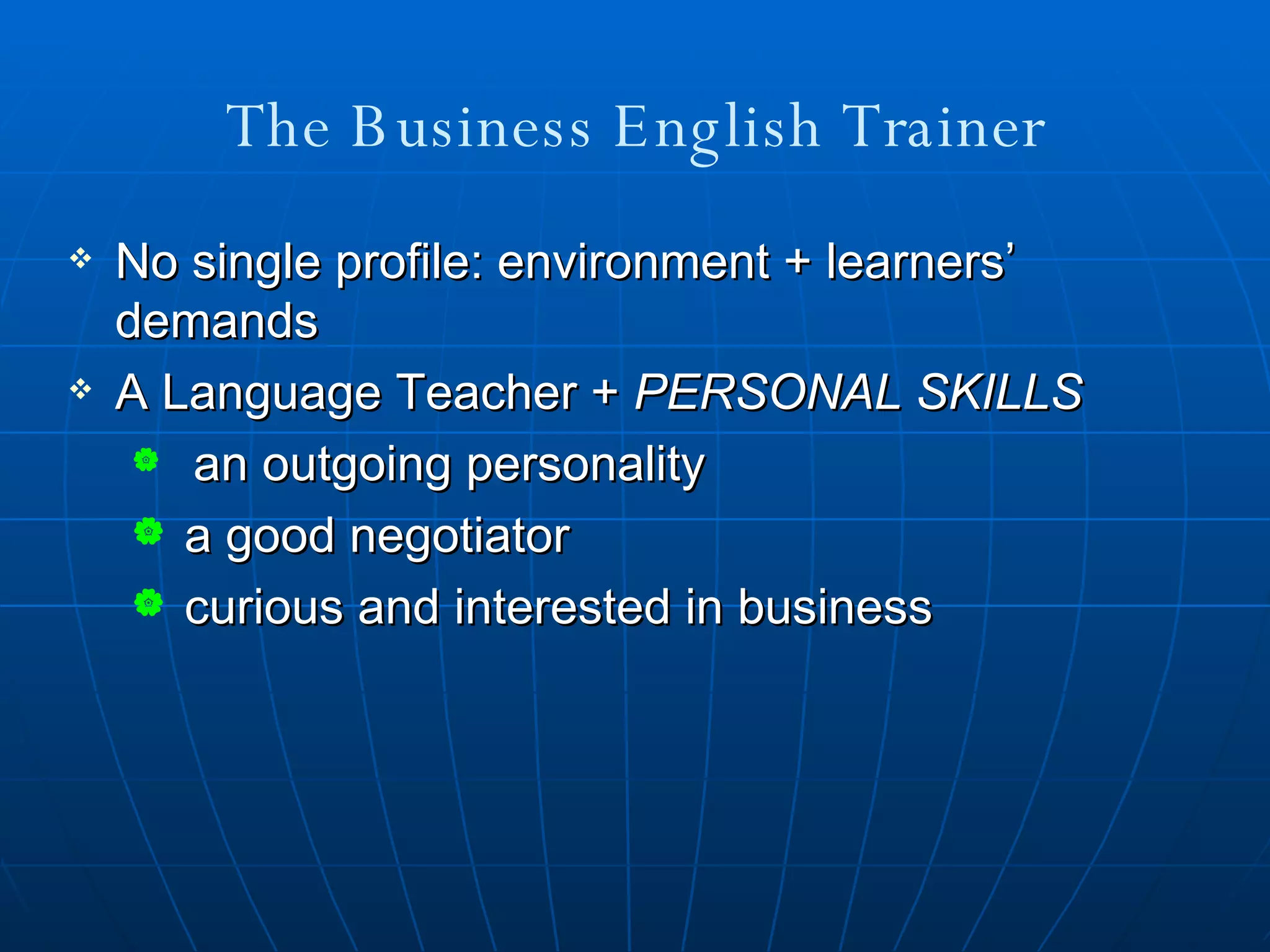
The Business English Trainer No single profile: environment + learners’ demands A Language Teacher +  PERSONAL SKILLS an outgoing personality a good negotiator curious and interested in business
Final  Words “ You get the best out of others when you give the best of yourself.”  Harry Firestone “ A man without a smiling face must not open a shop.” Chinese Proverb “ People who enjoy what they are doing invariably do it well.” Joe Gibbs.
[email_address] www.dianabusiness.blogspot.com www.slideshare.net/dianacporto

Teaching Business English

  • 1.
    Teaching Business English: aspects to consider Prof. Diana Cristina Porto
  • 2.
    Business English vs.General English Programmes Focus on developing: accuracy fluency Focus on developing : general language knowledge general communication skills. Focus on developing: accuracy fluency effectiveness Focus on developing: general and specialist language knowledge general and professional communication skills
  • 3.
    Business English vs.General English SYLLABUS Often determined by choice of textbook and end-of-term examination. Wide ranging syllabus: vocabulary from different areas and different styles Set courses with fixed objectives and syllabus. Special courses with special syllabus. One-to-one courses may develop syllabus and content on an ongoing basis.
  • 4.
    Business English vs.General English COURSE OBJECTIVES Individual objectives: culture, traveling abroad, obtaining a better job. Examination courses: fixed pre-determined objectives Defined precisely according to the needs analysis
  • 5.
    Business English vs.General English METHODOLOGY Communicative ELT methodology Communicative ELT methodology Communication skills training
  • 6.
    Business English vs.General English TRAINERS Need the following mix of knowledge and skills: ELT methodology Need the following mix of knowledge and skills: ELT methodology Communicative skills training Knowledge of business content
  • 7.
    Business English vs.General English EVALUATION OF PROGRESS Formal oral and written examination evaluating accuracy, fluency and general communicative ability. Informal assessment: accuracy, appropriacy of vocabulary and pronunciation. An off-the-shelf Business English test may be used by some organizations. Informal assessment: emphasis on success of communication
  • 8.
    Business English vs.General English MATERIALS Wide choice of off-the-shelf material for general English for all the levels. Materials development not required by the teacher. Off-the-shelf materials for business English but may not meet needs of group or course, then it may be necessary to develop materials for a specific course or to add authentic material.
  • 9.
    Business English LANGUAGEKNOWLEDGE COMMUNICATION SKILLS GRAMMAR VOCABULARY PRONUNCIATION PRESENTATIONS MEETINGS TELEPHONING WRITTEN REPORTS
  • 10.
    Business English LANGUAGEKNOWLEDGE GRAMMAR Clear rules Some cases of ambiguity BrE or AmE VOCABULARY Specialist/Specialist Specialist/non-Spec. Generalist/Generalist PRONUNCIATION Some SS have a real need No off-the-shelf materials for BS
  • 11.
    Business English COMMUNICATIONSKILLS PRESENTATIONS MEETINGS TELEPHONING WRITTEN DOCUMENTATION
  • 12.
    The Learners’ ObjectivesACCURACY EFFECTIVENESS FLUENCY
  • 13.
    The Learners’ ObjectivesACCURACY Language Knowledge Black or white Easier for trainer to assess and for student to see the improvement FLUENCY and EFFECTIVENESS Native speaker competence Zero competence
  • 14.
    The Learners’ ObjectivesFLUENCY OF COMMUNICATION Speed of Speaking Outside of range: uncomfortable gaps or incomprehensibility due to speed “ The perception of the listener” Effort of Speaking Impossible to determine and compare Ask the speaker
  • 15.
    The Learners’ ObjectivesEFFECTIVENESS Impact – Variety – Conciseness Stylistic feature Part of the media, part of the message Behavioural features contributing the use of hand and arm gestures the use of eye contact the use of vocal variety the use of visual aids moving within the audience area handling questions handling difficult audiences
  • 16.
    The Business EnglishTrainer No single profile: environment + learners’ demands A Language Teacher + PERSONAL SKILLS an outgoing personality a good negotiator curious and interested in business
  • 17.
    Final Words“ You get the best out of others when you give the best of yourself.” Harry Firestone “ A man without a smiling face must not open a shop.” Chinese Proverb “ People who enjoy what they are doing invariably do it well.” Joe Gibbs.
  • 18.