LET’S TALK 
BASIS FOR BUSINESS: 
BUILDING SPEAKING AND 
BUSINESS SKILLS 
AT B2 AND C1 
ANNE HODGSON 
IATEFL BESIG 13 NOV 2014
WHAT DO YOUR LEARNERS NEED TO DO 
IN CLASS IN ORDER TO IMPROVE? 
Let‘s Talk Basis for Business | IATEFL BESIG 2014 http://www.differentvoice.com/Portals/0/Photos/102309-young-adult-gr2oup.jpg
USING ENGLISH AT WORK 
3 
Let‘s Talk Basis for Business | IATEFL BESIG 2014
USING ENGLISH IN CLASS 
4 
@CallieWallie 
https://www.flickr.com/photos/eltpics/5194626510/in/set-72157625304912259/ 
Let‘s Talk Basis for Business | IATEFL BESIG 2014
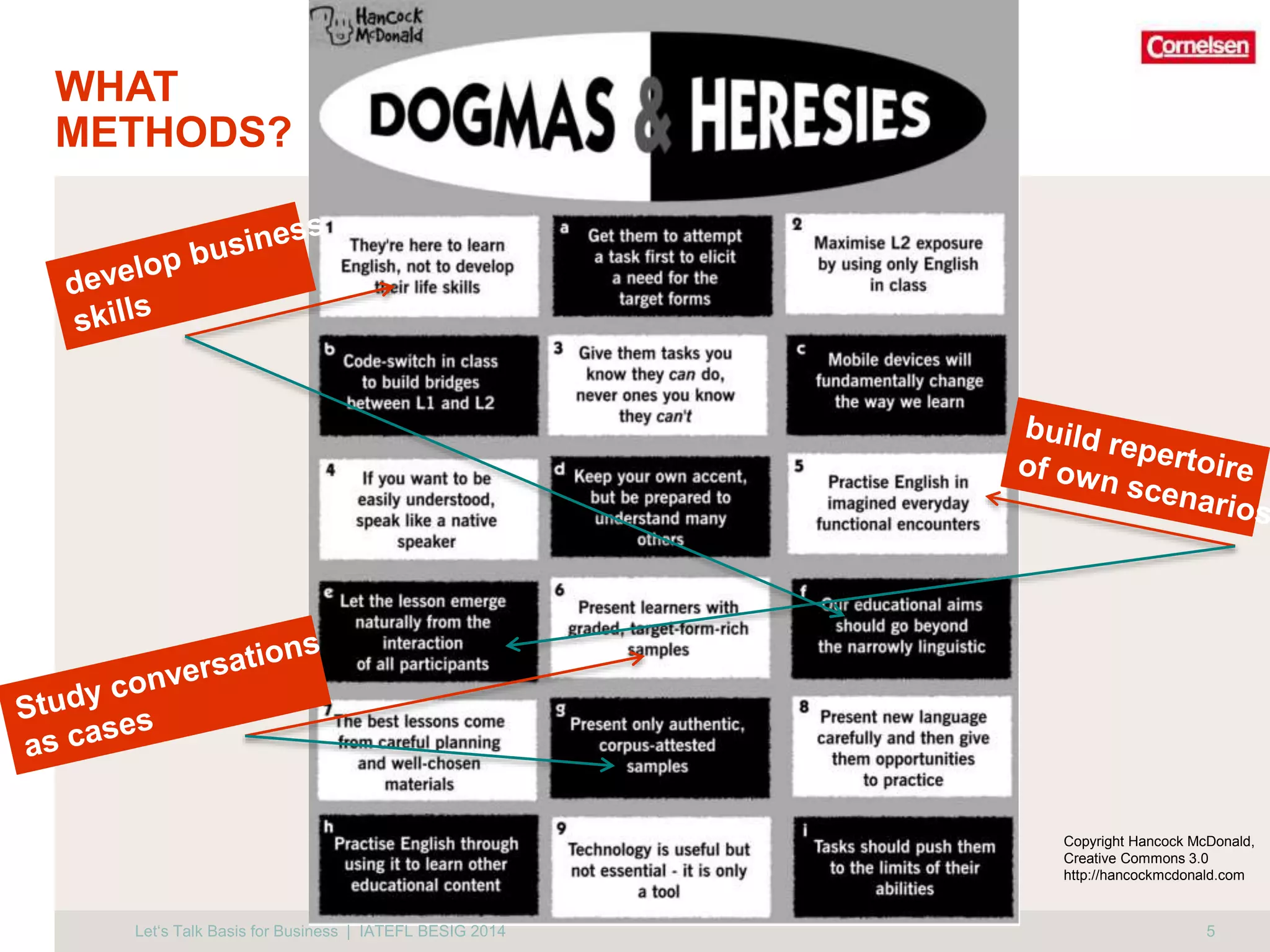
WHAT 
METHODS? 
Copyright Hancock McDonald, 
Creative Commons 3.0 
http://hancockmcdonald.com 
5 
Let‘s Talk Basis for Business | IATEFL BESIG 2014
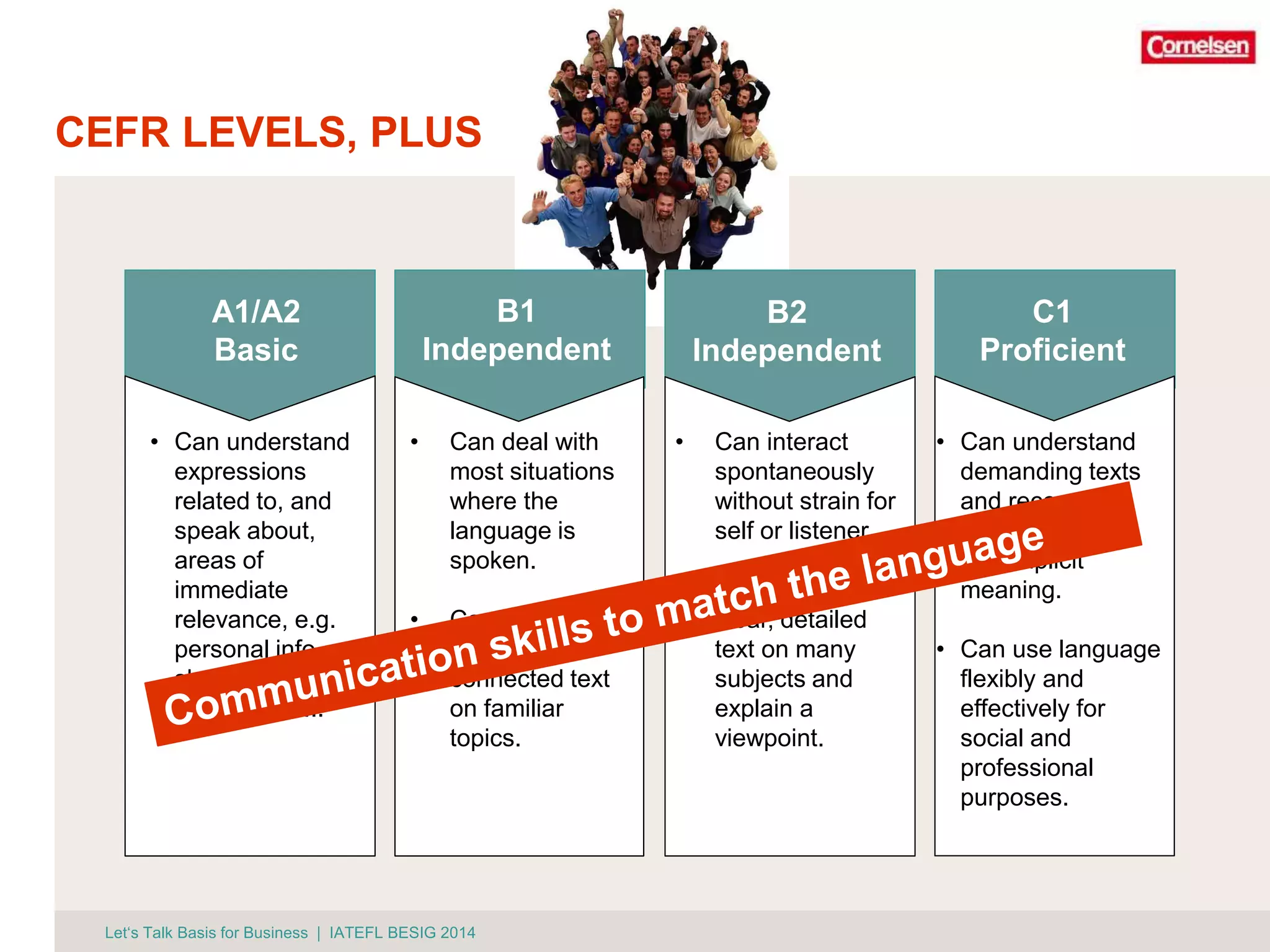
CEFR LEVELS, PLUS 
Features 
A1/A2 
Basic 
• Can understand 
expressions 
related to, and 
speak about, 
areas of 
immediate 
relevance, e.g. 
personal info, 
shopping, job, 
background... 
• Can deal with 
most situations 
where the 
language is 
spoken. 
• Can produce 
simple 
connected text 
on familiar 
topics. 
• Can interact 
spontaneously 
without strain for 
self or listener. 
• Can produce 
clear, detailed 
text on many 
subjects and 
explain a 
viewpoint. 
C1 
Proficient 
• Can understand 
demanding texts 
and recognise 
shifts in register 
and implicit 
meaning. 
• Can use language 
flexibly and 
effectively for 
social and 
professional 
purposes. 
B2 
Independent 
B1 
Independent 
Let‘s Talk Basis for Business | IATEFL BESIG 2014
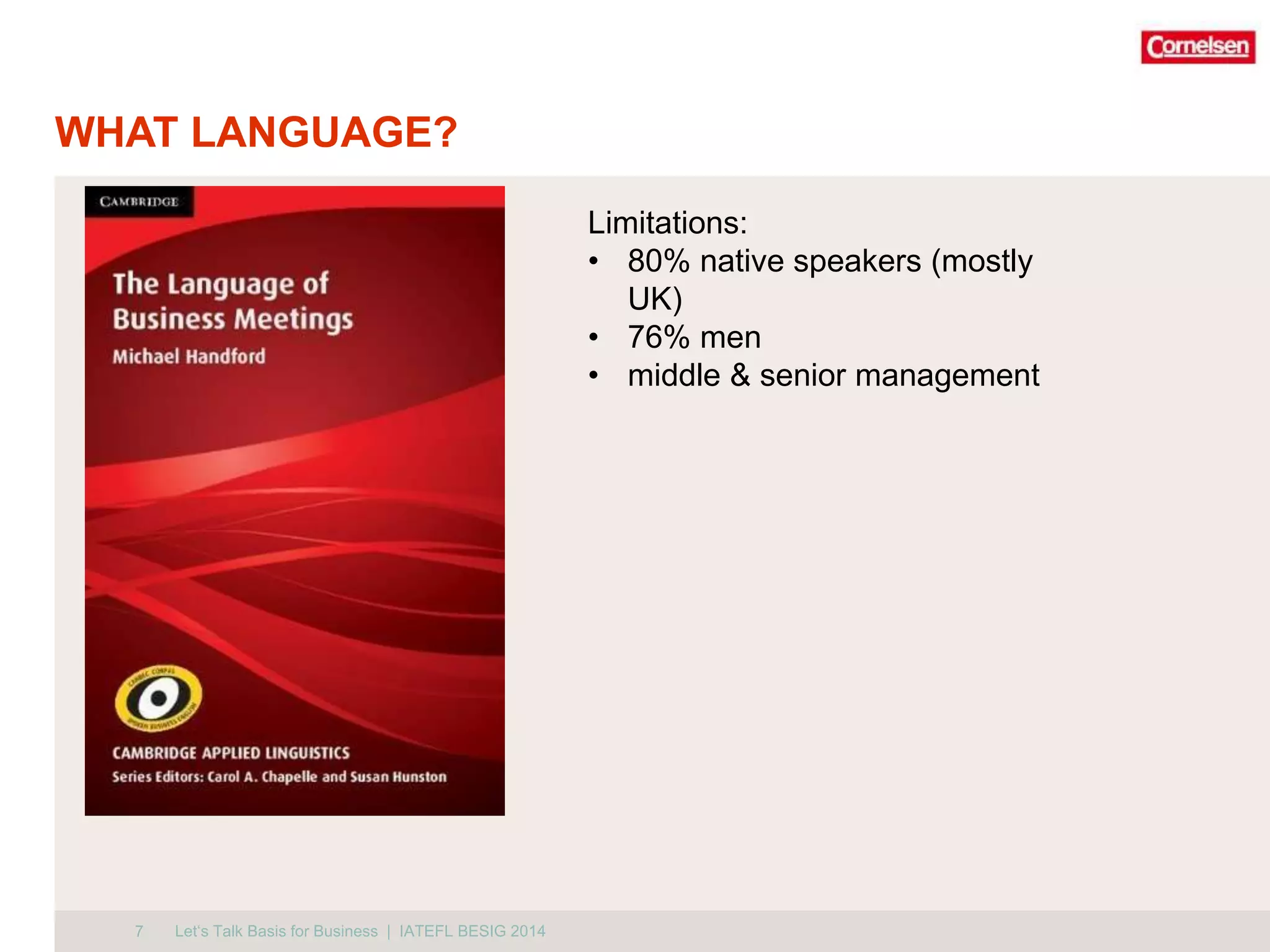
WHAT LANGUAGE? 
7 
Limitations: 
• 80% native speakers (mostly 
UK) 
• 76% men 
• middle & senior management 
Let‘s Talk Basis for Business | IATEFL BESIG 2014
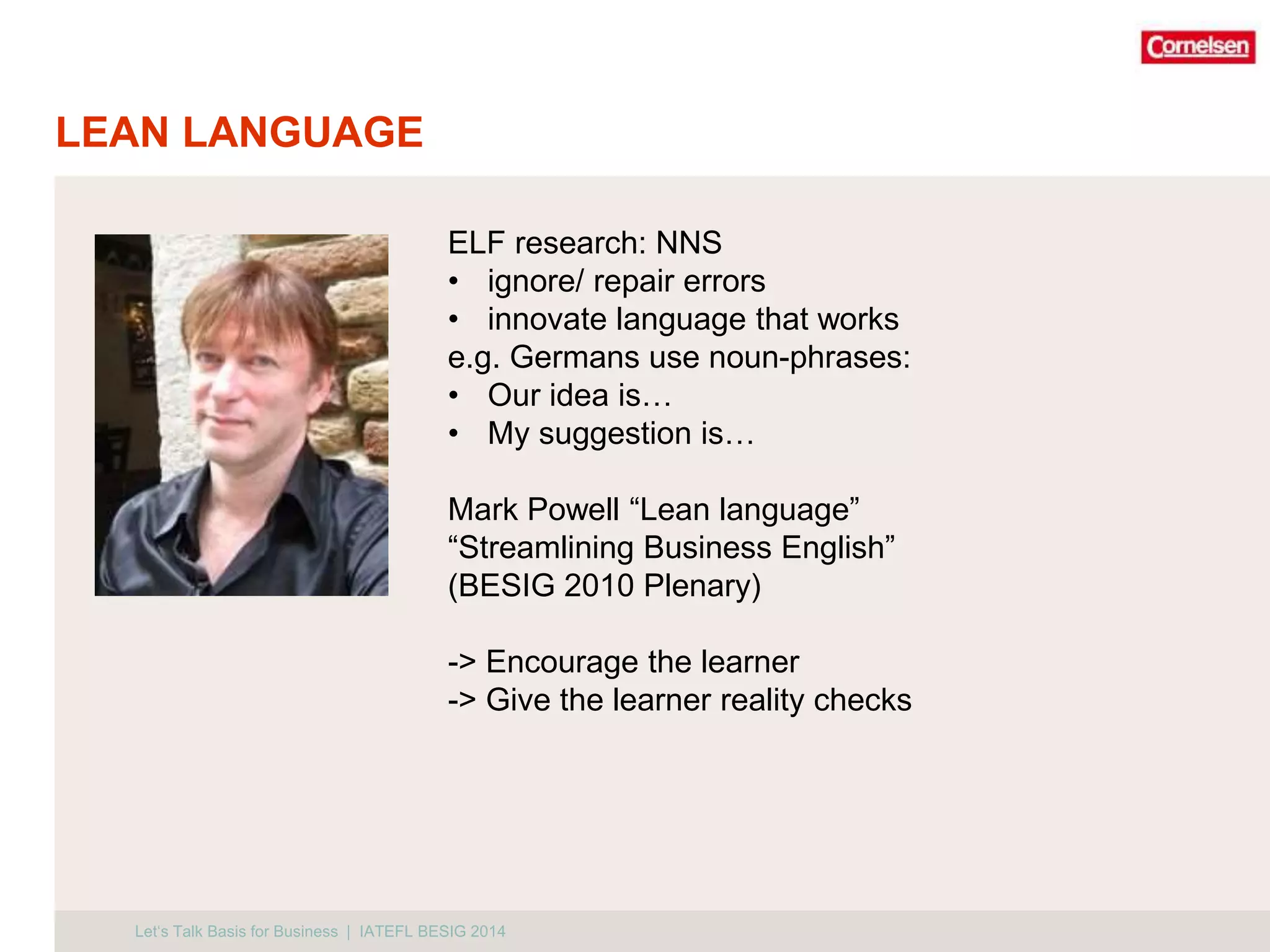
LEAN LANGUAGE 
ELF research: NNS 
• ignore/ repair errors 
• innovate language that works 
e.g. Germans use noun-phrases: 
• Our idea is… 
• My suggestion is… 
Mark Powell “Lean language” 
“Streamlining Business English” 
(BESIG 2010 Plenary) 
-> Encourage the learner 
-> Give the learner reality checks 
Let‘s Talk Basis for Business | IATEFL BESIG 2014
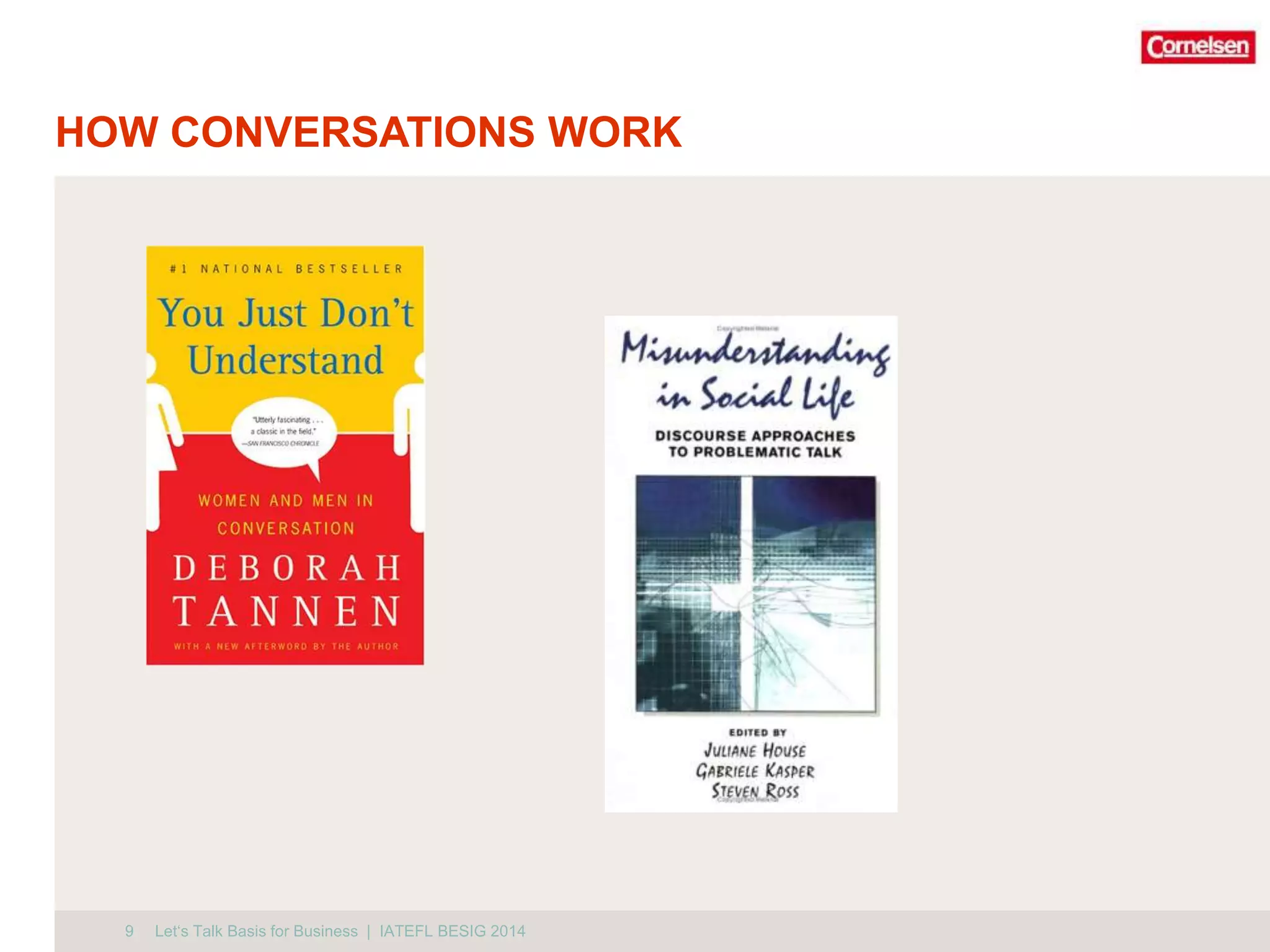
HOW CONVERSATIONS WORK 
9 Let‘s Talk Basis for Business | IATEFL BESIG 2014
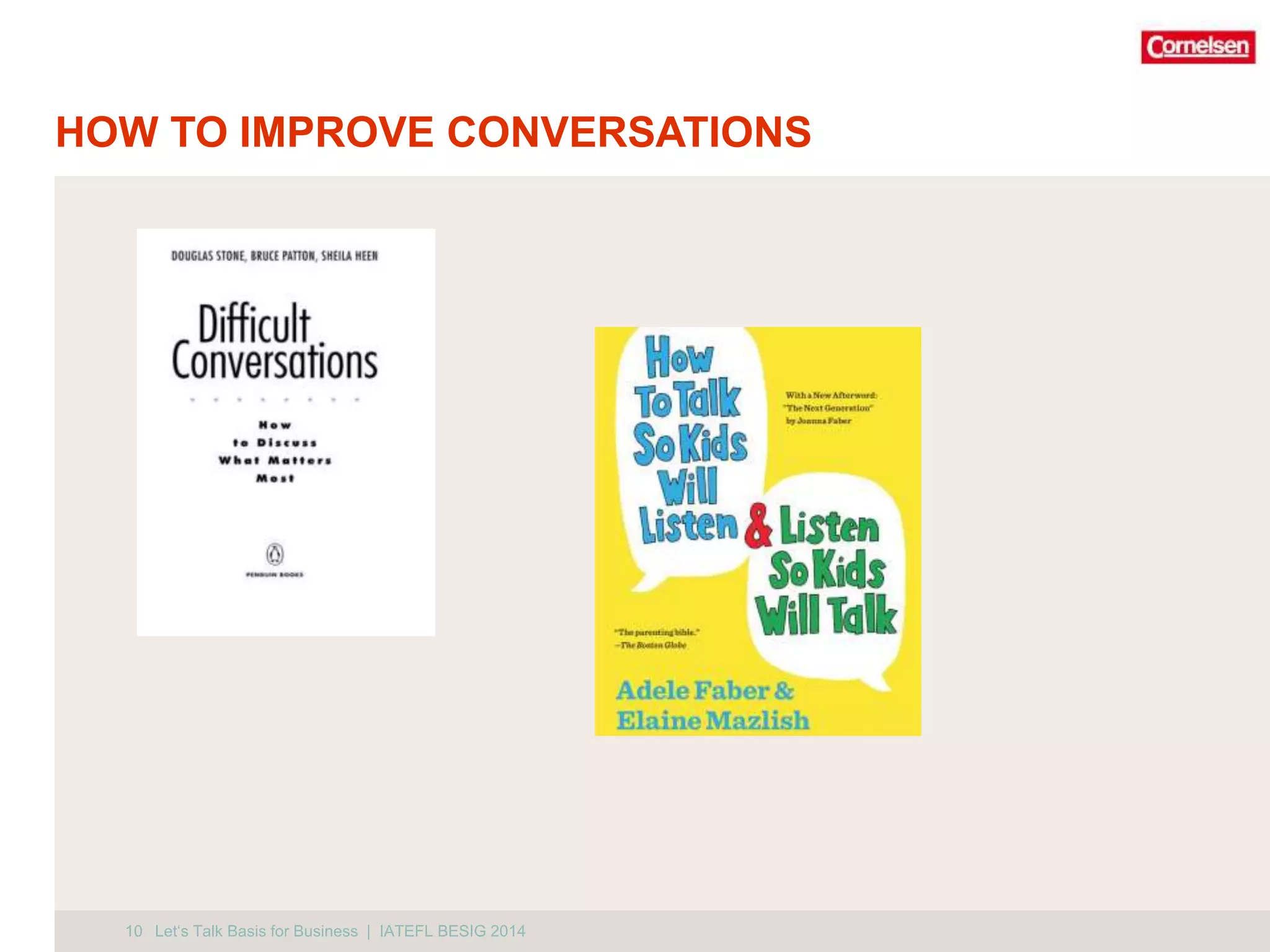
HOW TO IMPROVE CONVERSATIONS 
10 Let‘s Talk Basis for Business | IATEFL BESIG 2014
CONVERSATION FRAMEWORKS 
Relationships can be 
11 
internal <-> external 
peer <-> hierarchical 
new <-> longstanding 
still in negotiation <-> contractually bound 
similar <-> different cultures, genders, ages 
Different kinds of meeting 
informal <-> formal 
one to one <-> multiple participants 
floor: one at a time <-> all together now 
decision makers present <->absent 
sales <-> planning/ strategy 
stage of project or negotiation 
… add your criteria 
Let‘s Talk Basis for Business | IATEFL BESIG 2014
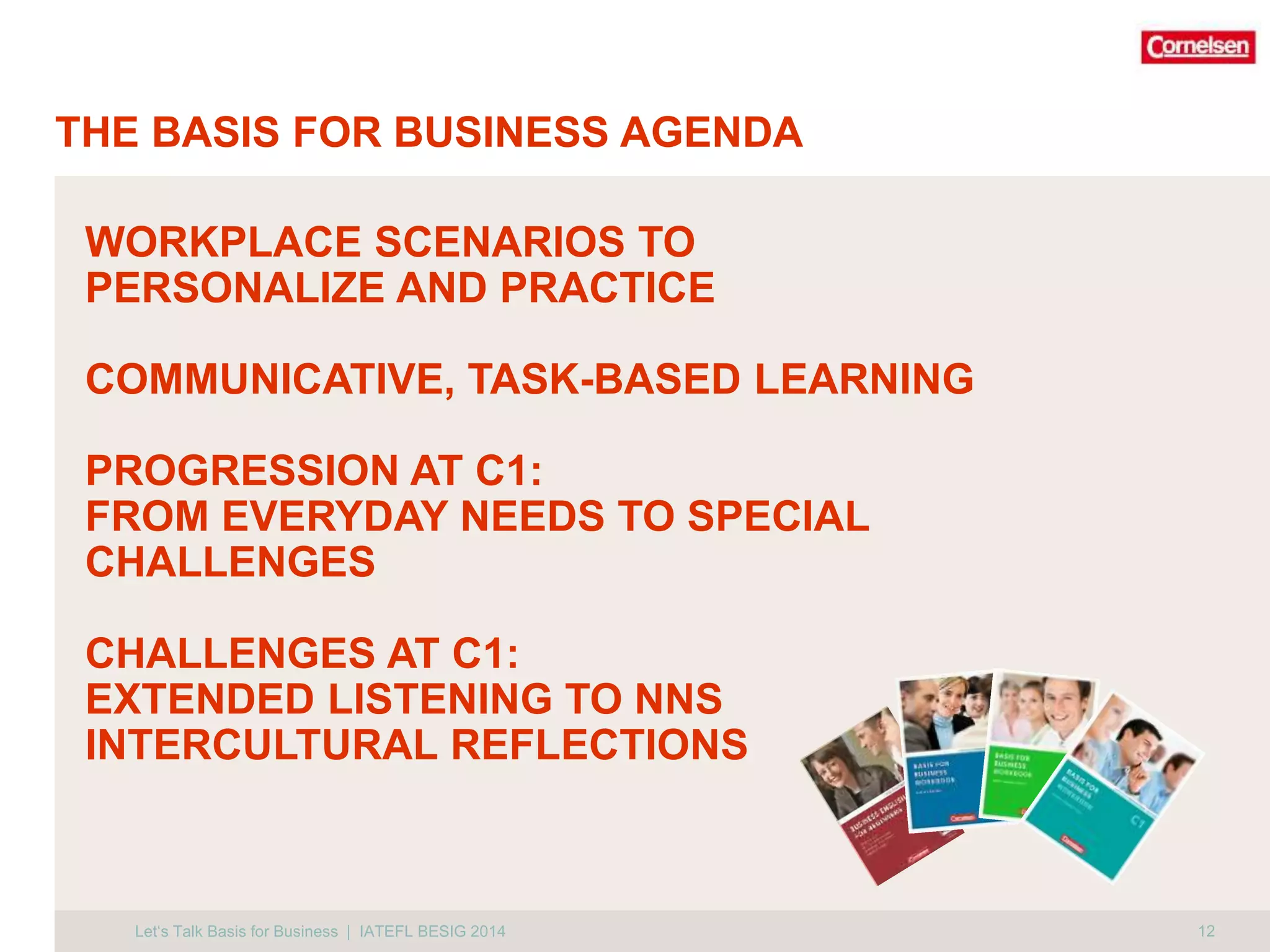
THE BASIS FOR BUSINESS AGENDA 
12 
WORKPLACE SCENARIOS TO 
PERSONALIZE AND PRACTICE 
COMMUNICATIVE, TASK-BASED LEARNING 
PROGRESSION AT C1: 
FROM EVERYDAY NEEDS TO SPECIAL 
CHALLENGES 
CHALLENGES AT C1: 
EXTENDED LISTENING TO NNS 
INTERCULTURAL REFLECTIONS 
Let‘s Talk Basis for Business | IATEFL BESIG 2014
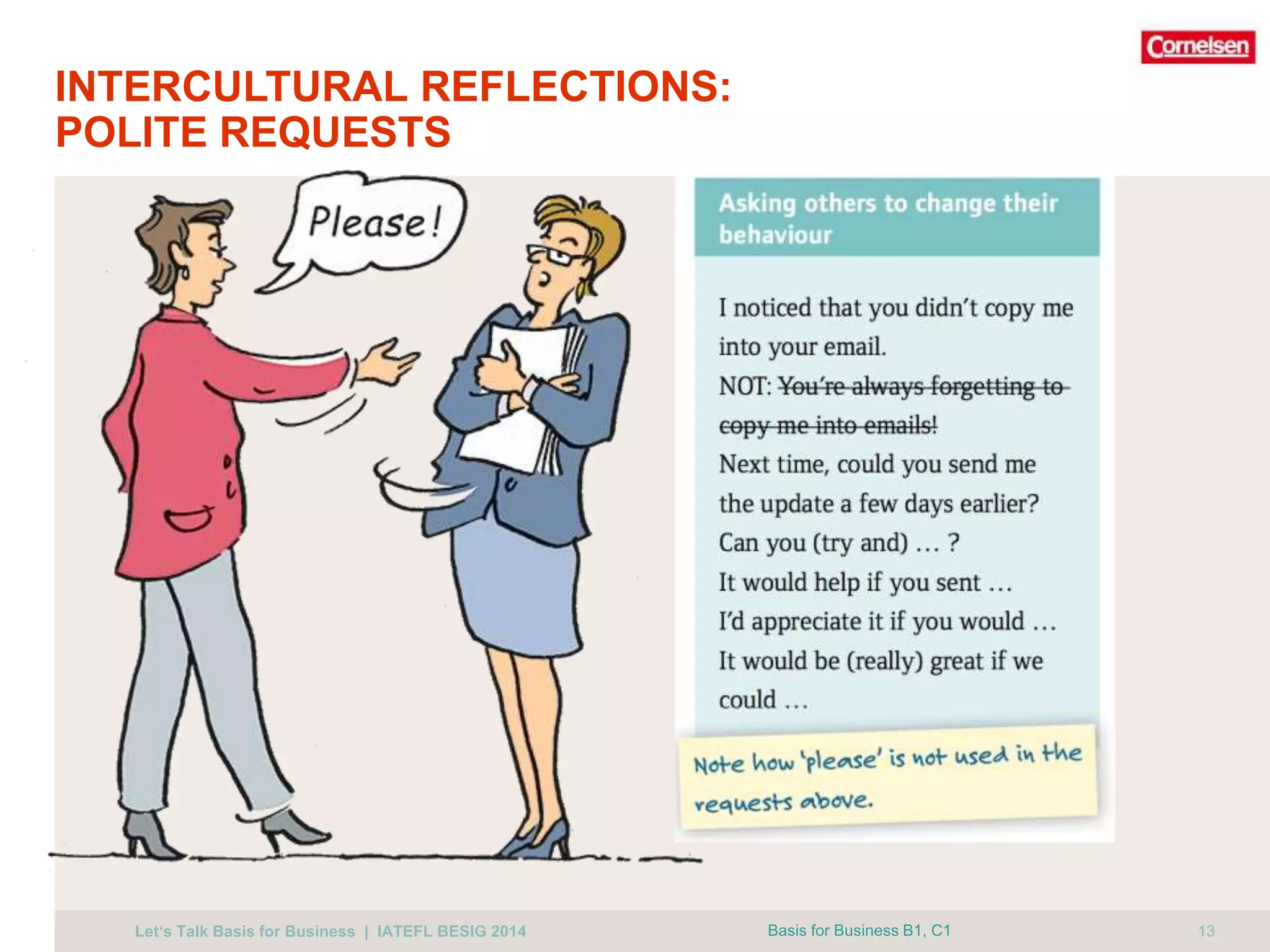
INTERCULTURAL REFLECTIONS: 
POLITE REQUESTS 
Basis for Business B1, C1 
Let‘s Talk Basis for Business | IATEFL BESIG 2014 13
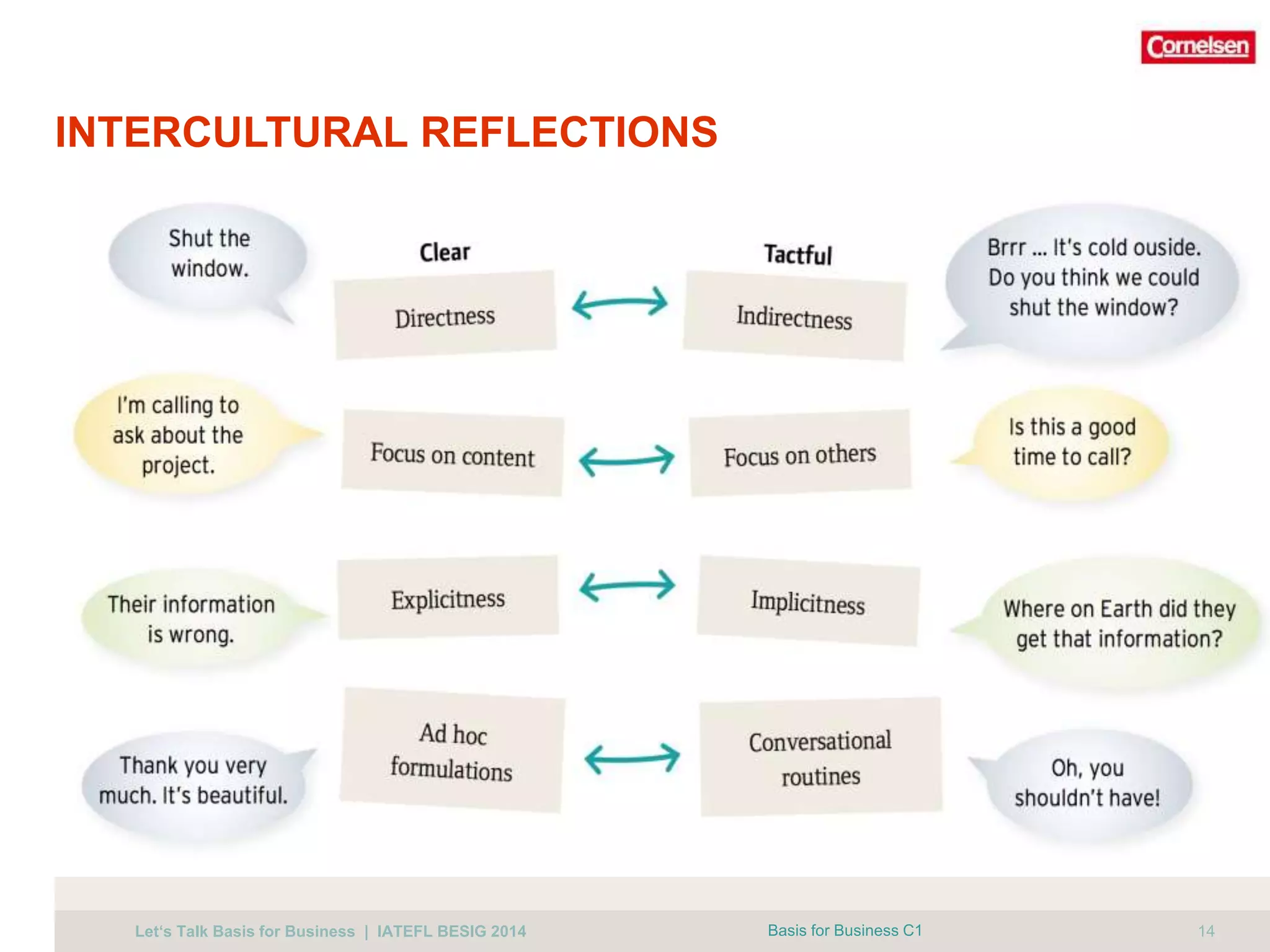
INTERCULTURAL REFLECTIONS 
Basis for Business C1 
Let‘s Talk Basis for Business | IATEFL BESIG 2014 14
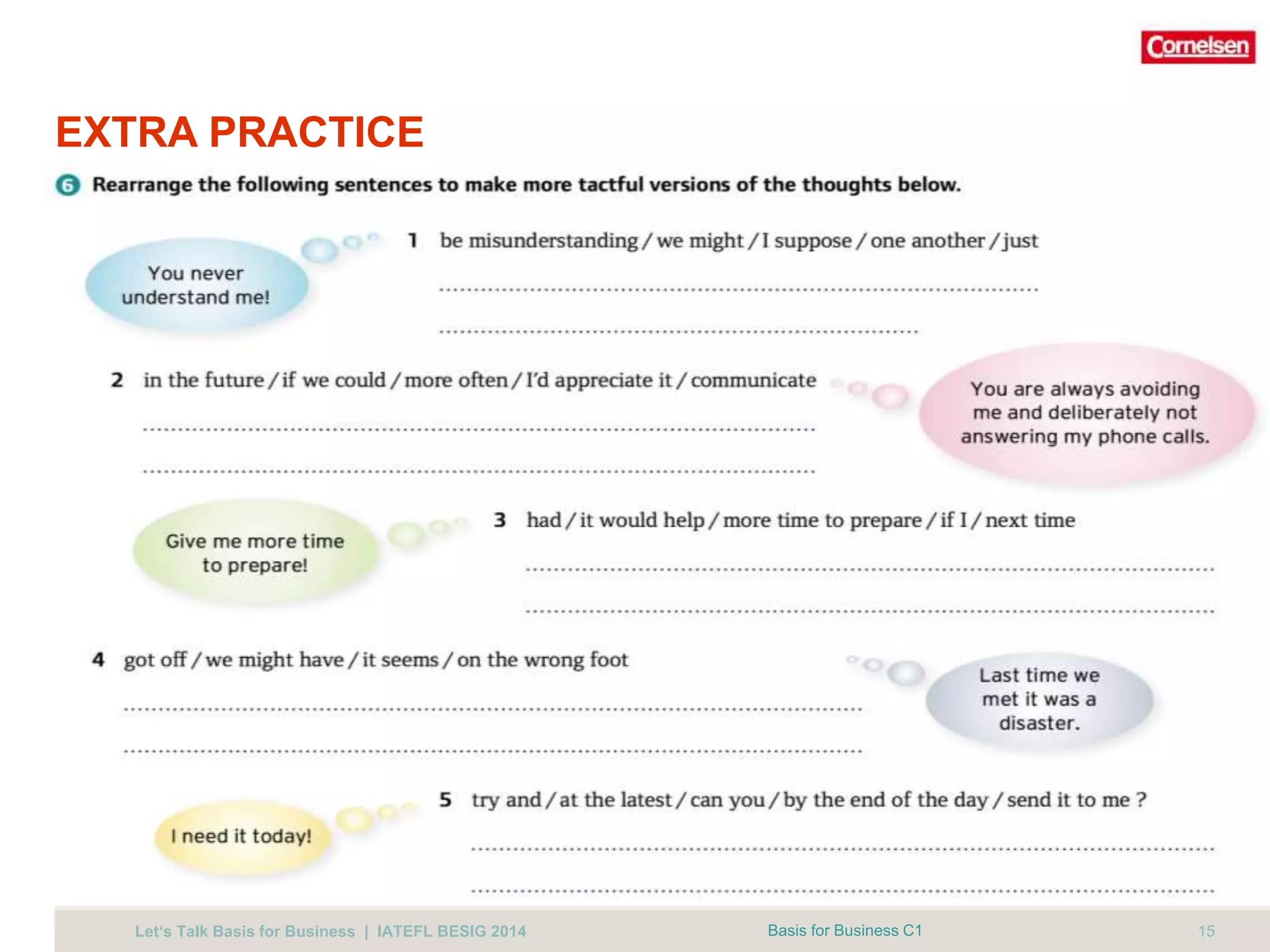
EXTRA PRACTICE 
Basis for Business C1 
Let‘s Talk Basis for Business | IATEFL BESIG 2014 15
BASIS FOR BUSINESS QUIZ 
1. How many units, parts and business files does Basis for Business C1 
have, from Welcome unit to the end? 
2. Each double-spread is designed to take 90 minutes. How many hours 
of teaching would that provide? Do you see the content providing 
more? 
3. What file format is the audio in? Where are the transcripts? 
4. Flip through the individual units and study the boxes in the outside 
margins: What colour are the Grammar boxes? How do they present 
grammar points? 
5. Find the blue-green Phrase boxes, also in the outside margin. What 
types of activities do they accompany? 
6. How do the Food for thought and the Did you know boxes differ? 
7. Where are the Outside View essays? What are they about? 
8. Which of the Skills files can be used to prepare a sales talk? 
9. Where are activities to elicit learner business experience normally 
located? 
Let‘s Talk Basis for Business | IATEFL BESIG 2014
ANSWERS 
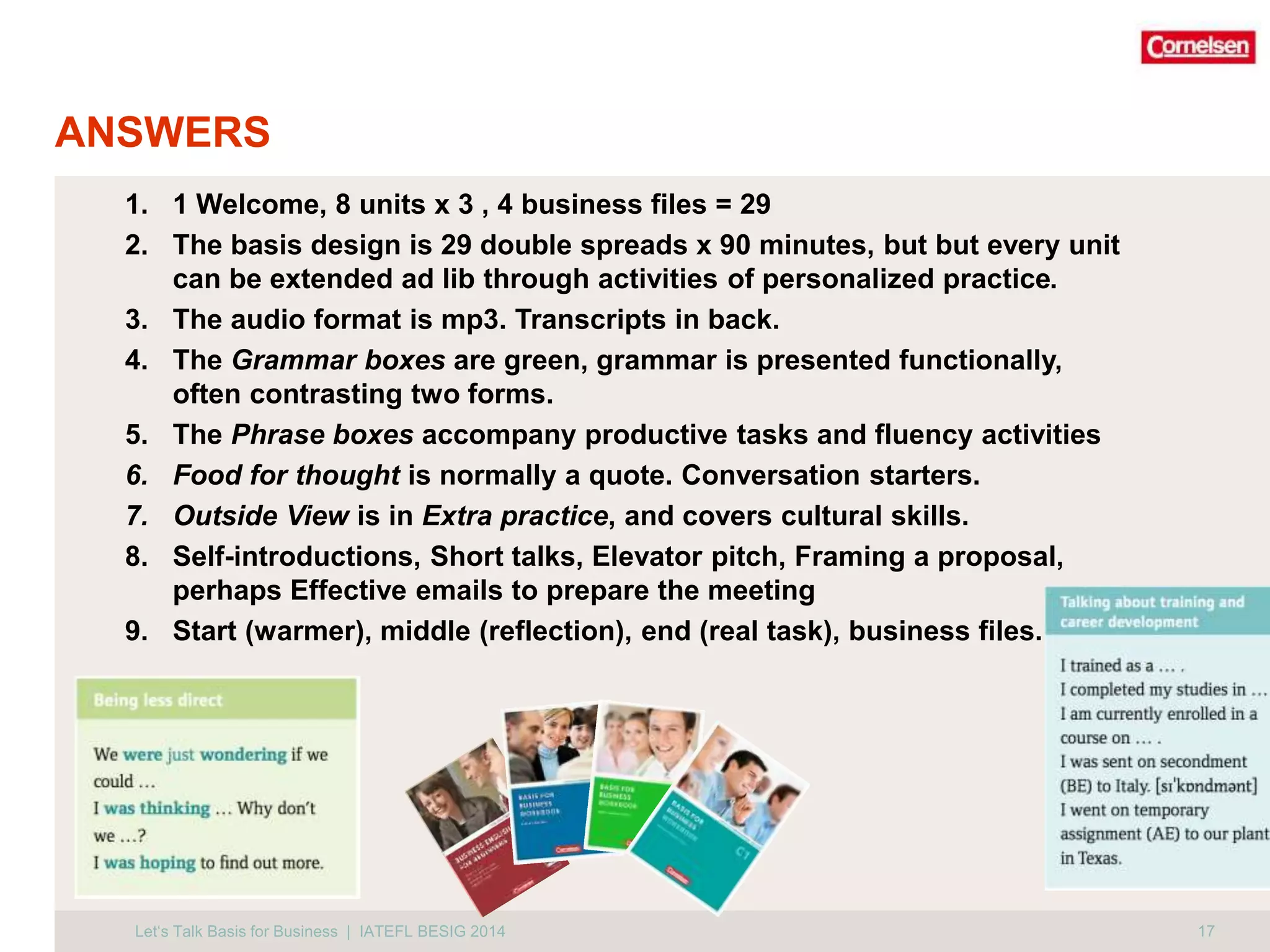
1. 1 Welcome, 8 units x 3 , 4 business files = 29 
2. The basis design is 29 double spreads x 90 minutes, but but every unit 
can be extended ad lib through activities of personalized practice. 
3. The audio format is mp3. Transcripts in back. 
4. The Grammar boxes are green, grammar is presented functionally, 
often contrasting two forms. 
5. The Phrase boxes accompany productive tasks and fluency activities 
6. Food for thought is normally a quote. Conversation starters. 
7. Outside View is in Extra practice, and covers cultural skills. 
8. Self-introductions, Short talks, Elevator pitch, Framing a proposal, 
perhaps Effective emails to prepare the meeting 
9. Start (warmer), middle (reflection), end (real task), business files. 
Let‘s Talk Basis for Business | IATEFL BESIG 2014 17
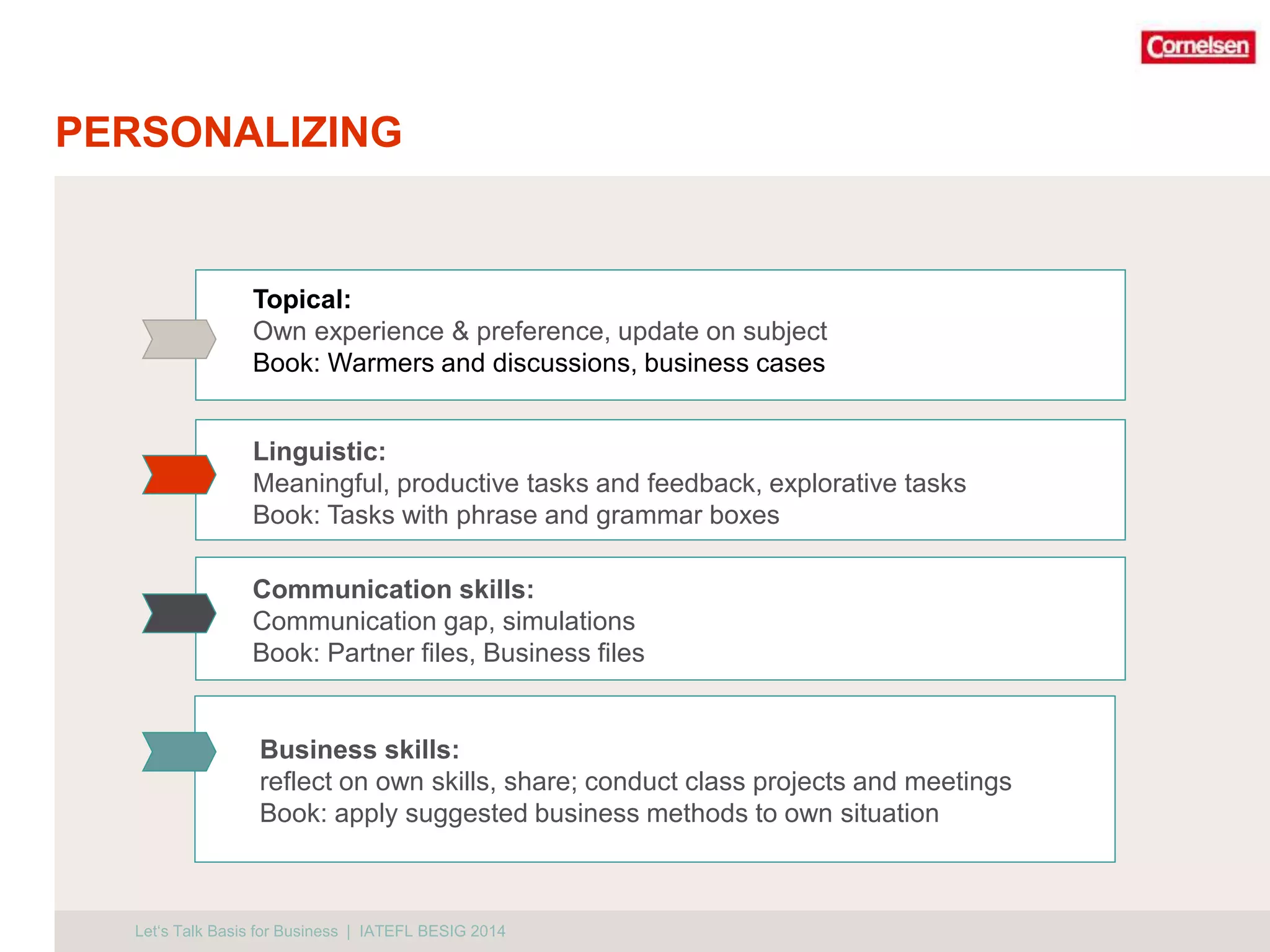
PERSONALIZING 
Topical: 
Own experience & preference, update on subject 
Book: Warmers and discussions, business cases 
Linguistic: 
Meaningful, productive tasks and feedback, explorative tasks 
Book: Tasks with phrase and grammar boxes 
Communication skills: 
Communication gap, simulations 
Book: Partner files, Business files 
Business skills: 
reflect on own skills, share; conduct class projects and meetings 
Book: apply suggested business methods to own situation 
Let‘s Talk Basis for Business | IATEFL BESIG 2014
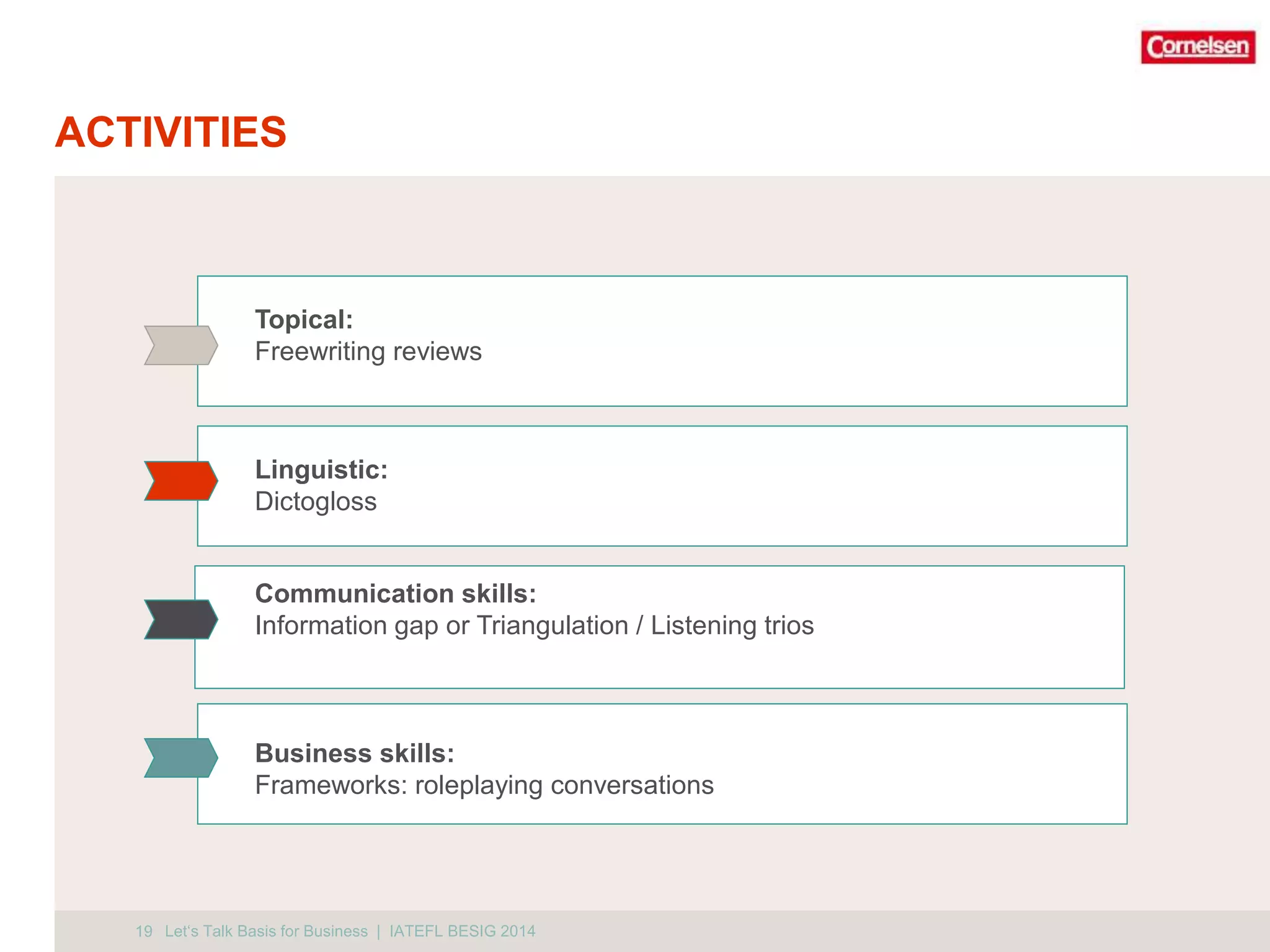
ACTIVITIES 
19 
Topical: 
Freewriting reviews 
Linguistic: 
Dictogloss 
Communication skills: 
Information gap or Triangulation / Listening trios 
Business skills: 
Frameworks: roleplaying conversations 
Let‘s Talk Basis for Business | IATEFL BESIG 2014
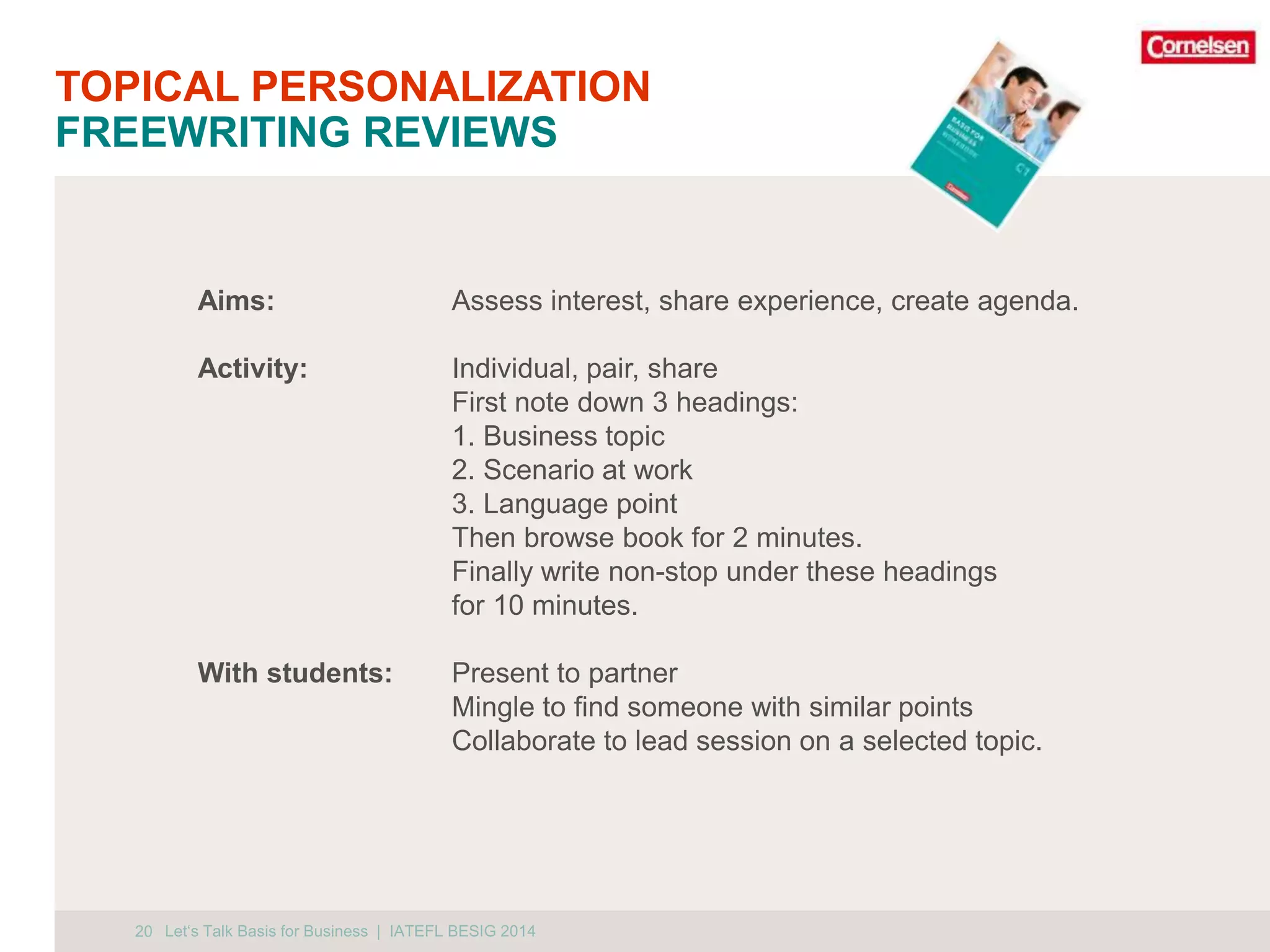
TOPICAL PERSONALIZATION 
FREEWRITING REVIEWS 
20 
Aims: Assess interest, share experience, create agenda. 
Activity: Individual, pair, share 
First note down 3 headings: 
1. Business topic 
2. Scenario at work 
3. Language point 
Then browse book for 2 minutes. 
Finally write non-stop under these headings 
for 10 minutes. 
With students: Present to partner 
Mingle to find someone with similar points 
Collaborate to lead session on a selected topic. 
Let‘s Talk Basis for Business | IATEFL BESIG 2014
COMMUNICATION SKILLS 
LISTENING TRIOS 
21 
Aims: Workout in all skills, especially listening. 
Activity: Form 3 groups. 
Each group reads a different text connected to 
one issue. It can also be a simulation that requires each 
group to develop a certain perspective 
Form trios with one person from each group. 
1. Summarize your text orally to a partner. 
2. Summarize what your partner tells you in writing. 
3. Discuss and triangulate the issue. Create a new text 
together. 
Follow-up: Compare the summaries of each trio for form, and 
collaborative texts for meaning. 
Our example: Ivo, Doug and Bob 
Relate the dilemma as if you were Ivo, Doug or Bob. 
Summarize each position individually. 
Let‘s Talk Basis for Business | IATETFLh BeESnIG d 20is14cuss and collaborate on a summary.
TRIOS: WHAT WOULD YOU DO? 
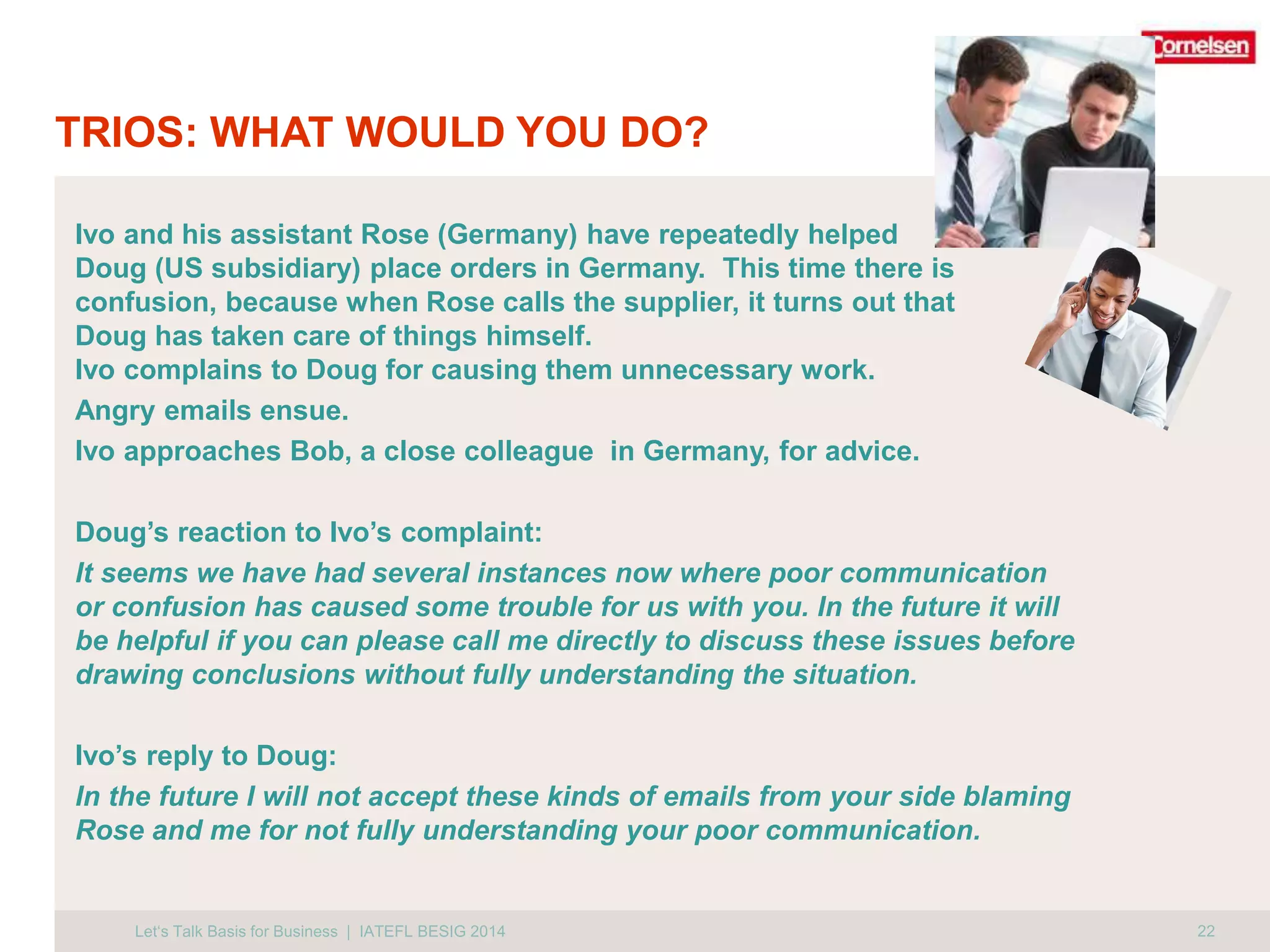
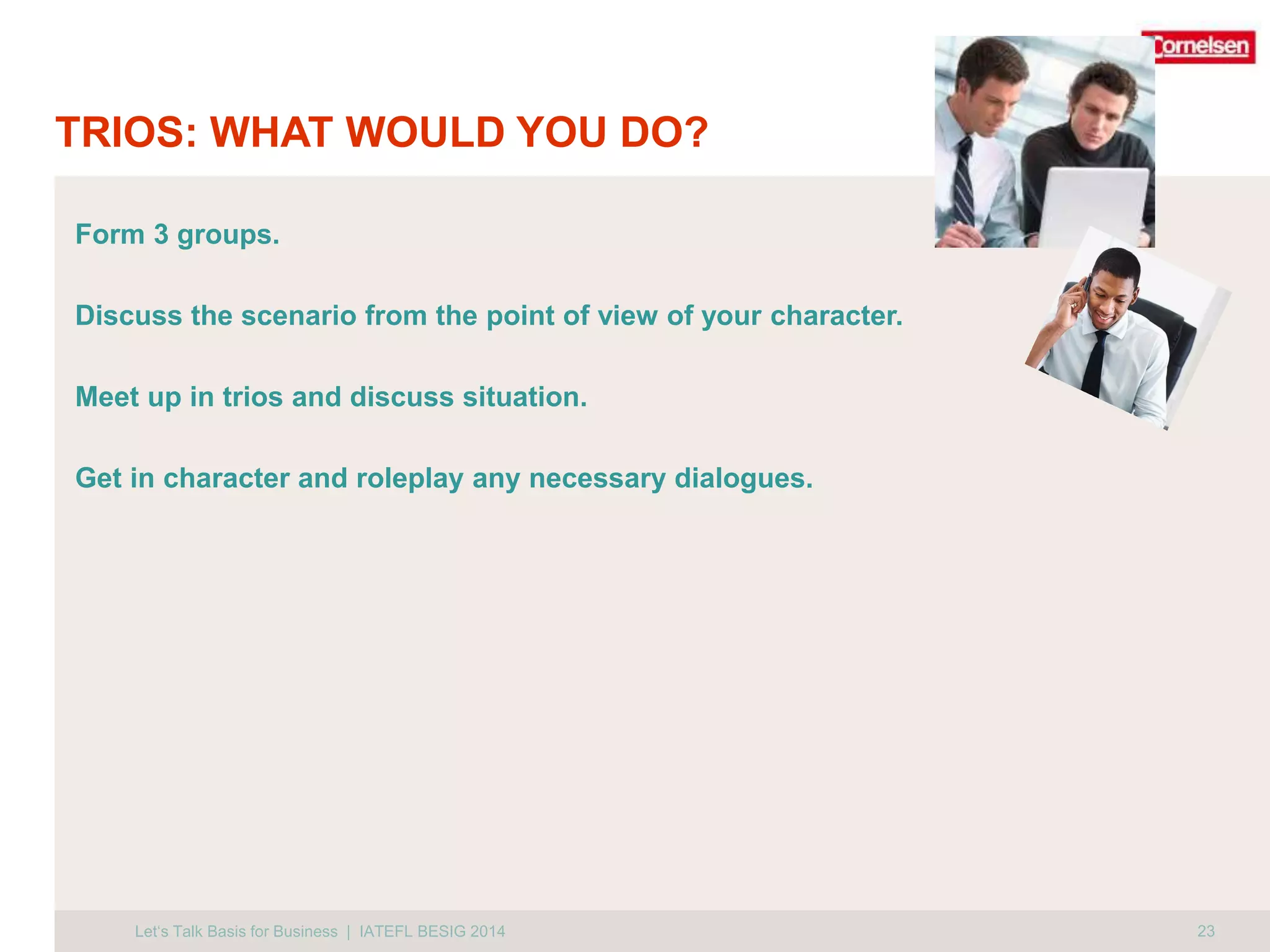
Ivo and his assistant Rose (Germany) have repeatedly helped 
Doug (US subsidiary) place orders in Germany. This time there is 
confusion, because when Rose calls the supplier, it turns out that 
Doug has taken care of things himself. 
Ivo complains to Doug for causing them unnecessary work. 
Angry emails ensue. 
Ivo approaches Bob, a close colleague in Germany, for advice. 
Doug’s reaction to Ivo’s complaint: 
It seems we have had several instances now where poor communication 
or confusion has caused some trouble for us with you. In the future it will 
be helpful if you can please call me directly to discuss these issues before 
drawing conclusions without fully understanding the situation. 
Ivo’s reply to Doug: 
In the future I will not accept these kinds of emails from your side blaming 
Rose and me for not fully understanding your poor communication. 
Let‘s Talk Basis for Business | IATEFL BESIG 2014 22
TRIOS: WHAT WOULD YOU DO? 
Form 3 groups. 
Discuss the scenario from the point of view of your character. 
Meet up in trios and discuss situation. 
Get in character and roleplay any necessary dialogues. 
Let‘s Talk Basis for Business | IATEFL BESIG 2014 23
LINGUISTIC PERSONALIZATION 
DICTOGLOSS 
24 
Aims: Assess learner language, analyse new input 
Activity: Groups of 4 
Text: 250 words in 12 sentences 
challenging level, new input 
Read at natural speed. 
Groups produce a grammatically 
correct version of the text. 
Compare versions. 
Follow-up: Focus on form. 
Examples: a. Outside View 
b. Doug’s telephone apology from C1/ 4B 
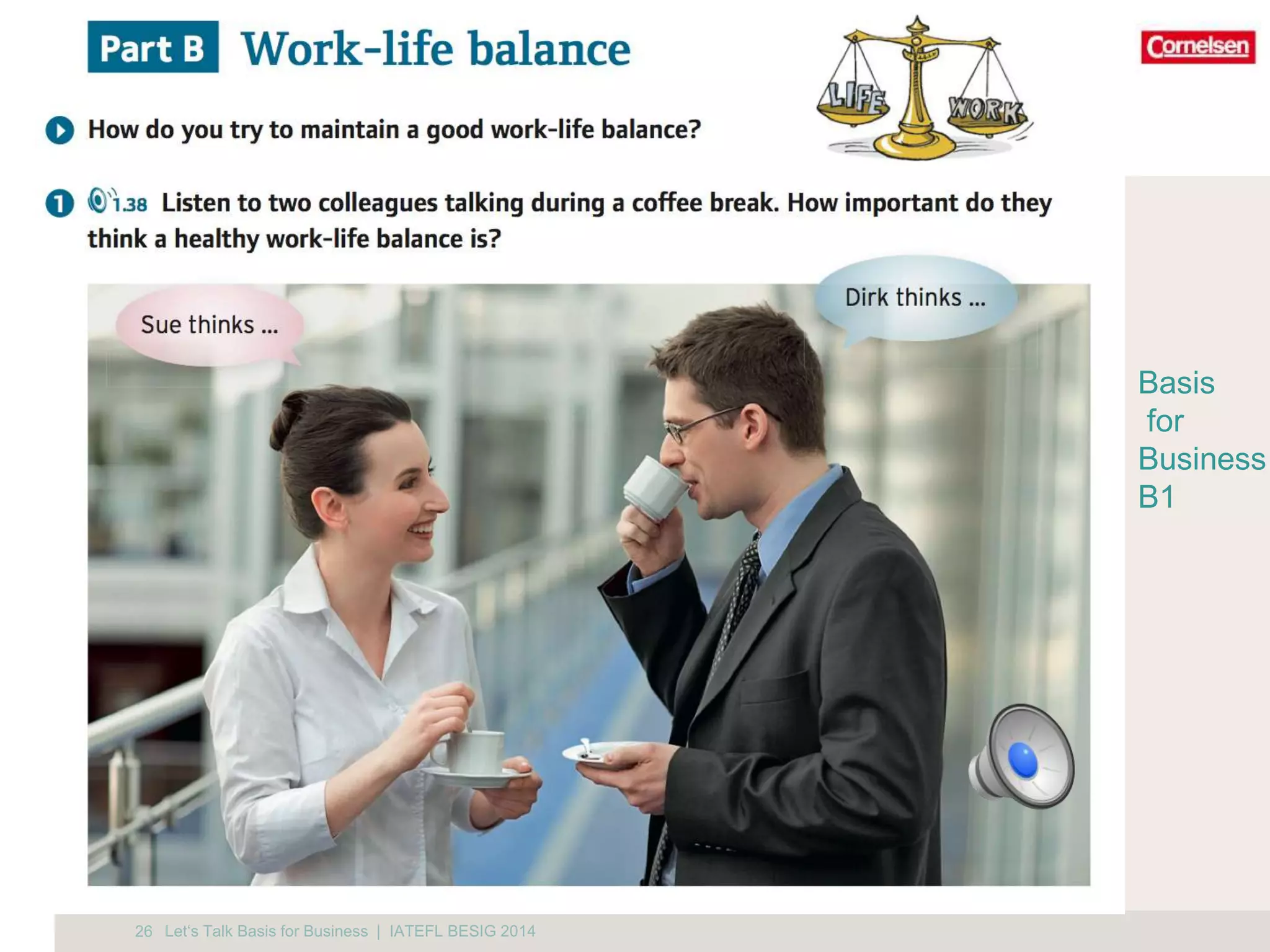
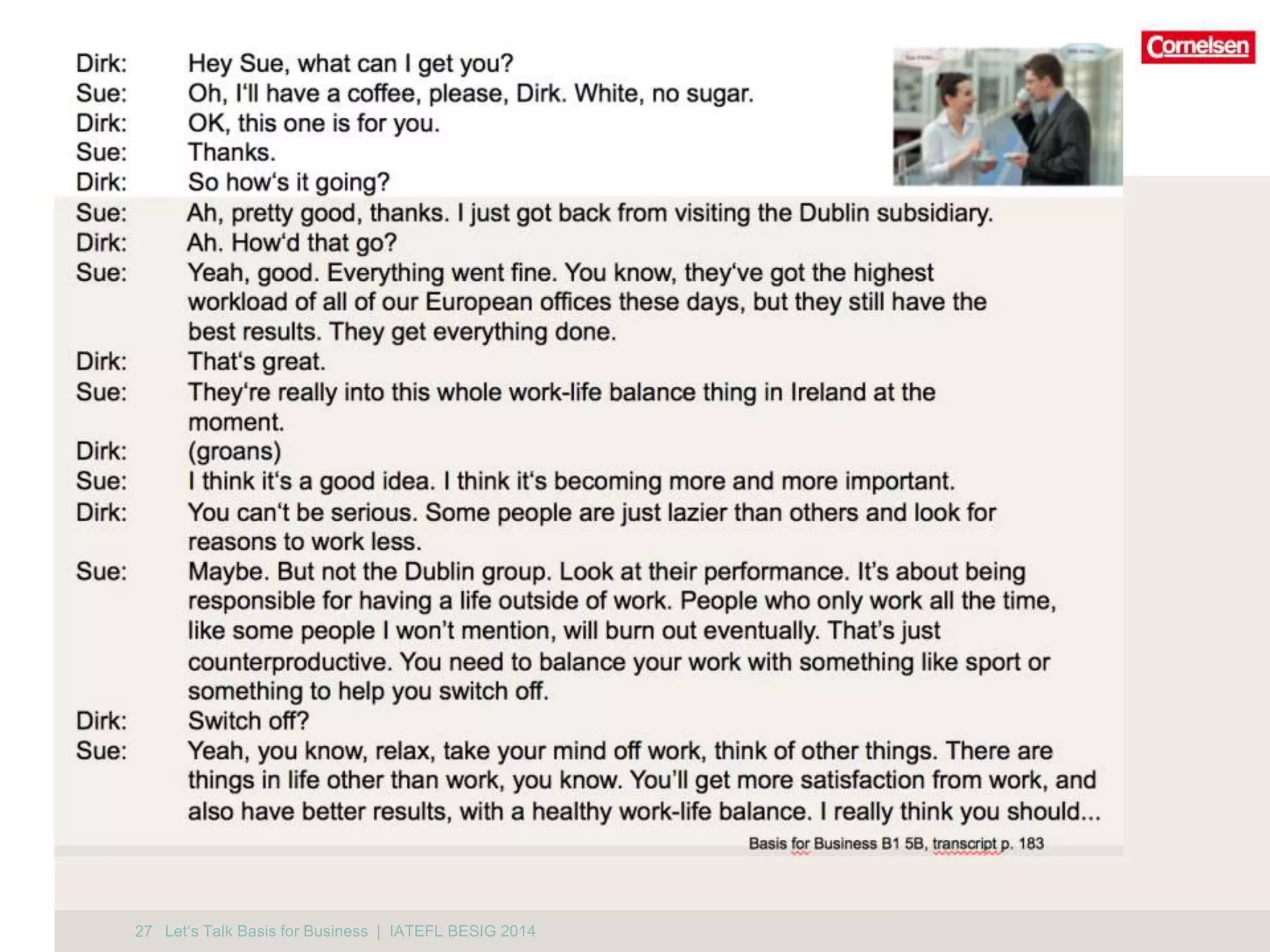
c. Dialogue Work-life-balance Sue/Dirk from B1/5B 
-> 
Let‘s Talk Basis for Business | IATEFL BESIG 2014
DICTOGLOSS 
Let‘s Talk Basis for Business | IATEFL BESIG 2014 25
26 Let‘s Talk Basis for Business | IATEFL BESIG 2014 
Basis 
for 
Business 
B1
27 Let‘s Talk Basis for Business | IATEFL BESIG 2014
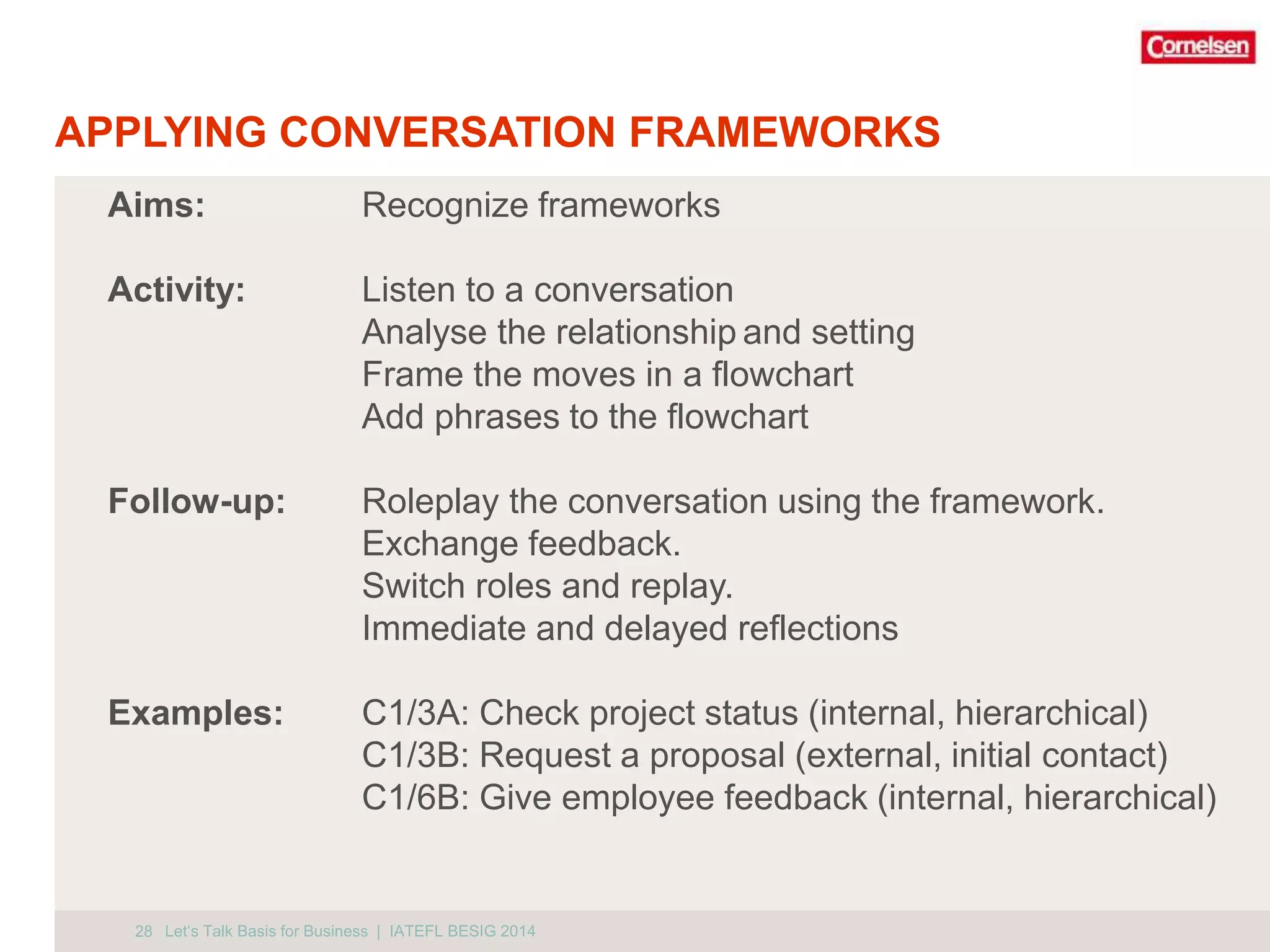
APPLYING CONVERSATION FRAMEWORKS 
Aims: Recognize frameworks 
Activity: Listen to a conversation 
28 
Analyse the relationship and setting 
Frame the moves in a flowchart 
Add phrases to the flowchart 
Follow-up: Roleplay the conversation using the framework. 
Exchange feedback. 
Switch roles and replay. 
Immediate and delayed reflections 
Examples: C1/3A: Check project status (internal, hierarchical) 
C1/3B: Request a proposal (external, initial contact) 
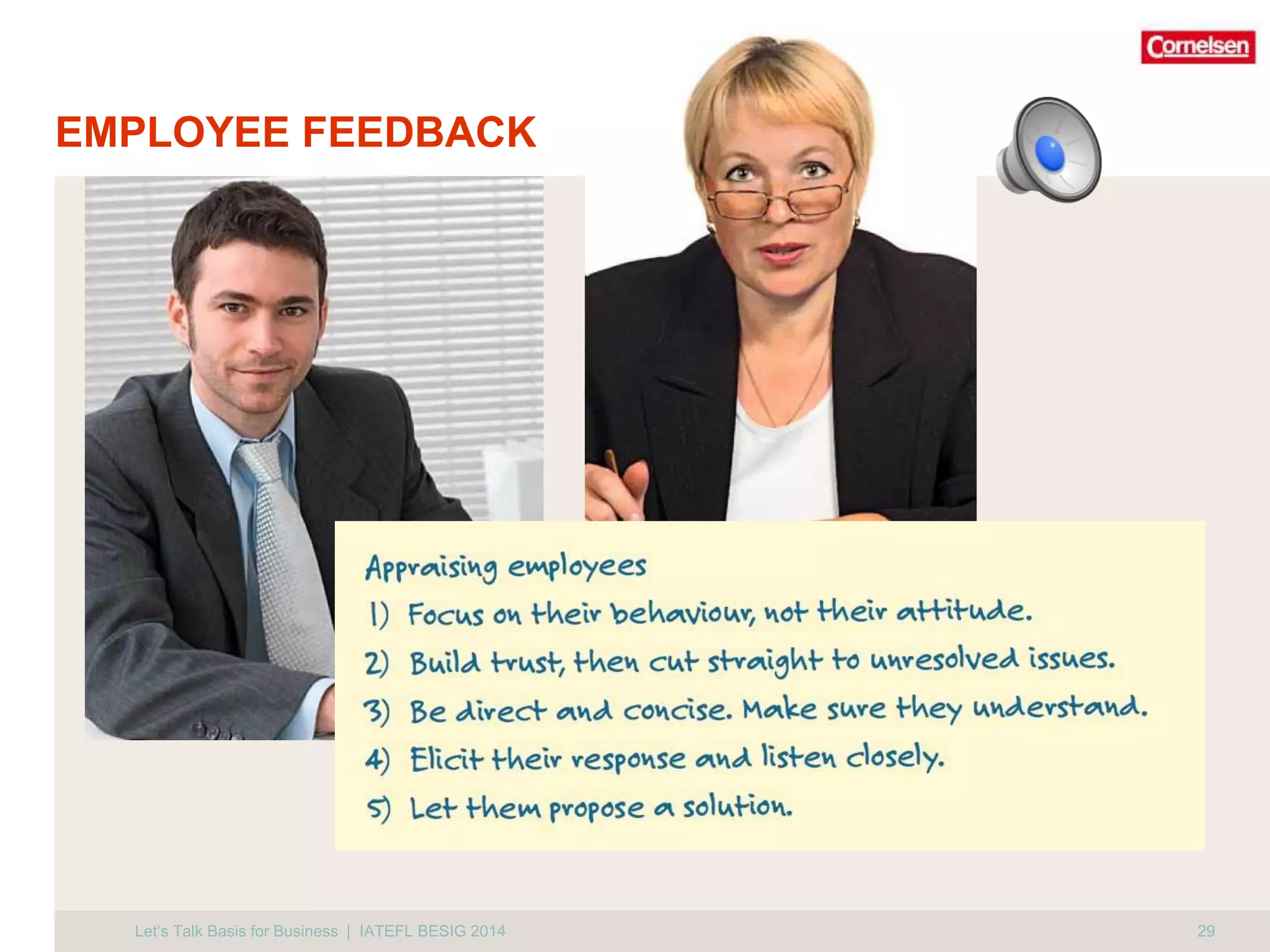
C1/6B: Give employee feedback (internal, hierarchical) 
Let‘s Talk Basis for Business | IATEFL BESIG 2014
EMPLOYEE FEEDBACK 
Let‘s Talk Basis for Business | IATEFL BESIG 2014 29
BUSINESS SKILLS 
REFRAME DIFFICULT CONVERSATIONS 
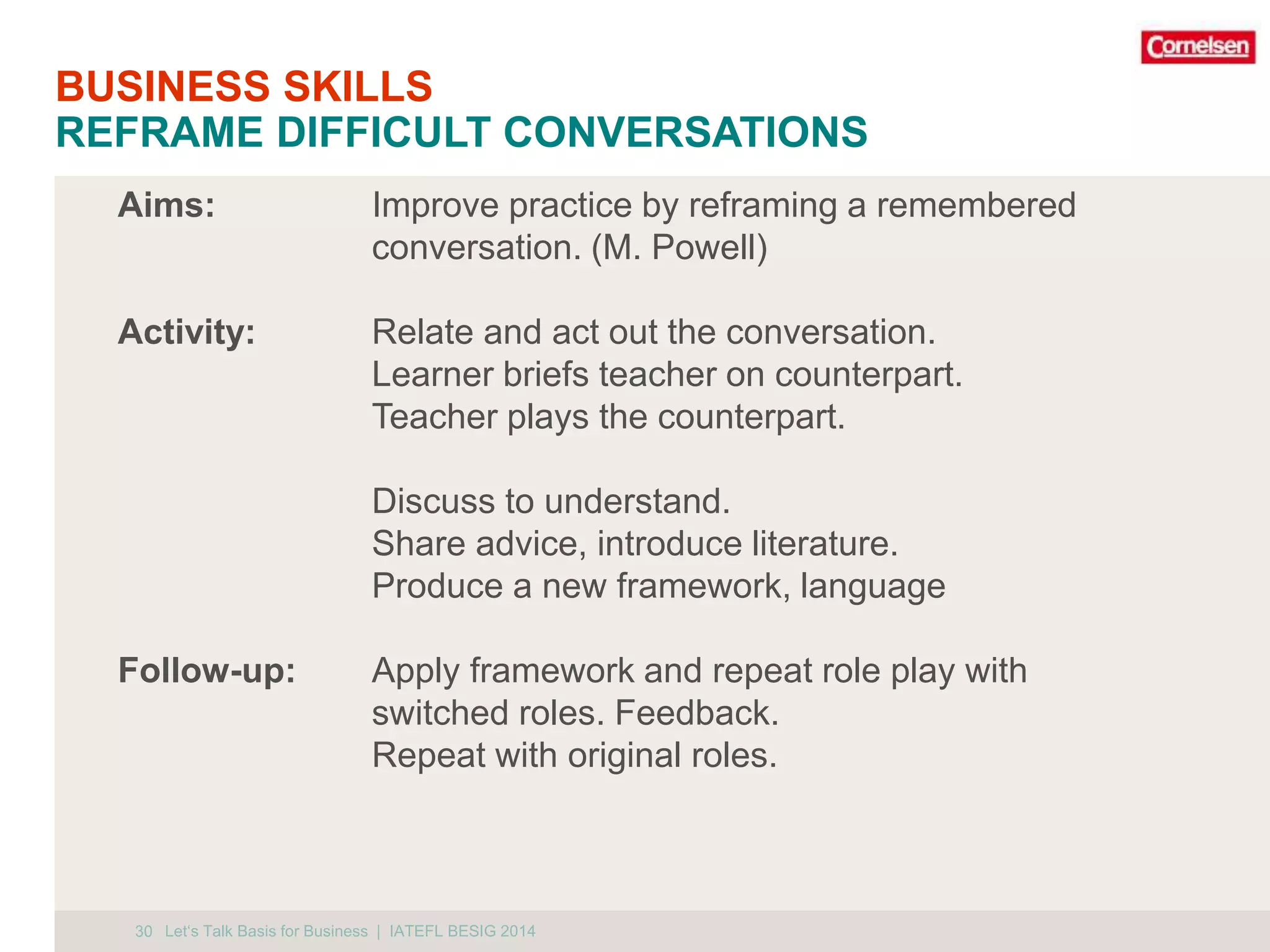
Aims: Improve practice by reframing a remembered 
30 
conversation. (M. Powell) 
Activity: Relate and act out the conversation. 
Learner briefs teacher on counterpart. 
Teacher plays the counterpart. 
Discuss to understand. 
Share advice, introduce literature. 
Produce a new framework, language 
Follow-up: Apply framework and repeat role play with 
switched roles. Feedback. 
Repeat with original roles. 
Let‘s Talk Basis for Business | IATEFL BESIG 2014
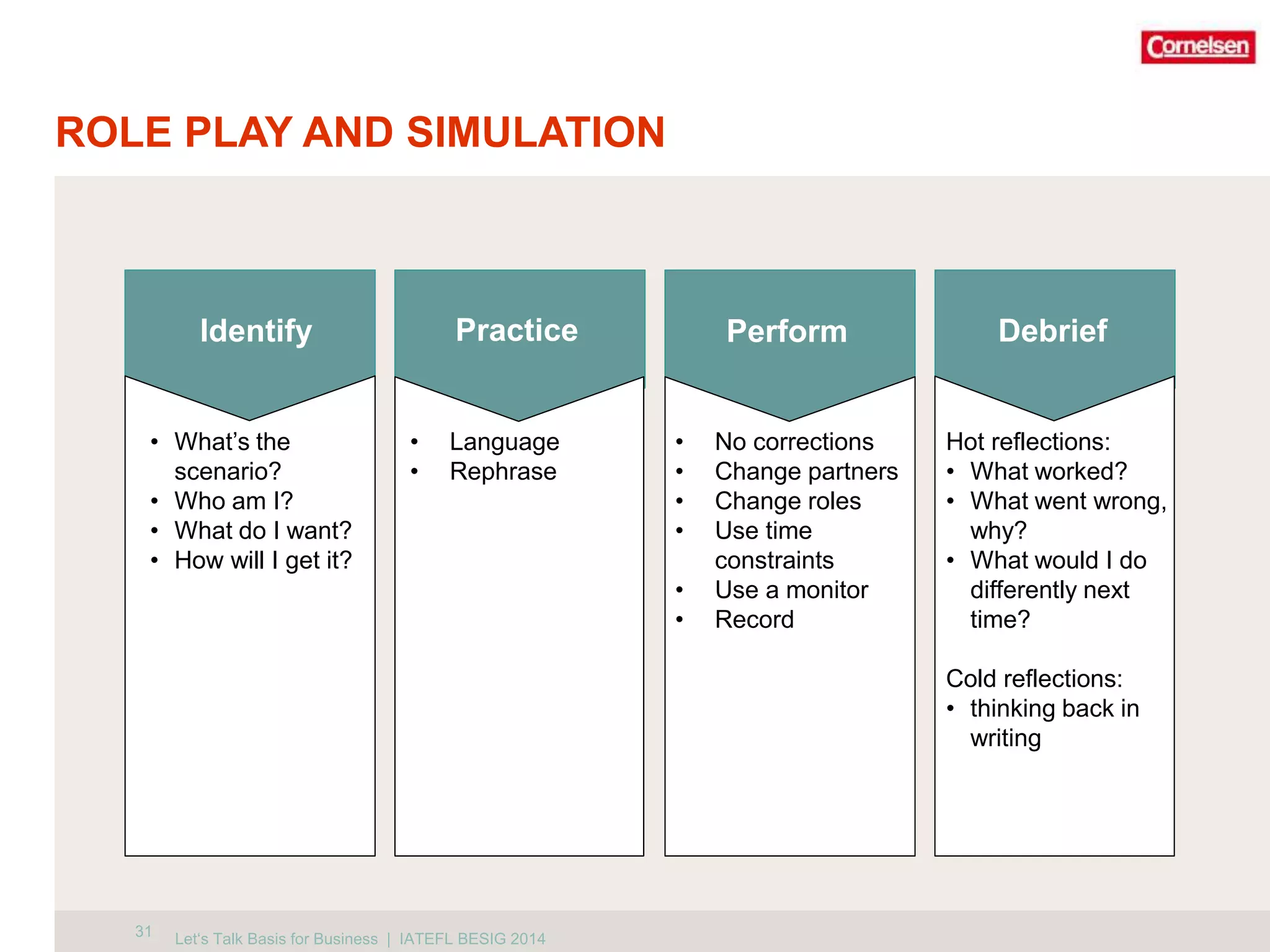
ROLE PLAY AND SIMULATION 
Features 
31 
Identify 
• What’s the 
scenario? 
• Who am I? 
• What do I want? 
• How will I get it? 
• Language 
• Rephrase 
• No corrections 
• Change partners 
• Change roles 
• Use time 
constraints 
• Use a monitor 
• Record 
Debrief 
Hot reflections: 
• What worked? 
• What went wrong, 
why? 
• What would I do 
differently next 
time? 
Cold reflections: 
• thinking back in 
writing 
Practice Perform 
Let‘s Talk Basis for Business | IATEFL BESIG 2014
BALANCE 
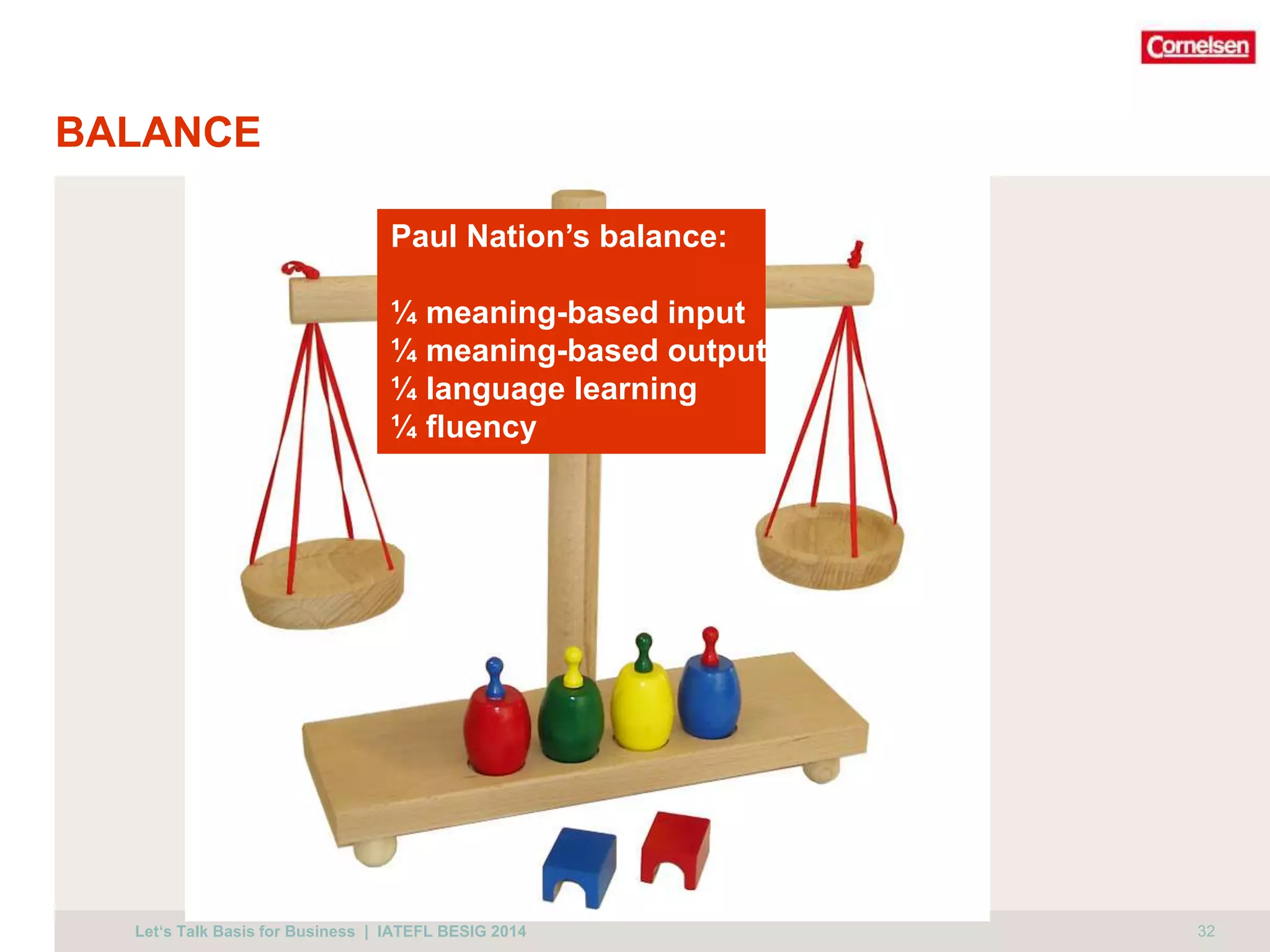
Paul Nation’s balance: 
¼ meaning-based input 
¼ meaning-based output 
¼ language learning 
¼ fluency 
Let‘s Talk Basis for Business | IATEFL BESIG 2014 32
FLUENCY ACTIVITIES 
Criteria: 
1. Is it meaning-focused? 
2. Is it easy and familiar? 
3. Is there pressure to go faster? 
4. Is there quantity of practice? 
Paul Nation’s 4–3–2 activity 
1. Speak for 4 minutes on a subject. 
2. Change partners and repeat what you said, taking 3 minutes. 
3. Change partners again and repeat, taking 2 minutes. 
33 
Let‘s Talk Basis for Business | IATEFL BESIG 2014
ROLEPLAYS 
Let‘s Talk Basis for Business | IATEFL BESIG 2014 34
SOUND OFF 
Let‘s Talk Basis for Business | IATEFL BESIG 2014 35
Recommended reading: 
Corpus linguistics: 
Francesco Bargiela-Chiappini et al., Business Discourse 
Research and Practice in Applied Linguistics, 2007, 2013. 
Michael Handford, The Language of Business Meetings 2010. 
Almut Koester, Investigating Workplace Discourse. 2006. 
Barbara Seidlhofer, Understanding English as a Lingua Franca. 2011 
Sociolinguistics/ Case studies: 
Juliane House et al.: Misunderstanding in Social Life. 2003. 
Barbara Tannen: You Just Don’t Understand. Men and Women in Conversation.1990. 
Talking 9 to 5. Men and Women at Work. 1994. 
Psychology and Communication skills / business self-help: 
Adele Faber, Elaine Mazish: How to Talk So Kids Will Listen and Liesten so Kids Will Talk. 1980. 
Diane A. Ross: The Elephant in the Office: Super-simple strategies for Difficlult Situations. 2013 
Douglas Stone et al.: Difficult Conversations. How to discuss what matters most. 1999. 
Thank you! 
anne.hodgson@t-online.de

Besig 2014 Session A3 Let's Talk Basis for Business: Building Speaking Skills and Business Skills at B2 and C1

  • 1.
    LET’S TALK BASISFOR BUSINESS: BUILDING SPEAKING AND BUSINESS SKILLS AT B2 AND C1 ANNE HODGSON IATEFL BESIG 13 NOV 2014
  • 2.
    WHAT DO YOURLEARNERS NEED TO DO IN CLASS IN ORDER TO IMPROVE? Let‘s Talk Basis for Business | IATEFL BESIG 2014 http://www.differentvoice.com/Portals/0/Photos/102309-young-adult-gr2oup.jpg
  • 3.
    USING ENGLISH ATWORK 3 Let‘s Talk Basis for Business | IATEFL BESIG 2014
  • 4.
    USING ENGLISH INCLASS 4 @CallieWallie https://www.flickr.com/photos/eltpics/5194626510/in/set-72157625304912259/ Let‘s Talk Basis for Business | IATEFL BESIG 2014
  • 5.
    WHAT METHODS? CopyrightHancock McDonald, Creative Commons 3.0 http://hancockmcdonald.com 5 Let‘s Talk Basis for Business | IATEFL BESIG 2014
  • 6.
    CEFR LEVELS, PLUS Features A1/A2 Basic • Can understand expressions related to, and speak about, areas of immediate relevance, e.g. personal info, shopping, job, background... • Can deal with most situations where the language is spoken. • Can produce simple connected text on familiar topics. • Can interact spontaneously without strain for self or listener. • Can produce clear, detailed text on many subjects and explain a viewpoint. C1 Proficient • Can understand demanding texts and recognise shifts in register and implicit meaning. • Can use language flexibly and effectively for social and professional purposes. B2 Independent B1 Independent Let‘s Talk Basis for Business | IATEFL BESIG 2014
  • 7.
    WHAT LANGUAGE? 7 Limitations: • 80% native speakers (mostly UK) • 76% men • middle & senior management Let‘s Talk Basis for Business | IATEFL BESIG 2014
  • 8.
    LEAN LANGUAGE ELFresearch: NNS • ignore/ repair errors • innovate language that works e.g. Germans use noun-phrases: • Our idea is… • My suggestion is… Mark Powell “Lean language” “Streamlining Business English” (BESIG 2010 Plenary) -> Encourage the learner -> Give the learner reality checks Let‘s Talk Basis for Business | IATEFL BESIG 2014
  • 9.
    HOW CONVERSATIONS WORK 9 Let‘s Talk Basis for Business | IATEFL BESIG 2014
  • 10.
    HOW TO IMPROVECONVERSATIONS 10 Let‘s Talk Basis for Business | IATEFL BESIG 2014
  • 11.
    CONVERSATION FRAMEWORKS Relationshipscan be 11 internal <-> external peer <-> hierarchical new <-> longstanding still in negotiation <-> contractually bound similar <-> different cultures, genders, ages Different kinds of meeting informal <-> formal one to one <-> multiple participants floor: one at a time <-> all together now decision makers present <->absent sales <-> planning/ strategy stage of project or negotiation … add your criteria Let‘s Talk Basis for Business | IATEFL BESIG 2014
  • 12.
    THE BASIS FORBUSINESS AGENDA 12 WORKPLACE SCENARIOS TO PERSONALIZE AND PRACTICE COMMUNICATIVE, TASK-BASED LEARNING PROGRESSION AT C1: FROM EVERYDAY NEEDS TO SPECIAL CHALLENGES CHALLENGES AT C1: EXTENDED LISTENING TO NNS INTERCULTURAL REFLECTIONS Let‘s Talk Basis for Business | IATEFL BESIG 2014
  • 13.
    INTERCULTURAL REFLECTIONS: POLITEREQUESTS Basis for Business B1, C1 Let‘s Talk Basis for Business | IATEFL BESIG 2014 13
  • 14.
    INTERCULTURAL REFLECTIONS Basisfor Business C1 Let‘s Talk Basis for Business | IATEFL BESIG 2014 14
  • 15.
    EXTRA PRACTICE Basisfor Business C1 Let‘s Talk Basis for Business | IATEFL BESIG 2014 15
  • 16.
    BASIS FOR BUSINESSQUIZ 1. How many units, parts and business files does Basis for Business C1 have, from Welcome unit to the end? 2. Each double-spread is designed to take 90 minutes. How many hours of teaching would that provide? Do you see the content providing more? 3. What file format is the audio in? Where are the transcripts? 4. Flip through the individual units and study the boxes in the outside margins: What colour are the Grammar boxes? How do they present grammar points? 5. Find the blue-green Phrase boxes, also in the outside margin. What types of activities do they accompany? 6. How do the Food for thought and the Did you know boxes differ? 7. Where are the Outside View essays? What are they about? 8. Which of the Skills files can be used to prepare a sales talk? 9. Where are activities to elicit learner business experience normally located? Let‘s Talk Basis for Business | IATEFL BESIG 2014
  • 17.
    ANSWERS 1. 1Welcome, 8 units x 3 , 4 business files = 29 2. The basis design is 29 double spreads x 90 minutes, but but every unit can be extended ad lib through activities of personalized practice. 3. The audio format is mp3. Transcripts in back. 4. The Grammar boxes are green, grammar is presented functionally, often contrasting two forms. 5. The Phrase boxes accompany productive tasks and fluency activities 6. Food for thought is normally a quote. Conversation starters. 7. Outside View is in Extra practice, and covers cultural skills. 8. Self-introductions, Short talks, Elevator pitch, Framing a proposal, perhaps Effective emails to prepare the meeting 9. Start (warmer), middle (reflection), end (real task), business files. Let‘s Talk Basis for Business | IATEFL BESIG 2014 17
  • 18.
    PERSONALIZING Topical: Ownexperience & preference, update on subject Book: Warmers and discussions, business cases Linguistic: Meaningful, productive tasks and feedback, explorative tasks Book: Tasks with phrase and grammar boxes Communication skills: Communication gap, simulations Book: Partner files, Business files Business skills: reflect on own skills, share; conduct class projects and meetings Book: apply suggested business methods to own situation Let‘s Talk Basis for Business | IATEFL BESIG 2014
  • 19.
    ACTIVITIES 19 Topical: Freewriting reviews Linguistic: Dictogloss Communication skills: Information gap or Triangulation / Listening trios Business skills: Frameworks: roleplaying conversations Let‘s Talk Basis for Business | IATEFL BESIG 2014
  • 20.
    TOPICAL PERSONALIZATION FREEWRITINGREVIEWS 20 Aims: Assess interest, share experience, create agenda. Activity: Individual, pair, share First note down 3 headings: 1. Business topic 2. Scenario at work 3. Language point Then browse book for 2 minutes. Finally write non-stop under these headings for 10 minutes. With students: Present to partner Mingle to find someone with similar points Collaborate to lead session on a selected topic. Let‘s Talk Basis for Business | IATEFL BESIG 2014
  • 21.
    COMMUNICATION SKILLS LISTENINGTRIOS 21 Aims: Workout in all skills, especially listening. Activity: Form 3 groups. Each group reads a different text connected to one issue. It can also be a simulation that requires each group to develop a certain perspective Form trios with one person from each group. 1. Summarize your text orally to a partner. 2. Summarize what your partner tells you in writing. 3. Discuss and triangulate the issue. Create a new text together. Follow-up: Compare the summaries of each trio for form, and collaborative texts for meaning. Our example: Ivo, Doug and Bob Relate the dilemma as if you were Ivo, Doug or Bob. Summarize each position individually. Let‘s Talk Basis for Business | IATETFLh BeESnIG d 20is14cuss and collaborate on a summary.
  • 22.
    TRIOS: WHAT WOULDYOU DO? Ivo and his assistant Rose (Germany) have repeatedly helped Doug (US subsidiary) place orders in Germany. This time there is confusion, because when Rose calls the supplier, it turns out that Doug has taken care of things himself. Ivo complains to Doug for causing them unnecessary work. Angry emails ensue. Ivo approaches Bob, a close colleague in Germany, for advice. Doug’s reaction to Ivo’s complaint: It seems we have had several instances now where poor communication or confusion has caused some trouble for us with you. In the future it will be helpful if you can please call me directly to discuss these issues before drawing conclusions without fully understanding the situation. Ivo’s reply to Doug: In the future I will not accept these kinds of emails from your side blaming Rose and me for not fully understanding your poor communication. Let‘s Talk Basis for Business | IATEFL BESIG 2014 22
  • 23.
    TRIOS: WHAT WOULDYOU DO? Form 3 groups. Discuss the scenario from the point of view of your character. Meet up in trios and discuss situation. Get in character and roleplay any necessary dialogues. Let‘s Talk Basis for Business | IATEFL BESIG 2014 23
  • 24.
    LINGUISTIC PERSONALIZATION DICTOGLOSS 24 Aims: Assess learner language, analyse new input Activity: Groups of 4 Text: 250 words in 12 sentences challenging level, new input Read at natural speed. Groups produce a grammatically correct version of the text. Compare versions. Follow-up: Focus on form. Examples: a. Outside View b. Doug’s telephone apology from C1/ 4B c. Dialogue Work-life-balance Sue/Dirk from B1/5B -> Let‘s Talk Basis for Business | IATEFL BESIG 2014
  • 25.
    DICTOGLOSS Let‘s TalkBasis for Business | IATEFL BESIG 2014 25
  • 26.
    26 Let‘s TalkBasis for Business | IATEFL BESIG 2014 Basis for Business B1
  • 27.
    27 Let‘s TalkBasis for Business | IATEFL BESIG 2014
  • 28.
    APPLYING CONVERSATION FRAMEWORKS Aims: Recognize frameworks Activity: Listen to a conversation 28 Analyse the relationship and setting Frame the moves in a flowchart Add phrases to the flowchart Follow-up: Roleplay the conversation using the framework. Exchange feedback. Switch roles and replay. Immediate and delayed reflections Examples: C1/3A: Check project status (internal, hierarchical) C1/3B: Request a proposal (external, initial contact) C1/6B: Give employee feedback (internal, hierarchical) Let‘s Talk Basis for Business | IATEFL BESIG 2014
  • 29.
    EMPLOYEE FEEDBACK Let‘sTalk Basis for Business | IATEFL BESIG 2014 29
  • 30.
    BUSINESS SKILLS REFRAMEDIFFICULT CONVERSATIONS Aims: Improve practice by reframing a remembered 30 conversation. (M. Powell) Activity: Relate and act out the conversation. Learner briefs teacher on counterpart. Teacher plays the counterpart. Discuss to understand. Share advice, introduce literature. Produce a new framework, language Follow-up: Apply framework and repeat role play with switched roles. Feedback. Repeat with original roles. Let‘s Talk Basis for Business | IATEFL BESIG 2014
  • 31.
    ROLE PLAY ANDSIMULATION Features 31 Identify • What’s the scenario? • Who am I? • What do I want? • How will I get it? • Language • Rephrase • No corrections • Change partners • Change roles • Use time constraints • Use a monitor • Record Debrief Hot reflections: • What worked? • What went wrong, why? • What would I do differently next time? Cold reflections: • thinking back in writing Practice Perform Let‘s Talk Basis for Business | IATEFL BESIG 2014
  • 32.
    BALANCE Paul Nation’sbalance: ¼ meaning-based input ¼ meaning-based output ¼ language learning ¼ fluency Let‘s Talk Basis for Business | IATEFL BESIG 2014 32
  • 33.
    FLUENCY ACTIVITIES Criteria: 1. Is it meaning-focused? 2. Is it easy and familiar? 3. Is there pressure to go faster? 4. Is there quantity of practice? Paul Nation’s 4–3–2 activity 1. Speak for 4 minutes on a subject. 2. Change partners and repeat what you said, taking 3 minutes. 3. Change partners again and repeat, taking 2 minutes. 33 Let‘s Talk Basis for Business | IATEFL BESIG 2014
  • 34.
    ROLEPLAYS Let‘s TalkBasis for Business | IATEFL BESIG 2014 34
  • 35.
    SOUND OFF Let‘sTalk Basis for Business | IATEFL BESIG 2014 35
  • 36.
    Recommended reading: Corpuslinguistics: Francesco Bargiela-Chiappini et al., Business Discourse Research and Practice in Applied Linguistics, 2007, 2013. Michael Handford, The Language of Business Meetings 2010. Almut Koester, Investigating Workplace Discourse. 2006. Barbara Seidlhofer, Understanding English as a Lingua Franca. 2011 Sociolinguistics/ Case studies: Juliane House et al.: Misunderstanding in Social Life. 2003. Barbara Tannen: You Just Don’t Understand. Men and Women in Conversation.1990. Talking 9 to 5. Men and Women at Work. 1994. Psychology and Communication skills / business self-help: Adele Faber, Elaine Mazish: How to Talk So Kids Will Listen and Liesten so Kids Will Talk. 1980. Diane A. Ross: The Elephant in the Office: Super-simple strategies for Difficlult Situations. 2013 Douglas Stone et al.: Difficult Conversations. How to discuss what matters most. 1999. Thank you! anne.hodgson@t-online.de

Editor's Notes

  • #37 Ron Carter + Mike McCarthy CANBEC Almut Koester Investigating Workplace Discourse 2006 Mike Handford: The Language of Business Meetings 2010 – 64 meetings recorded in 26 different companies in the UK, other parts of Europe and Japan. Prof. Juliane House on intercultural pragmatics and translation Light reading for the classroom: Stephen Evans, What Paddington tells us about German v British manners. BBC News Europe, 26 May 2011 Selections from Barbara Tannen‘s and Adele Faber‘s books