Business Communication
Essentials
COM 3110

Monday/Wednesday/Friday
5:00 pm to 7:10 pm
C

Jessica Delgado
delgadoj@fiu.edu
COM 3110

• Attendance is mandatory
• Three learning objectives: Business Writing, Oral Presentation, and Language
• Business Writing Skills
• Oral Presentation Skills
• Language Skills
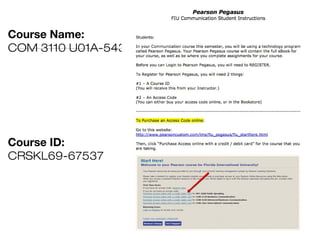
Course Name:
COM 3110 U01A-54359

Course ID:
CRSKL69-67537
Understanding Business Communication in
Today's Workplace
Chapter 1
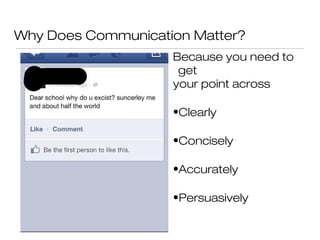
Why Does Communication Matter?
Because you need to
get
your point across
•Clearly
•Concisely
•Accurately
•Persuasively
Communicating
Effectively
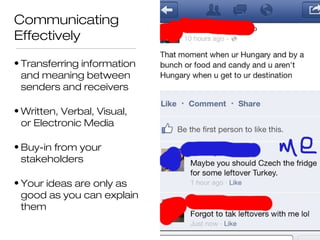
• Transferring information
and meaning between
senders and receivers
• Written, Verbal, Visual,
or Electronic Media
• Buy-in from your
stakeholders
• Your ideas are only as
good as you can explain
them
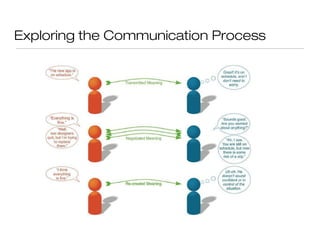
Exploring the Communication Process
Committing to Ethical Communication

Examples of unethical communication include the following:

• Plagiarizing
• Omitting essential information
• Selectively misquoting
• Distorting statistics or visuals
• Failing to respect privacy or information security needs
Committing to Ethical Communication
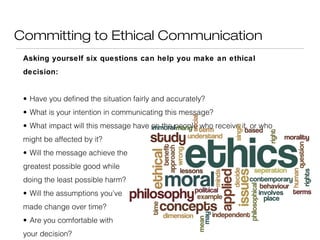
Asking yourself six questions can help you make an ethical
decision:
• Have you defined the situation fairly and accurately?
• What is your intention in communicating this message?
• What impact will this message have on the people who receive it, or who
might be affected by it?
• Will the message achieve the
greatest possible good while
doing the least possible harm?
• Will the assumptions you’ve
made change over time?
• Are you comfortable with
your decision?
Communicating in a World of Diversity
Follow the tips below to communicate more effectively in cross-cultural situations:
• Avoid ethnocentrism (the tendency to judge all other groups according to the
standards, behaviors, and customs of one’s own group).
• Avoid stereotyping (assigning a wide range of generalized—and often inaccurate
—attributes to individuals on the basis of their membership in a particular culture or
social group).
• Don’t automatically assume that others think, believe, or behave as you do.
• Accept differences in others without judging them.
• Learn how to communicate respect in various cultures.
• Tolerate ambiguity and control your frustration.
• Don’t be distracted by superficial factors such
as personal appearance.
• Recognize your own cultural biases.
• Be flexible and be prepared to change your habits and attitudes.
• Observe and learn, the more you learn, the more effective you’ll be.
Communicating in a World of Diversity
To help you prepare effective written communications for multicultural (and multilingual)
audiences, remember these tips:
• Use plain English
• Be clear
• Address international correspondence properly
• Cite numbers carefully
• Avoid slang and be careful with jargon and abbreviations
• Be brief
• Use short paragraphs
• Use transitions
Communicating in a World of Diversity
To help you prepare effective oral messages for those of whom English is not their
native language, remember these tips:
• Speak clearly, simply, and relatively slowly
• Look for feedback
• Rephrase if necessary
• Clarify your true intent with repetition and
examples
• Don’t talk down to the other person
• Learn important phrases in your audience’s language
• Listen carefully and respectfully
• Adapt your conversation style to the other person’s
• Check frequently for comprehension
• Clarify what will happen next
Using Technology to Improve Business
Communication
Using Social Media Judiciously and
Consciously

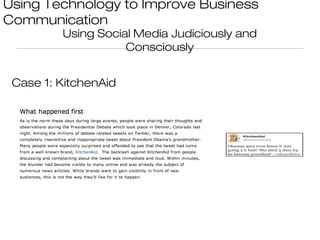
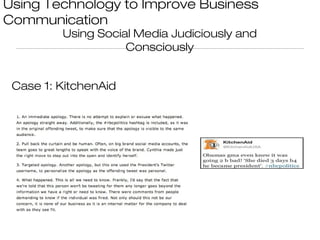
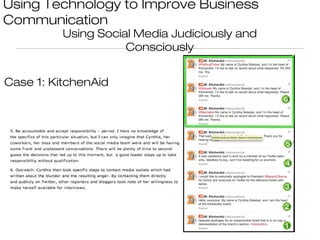
Case 1: KitchenAid
Using Technology to Improve Business
Communication
Using Social Media Judiciously and
Consciously

Case 1: KitchenAid
Using Technology to Improve Business
Communication
Using Social Media Judiciously and
Consciously

Case 1: KitchenAid
Using Technology to Improve Business
Communication
Using Social Media Judiciously and
Consciously
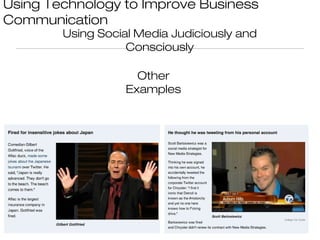
Other
Examples

Com 3110 monday

  • 1.
    Business Communication Essentials COM 3110 Monday/Wednesday/Friday 5:00pm to 7:10 pm C Jessica Delgado delgadoj@fiu.edu
  • 3.
    COM 3110 • Attendanceis mandatory • Three learning objectives: Business Writing, Oral Presentation, and Language • Business Writing Skills • Oral Presentation Skills • Language Skills
  • 4.
    Course Name: COM 3110U01A-54359 Course ID: CRSKL69-67537
  • 5.
    Understanding Business Communicationin Today's Workplace Chapter 1
  • 6.
    Why Does CommunicationMatter? Because you need to get your point across •Clearly •Concisely •Accurately •Persuasively
  • 7.
    Communicating Effectively • Transferring information andmeaning between senders and receivers • Written, Verbal, Visual, or Electronic Media • Buy-in from your stakeholders • Your ideas are only as good as you can explain them
  • 8.
  • 9.
    Committing to EthicalCommunication Examples of unethical communication include the following: • Plagiarizing • Omitting essential information • Selectively misquoting • Distorting statistics or visuals • Failing to respect privacy or information security needs
  • 10.
    Committing to EthicalCommunication Asking yourself six questions can help you make an ethical decision: • Have you defined the situation fairly and accurately? • What is your intention in communicating this message? • What impact will this message have on the people who receive it, or who might be affected by it? • Will the message achieve the greatest possible good while doing the least possible harm? • Will the assumptions you’ve made change over time? • Are you comfortable with your decision?
  • 11.
    Communicating in aWorld of Diversity Follow the tips below to communicate more effectively in cross-cultural situations: • Avoid ethnocentrism (the tendency to judge all other groups according to the standards, behaviors, and customs of one’s own group). • Avoid stereotyping (assigning a wide range of generalized—and often inaccurate —attributes to individuals on the basis of their membership in a particular culture or social group). • Don’t automatically assume that others think, believe, or behave as you do. • Accept differences in others without judging them. • Learn how to communicate respect in various cultures. • Tolerate ambiguity and control your frustration. • Don’t be distracted by superficial factors such as personal appearance. • Recognize your own cultural biases. • Be flexible and be prepared to change your habits and attitudes. • Observe and learn, the more you learn, the more effective you’ll be.
  • 12.
    Communicating in aWorld of Diversity To help you prepare effective written communications for multicultural (and multilingual) audiences, remember these tips: • Use plain English • Be clear • Address international correspondence properly • Cite numbers carefully • Avoid slang and be careful with jargon and abbreviations • Be brief • Use short paragraphs • Use transitions
  • 13.
    Communicating in aWorld of Diversity To help you prepare effective oral messages for those of whom English is not their native language, remember these tips: • Speak clearly, simply, and relatively slowly • Look for feedback • Rephrase if necessary • Clarify your true intent with repetition and examples • Don’t talk down to the other person • Learn important phrases in your audience’s language • Listen carefully and respectfully • Adapt your conversation style to the other person’s • Check frequently for comprehension • Clarify what will happen next
  • 14.
    Using Technology toImprove Business Communication Using Social Media Judiciously and Consciously Case 1: KitchenAid
  • 15.
    Using Technology toImprove Business Communication Using Social Media Judiciously and Consciously Case 1: KitchenAid
  • 16.
    Using Technology toImprove Business Communication Using Social Media Judiciously and Consciously Case 1: KitchenAid
  • 17.
    Using Technology toImprove Business Communication Using Social Media Judiciously and Consciously Other Examples

Editor's Notes

  • #4 Effective Communication helps your company, and you, in a lot of different ways. With effective communication you can: * influence conversations, perceptions, and trends * increase productivity and faster problem solving * better financial results and higher returns for investors * stronger decision making based on timely, reliable information Why? Because you will need to know your material, you will know your audience, and you will know your product.
  • #5 What will you learn with this class? You will improve your writing, speaking, and presentation skills You will be able to identify various commonly misused phrases and word avoid jargon
  • #6 Effective Communication helps your company, and you, in a lot of different ways. With effective communication you can: * influence conversations, perceptions, and trends * increase productivity and faster problem solving * better financial results and higher returns for investors * stronger decision making based on timely, reliable information Why? Because you will need to know your material, you will know your audience, and you will know your product.
  • #7 Sometimes it's not what you say, but how you say it. Think of when you are making a big decision, do you go with the person that cannot express themselves? that person who tells you to "trust them," but doesn't clearly communicate why? It's the same thing with Business Communication. You don't have to be the loudest, smartest, arrogant, or rudest to get people to follow you. Do your job and do it well. You need to know your facts, know your product, and be sure in what you say. Avoid jargon. Be clear. Be concise. Learn the terminology of your organization. You need to read your audience. Learn what style of communication to use at the precise moment In this chapter, we'll go over the importance of effective business communication, what it means to communicate as a professional describe the communication process model and explain how social media is changing the communication landscape
  • #8 What Makes Business Communication Effective? Goal is to strengthen the connections between a company and all of its stakeholders. What does that mean? It means that those groups affected in some way by the company's actions: Customers, shareholders, suppliers, neighbors- ANYONE that has an interest or a "stake" in the outcome. Provide: * Practical Information * Give facts rather than a vague impression * Present information in a concise, efficient manner * Clarify expectations and responsibilities * Offer compelling, persuasive arguments and recommendations Communicate as a professional. Professionalism: The quality of performing at a high level and conducting oneself with purpose and pride. Six distinct traits: striving to excel being dependable and accountable being a team player demonstrating a sense of etiquette making ethical decisions, maintaining a positive outlook