
Language Learning Strategies II November 6, 2007
Goals for today… Goals and Homework (2:00-2:05) The Good Language Learner – brainstorm and discussion (2:05-2:20) The Good Language Learner Profile Activity (2:20 – 2:30) Speaking, Reading, & Writing (2:30 – 3:15)
Homework for next time… Read SA pp. 203-245 Language Learner Profile report due
What is a “good” language learner? In small groups brainstorm words or short phrases on board for 1 minute
Does the ‘Good Language Learner’ Exist? “ Initially, learning French was a lot of nitty gritty details. Immersion was the key for me. I got involved in events and in speaking up even when I was not comfortable. Not only did I study abroad, I also taught in Cameroon and in France. Some of my closest friends are native French speakers and we stay in touch by phone, e-mail, letters, and special trips. I still maintain my fluency ten years later with a real purpose for communicating in French. “ Tracie DeVine, native English speaker  “ I went into my first language class and made a promise to myself that I would speak this language without an accent. I went on to become not only fluent in English, but also Latin, French, and have just passed intermediate Arabic. My fluency and ease with English enabled me to study abroad. “  Gabi Schmiegel, native German speaker
Strategies used by “good” language learners Making reasoned guesses when not sure Making an effort to communicate and to learn through communication Finding strategies for overcoming inhibitions in target language interaction Practicing the language whenever possible Monitoring their speech and that of others Attending to form (i.e., grammar) Paying attention to meaning ---Rubin (1975)
Exchange Language Learner Profiles Read over the profile. Ask the person some questions or clarifications or simply write down more information. For next time you will write a language learning profile on that person (see example) and post to your blog  (2-5 pages)
Speaking, Reading, Writing In small groups generate  lists of activities you could do to practice each of these skills prior to studying abroad
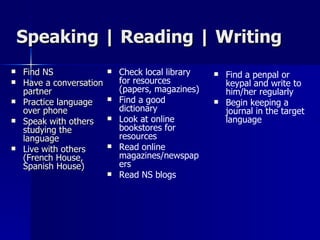
Speaking | Reading | Writing Find NS Have a conversation partner Practice language over phone Speak with others studying the language Live with others (French House, Spanish House) Check local library for resources (papers, magazines) Find a good dictionary Look at online bookstores for resources Read online magazines/newspapers Read NS blogs Find a penpal or keypal and write to him/her regularly Begin keeping a journal in the target language
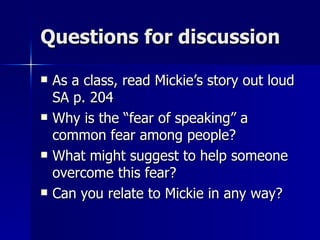
Questions for discussion As a class, read Mickie’s story out loud SA p. 204 Why is the “fear of speaking” a common fear among people? What might suggest to help someone overcome this fear? Can you relate to Mickie in any way?
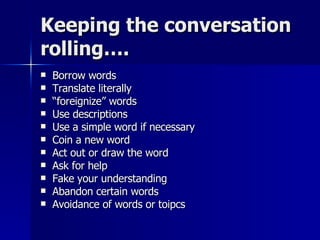
Keeping the conversation rolling…. Borrow words Translate literally “ foreignize” words Use descriptions Use a simple word if necessary Coin a new word Act out or draw the word Ask for help Fake your understanding Abandon certain words Avoidance of words or toipcs
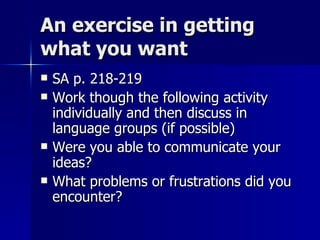
An exercise in getting what you want SA p. 218-219 Work though the following activity individually and then discuss in language groups (if possible) Were you able to communicate your ideas? What problems or frustrations did you encounter?
Strategies for increasing your reading comprehension Decide why you need to read it Skim the text Use top-down and bottom-up strategies Don’t overuse dictionary Read between lines Get background info first
Filling in the Gaps (reading activity) SA pp. 229 Read directions together, then answer the following questions (next slide)
Filling in the Gaps (reading activity) SA pp. 229 --- how well did you understand the text?? (discuss questions that follow in small groups) What is the main point of the passage? According to the author, what features has technology brought to personal organization? What are the advantages and disadvantages of these advances? Does the author feel that people are better organized today than n the past? How many of the words did you “fill in”? Were you able to get the gist of the story without knowing some words? What strategies did you employ to help you figure out the meaning of the text?
Writing – Some Advice Go back to go forward Repeat key words and phrases Plan out what you are going to write Discuss what you want to say with someone else before writing Leave a blank for words you don’t know Edit grammar and mechanics after your ideas are written Make major revisions after your ideas are written down Distance yourself from writing Give yourself extra time to write Read in target language in order to improve your writing in that language
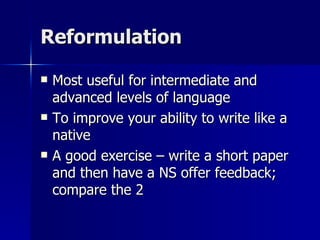
Reformulation Most useful for intermediate and advanced levels of language To improve your ability to write like a native A good exercise – write a short paper and then have a NS offer feedback; compare the 2
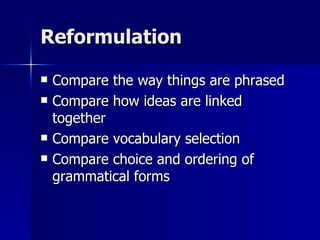
Reformulation Compare the way things are phrased Compare how ideas are linked together Compare vocabulary selection Compare choice and ordering of grammatical forms
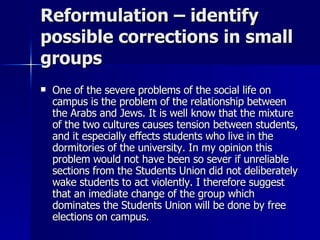
Reformulation – identify possible corrections in small groups One of the severe problems of the social life on campus is the problem of the relationship between the Arabs and Jews. It is well know that the mixture of the two cultures causes tension between students, and it especially effects students who live in the dormitories of the university. In my opinion this problem would not have been so sever if unreliable sections from the Students Union did not deliberately wake students to act violently. I therefore suggest that an imediate change of the group which dominates the Students Union will be done by free elections on campus.

Nov.6

  • 1.
    Language Learning StrategiesII November 6, 2007
  • 2.
    Goals for today…Goals and Homework (2:00-2:05) The Good Language Learner – brainstorm and discussion (2:05-2:20) The Good Language Learner Profile Activity (2:20 – 2:30) Speaking, Reading, & Writing (2:30 – 3:15)
  • 3.
    Homework for nexttime… Read SA pp. 203-245 Language Learner Profile report due
  • 4.
    What is a“good” language learner? In small groups brainstorm words or short phrases on board for 1 minute
  • 5.
    Does the ‘GoodLanguage Learner’ Exist? “ Initially, learning French was a lot of nitty gritty details. Immersion was the key for me. I got involved in events and in speaking up even when I was not comfortable. Not only did I study abroad, I also taught in Cameroon and in France. Some of my closest friends are native French speakers and we stay in touch by phone, e-mail, letters, and special trips. I still maintain my fluency ten years later with a real purpose for communicating in French. “ Tracie DeVine, native English speaker “ I went into my first language class and made a promise to myself that I would speak this language without an accent. I went on to become not only fluent in English, but also Latin, French, and have just passed intermediate Arabic. My fluency and ease with English enabled me to study abroad. “ Gabi Schmiegel, native German speaker
  • 6.
    Strategies used by“good” language learners Making reasoned guesses when not sure Making an effort to communicate and to learn through communication Finding strategies for overcoming inhibitions in target language interaction Practicing the language whenever possible Monitoring their speech and that of others Attending to form (i.e., grammar) Paying attention to meaning ---Rubin (1975)
  • 7.
    Exchange Language LearnerProfiles Read over the profile. Ask the person some questions or clarifications or simply write down more information. For next time you will write a language learning profile on that person (see example) and post to your blog (2-5 pages)
  • 8.
    Speaking, Reading, WritingIn small groups generate lists of activities you could do to practice each of these skills prior to studying abroad
  • 9.
    Speaking | Reading| Writing Find NS Have a conversation partner Practice language over phone Speak with others studying the language Live with others (French House, Spanish House) Check local library for resources (papers, magazines) Find a good dictionary Look at online bookstores for resources Read online magazines/newspapers Read NS blogs Find a penpal or keypal and write to him/her regularly Begin keeping a journal in the target language
  • 10.
    Questions for discussionAs a class, read Mickie’s story out loud SA p. 204 Why is the “fear of speaking” a common fear among people? What might suggest to help someone overcome this fear? Can you relate to Mickie in any way?
  • 11.
    Keeping the conversationrolling…. Borrow words Translate literally “ foreignize” words Use descriptions Use a simple word if necessary Coin a new word Act out or draw the word Ask for help Fake your understanding Abandon certain words Avoidance of words or toipcs
  • 12.
    An exercise ingetting what you want SA p. 218-219 Work though the following activity individually and then discuss in language groups (if possible) Were you able to communicate your ideas? What problems or frustrations did you encounter?
  • 13.
    Strategies for increasingyour reading comprehension Decide why you need to read it Skim the text Use top-down and bottom-up strategies Don’t overuse dictionary Read between lines Get background info first
  • 14.
    Filling in theGaps (reading activity) SA pp. 229 Read directions together, then answer the following questions (next slide)
  • 15.
    Filling in theGaps (reading activity) SA pp. 229 --- how well did you understand the text?? (discuss questions that follow in small groups) What is the main point of the passage? According to the author, what features has technology brought to personal organization? What are the advantages and disadvantages of these advances? Does the author feel that people are better organized today than n the past? How many of the words did you “fill in”? Were you able to get the gist of the story without knowing some words? What strategies did you employ to help you figure out the meaning of the text?
  • 16.
    Writing – SomeAdvice Go back to go forward Repeat key words and phrases Plan out what you are going to write Discuss what you want to say with someone else before writing Leave a blank for words you don’t know Edit grammar and mechanics after your ideas are written Make major revisions after your ideas are written down Distance yourself from writing Give yourself extra time to write Read in target language in order to improve your writing in that language
  • 17.
    Reformulation Most usefulfor intermediate and advanced levels of language To improve your ability to write like a native A good exercise – write a short paper and then have a NS offer feedback; compare the 2
  • 18.
    Reformulation Compare theway things are phrased Compare how ideas are linked together Compare vocabulary selection Compare choice and ordering of grammatical forms
  • 19.
    Reformulation – identifypossible corrections in small groups One of the severe problems of the social life on campus is the problem of the relationship between the Arabs and Jews. It is well know that the mixture of the two cultures causes tension between students, and it especially effects students who live in the dormitories of the university. In my opinion this problem would not have been so sever if unreliable sections from the Students Union did not deliberately wake students to act violently. I therefore suggest that an imediate change of the group which dominates the Students Union will be done by free elections on campus.