Estimation and
                    Confidence Intervals
                        Chapter 9


McGraw-Hill/Irwin          Copyright © 2012 by The McGraw-Hill Companies, Inc. All rights reserved.
Learning Objectives
LO1 Define a point estimate.
LO2 Define level of confidence.
LO3 Compute a confidence interval for the population
    mean when the population standard deviation is
    known.
LO4 Compute a confidence interval for a population mean
    when the population standard deviation is unknown.
LO5 Compute a confidence interval for a population
    proportion.
LO6 Calculate the required sample size to estimate a
    population proportion or population mean.
LO7 Adjust a confidence interval for finite populations
                                                          9-2
LO1 Define a point estimate.


Point Estimates

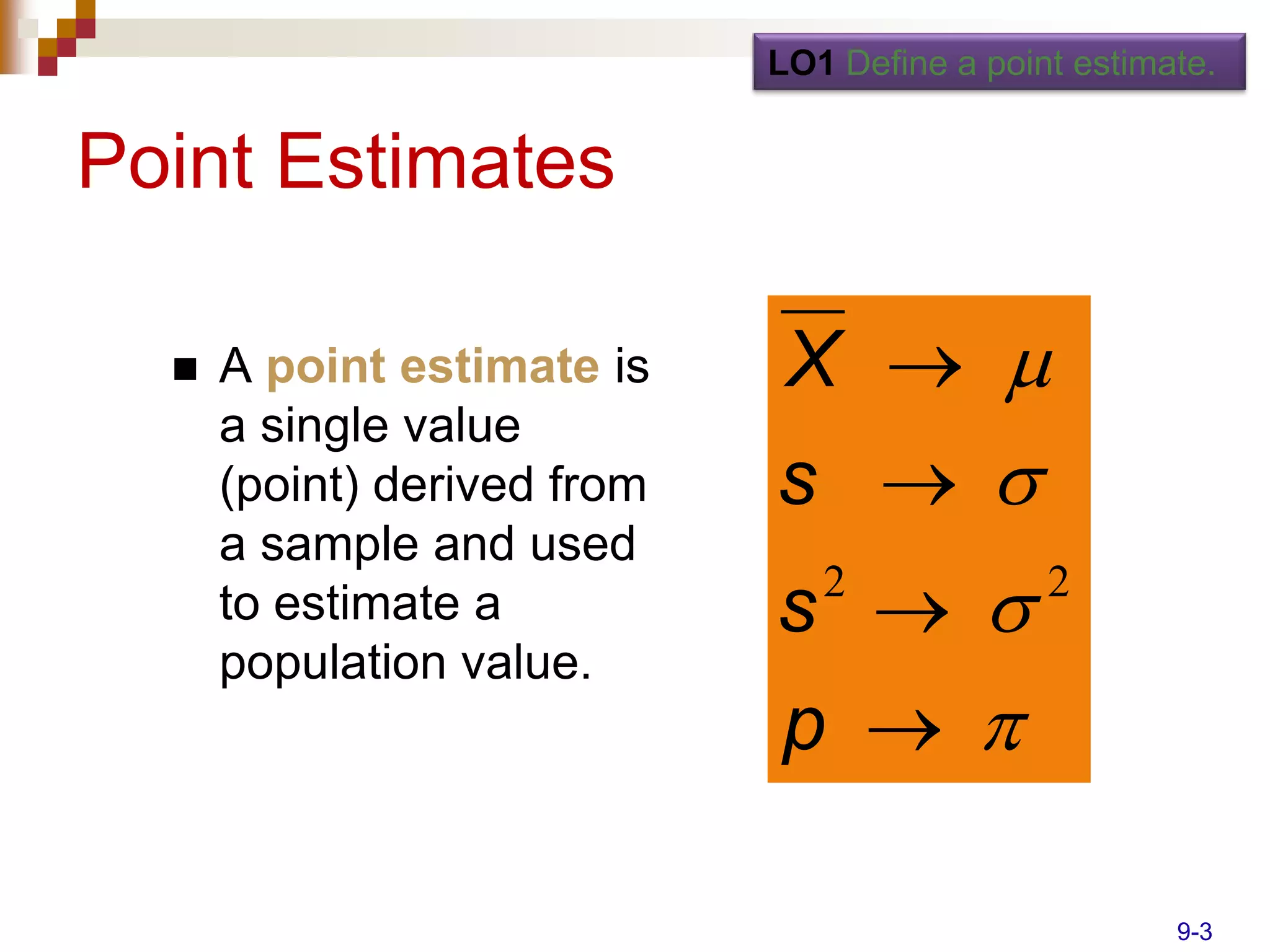
     A point estimate is    X  
      a single value
      (point) derived from   s  
      a sample and used
      to estimate a          s  
                                2             2
      population value.
                             p  

                                                      9-3
LO2 Define a confidence estimate.


Confidence Interval Estimates
    A confidence interval estimate is a range
     of values constructed from sample data so
     that the population parameter is likely to
     occur within that range at a specified
     probability. The specified probability is called
     the level of confidence.


 C.I. = point estimate ± margin of error


                                                           9-4
LO2
Factors Affecting Confidence
Interval Estimates
 The width of a confidence interval are
 determined by:
    1.The sample size, n.
    2.The variability in the population, usually
     σ estimated by s.
    3.The desired level of confidence.


                                                   9-5
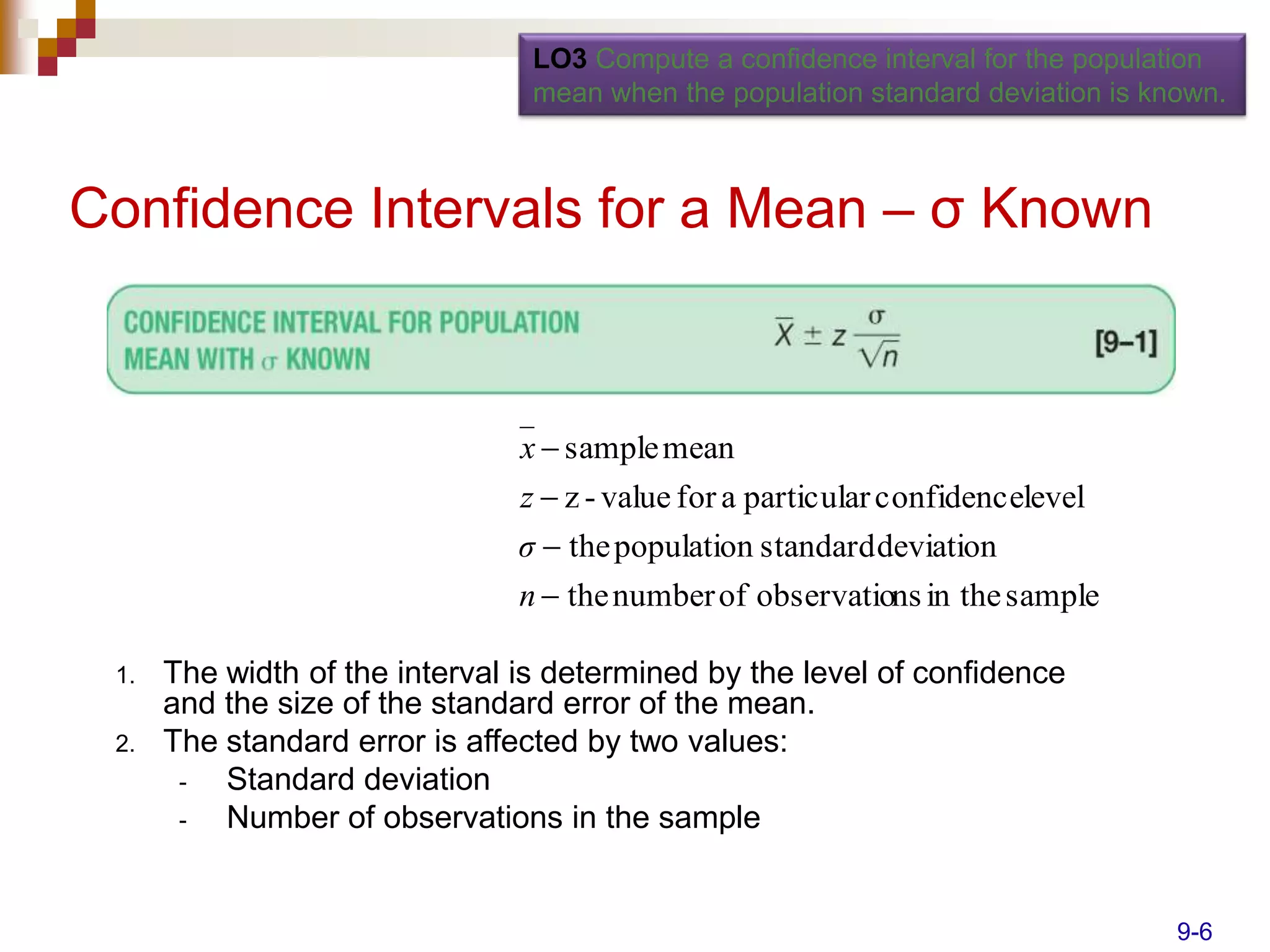
LO3 Compute a confidence interval for the population
                                 mean when the population standard deviation is known.


Confidence Intervals for a Mean – σ Known


                                x  sample mean
                               z  z - value for a particular confidencelevel
                               σ  the population standard deviation
                                n  the number of observations in the sample

 1.   The width of the interval is determined by the level of confidence
      and the size of the standard error of the mean.
 2.   The standard error is affected by two values:
       -  Standard deviation
       -  Number of observations in the sample


                                                                                  9-6
LO3

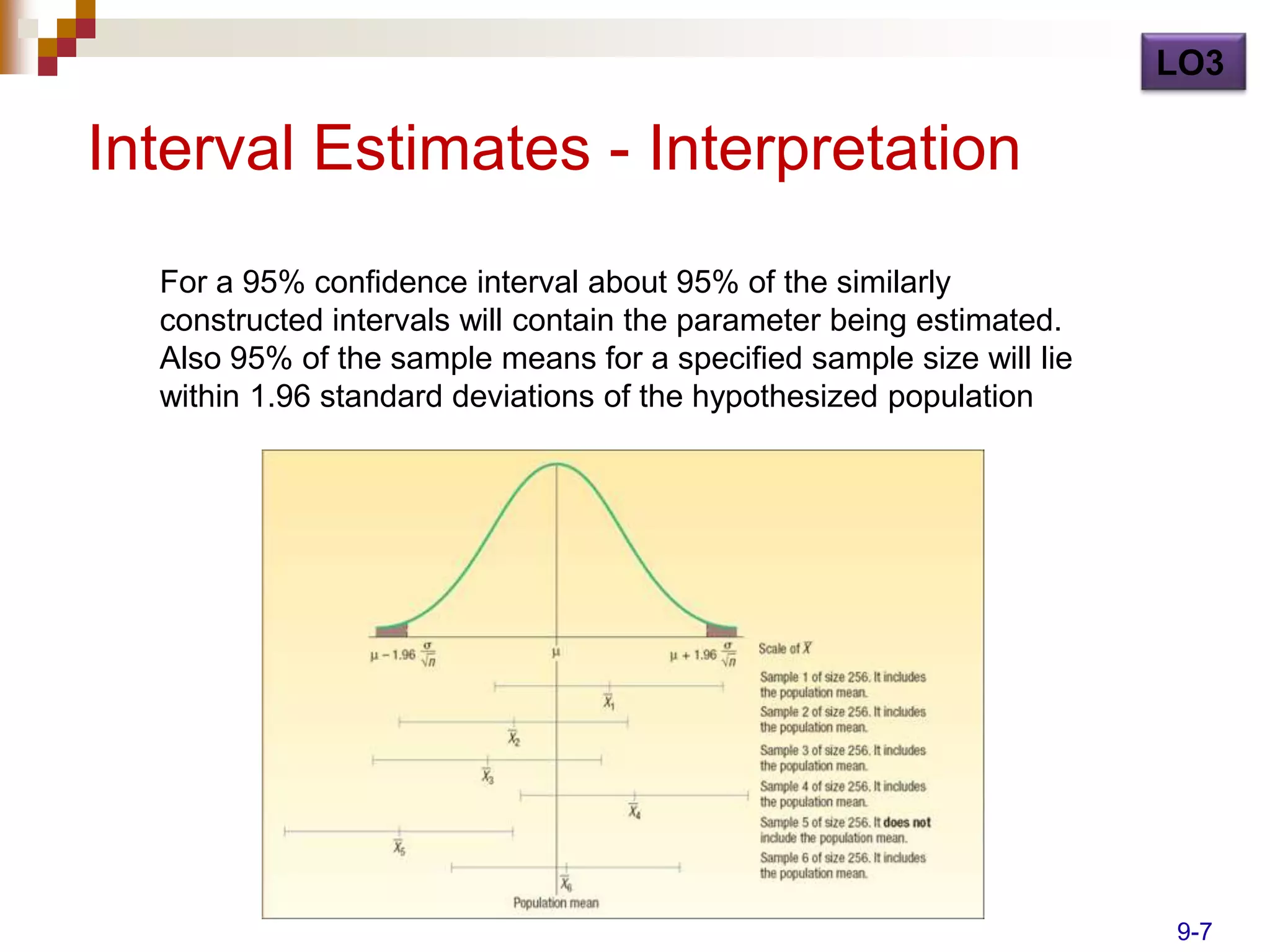
Interval Estimates - Interpretation
  For a 95% confidence interval about 95% of the similarly
  constructed intervals will contain the parameter being estimated.
  Also 95% of the sample means for a specified sample size will lie
  within 1.96 standard deviations of the hypothesized population


                                                                      9-7
LO3

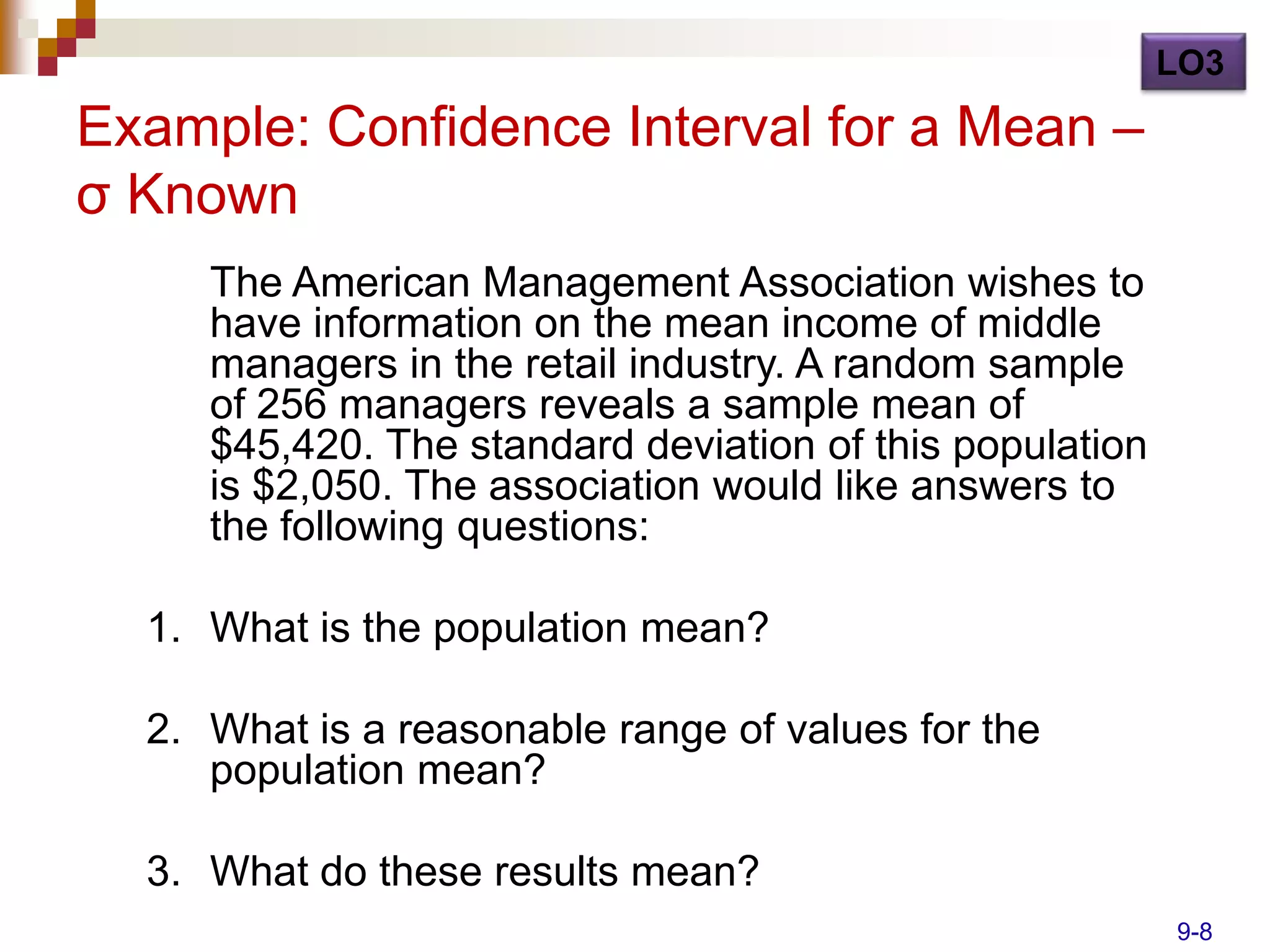
Example: Confidence Interval for a Mean –
σ Known
     The American Management Association wishes to
     have information on the mean income of middle
     managers in the retail industry. A random sample
     of 256 managers reveals a sample mean of
     $45,420. The standard deviation of this population
     is $2,050. The association would like answers to
     the following questions:

  1. What is the population mean?

  2. What is a reasonable range of values for the
     population mean?

  3. What do these results mean?
                                                          9-8
LO3

Example: Confidence Interval for a Mean –
σ Known
     The American Management Association wishes to have information
     on the mean income of middle managers in the retail industry. A
     random sample of 256 managers reveals a sample mean of
     $45,420. The standard deviation of this population is $2,050. The
     association would like answers to the following questions:

     What is the population mean?

     In this case, we do not know. We do know the sample mean is
     $45,420. Hence, our best estimate of the unknown population
     value is the corresponding sample statistic.

     The sample mean of $45,420 is a point estimate of the unknown
     population mean.


                                                                         9-9
LO3
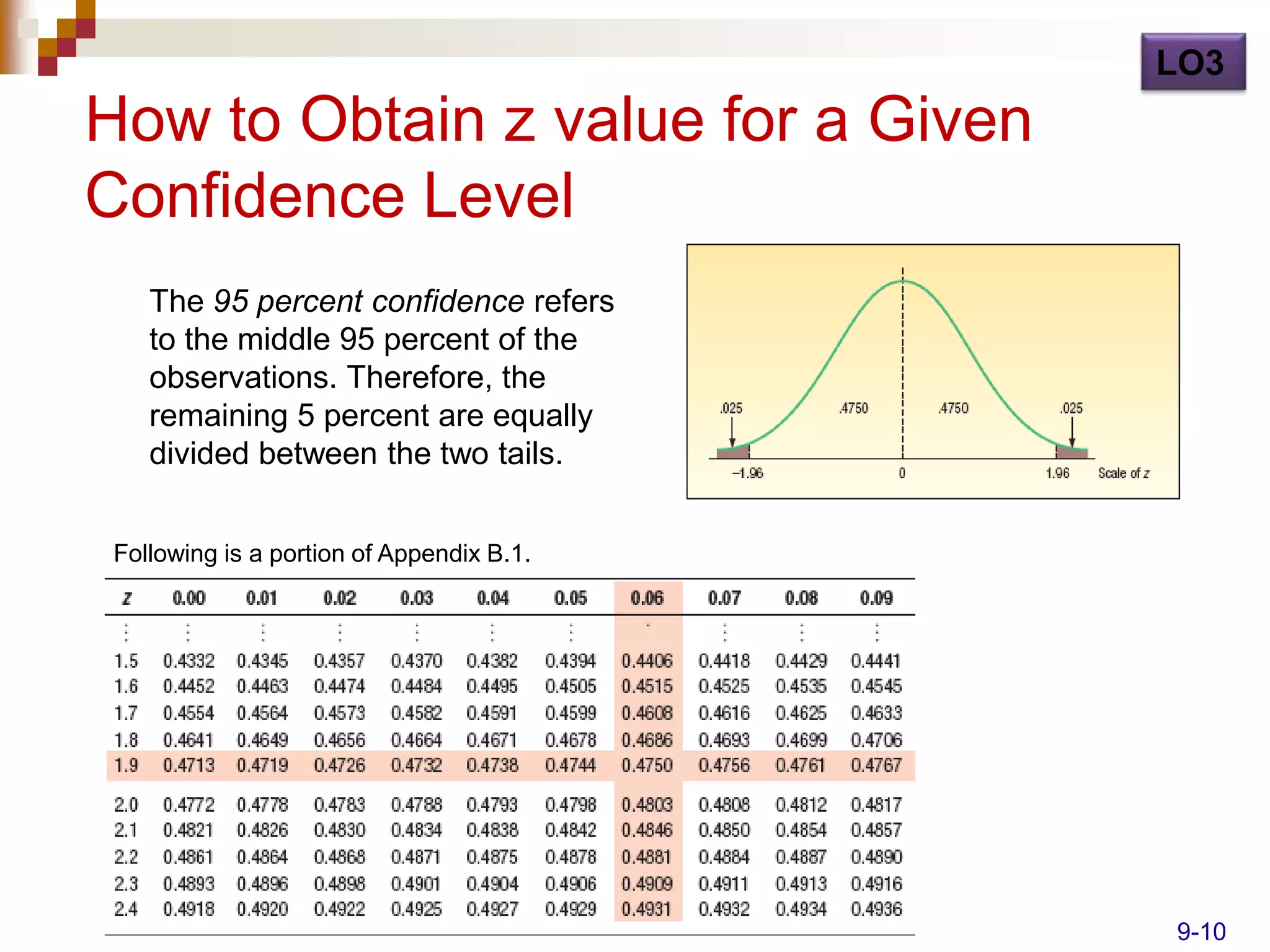
How to Obtain z value for a Given
Confidence Level
    The 95 percent confidence refers
    to the middle 95 percent of the
    observations. Therefore, the
    remaining 5 percent are equally
    divided between the two tails.


 Following is a portion of Appendix B.1.


                                           9-10
LO3

Example: Confidence Interval for a Mean –
σ Known
      The American Management Association wishes to have information
      on the mean income of middle managers in the retail industry. A
      random sample of 256 managers reveals a sample mean of
      $45,420. The standard deviation of this population is $2,050. The
      association would like answers to the following questions:

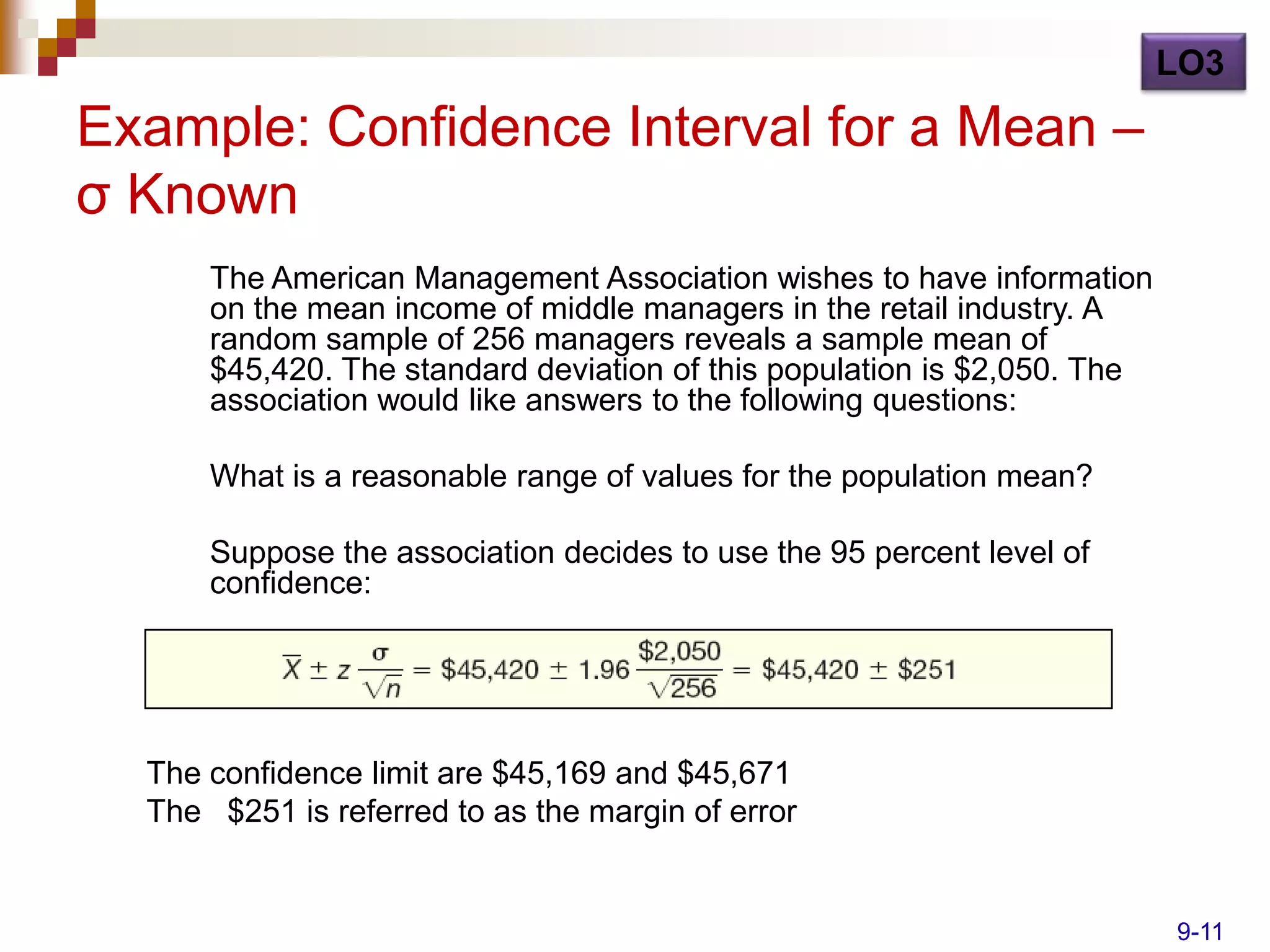
      What is a reasonable range of values for the population mean?

      Suppose the association decides to use the 95 percent level of
      confidence:


  The confidence limit are $45,169 and $45,671
  The $251 is referred to as the margin of error


                                                                          9-11
LO3

Example: Confidence Interval for a Mean -
Interpretation
 The American Management
 Association wishes to have
 information on the mean income of
 middle managers in the retail industry.
 A random sample of 256 managers
 reveals a sample mean of $45,420.
 The standard deviation of this
 population is $2,050. The confidence
 limit are $45,169 and $45,671

 What is the interpretation of the
 confidence limits $45,169 and
 $45,671?

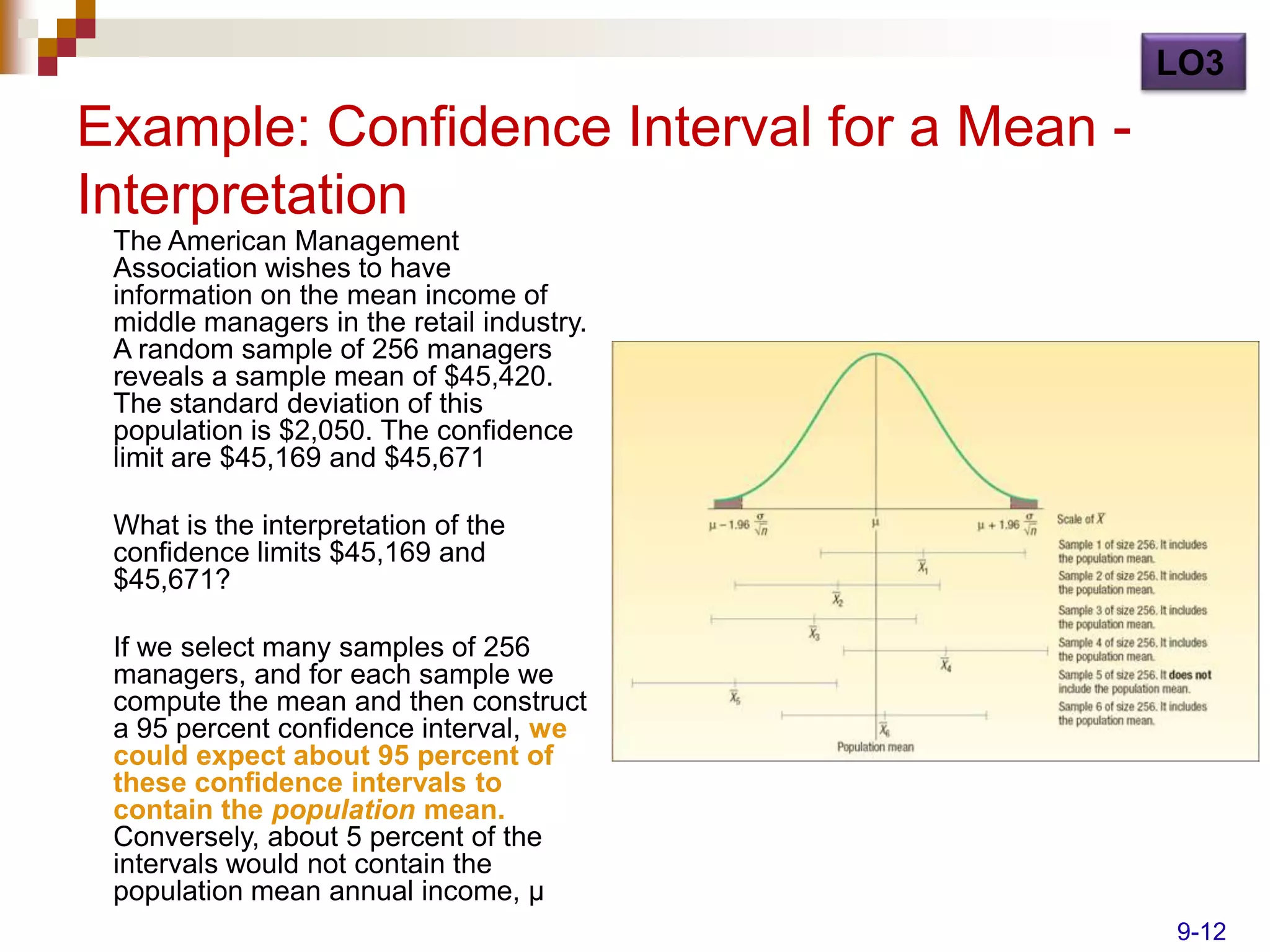
 If we select many samples of 256
 managers, and for each sample we
 compute the mean and then construct
 a 95 percent confidence interval, we
 could expect about 95 percent of
 these confidence intervals to
 contain the population mean.
 Conversely, about 5 percent of the
 intervals would not contain the
 population mean annual income, µ
                                            9-12
LO4 Compute a confidence interval for the population mean
                            when the population standard deviation is not known.


Population Standard Deviation (σ) Unknown
   In most sampling situations the population standard deviation (σ) is
   not known. Below are some examples where it is unlikely the
   population standard deviations would be known.
1. The Dean of the Business College wants to estimate the mean number of
   hours full-time students work at paying jobs each week. He selects a
   sample of 30 students, contacts each student and asks them how many
   hours they worked last week.

2. The Dean of Students wants to estimate the distance the typical commuter
   student travels to class. She selects a sample of 40 commuter students,
   contacts each, and determines the one-way distance from each student’s
   home to the center of campus.

3. The Director of Student Loans wants to know the mean amount owed on
   student loans at the time of his/her graduation. The director selects a
   sample of 20 graduating students and contacts each to find the information.

                                                                                 9-13
LO4
Characteristics of the t-
distribution
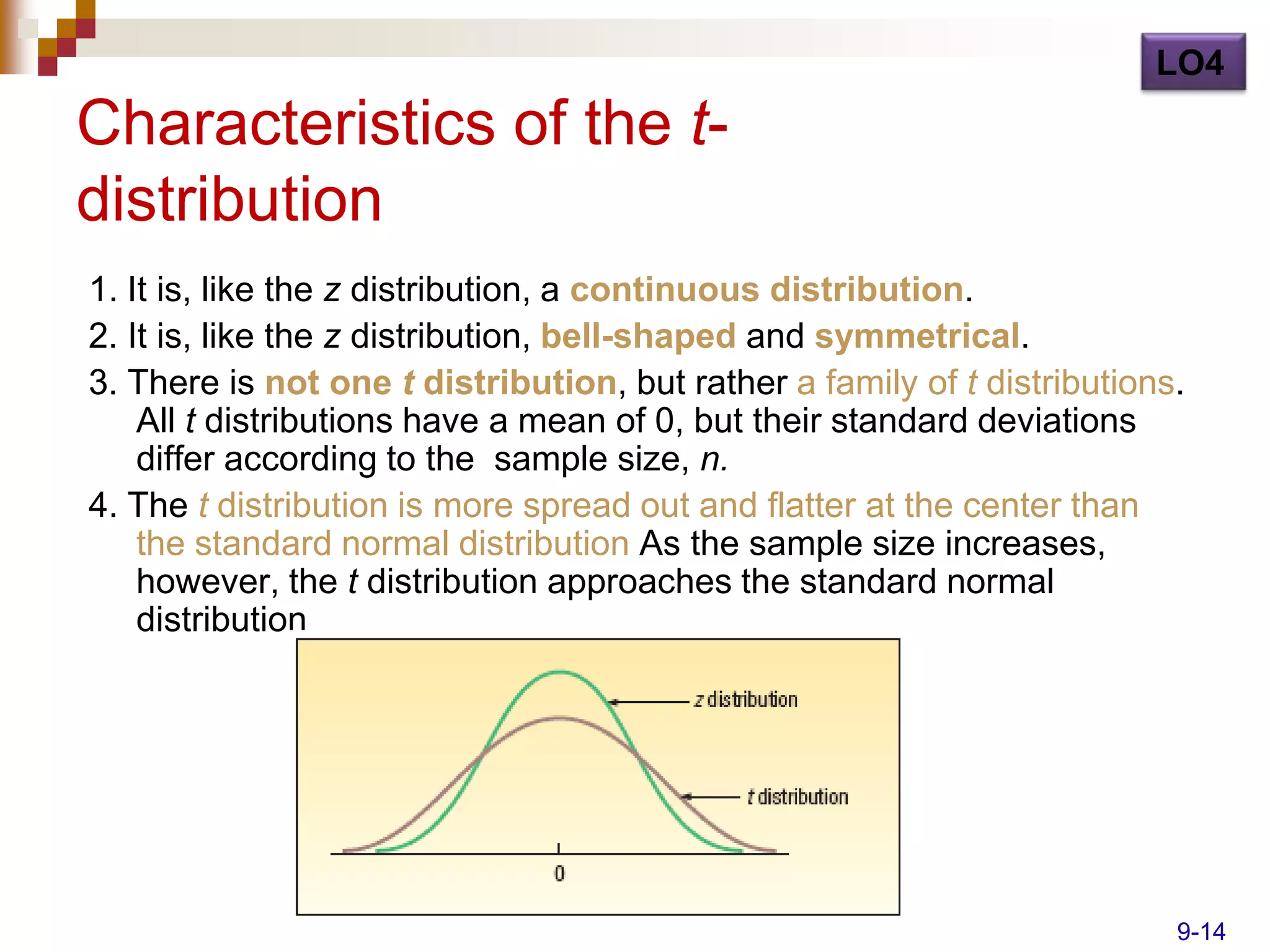
1. It is, like the z distribution, a continuous distribution.
2. It is, like the z distribution, bell-shaped and symmetrical.
3. There is not one t distribution, but rather a family of t distributions.
    All t distributions have a mean of 0, but their standard deviations
    differ according to the sample size, n.
4. The t distribution is more spread out and flatter at the center than
    the standard normal distribution As the sample size increases,
    however, the t distribution approaches the standard normal
    distribution


                                                                          9-14
LO4

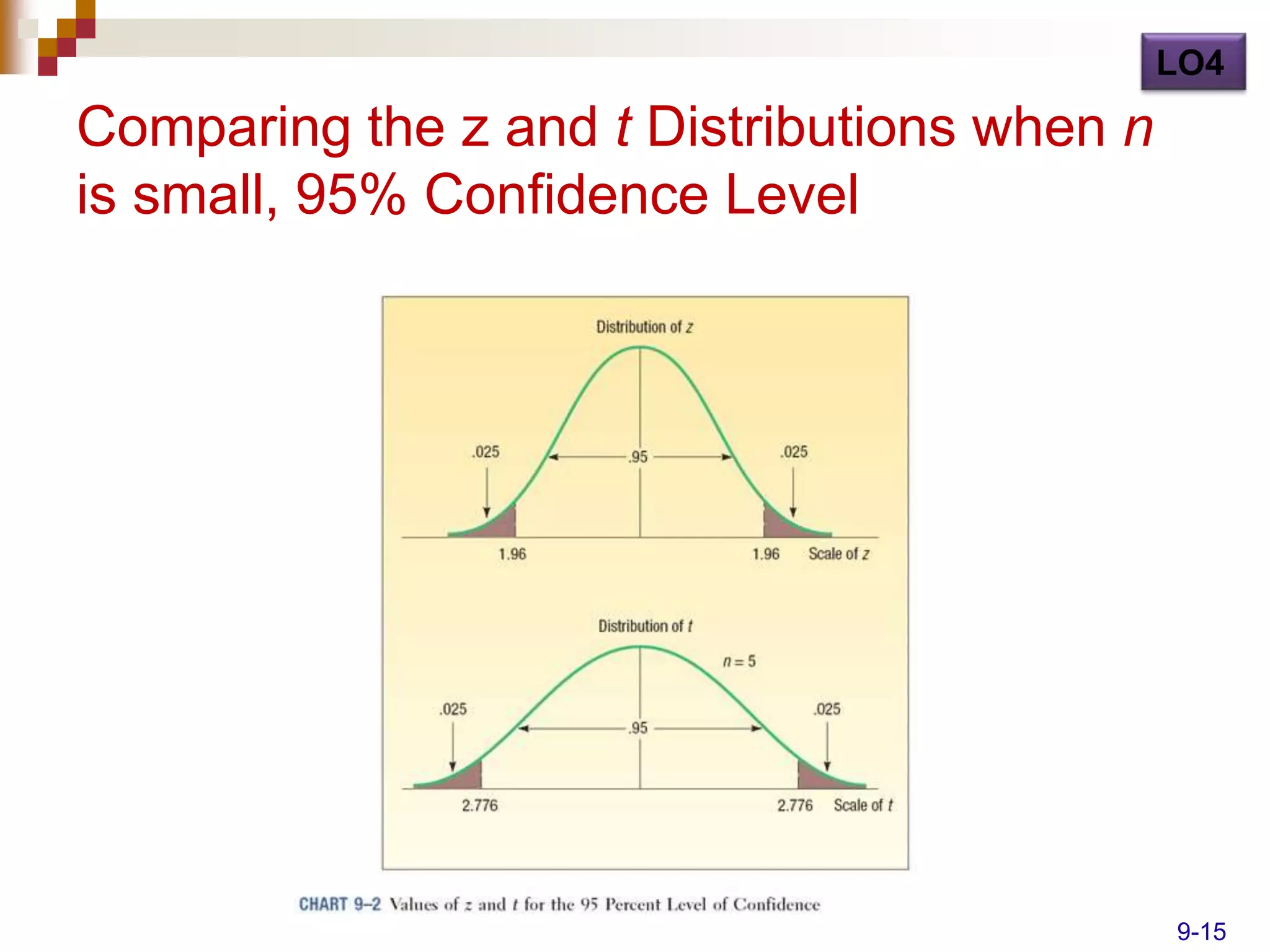
Comparing the z and t Distributions when n
is small, 95% Confidence Level


                                             9-15
LO4
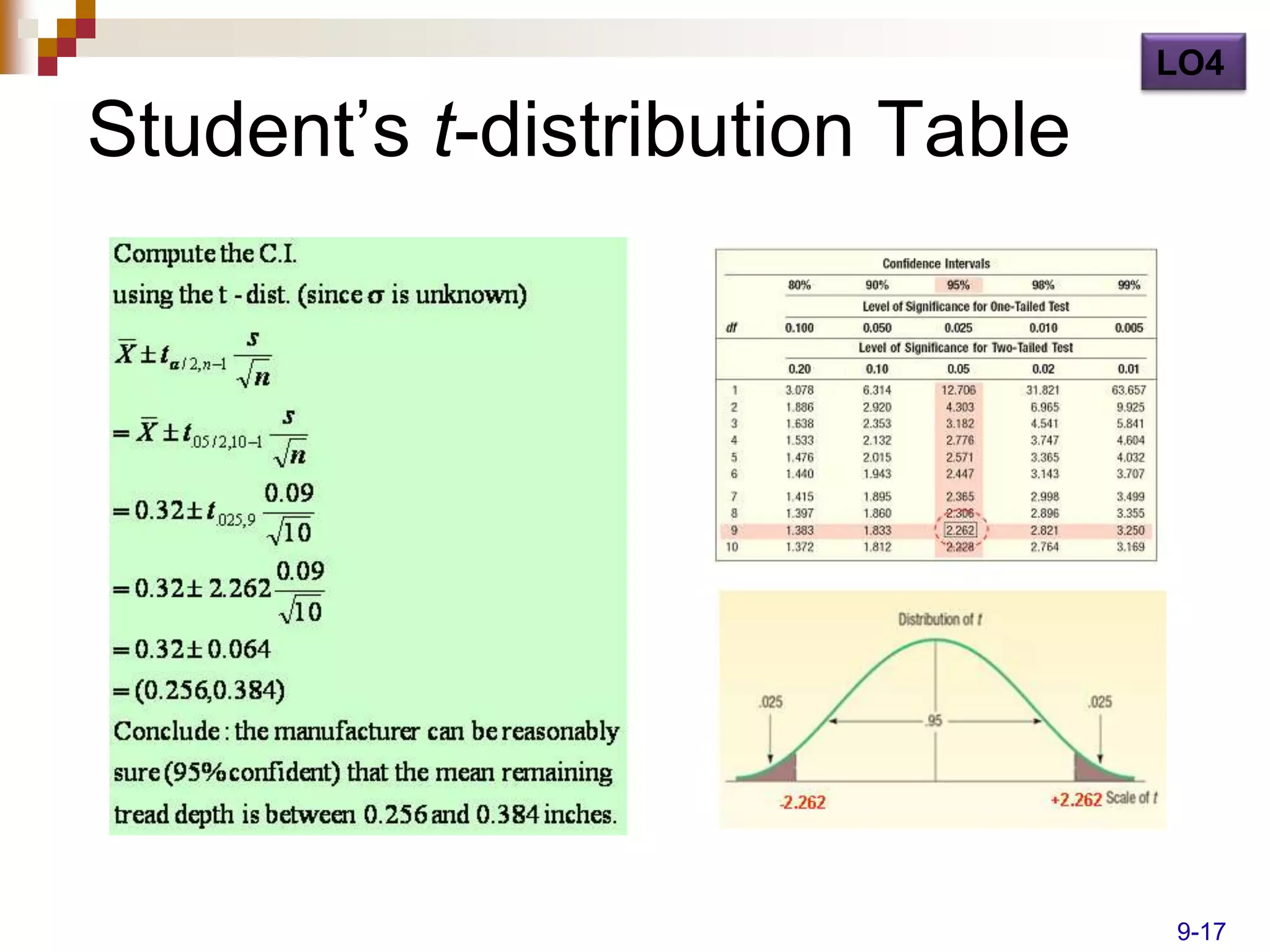
Confidence Interval for the Mean –
Example using the t-distribution

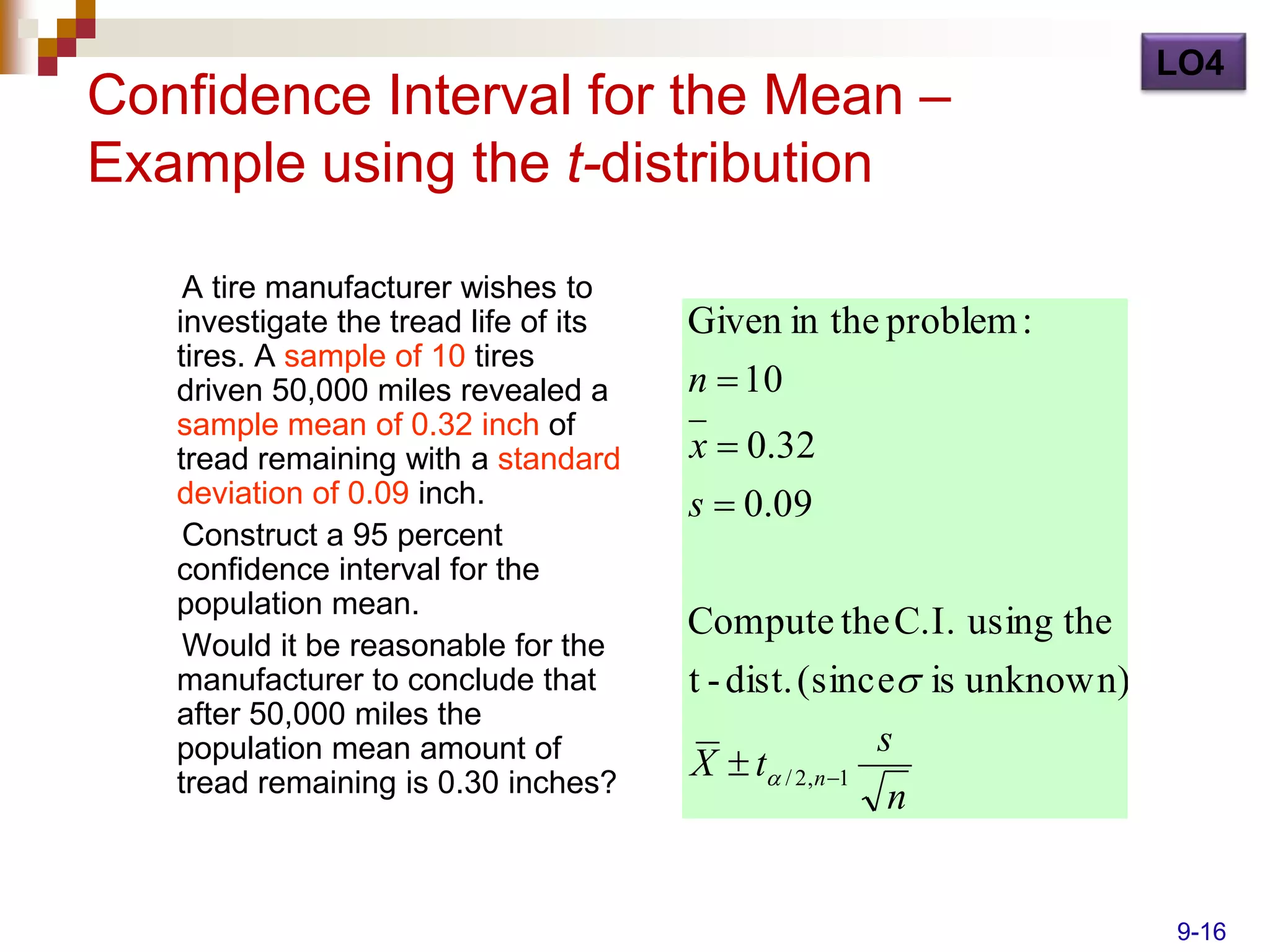
    A tire manufacturer wishes to
   investigate the tread life of its   Given in the problem :
   tires. A sample of 10 tires
   driven 50,000 miles revealed a      n  10
   sample mean of 0.32 inch of
   tread remaining with a standard     x  0.32
   deviation of 0.09 inch.             s  0.09
    Construct a 95 percent
   confidence interval for the
   population mean.
                                       Compute the C.I. using the
    Would it be reasonable for the
   manufacturer to conclude that       t - dist. (since is unknown)
   after 50,000 miles the
   population mean amount of                             s
   tread remaining is 0.30 inches?
                                       X  t / 2,n 1
                                                          n


                                                                       9-16
LO4

Student’s t-distribution Table


                                 9-17
LO4

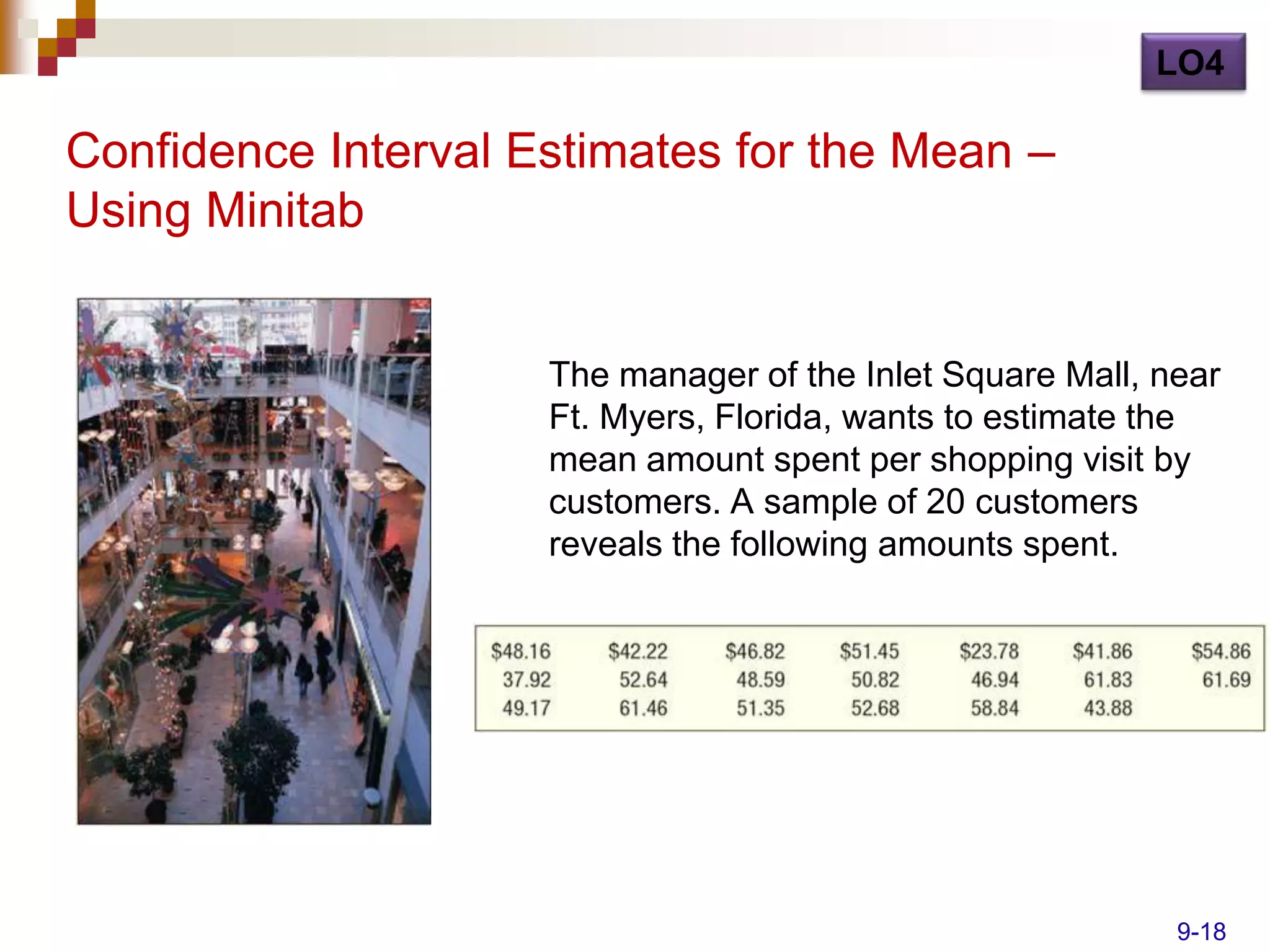
Confidence Interval Estimates for the Mean –
Using Minitab


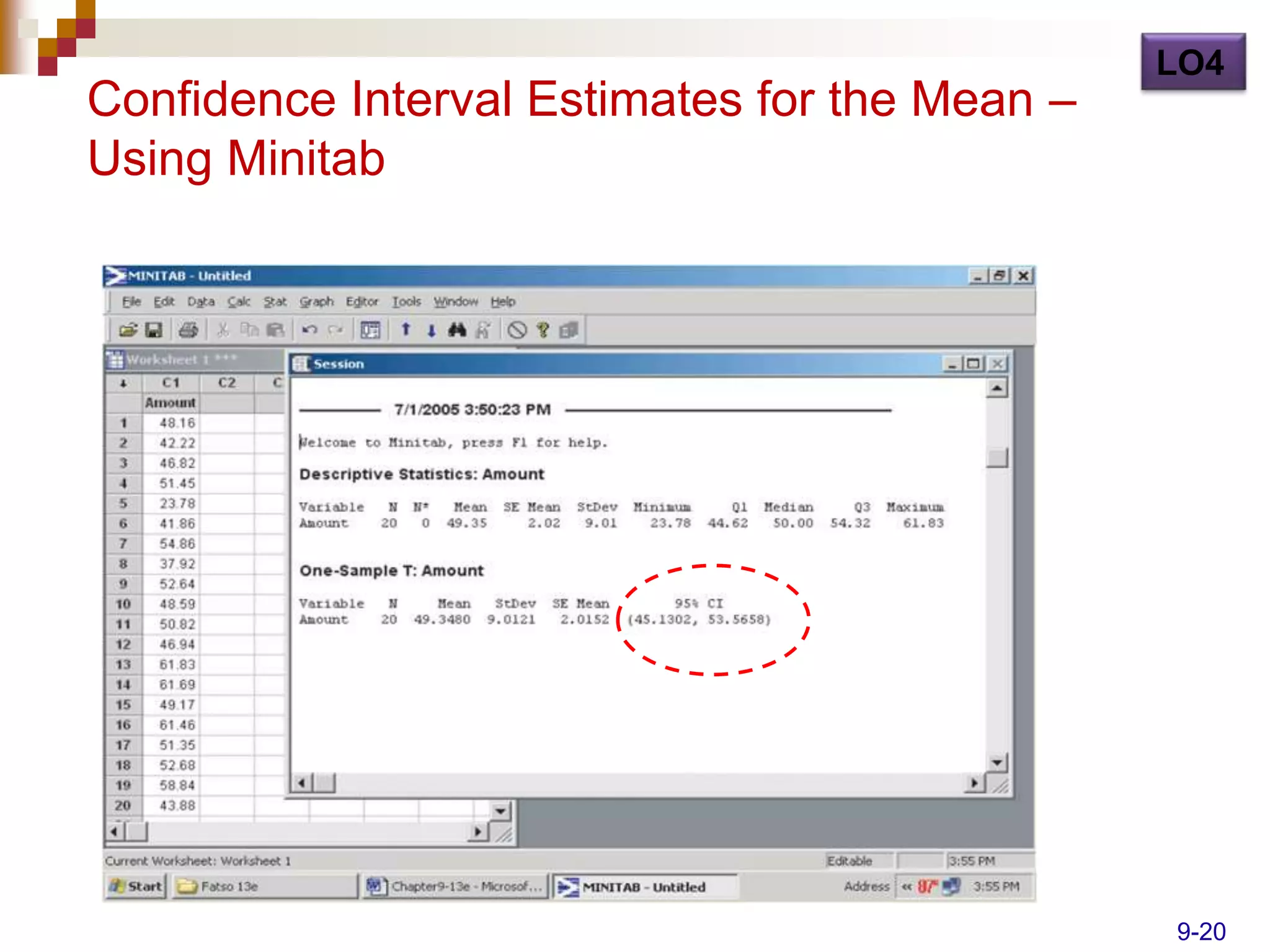
                     The manager of the Inlet Square Mall, near
                     Ft. Myers, Florida, wants to estimate the
                     mean amount spent per shopping visit by
                     customers. A sample of 20 customers
                     reveals the following amounts spent.


                                                            9-18
LO4
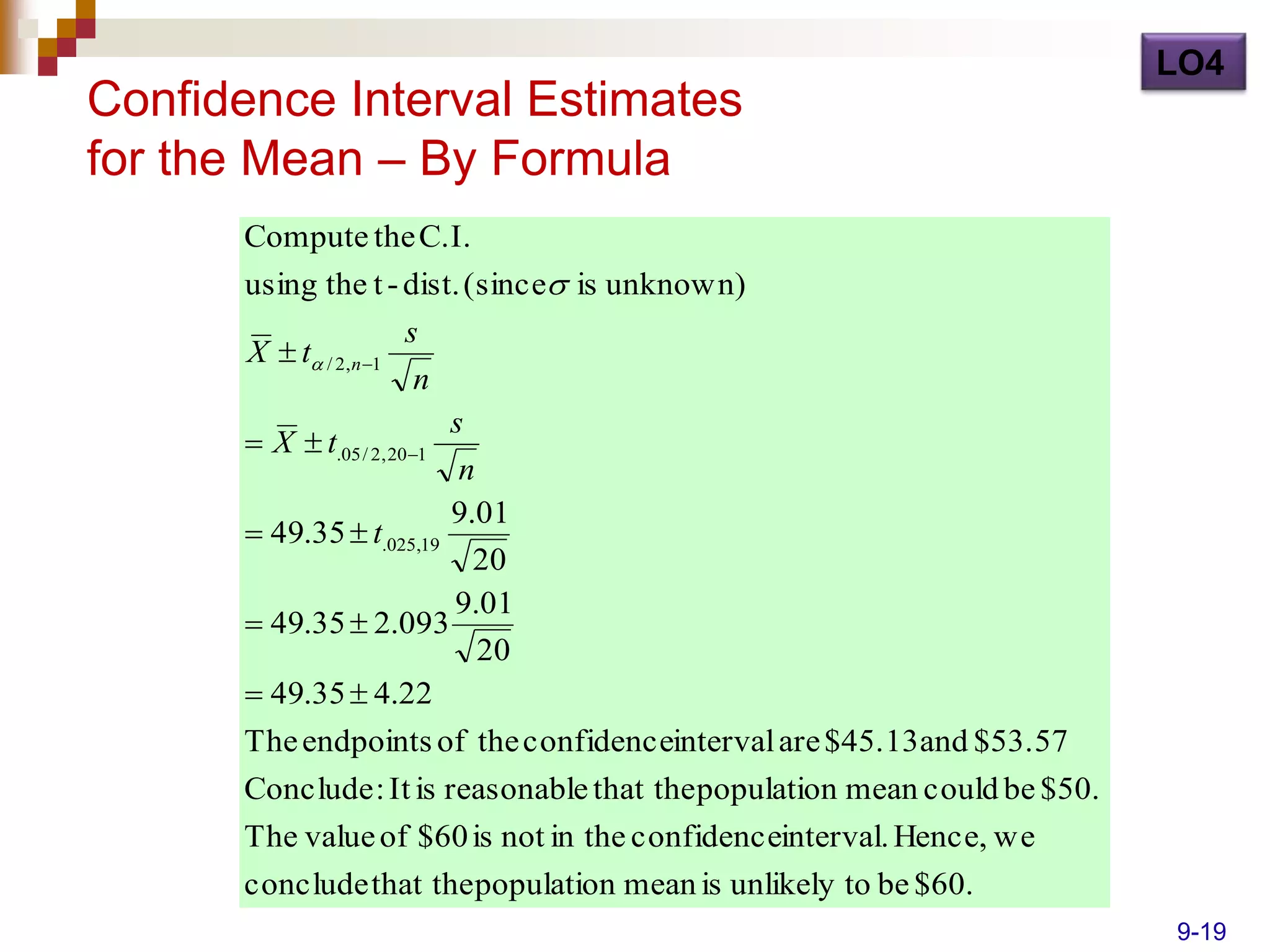
Confidence Interval Estimates
for the Mean – By Formula
      Compute the C.I.
      using the t - dist. (since is unknown)
                        s
      X  t / 2,n 1
                         n
                           s
       X  t.05 / 2, 201
                            n
                           9.01
       49.35  t.025,19
                             20
                           9.01
       49.35  2.093
                              20
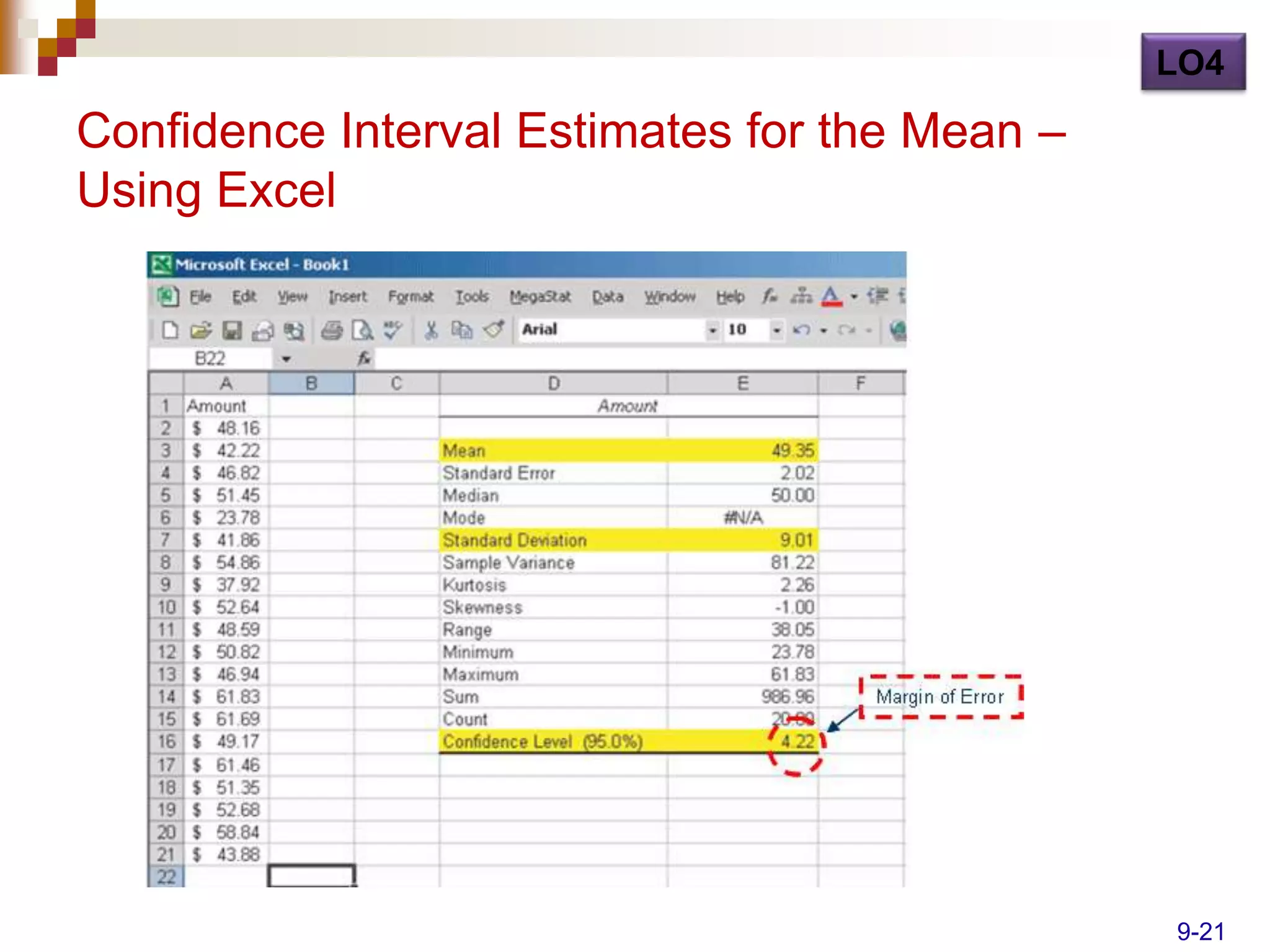
       49.35  4.22
      The endpoints of the confidenceinterval are $45.13 and $53.57
      Conclude : It is reasonable that the population mean could be $50.
      The value of $60 is not in the confidenceinterval. Hence, we
      conclude that the population mean is unlikely to be $60.
                                                                           9-19
LO4
Confidence Interval Estimates for the Mean –
Using Minitab


                                               9-20
LO4

Confidence Interval Estimates for the Mean –
Using Excel


                                               9-21
LO4

Confidence Interval Estimates for the Mean


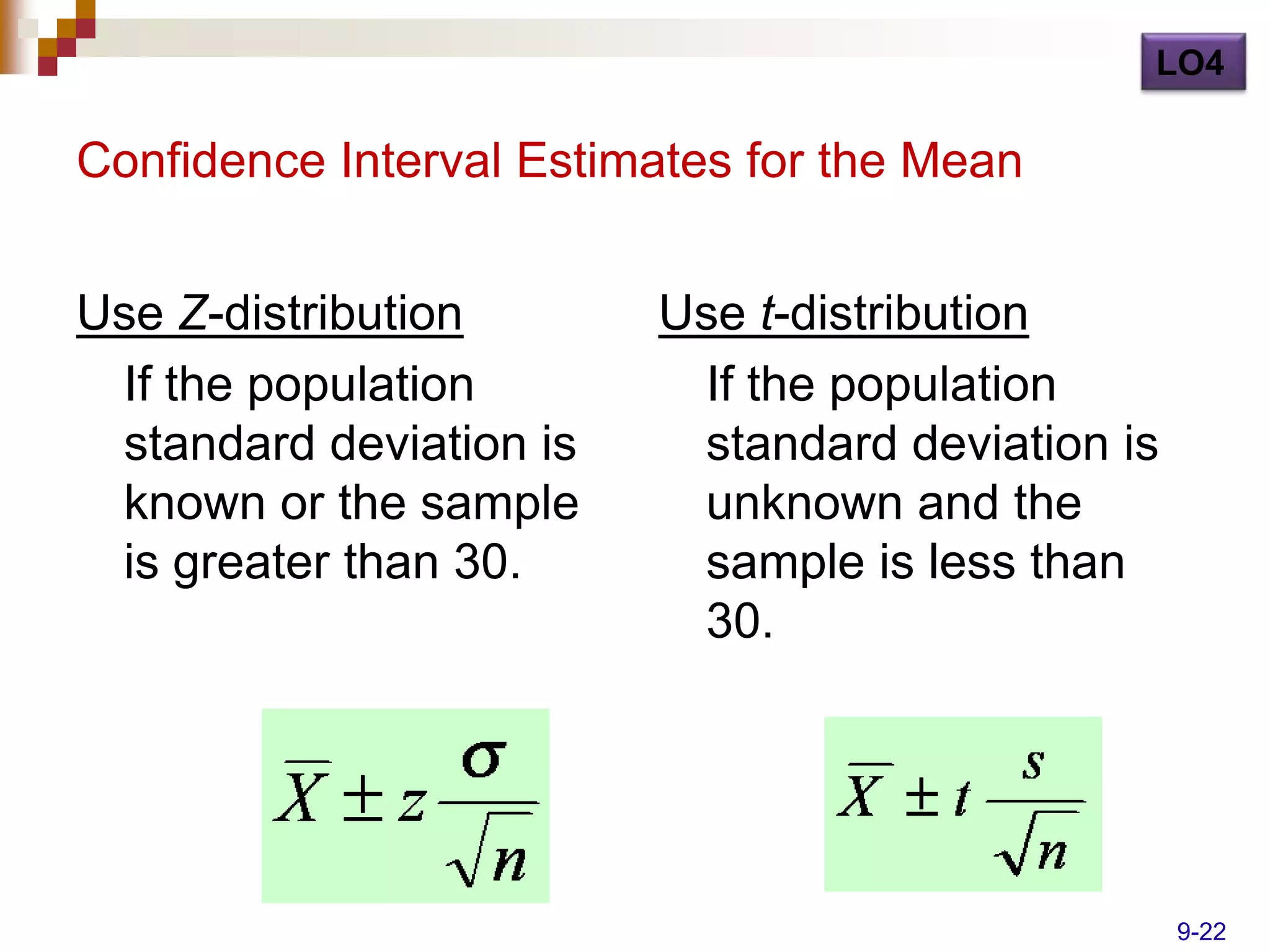
Use Z-distribution       Use t-distribution
 If the population        If the population
 standard deviation is    standard deviation is
 known or the sample      unknown and the
 is greater than 30.      sample is less than
                          30.


                                                  9-22
LO4

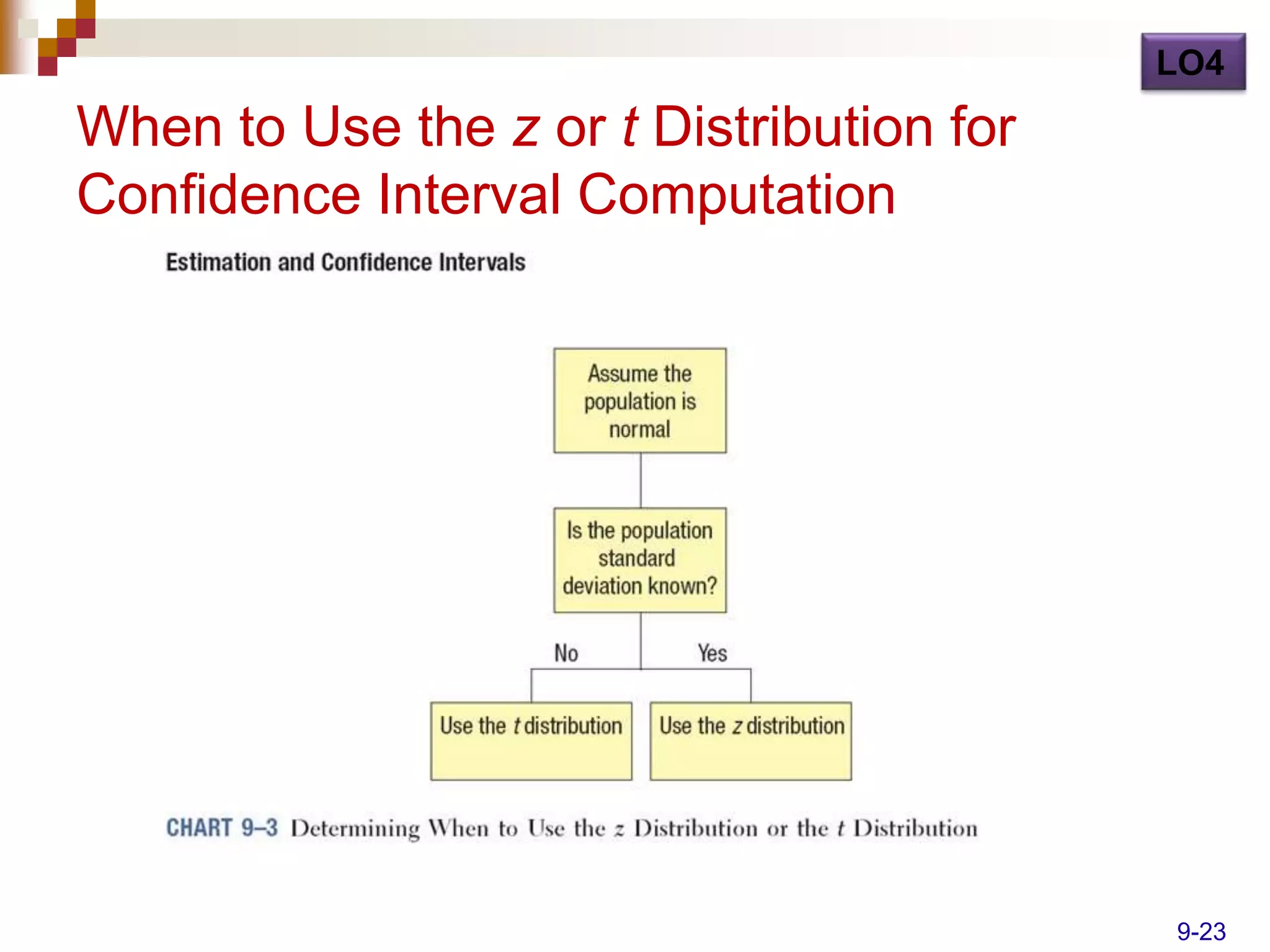
When to Use the z or t Distribution for
Confidence Interval Computation


                                          9-23
LO5 Compute a confidence
                                            interval for a population proportion.


A Confidence Interval for a Proportion (π)
 The examples below illustrate the nominal scale of measurement.
 1. The career services director at Southern Technical Institute
    reports that 80 percent of its graduates enter the job market
    in a position related to their field of study.
 2. A company representative claims that 45 percent of Burger
    King sales are made at the drive-through window.
 3. A survey of homes in the Chicago area indicated that 85
    percent of the new construction had central air conditioning.
 4. A recent survey of married men between the ages of 35 and
    50 found that 63 percent felt that both partners should earn a
    living.


                                                                            9-24
LO5

Using the Normal Distribution to
Approximate the Binomial Distribution
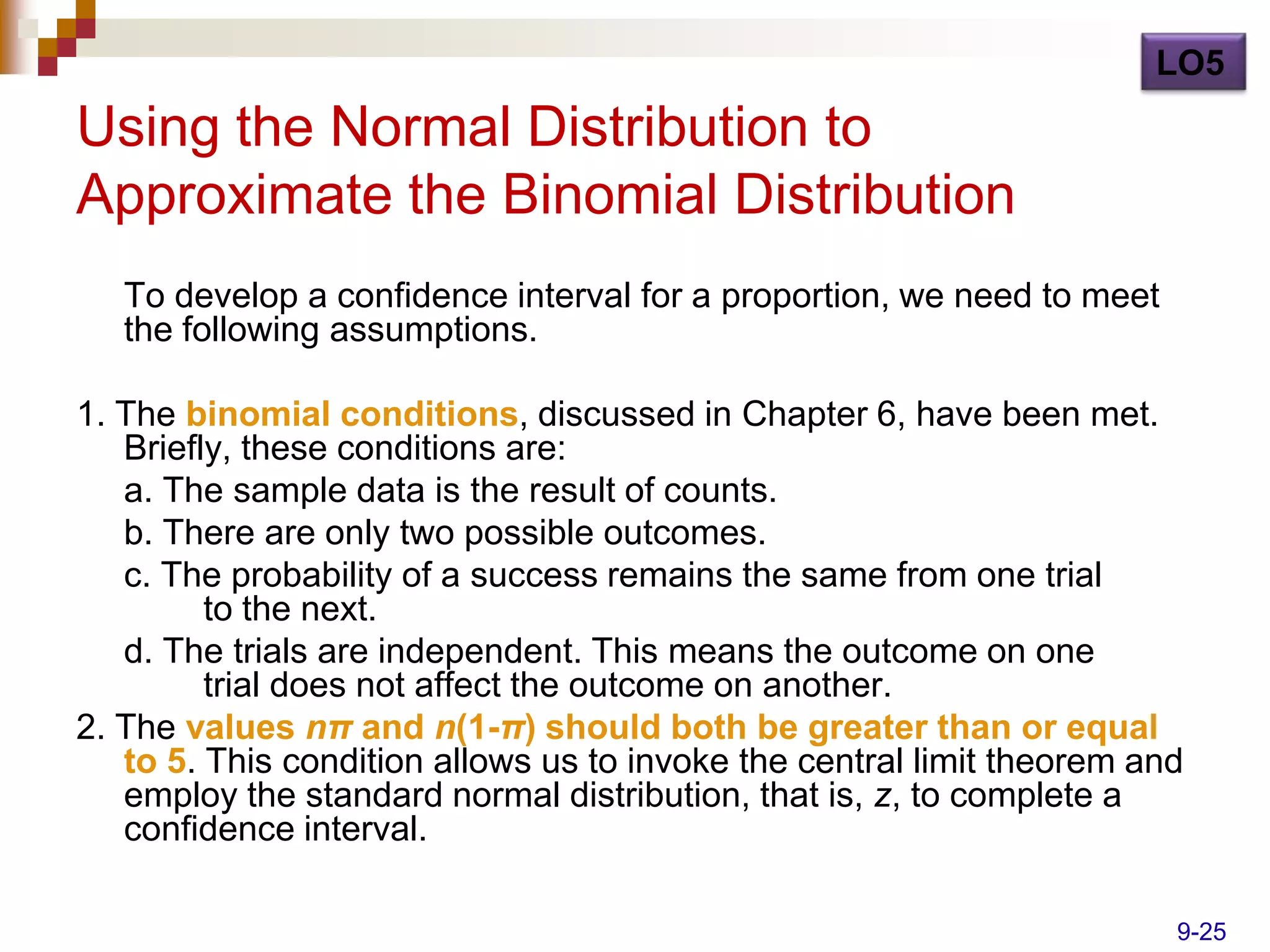
   To develop a confidence interval for a proportion, we need to meet
   the following assumptions.

1. The binomial conditions, discussed in Chapter 6, have been met.
   Briefly, these conditions are:
   a. The sample data is the result of counts.
   b. There are only two possible outcomes.
   c. The probability of a success remains the same from one trial
         to the next.
   d. The trials are independent. This means the outcome on one
         trial does not affect the outcome on another.
2. The values nπ and n(1-π) should both be greater than or equal
   to 5. This condition allows us to invoke the central limit theorem and
   employ the standard normal distribution, that is, z, to complete a
   confidence interval.

                                                                        9-25
LO5

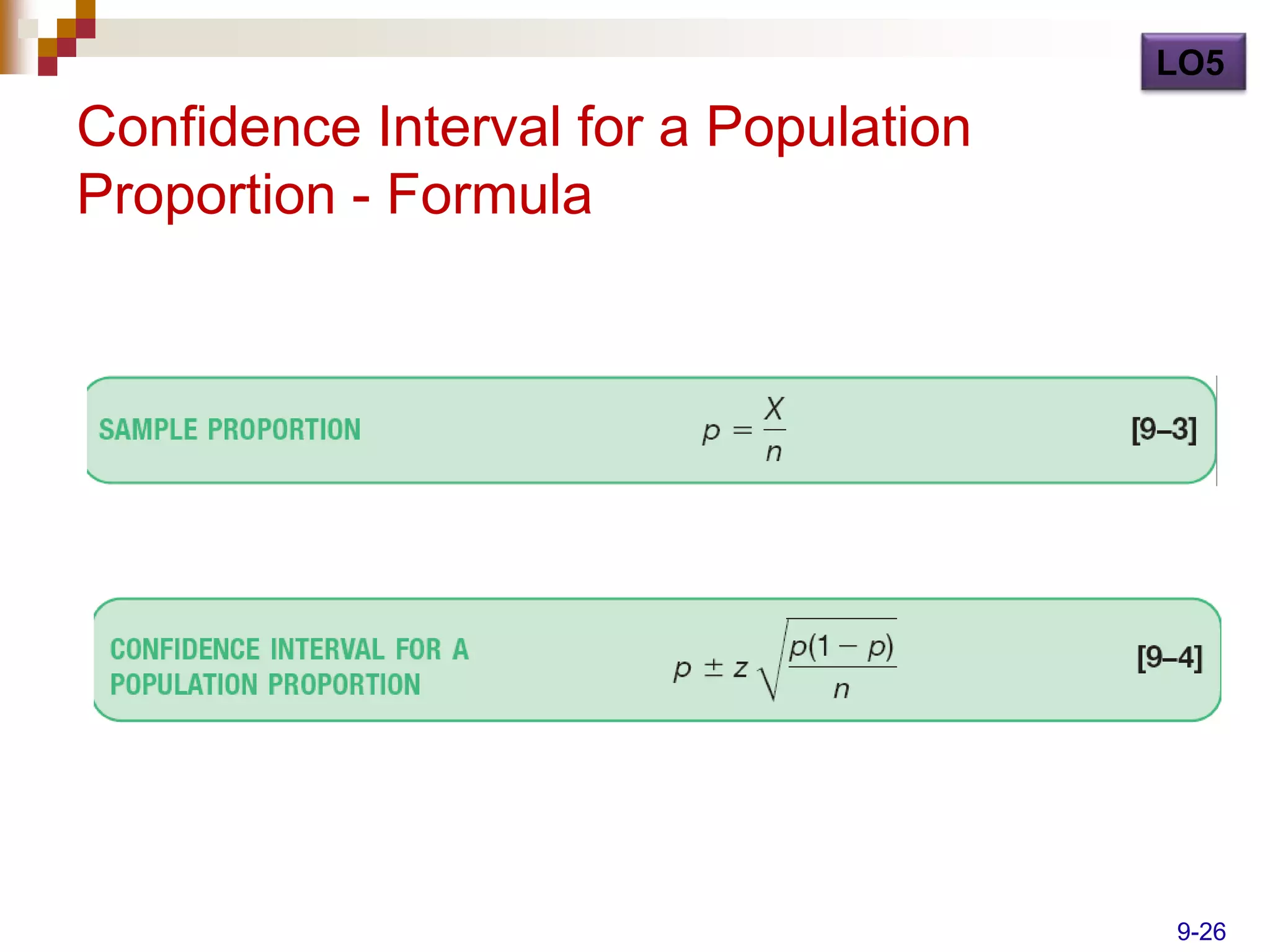
Confidence Interval for a Population
Proportion - Formula


                                       9-26
LO5
Confidence Interval for a Population Proportion-
Example

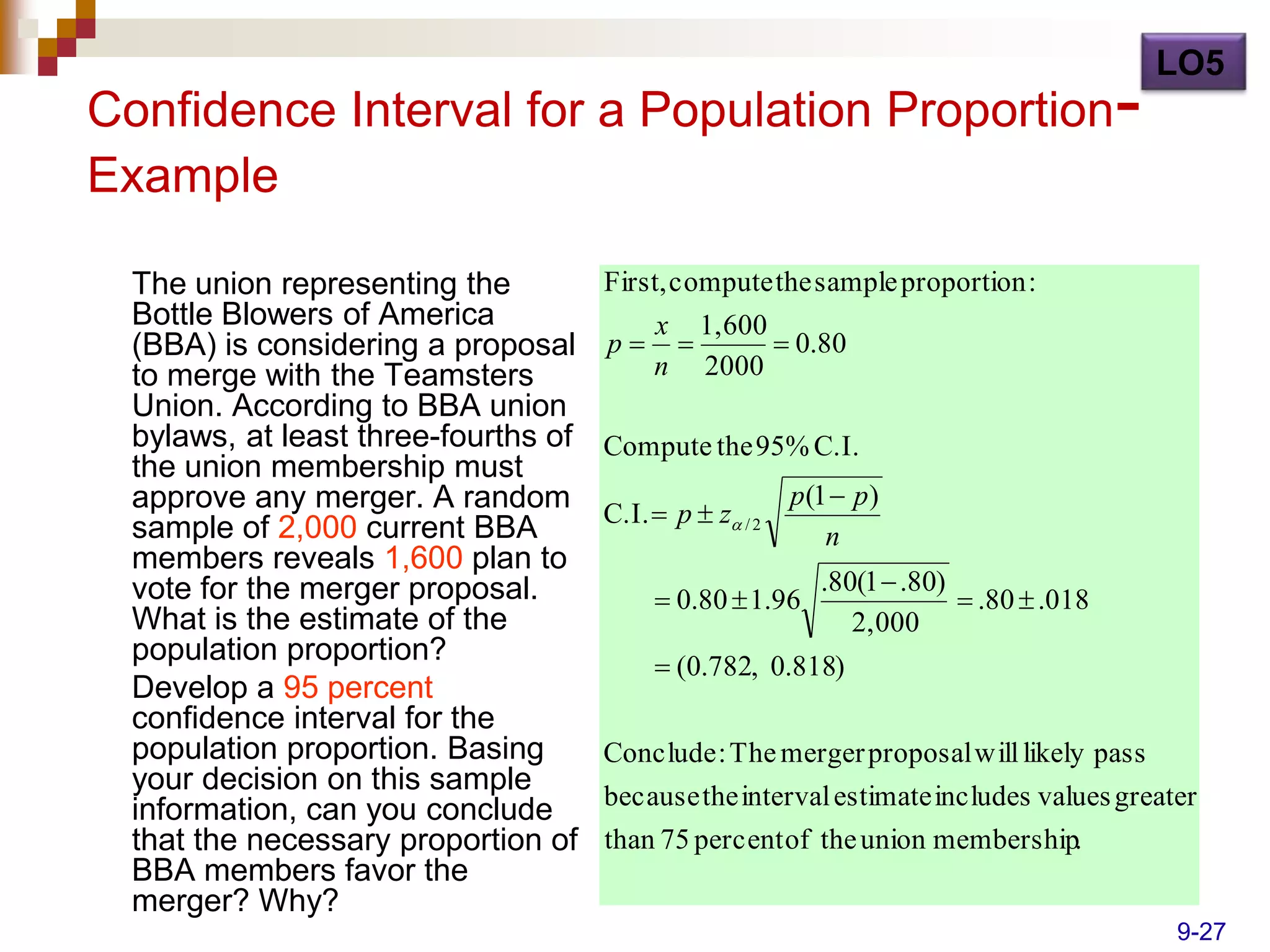
  The union representing the          First, compute the sample proportion :
  Bottle Blowers of America                x 1,600
  (BBA) is considering a proposal     p           0.80
  to merge with the Teamsters              n 2000
  Union. According to BBA union
  bylaws, at least three-fourths of   Compute the 95% C.I.
  the union membership must
  approve any merger. A random                            p (1  p )
                                      C.I.  p  z / 2
  sample of 2,000 current BBA                                 n
  members reveals 1,600 plan to
  vote for the merger proposal.                              .80(1  .80)
                                            0.80  1.96                   .80  .018
  What is the estimate of the                                   2,000
  population proportion?                    (0.782, 0.818)
  Develop a 95 percent
  confidence interval for the
  population proportion. Basing       Conclude : The merger proposal will likely pass
  your decision on this sample
                                      because the interval estimate includes values greater
  information, can you conclude
  that the necessary proportion of    than 75 percent of the union membership.
  BBA members favor the
  merger? Why?
                                                                                         9-27
LO6 Calculate the required sample size to estimate a
                     population proportion or population mean.

Selecting an Appropriate
Sample Size
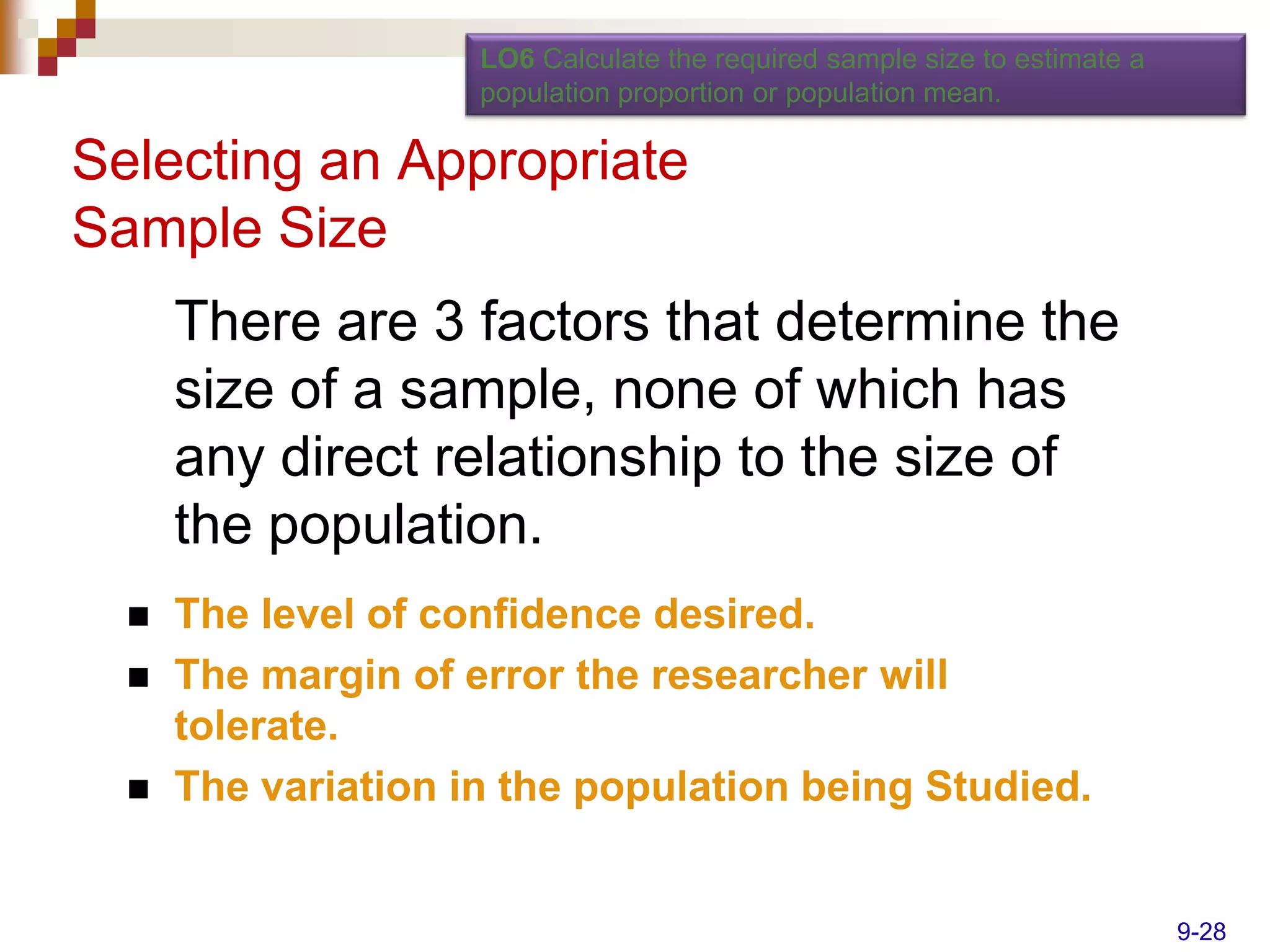
      There are 3 factors that determine the
      size of a sample, none of which has
      any direct relationship to the size of
      the population.
     The level of confidence desired.
     The margin of error the researcher will
      tolerate.
     The variation in the population being Studied.


                                                                            9-28
LO6

What If Population Standard
Deviation is not Known

 1.   Conduct a Pilot Study
 2.   Use a Comparable Study
 3.   Use a Range-based approach


                                   9-29
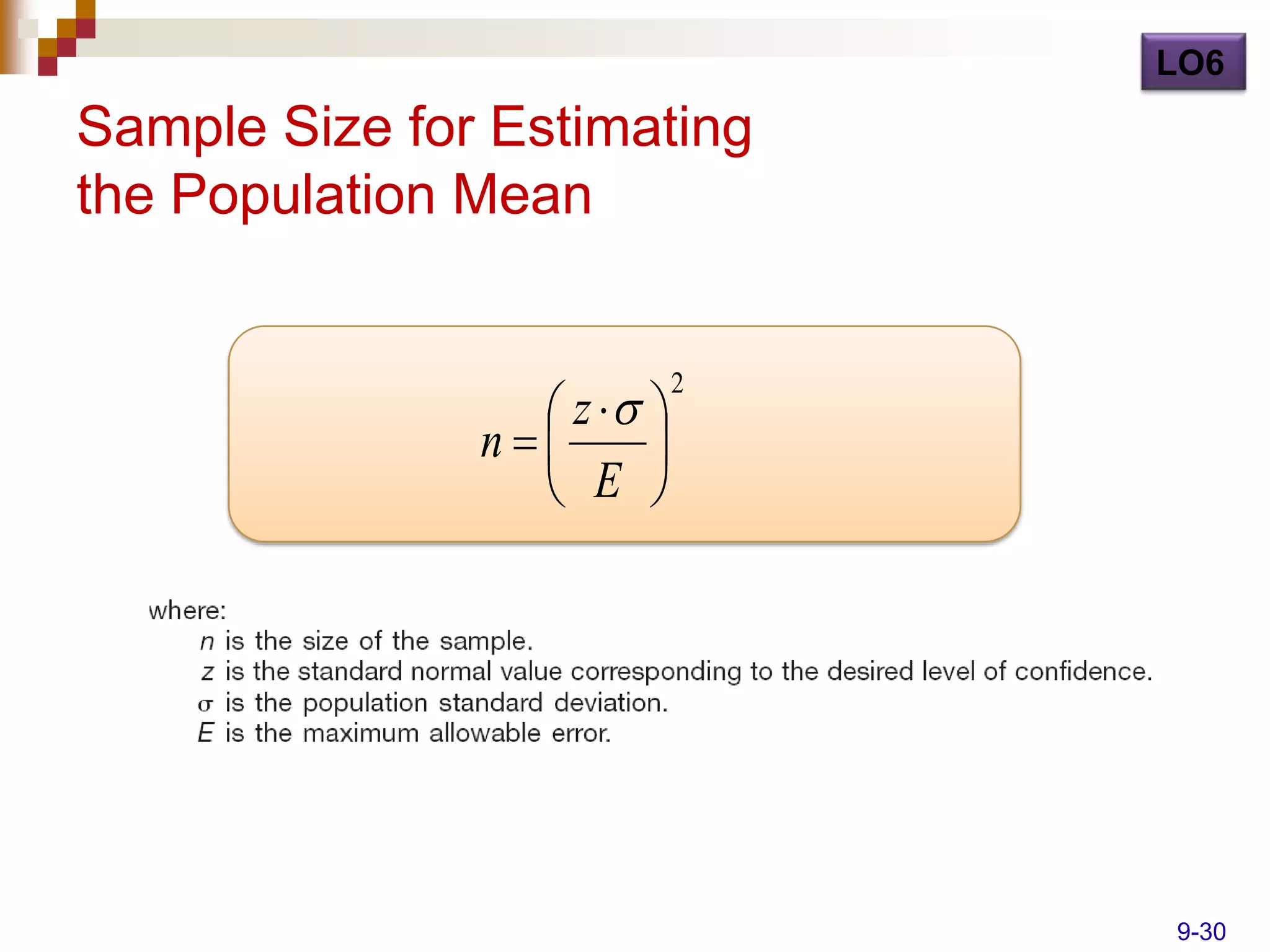
LO6

Sample Size for Estimating
the Population Mean


                  z  
                            2

               n      
                  E 


                                9-30
LO6
Sample Size Determination
for a Variable-Example
    A student in public administration
    wants to determine the mean amount
    members of city councils in large cities
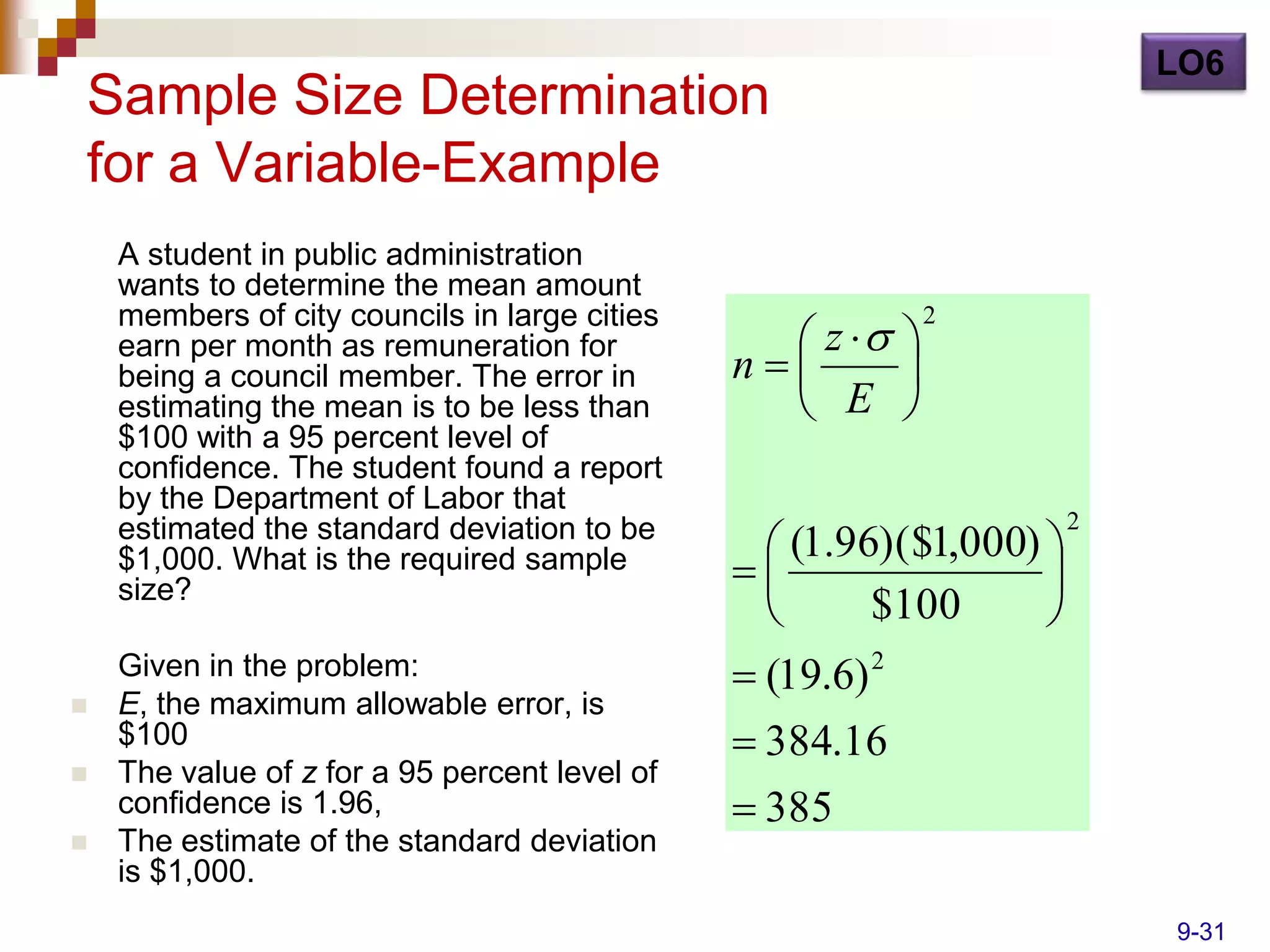
                                                  z  
                                                            2
    earn per month as remuneration for
    being a council member. The error in       n      
    estimating the mean is to be less than        E 
    $100 with a 95 percent level of
    confidence. The student found a report
    by the Department of Labor that
                                                                     2
    estimated the standard deviation to be
                                                 (1.96)($1,000) 
    $1,000. What is the required sample
    size?
                                                               
                                                      $100      
    Given in the problem:                       (19.6) 2
   E, the maximum allowable error, is
    $100                                        384.16
   The value of z for a 95 percent level of
    confidence is 1.96,                         385
   The estimate of the standard deviation
    is $1,000.
                                                                         9-31
LO6
Sample Size Determination for
a Variable- Another Example
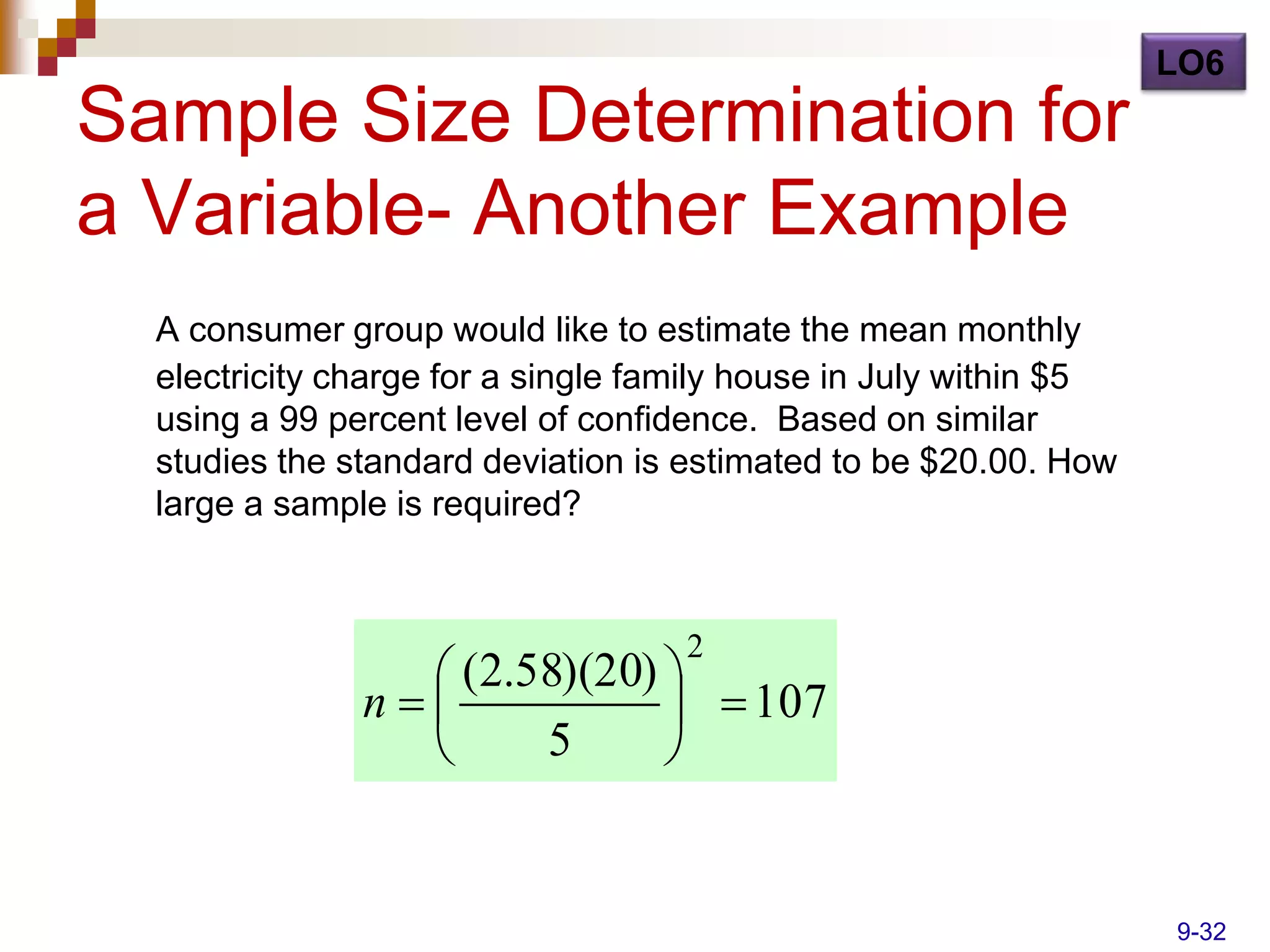
  A consumer group would like to estimate the mean monthly
  electricity charge for a single family house in July within $5
  using a 99 percent level of confidence. Based on similar
  studies the standard deviation is estimated to be $20.00. How
  large a sample is required?


                                    2
                  (2.58)(20) 
               n              107
                      5      


                                                                   9-32
LO6
Sample Size for Estimating a
Population Proportion
                                            2
                              Z
                n   (1   ) 
                              E 

     where:
              n is the size of the sample
              z is the standard normal value corresponding to
                  the desired level of confidence
              E is the maximum allowable error


                                                                9-33
LO6
Sample Size Determination -
Example
      The American Kennel Club wanted to estimate the
      proportion of children that have a dog as a pet. If the
      club wanted the estimate to be within 3% of the
      population proportion, how many children would they
      need to contact? Assume a 95% level of confidence
      and that the club estimated that 30% of the children
      have a dog as a pet.
                             2
                      Z
        n   (1   ) 
                      E 
                                 2
                       1.96 
        n  (.30)(.70)        897
                       .03 
                                                                9-34
LO6

Another Example
  A study needs to estimate the                               2
                                                   Z
  proportion of cities that have     n   (1   ) 
  private refuse collectors. The
  investigator wants the margin of
                                                   E 
  error to be within .10 of the
  population proportion, the
  desired level of confidence is                          2
                                                      1.65 
  90 percent, and no estimate is     n  (.5)(1  .5)        68.0625
  available for the population                        .10 
  proportion. What is the required   n  69 cities
  sample size?


                                                                          9-35
LO7 Adjust a confidence interval for
                                          finite populations.

Finite-Population Correction
Factor
   A population that has a fixed upper bound is said to be finite.
   For a finite population, where the total number of objects is N
    and the size of the sample is n, the following adjustment is made
    to the standard errors of the sample means and the proportion:
   However, if n/N < .05, the finite-population correction factor may
    be ignored.
     Standard Error of the Mean         Standard Error of the Proportion


          N n                              p(1  p) N  n
    x                                 p 
          n N 1                                n     N 1

                                                                           9-36
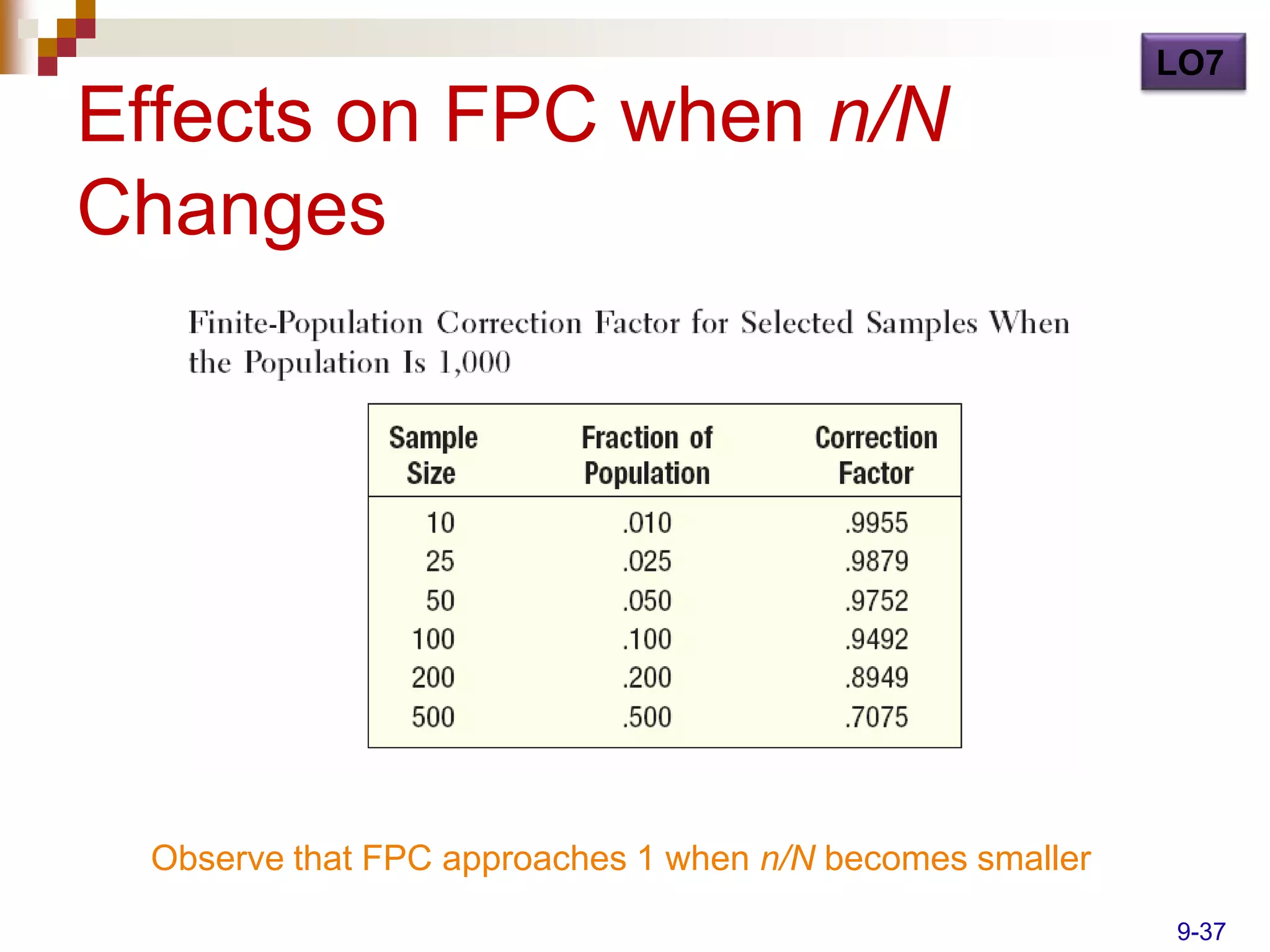
LO7
Effects on FPC when n/N
Changes


 Observe that FPC approaches 1 when n/N becomes smaller
                                                          9-37
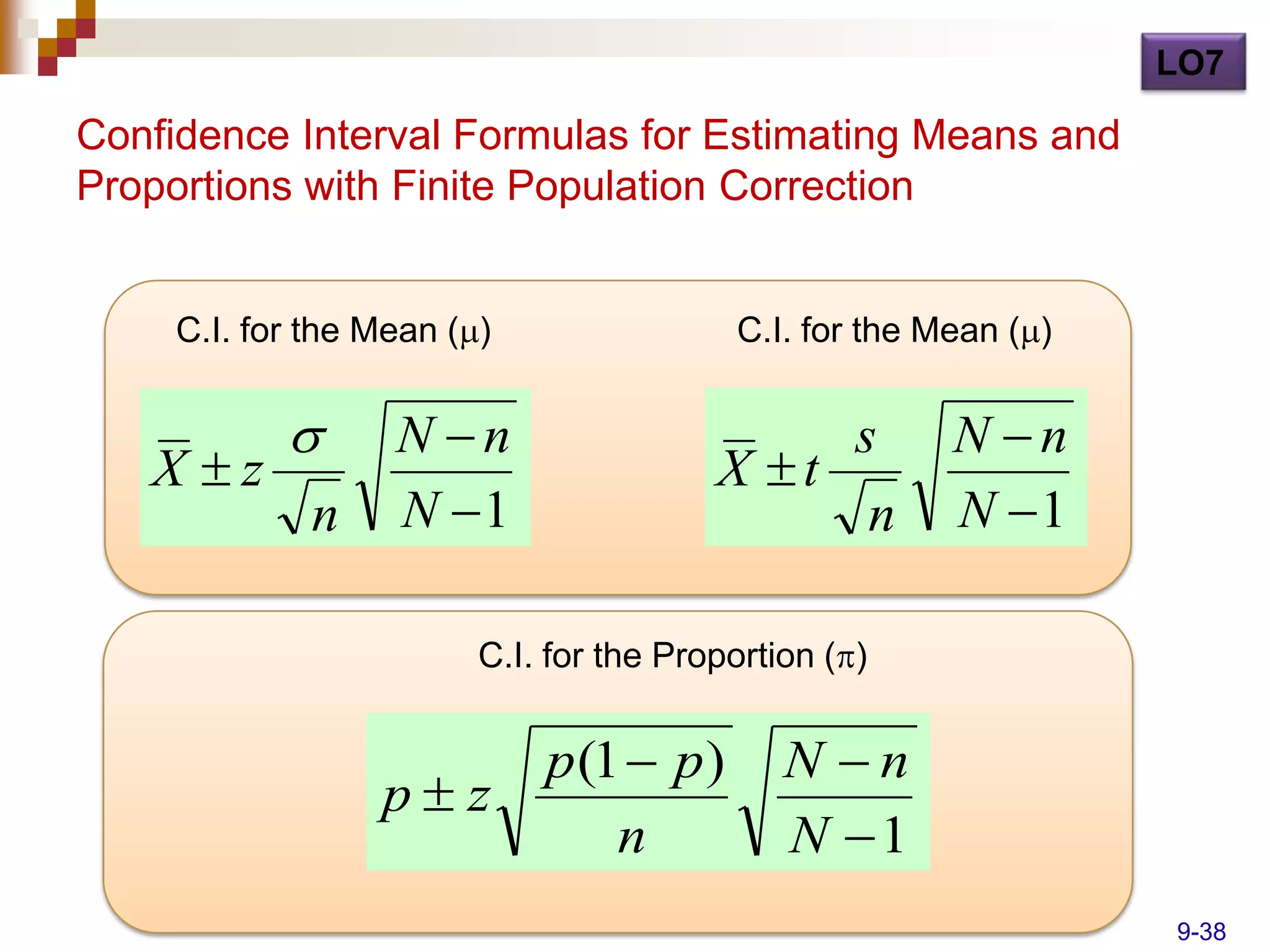
LO7

Confidence Interval Formulas for Estimating Means and
Proportions with Finite Population Correction


     C.I. for the Mean ()                C.I. for the Mean ()


                  N n                       s         N n
   X z                                  X t
              n    N 1                        n        N 1

                         C.I. for the Proportion ()


                             p (1  p )       N n
                  pz
                                 n            N 1
                                                                  9-38
LO7


CI for Mean with FPC - Example
  There are 250 families in    Given in Problem:
  Scandia, Pennsylvania. A     N – 250
  random sample of 40 of       n – 40
  these families revealed
  the mean annual church       s - $75
  contribution was $450 and
  the standard deviation of       Since n/N = 40/250 = 0.16, the
  this was $75.                   finite population correction factor
  Could the population            must be used.
  mean be $445 or $425?           The population standard
                                  deviation is not known therefore
  1. What is the population       use the t-distribution (may use
  mean? What is the best          the z-dist since n>30)
  estimate of the population      Use the formula below to
  mean?                           compute the confidence interval:
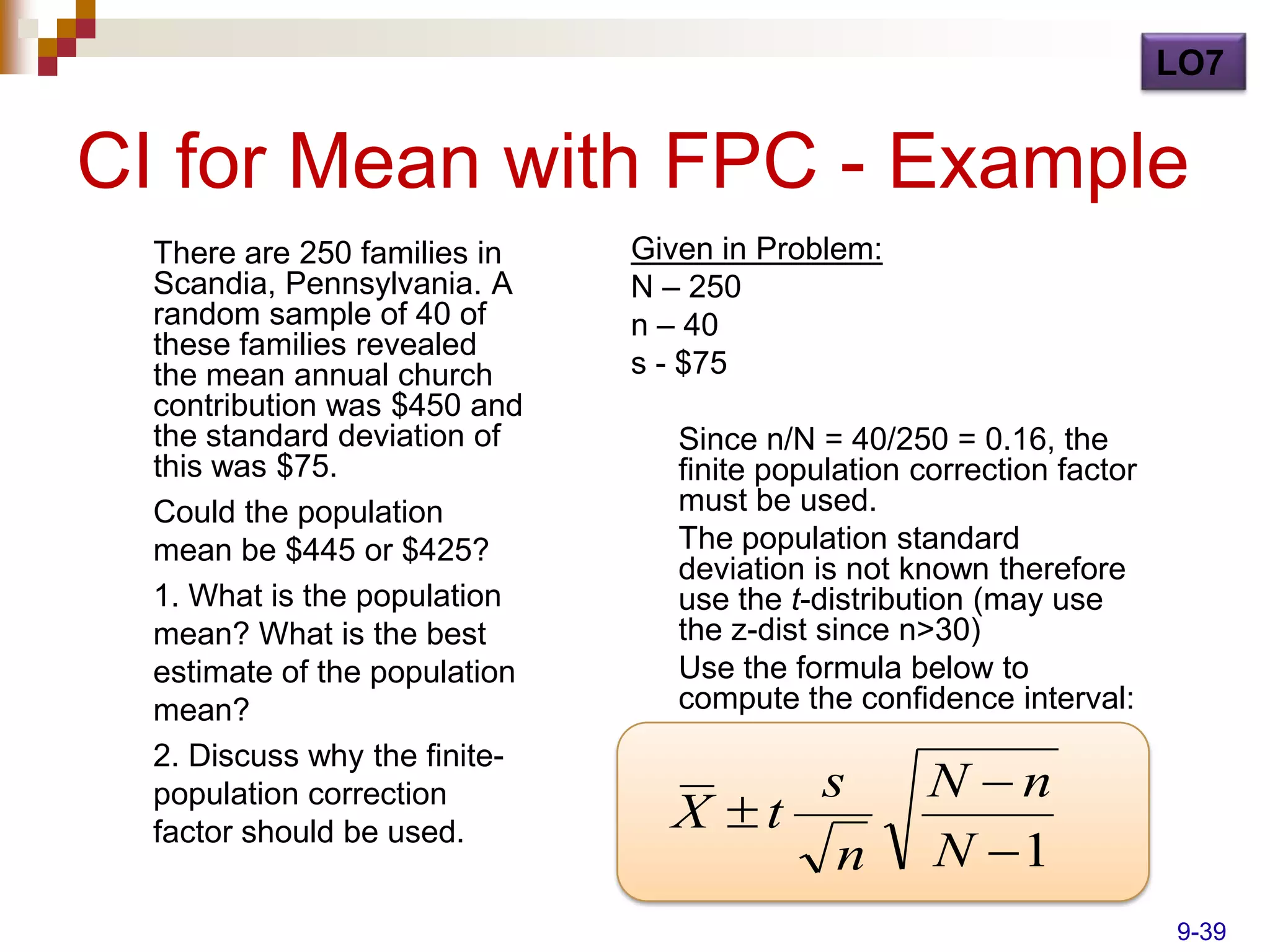
  2. Discuss why the finite-
                                      s              N n
  population correction
                                 X t
  factor should be used.
                                       n             N 1
                                                                        9-39
LO7
CI For Mean with FPC -
Example
           s    N n
    X t
            n   N 1


                                     $75     250  40
             $450  t.10 / 2,401
                                      40      250  1
                                $75        250  40
             $450  1.685
                                 40         250  1
             $450  $19.98 .8434
             $450  $18.35
             ($431.65, $468.35)


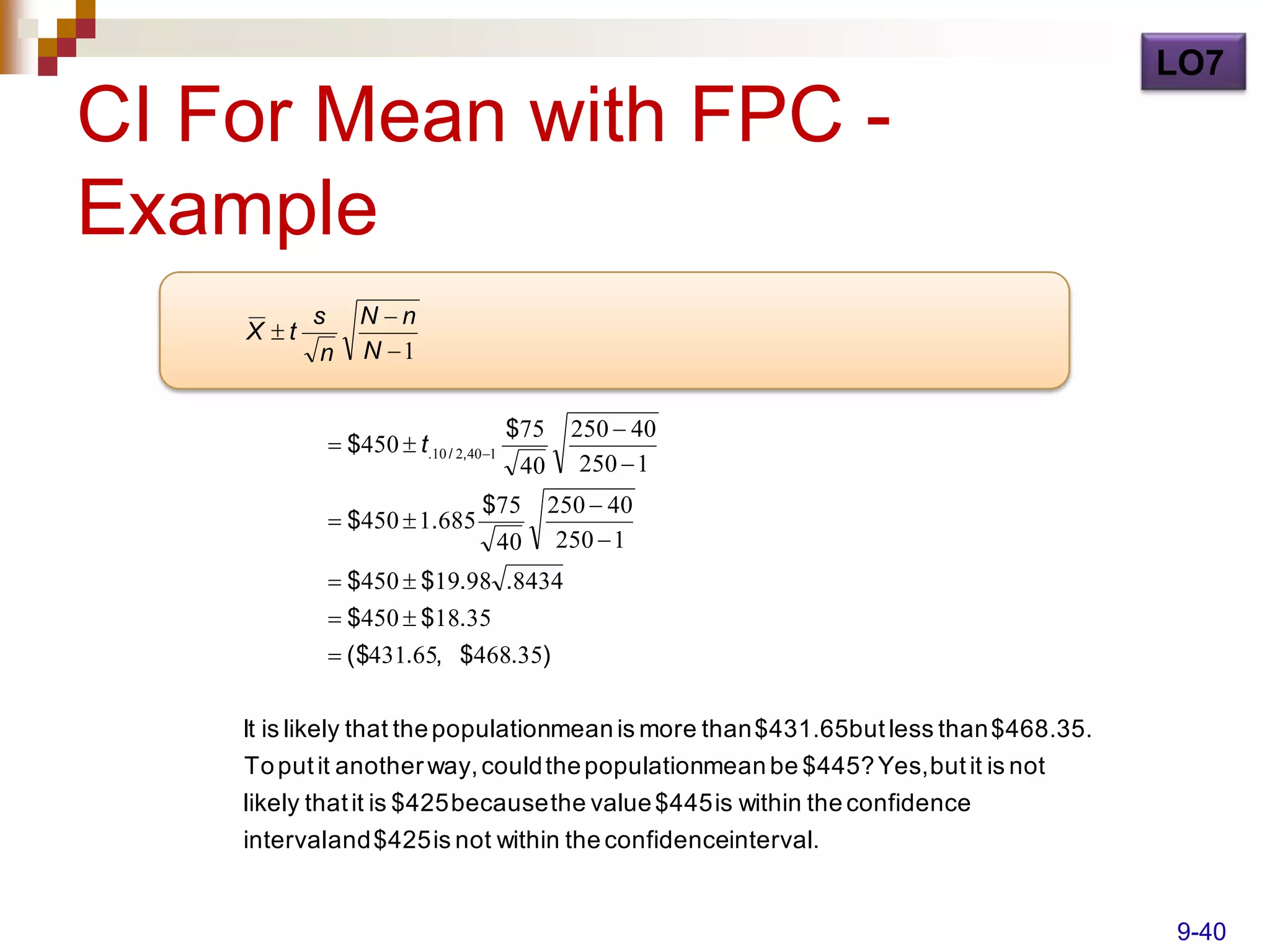
    It is likely that the populationmean is more than $431.65but less than $468.35.
    To put it another way, could the populationmean be $445? Yes, but it is not
    likely that it is $425 because the value $445 is within the confidence
    intervaland $425 is not within the confidenceinterval.


                                                                                      9-40

Chap009

  • 1.
    Estimation and Confidence Intervals Chapter 9 McGraw-Hill/Irwin Copyright © 2012 by The McGraw-Hill Companies, Inc. All rights reserved.
  • 2.
    Learning Objectives LO1 Definea point estimate. LO2 Define level of confidence. LO3 Compute a confidence interval for the population mean when the population standard deviation is known. LO4 Compute a confidence interval for a population mean when the population standard deviation is unknown. LO5 Compute a confidence interval for a population proportion. LO6 Calculate the required sample size to estimate a population proportion or population mean. LO7 Adjust a confidence interval for finite populations 9-2
  • 3.
    LO1 Define apoint estimate. Point Estimates  A point estimate is X   a single value (point) derived from s   a sample and used to estimate a s   2 2 population value. p   9-3
  • 4.
    LO2 Define aconfidence estimate. Confidence Interval Estimates  A confidence interval estimate is a range of values constructed from sample data so that the population parameter is likely to occur within that range at a specified probability. The specified probability is called the level of confidence. C.I. = point estimate ± margin of error 9-4
  • 5.
    LO2 Factors Affecting Confidence IntervalEstimates The width of a confidence interval are determined by: 1.The sample size, n. 2.The variability in the population, usually σ estimated by s. 3.The desired level of confidence. 9-5
  • 6.
    LO3 Compute aconfidence interval for the population mean when the population standard deviation is known. Confidence Intervals for a Mean – σ Known x  sample mean z  z - value for a particular confidencelevel σ  the population standard deviation n  the number of observations in the sample 1. The width of the interval is determined by the level of confidence and the size of the standard error of the mean. 2. The standard error is affected by two values: - Standard deviation - Number of observations in the sample 9-6
  • 7.
    LO3 Interval Estimates -Interpretation For a 95% confidence interval about 95% of the similarly constructed intervals will contain the parameter being estimated. Also 95% of the sample means for a specified sample size will lie within 1.96 standard deviations of the hypothesized population 9-7
  • 8.
    LO3 Example: Confidence Intervalfor a Mean – σ Known The American Management Association wishes to have information on the mean income of middle managers in the retail industry. A random sample of 256 managers reveals a sample mean of $45,420. The standard deviation of this population is $2,050. The association would like answers to the following questions: 1. What is the population mean? 2. What is a reasonable range of values for the population mean? 3. What do these results mean? 9-8
  • 9.
    LO3 Example: Confidence Intervalfor a Mean – σ Known The American Management Association wishes to have information on the mean income of middle managers in the retail industry. A random sample of 256 managers reveals a sample mean of $45,420. The standard deviation of this population is $2,050. The association would like answers to the following questions: What is the population mean? In this case, we do not know. We do know the sample mean is $45,420. Hence, our best estimate of the unknown population value is the corresponding sample statistic. The sample mean of $45,420 is a point estimate of the unknown population mean. 9-9
  • 10.
    LO3 How to Obtainz value for a Given Confidence Level The 95 percent confidence refers to the middle 95 percent of the observations. Therefore, the remaining 5 percent are equally divided between the two tails. Following is a portion of Appendix B.1. 9-10
  • 11.
    LO3 Example: Confidence Intervalfor a Mean – σ Known The American Management Association wishes to have information on the mean income of middle managers in the retail industry. A random sample of 256 managers reveals a sample mean of $45,420. The standard deviation of this population is $2,050. The association would like answers to the following questions: What is a reasonable range of values for the population mean? Suppose the association decides to use the 95 percent level of confidence: The confidence limit are $45,169 and $45,671 The $251 is referred to as the margin of error 9-11
  • 12.
    LO3 Example: Confidence Intervalfor a Mean - Interpretation The American Management Association wishes to have information on the mean income of middle managers in the retail industry. A random sample of 256 managers reveals a sample mean of $45,420. The standard deviation of this population is $2,050. The confidence limit are $45,169 and $45,671 What is the interpretation of the confidence limits $45,169 and $45,671? If we select many samples of 256 managers, and for each sample we compute the mean and then construct a 95 percent confidence interval, we could expect about 95 percent of these confidence intervals to contain the population mean. Conversely, about 5 percent of the intervals would not contain the population mean annual income, µ 9-12
  • 13.
    LO4 Compute aconfidence interval for the population mean when the population standard deviation is not known. Population Standard Deviation (σ) Unknown In most sampling situations the population standard deviation (σ) is not known. Below are some examples where it is unlikely the population standard deviations would be known. 1. The Dean of the Business College wants to estimate the mean number of hours full-time students work at paying jobs each week. He selects a sample of 30 students, contacts each student and asks them how many hours they worked last week. 2. The Dean of Students wants to estimate the distance the typical commuter student travels to class. She selects a sample of 40 commuter students, contacts each, and determines the one-way distance from each student’s home to the center of campus. 3. The Director of Student Loans wants to know the mean amount owed on student loans at the time of his/her graduation. The director selects a sample of 20 graduating students and contacts each to find the information. 9-13
  • 14.
    LO4 Characteristics of thet- distribution 1. It is, like the z distribution, a continuous distribution. 2. It is, like the z distribution, bell-shaped and symmetrical. 3. There is not one t distribution, but rather a family of t distributions. All t distributions have a mean of 0, but their standard deviations differ according to the sample size, n. 4. The t distribution is more spread out and flatter at the center than the standard normal distribution As the sample size increases, however, the t distribution approaches the standard normal distribution 9-14
  • 15.
    LO4 Comparing the zand t Distributions when n is small, 95% Confidence Level 9-15
  • 16.
    LO4 Confidence Interval forthe Mean – Example using the t-distribution A tire manufacturer wishes to investigate the tread life of its Given in the problem : tires. A sample of 10 tires driven 50,000 miles revealed a n  10 sample mean of 0.32 inch of tread remaining with a standard x  0.32 deviation of 0.09 inch. s  0.09 Construct a 95 percent confidence interval for the population mean. Compute the C.I. using the Would it be reasonable for the manufacturer to conclude that t - dist. (since is unknown) after 50,000 miles the population mean amount of s tread remaining is 0.30 inches? X  t / 2,n 1 n 9-16
  • 17.
  • 18.
    LO4 Confidence Interval Estimatesfor the Mean – Using Minitab The manager of the Inlet Square Mall, near Ft. Myers, Florida, wants to estimate the mean amount spent per shopping visit by customers. A sample of 20 customers reveals the following amounts spent. 9-18
  • 19.
    LO4 Confidence Interval Estimates forthe Mean – By Formula Compute the C.I. using the t - dist. (since is unknown) s X  t / 2,n 1 n s  X  t.05 / 2, 201 n 9.01  49.35  t.025,19 20 9.01  49.35  2.093 20  49.35  4.22 The endpoints of the confidenceinterval are $45.13 and $53.57 Conclude : It is reasonable that the population mean could be $50. The value of $60 is not in the confidenceinterval. Hence, we conclude that the population mean is unlikely to be $60. 9-19
  • 20.
    LO4 Confidence Interval Estimatesfor the Mean – Using Minitab 9-20
  • 21.
    LO4 Confidence Interval Estimatesfor the Mean – Using Excel 9-21
  • 22.
    LO4 Confidence Interval Estimatesfor the Mean Use Z-distribution Use t-distribution If the population If the population standard deviation is standard deviation is known or the sample unknown and the is greater than 30. sample is less than 30. 9-22
  • 23.
    LO4 When to Usethe z or t Distribution for Confidence Interval Computation 9-23
  • 24.
    LO5 Compute aconfidence interval for a population proportion. A Confidence Interval for a Proportion (π) The examples below illustrate the nominal scale of measurement. 1. The career services director at Southern Technical Institute reports that 80 percent of its graduates enter the job market in a position related to their field of study. 2. A company representative claims that 45 percent of Burger King sales are made at the drive-through window. 3. A survey of homes in the Chicago area indicated that 85 percent of the new construction had central air conditioning. 4. A recent survey of married men between the ages of 35 and 50 found that 63 percent felt that both partners should earn a living. 9-24
  • 25.
    LO5 Using the NormalDistribution to Approximate the Binomial Distribution To develop a confidence interval for a proportion, we need to meet the following assumptions. 1. The binomial conditions, discussed in Chapter 6, have been met. Briefly, these conditions are: a. The sample data is the result of counts. b. There are only two possible outcomes. c. The probability of a success remains the same from one trial to the next. d. The trials are independent. This means the outcome on one trial does not affect the outcome on another. 2. The values nπ and n(1-π) should both be greater than or equal to 5. This condition allows us to invoke the central limit theorem and employ the standard normal distribution, that is, z, to complete a confidence interval. 9-25
  • 26.
    LO5 Confidence Interval fora Population Proportion - Formula 9-26
  • 27.
    LO5 Confidence Interval fora Population Proportion- Example The union representing the First, compute the sample proportion : Bottle Blowers of America x 1,600 (BBA) is considering a proposal p   0.80 to merge with the Teamsters n 2000 Union. According to BBA union bylaws, at least three-fourths of Compute the 95% C.I. the union membership must approve any merger. A random p (1  p ) C.I.  p  z / 2 sample of 2,000 current BBA n members reveals 1,600 plan to vote for the merger proposal. .80(1  .80)  0.80  1.96  .80  .018 What is the estimate of the 2,000 population proportion?  (0.782, 0.818) Develop a 95 percent confidence interval for the population proportion. Basing Conclude : The merger proposal will likely pass your decision on this sample because the interval estimate includes values greater information, can you conclude that the necessary proportion of than 75 percent of the union membership. BBA members favor the merger? Why? 9-27
  • 28.
    LO6 Calculate therequired sample size to estimate a population proportion or population mean. Selecting an Appropriate Sample Size There are 3 factors that determine the size of a sample, none of which has any direct relationship to the size of the population.  The level of confidence desired.  The margin of error the researcher will tolerate.  The variation in the population being Studied. 9-28
  • 29.
    LO6 What If PopulationStandard Deviation is not Known 1. Conduct a Pilot Study 2. Use a Comparable Study 3. Use a Range-based approach 9-29
  • 30.
    LO6 Sample Size forEstimating the Population Mean  z   2 n   E  9-30
  • 31.
    LO6 Sample Size Determination fora Variable-Example A student in public administration wants to determine the mean amount members of city councils in large cities  z   2 earn per month as remuneration for being a council member. The error in n  estimating the mean is to be less than  E  $100 with a 95 percent level of confidence. The student found a report by the Department of Labor that 2 estimated the standard deviation to be  (1.96)($1,000)  $1,000. What is the required sample size?    $100  Given in the problem:  (19.6) 2  E, the maximum allowable error, is $100  384.16  The value of z for a 95 percent level of confidence is 1.96,  385  The estimate of the standard deviation is $1,000. 9-31
  • 32.
    LO6 Sample Size Determinationfor a Variable- Another Example A consumer group would like to estimate the mean monthly electricity charge for a single family house in July within $5 using a 99 percent level of confidence. Based on similar studies the standard deviation is estimated to be $20.00. How large a sample is required? 2  (2.58)(20)  n   107  5  9-32
  • 33.
    LO6 Sample Size forEstimating a Population Proportion 2 Z n   (1   )  E  where: n is the size of the sample z is the standard normal value corresponding to the desired level of confidence E is the maximum allowable error 9-33
  • 34.
    LO6 Sample Size Determination- Example The American Kennel Club wanted to estimate the proportion of children that have a dog as a pet. If the club wanted the estimate to be within 3% of the population proportion, how many children would they need to contact? Assume a 95% level of confidence and that the club estimated that 30% of the children have a dog as a pet. 2 Z n   (1   )  E  2  1.96  n  (.30)(.70)   897  .03  9-34
  • 35.
    LO6 Another Example A study needs to estimate the 2 Z proportion of cities that have n   (1   )  private refuse collectors. The investigator wants the margin of E  error to be within .10 of the population proportion, the desired level of confidence is 2  1.65  90 percent, and no estimate is n  (.5)(1  .5)   68.0625 available for the population  .10  proportion. What is the required n  69 cities sample size? 9-35
  • 36.
    LO7 Adjust aconfidence interval for finite populations. Finite-Population Correction Factor  A population that has a fixed upper bound is said to be finite.  For a finite population, where the total number of objects is N and the size of the sample is n, the following adjustment is made to the standard errors of the sample means and the proportion:  However, if n/N < .05, the finite-population correction factor may be ignored. Standard Error of the Mean Standard Error of the Proportion  N n p(1  p) N  n x  p  n N 1 n N 1 9-36
  • 37.
    LO7 Effects on FPCwhen n/N Changes Observe that FPC approaches 1 when n/N becomes smaller 9-37
  • 38.
    LO7 Confidence Interval Formulasfor Estimating Means and Proportions with Finite Population Correction C.I. for the Mean () C.I. for the Mean ()  N n s N n X z X t n N 1 n N 1 C.I. for the Proportion () p (1  p ) N n pz n N 1 9-38
  • 39.
    LO7 CI for Meanwith FPC - Example There are 250 families in Given in Problem: Scandia, Pennsylvania. A N – 250 random sample of 40 of n – 40 these families revealed the mean annual church s - $75 contribution was $450 and the standard deviation of Since n/N = 40/250 = 0.16, the this was $75. finite population correction factor Could the population must be used. mean be $445 or $425? The population standard deviation is not known therefore 1. What is the population use the t-distribution (may use mean? What is the best the z-dist since n>30) estimate of the population Use the formula below to mean? compute the confidence interval: 2. Discuss why the finite- s N n population correction X t factor should be used. n N 1 9-39
  • 40.
    LO7 CI For Meanwith FPC - Example s N n X t n N 1 $75 250  40  $450  t.10 / 2,401 40 250  1 $75 250  40  $450  1.685 40 250  1  $450  $19.98 .8434  $450  $18.35  ($431.65, $468.35) It is likely that the populationmean is more than $431.65but less than $468.35. To put it another way, could the populationmean be $445? Yes, but it is not likely that it is $425 because the value $445 is within the confidence intervaland $425 is not within the confidenceinterval. 9-40