Discrete
                    Probability
                    Distributions
                        Chapter 6


McGraw-Hill/Irwin           Copyright © 2012 by The McGraw-Hill Companies, Inc. All rights reserved.
Learning Objectives
LO1 Identify the characteristics of a probability distribution.
LO2 Distinguish between discrete and continuous random
    variable.
LO3 Compute the mean of a probability distribution.
LO4 Compute the variance and standard deviation of a
    probability distribution.
LO5 Describe and compute probabilities for a binomial
    distribution.
LO6 Describe and compute probabilities for a
    hypergeometric distribution.
LO7 Describe and compute probabilities for a Poisson
    distribution.                                               6-2
LO1 Identify the characteristics
                                        of a probability distribution.


What is a Probability Distribution?
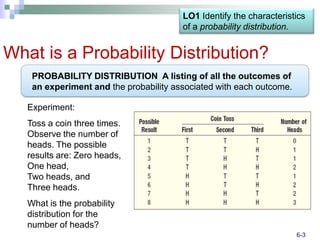
    PROBABILITY DISTRIBUTION A listing of all the outcomes of
    an experiment and the probability associated with each outcome.

   Experiment:
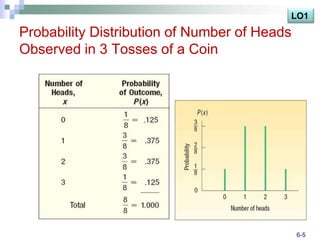
   Toss a coin three times.
   Observe the number of
   heads. The possible
   results are: Zero heads,
   One head,
   Two heads, and
   Three heads.
   What is the probability
   distribution for the
   number of heads?
                                                                      6-3
LO1

Characteristics of a Probability Distribution

 CHARACTERISTICS OF A PROBABILITY
 DISTRIBUTION
 1.The probability of a particular outcome is between
   0 and 1 inclusive.
 2. The outcomes are mutually exclusive events.
 3. The list is exhaustive. So the sum of the probabilities
    of the various events is equal to 1.


                                                              6-4
LO1

Probability Distribution of Number of Heads
Observed in 3 Tosses of a Coin


                                              6-5
LO1

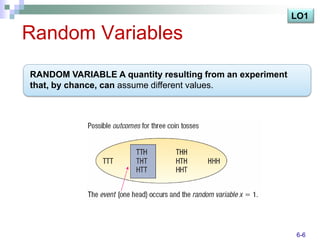
Random Variables
RANDOM VARIABLE A quantity resulting from an experiment
that, by chance, can assume different values.


                                                          6-6
LO2 Distinguish between discrete
                                     and continuous random variable.


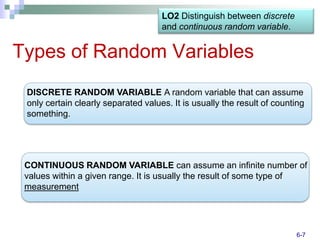
Types of Random Variables
 DISCRETE RANDOM VARIABLE A random variable that can assume
 only certain clearly separated values. It is usually the result of counting
 something.


 CONTINUOUS RANDOM VARIABLE can assume an infinite number of
 values within a given range. It is usually the result of some type of
 measurement


                                                                         6-7
LO2


Discrete Random Variables

 DISCRETE RANDOM VARIABLE A random variable that can assume
 only certain clearly separated values. It is usually the result of counting
 something.


 EXAMPLES
 1. The number of students in a class.
 2. The number of children in a family.
 3. The number of cars entering a carwash in a hour.
 4. Number of home mortgages approved by Coastal Federal
    Bank last week.


                                                                         6-8
LO2

Continuous Random Variables

 CONTINUOUS RANDOM VARIABLE can assume an infinite number of
 values within a given range. It is usually the result of some type of
 measurement


 EXAMPLES
  The length of each song on the latest Tim McGraw album.
  The weight of each student in this class.
  The temperature outside as you are reading this book.
  The amount of money earned by each of the more than 750
   players currently on Major League Baseball team rosters.


                                                                  6-9
LO3 Compute the mean of a
                         probability distribution.

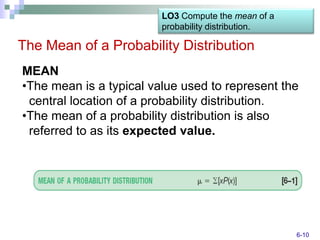
The Mean of a Probability Distribution
MEAN
•The mean is a typical value used to represent the
 central location of a probability distribution.
•The mean of a probability distribution is also
 referred to as its expected value.


                                                     6-10
LO3

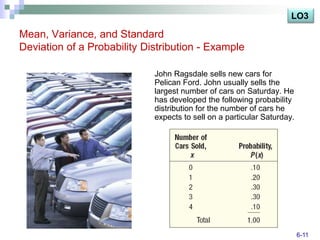
Mean, Variance, and Standard
Deviation of a Probability Distribution - Example

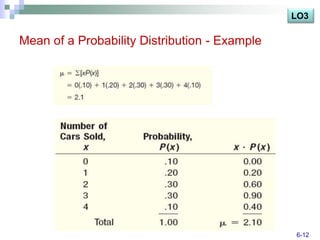
                             John Ragsdale sells new cars for
                             Pelican Ford. John usually sells the
                             largest number of cars on Saturday. He
                             has developed the following probability
                             distribution for the number of cars he
                             expects to sell on a particular Saturday.


                                                                         6-11
LO3

Mean of a Probability Distribution - Example


                                               6-12
LO4 Compute the variance and standard
                             deviation of a probability distribution.
    The Variance and Standard
    Deviation of a Probability Distribution
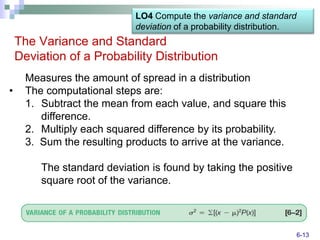
      Measures the amount of spread in a distribution
•     The computational steps are:
      1. Subtract the mean from each value, and square this
         difference.
      2. Multiply each squared difference by its probability.
      3. Sum the resulting products to arrive at the variance.

         The standard deviation is found by taking the positive
         square root of the variance.


                                                                        6-13
LO4

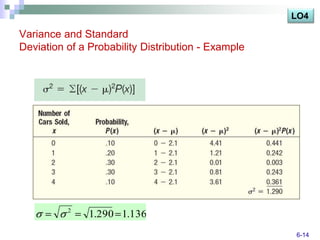
Variance and Standard
Deviation of a Probability Distribution - Example


          2
               1.290 1.136
                                                    6-14
LO5 Describe and compute probabilities for
                       a binomial distribution.


Binomial Probability Distribution
    A Widely occurring discrete probability
     distribution
    Characteristics of a Binomial Probability
     Distribution
1.    There are only two possible outcomes on a
      particular trial of an experiment.
2.    The outcomes are mutually exclusive,
3.    The random variable is the result of counts.
4.     Each trial is independent of any other trial
                                                              6-15
LO5


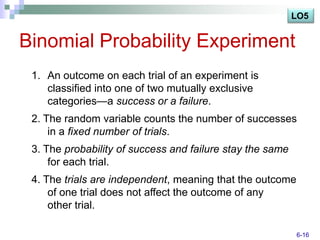
Binomial Probability Experiment
 1. An outcome on each trial of an experiment is
    classified into one of two mutually exclusive
    categories—a success or a failure.
 2. The random variable counts the number of successes
     in a fixed number of trials.
 3. The probability of success and failure stay the same
     for each trial.
 4. The trials are independent, meaning that the outcome
     of one trial does not affect the outcome of any
     other trial.

                                                           6-16
LO5


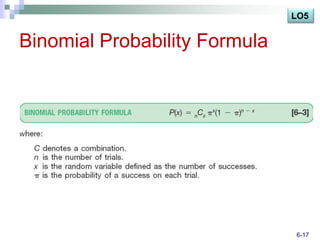
Binomial Probability Formula


                               6-17
LO5

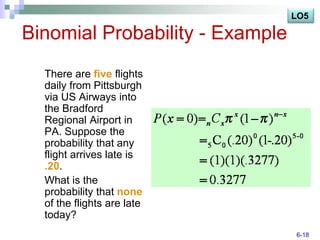
Binomial Probability - Example
  There are five flights
  daily from Pittsburgh
  via US Airways into
  the Bradford
  Regional Airport in
  PA. Suppose the
  probability that any
  flight arrives late is
  .20.
  What is the
  probability that none
  of the flights are late
  today?
                                 6-18
LO5


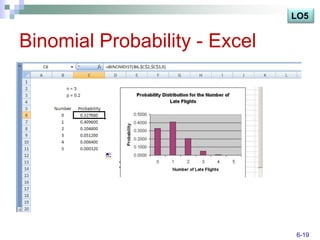
Binomial Probability - Excel


                               6-19
LO5

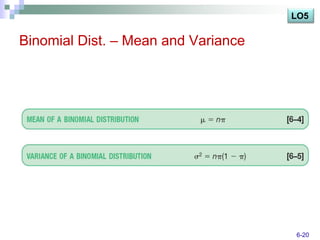
Binomial Dist. – Mean and Variance


                                     6-20
LO5

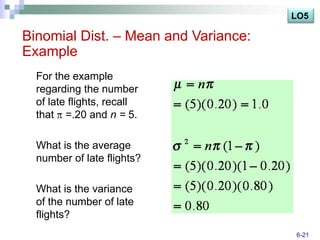
Binomial Dist. – Mean and Variance:
Example
  For the example
  regarding the number
  of late flights, recall
  that =.20 and n = 5.

  What is the average
  number of late flights?

  What is the variance
  of the number of late
  flights?
                                      6-21
LO5
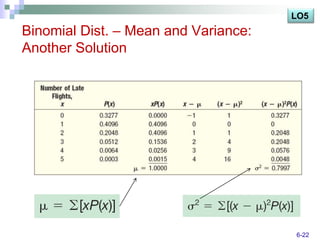
Binomial Dist. – Mean and Variance:
Another Solution


                                      6-22
LO5


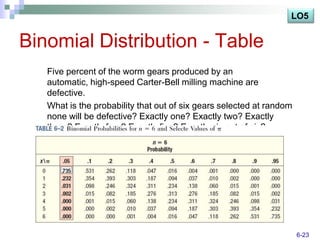
Binomial Distribution - Table
   Five percent of the worm gears produced by an
   automatic, high-speed Carter-Bell milling machine are
   defective.
   What is the probability that out of six gears selected at random
   none will be defective? Exactly one? Exactly two? Exactly
   three? Exactly four? Exactly five? Exactly six out of six?


                                                                      6-23
LO5


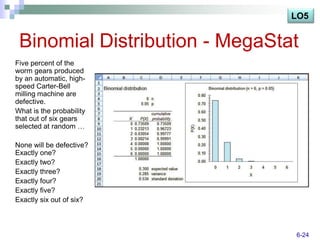
 Binomial Distribution - MegaStat
Five percent of the
worm gears produced
by an automatic, high-
speed Carter-Bell
milling machine are
defective.
What is the probability
that out of six gears
selected at random …

None will be defective?
Exactly one?
Exactly two?
Exactly three?
Exactly four?
Exactly five?
Exactly six out of six?


                                6-24
LO5

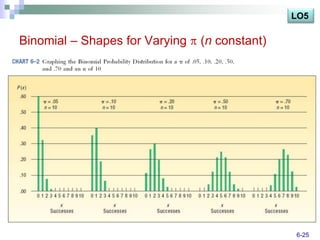
Binomial – Shapes for Varying   (n constant)


                                               6-25
LO5

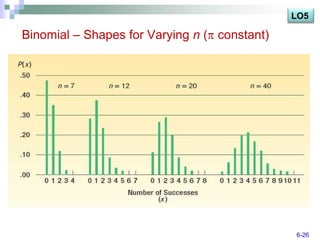
Binomial – Shapes for Varying n ( constant)


                                              6-26
LO5

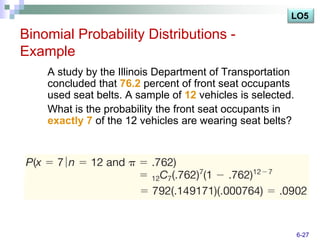
Binomial Probability Distributions -
Example
    A study by the Illinois Department of Transportation
    concluded that 76.2 percent of front seat occupants
    used seat belts. A sample of 12 vehicles is selected.
    What is the probability the front seat occupants in
    exactly 7 of the 12 vehicles are wearing seat belts?


                                                            6-27
LO5

Binomial Probability Distributions -
Example
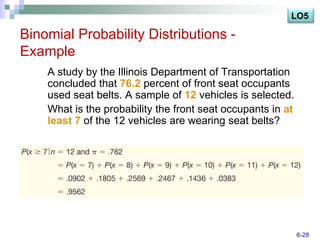
    A study by the Illinois Department of Transportation
    concluded that 76.2 percent of front seat occupants
    used seat belts. A sample of 12 vehicles is selected.
    What is the probability the front seat occupants in at
    least 7 of the 12 vehicles are wearing seat belts?


                                                             6-28
LO5

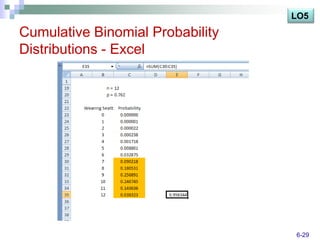
Cumulative Binomial Probability
Distributions - Excel


                                  6-29
LO6 Describe and compute probabilities for
                         a hypergeometric distribution.

Hypergeometric Probability Distribution
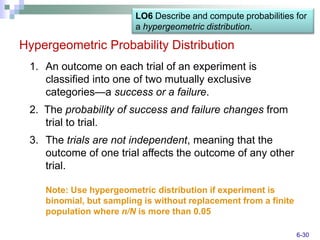
 1. An outcome on each trial of an experiment is
    classified into one of two mutually exclusive
    categories—a success or a failure.
 2. The probability of success and failure changes from
    trial to trial.
 3. The trials are not independent, meaning that the
    outcome of one trial affects the outcome of any other
    trial.

    Note: Use hypergeometric distribution if experiment is
    binomial, but sampling is without replacement from a finite
    population where n/N is more than 0.05

                                                                  6-30
LO6

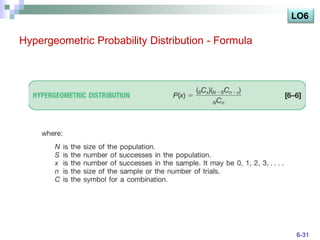
Hypergeometric Probability Distribution - Formula


                                                    6-31
LO6

Hypergeometric Probability Distribution - Example


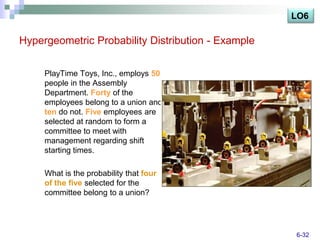
     PlayTime Toys, Inc., employs 50
     people in the Assembly
     Department. Forty of the
     employees belong to a union and
     ten do not. Five employees are
     selected at random to form a
     committee to meet with
     management regarding shift
     starting times.

     What is the probability that four
     of the five selected for the
     committee belong to a union?


                                                    6-32
LO6

Hypergeometric Probability Distribution - Example

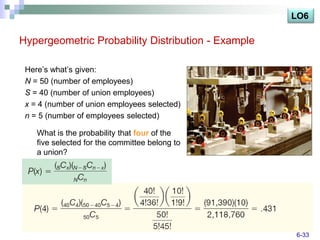
 Here’s what’s given:
 N = 50 (number of employees)
 S = 40 (number of union employees)
 x = 4 (number of union employees selected)
 n = 5 (number of employees selected)

    What is the probability that four of the
    five selected for the committee belong to
    a union?


                                                    33
                                                    6-33
LO7 Describe and compute
                            probabilities for a Poisson distribution.

Poisson Probability Distribution
   The Poisson probability distribution
   describes the number of times some event
   occurs during a specified interval. The
   interval may be time, distance, area, or volume.

Assumptions of the Poisson Distribution
     The probability is proportional to the length of the
      interval.
     The intervals are independent.


                                                                  6-34
LO7


Poisson Probability Distribution
    The Poisson probability distribution is characterized
    by the number of times an event happens during
    some interval or continuum.
 Examples include:
 • The number of misspelled words per page in a
    newspaper.
 • The number of calls per hour received by Dyson
    Vacuum Cleaner Company.
 • The number of vehicles sold per day at Hyatt Buick
    GMC in Durham, North Carolina.
 • The number of goals scored in a college soccer game.
                                                            6-35
LO7


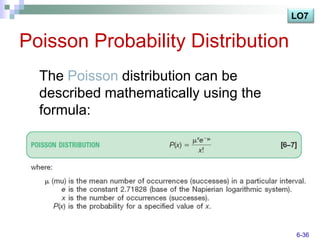
Poisson Probability Distribution
  The Poisson distribution can be
  described mathematically using the
  formula:


                                       6-36
LO7


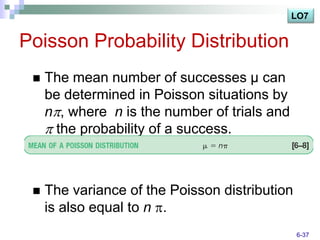
Poisson Probability Distribution
    The mean number of successes μ can
     be determined in Poisson situations by
     n , where n is the number of trials and
      the probability of a success.


    The variance of the Poisson distribution
     is also equal to n .
                                                6-37
LO7

Poisson Probability Distribution - Example

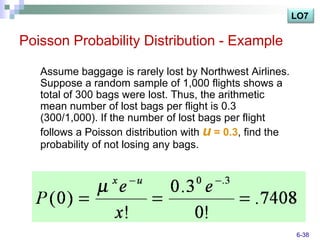
   Assume baggage is rarely lost by Northwest Airlines.
   Suppose a random sample of 1,000 flights shows a
   total of 300 bags were lost. Thus, the arithmetic
   mean number of lost bags per flight is 0.3
   (300/1,000). If the number of lost bags per flight
   follows a Poisson distribution with u = 0.3, find the
   probability of not losing any bags.


                                                           6-38
LO7

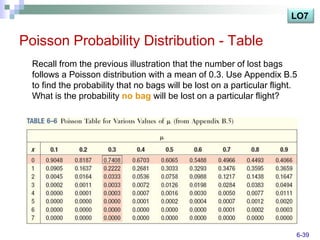
Poisson Probability Distribution - Table
  Recall from the previous illustration that the number of lost bags
  follows a Poisson distribution with a mean of 0.3. Use Appendix B.5
  to find the probability that no bags will be lost on a particular flight.
  What is the probability no bag will be lost on a particular flight?


                                                                          6-39
LO7

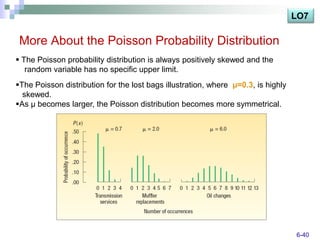
 More About the Poisson Probability Distribution
 The Poisson probability distribution is always positively skewed and the
   random variable has no specific upper limit.
The Poisson distribution for the lost bags illustration, where µ=0.3, is highly
  skewed.
As µ becomes larger, the Poisson distribution becomes more symmetrical.


                                                                                   6-40

Chap006

  • 1.
    Discrete Probability Distributions Chapter 6 McGraw-Hill/Irwin Copyright © 2012 by The McGraw-Hill Companies, Inc. All rights reserved.
  • 2.
    Learning Objectives LO1 Identifythe characteristics of a probability distribution. LO2 Distinguish between discrete and continuous random variable. LO3 Compute the mean of a probability distribution. LO4 Compute the variance and standard deviation of a probability distribution. LO5 Describe and compute probabilities for a binomial distribution. LO6 Describe and compute probabilities for a hypergeometric distribution. LO7 Describe and compute probabilities for a Poisson distribution. 6-2
  • 3.
    LO1 Identify thecharacteristics of a probability distribution. What is a Probability Distribution? PROBABILITY DISTRIBUTION A listing of all the outcomes of an experiment and the probability associated with each outcome. Experiment: Toss a coin three times. Observe the number of heads. The possible results are: Zero heads, One head, Two heads, and Three heads. What is the probability distribution for the number of heads? 6-3
  • 4.
    LO1 Characteristics of aProbability Distribution CHARACTERISTICS OF A PROBABILITY DISTRIBUTION 1.The probability of a particular outcome is between 0 and 1 inclusive. 2. The outcomes are mutually exclusive events. 3. The list is exhaustive. So the sum of the probabilities of the various events is equal to 1. 6-4
  • 5.
    LO1 Probability Distribution ofNumber of Heads Observed in 3 Tosses of a Coin 6-5
  • 6.
    LO1 Random Variables RANDOM VARIABLEA quantity resulting from an experiment that, by chance, can assume different values. 6-6
  • 7.
    LO2 Distinguish betweendiscrete and continuous random variable. Types of Random Variables DISCRETE RANDOM VARIABLE A random variable that can assume only certain clearly separated values. It is usually the result of counting something. CONTINUOUS RANDOM VARIABLE can assume an infinite number of values within a given range. It is usually the result of some type of measurement 6-7
  • 8.
    LO2 Discrete Random Variables DISCRETE RANDOM VARIABLE A random variable that can assume only certain clearly separated values. It is usually the result of counting something. EXAMPLES 1. The number of students in a class. 2. The number of children in a family. 3. The number of cars entering a carwash in a hour. 4. Number of home mortgages approved by Coastal Federal Bank last week. 6-8
  • 9.
    LO2 Continuous Random Variables CONTINUOUS RANDOM VARIABLE can assume an infinite number of values within a given range. It is usually the result of some type of measurement EXAMPLES  The length of each song on the latest Tim McGraw album.  The weight of each student in this class.  The temperature outside as you are reading this book.  The amount of money earned by each of the more than 750 players currently on Major League Baseball team rosters. 6-9
  • 10.
    LO3 Compute themean of a probability distribution. The Mean of a Probability Distribution MEAN •The mean is a typical value used to represent the central location of a probability distribution. •The mean of a probability distribution is also referred to as its expected value. 6-10
  • 11.
    LO3 Mean, Variance, andStandard Deviation of a Probability Distribution - Example John Ragsdale sells new cars for Pelican Ford. John usually sells the largest number of cars on Saturday. He has developed the following probability distribution for the number of cars he expects to sell on a particular Saturday. 6-11
  • 12.
    LO3 Mean of aProbability Distribution - Example 6-12
  • 13.
    LO4 Compute thevariance and standard deviation of a probability distribution. The Variance and Standard Deviation of a Probability Distribution Measures the amount of spread in a distribution • The computational steps are: 1. Subtract the mean from each value, and square this difference. 2. Multiply each squared difference by its probability. 3. Sum the resulting products to arrive at the variance. The standard deviation is found by taking the positive square root of the variance. 6-13
  • 14.
    LO4 Variance and Standard Deviationof a Probability Distribution - Example 2 1.290 1.136 6-14
  • 15.
    LO5 Describe andcompute probabilities for a binomial distribution. Binomial Probability Distribution  A Widely occurring discrete probability distribution  Characteristics of a Binomial Probability Distribution 1. There are only two possible outcomes on a particular trial of an experiment. 2. The outcomes are mutually exclusive, 3. The random variable is the result of counts. 4. Each trial is independent of any other trial 6-15
  • 16.
    LO5 Binomial Probability Experiment 1. An outcome on each trial of an experiment is classified into one of two mutually exclusive categories—a success or a failure. 2. The random variable counts the number of successes in a fixed number of trials. 3. The probability of success and failure stay the same for each trial. 4. The trials are independent, meaning that the outcome of one trial does not affect the outcome of any other trial. 6-16
  • 17.
  • 18.
    LO5 Binomial Probability -Example There are five flights daily from Pittsburgh via US Airways into the Bradford Regional Airport in PA. Suppose the probability that any flight arrives late is .20. What is the probability that none of the flights are late today? 6-18
  • 19.
  • 20.
    LO5 Binomial Dist. –Mean and Variance 6-20
  • 21.
    LO5 Binomial Dist. –Mean and Variance: Example For the example regarding the number of late flights, recall that =.20 and n = 5. What is the average number of late flights? What is the variance of the number of late flights? 6-21
  • 22.
    LO5 Binomial Dist. –Mean and Variance: Another Solution 6-22
  • 23.
    LO5 Binomial Distribution -Table Five percent of the worm gears produced by an automatic, high-speed Carter-Bell milling machine are defective. What is the probability that out of six gears selected at random none will be defective? Exactly one? Exactly two? Exactly three? Exactly four? Exactly five? Exactly six out of six? 6-23
  • 24.
    LO5 Binomial Distribution- MegaStat Five percent of the worm gears produced by an automatic, high- speed Carter-Bell milling machine are defective. What is the probability that out of six gears selected at random … None will be defective? Exactly one? Exactly two? Exactly three? Exactly four? Exactly five? Exactly six out of six? 6-24
  • 25.
    LO5 Binomial – Shapesfor Varying (n constant) 6-25
  • 26.
    LO5 Binomial – Shapesfor Varying n ( constant) 6-26
  • 27.
    LO5 Binomial Probability Distributions- Example A study by the Illinois Department of Transportation concluded that 76.2 percent of front seat occupants used seat belts. A sample of 12 vehicles is selected. What is the probability the front seat occupants in exactly 7 of the 12 vehicles are wearing seat belts? 6-27
  • 28.
    LO5 Binomial Probability Distributions- Example A study by the Illinois Department of Transportation concluded that 76.2 percent of front seat occupants used seat belts. A sample of 12 vehicles is selected. What is the probability the front seat occupants in at least 7 of the 12 vehicles are wearing seat belts? 6-28
  • 29.
  • 30.
    LO6 Describe andcompute probabilities for a hypergeometric distribution. Hypergeometric Probability Distribution 1. An outcome on each trial of an experiment is classified into one of two mutually exclusive categories—a success or a failure. 2. The probability of success and failure changes from trial to trial. 3. The trials are not independent, meaning that the outcome of one trial affects the outcome of any other trial. Note: Use hypergeometric distribution if experiment is binomial, but sampling is without replacement from a finite population where n/N is more than 0.05 6-30
  • 31.
  • 32.
    LO6 Hypergeometric Probability Distribution- Example PlayTime Toys, Inc., employs 50 people in the Assembly Department. Forty of the employees belong to a union and ten do not. Five employees are selected at random to form a committee to meet with management regarding shift starting times. What is the probability that four of the five selected for the committee belong to a union? 6-32
  • 33.
    LO6 Hypergeometric Probability Distribution- Example Here’s what’s given: N = 50 (number of employees) S = 40 (number of union employees) x = 4 (number of union employees selected) n = 5 (number of employees selected) What is the probability that four of the five selected for the committee belong to a union? 33 6-33
  • 34.
    LO7 Describe andcompute probabilities for a Poisson distribution. Poisson Probability Distribution The Poisson probability distribution describes the number of times some event occurs during a specified interval. The interval may be time, distance, area, or volume. Assumptions of the Poisson Distribution  The probability is proportional to the length of the interval.  The intervals are independent. 6-34
  • 35.
    LO7 Poisson Probability Distribution The Poisson probability distribution is characterized by the number of times an event happens during some interval or continuum. Examples include: • The number of misspelled words per page in a newspaper. • The number of calls per hour received by Dyson Vacuum Cleaner Company. • The number of vehicles sold per day at Hyatt Buick GMC in Durham, North Carolina. • The number of goals scored in a college soccer game. 6-35
  • 36.
    LO7 Poisson Probability Distribution The Poisson distribution can be described mathematically using the formula: 6-36
  • 37.
    LO7 Poisson Probability Distribution  The mean number of successes μ can be determined in Poisson situations by n , where n is the number of trials and the probability of a success.  The variance of the Poisson distribution is also equal to n . 6-37
  • 38.
    LO7 Poisson Probability Distribution- Example Assume baggage is rarely lost by Northwest Airlines. Suppose a random sample of 1,000 flights shows a total of 300 bags were lost. Thus, the arithmetic mean number of lost bags per flight is 0.3 (300/1,000). If the number of lost bags per flight follows a Poisson distribution with u = 0.3, find the probability of not losing any bags. 6-38
  • 39.
    LO7 Poisson Probability Distribution- Table Recall from the previous illustration that the number of lost bags follows a Poisson distribution with a mean of 0.3. Use Appendix B.5 to find the probability that no bags will be lost on a particular flight. What is the probability no bag will be lost on a particular flight? 6-39
  • 40.
    LO7 More Aboutthe Poisson Probability Distribution  The Poisson probability distribution is always positively skewed and the random variable has no specific upper limit. The Poisson distribution for the lost bags illustration, where µ=0.3, is highly skewed. As µ becomes larger, the Poisson distribution becomes more symmetrical. 6-40