AS Economics
PowerPoint Briefings 2006
tutor2u™
Unemployment
tutor2u™
Key Issues
• The meaning of unemployment
• Different types of unemployment
• Consequences of unemployment
• Unemployment and economic growth
• Recent trends in UK unemployment
• Full employment
tutor2u™
Measuring Unemployment
• A Working Definition of Unemployment
– People able, available and willing to find
work and actively seeking work – but
not employed
– The unemployed are included in the
labour force
tutor2u™
Measuring Unemployment
• The Claimant Count Measure
– The number of people claiming the
Jobseekers’ Allowance
– Monthly count of unemployed
– Currently under 950,000 – about 3.0%
of the labour force
tutor2u™
Measuring Unemployment
• The Labour Force Survey (ILO measure)
– An internationally agreed standard measure
of unemployment
– Must have actively sought work in the
previous four weeks and be available to start
work immediately
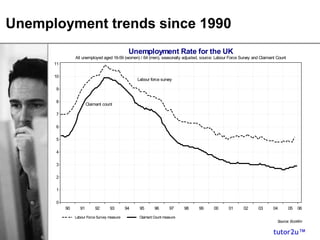
– Higher figure than the claimant count –
approximately half a million higher
– Higher because there are limits on who can
claim unemployment benefit – so the true
level of unemployment is higher than the
official figures suggest
tutor2u™
Hidden Unemployment
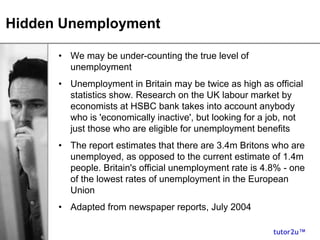
• We may be under-counting the true level of
unemployment
• Unemployment in Britain may be twice as high as official
statistics show. Research on the UK labour market by
economists at HSBC bank takes into account anybody
who is 'economically inactive', but looking for a job, not
just those who are eligible for unemployment benefits
• The report estimates that there are 3.4m Britons who are
unemployed, as opposed to the current estimate of 1.4m
people. Britain's official unemployment rate is 4.8% - one
of the lowest rates of unemployment in the European
Union
• Adapted from newspaper reports, July 2004
tutor2u™
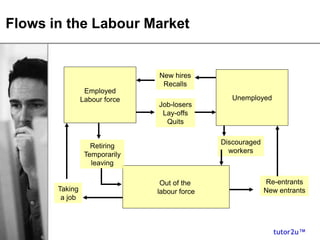
Flows in the Labour Market
Employed
Labour force Unemployed
Out of the
labour forceTaking
a job
Retiring
Temporarily
leaving
New hires
Recalls
Job-losers
Lay-offs
Quits
Re-entrants
New entrants
Discouraged
workers
tutor2u™
Unemployment trends since 1990
All unemployed aged 16-59 (women) / 64 (men), seasonally adjusted, source: Labour Force Survey and Claimant Count
Unemployment Rate for the UK
Labour Force Survey measure Claimant Count measure
Source: EcoWin
90 91 92 93 94 95 96 97 98 99 00 01 02 03 04 05 06
0
1
2
3
4
5
6
7
8
9
10
11
Labour force survey
Claimant count
tutor2u™
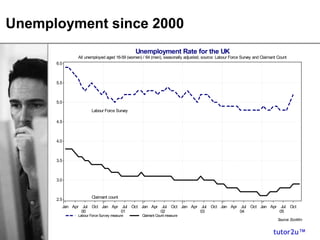
Unemployment since 2000
All unemployed aged 16-59 (women) / 64 (men), seasonally adjusted, source: Labour Force Survey and Claimant Count
Unemployment Rate for the UK
Labour Force Survey measure Claimant Count measure
Source: EcoWin
Jan Apr Jul Oct Jan Apr Jul Oct Jan Apr Jul Oct Jan Apr Jul Oct Jan Apr Jul Oct Jan Apr Jul Oct
00 01 02 03 04 05
2.5
3.0
3.5
4.0
4.5
5.0
5.5
6.0
Labour Force SurveyLabour force survey
Labour Force Survey
Claimant count
tutor2u™
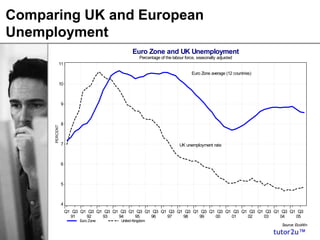
Comparing UK and European
Unemployment
Percentage of the labour force, seasonally adjusted
Euro Zone and UK Unemployment
Euro Zone United Kingdom
Source: EcoWin
Q1 Q3 Q1 Q3 Q1 Q3 Q1 Q3 Q1 Q3 Q1 Q3 Q1 Q3 Q1 Q3 Q1 Q3 Q1 Q3 Q1 Q3 Q1 Q3 Q1 Q3 Q1 Q3 Q1 Q3
91 92 93 94 95 96 97 98 99 00 01 02 03 04 05
PERCENT
4
5
6
7
8
9
10
11
Euro Zone average (12 countries)
UK unemployment rate
tutor2u™
Types of Unemployment
• Seasonal
– Regular seasonal changes in
employment / labour demand
– Affects certain industries more than
others
• Catering and leisure
• Construction
• Retailing
• Tourism
• Agriculture
tutor2u™
Types of Unemployment
• Frictional
– Transitional unemployment due to people
moving between jobs: Includes people
experiencing short spells of
unemployment
– Includes new and returning entrants into
the labour market
– Imperfect information about available job
opportunities can lengthen the period of
someone’s job search
tutor2u™
Structural Unemployment
• Structural
– Arises from the mismatch of skills and job
opportunities as the pattern of labour
demand in the economy changes
– Occupational immobility of labour
– Often involves long-term unemployment
– Prevalent in regions where industries go
into long-term decline
– Good examples include industries such
as mining, engineering and textiles
tutor2u™
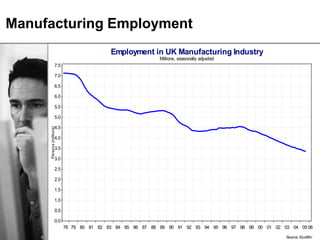
Manufacturing Employment
Millions, seasonally adjusted
Employment in UK Manufacturing Industry
Source: EcoWin
78 79 80 81 82 83 84 85 86 87 88 89 90 91 92 93 94 95 96 97 98 99 00 01 02 03 04 05 06
Persons(millions)
0.0
0.5
1.0
1.5
2.0
2.5
3.0
3.5
4.0
4.5
5.0
5.5
6.0
6.5
7.0
7.5
tutor2u™
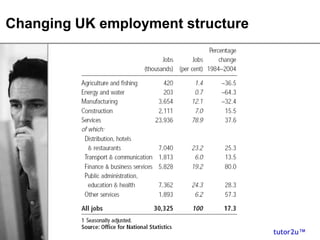
Changing UK employment structure
tutor2u™
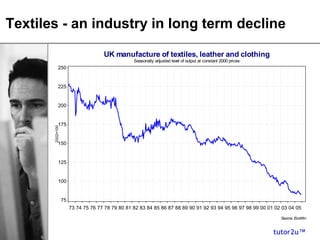
Textiles - an industry in long term decline
Seasonally adjusted level of output at constant 2000 prices
UK manufacture of textiles, leather and clothing
Source: EcoWin
73 74 75 76 77 78 79 80 81 82 83 84 85 86 87 88 89 90 91 92 93 94 95 96 97 98 99 00 01 02 03 04 05
2002=100
75
100
125
150
175
200
225
250
tutor2u™
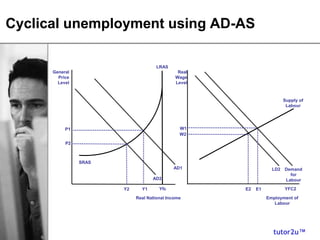
Cyclical unemployment
• Cyclical (Keynesian)
– There is a cyclical relationship between demand,
output, employment and unemployment
– Caused by a fall in aggregate demand leading to a
loss of real national output and employment
– A slowdown can lead to businesses laying off
workers because they lack confidence that demand
will recover
– Keynes argued that an economy can become stuck
with a low rate of AD and an economy operating
persistently below its potential
tutor2u™
Cyclical unemployment using AD-AS
General
Price
Level
Real National Income
AD1
SRAS
P1
Y1
LRAS
Yfc
AD2
Y2
P2
Real
Wage
Level
LD2
W1
E2 YFC2E1
Demand
for
Labour
W2
Employment of
Labour
Supply of
Labour
tutor2u™
Real Wage Unemployment
• Real Wage Unemployment
– Created when real wages are maintained
above their market clearing level leading to
an excess supply of labour at the prevailing
wage rate
– Some economists believe that
unemployment can be created if the
national minimum wage is set too high
tutor2u™
Unemployment and Growth in the UK
Real GDP and Claimant Count Unemployment
United Kingdom, Unemployment, Rate, Claimant count, SA Real GDPgrowth [ar 4 quarters]
Source: EcoWin
80 81 82 83 84 85 86 87 88 89 90 91 92 93 94 95 96 97 98 99 00 01 02 03 04 05 06
Percent
-5
-4
-3
-2
-1
0
1
2
3
4
5
6
Real GDP growth
Percent
0
2
4
6
8
10
12
Unemployment (%)
tutor2u™
Recent examples of cyclical unemployment
• Recession in the UK in the early 1990s
– Unemployment rose from 1.6 million in 1989
to 2.9 million in 1993
• The recent recession in UK manufacturing
industry
• Slow growth and rising unemployment in
Germany
• The end of full-employment for Japan during the
last ten years
tutor2u™
Economic and Social Costs of
Unemployment
• The private costs for the unemployed
– Loss of income
– Fall in real living standards
– Increased health risks
• Stress
• Reduction in quality of diet
• Social exclusion because of loss of work and income
– Loss of marketable skills (human capital) and
motivation
• The longer the duration of unemployment, the lower
the chances of finding fresh employment - the
unemployed become less attractive to potential
employers
tutor2u™
Consequences of Unemployment (2)
• Economic Consequences for Businesses
– Negative consequences
• Fall in demand for goods and services
• Fall in demand for businesses further down the supply
chain
• Consider the negative multiplier effects from the
closure of a major employer in a town or city
– Some positive consequences
• Bigger pool of surplus labour is available – but still a
problem if there is plenty of structural unemployment
• Less pressure to pay higher wages
• Less risk of industrial / strike action – fear of job
losses – leading to reduced trade union power
tutor2u™
Consequences of Unemployment (3)
• Consequences for the Government (Fiscal Policy)
– Increased spending on unemployment benefits
and other income –related state welfare
payments
– Fall in revenue from income tax and taxes on
consumer spending
– Fall in profits – reduction in revenue from
corporation tax
– May lead to rise in government borrowing (i.e. a
budget deficit)
tutor2u™
Consequences of Unemployment (3)
• Consequences for the economy as a whole
– Lost output (real GDP) from people being out of
work – the economy will be operating well within
its production frontier
– Unemployment seen as an inefficient way of
allocating resources – labour market failure?
– Some of the long-term unemployed may leave
the labour force permanently – fall in potential
GDP
– Increase in the inequality – rise in relative
poverty
AS Economics
PowerPoint Briefings 2006
tutor2u™
Policies to reduce unemployment
Demand and supply side approaches
tutor2u™
Demand side Policies to Reduce Unemployment
• These are mainly measures to boost total labour demand
(reduce cyclical unemployment)
– Lower interest rates (a monetary policy stimulus)
– A lower exchange rate (helps exporters)
– Lower direct taxes (fiscal stimulus to spending power)
– Government spending on major capital projects (e.g.
improving the transport infrastructure)
– Employment subsidies (including the New Deal
programme) – designed to reduce the cost to a
business of employing additional workers
– Incentives to encourage flows of foreign investment in
the UK – particularly in areas of above average
unemployment
tutor2u™
Supply-side policies to reduce Unemployment
• Supply-side policies
• These are measures to improve labour supply (reduce
frictional and structural unemployment)
– Increased spending on education & training
including an emphasis on “lifetime-learning”)
– Improved flows of information on job vacancies
– Changes to tax and benefits to improve incentives
– Measures designed to make the labour market
more flexible so that workers have the skills and
education that gives them improved employment
options
tutor2u™
Consequences of falling unemployment
• The circular flow and the multiplier:
– Incomes flowing into households will grow
– Falling unemployment adds to demand and
creates a positive multiplier effect on incomes,
demand and output.
• The balance of payments:
– When incomes and spending are growing, there
is an increase in the demand for imports. Unless
this is matched by a rise in export sales, the trade
balance in goods and services will worsen
tutor2u™
Consequences of falling unemployment
• Government finances:
– With more people in work paying income tax,
national insurance and value added tax, the
government can expect a large rise in tax
revenues and a reduction in social security
benefits
• Inflationary effects
– Falling unemployment can also create a rise in
inflationary pressure – particularly when the
economy moves close to operating at full capacity
– However this is not really a risk when the
economy is coming out of recession, since
aggregate supply is likely to be highly elastic
because of a high level of spare capacity
tutor2u™
Falling unemployment in the UK
• Demand factors
– Sustained economic growth since 1992
– Growth creates jobs to replace jobs lost in industries
suffering from long term decline
– High levels of inward investment from overseas
– Strong consumer demand and housing boom
• Supply factors
– Extra investment in education and training
– Britain now has a more flexible labour market than
in the past – workers have more adaptable skills
– Employment laws have changed – easier for firms
to take on extra workers
• E.g. growth of temporary and part time employment
tutor2u™
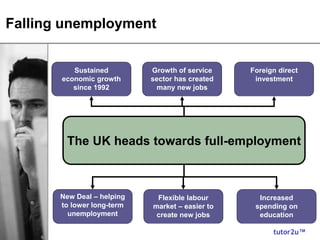
Falling unemployment
Growth of service
sector has created
many new jobs
Foreign direct
investment
New Deal – helping
to lower long-term
unemployment
Flexible labour
market – easier to
create new jobs
Increased
spending on
education
Sustained
economic growth
since 1992
The UK heads towards full-employment

Unemployment ppt (tutor2u)

  • 1.
    AS Economics PowerPoint Briefings2006 tutor2u™ Unemployment
  • 2.
    tutor2u™ Key Issues • Themeaning of unemployment • Different types of unemployment • Consequences of unemployment • Unemployment and economic growth • Recent trends in UK unemployment • Full employment
  • 3.
    tutor2u™ Measuring Unemployment • AWorking Definition of Unemployment – People able, available and willing to find work and actively seeking work – but not employed – The unemployed are included in the labour force
  • 4.
    tutor2u™ Measuring Unemployment • TheClaimant Count Measure – The number of people claiming the Jobseekers’ Allowance – Monthly count of unemployed – Currently under 950,000 – about 3.0% of the labour force
  • 5.
    tutor2u™ Measuring Unemployment • TheLabour Force Survey (ILO measure) – An internationally agreed standard measure of unemployment – Must have actively sought work in the previous four weeks and be available to start work immediately – Higher figure than the claimant count – approximately half a million higher – Higher because there are limits on who can claim unemployment benefit – so the true level of unemployment is higher than the official figures suggest
  • 6.
    tutor2u™ Hidden Unemployment • Wemay be under-counting the true level of unemployment • Unemployment in Britain may be twice as high as official statistics show. Research on the UK labour market by economists at HSBC bank takes into account anybody who is 'economically inactive', but looking for a job, not just those who are eligible for unemployment benefits • The report estimates that there are 3.4m Britons who are unemployed, as opposed to the current estimate of 1.4m people. Britain's official unemployment rate is 4.8% - one of the lowest rates of unemployment in the European Union • Adapted from newspaper reports, July 2004
  • 7.
    tutor2u™ Flows in theLabour Market Employed Labour force Unemployed Out of the labour forceTaking a job Retiring Temporarily leaving New hires Recalls Job-losers Lay-offs Quits Re-entrants New entrants Discouraged workers
  • 8.
    tutor2u™ Unemployment trends since1990 All unemployed aged 16-59 (women) / 64 (men), seasonally adjusted, source: Labour Force Survey and Claimant Count Unemployment Rate for the UK Labour Force Survey measure Claimant Count measure Source: EcoWin 90 91 92 93 94 95 96 97 98 99 00 01 02 03 04 05 06 0 1 2 3 4 5 6 7 8 9 10 11 Labour force survey Claimant count
  • 9.
    tutor2u™ Unemployment since 2000 Allunemployed aged 16-59 (women) / 64 (men), seasonally adjusted, source: Labour Force Survey and Claimant Count Unemployment Rate for the UK Labour Force Survey measure Claimant Count measure Source: EcoWin Jan Apr Jul Oct Jan Apr Jul Oct Jan Apr Jul Oct Jan Apr Jul Oct Jan Apr Jul Oct Jan Apr Jul Oct 00 01 02 03 04 05 2.5 3.0 3.5 4.0 4.5 5.0 5.5 6.0 Labour Force SurveyLabour force survey Labour Force Survey Claimant count
  • 10.
    tutor2u™ Comparing UK andEuropean Unemployment Percentage of the labour force, seasonally adjusted Euro Zone and UK Unemployment Euro Zone United Kingdom Source: EcoWin Q1 Q3 Q1 Q3 Q1 Q3 Q1 Q3 Q1 Q3 Q1 Q3 Q1 Q3 Q1 Q3 Q1 Q3 Q1 Q3 Q1 Q3 Q1 Q3 Q1 Q3 Q1 Q3 Q1 Q3 91 92 93 94 95 96 97 98 99 00 01 02 03 04 05 PERCENT 4 5 6 7 8 9 10 11 Euro Zone average (12 countries) UK unemployment rate
  • 11.
    tutor2u™ Types of Unemployment •Seasonal – Regular seasonal changes in employment / labour demand – Affects certain industries more than others • Catering and leisure • Construction • Retailing • Tourism • Agriculture
  • 12.
    tutor2u™ Types of Unemployment •Frictional – Transitional unemployment due to people moving between jobs: Includes people experiencing short spells of unemployment – Includes new and returning entrants into the labour market – Imperfect information about available job opportunities can lengthen the period of someone’s job search
  • 13.
    tutor2u™ Structural Unemployment • Structural –Arises from the mismatch of skills and job opportunities as the pattern of labour demand in the economy changes – Occupational immobility of labour – Often involves long-term unemployment – Prevalent in regions where industries go into long-term decline – Good examples include industries such as mining, engineering and textiles
  • 14.
    tutor2u™ Manufacturing Employment Millions, seasonallyadjusted Employment in UK Manufacturing Industry Source: EcoWin 78 79 80 81 82 83 84 85 86 87 88 89 90 91 92 93 94 95 96 97 98 99 00 01 02 03 04 05 06 Persons(millions) 0.0 0.5 1.0 1.5 2.0 2.5 3.0 3.5 4.0 4.5 5.0 5.5 6.0 6.5 7.0 7.5
  • 15.
  • 16.
    tutor2u™ Textiles - anindustry in long term decline Seasonally adjusted level of output at constant 2000 prices UK manufacture of textiles, leather and clothing Source: EcoWin 73 74 75 76 77 78 79 80 81 82 83 84 85 86 87 88 89 90 91 92 93 94 95 96 97 98 99 00 01 02 03 04 05 2002=100 75 100 125 150 175 200 225 250
  • 17.
    tutor2u™ Cyclical unemployment • Cyclical(Keynesian) – There is a cyclical relationship between demand, output, employment and unemployment – Caused by a fall in aggregate demand leading to a loss of real national output and employment – A slowdown can lead to businesses laying off workers because they lack confidence that demand will recover – Keynes argued that an economy can become stuck with a low rate of AD and an economy operating persistently below its potential
  • 18.
    tutor2u™ Cyclical unemployment usingAD-AS General Price Level Real National Income AD1 SRAS P1 Y1 LRAS Yfc AD2 Y2 P2 Real Wage Level LD2 W1 E2 YFC2E1 Demand for Labour W2 Employment of Labour Supply of Labour
  • 19.
    tutor2u™ Real Wage Unemployment •Real Wage Unemployment – Created when real wages are maintained above their market clearing level leading to an excess supply of labour at the prevailing wage rate – Some economists believe that unemployment can be created if the national minimum wage is set too high
  • 20.
    tutor2u™ Unemployment and Growthin the UK Real GDP and Claimant Count Unemployment United Kingdom, Unemployment, Rate, Claimant count, SA Real GDPgrowth [ar 4 quarters] Source: EcoWin 80 81 82 83 84 85 86 87 88 89 90 91 92 93 94 95 96 97 98 99 00 01 02 03 04 05 06 Percent -5 -4 -3 -2 -1 0 1 2 3 4 5 6 Real GDP growth Percent 0 2 4 6 8 10 12 Unemployment (%)
  • 21.
    tutor2u™ Recent examples ofcyclical unemployment • Recession in the UK in the early 1990s – Unemployment rose from 1.6 million in 1989 to 2.9 million in 1993 • The recent recession in UK manufacturing industry • Slow growth and rising unemployment in Germany • The end of full-employment for Japan during the last ten years
  • 22.
    tutor2u™ Economic and SocialCosts of Unemployment • The private costs for the unemployed – Loss of income – Fall in real living standards – Increased health risks • Stress • Reduction in quality of diet • Social exclusion because of loss of work and income – Loss of marketable skills (human capital) and motivation • The longer the duration of unemployment, the lower the chances of finding fresh employment - the unemployed become less attractive to potential employers
  • 23.
    tutor2u™ Consequences of Unemployment(2) • Economic Consequences for Businesses – Negative consequences • Fall in demand for goods and services • Fall in demand for businesses further down the supply chain • Consider the negative multiplier effects from the closure of a major employer in a town or city – Some positive consequences • Bigger pool of surplus labour is available – but still a problem if there is plenty of structural unemployment • Less pressure to pay higher wages • Less risk of industrial / strike action – fear of job losses – leading to reduced trade union power
  • 24.
    tutor2u™ Consequences of Unemployment(3) • Consequences for the Government (Fiscal Policy) – Increased spending on unemployment benefits and other income –related state welfare payments – Fall in revenue from income tax and taxes on consumer spending – Fall in profits – reduction in revenue from corporation tax – May lead to rise in government borrowing (i.e. a budget deficit)
  • 25.
    tutor2u™ Consequences of Unemployment(3) • Consequences for the economy as a whole – Lost output (real GDP) from people being out of work – the economy will be operating well within its production frontier – Unemployment seen as an inefficient way of allocating resources – labour market failure? – Some of the long-term unemployed may leave the labour force permanently – fall in potential GDP – Increase in the inequality – rise in relative poverty
  • 26.
    AS Economics PowerPoint Briefings2006 tutor2u™ Policies to reduce unemployment Demand and supply side approaches
  • 27.
    tutor2u™ Demand side Policiesto Reduce Unemployment • These are mainly measures to boost total labour demand (reduce cyclical unemployment) – Lower interest rates (a monetary policy stimulus) – A lower exchange rate (helps exporters) – Lower direct taxes (fiscal stimulus to spending power) – Government spending on major capital projects (e.g. improving the transport infrastructure) – Employment subsidies (including the New Deal programme) – designed to reduce the cost to a business of employing additional workers – Incentives to encourage flows of foreign investment in the UK – particularly in areas of above average unemployment
  • 28.
    tutor2u™ Supply-side policies toreduce Unemployment • Supply-side policies • These are measures to improve labour supply (reduce frictional and structural unemployment) – Increased spending on education & training including an emphasis on “lifetime-learning”) – Improved flows of information on job vacancies – Changes to tax and benefits to improve incentives – Measures designed to make the labour market more flexible so that workers have the skills and education that gives them improved employment options
  • 29.
    tutor2u™ Consequences of fallingunemployment • The circular flow and the multiplier: – Incomes flowing into households will grow – Falling unemployment adds to demand and creates a positive multiplier effect on incomes, demand and output. • The balance of payments: – When incomes and spending are growing, there is an increase in the demand for imports. Unless this is matched by a rise in export sales, the trade balance in goods and services will worsen
  • 30.
    tutor2u™ Consequences of fallingunemployment • Government finances: – With more people in work paying income tax, national insurance and value added tax, the government can expect a large rise in tax revenues and a reduction in social security benefits • Inflationary effects – Falling unemployment can also create a rise in inflationary pressure – particularly when the economy moves close to operating at full capacity – However this is not really a risk when the economy is coming out of recession, since aggregate supply is likely to be highly elastic because of a high level of spare capacity
  • 31.
    tutor2u™ Falling unemployment inthe UK • Demand factors – Sustained economic growth since 1992 – Growth creates jobs to replace jobs lost in industries suffering from long term decline – High levels of inward investment from overseas – Strong consumer demand and housing boom • Supply factors – Extra investment in education and training – Britain now has a more flexible labour market than in the past – workers have more adaptable skills – Employment laws have changed – easier for firms to take on extra workers • E.g. growth of temporary and part time employment
  • 32.
    tutor2u™ Falling unemployment Growth ofservice sector has created many new jobs Foreign direct investment New Deal – helping to lower long-term unemployment Flexible labour market – easier to create new jobs Increased spending on education Sustained economic growth since 1992 The UK heads towards full-employment