1
Consumption, Saving and
Investment Functions
MOOCS
by
Dr. Subir Maitra
Associate Professor of Economics
For B.Com (Honours) Third YearFor B.Com (Honours) Third Year
University of CalcuttaUniversity of Calcutta
2
Consumption Function
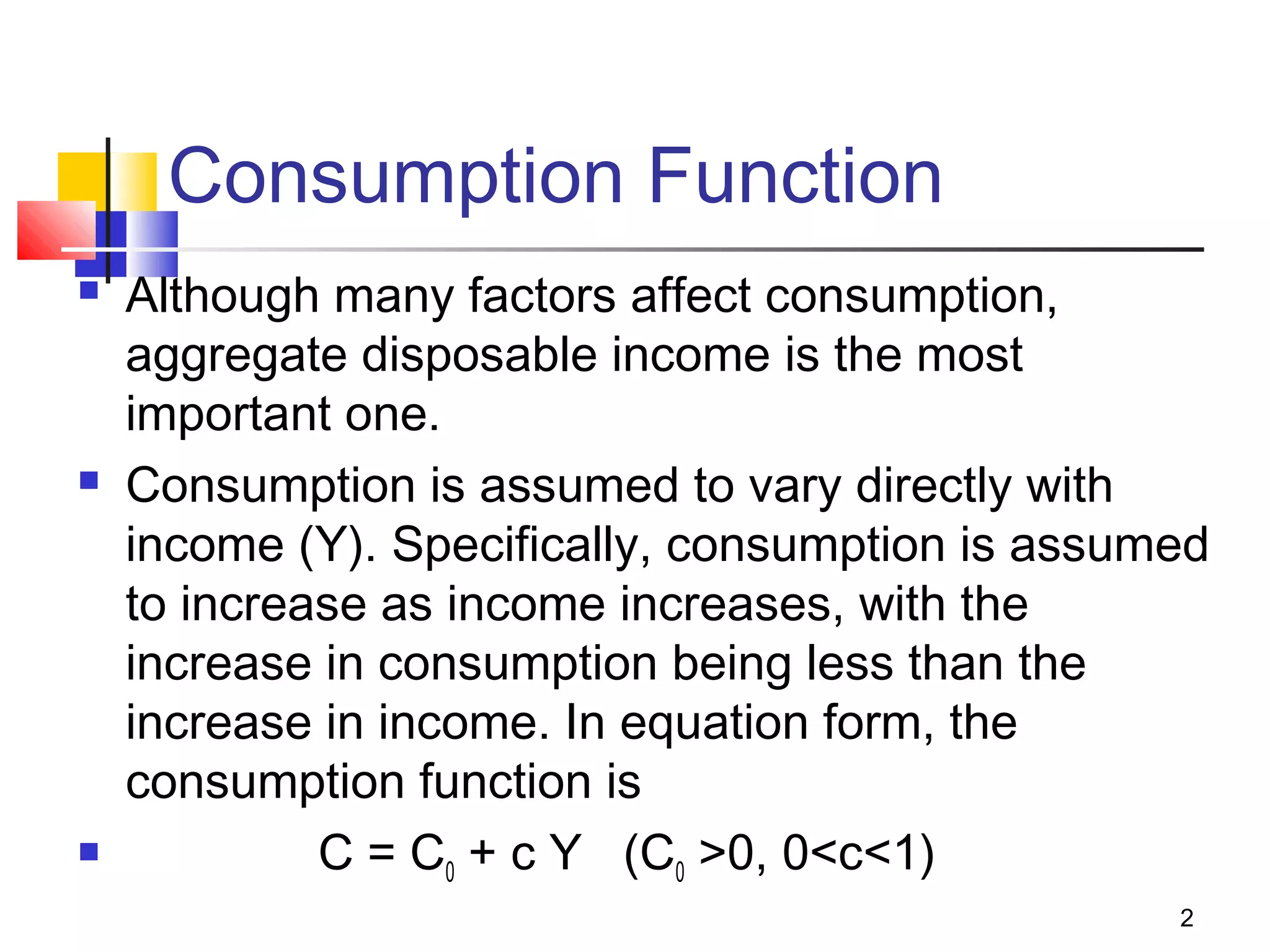
 Although many factors affect consumption,
aggregate disposable income is the most
important one.
 Consumption is assumed to vary directly with
income (Y). Specifically, consumption is assumed
to increase as income increases, with the
increase in consumption being less than the
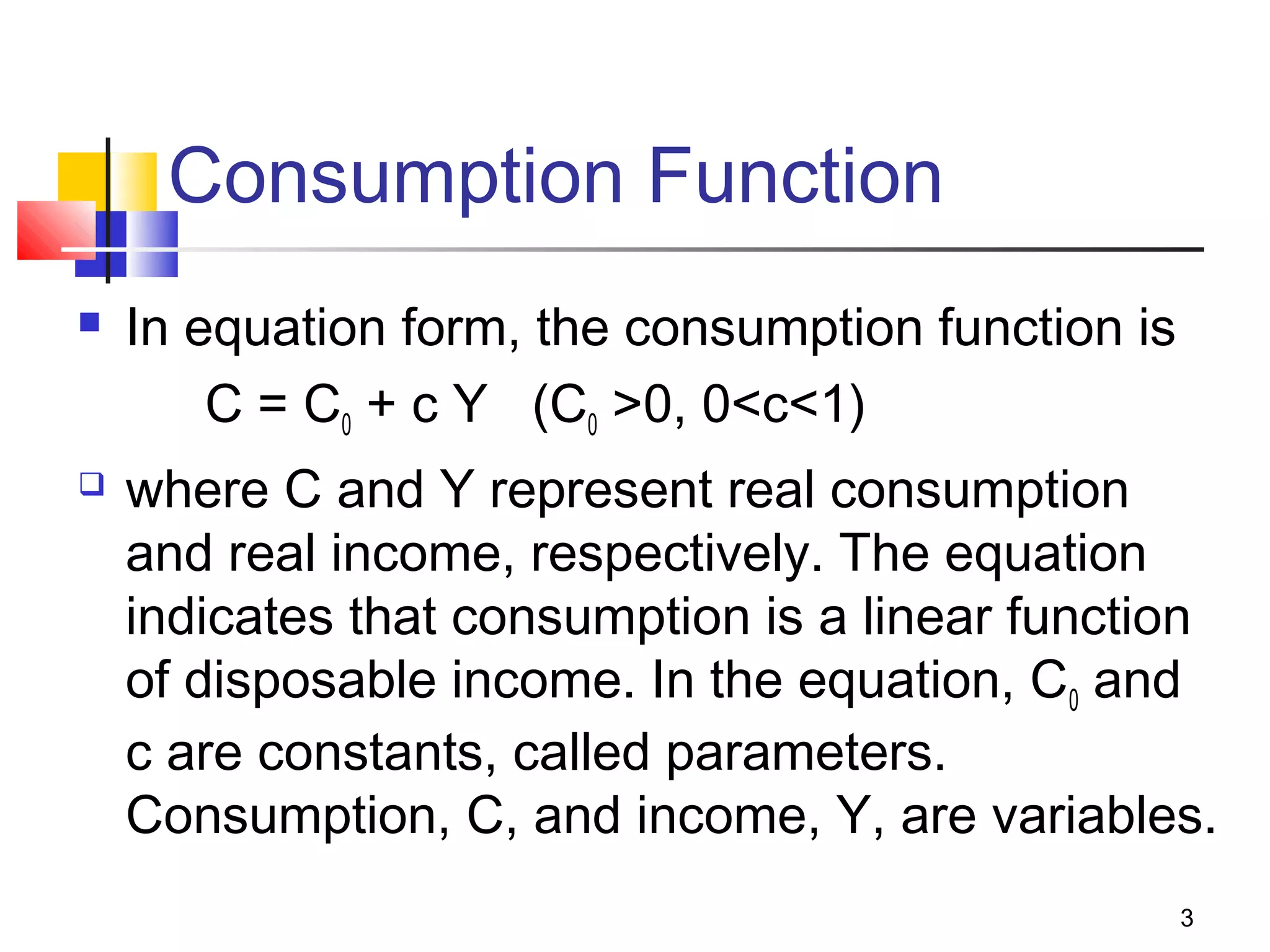
increase in income. In equation form, the
consumption function is
 C = C0 + c Y (C0 >0, 0<c<1)
3
Consumption Function
 In equation form, the consumption function is
C = C0 + c Y (C0 >0, 0<c<1)
 where C and Y represent real consumption
and real income, respectively. The equation
indicates that consumption is a linear function
of disposable income. In the equation, C0 and
c are constants, called parameters.
Consumption, C, and income, Y, are variables.
4
Consumption Function
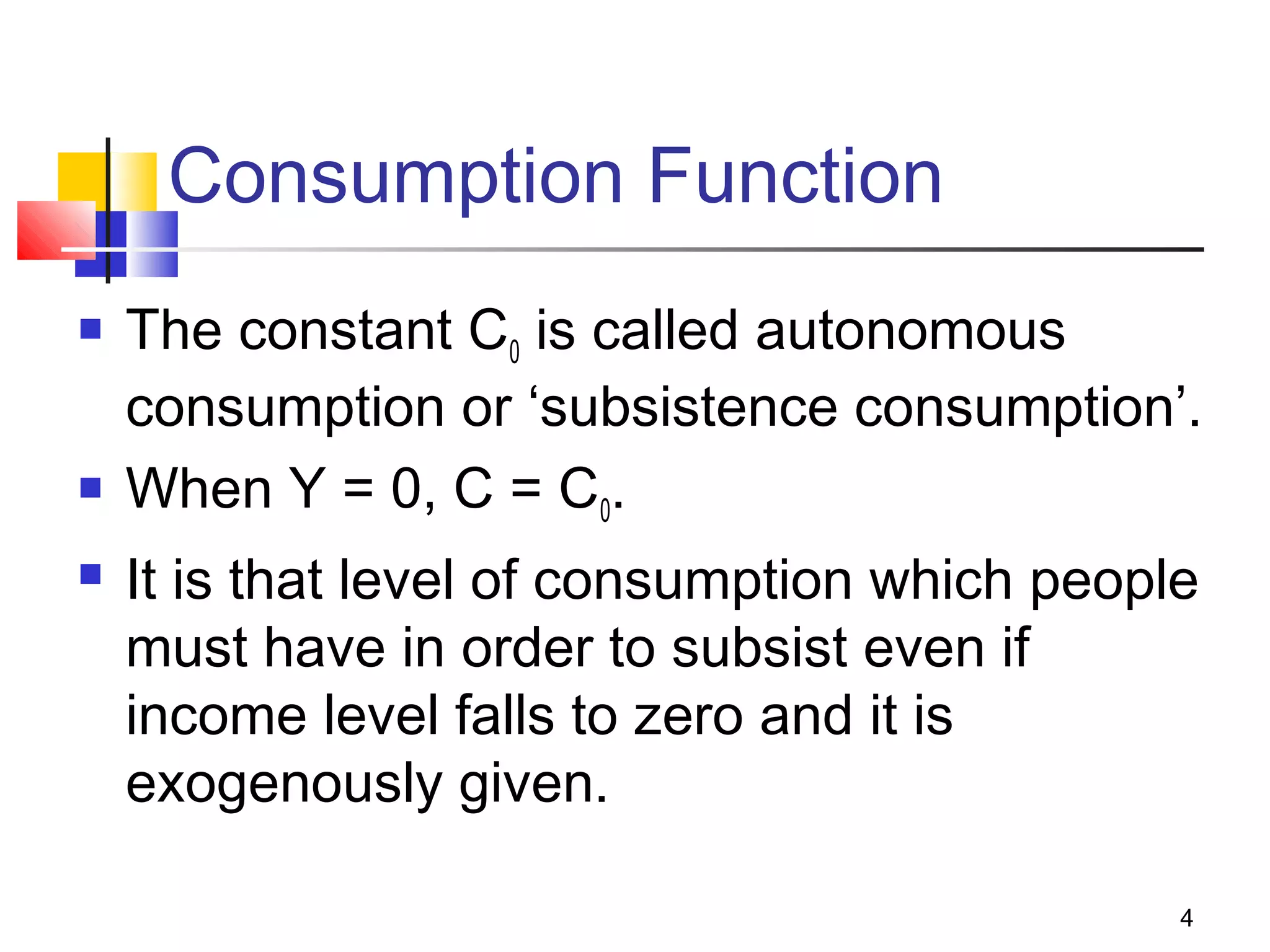
 The constant C0 is called autonomous
consumption or ‘subsistence consumption’.
 When Y = 0, C = C0.
 It is that level of consumption which people
must have in order to subsist even if
income level falls to zero and it is
exogenously given.
5
Consumption Function
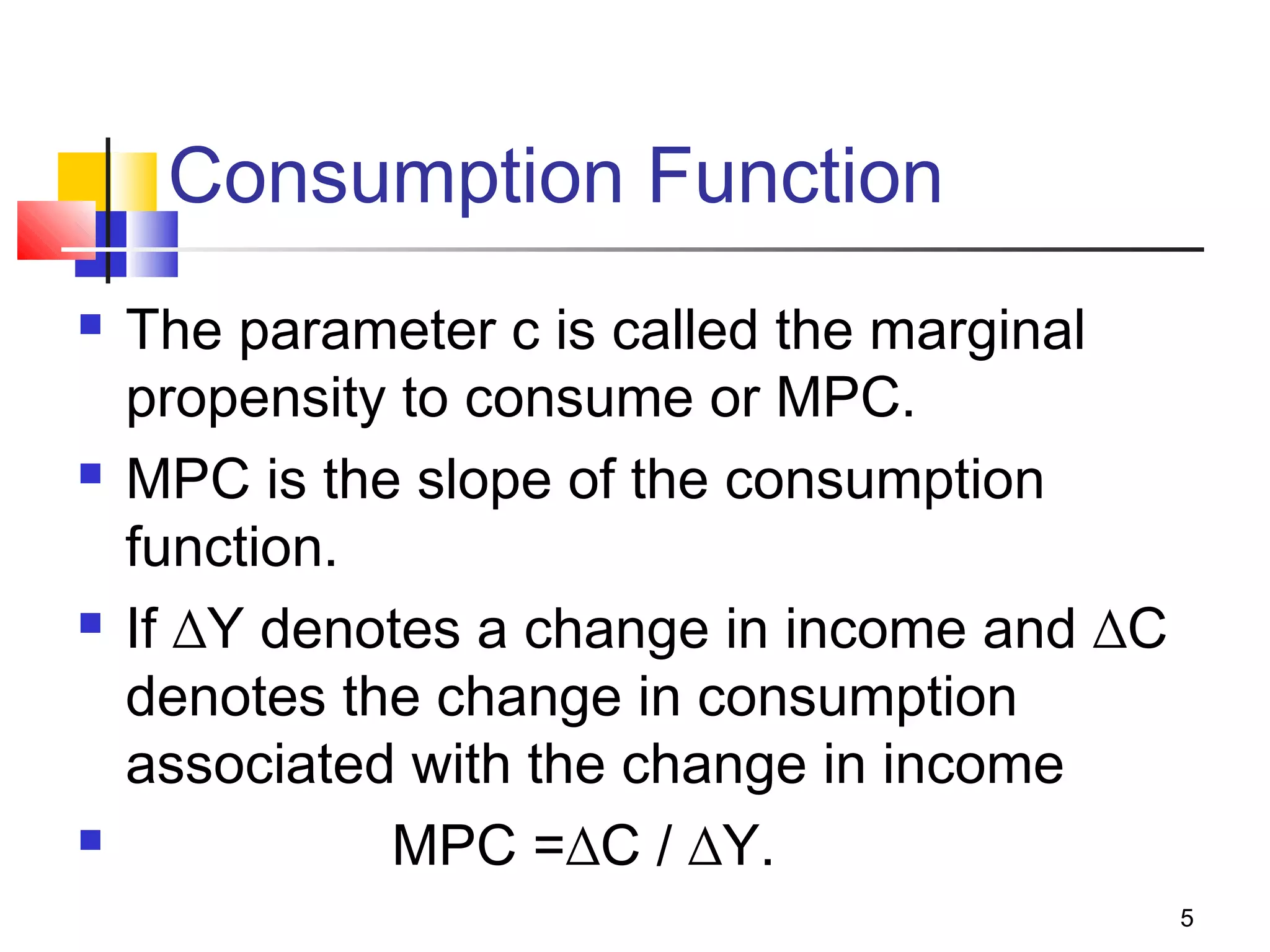
 The parameter c is called the marginal
propensity to consume or MPC.
 MPC is the slope of the consumption
function.
 If ∆Y denotes a change in income and ∆C
denotes the change in consumption
associated with the change in income
 MPC =∆C / ∆Y.
6
Consumption Function
 For example, if Y increases by Rs.200 and,
as a result, consumption increases by
Rs.150, the MPC is 150/200 = 0.75.
 Thus consumption increases as Y
increases, but by a smaller amount. This
implies that, the MPC, must be between 0
and 1.
7
Consumption Function
8
Consumption Function
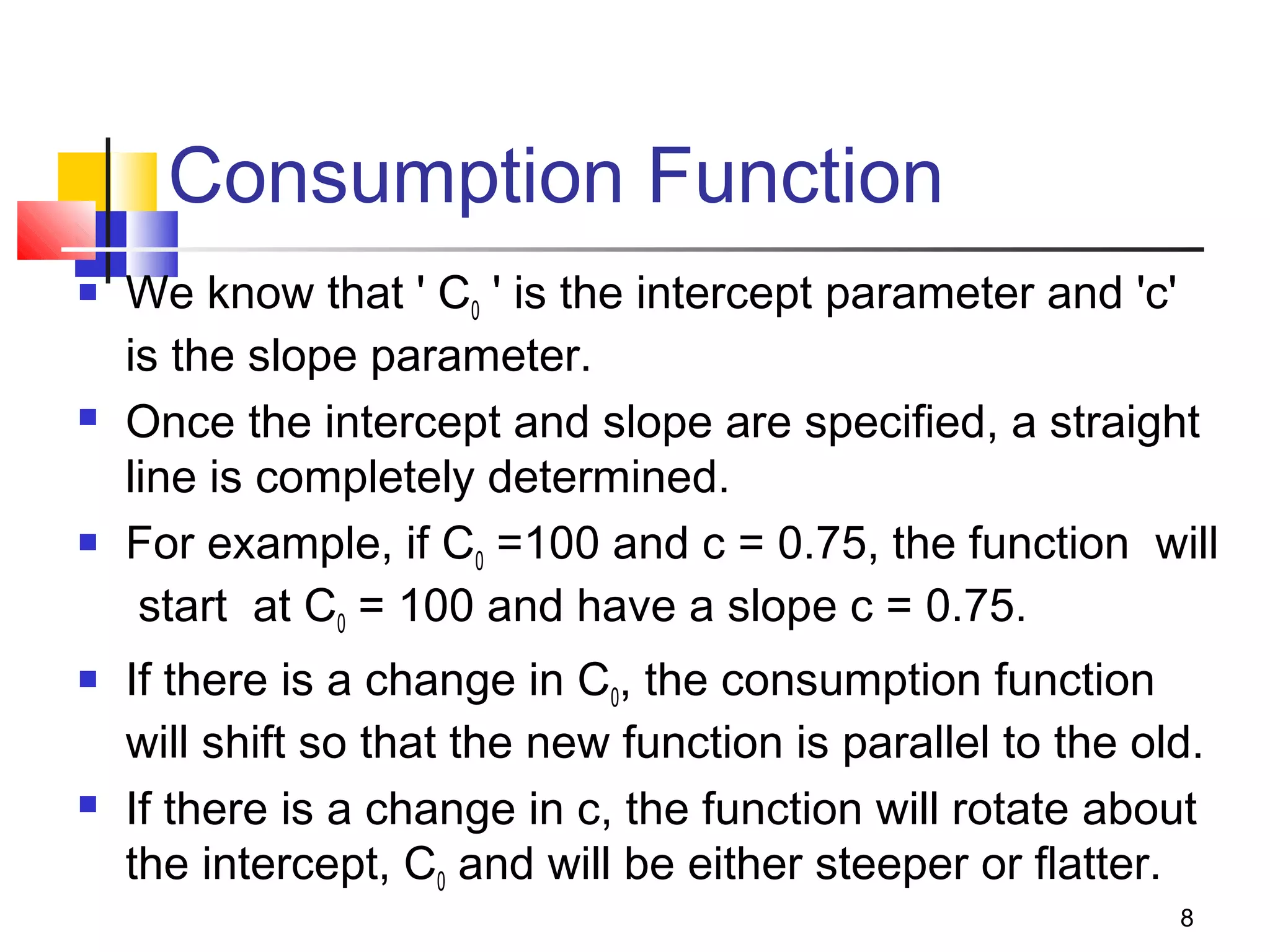
 We know that ' C0 ' is the intercept parameter and 'c'
is the slope parameter.
 Once the intercept and slope are specified, a straight
line is completely determined.
 For example, if C0 =100 and c = 0.75, the function will
start at C0 = 100 and have a slope c = 0.75.
 If there is a change in C0, the consumption function
will shift so that the new function is parallel to the old.
 If there is a change in c, the function will rotate about
the intercept, C0 and will be either steeper or flatter.
Saving Function
 Since the decision on how much income to
consume implies a decision on how much
to save, a saving function may be derived
with the aid of the consumption function.
With no government and foreign trade
sectors, income equals, by definition,
consumption C plus saving, S:
Y = C + S
9
Saving Function
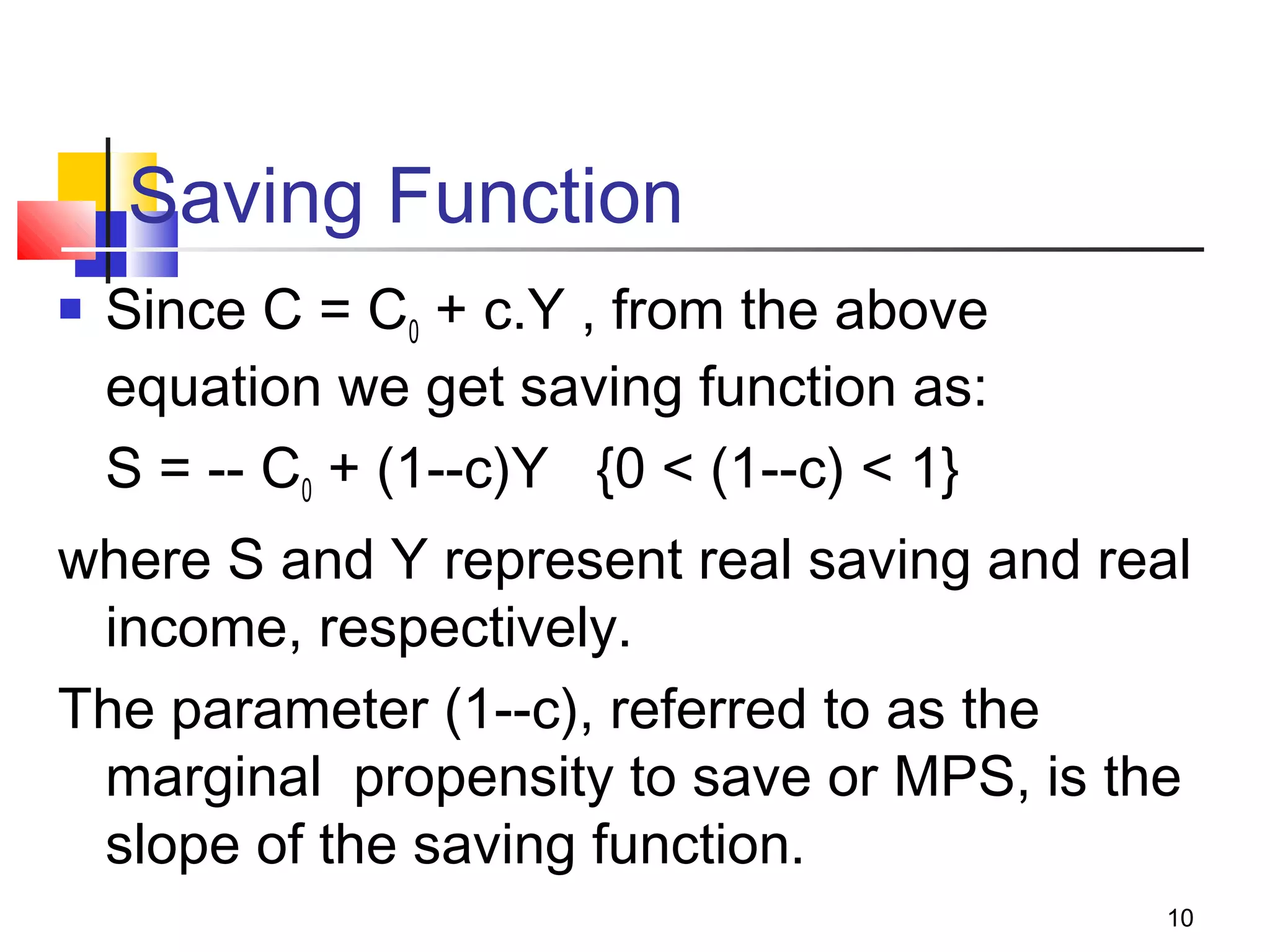
 Since C = C0 + c.Y , from the above
equation we get saving function as:
S = -- C0 + (1--c)Y {0 < (1--c) < 1}
where S and Y represent real saving and real
income, respectively.
The parameter (1--c), referred to as the
marginal propensity to save or MPS, is the
slope of the saving function.
10
Saving Function
 If ∆Y = a change in income and ∆S = the change
in saving associated with the change in income,
MPS=(1--c)=∆S/∆Y.
 For example, if income increases by Rs.200 Crore
and, as a consequence, saving increases by
Rs.50 Crore, the MPS is 50/200= 0.25.
 Since 0 < c < 1, 0<(1—c)<1, which implies that
saving increases as income increases, but by a
smaller amount.
11
Saving Function
 The saving function may be plotted in the
same manner as the consumption function.
 When Y= 0, S = -- C0, which is represented
by the negative intercept. Saving is
negative at income levels less than Y1 since
consumption exceeds income.
12
Saving Function
 The constant C0 is called autonomous
consumption or ‘subsistence consumption’.
 It is that level of consumption which people
must have in order to subsist even if income
level falls to zero and it is exogenously given.
 Thus, when Y = 0, people dissave by an
amount equal to C0 (or, save by an amount
equal to – C0).
13
Saving Function
 If there is a change in C0, the saving
function will shift so that the new function is
parallel to the old.
 If there is a change in c => a change in (1—
c) => a change in MPS, the function will
rotate about the intercept, -- C0 and will be
either steeper or flatter.
14
Saving Function
 The saving function would shift up parallely
upward if C0 decreases.
 C0 may decrease because of (i) forced saving
such as to gain tax benefits and/or (ii) people
becoming more thrifty i.e. careful about
spending money.
 In such situation, we will have a new saving
function above and parallel to the earlier one.
15
Saving Function
16
Investment Function
 Like consumption, investment depends on
many factors, including interest rates.
 In the SKM, however, investment is
assumed to be an autonomous or
exogenous variable -- a variable whose
value is determined outside the model.
 Thus, investment is a constant, I0 (I0 >0).
17
Investment Function
 Since investment is assumed to be constant at the Ī
level, the investment function is
I = I0 (I0 >0)
where I represents real investment and I0
represents a given, positive level of investment.
 Suppose I0 = Rs. 50. With investment on the vertical
axis and income on the horizontal, the investment
function is plotted as the horizontal line indicating that
investment does not vary with the level of income.
18
Investment Function
19

Consumption Saving and Investment function

  • 1.
    1 Consumption, Saving and InvestmentFunctions MOOCS by Dr. Subir Maitra Associate Professor of Economics For B.Com (Honours) Third YearFor B.Com (Honours) Third Year University of CalcuttaUniversity of Calcutta
  • 2.
    2 Consumption Function  Althoughmany factors affect consumption, aggregate disposable income is the most important one.  Consumption is assumed to vary directly with income (Y). Specifically, consumption is assumed to increase as income increases, with the increase in consumption being less than the increase in income. In equation form, the consumption function is  C = C0 + c Y (C0 >0, 0<c<1)
  • 3.
    3 Consumption Function  Inequation form, the consumption function is C = C0 + c Y (C0 >0, 0<c<1)  where C and Y represent real consumption and real income, respectively. The equation indicates that consumption is a linear function of disposable income. In the equation, C0 and c are constants, called parameters. Consumption, C, and income, Y, are variables.
  • 4.
    4 Consumption Function  Theconstant C0 is called autonomous consumption or ‘subsistence consumption’.  When Y = 0, C = C0.  It is that level of consumption which people must have in order to subsist even if income level falls to zero and it is exogenously given.
  • 5.
    5 Consumption Function  Theparameter c is called the marginal propensity to consume or MPC.  MPC is the slope of the consumption function.  If ∆Y denotes a change in income and ∆C denotes the change in consumption associated with the change in income  MPC =∆C / ∆Y.
  • 6.
    6 Consumption Function  Forexample, if Y increases by Rs.200 and, as a result, consumption increases by Rs.150, the MPC is 150/200 = 0.75.  Thus consumption increases as Y increases, but by a smaller amount. This implies that, the MPC, must be between 0 and 1.
  • 7.
  • 8.
    8 Consumption Function  Weknow that ' C0 ' is the intercept parameter and 'c' is the slope parameter.  Once the intercept and slope are specified, a straight line is completely determined.  For example, if C0 =100 and c = 0.75, the function will start at C0 = 100 and have a slope c = 0.75.  If there is a change in C0, the consumption function will shift so that the new function is parallel to the old.  If there is a change in c, the function will rotate about the intercept, C0 and will be either steeper or flatter.
  • 9.
    Saving Function  Sincethe decision on how much income to consume implies a decision on how much to save, a saving function may be derived with the aid of the consumption function. With no government and foreign trade sectors, income equals, by definition, consumption C plus saving, S: Y = C + S 9
  • 10.
    Saving Function  SinceC = C0 + c.Y , from the above equation we get saving function as: S = -- C0 + (1--c)Y {0 < (1--c) < 1} where S and Y represent real saving and real income, respectively. The parameter (1--c), referred to as the marginal propensity to save or MPS, is the slope of the saving function. 10
  • 11.
    Saving Function  If∆Y = a change in income and ∆S = the change in saving associated with the change in income, MPS=(1--c)=∆S/∆Y.  For example, if income increases by Rs.200 Crore and, as a consequence, saving increases by Rs.50 Crore, the MPS is 50/200= 0.25.  Since 0 < c < 1, 0<(1—c)<1, which implies that saving increases as income increases, but by a smaller amount. 11
  • 12.
    Saving Function  Thesaving function may be plotted in the same manner as the consumption function.  When Y= 0, S = -- C0, which is represented by the negative intercept. Saving is negative at income levels less than Y1 since consumption exceeds income. 12
  • 13.
    Saving Function  Theconstant C0 is called autonomous consumption or ‘subsistence consumption’.  It is that level of consumption which people must have in order to subsist even if income level falls to zero and it is exogenously given.  Thus, when Y = 0, people dissave by an amount equal to C0 (or, save by an amount equal to – C0). 13
  • 14.
    Saving Function  Ifthere is a change in C0, the saving function will shift so that the new function is parallel to the old.  If there is a change in c => a change in (1— c) => a change in MPS, the function will rotate about the intercept, -- C0 and will be either steeper or flatter. 14
  • 15.
    Saving Function  Thesaving function would shift up parallely upward if C0 decreases.  C0 may decrease because of (i) forced saving such as to gain tax benefits and/or (ii) people becoming more thrifty i.e. careful about spending money.  In such situation, we will have a new saving function above and parallel to the earlier one. 15
  • 16.
  • 17.
    Investment Function  Likeconsumption, investment depends on many factors, including interest rates.  In the SKM, however, investment is assumed to be an autonomous or exogenous variable -- a variable whose value is determined outside the model.  Thus, investment is a constant, I0 (I0 >0). 17
  • 18.
    Investment Function  Sinceinvestment is assumed to be constant at the Ī level, the investment function is I = I0 (I0 >0) where I represents real investment and I0 represents a given, positive level of investment.  Suppose I0 = Rs. 50. With investment on the vertical axis and income on the horizontal, the investment function is plotted as the horizontal line indicating that investment does not vary with the level of income. 18
  • 19.