COCOMO Model
Basic
Introduction
COCOMO is one of the most widely used software
estimation models in the world
It was developed by Barry Boehm in 1981
COCOMO predicts the effort and schedule for a software
product development based on inputs relating to the size of
the software and a number of cost drivers that affect
productivity
COCOMO Models
COCOMO has three different models that reflect the
complexity:
the Basic Model
the Intermediate Model
and the Detailed Model
The Development Modes: Project
Characteristics
Organic Mode
• Relatively small, simple software projects
• Small teams with good application experience work to a
set of less than rigid requirements
• Similar to the previously developed projects
• relatively small and requires little innovation
Semidetached Mode
• Intermediate (in size and complexity) software projects in
which teams with mixed experience levels must meet a mix
of rigid and less than rigid requirements.
Contd…
Embedded Mode
• Software projects that must be developed within a set of tight
hardware, software, and operational constraints.
COCOMO:
Some Assumptions
Primary cost driver is the number of Delivered Source
Instructions (DSI) / Delivered Line Of Code
developed by the project
COCOMO estimates assume that the project will enjoy
good management by both the developer and the
customer
Assumes the requirements specification is not
substantially changed after the plans and requirements
phase
Basic COCOMO
Basic COCOMO is good for quick, early, rough order of
magnitude estimates of software costs
It does not account for differences in hardware
constraints, personnel quality and experience, use of
modern tools and techniques, and other project attributes
known to have a significant influence on software costs,
which limits its accuracy
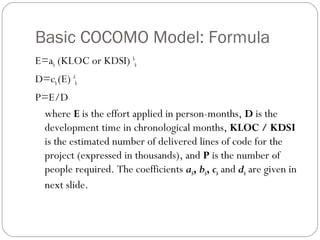
Basic COCOMO Model: Formula
E=ab (KLOC or KDSI) b
b
D=cb(E) d
b
P=E/D
where E is the effort applied in person-months, D is the
development time in chronological months, KLOC / KDSI
is the estimated number of delivered lines of code for the
project (expressed in thousands), and P is the number of
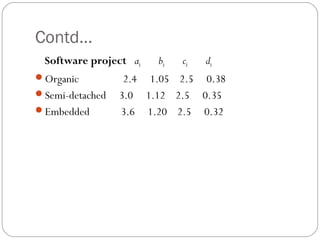
people required. The coefficients ab, bb, cb and db are given in
next slide.
Contd…
Software project ab bb cb db
Organic 2.4 1.05 2.5 0.38
Semi-detached 3.0 1.12 2.5 0.35
Embedded 3.6 1.20 2.5 0.32
Basic COCOMO Model: Equation
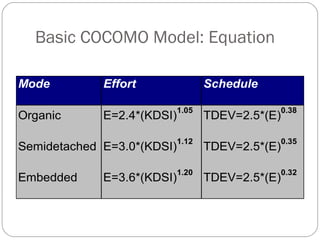
Mode Effort Schedule
Organic E=2.4*(KDSI)
1.05
TDEV=2.5*(E)
0.38
Semidetached E=3.0*(KDSI)
1.12
TDEV=2.5*(E)
0.35
Embedded E=3.6*(KDSI)
1.20
TDEV=2.5*(E)
0.32
Basic COCOMO Model: Limitation
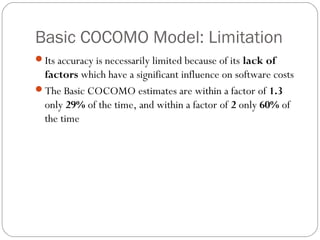
Its accuracy is necessarily limited because of its lack of
factors which have a significant influence on software costs
The Basic COCOMO estimates are within a factor of 1.3
only 29% of the time, and within a factor of 2 only 60% of
the time
Basic COCOMO Model: Example
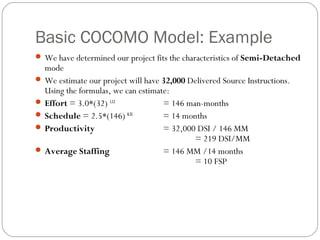
 We have determined our project fits the characteristics of Semi-Detached
mode
 We estimate our project will have 32,000 Delivered Source Instructions.
Using the formulas, we can estimate:
 Effort = 3.0*(32) 1.12
= 146 man-months
 Schedule = 2.5*(146) 0.35
= 14 months
 Productivity = 32,000 DSI / 146 MM
= 219 DSI/MM
 Average Staffing = 146 MM /14 months
= 10 FSP
Function Point Analysis
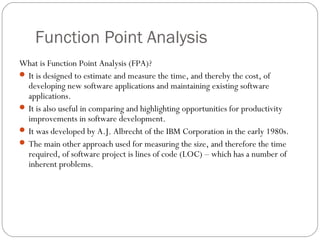
What is Function Point Analysis (FPA)?
 It is designed to estimate and measure the time, and thereby the cost, of
developing new software applications and maintaining existing software
applications.
 It is also useful in comparing and highlighting opportunities for productivity
improvements in software development.
 It was developed by A.J. Albrecht of the IBM Corporation in the early 1980s.
 The main other approach used for measuring the size, and therefore the time
required, of software project is lines of code (LOC) – which has a number of
inherent problems.
Function Point Analysis
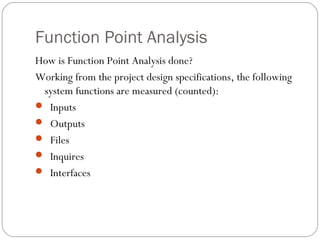
How is Function Point Analysis done?
Working from the project design specifications, the following
system functions are measured (counted):
 Inputs
 Outputs
 Files
 Inquires
 Interfaces
Function Point Analysis
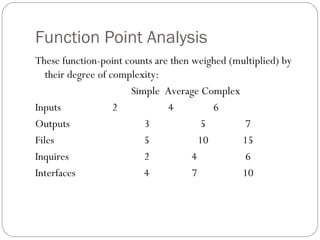
These function-point counts are then weighed (multiplied) by
their degree of complexity:
Simple Average Complex
Inputs 2 4 6
Outputs 3 5 7
Files 5 10 15
Inquires 2 4 6
Interfaces 4 7 10
Function Point Analysis
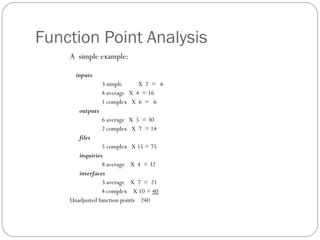
A simple example:
inputs
3 simple X 2 = 6
4 average X 4 = 16
1 complex X 6 = 6
outputs
6 average X 5 = 30
2 complex X 7 = 14
files
5 complex X 15 = 75
inquiries
8 average X 4 = 32
interfaces
3 average X 7 = 21
4 complex X 10 = 40
Unadjusted function points 240
Function Point Analysis
In addition to these individually weighted function points, there are factors that affect
the project and/or system as a whole. There are a number (~35) of these factors
that affect the size of the project effort, and each is ranked from “0”- no influence to
“5”- essential.
The following are some examples of these factors:
 Is high performance critical?
 Is the internal processing complex?
 Is the system to be used in multiple sites and/or by multiple organizations?
 Is the code designed to be reusable?
 Is the processing to be distributed?
 and so forth . . .
Function Point Analysis
Continuing our example . . .
Complex internal processing = 3
Code to be reusable = 2
High performance = 4
Multiple sites = 3
Distributed processing = 5
Project adjustment factor = 17
Adjustment calculation:
Adjusted FP = Unadjusted FP X [0.65 + (adjustment factor X 0.01)]
= 240 X [0.65 + ( 17 X 0.01)]
= 240 X [0.82]
= 197 Adjusted function points
Function Point Analysis
But how long will the project take and how much will it cost?
As previously measured, programmers in our organization
average 18 function points per month. Thus . . .
197 FP divided by 18 = 11 man-months
If the average programmer is paid $5,200 per month
(including benefits), then the [labor] cost of the project will
be . . .
11 man-months X $5,200 = $57,200
Function Point Analysis
Because function point analysis is independent of language used,
development platform, etc. it can be used to identify the
productivity benefits of . . .
One programming language over another
One development platform over another
One development methodology over another
One programming department over another
Before-and-after gains in investing in programmer training
And so forth . . .
Function Point Analysis
But there are problems and criticisms:
 Function point counts are affected by project size
 Difficult to apply to massively distributed systems or to systems with very
complex internal processing
 Difficult to define logical files from physical files
 The validity of the weights that Albrecht established – and the consistency
of their application – has been challenged
 Different companies will calculate function points slightly different, making
intercompany comparisons questionable

Cocomo model

  • 1.
  • 2.
    Introduction COCOMO is oneof the most widely used software estimation models in the world It was developed by Barry Boehm in 1981 COCOMO predicts the effort and schedule for a software product development based on inputs relating to the size of the software and a number of cost drivers that affect productivity
  • 3.
    COCOMO Models COCOMO hasthree different models that reflect the complexity: the Basic Model the Intermediate Model and the Detailed Model
  • 4.
    The Development Modes:Project Characteristics Organic Mode • Relatively small, simple software projects • Small teams with good application experience work to a set of less than rigid requirements • Similar to the previously developed projects • relatively small and requires little innovation Semidetached Mode • Intermediate (in size and complexity) software projects in which teams with mixed experience levels must meet a mix of rigid and less than rigid requirements.
  • 5.
    Contd… Embedded Mode • Softwareprojects that must be developed within a set of tight hardware, software, and operational constraints.
  • 6.
    COCOMO: Some Assumptions Primary costdriver is the number of Delivered Source Instructions (DSI) / Delivered Line Of Code developed by the project COCOMO estimates assume that the project will enjoy good management by both the developer and the customer Assumes the requirements specification is not substantially changed after the plans and requirements phase
  • 7.
    Basic COCOMO Basic COCOMOis good for quick, early, rough order of magnitude estimates of software costs It does not account for differences in hardware constraints, personnel quality and experience, use of modern tools and techniques, and other project attributes known to have a significant influence on software costs, which limits its accuracy
  • 8.
    Basic COCOMO Model:Formula E=ab (KLOC or KDSI) b b D=cb(E) d b P=E/D where E is the effort applied in person-months, D is the development time in chronological months, KLOC / KDSI is the estimated number of delivered lines of code for the project (expressed in thousands), and P is the number of people required. The coefficients ab, bb, cb and db are given in next slide.
  • 9.
    Contd… Software project abbb cb db Organic 2.4 1.05 2.5 0.38 Semi-detached 3.0 1.12 2.5 0.35 Embedded 3.6 1.20 2.5 0.32
  • 10.
    Basic COCOMO Model:Equation Mode Effort Schedule Organic E=2.4*(KDSI) 1.05 TDEV=2.5*(E) 0.38 Semidetached E=3.0*(KDSI) 1.12 TDEV=2.5*(E) 0.35 Embedded E=3.6*(KDSI) 1.20 TDEV=2.5*(E) 0.32
  • 11.
    Basic COCOMO Model:Limitation Its accuracy is necessarily limited because of its lack of factors which have a significant influence on software costs The Basic COCOMO estimates are within a factor of 1.3 only 29% of the time, and within a factor of 2 only 60% of the time
  • 12.
    Basic COCOMO Model:Example  We have determined our project fits the characteristics of Semi-Detached mode  We estimate our project will have 32,000 Delivered Source Instructions. Using the formulas, we can estimate:  Effort = 3.0*(32) 1.12 = 146 man-months  Schedule = 2.5*(146) 0.35 = 14 months  Productivity = 32,000 DSI / 146 MM = 219 DSI/MM  Average Staffing = 146 MM /14 months = 10 FSP
  • 13.
    Function Point Analysis Whatis Function Point Analysis (FPA)?  It is designed to estimate and measure the time, and thereby the cost, of developing new software applications and maintaining existing software applications.  It is also useful in comparing and highlighting opportunities for productivity improvements in software development.  It was developed by A.J. Albrecht of the IBM Corporation in the early 1980s.  The main other approach used for measuring the size, and therefore the time required, of software project is lines of code (LOC) – which has a number of inherent problems.
  • 14.
    Function Point Analysis Howis Function Point Analysis done? Working from the project design specifications, the following system functions are measured (counted):  Inputs  Outputs  Files  Inquires  Interfaces
  • 15.
    Function Point Analysis Thesefunction-point counts are then weighed (multiplied) by their degree of complexity: Simple Average Complex Inputs 2 4 6 Outputs 3 5 7 Files 5 10 15 Inquires 2 4 6 Interfaces 4 7 10
  • 16.
    Function Point Analysis Asimple example: inputs 3 simple X 2 = 6 4 average X 4 = 16 1 complex X 6 = 6 outputs 6 average X 5 = 30 2 complex X 7 = 14 files 5 complex X 15 = 75 inquiries 8 average X 4 = 32 interfaces 3 average X 7 = 21 4 complex X 10 = 40 Unadjusted function points 240
  • 17.
    Function Point Analysis Inaddition to these individually weighted function points, there are factors that affect the project and/or system as a whole. There are a number (~35) of these factors that affect the size of the project effort, and each is ranked from “0”- no influence to “5”- essential. The following are some examples of these factors:  Is high performance critical?  Is the internal processing complex?  Is the system to be used in multiple sites and/or by multiple organizations?  Is the code designed to be reusable?  Is the processing to be distributed?  and so forth . . .
  • 18.
    Function Point Analysis Continuingour example . . . Complex internal processing = 3 Code to be reusable = 2 High performance = 4 Multiple sites = 3 Distributed processing = 5 Project adjustment factor = 17 Adjustment calculation: Adjusted FP = Unadjusted FP X [0.65 + (adjustment factor X 0.01)] = 240 X [0.65 + ( 17 X 0.01)] = 240 X [0.82] = 197 Adjusted function points
  • 19.
    Function Point Analysis Buthow long will the project take and how much will it cost? As previously measured, programmers in our organization average 18 function points per month. Thus . . . 197 FP divided by 18 = 11 man-months If the average programmer is paid $5,200 per month (including benefits), then the [labor] cost of the project will be . . . 11 man-months X $5,200 = $57,200
  • 20.
    Function Point Analysis Becausefunction point analysis is independent of language used, development platform, etc. it can be used to identify the productivity benefits of . . . One programming language over another One development platform over another One development methodology over another One programming department over another Before-and-after gains in investing in programmer training And so forth . . .
  • 21.
    Function Point Analysis Butthere are problems and criticisms:  Function point counts are affected by project size  Difficult to apply to massively distributed systems or to systems with very complex internal processing  Difficult to define logical files from physical files  The validity of the weights that Albrecht established – and the consistency of their application – has been challenged  Different companies will calculate function points slightly different, making intercompany comparisons questionable