1
UIT1522 - Distributed Computing
Session 29 – Synchronization
2
OUTLINE
 Distributed Algorithms
 Time and Clocks
 Global State
 Concurrency Control
 Distributed Transactions
3
INTRODUCTION TO SYNCHRONIZATION
 How processes cooperate and synchronize with each other?
 Simultaneously access a shared resources , such as printer,
 Agree on the ordering of events, such as whether message m1 from
process P was sent before or after message m2 from process Q.
4
DISTRIBUTED ALGORITHMS
Algorithms that are intended to work in a distributed environment.
 Used to accomplish tasks such as:
 Communication
 Accessing resources
 Allocating resources
 etc.
 Synchronization and coordination linked to distributed algorithms
 Achieved using distributed algorithms
5
SYNCHRONOUS VS ASYNCHRONOUS DISTRIBUTED SYSTEMS
Timing model of a distributed system
 Affected by:
 Execution speed/time of processes
 Communication delay
 Clocks & clock drift
 (Partial) failure
6
SYNCHRONOUS DISTRIBUTED SYSTEM
Time variance is bounded
 Execution: bounded execution speed and time
 Communication: bounded transmission delay
 Clocks: bounded clock drift (and differences in clocks)
 Effect:
 Easier to design distributed algorithms
 Very restrictive requirements
 Limit concurrent use of network
 Require precise clocks and synchronization
7
ASYNCHRONOUS DISTRIBUTED SYSTEM
Time variance is not bounded
 Execution: different steps can have varying duration
 Communication: transmission delays vary widely
 Clocks: arbitrary clock drift
 Effect:
 Allows no assumption about time intervals
 Most asynchronous DS problems hard to solve
 Solution for asynchronous DS is also a solution for synchronous DS
 Most real distributed systems are hybrid synch and asynchronous.
8
EVALUATING DISTRIBUTEDA LGORITHMS
 General Properties:
 Performance
 number of messages exchanged
 response/wait time • delay
 throughput
 complexity: Efficiency

 resource usage: memory, CPU, etc.
 Scalability
 Reliability
 number of points of failure (low is good)
9
SYNCHRONIZATION AND COORDINATION
 making sure that processes doing the right thing at the right time.
 allowing processes to synchronize and coordinate their actions
 Two fundamental issues:
 Coordination (the right thing)
 Synchronization (the right time)
10
COORDINATION
 Coordination refers to coordinating the actions of separate processes
relative to each other and allowing them to agree on global state (such
as values of a shared variable).
“Coordinate actions and agree on values.”
 Coordinate Actions:
 What actions will occur
 Who will perform actions
 Agree on Values:
 Agree on global value
 Agree on environment
 Agree on state
 Examples of coordination include ensuring that processes agree on:
 what actions will be performed?
 who will be performing actions?
 and the state of the system?
11
SYNCHRONIZATION AND TIME
 Synchronization is coordination with respect to time, and refers to the
ordering of events and execution of instructions in time.
“Ordering of all actions”
 Total ordering of events (whether message m1 from process P was
sent before or after message m2 from process Q)
 Ordering of access to resources
 Examples of synchronization include,
 Ordering distributed events and
 ensuring that a process performs an action at a particular time.
12
MAIN ISSUES
 Time and Clocks: synchronizing clocks and using time in distributed
algorithms
 Global State: how to acquire knowledge of the system’s global state
 Concurrency Control: coordinating concurrent access to resources
 Coordination: when do processes need to coordinate and how do
they do it
13
TIME AND CLOCKS
 It is often important to know when events occurred and in what order
they occurred.
 In a non-distributed system dealing with time is trivial as there is a
single shared clock, where all processes see the same time.
 In a distributed system, on the other hand, each computer has its own
clock.
 Because no clock is perfect each of these clocks has its own skew
which causes clocks on different computers to drift and eventually
become out of sync.
14
CLOCKS
 Computer Clocks: oscillates at known frequency
 Clock Skew:
 different computers run at slightly different rates
 Clocks get out of sync
 Maximum drift rate
 Timestamps: Used to denote at which time an event occurred
15
PHYSICAL CLOCKS
 Based on actual time:
 Physical clocks keep track of physical time.
 In distributed systems that based on actual time it is necessary to keep individual
computer clocks synchronized.
 The clocks can be synchronized to global time (external synchronization), or to
each other (internal synchronization).
 Examples:
 Performing events at an exact time (turn lights on/off, lock/unlock gates)
 sorting of events (for security, for profiling)
 Tracking (tracking a moving object with separate cameras)
16
SYNCHRONIZING PHYSICAL CLOCKS
 External Synchronization:
 Clocks synchronize to an external time source
 Synchronize with UTC every δ seconds
 Internal Synchronization:
 Clocks synchronize locally
 Only synchronized with each other
 Time Server:
 Server that has the correct time
 Server that calculates the correct time
17
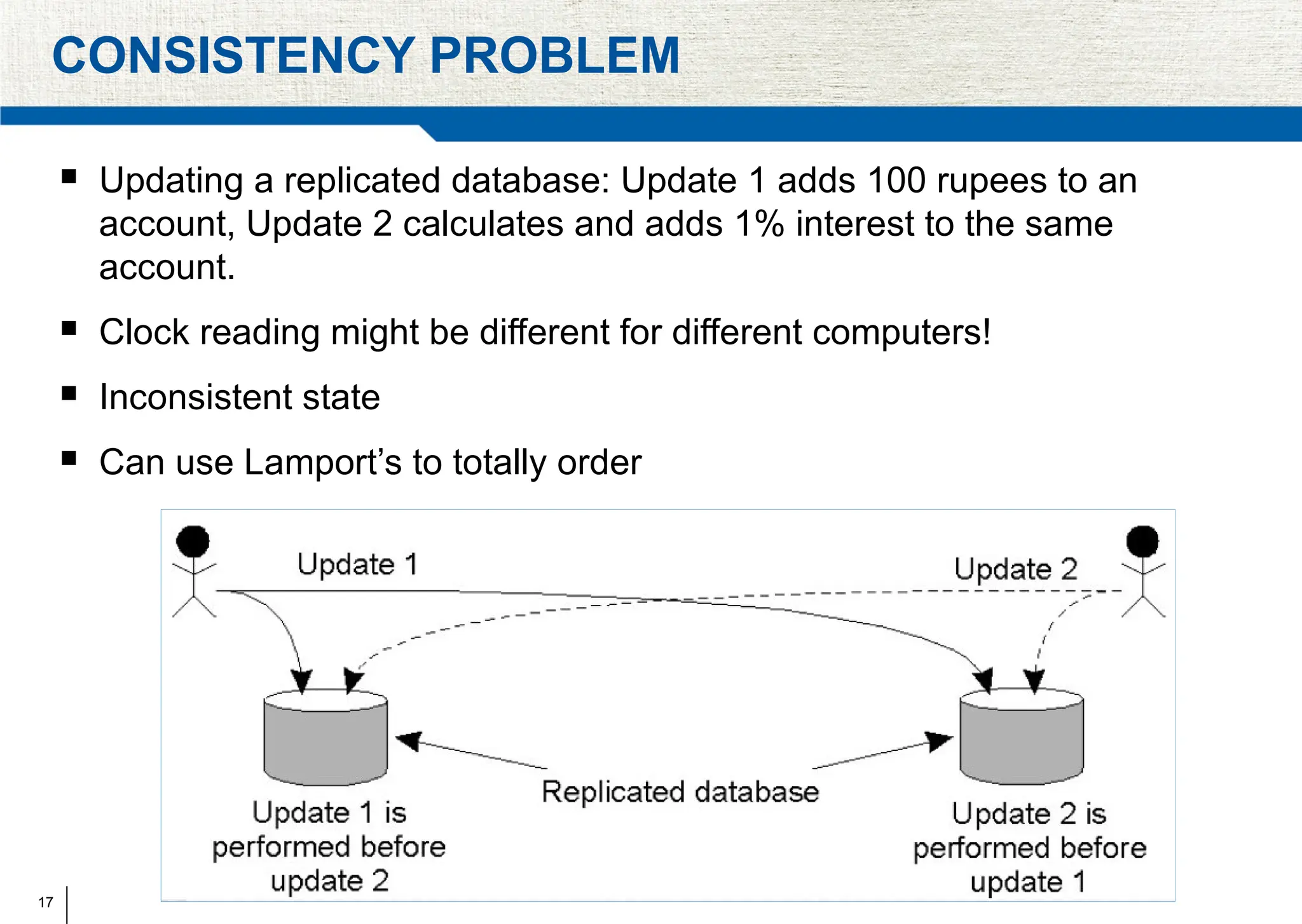
CONSISTENCY PROBLEM
 Updating a replicated database: Update 1 adds 100 rupees to an
account, Update 2 calculates and adds 1% interest to the same
account.
 Clock reading might be different for different computers!
 Inconsistent state
 Can use Lamport’s to totally order
18
COMPUTER CLOCK
 We need to measure time accurately
 to know the time an event occurred at a computer
 Algorithms for clock synchronization useful
 for concurrency control based on timestamp ordering authenticity of requests.
 e.g. in Kerberos etc
 Each computer in a DS has its own internal clock
19
CLOCK SYNCHRONIZATION
 There exists a time server receiving signals from a UTC source
 Cristian’s algorithm
  There is no UTC source available
 Berkley’s algorithm
  Exact time does not matter!
 Lamport’s algorithm
20
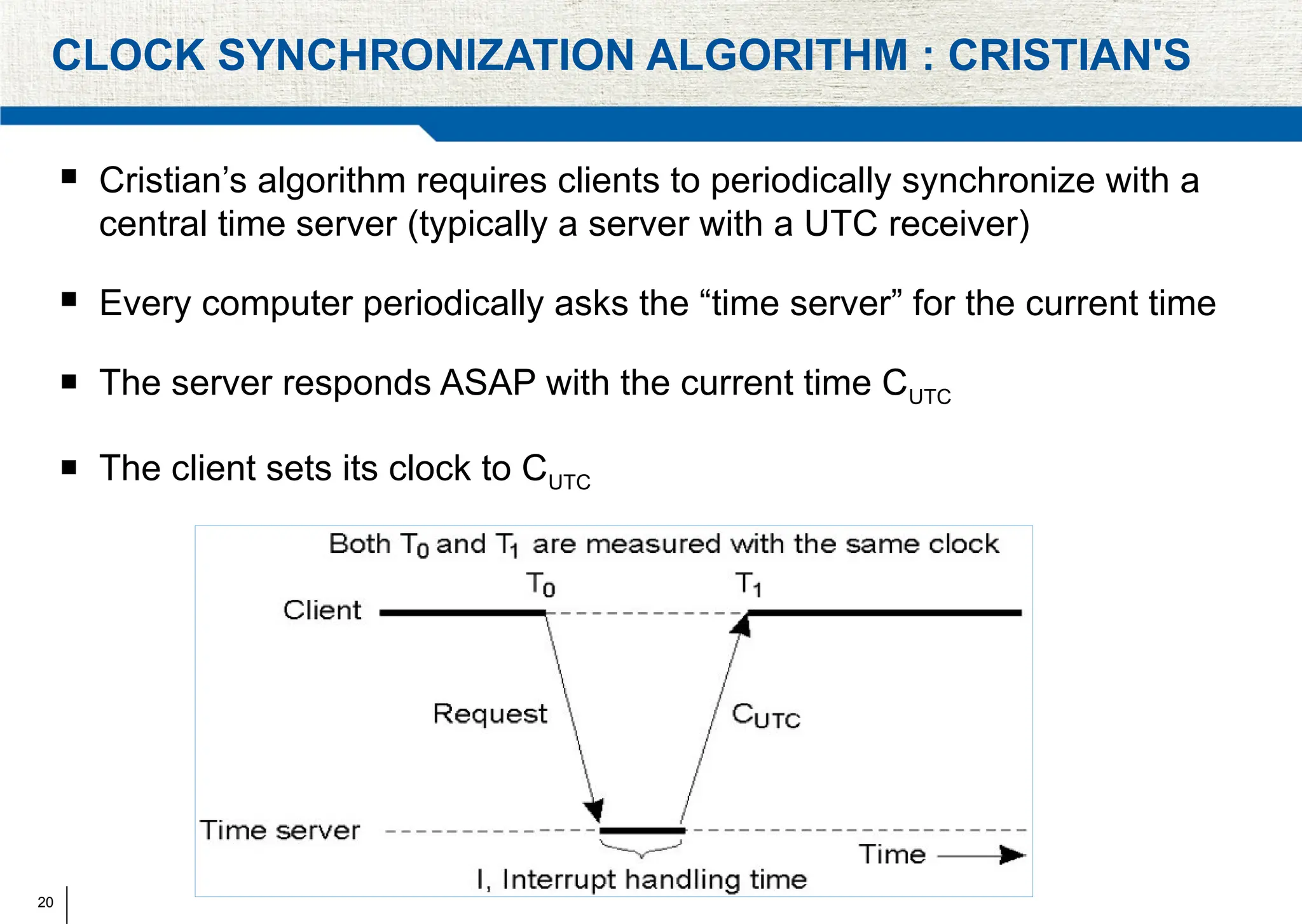
CLOCK SYNCHRONIZATION ALGORITHM : CRISTIAN'S
 Cristian’s algorithm requires clients to periodically synchronize with a
central time server (typically a server with a UTC receiver)
 Every computer periodically asks the “time server” for the current time
 The server responds ASAP with the current time CUTC
 The client sets its clock to CUTC
21
CLOCK SYNCHRONIZATION ALGORITHM : BERKELEY
 An algorithm for internal synchronization of a group of computers
 A master polls to collect clock values from the others (slaves)
 The master uses round trip times to estimate the slaves’ clock values
 It takes an average It sends the required adjustment to the slaves

 If master fails, can elect a new master to take over
22
CLOCK SYNCHRONIZATION ALGORITHM : BERKELEY
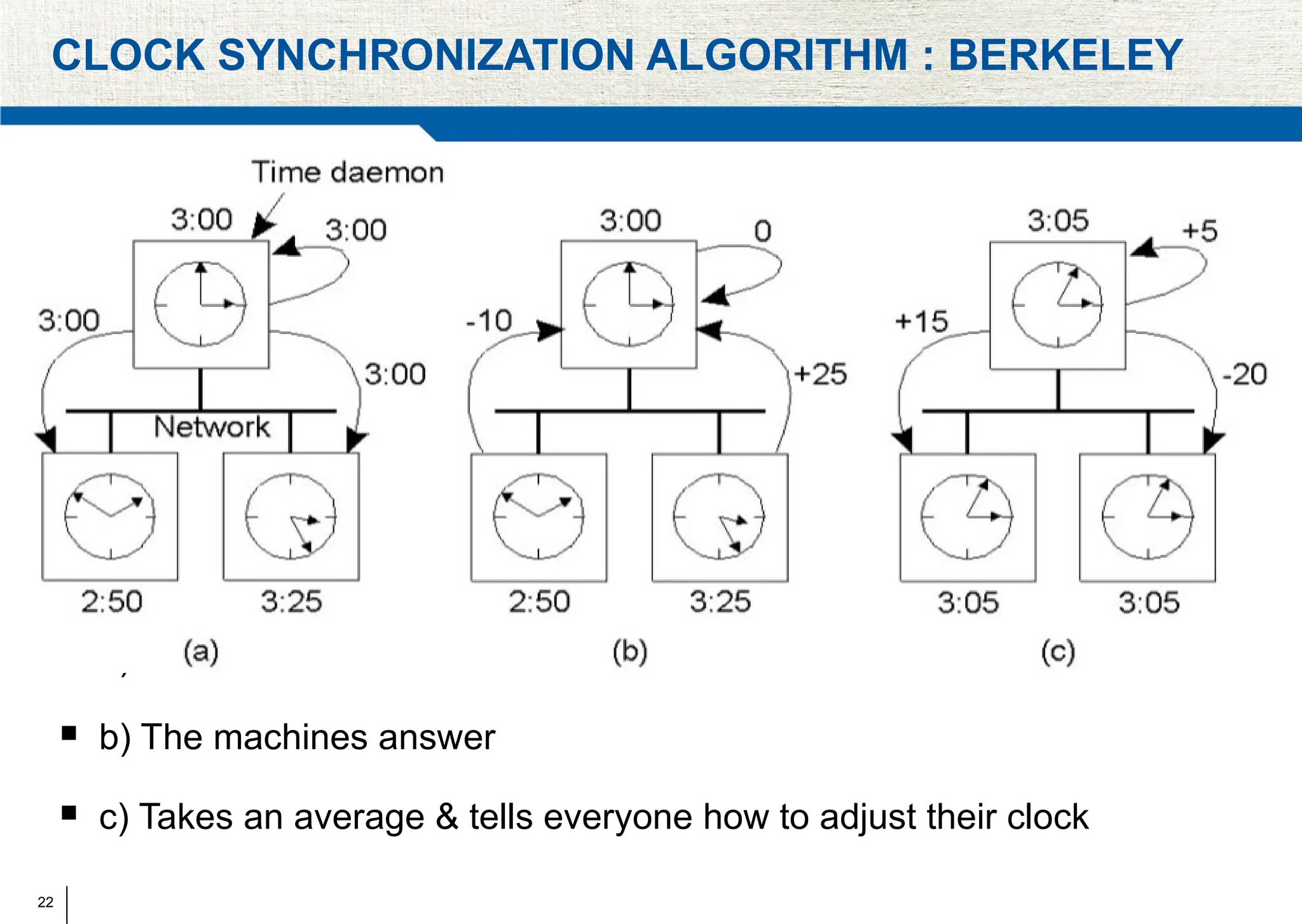
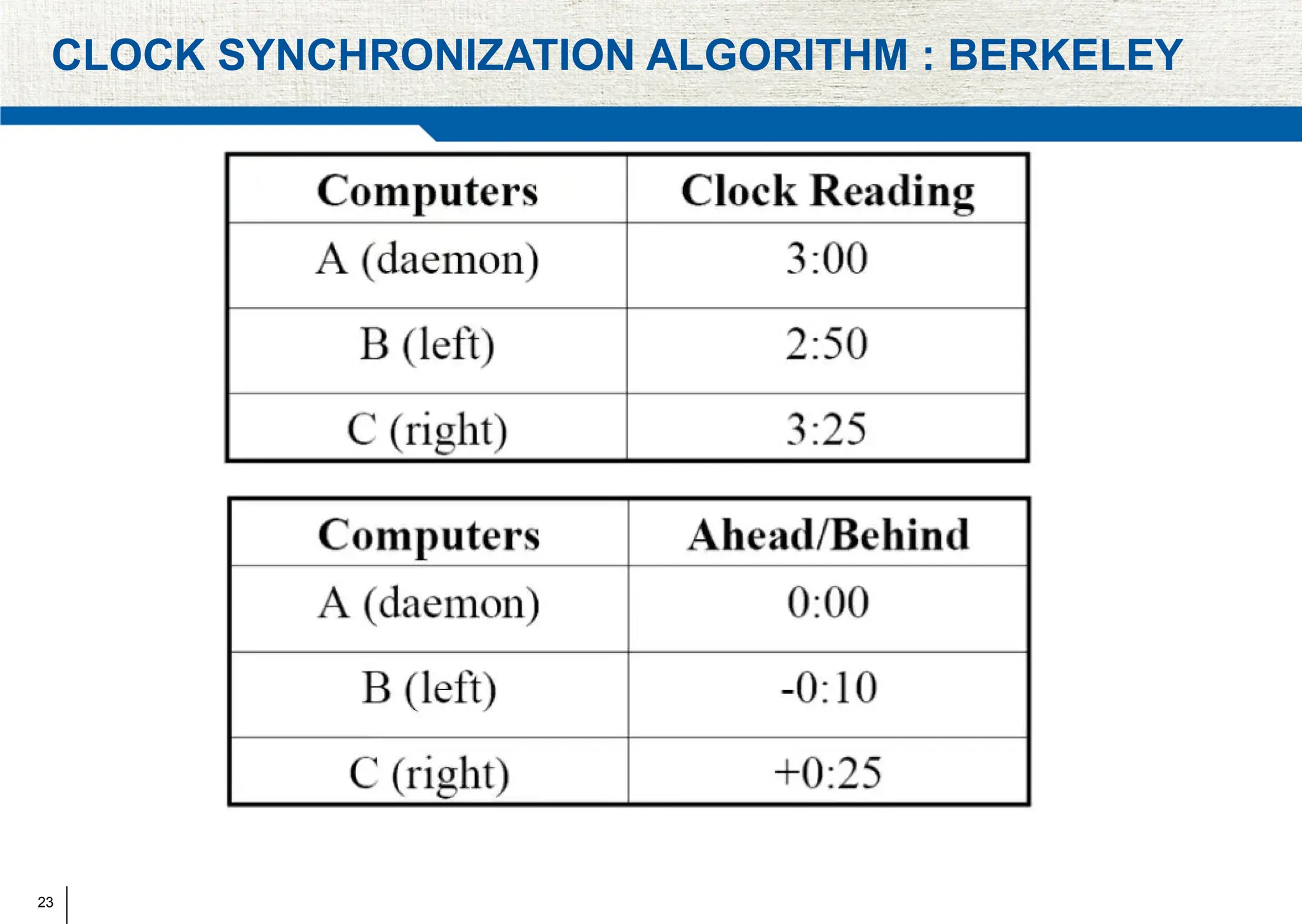
 a) The time daemon asks all the other machines for their clock values
 b) The machines answer
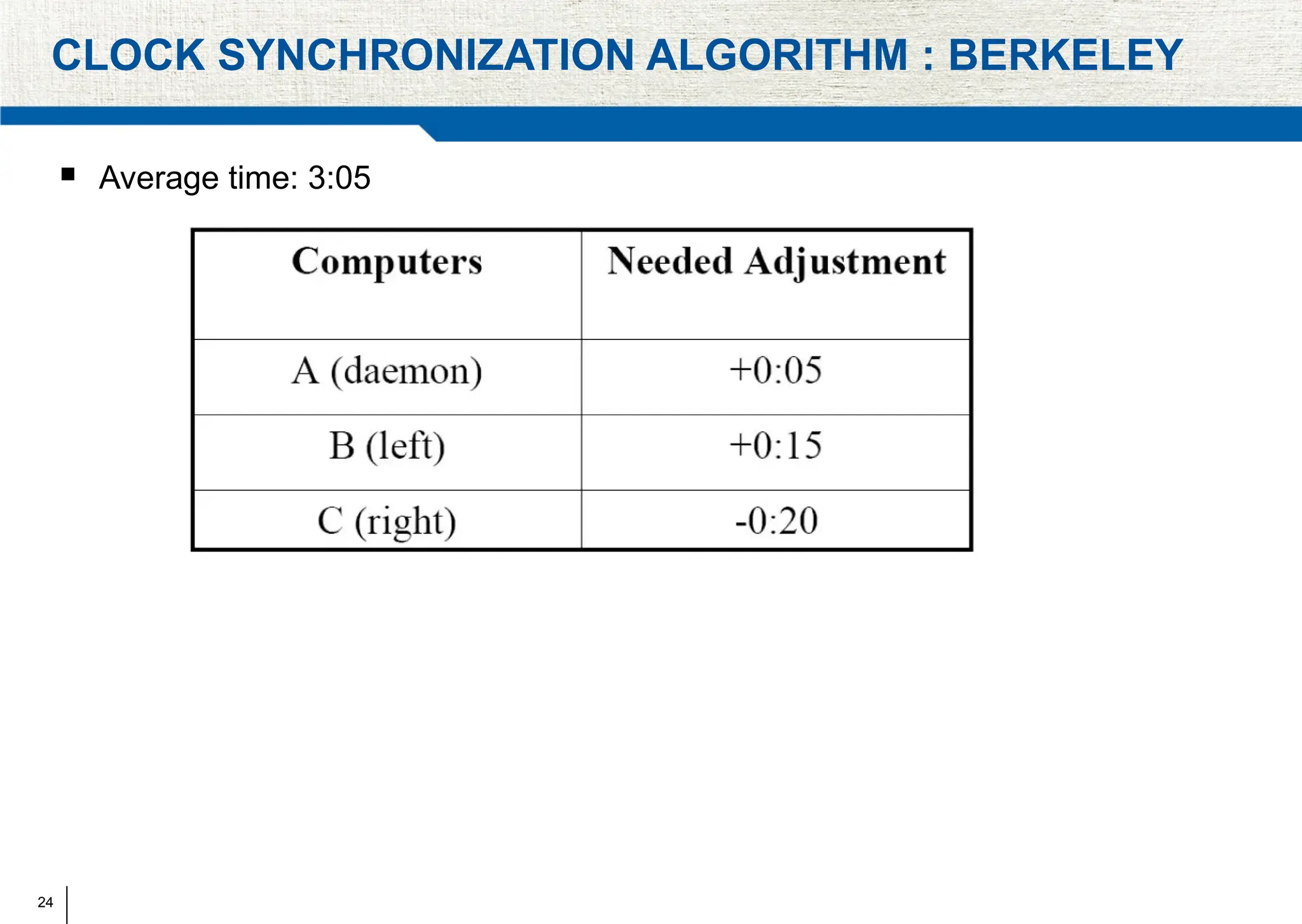
 c) Takes an average & tells everyone how to adjust their clock
23
CLOCK SYNCHRONIZATION ALGORITHM : BERKELEY
24
CLOCK SYNCHRONIZATION ALGORITHM : BERKELEY
 Average time: 3:05
25
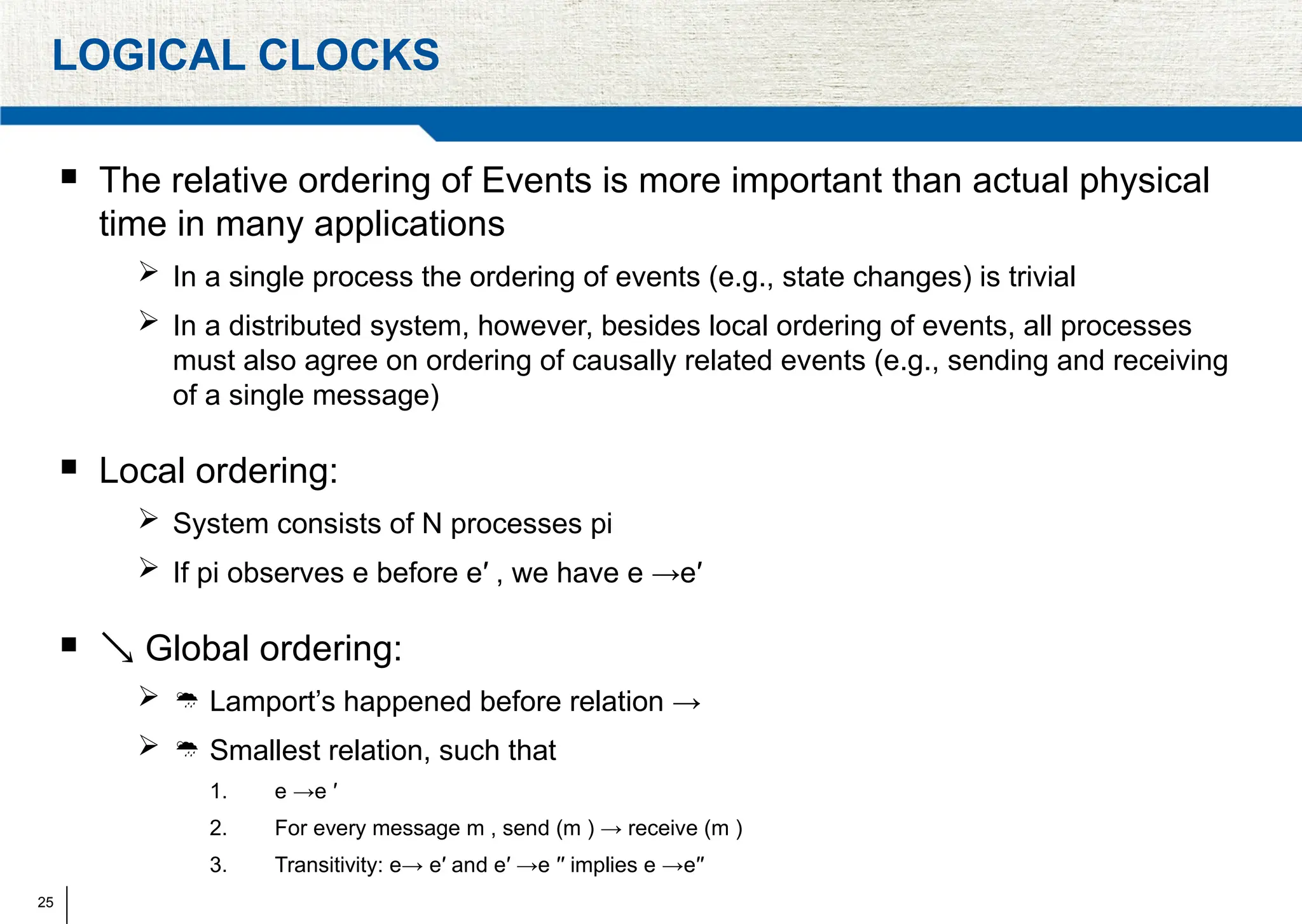
LOGICAL CLOCKS
 The relative ordering of Events is more important than actual physical
time in many applications
 In a single process the ordering of events (e.g., state changes) is trivial
 In a distributed system, however, besides local ordering of events, all processes
must also agree on ordering of causally related events (e.g., sending and receiving
of a single message)
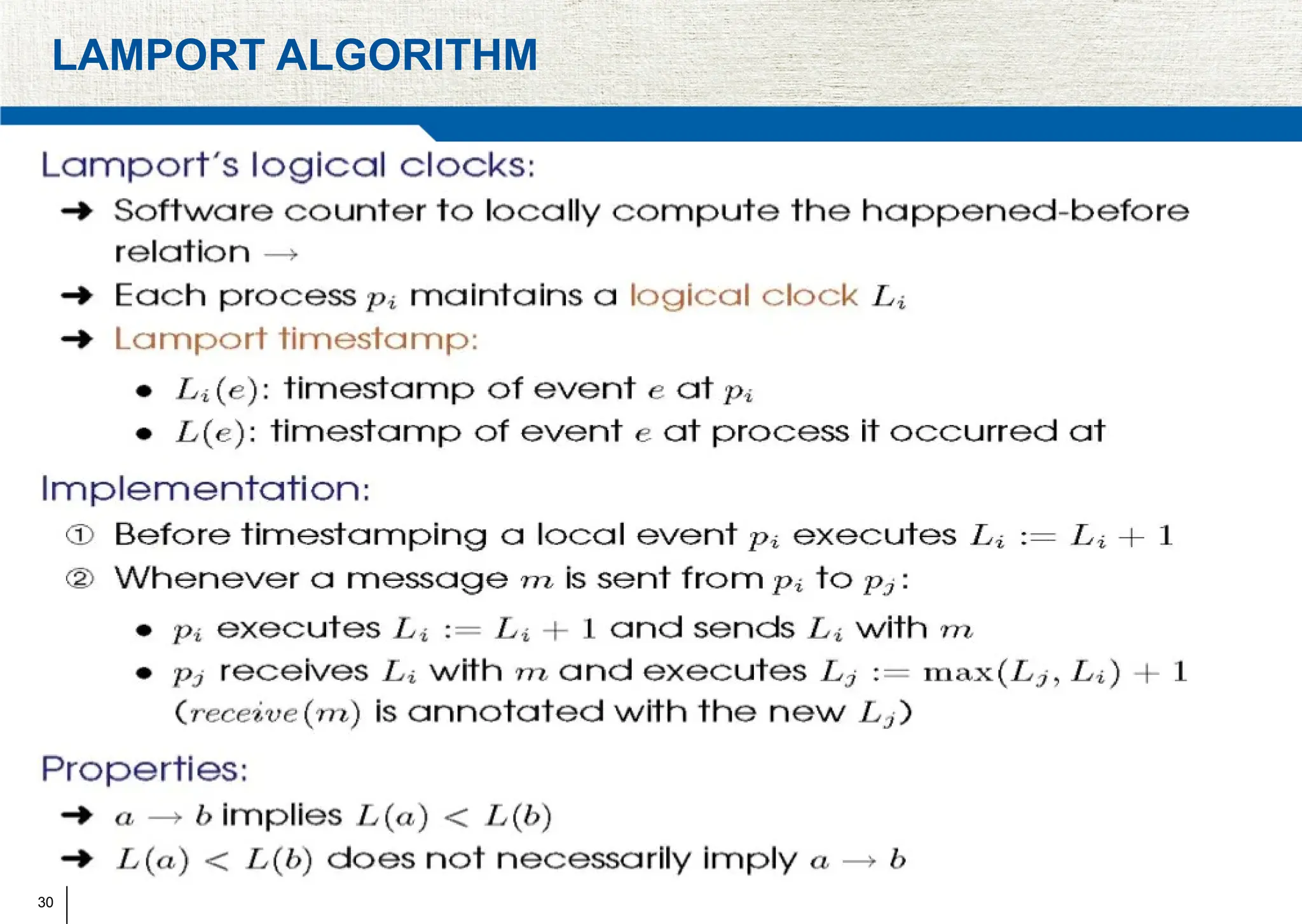
 Local ordering:
 System consists of N processes pi
 If pi observes e before e′ , we have e →e′
  Global ordering:
  Lamport’s happened before relation →
  Smallest relation, such that
1. e →e ′
2. For every message m , send (m ) → receive (m )
3. Transitivity: e→ e′ and e′ →e ′′ implies e →e′′
26
ORDERING EVENTS
 Event ordering linked with concept of causality:
 Saying that event a happened before event b is same as saying that event
a casually affects event b
 If events a and b happen on processes that do not exchange any data,
their exact ordering is not important
27
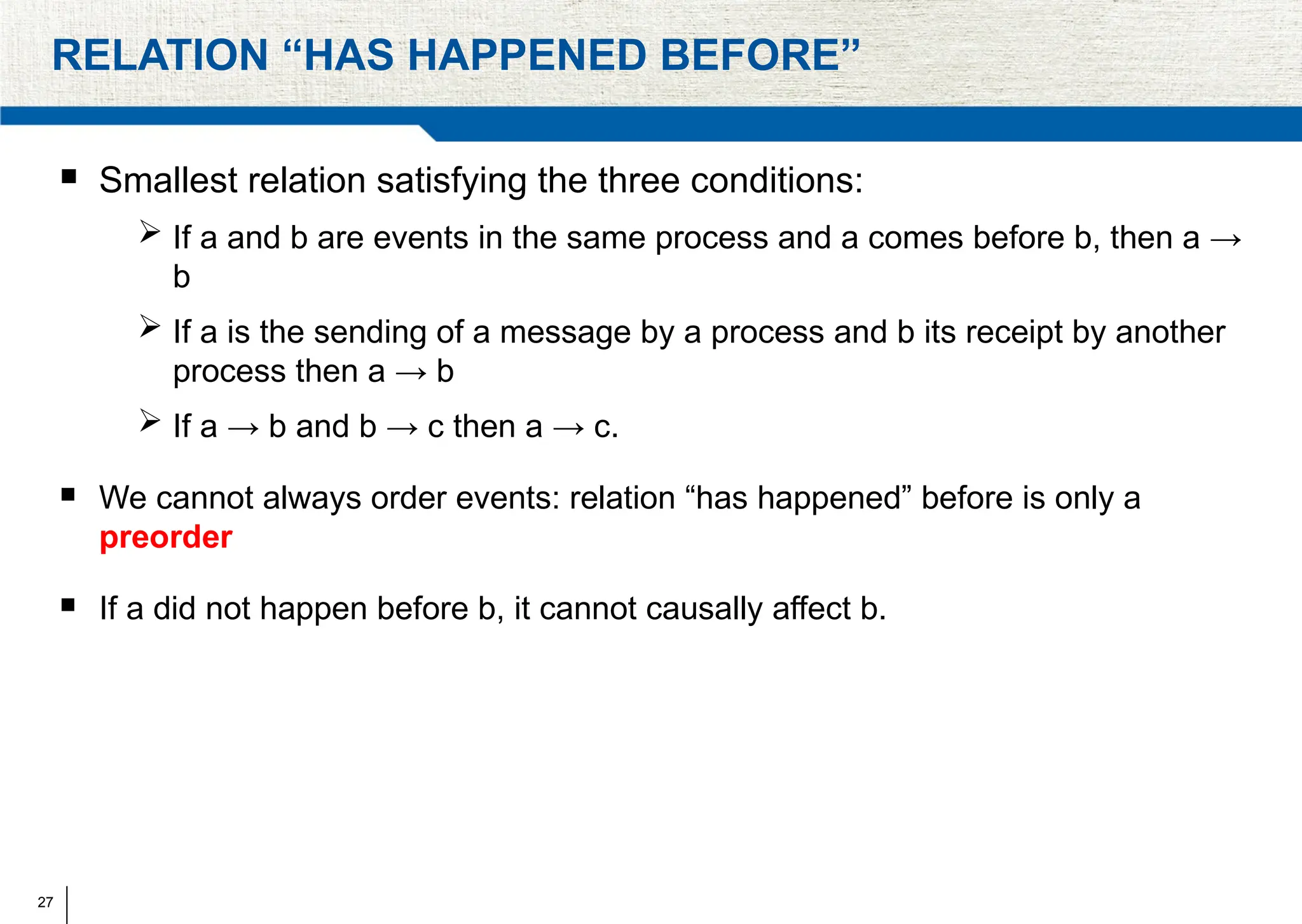
RELATION “HAS HAPPENED BEFORE”
 Smallest relation satisfying the three conditions:
 If a and b are events in the same process and a comes before b, then a →
b
 If a is the sending of a message by a process and b its receipt by another
process then a → b
 If a → b and b → c then a → c.
 We cannot always order events: relation “has happened” before is only a
preorder
 If a did not happen before b, it cannot causally affect b.
28
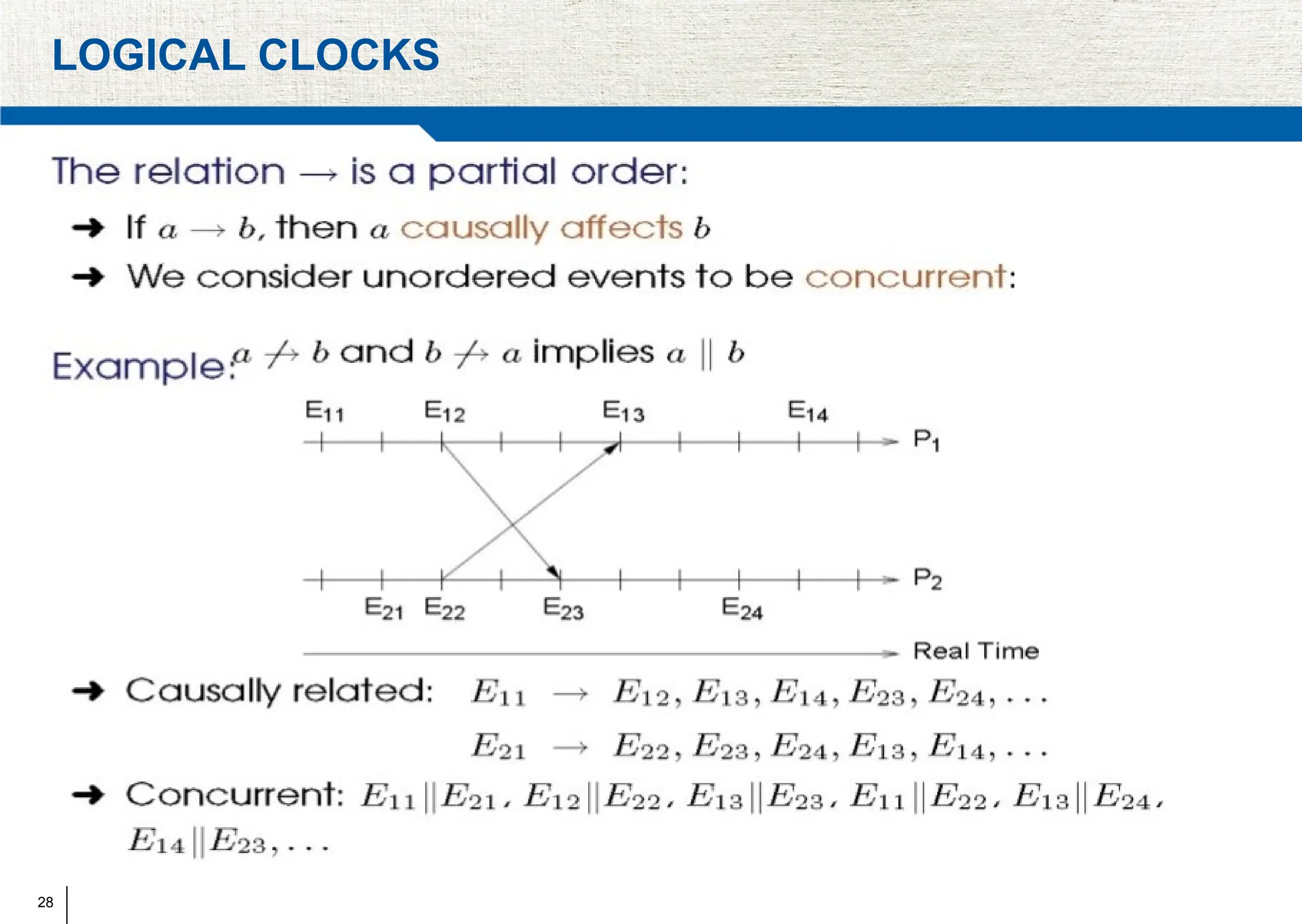
LOGICAL CLOCKS
29
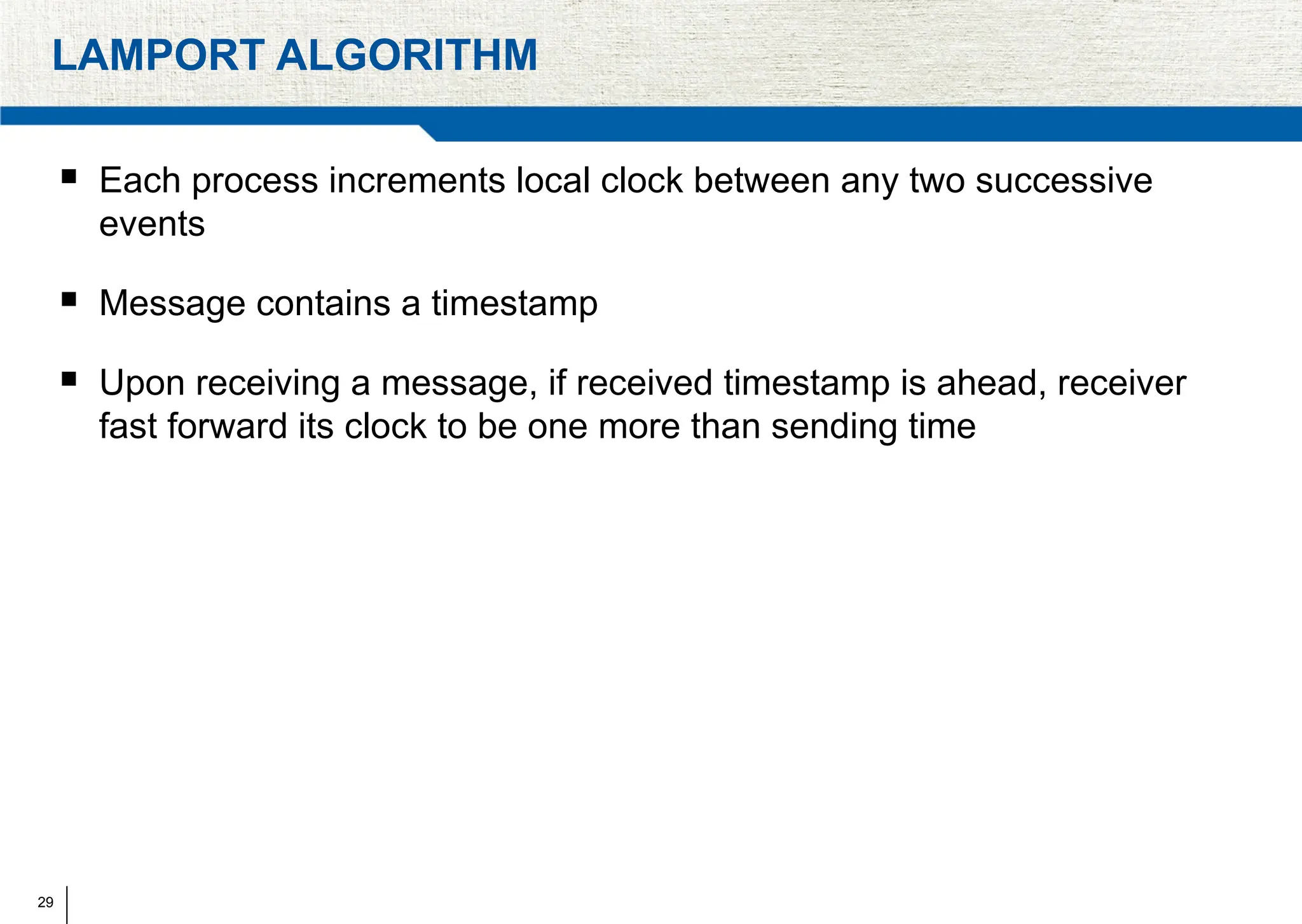
LAMPORT ALGORITHM
 Each process increments local clock between any two successive
events
 Message contains a timestamp
 Upon receiving a message, if received timestamp is ahead, receiver
fast forward its clock to be one more than sending time
30
LAMPORT ALGORITHM
31
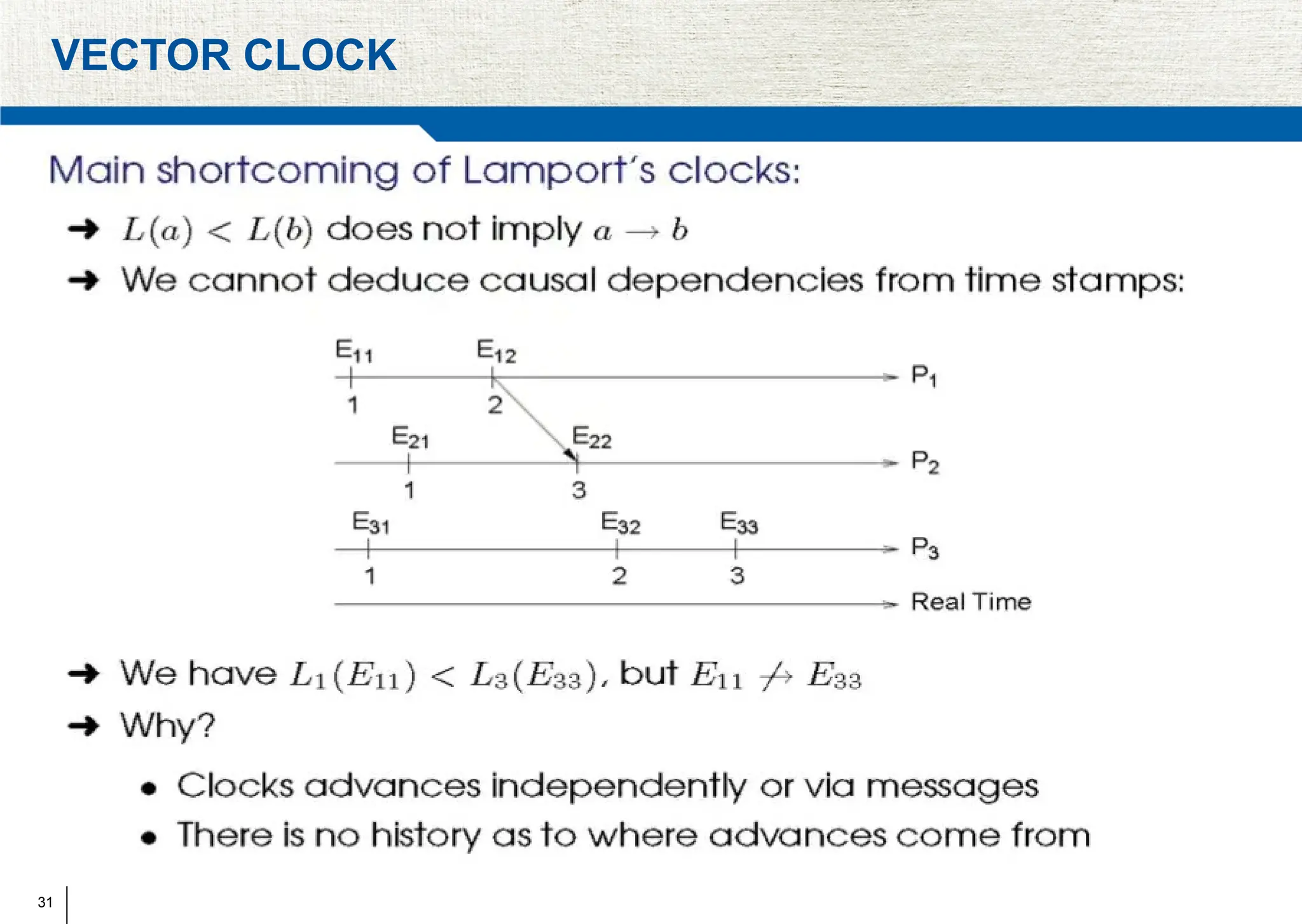
VECTOR CLOCK
32
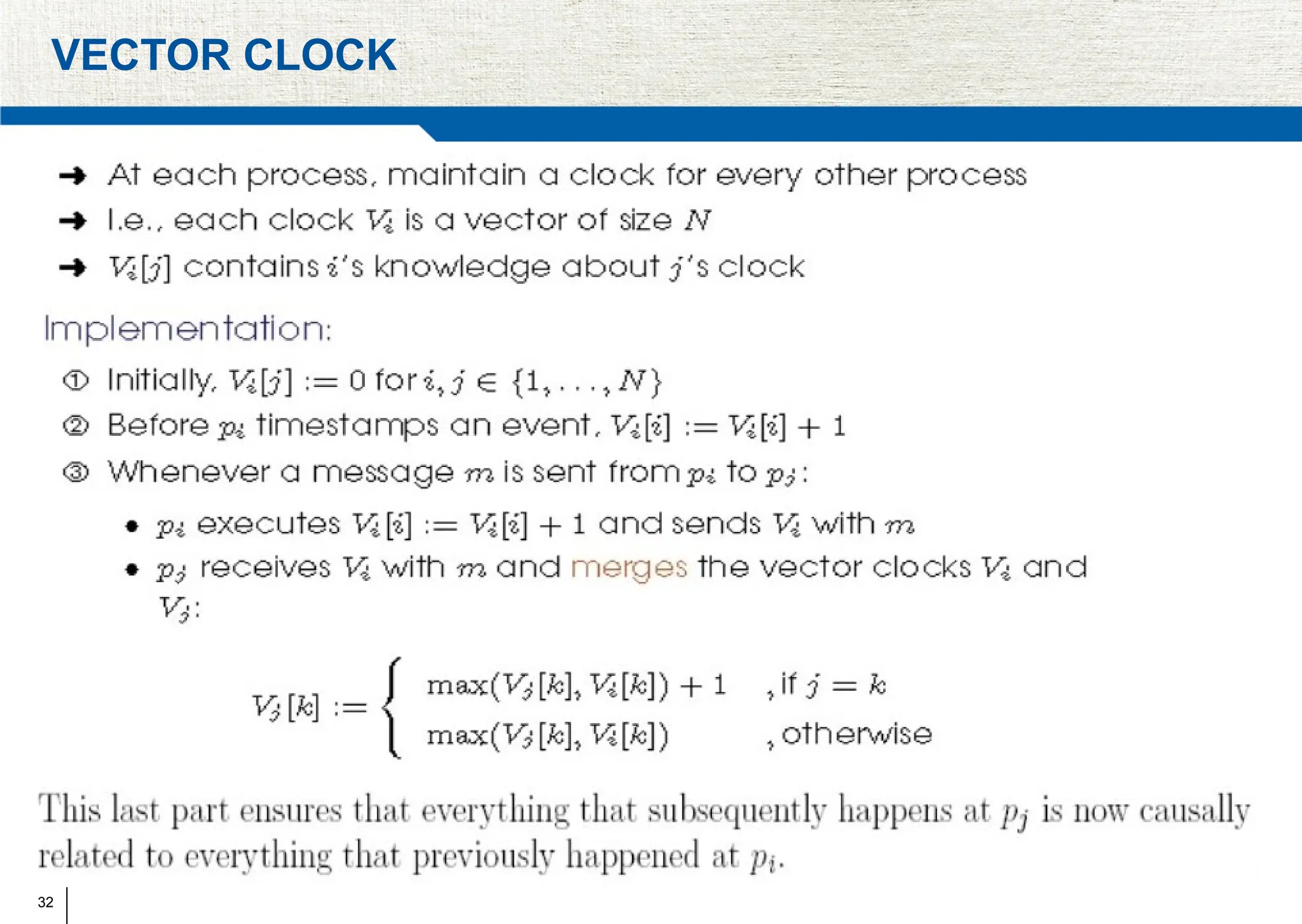
VECTOR CLOCK
33
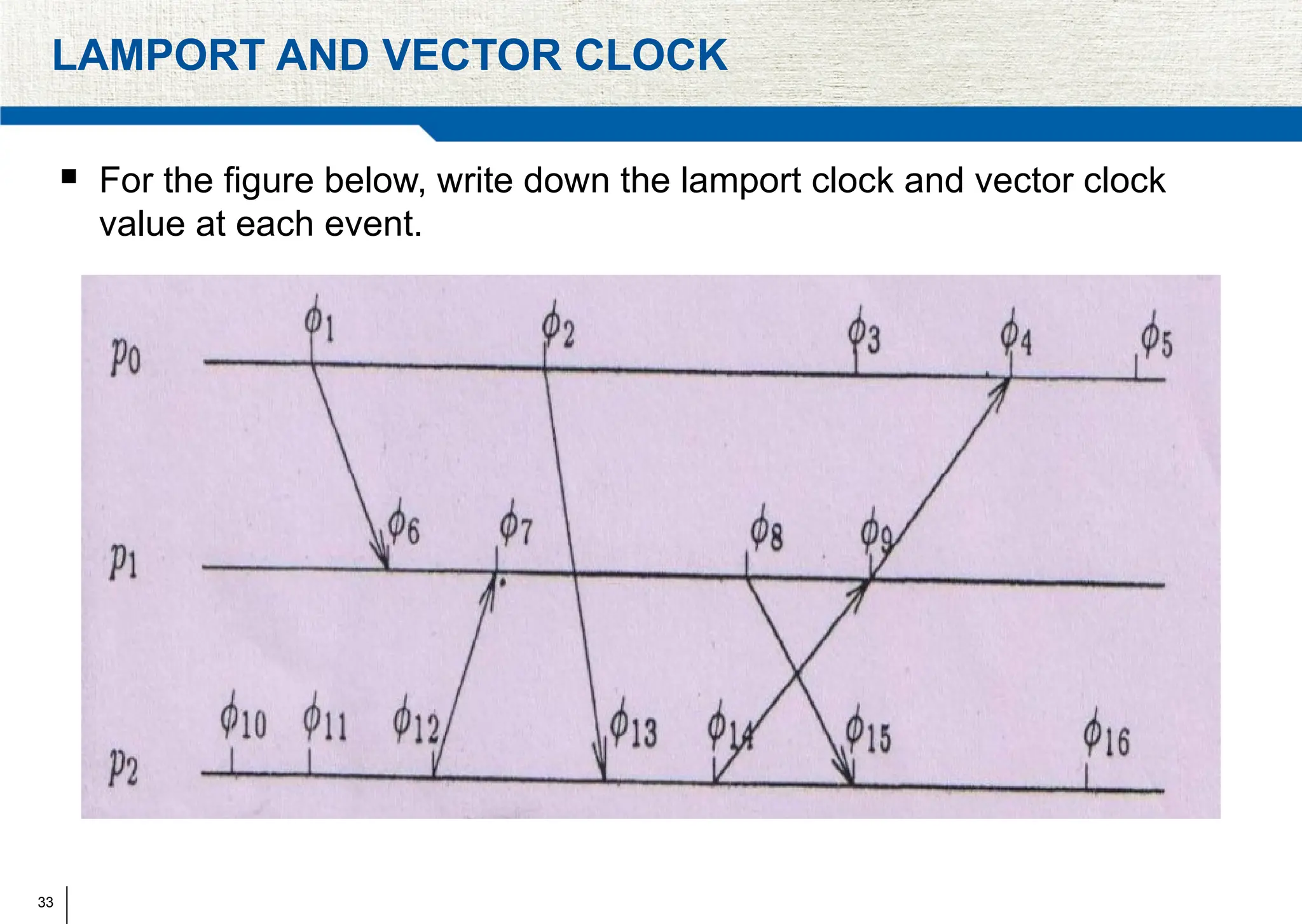
LAMPORT AND VECTOR CLOCK
 For the figure below, write down the lamport clock and vector clock
value at each event.
34
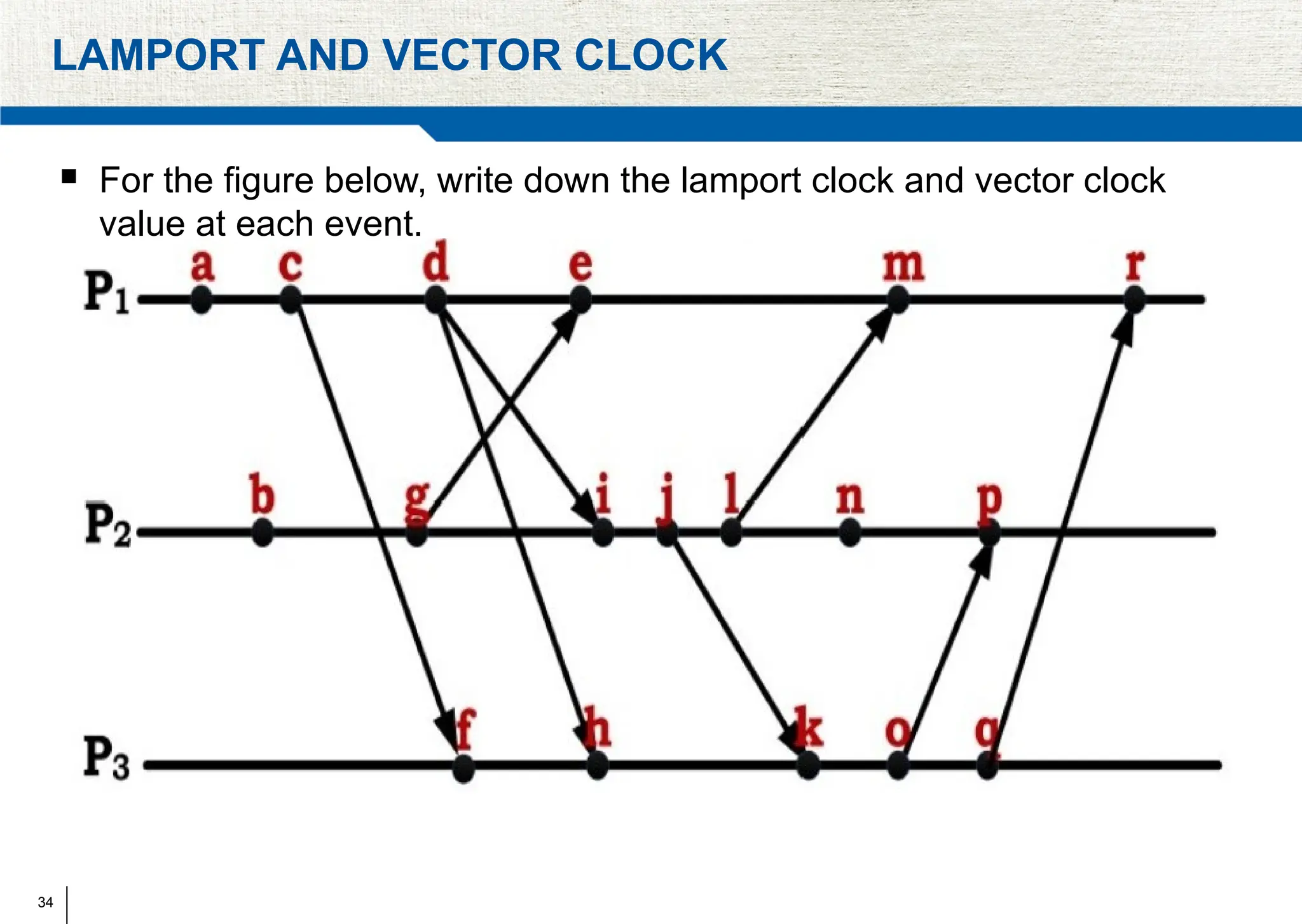
LAMPORT AND VECTOR CLOCK
 For the figure below, write down the lamport clock and vector clock
value at each event.
35
DETERMINING GLOBAL STATES
 Global State
 “The global state of a distributed computation is the set of local states of all
individual processes involved in the computation plus the state of the
communication channels.”
 Knowing the global state of distributed system may be useful for many
reasons.
 For example: How to know that system is dealing with deadlock or
distributed computation has correctly terminated?
36
GLOBAL STATES
 Determining global properties: often difficult, but essential for some
applications.
 Distributed garbage collection:
 Do any references exist to a given object?: Collects remote server objects
that are no longer referenced by any client in the network .
 Distributed deadlock detection:
 Do processes wait in a cycle for each other?
 Distributed algorithm termination detection:
 Did a set of processes finish all activity? (Consider messages in transit)
All these properties are stable: once they occur, they do not disappear
without outside intervention.
37
ANALYSIS OF GLOBAL STATE (DISTRIBUTED SNAPSHOT)
 A distributed snapshot reflects a state in which the distributed system
might have been.
 A snapshot reflects a consistent global state
 Example:
1. if we have recorded that a process Q has received a message from
another process P,
2. then we should also recorded that process P has actually sent that
message
3. Otherwise, a snapshot will contain the recording of messages that have
been received but never sent,
4. Which indicate the inconsistent global state
5. The reverse condition (P has sent a message that Q has not yet
received) is allowed
38
MORE ON STATES
 process state
 memory state + register state + open files + kernel buffers + …
Or
 application specific info like transactions completed, functions
executed etc,.
 channel state
 “Messages in transit” i.e. those messages that have been sent but not
yet received
39
WHY GLOBAL STATE DETERMINATION IS DIFFICULT IN
DISTRIBUTED SYSTEMS?
 Distributed State :
 Have to collect information that is spread across several machines!!
 Only Local knowledge :
 A process in the computation does not know the state of other processes.
40
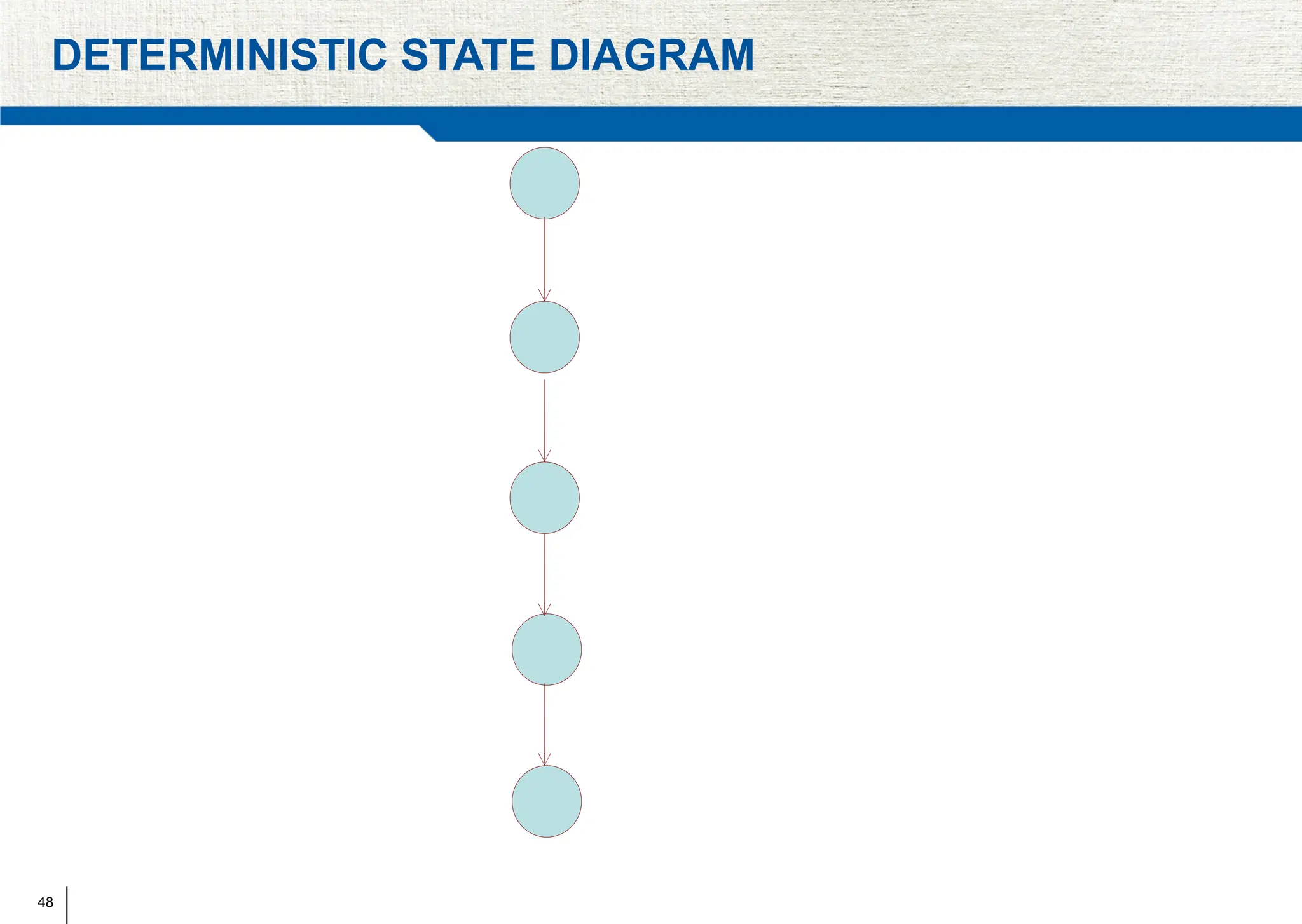
DIFFICULTIES DUE TO NON DETERMINISM
 Deterministic Computation
 At any point in computation there is at most one event that can
happen next.
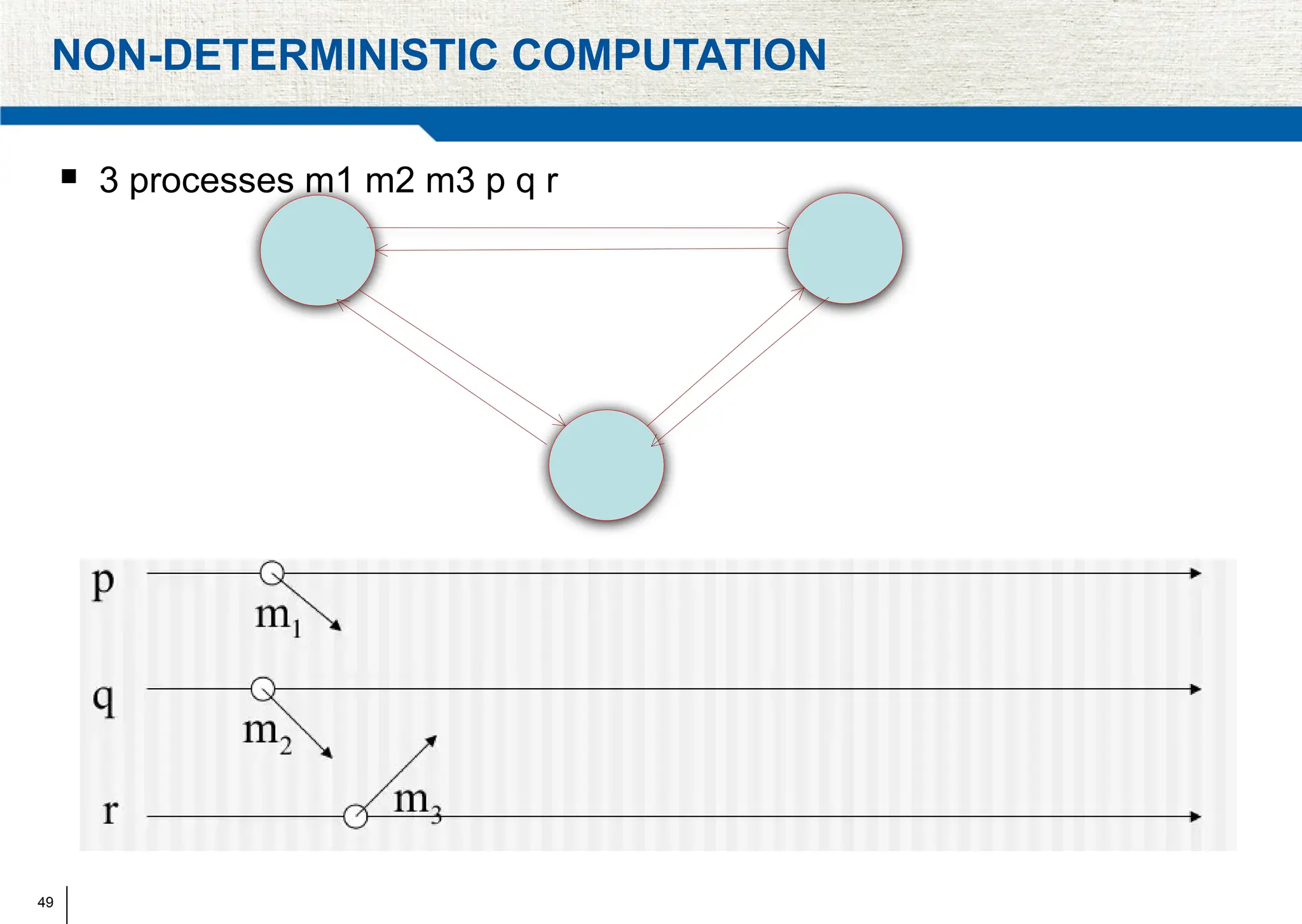
 Non-Deterministic Computation
 At any point in computation there can be more than one event that
can happen next.
41
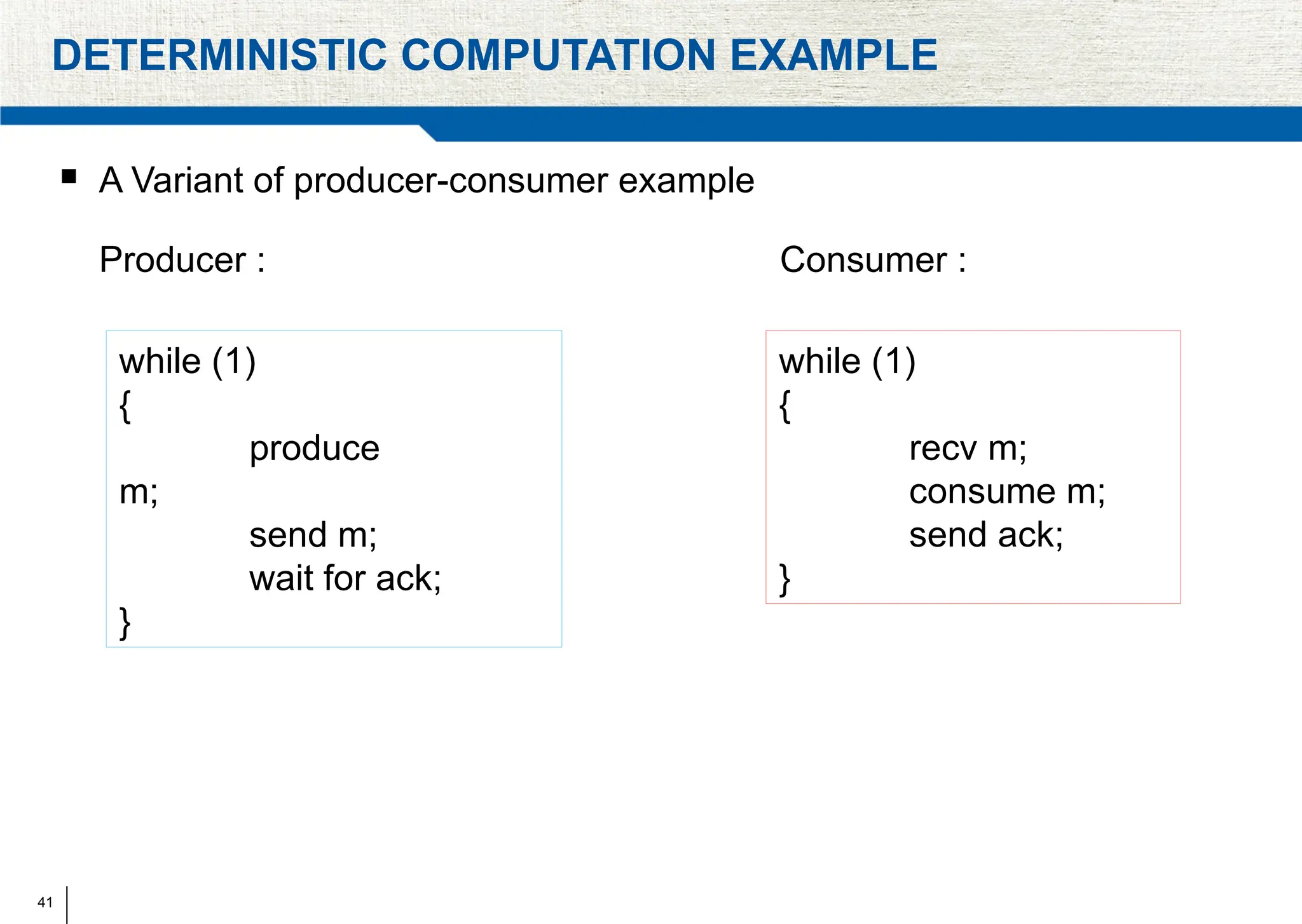
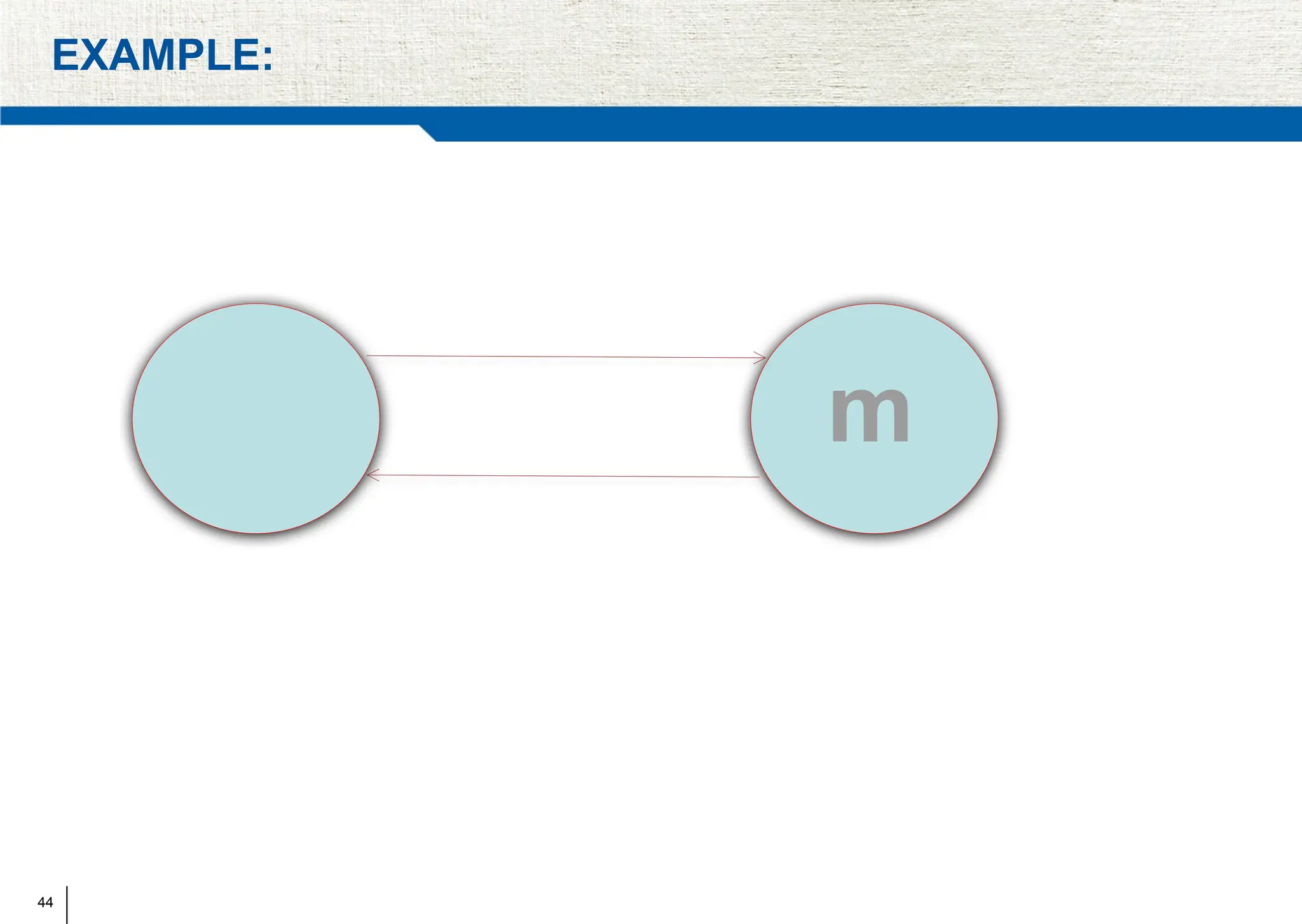
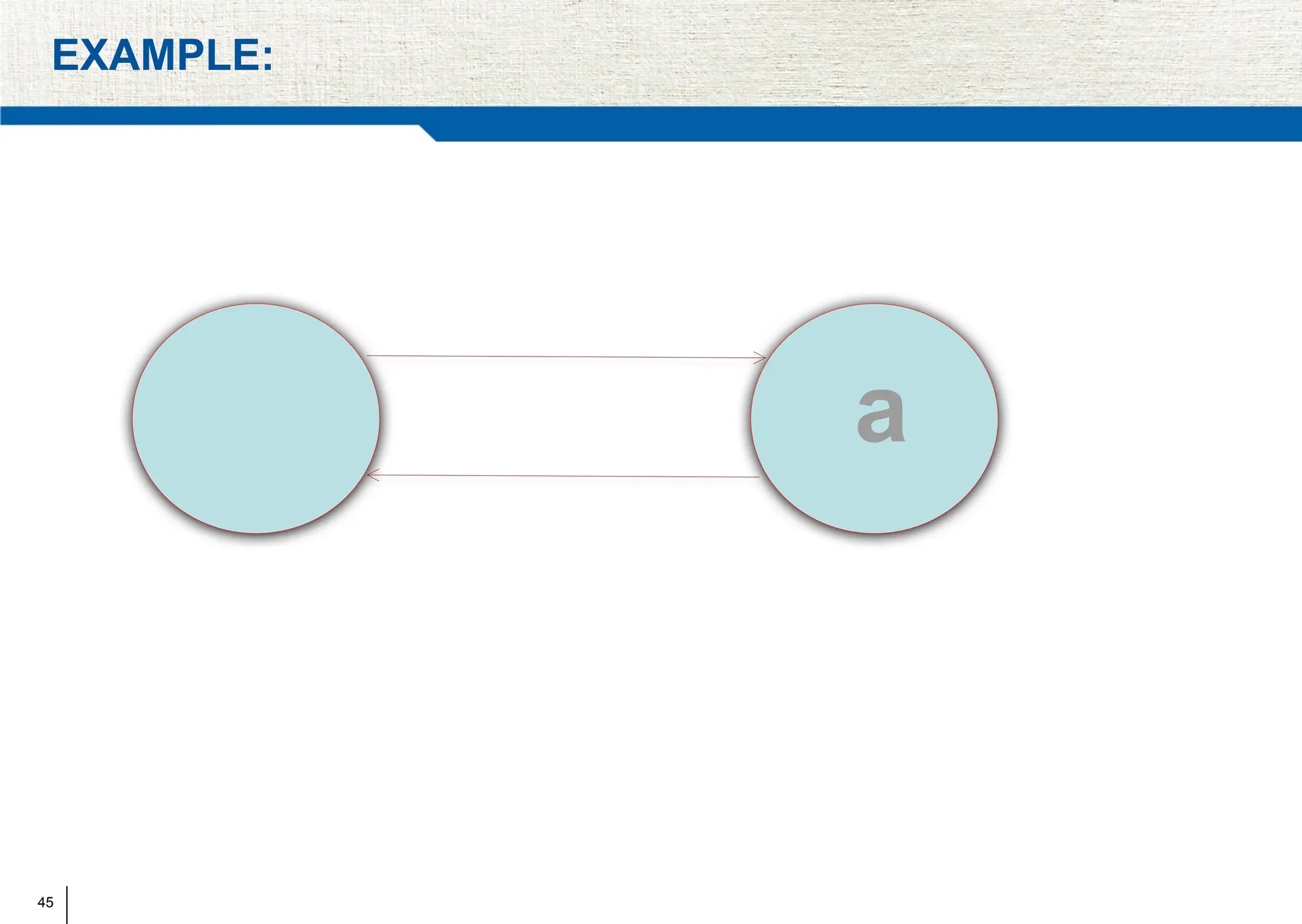
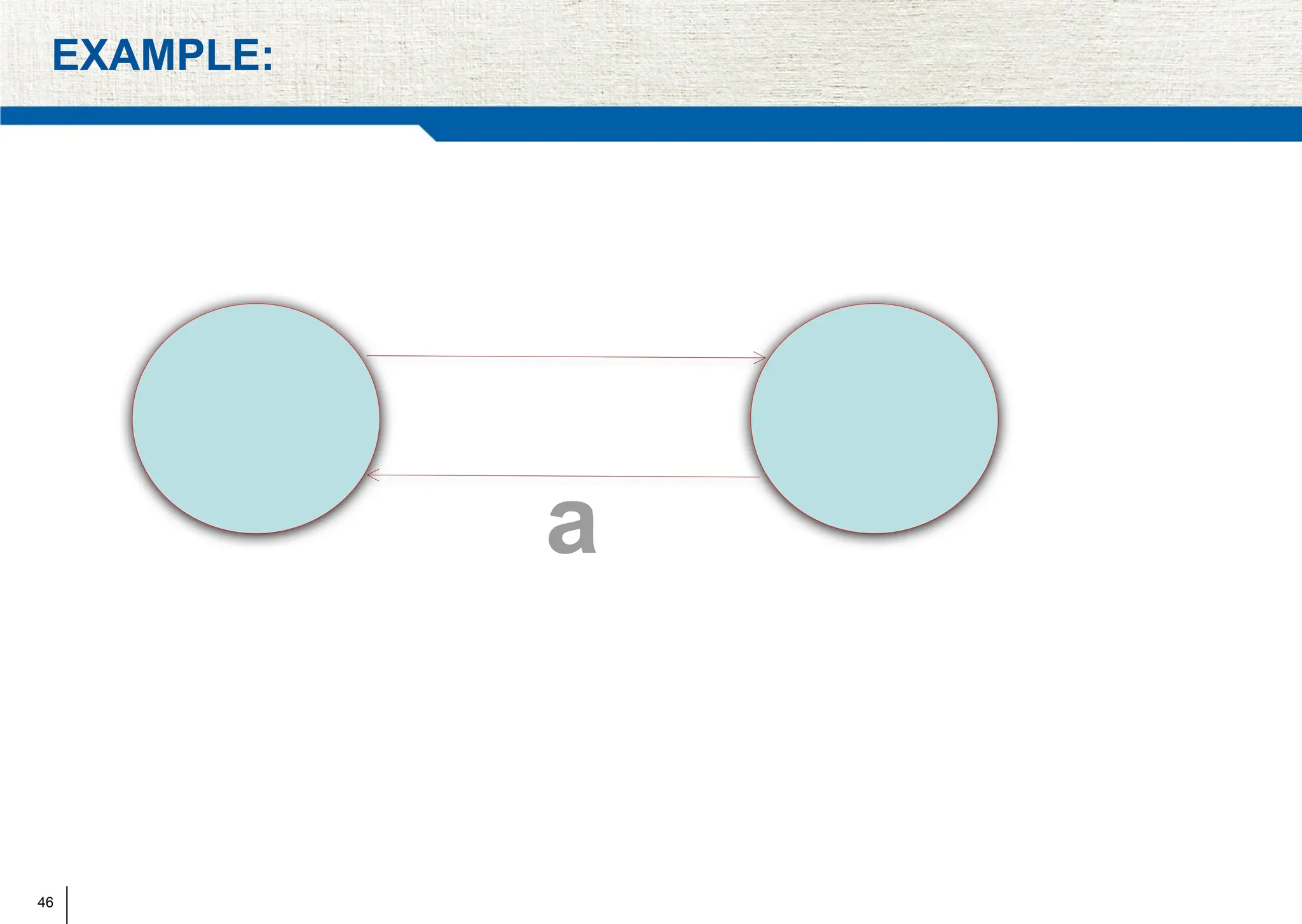
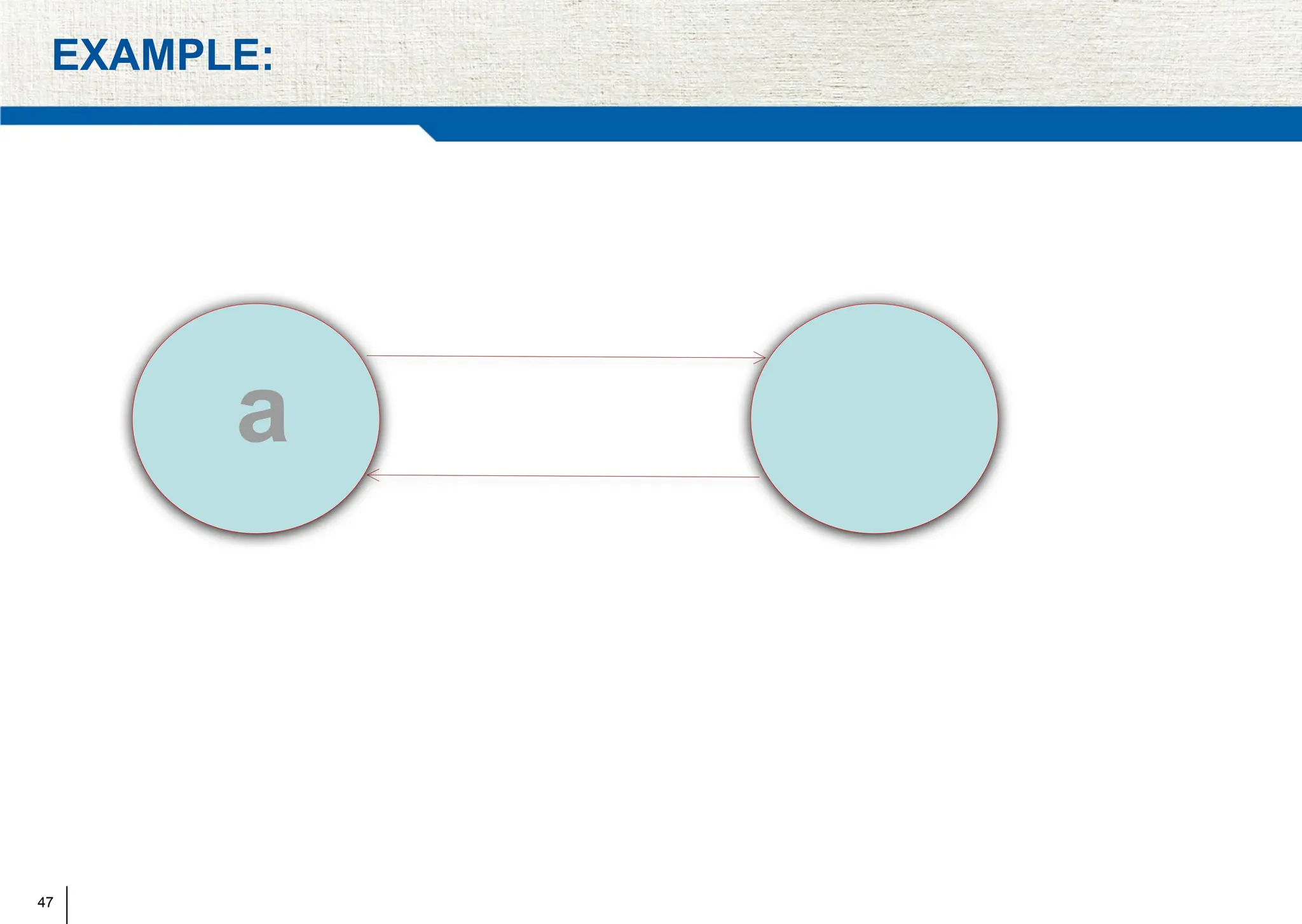
DETERMINISTIC COMPUTATION EXAMPLE
 A Variant of producer-consumer example
Producer : Consumer :
while (1)
{
produce
m;
send m;
wait for ack;
}
while (1)
{
recv m;
consume m;
send ack;
}
42
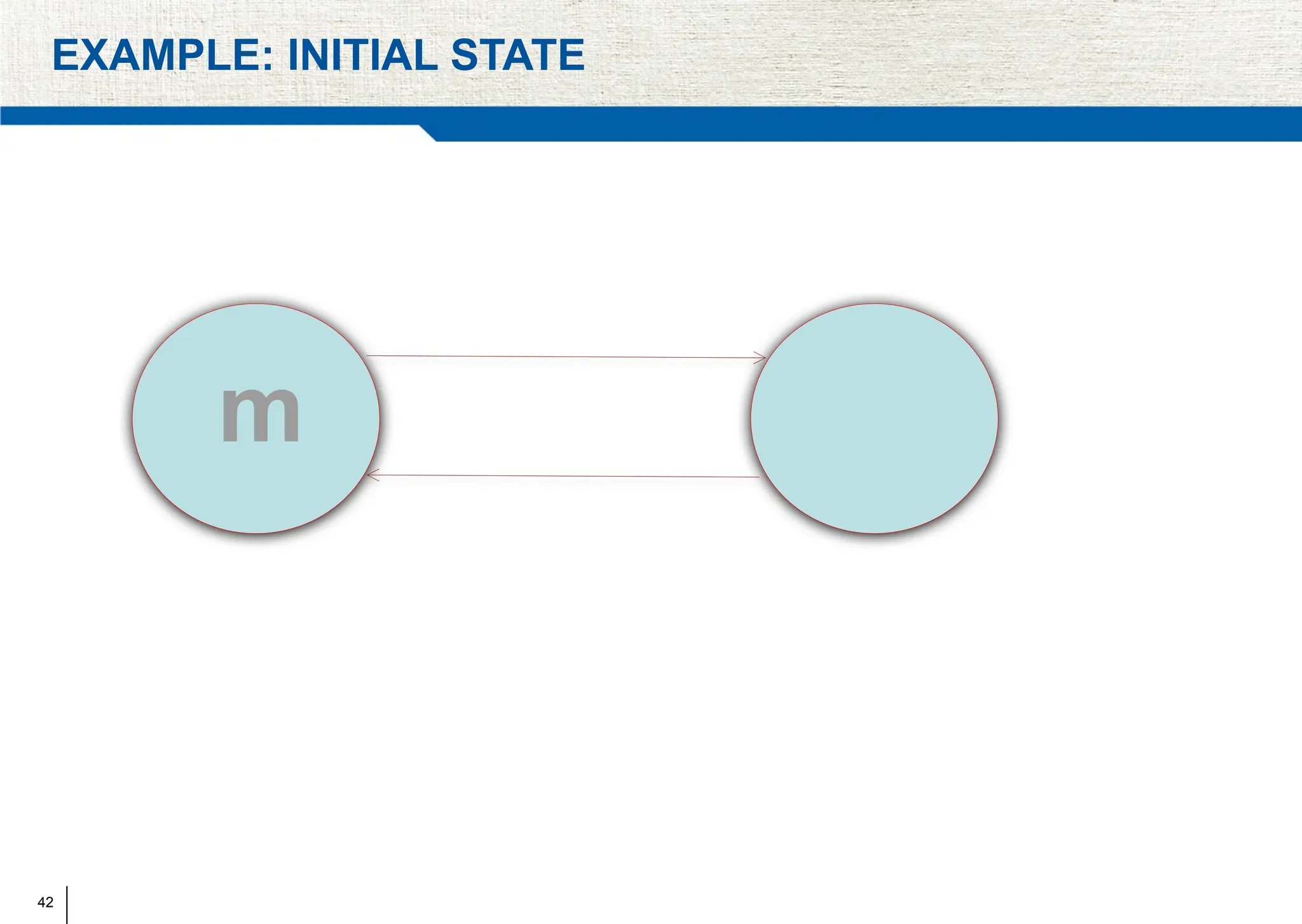
EXAMPLE: INITIAL STATE
m
43
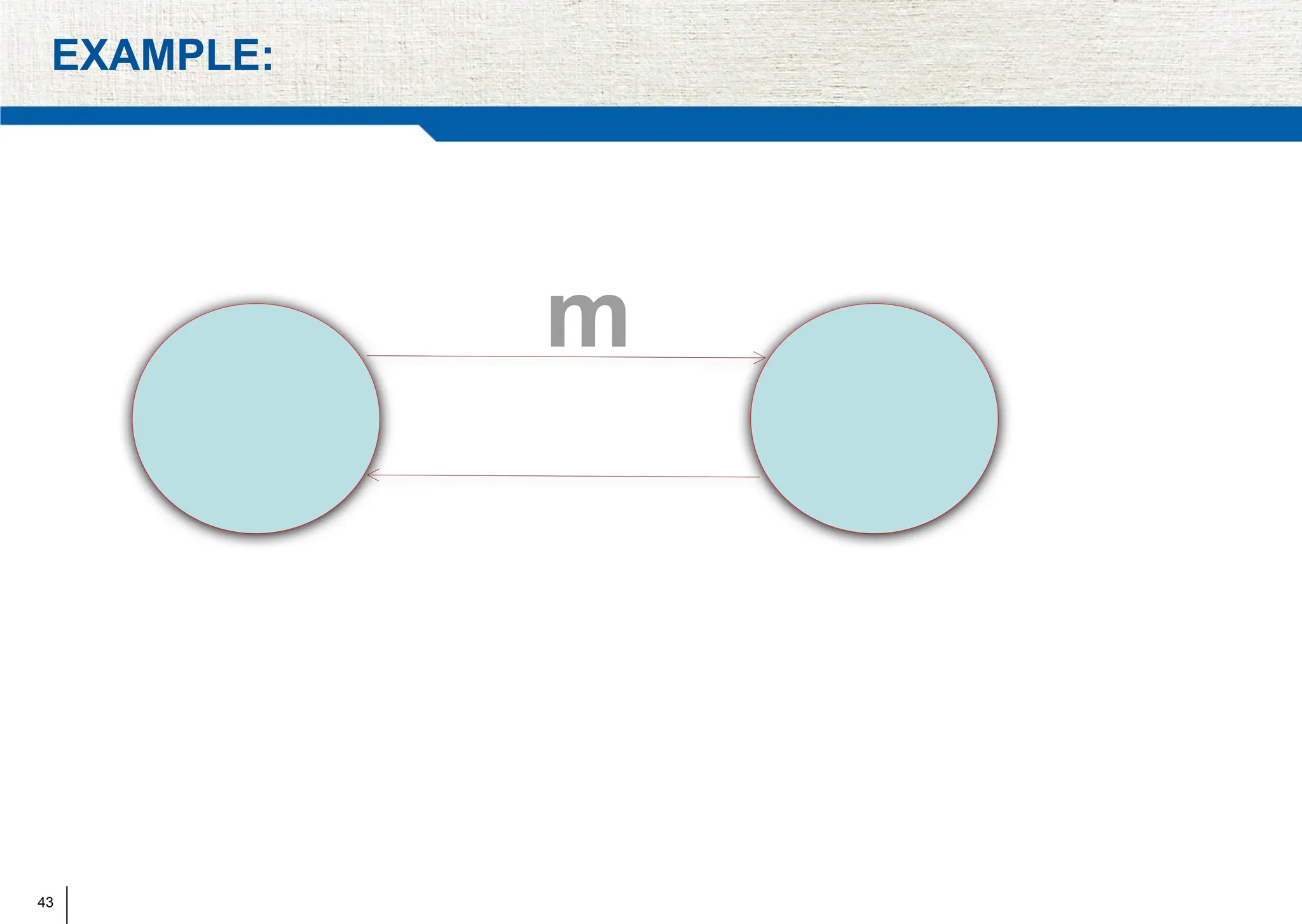
EXAMPLE:
m
44
EXAMPLE:
m
45
EXAMPLE:
a
46
EXAMPLE:
a
47
EXAMPLE:
a
48
DETERMINISTIC STATE DIAGRAM
49
NON-DETERMINISTIC COMPUTATION
 3 processes m1 m2 m3 p q r
50
ELECTION ALGORITHMS
 In distributed computing, leader election is the process of designating a
single process as the organizer of some task distributed among several
computers (nodes).
 Before the task is begun, all network nodes are unaware which node
will serve as the "leader," or coordinator, of the task.
 After a leader election algorithm has been run, however, each node
throughout the network recognizes a particular, unique node as the
task leader.
 Many distributed algorithms require one process to act as coordinator,
initiator, or otherwise perform special role.
51
ELECTION ALGORITHMS
 All processes in distributed systems may be equal characteristics,
there is no way to select one of them to be special.
 Assume have some “ID” that is a number, that every process knows the process
number of every other process.
 “elect” process with the highest number as leader
52
ELECTION ALGORITHMS
 Election
 Goal:
 ensure that the election achieves an agreement among all the processes
 the P with the highest id is elected
53
CONCURRENCY IN A NON-DISTRIBUTED SYSTEM
 Concurrency in distributed systems are familiar from the study of OS
and multithreaded programming problems
 Prevent race conditions (race conditions that occur when concurrent
processes access shared resources)
 Critical sections
 In non-distributed system above problems are solved by implementing
mutual exclusion using local primitives such as
 Locks
 Semaphores
54
CONCURRENCY IN A DISTRIBUTED SYSTEM
 Distributed System introduces more challenges of concurrency due to
 No directly shared resources (e.g., memory)
 No global state
 No global clock
 No centralized algorithms
 presence of communication delays
55
DISTRIBUTED MUTUAL EXCLUSION
 Concurrent access to distributed resources
 Must prevent race conditions during critical regions
 Requirements:
1. Safety: At most one process may execute the critical section at a time
2. Liveness: Requests to enter and exit the critical section ultimately succeed
3. Ordering: Requests are processed in happened- before ordering
56
METHOD 1: CENTRAL SERVER
 Simplest approach: use a central server that controls the entering and
exiting of critical sections.
 Requests to enter and exit a critical section are sent to a lock server (or
coordinator)
 Permission to enter is granted by receiving a token
 When critical section left, token is returned to the server
57
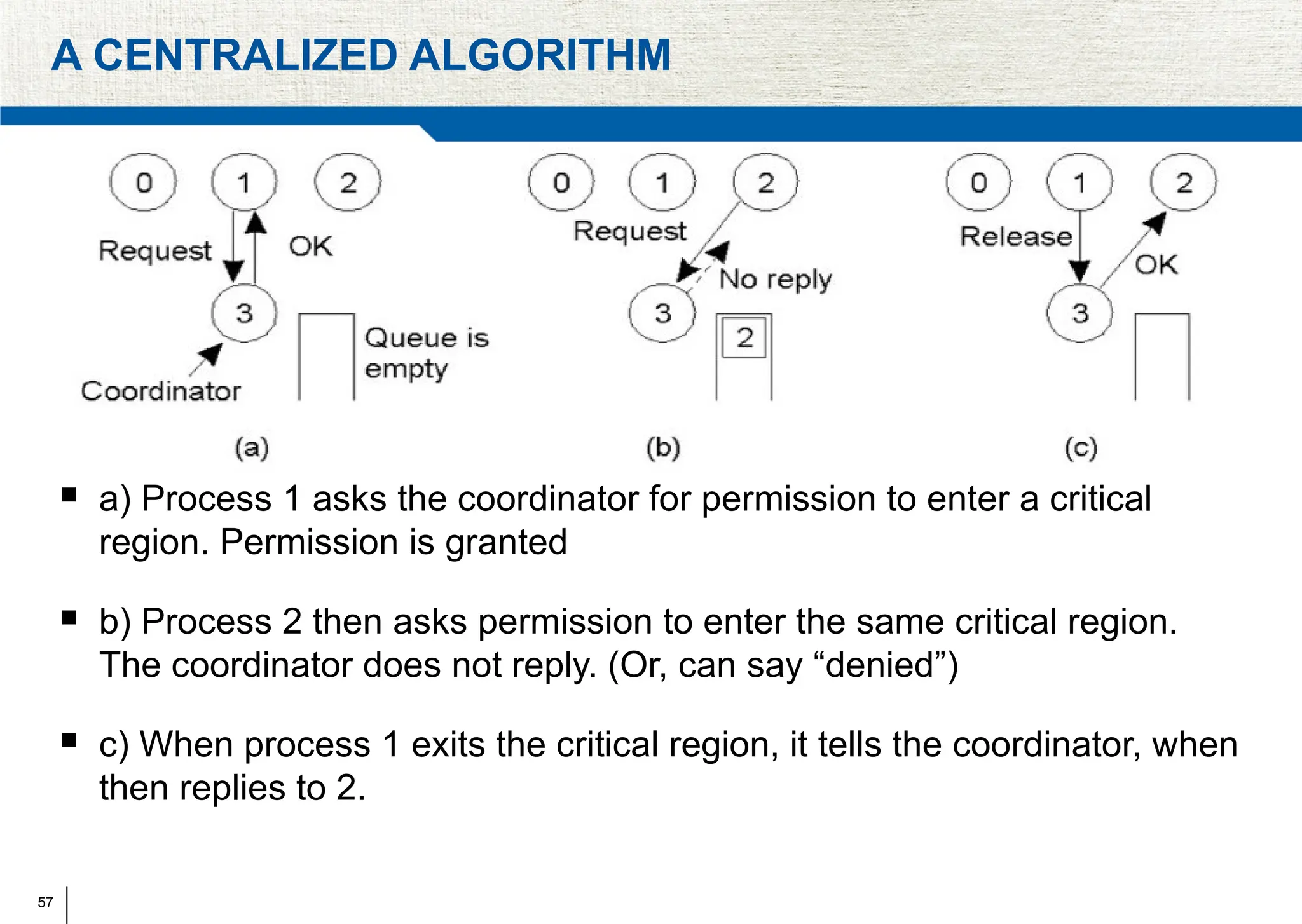
A CENTRALIZED ALGORITHM
 a) Process 1 asks the coordinator for permission to enter a critical
region. Permission is granted
 b) Process 2 then asks permission to enter the same critical region.
The coordinator does not reply. (Or, can say “denied”)
 c) When process 1 exits the critical region, it tells the coordinator, when
then replies to 2.
58
A CENTRALIZED ALGORITHM
 This scheme is easy to implement, but it does not scale well due to the
central authority.
 Moreover, it is vulnerable to failure of the central server.
59
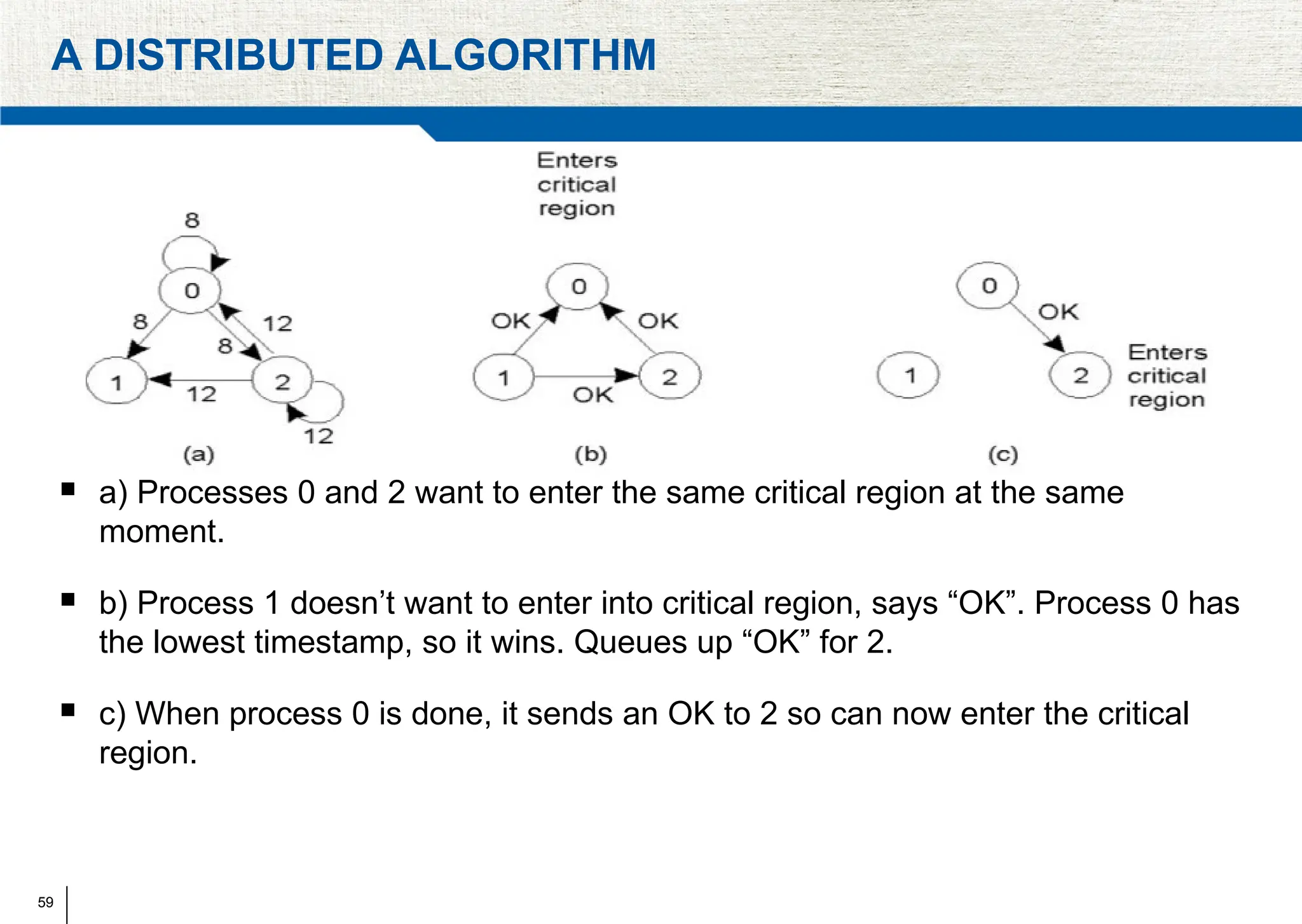
A DISTRIBUTED ALGORITHM
 a) Processes 0 and 2 want to enter the same critical region at the same
moment.
 b) Process 1 doesn’t want to enter into critical region, says “OK”. Process 0 has
the lowest timestamp, so it wins. Queues up “OK” for 2.
 c) When process 0 is done, it sends an OK to 2 so can now enter the critical
region.
60
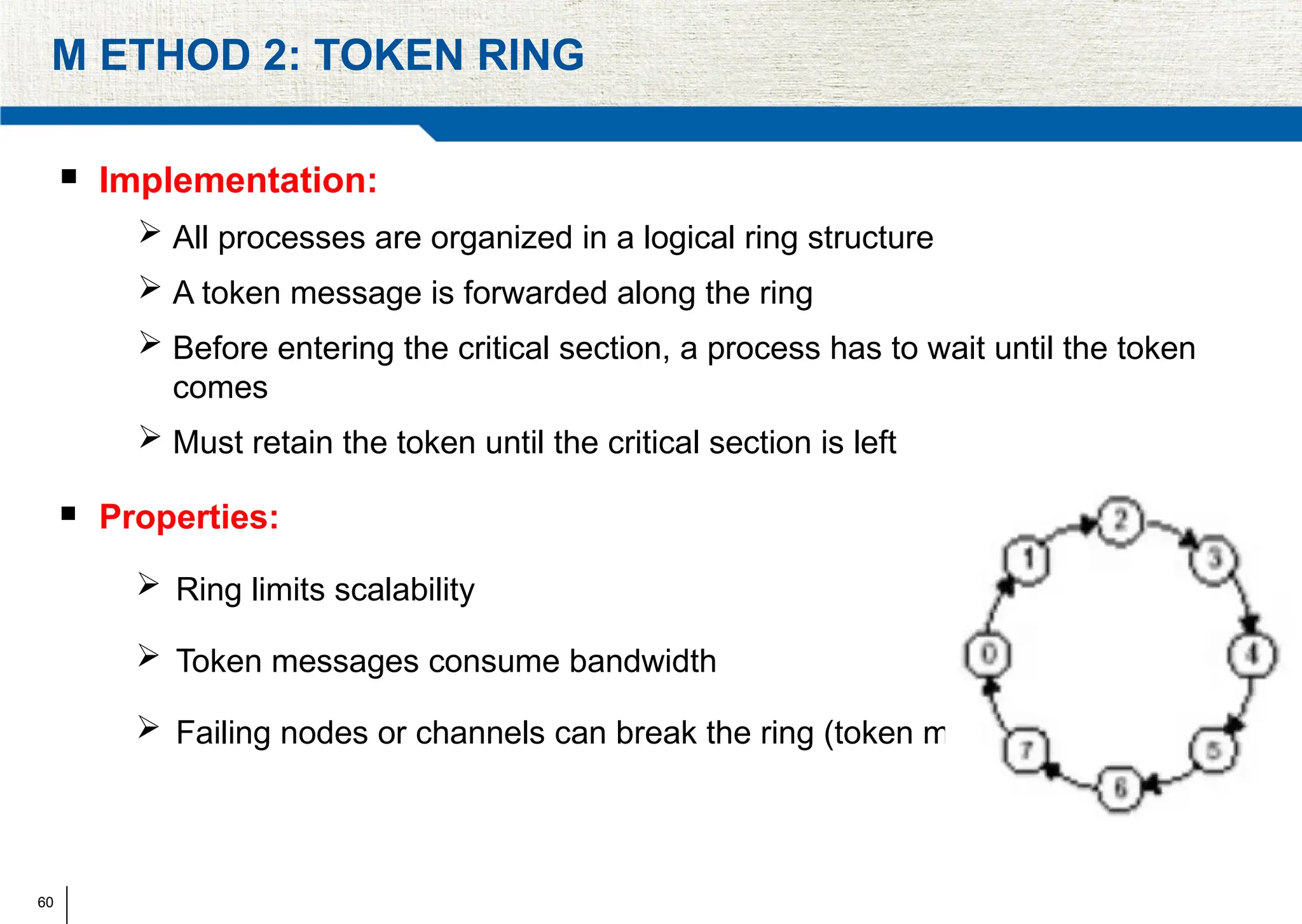
M ETHOD 2: TOKEN RING
 Implementation:
 All processes are organized in a logical ring structure
 A token message is forwarded along the ring
 Before entering the critical section, a process has to wait until the token
comes
 Must retain the token until the critical section is left
 Properties:
 Ring limits scalability
 Token messages consume bandwidth
 Failing nodes or channels can break the ring (token might be lost)
61
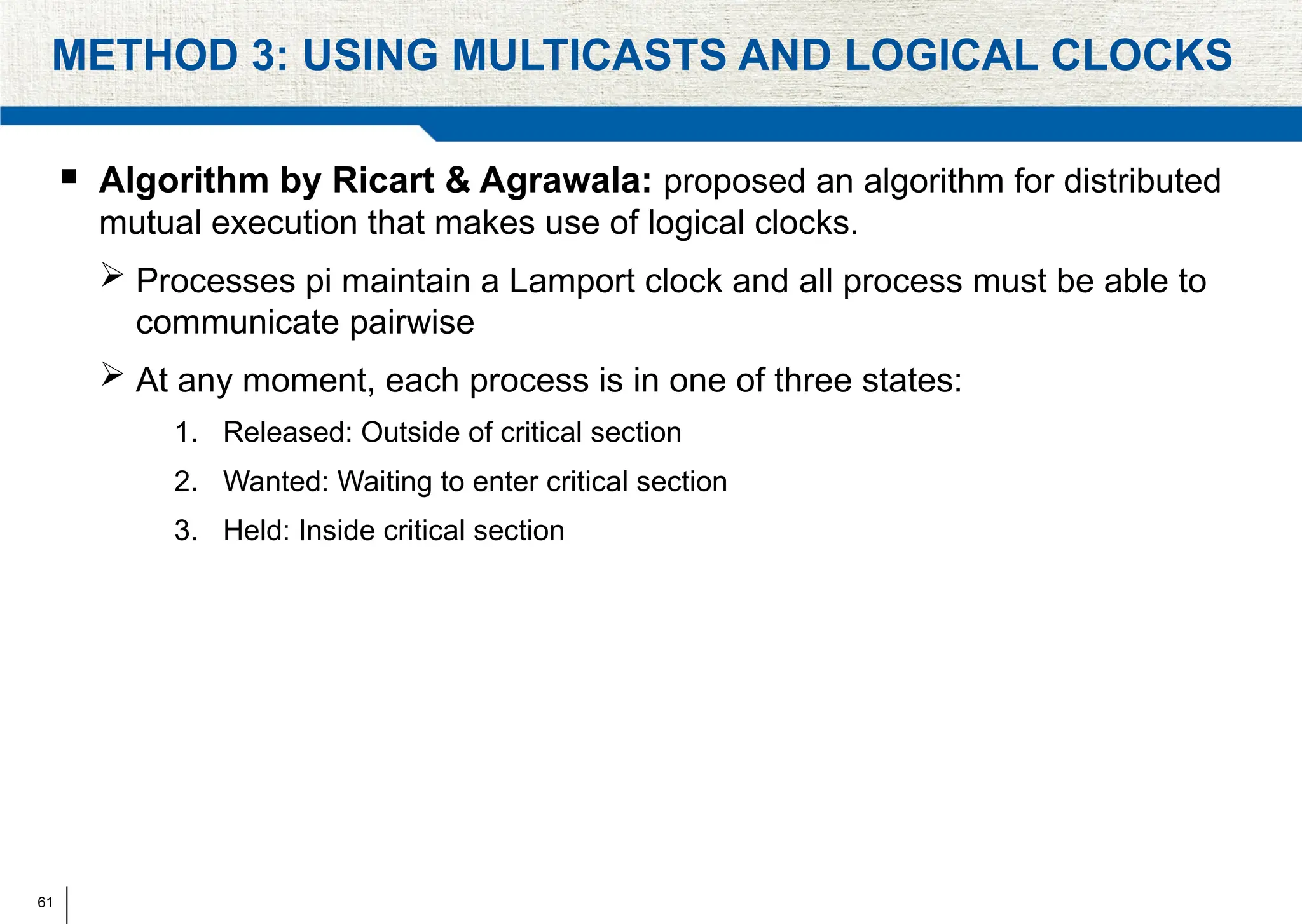
METHOD 3: USING MULTICASTS AND LOGICAL CLOCKS
 Algorithm by Ricart & Agrawala: proposed an algorithm for distributed
mutual execution that makes use of logical clocks.
 Processes pi maintain a Lamport clock and all process must be able to
communicate pairwise
 At any moment, each process is in one of three states:
1. Released: Outside of critical section
2. Wanted: Waiting to enter critical section
3. Held: Inside critical section
62
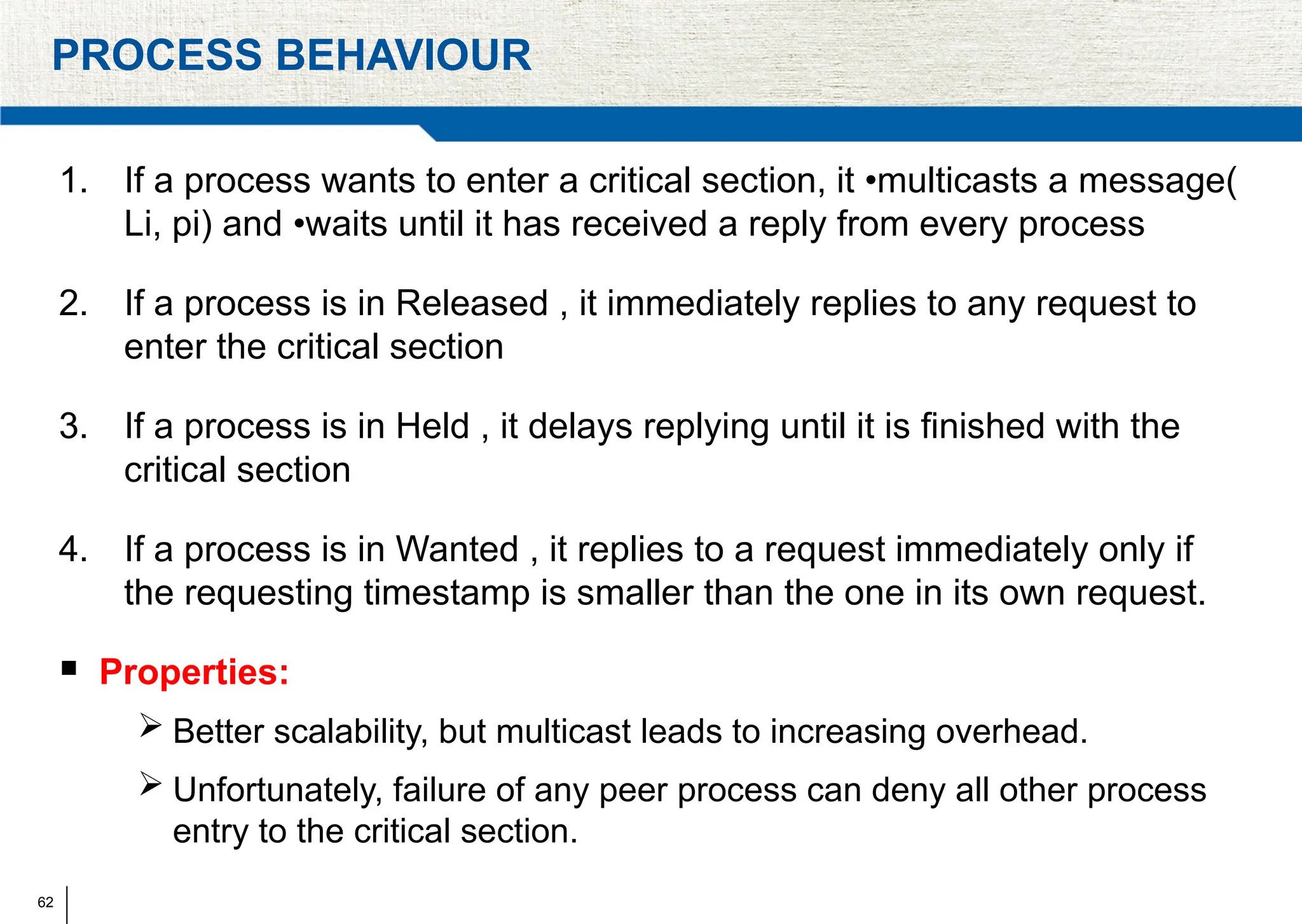
PROCESS BEHAVIOUR
1. If a process wants to enter a critical section, it •multicasts a message(
Li, pi) and •waits until it has received a reply from every process
2. If a process is in Released , it immediately replies to any request to
enter the critical section
3. If a process is in Held , it delays replying until it is finished with the
critical section
4. If a process is in Wanted , it replies to a request immediately only if
the requesting timestamp is smaller than the one in its own request.
 Properties:
 Better scalability, but multicast leads to increasing overhead.
 Unfortunately, failure of any peer process can deny all other process
entry to the critical section.
63
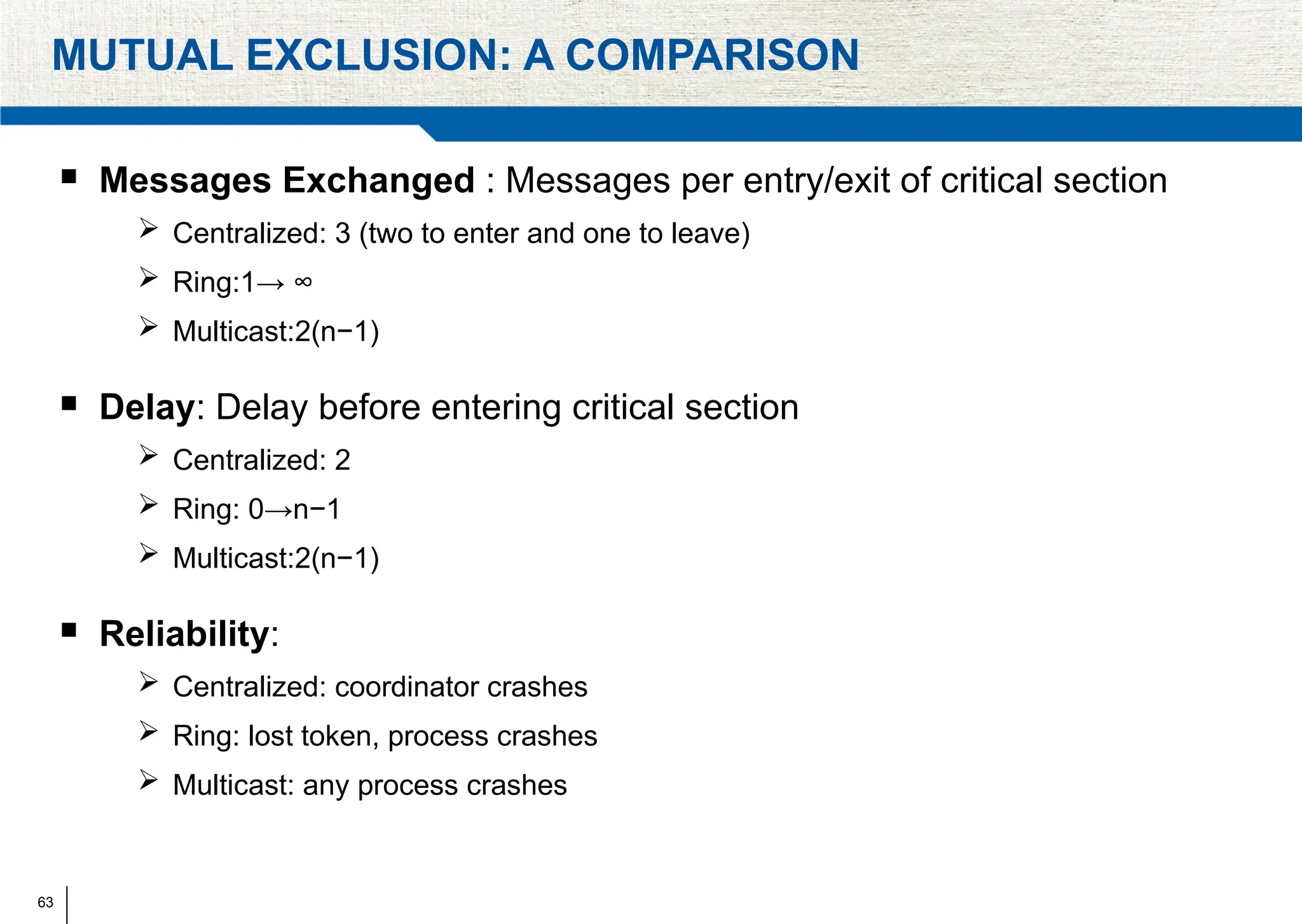
MUTUAL EXCLUSION: A COMPARISON
 Messages Exchanged : Messages per entry/exit of critical section
 Centralized: 3 (two to enter and one to leave)
 Ring:1→ ∞
 Multicast:2(n−1)
 Delay: Delay before entering critical section
 Centralized: 2
 Ring: 0→n−1
 Multicast:2(n−1)
 Reliability:
 Centralized: coordinator crashes
 Ring: lost token, process crashes
 Multicast: any process crashes
64
TEST YOUR SKILLS
 Any Queries

Cross cutting concerns should be logically centralized DRY ,but it may appear multiple places in implementation.

  • 1.
    1 UIT1522 - DistributedComputing Session 29 – Synchronization
  • 2.
    2 OUTLINE  Distributed Algorithms Time and Clocks  Global State  Concurrency Control  Distributed Transactions
  • 3.
    3 INTRODUCTION TO SYNCHRONIZATION How processes cooperate and synchronize with each other?  Simultaneously access a shared resources , such as printer,  Agree on the ordering of events, such as whether message m1 from process P was sent before or after message m2 from process Q.
  • 4.
    4 DISTRIBUTED ALGORITHMS Algorithms thatare intended to work in a distributed environment.  Used to accomplish tasks such as:  Communication  Accessing resources  Allocating resources  etc.  Synchronization and coordination linked to distributed algorithms  Achieved using distributed algorithms
  • 5.
    5 SYNCHRONOUS VS ASYNCHRONOUSDISTRIBUTED SYSTEMS Timing model of a distributed system  Affected by:  Execution speed/time of processes  Communication delay  Clocks & clock drift  (Partial) failure
  • 6.
    6 SYNCHRONOUS DISTRIBUTED SYSTEM Timevariance is bounded  Execution: bounded execution speed and time  Communication: bounded transmission delay  Clocks: bounded clock drift (and differences in clocks)  Effect:  Easier to design distributed algorithms  Very restrictive requirements  Limit concurrent use of network  Require precise clocks and synchronization
  • 7.
    7 ASYNCHRONOUS DISTRIBUTED SYSTEM Timevariance is not bounded  Execution: different steps can have varying duration  Communication: transmission delays vary widely  Clocks: arbitrary clock drift  Effect:  Allows no assumption about time intervals  Most asynchronous DS problems hard to solve  Solution for asynchronous DS is also a solution for synchronous DS  Most real distributed systems are hybrid synch and asynchronous.
  • 8.
    8 EVALUATING DISTRIBUTEDA LGORITHMS General Properties:  Performance  number of messages exchanged  response/wait time • delay  throughput  complexity: Efficiency   resource usage: memory, CPU, etc.  Scalability  Reliability  number of points of failure (low is good)
  • 9.
    9 SYNCHRONIZATION AND COORDINATION making sure that processes doing the right thing at the right time.  allowing processes to synchronize and coordinate their actions  Two fundamental issues:  Coordination (the right thing)  Synchronization (the right time)
  • 10.
    10 COORDINATION  Coordination refersto coordinating the actions of separate processes relative to each other and allowing them to agree on global state (such as values of a shared variable). “Coordinate actions and agree on values.”  Coordinate Actions:  What actions will occur  Who will perform actions  Agree on Values:  Agree on global value  Agree on environment  Agree on state  Examples of coordination include ensuring that processes agree on:  what actions will be performed?  who will be performing actions?  and the state of the system?
  • 11.
    11 SYNCHRONIZATION AND TIME Synchronization is coordination with respect to time, and refers to the ordering of events and execution of instructions in time. “Ordering of all actions”  Total ordering of events (whether message m1 from process P was sent before or after message m2 from process Q)  Ordering of access to resources  Examples of synchronization include,  Ordering distributed events and  ensuring that a process performs an action at a particular time.
  • 12.
    12 MAIN ISSUES  Timeand Clocks: synchronizing clocks and using time in distributed algorithms  Global State: how to acquire knowledge of the system’s global state  Concurrency Control: coordinating concurrent access to resources  Coordination: when do processes need to coordinate and how do they do it
  • 13.
    13 TIME AND CLOCKS It is often important to know when events occurred and in what order they occurred.  In a non-distributed system dealing with time is trivial as there is a single shared clock, where all processes see the same time.  In a distributed system, on the other hand, each computer has its own clock.  Because no clock is perfect each of these clocks has its own skew which causes clocks on different computers to drift and eventually become out of sync.
  • 14.
    14 CLOCKS  Computer Clocks:oscillates at known frequency  Clock Skew:  different computers run at slightly different rates  Clocks get out of sync  Maximum drift rate  Timestamps: Used to denote at which time an event occurred
  • 15.
    15 PHYSICAL CLOCKS  Basedon actual time:  Physical clocks keep track of physical time.  In distributed systems that based on actual time it is necessary to keep individual computer clocks synchronized.  The clocks can be synchronized to global time (external synchronization), or to each other (internal synchronization).  Examples:  Performing events at an exact time (turn lights on/off, lock/unlock gates)  sorting of events (for security, for profiling)  Tracking (tracking a moving object with separate cameras)
  • 16.
    16 SYNCHRONIZING PHYSICAL CLOCKS External Synchronization:  Clocks synchronize to an external time source  Synchronize with UTC every δ seconds  Internal Synchronization:  Clocks synchronize locally  Only synchronized with each other  Time Server:  Server that has the correct time  Server that calculates the correct time
  • 17.
    17 CONSISTENCY PROBLEM  Updatinga replicated database: Update 1 adds 100 rupees to an account, Update 2 calculates and adds 1% interest to the same account.  Clock reading might be different for different computers!  Inconsistent state  Can use Lamport’s to totally order
  • 18.
    18 COMPUTER CLOCK  Weneed to measure time accurately  to know the time an event occurred at a computer  Algorithms for clock synchronization useful  for concurrency control based on timestamp ordering authenticity of requests.  e.g. in Kerberos etc  Each computer in a DS has its own internal clock
  • 19.
    19 CLOCK SYNCHRONIZATION  Thereexists a time server receiving signals from a UTC source  Cristian’s algorithm   There is no UTC source available  Berkley’s algorithm   Exact time does not matter!  Lamport’s algorithm
  • 20.
    20 CLOCK SYNCHRONIZATION ALGORITHM: CRISTIAN'S  Cristian’s algorithm requires clients to periodically synchronize with a central time server (typically a server with a UTC receiver)  Every computer periodically asks the “time server” for the current time  The server responds ASAP with the current time CUTC  The client sets its clock to CUTC
  • 21.
    21 CLOCK SYNCHRONIZATION ALGORITHM: BERKELEY  An algorithm for internal synchronization of a group of computers  A master polls to collect clock values from the others (slaves)  The master uses round trip times to estimate the slaves’ clock values  It takes an average It sends the required adjustment to the slaves   If master fails, can elect a new master to take over
  • 22.
    22 CLOCK SYNCHRONIZATION ALGORITHM: BERKELEY  a) The time daemon asks all the other machines for their clock values  b) The machines answer  c) Takes an average & tells everyone how to adjust their clock
  • 23.
  • 24.
    24 CLOCK SYNCHRONIZATION ALGORITHM: BERKELEY  Average time: 3:05
  • 25.
    25 LOGICAL CLOCKS  Therelative ordering of Events is more important than actual physical time in many applications  In a single process the ordering of events (e.g., state changes) is trivial  In a distributed system, however, besides local ordering of events, all processes must also agree on ordering of causally related events (e.g., sending and receiving of a single message)  Local ordering:  System consists of N processes pi  If pi observes e before e′ , we have e →e′   Global ordering:   Lamport’s happened before relation →   Smallest relation, such that 1. e →e ′ 2. For every message m , send (m ) → receive (m ) 3. Transitivity: e→ e′ and e′ →e ′′ implies e →e′′
  • 26.
    26 ORDERING EVENTS  Eventordering linked with concept of causality:  Saying that event a happened before event b is same as saying that event a casually affects event b  If events a and b happen on processes that do not exchange any data, their exact ordering is not important
  • 27.
    27 RELATION “HAS HAPPENEDBEFORE”  Smallest relation satisfying the three conditions:  If a and b are events in the same process and a comes before b, then a → b  If a is the sending of a message by a process and b its receipt by another process then a → b  If a → b and b → c then a → c.  We cannot always order events: relation “has happened” before is only a preorder  If a did not happen before b, it cannot causally affect b.
  • 28.
  • 29.
    29 LAMPORT ALGORITHM  Eachprocess increments local clock between any two successive events  Message contains a timestamp  Upon receiving a message, if received timestamp is ahead, receiver fast forward its clock to be one more than sending time
  • 30.
  • 31.
  • 32.
  • 33.
    33 LAMPORT AND VECTORCLOCK  For the figure below, write down the lamport clock and vector clock value at each event.
  • 34.
    34 LAMPORT AND VECTORCLOCK  For the figure below, write down the lamport clock and vector clock value at each event.
  • 35.
    35 DETERMINING GLOBAL STATES Global State  “The global state of a distributed computation is the set of local states of all individual processes involved in the computation plus the state of the communication channels.”  Knowing the global state of distributed system may be useful for many reasons.  For example: How to know that system is dealing with deadlock or distributed computation has correctly terminated?
  • 36.
    36 GLOBAL STATES  Determiningglobal properties: often difficult, but essential for some applications.  Distributed garbage collection:  Do any references exist to a given object?: Collects remote server objects that are no longer referenced by any client in the network .  Distributed deadlock detection:  Do processes wait in a cycle for each other?  Distributed algorithm termination detection:  Did a set of processes finish all activity? (Consider messages in transit) All these properties are stable: once they occur, they do not disappear without outside intervention.
  • 37.
    37 ANALYSIS OF GLOBALSTATE (DISTRIBUTED SNAPSHOT)  A distributed snapshot reflects a state in which the distributed system might have been.  A snapshot reflects a consistent global state  Example: 1. if we have recorded that a process Q has received a message from another process P, 2. then we should also recorded that process P has actually sent that message 3. Otherwise, a snapshot will contain the recording of messages that have been received but never sent, 4. Which indicate the inconsistent global state 5. The reverse condition (P has sent a message that Q has not yet received) is allowed
  • 38.
    38 MORE ON STATES process state  memory state + register state + open files + kernel buffers + … Or  application specific info like transactions completed, functions executed etc,.  channel state  “Messages in transit” i.e. those messages that have been sent but not yet received
  • 39.
    39 WHY GLOBAL STATEDETERMINATION IS DIFFICULT IN DISTRIBUTED SYSTEMS?  Distributed State :  Have to collect information that is spread across several machines!!  Only Local knowledge :  A process in the computation does not know the state of other processes.
  • 40.
    40 DIFFICULTIES DUE TONON DETERMINISM  Deterministic Computation  At any point in computation there is at most one event that can happen next.  Non-Deterministic Computation  At any point in computation there can be more than one event that can happen next.
  • 41.
    41 DETERMINISTIC COMPUTATION EXAMPLE A Variant of producer-consumer example Producer : Consumer : while (1) { produce m; send m; wait for ack; } while (1) { recv m; consume m; send ack; }
  • 42.
  • 43.
  • 44.
  • 45.
  • 46.
  • 47.
  • 48.
  • 49.
  • 50.
    50 ELECTION ALGORITHMS  Indistributed computing, leader election is the process of designating a single process as the organizer of some task distributed among several computers (nodes).  Before the task is begun, all network nodes are unaware which node will serve as the "leader," or coordinator, of the task.  After a leader election algorithm has been run, however, each node throughout the network recognizes a particular, unique node as the task leader.  Many distributed algorithms require one process to act as coordinator, initiator, or otherwise perform special role.
  • 51.
    51 ELECTION ALGORITHMS  Allprocesses in distributed systems may be equal characteristics, there is no way to select one of them to be special.  Assume have some “ID” that is a number, that every process knows the process number of every other process.  “elect” process with the highest number as leader
  • 52.
    52 ELECTION ALGORITHMS  Election Goal:  ensure that the election achieves an agreement among all the processes  the P with the highest id is elected
  • 53.
    53 CONCURRENCY IN ANON-DISTRIBUTED SYSTEM  Concurrency in distributed systems are familiar from the study of OS and multithreaded programming problems  Prevent race conditions (race conditions that occur when concurrent processes access shared resources)  Critical sections  In non-distributed system above problems are solved by implementing mutual exclusion using local primitives such as  Locks  Semaphores
  • 54.
    54 CONCURRENCY IN ADISTRIBUTED SYSTEM  Distributed System introduces more challenges of concurrency due to  No directly shared resources (e.g., memory)  No global state  No global clock  No centralized algorithms  presence of communication delays
  • 55.
    55 DISTRIBUTED MUTUAL EXCLUSION Concurrent access to distributed resources  Must prevent race conditions during critical regions  Requirements: 1. Safety: At most one process may execute the critical section at a time 2. Liveness: Requests to enter and exit the critical section ultimately succeed 3. Ordering: Requests are processed in happened- before ordering
  • 56.
    56 METHOD 1: CENTRALSERVER  Simplest approach: use a central server that controls the entering and exiting of critical sections.  Requests to enter and exit a critical section are sent to a lock server (or coordinator)  Permission to enter is granted by receiving a token  When critical section left, token is returned to the server
  • 57.
    57 A CENTRALIZED ALGORITHM a) Process 1 asks the coordinator for permission to enter a critical region. Permission is granted  b) Process 2 then asks permission to enter the same critical region. The coordinator does not reply. (Or, can say “denied”)  c) When process 1 exits the critical region, it tells the coordinator, when then replies to 2.
  • 58.
    58 A CENTRALIZED ALGORITHM This scheme is easy to implement, but it does not scale well due to the central authority.  Moreover, it is vulnerable to failure of the central server.
  • 59.
    59 A DISTRIBUTED ALGORITHM a) Processes 0 and 2 want to enter the same critical region at the same moment.  b) Process 1 doesn’t want to enter into critical region, says “OK”. Process 0 has the lowest timestamp, so it wins. Queues up “OK” for 2.  c) When process 0 is done, it sends an OK to 2 so can now enter the critical region.
  • 60.
    60 M ETHOD 2:TOKEN RING  Implementation:  All processes are organized in a logical ring structure  A token message is forwarded along the ring  Before entering the critical section, a process has to wait until the token comes  Must retain the token until the critical section is left  Properties:  Ring limits scalability  Token messages consume bandwidth  Failing nodes or channels can break the ring (token might be lost)
  • 61.
    61 METHOD 3: USINGMULTICASTS AND LOGICAL CLOCKS  Algorithm by Ricart & Agrawala: proposed an algorithm for distributed mutual execution that makes use of logical clocks.  Processes pi maintain a Lamport clock and all process must be able to communicate pairwise  At any moment, each process is in one of three states: 1. Released: Outside of critical section 2. Wanted: Waiting to enter critical section 3. Held: Inside critical section
  • 62.
    62 PROCESS BEHAVIOUR 1. Ifa process wants to enter a critical section, it •multicasts a message( Li, pi) and •waits until it has received a reply from every process 2. If a process is in Released , it immediately replies to any request to enter the critical section 3. If a process is in Held , it delays replying until it is finished with the critical section 4. If a process is in Wanted , it replies to a request immediately only if the requesting timestamp is smaller than the one in its own request.  Properties:  Better scalability, but multicast leads to increasing overhead.  Unfortunately, failure of any peer process can deny all other process entry to the critical section.
  • 63.
    63 MUTUAL EXCLUSION: ACOMPARISON  Messages Exchanged : Messages per entry/exit of critical section  Centralized: 3 (two to enter and one to leave)  Ring:1→ ∞  Multicast:2(n−1)  Delay: Delay before entering critical section  Centralized: 2  Ring: 0→n−1  Multicast:2(n−1)  Reliability:  Centralized: coordinator crashes  Ring: lost token, process crashes  Multicast: any process crashes
  • 64.